


You're standing in the pet store aisle, holding a dental chew in one hand and a toothpaste tube in the other, trying to decide whether either one matters. Your dog's breath has started to smell, you've noticed a little yellow buildup near the back teeth, and the packaging makes every product sound like a shortcut. That's exactly where dog dental health supplements can help, but only if you think of them as adjuncts, not magic replacements for brushing or veterinary care.
Table of Contents
- Why Dog Dental Health Supplements Exist in the First Place
- The Five Main Types of Dental Supplements and How Each Works
- Which Ingredients Actually Have Evidence Behind Them
- Safety, Dosing, and Interactions Owners Need to Know
- Supplements Help, But They Cannot Replace Brushing or the Vet
- Fitting Dental Care Into a Broader Daily Supplement Routine
- How to Evaluate Product Quality Before You Buy
- Common Questions Dog Owners Ask About Dental Supplements
Why Dog Dental Health Supplements Exist in the First Place
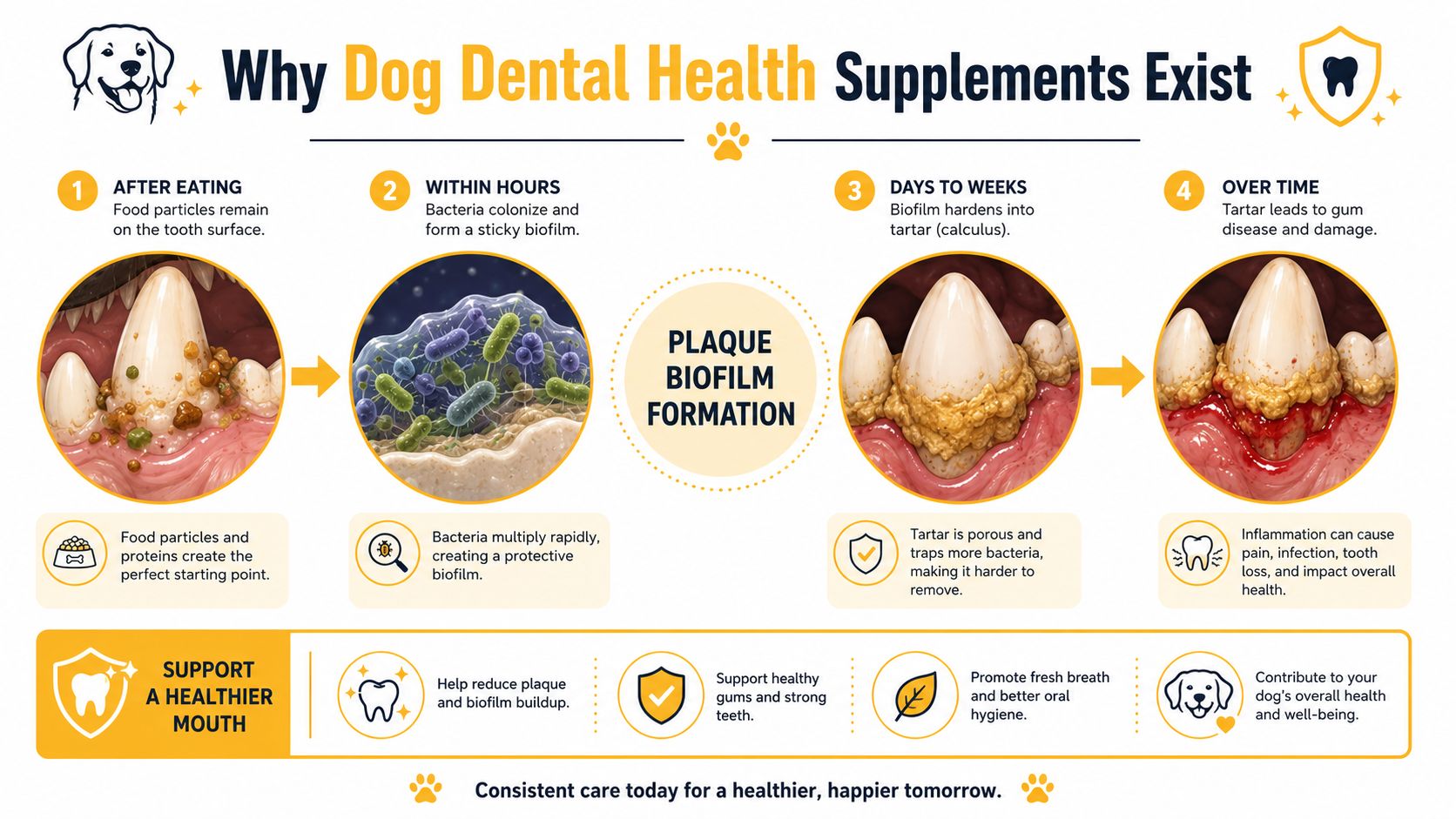
The problem starts fast. After a meal, bacteria in the mouth begin sticking to the tooth surface, mixing with saliva and food residue to form a sticky biofilm, which is just a fancy word for a living layer of grime that clings like ants on a picnic table. Left alone, that soft film hardens into tartar, and tartar is much harder to remove at home than plaque.
That matters because plaque and tartar don't just affect appearance. They can irritate the gums, contribute to halitosis, and create the conditions that lead into periodontal disease. Once the gumline is inflamed, the mouth becomes a much rougher place for a dog to live in, chew with, and keep clean.
The reason this category exists at all is simple, oral care products are trying to interrupt that sequence earlier. In a major Rutgers canine oral-bacteria study, several interventions lowered bacteria on dogs' teeth by 54.6% to 79.0%, including raw bones at 79.0%, brushing at 70.3%, bully sticks at 60.2%, and VeggieDent chews at 54.6% (Rutgers study). The sample sizes were small, but the signal was clear, chewing and brushing can measurably change the oral environment.
Practical rule: if a product only promises fresher breath and never mentions plaque, calculus, or bacterial load, it's probably being marketed like a mint, not a dental aid.
| Common Dental Supplement Format | Primary Action | Best For | Main Limitation |
|---|---|---|---|
| Chews | Mechanical scraping and prolonged chewing | Dogs that like to chew | Won't reach every tooth surface |
| Powders | Mixed into food for daily exposure | Picky dogs that won't accept treats | Depends on consistent feeding |
| Pastes and sprays | Direct oral application | Targeted use and spot care | Often harder to apply reliably |
| Probiotics | Microbiome support | Owners focused on oral balance | Evidence is narrower and product-specific |
| Water additives | Passive daily exposure | Multi-dog homes and low-effort routines | Can't replace mechanical cleaning |
The Five Main Types of Dental Supplements and How Each Works
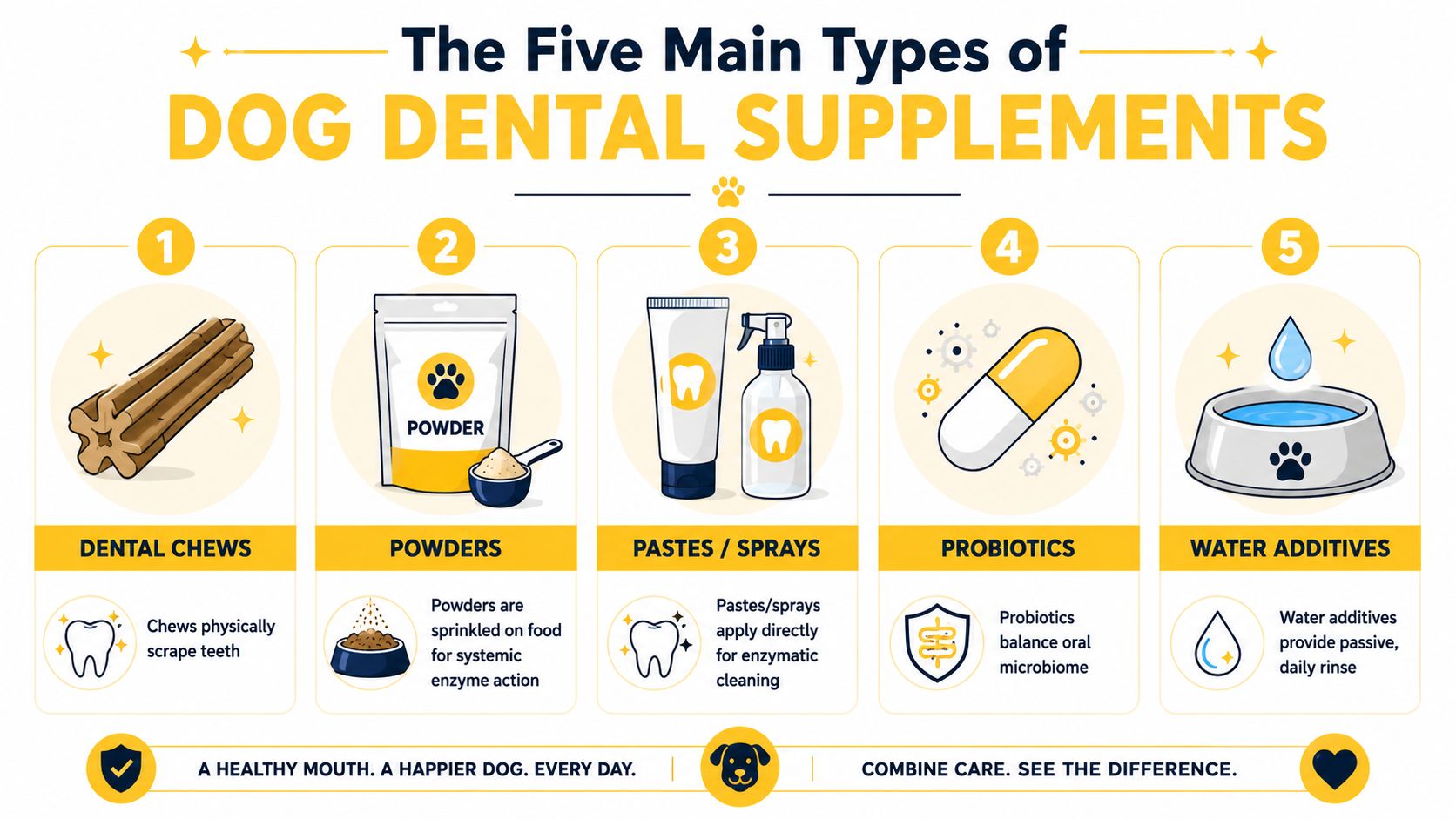
Dog dental products are often grouped into one bucket, but they do different jobs. A chew works through contact, a powder works through daily ingestion, a paste or spray works through direct application, a probiotic tries to shift the oral microbial mix, and a water additive aims for repeated, low-effort exposure over time. Once you know the delivery format, the marketing copy becomes much easier to read.
Chews, powders, and direct-apply products
Dental chews are the easiest category to understand because the dog's mouth does part of the work. The chewing motion creates friction, and that matters more for some dogs than others, especially aggressive chewers that grind a product against the teeth. A good chew can help interrupt plaque in the places the teeth touch.
Oral powders use a different route. They are sprinkled on food, which makes them practical for dogs that refuse toothbrushes or chews, but they depend on the dog's normal eating routine rather than bite force. A powdered topper can fit well in a house where the dog already eats calmly and consistently, yet it only works when the owner uses it every day.
Enzymatic pastes and sprays are more hands-on. Owners usually choose them when they want a direct oral product but cannot complete a full brushing routine every day. For many senior dogs with missing teeth or sore mouths, these can fit better than a chew because the product can be placed where needed without asking the dog to chew hard.
Microbiome and water-based formats
Oral probiotics try to influence the mouth's bacterial balance instead of scrubbing surfaces. That makes them interesting, but their value depends on strain selection and the actual formulation. They are not interchangeable with general digestive probiotics, because the mouth and the gut do not face the same conditions.
Water additives are the lowest-effort option. They fit better in homes where brushing is inconsistent or where multiple dogs share a routine, but their effect is passive. They can support oral hygiene, yet they do not remove plaque the way brushing or chewing can.
A useful example is the product category itself, not a single brand. A multi-system powder like DA-1™ Daily All-in-One - Senior Dog Support, Joints, Skin/Coat & More is a broad daily topper, but a topper that supports general wellness is not the same thing as a targeted oral product.
| Format | Best Match | What It Helps With | What It Can't Do Well |
|---|---|---|---|
| Chew | Strong chewers | Mechanical abrasion | Replace brushing |
| Powder | Food-toppers | Daily consistency | Clean hard tartar |
| Paste or spray | Hands-on routines | Spot application | Work if owners skip use |
| Probiotic | Microbiome-focused owners | Oral balance | Act like a scraper |
| Water additive | Low-maintenance homes | Passive support | Remove buildup alone |
Which Ingredients Actually Have Evidence Behind Them
The ingredient list matters more than the front label. Two products can both say “dental support,” but one may lean on ingredients with real canine data while the other leans on vague flavoring and broad claims. The best evidence concentrates around a few actives, especially Ascophyllum nodosum.
What has the clearest support
Brown seaweed, especially Ascophyllum nodosum, has the strongest recurring signal in the data you gave. Controlled canine research has linked it with reductions in plaque index, calculus index, and volatile sulfur compounds, and a Frontiers paper reported oral-health-related metabolic changes after 30 days of supplementation (Frontiers study). That doesn't make it a cure, but it does make it one of the more defensible ingredients to look for.
Zinc salts and vitamin C show up more often in mixed formulas than as standalone proof points. A clinical report described a single dental treat with vitamin C and zinc sulfate producing antibacterial effects lasting up to 12 hours and VSC reduction lasting up to 24 hours (canine oral-care review). That supports the idea that chemistry and chew format can work together.
What looks promising, but depends on the formulation
Enzymes such as glucose oxidase, lysozyme, and lactoferrin are usually marketed as helpers that make plaque harder to build. They make the most sense in products where the active gets enough contact time in the mouth. Chlorhexidine, where it's legal and appropriately formulated, is another ingredient that can matter, but it's generally used carefully because it's more of a targeted antiseptic than a casual daily flavoring.
Postbiotics are the newest category with a credible signal. A later study reported a 27% reduction in volatile sulfur compounds versus placebo, with improvement showing up after only 7 days (postbiotic oral-care study). That's useful for owners who care about measurable breath-related changes, but it still isn't the same as replacing mechanical care.
A simple evidence hierarchy
Best question to ask: does this ingredient change plaque, calculus, or VSCs, or does it only claim fresher breath?
- Strongest support: Ascophyllum nodosum
- Moderate support: zinc salts, enzyme-based formulas, some chlorhexidine products
- Emerging support: postbiotics, selected probiotic approaches
- Needs caution: anything that promises oral cleaning without saying how it changes plaque or calculus
Safety, Dosing, and Interactions Owners Need to Know
A dental product can be helpful and still be a bad fit for a particular dog. That's why safety is not a side note, it's part of the decision.
Start with the ingredient list, not the promise
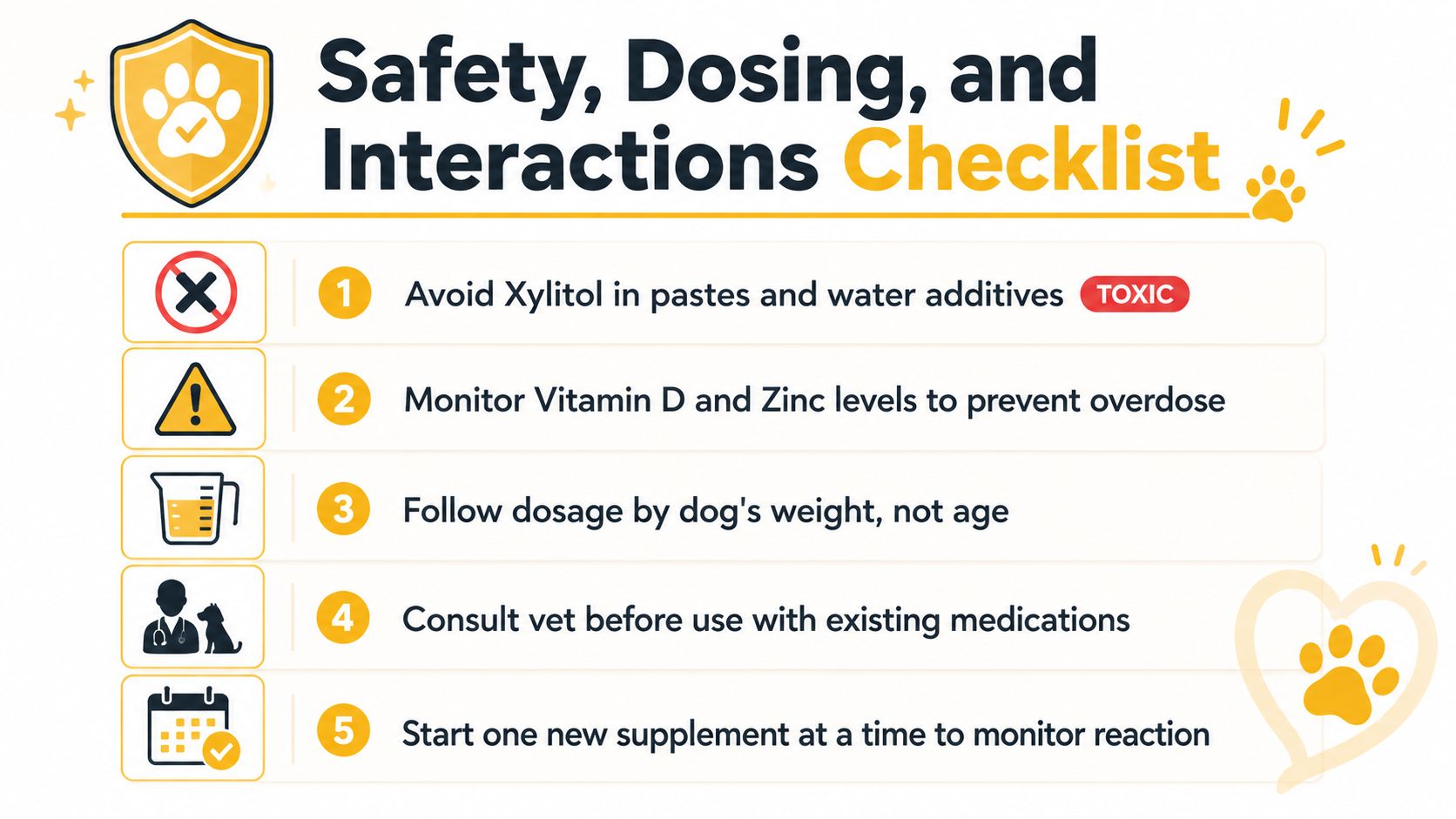
Xylitol is the big red flag in some oral products, especially human-style pastes or rinse-type products adapted for pets. If you see it on the label, stop there and choose something else. The same caution applies to supplements that pile on vitamin D or zinc without a clear use case, because more isn't automatically better.
Dose matters too. A chew that's fine for a larger dog may be too much for a small one, and a powder designed for a full-grown adult may not fit a puppy or a dog with special dietary needs. Follow dosage by body size and life stage, not by how much the dog likes the taste.
Watch timing and medical context
If a dog already uses a brushing routine, many owners do better by spacing a new powder or enzyme-based product away from brushing, so the ingredients aren't wiped away immediately. When the dog is on antibiotics or managing a chronic issue like kidney disease, a vet should be part of the decision before adding oral supplements.
A few warning signs should stop the experiment entirely.
If you see excessive drooling, bleeding gums, pawing at the mouth, or sudden tooth loss, treat that as a veterinary problem, not a supplement problem.
Supplements Help, But They Cannot Replace Brushing or the Vet
The most tempting mistake is treating a supplement like an alternative to dental care. The evidence doesn't support that shortcut. Cornell's Riney Canine Health Center says there isn't enough scientific data to support dental sprays on their own, and a recent systematic review found the best results came from combined home-care protocols, not a single product used in isolation (Cornell guidance).
That lines up with the controlled studies in your evidence brief. A daily chew can help, a water additive can help, and brushing can help, but the strongest routines combine methods instead of betting on one shiny label. In one study, a xylitol water additive reduced mean plaque score by 5.1% and mean calculus score by 14.9% (canine adjunct study), which is useful, but it still reads like support, not a full replacement for brushing or scaling.
The practical hierarchy is straightforward. Daily brushing is still the gold standard for home care. Dental chews and water additives can support maintenance. Sprays and standalone powders are gap-fillers when brushing is unrealistic. Professional scaling under anesthesia is the treatment route once tartar and periodontal pockets are established.
The hard truth is that home products work best before disease gets entrenched. If the gums are red, the teeth are heavily coated, or the mouth smells distinctly foul despite daily care, that's a vet appointment, not a shopping trip.
Learn more about natural dog dental care
Fitting Dental Care Into a Broader Daily Supplement Routine
A dog that already gets a morning chew, a joint powder, or a skin-and-coat supplement needs dental care to fit into that rhythm. Oral support works best as one layer in a routine, not as a replacement for brushing or veterinary care.
A general wellness product can sit beside a targeted oral product, but it does not do the same job. A daily scoop of DA-1™ Daily All-in-One - Senior Dog Support, Joints, Skin/Coat & More is positioned as a broad formula for whole-body support, while a dental chew, powder, or water additive is meant to focus on the mouth. That difference matters because plaque control depends on products that change what happens on the tooth surface.
Read more about building a practical dog dental care routine
A simple routine can stay practical. Brush in the morning if your dog tolerates it, or use a chew when brushing is not realistic. Feed breakfast with the regular all-in-one supplement, then add a targeted dental product if your dog needs extra oral support. In homes with more than one dog, a water additive can be the easier evening option because it does not depend on every dog accepting the same chew.
Timing and purpose matter more than piling on products. If one supplement already supports general health, adding another should answer a clear oral need. Otherwise, the routine starts to look busy without becoming more effective.
That is the basic test to use with any claims. General wellness supplements can support the rest of the body, but a mouth-focused product has to earn its place by doing something specific for plaque, tartar, or breath.
How to Evaluate Product Quality Before You Buy
Labels are full of words that sound reassuring but mean very different things. Human-grade ingredients tells you something about ingredient sourcing, not automatically about oral efficacy. FDA-registered facility manufacturing speaks to where a product is made, while third-party batch testing matters because it helps verify what's in the pouch or bottle.
A good label usually answers five questions quickly. What are the active ingredients? Is the dosing clear? Is there a lot number? Is there a real way to contact the company? Does the brand avoid vague language like “miracle breath” or “approved by the FDA” when that wording doesn't mean what shoppers think it means?
If you're comparing products, ask whether the company offers flexibility on subscriptions, because pause and cancel options reduce the risk of testing a new routine. A money-back guarantee can also make the first trial less stressful, especially for a category where dogs may reject the taste or the owner may want to switch formats.
See more guidance on dog dental care products
| Quality Signal | What It Means | Why It Matters |
|---|---|---|
| Human-grade ingredients | Ingredient sourcing standard | Helps screen for basic quality |
| FDA-registered facility | Manufacturing location meets registration requirements | Adds manufacturing accountability |
| Third-party batch testing | Outside testing for identity or purity | Reduces blind trust in the label |
| Vet formulation claims | Built with veterinary input | Suggests product design considered animal use |
| NASC seal | Quality seal from a supplement trade group | Gives an extra screening layer |
Common Questions Dog Owners Ask About Dental Supplements
How fast should you expect results? Usually weeks, not days, especially if the product is trying to affect plaque or calculus rather than just breath. Puppies and senior dogs can sometimes use similar categories, but the dose, chew texture, and ingredient profile should match life stage and mouth condition, not just the marketing copy.
What if you switch brands? Do it gradually so the dog's stomach and routine don't get upset. If the dog refuses a chew or powder, the format may be the problem, not the idea, so move to a different delivery style instead of forcing compliance.
The biggest mistake is expecting one product to do everything. A dental supplement is easiest to use when it fits a real routine, not a fantasy one.
A CTA for Pure Paw Labs.