


You wipe your dog's mouth after dinner and notice a red, crusty patch tucked under the lip. Perhaps there's an unfamiliar smell, or your dog pulls away when you try to look closer. It's hard to know whether you're seeing a minor irritation, a dental problem, or something that needs urgent attention.
Canine lip sores describe a symptom, not a diagnosis. The most useful starting point is to work out whether the sore sits in an external skin fold or inside the mouth. Gentle care can protect irritated tissue, but a recurring sore needs more than another cream, especially when nobody has examined the teeth or sampled the lesion.
Table of Contents
- Causes of Canine Lip Sores at a Glance
- Telling Lip Sores Apart by Clues You Can See
- How to Care for Lip Sores at Home Safely
- Veterinary Diagnostics for Lip Sores
- Veterinary Treatments Matched to the Cause
- Red Flags and the Booking Decision
Causes of Canine Lip Sores at a Glance
| Cause | Typical appearance | Where it shows |
|---|---|---|
| Lip-fold dermatitis | Moist, red, smelly, crusted fold | Lower lip folds |
| Contact ulcer | Shallow sore on the inner lip | Inner upper lip beside the upper canine or fourth premolar |
| Periodontal disease or stomatitis | Redness, swelling and bad breath | Lips near the gums and teeth |
| Trauma or chemical burn | Raw wound after chewing, plants or chemicals | Any lip surface |
| Bacterial or fungal infection | Crusts, pus or pale patches | Lip folds and skin around the mouth |
| Immune-mediated disease, such as lupus | Loss of pigment, crusting or blistering | Lips and nose |
| Neoplasia, or cancer | Persistent lump or non-healing ulcer | Lip or inside of the mouth |
| Systemic illness, such as kidney failure or distemper | Ulcers with other body-wide signs | Lips alongside signs elsewhere in the body |
These appearances are starting clues, not diagnostic labels. A crust can cover a superficial irritation or a deeper ulcer, and bacteria may complicate a sore without being its original cause.
Start with the fold and the mouth
Among 974 dogs diagnosed with skin-fold dermatitis, the lip was the most frequently recorded affected site, accounting for 358 cases, or 36.76%, in a UK veterinary-records study. That doesn't mean most canine lip sores are fold disease. It means the lip deserves careful attention when a dog has inflamed skin folds.
Deep folds, heavy lips and short-faced anatomy can create sheltered pockets where saliva and debris collect. Owners may notice the smell before they notice damaged skin. Although dog skin allergies can complicate skin care, an isolated wet fold shouldn't automatically be blamed on food.
Inside the mouth, the mechanism may be different. A tooth can repeatedly contact the inner lip, while inflammation around the teeth or widespread inflammation of the mouth, called stomatitis, can involve neighboring lip tissue.
Consider injury and less obvious disease
Chewing injuries, sharp plant material, fiberglass insulation, chemical exposure and burns can damage the lip directly. A sudden sore after chewing a damaged object deserves a different investigation from crusting that repeatedly returns without an obvious injury.
Infections, immune-mediated conditions and tumors can also affect the lips. Kidney failure and infections such as distemper may produce oral lesions alongside other illness signs, although the absence of obvious body-wide symptoms doesn't rule out a significant problem.
Before the appointment, record which side is affected, the exact fold or inner surface, when you first noticed it, whether it hurts and whether it's enlarging. Those details help your veterinarian distinguish a local mechanical problem from disease that needs a broader investigation.
Telling Lip Sores Apart by Clues You Can See
Redness is easy to spot, but location and your dog's behavior are more useful than color alone. Look for wetness, odor, an obvious hollow or ulcer, and changes in eating. Don't press into the sore to test its depth or force open a painful mouth.
| Clue you can see | Likely direction | Next step |
|---|---|---|
| Red, smelly sore inside a moist lower lip fold | Lip-fold dermatitis or secondary infection | Keep the fold dry and arrange a veterinary check if it isn't clearly improving |
| Shallow sore on the inner upper lip that lines up with a tooth | Contact ulcer from tooth contact | Dental and oral examination |
| Bleeding gums, bad breath and drooling with lip sores | Periodontal disease or stomatitis | Oral examination and dental radiographs when indicated |
| Loss of pigment on the nose or lips with crusting | Immune-mediated disease such as lupus | Veterinary examination and possible biopsy |
| Firm lump or ulcer that doesn't heal | Possible neoplasia | Cytology or biopsy |
| Sore with weight loss, drinking changes or poor appetite | Possible systemic illness | Bloodwork and urinalysis |
Match the sore to its surroundings
A patch hidden where the lower lip folds against itself suggests a local skin problem. A shallow inner-lip sore directly opposite a tooth raises a different question: is that tooth contacting the damaged tissue whenever the mouth closes? You can note that alignment without trying to manipulate the tooth.
Dental disease deserves particular attention. The Merck Veterinary Manual reports that up to 80% of dogs have periodontal disease by 3 years of age and describes contact ulcers where the inner upper lip touches a tooth. A seemingly small lip lesion can therefore justify a careful dental assessment, not just surface cleaning.
A natural dog dental care routine can support ongoing hygiene, but brushing over an active ulcer isn't a substitute for finding its cause. Pause anything that makes the area bleed or causes your dog to recoil.
Watch the pattern, not just the patch
Pigment loss with crusting, a firm thickened area or sores at several body sites changes the level of concern. None proves an immune condition or cancer, but each makes a simple surface irritation less safe to assume.
A sore that looks smaller but becomes more painful isn't clearly improving.
Changes in appetite can be subtle. A dog may still approach dinner but drop kibble, chew on one side or abandon a favorite chew. Those behaviors belong in your notes.
Photograph the lip in the same light each day while you're awaiting advice, without repeatedly handling it. Record the date, appetite, drooling and any new affected areas so your veterinarian can assess the direction of change.
How to Care for Lip Sores at Home Safely
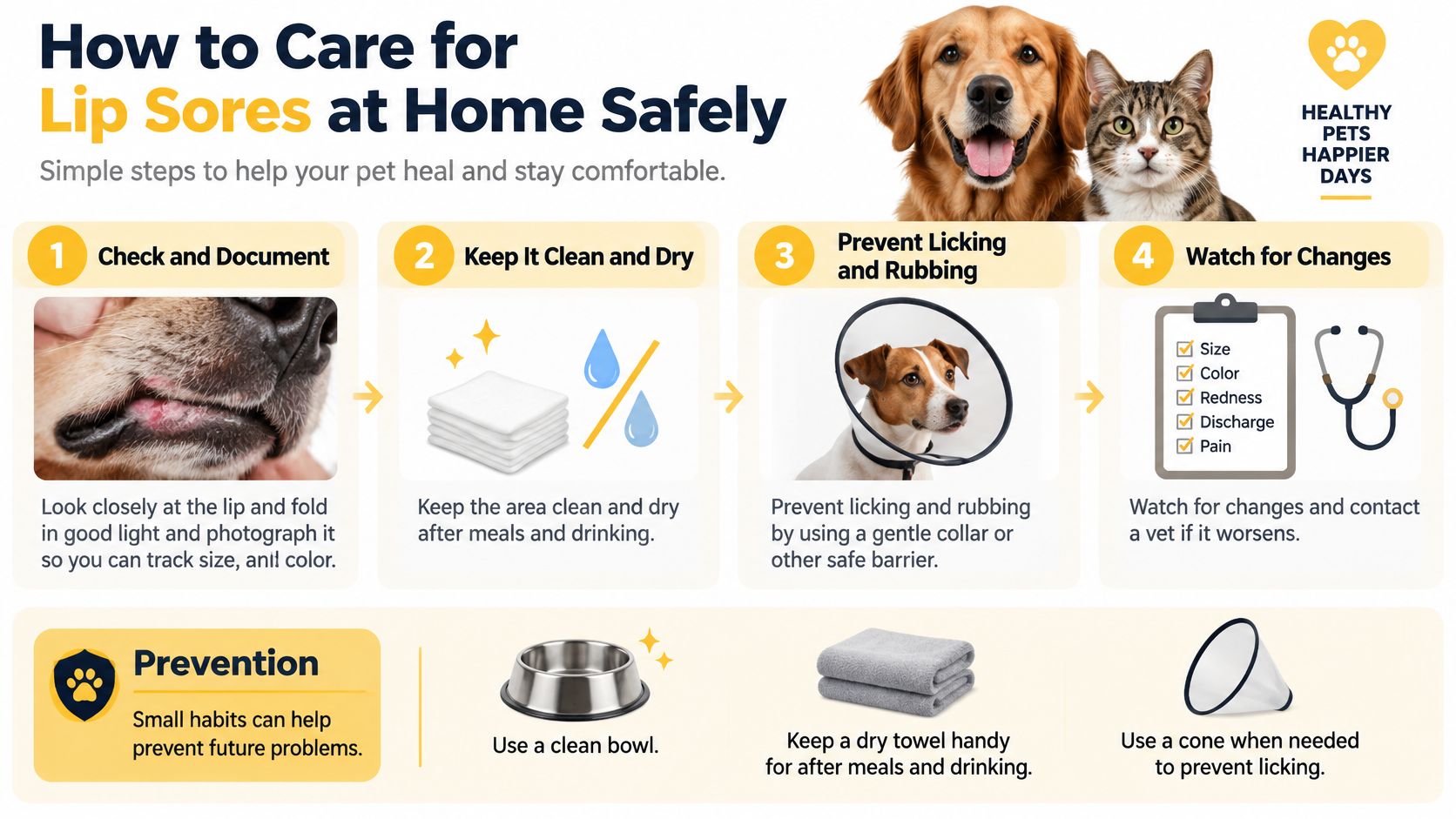
If you notice a small sore on your dog's lip, take a clear photo in good light before touching it. For a comfortable dog with a stable, external irritation, gentle cleaning can reduce trapped food and moisture while you arrange veterinary advice. Contact a veterinarian promptly if the sore is very painful, spreading, bleeding, or accompanied by signs of illness.
Gentle first aid
- Look without forcing. Use good light and approach when your dog is calm. Stop if your dog stiffens, flinches, or resists. Pain can make even a normally gentle dog bite.
- Rinse the outer surface. Use lukewarm water or sterile saline on soft gauze to lift away saliva, food, and loose debris. Keep fluid out of the mouth, and don't probe beneath the skin.
- Pat the fold dry. Use a clean, soft cloth and avoid rubbing. Check after meals and drinking, when damp hair or a lip fold can hold moisture against the skin.
- Leave fragile tissue alone. Avoid hydrogen peroxide, alcohol, undiluted antiseptics, and vigorous scrubbing. Don't peel attached crusts or dig into an ulcer with cotton swabs.
- Remove possible irritants. Put away splintered chews, damaged toys, or plant material your dog can reach. Leave anything embedded in the lip or lodged in the mouth for a veterinarian to assess.
- Limit rubbing. A properly fitted protective cone may help if your dog paws at the mouth or rubs it against furniture. Use a soft collar only if it prevents contact without pressing on the sore.
- Use medication only with veterinary guidance. Human creams, steroid preparations, antibiotic ointments, human painkillers, and leftover veterinary medication may be unsuitable. Ask your veterinarian before applying or giving any medication.
Prevention starts with the physical problem
The VetCompass skin-fold dermatitis study describes how friction, retained moisture, and poor ventilation can affect skin where surfaces meet. When a sore sits in a lip fold, gentle cleaning and drying address that local environment. Switching foods at random won't resolve a fold that repeatedly traps moisture or rubs against a tooth.
If you care for a dog with wrinkly skin, include a gentle fold check in routine grooming. Use a clean cloth for the affected area and wash food and water bowls. Ask your veterinarian to demonstrate a suitable cleaning technique, especially if sores keep returning.
Aim for a clean, dry fold that stays comfortable. Once the sore has settled, follow your veterinarian's advice on dental care. If gentle care isn't helping, or the sore returns, arrange an examination: repeated cleaning can't identify a tooth-contact problem or another cause that needs specific treatment.
Veterinary Diagnostics for Lip Sores
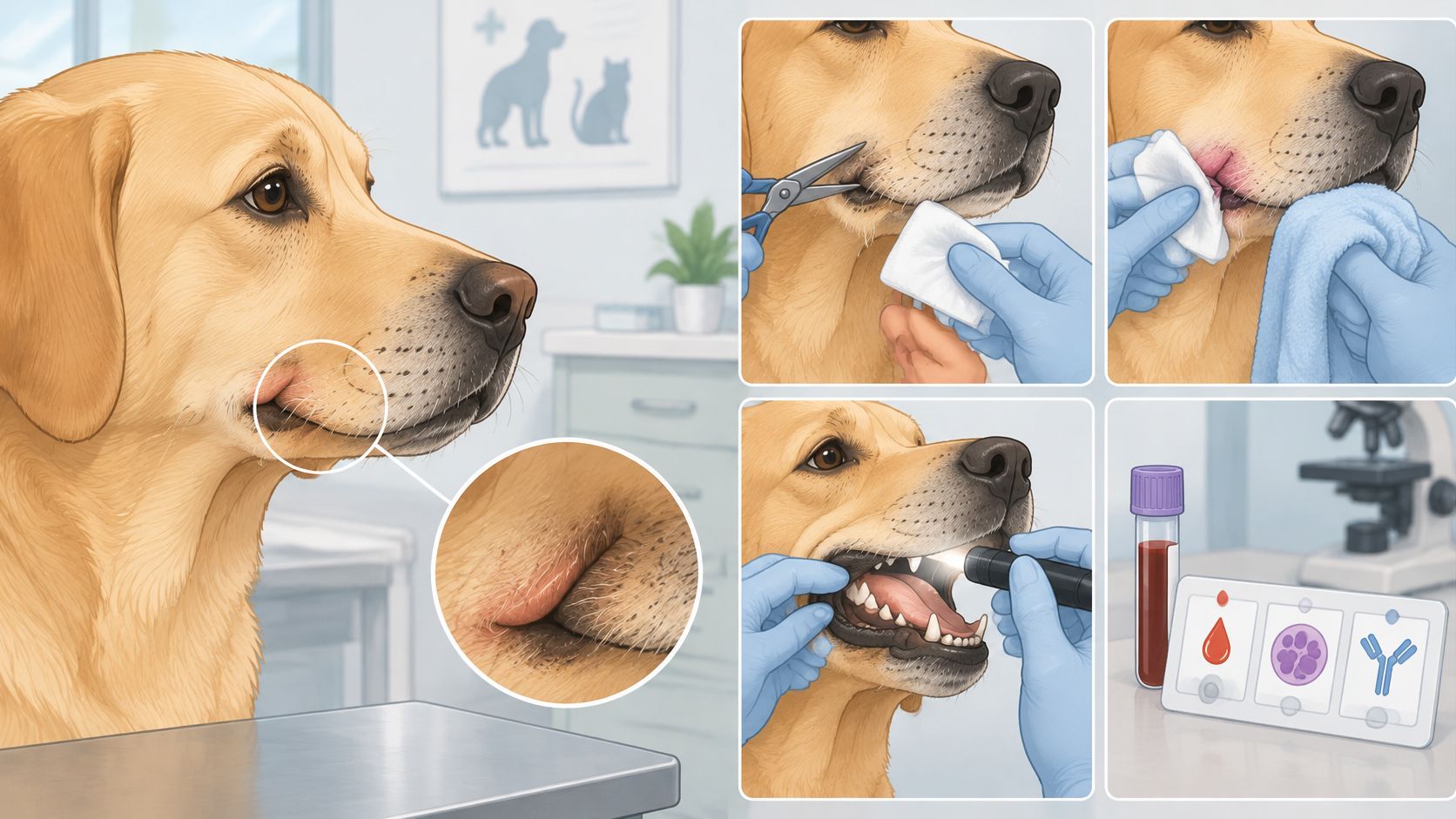
Your veterinarian starts by examining the lips, folds, gums and teeth, then checks the rest of your dog for related changes. They'll assess the lesion's depth, tenderness, tooth contact and any thickening or lumps. Pain or limited access may mean a complete oral assessment requires sedation or anesthesia.
| Test | What it reveals | When vets use it |
|---|---|---|
| Full oral and lip-fold exam | Location, depth, pain, tooth contact and lumps | Every case |
| Cytology | Cell types, microorganisms and inflammatory patterns | Persistent or atypical lesions |
| Bacterial culture and sensitivity | Bacteria present and likely antibiotic susceptibility | Recurrent or unresponsive infection |
| Biopsy | Tissue changes supporting immune disease or a tumor diagnosis | Unresolved or suspicious lesions |
| Bloodwork and urinalysis | Evidence of kidney disease or other systemic illness | Sores with body-wide signs or several affected sites |
| Dental radiographs | Root and supporting bone disease below the gum | Suspected periodontal disease |
Choose tests that answer a question
Cytology involves collecting material from the lesion and examining it under a microscope. It can help establish whether bacteria are accompanied by inflammation, whether yeast is present or whether unusual cells need further investigation. It doesn't replace a tissue biopsy when the underlying structure matters.
A bacterial culture is particularly useful when infection returns or doesn't respond as expected. Susceptibility results help the veterinarian choose an antibiotic, but the result still needs interpretation alongside the examination and cytology.
The antimicrobial-use guidelines emphasize that lip-fold intertrigo, mucocutaneous pyoderma and mucocutaneous lupus can closely resemble one another. Persistent or atypical lesions may therefore need sampling rather than another empirical antibiotic course.
Investigate beyond the surface
A biopsy removes a small tissue sample for a pathologist to examine. Your veterinarian chooses the sampling site carefully because a heavily damaged ulcer center may be less informative than its active edge. Sedation or anesthesia helps make sampling safe and comfortable.
Blood and urine testing answer different questions, particularly when your dog has drinking changes, weight loss or poor appetite. Dental radiographs assess structures that aren't visible during a simple look inside the mouth.
Owners researching English Bulldog skin bumps may recognize familiar-looking skin changes, but breed and appearance alone don't determine which test is appropriate.
Bring questions that clarify the decision: Which test is next? What result would change treatment? When should we recheck? A clear answer helps you understand why a test is useful rather than viewing it as an extra step before treatment.
Veterinary Treatments Matched to the Cause
A sore directly opposite a canine tooth may keep reopening each time the dog closes its mouth. In that case, treatment needs to address the tooth's contact with the lip. The veterinarian may combine pain relief, local care and treatment of the underlying condition, depending on what the examination and tests show.
Local fold, dental and injury care
Lip-fold dermatitis may be managed by carefully clipping surrounding hair, cleaning the fold and using a prescribed topical treatment. The veterinarian will choose antimicrobial treatment based on whether infection is present and how extensive it is. Oral antibiotics aren't automatic. If the fold's shape contributes to repeated flare-ups, ask about longer-term care options.
Contact ulcers need a dental plan to remove the source of repeated friction or pressure. Depending on the tooth and bite, treatment may involve extraction or a specialist dental procedure. Tooth shortening requires veterinary judgment and should never be attempted at home.
Periodontal disease or stomatitis calls for treatment inside the mouth. Professional dental care generally involves anesthesia, allowing the veterinarian to examine the mouth, take images and clean beneath the gumline. Teeth that cannot be retained comfortably may need extraction. Follow the clinic's feeding and oral-care instructions during recovery.
Traumatic or chemical injuries may need flushing, removal of foreign material, pain control and assessment for deeper damage. If a chemical may be involved, bring its packaging or a photograph. Don't try to neutralize it with another household substance. Follow-up checks whether the tissue is healing and your dog can eat and drink comfortably.
Immune disease, tumors and systemic illness
Immune-mediated conditions such as lupus may require topical or systemic medication to reduce inappropriate immune activity. Sun-exposure management may also be part of care, depending on the diagnosis. Treatment may need to be adjusted gradually, so don't stop medication when the surface first looks normal.
For a confirmed tumor, the plan depends on its type, location and extent. Surgery may be recommended, and some dogs may benefit from specialist referral or additional treatment. The appearance of a lump alone cannot determine which approach is suitable.
If an underlying systemic illness is causing oral ulceration, treating that illness is central to the plan. The veterinarian may also provide pain relief, hydration or feeding support while the mouth recovers.
- Follow the prescription: Don't stop, extend or change a medication course without veterinary advice.
- Keep the recheck: Tissue may still need assessment even when your dog seems comfortable.
- Report adverse changes: Call the prescribing clinic about vomiting, unusual lethargy or new sores.
A well-matched treatment plan helps the dog eat comfortably while the tissue heals.
Red Flags and the Booking Decision
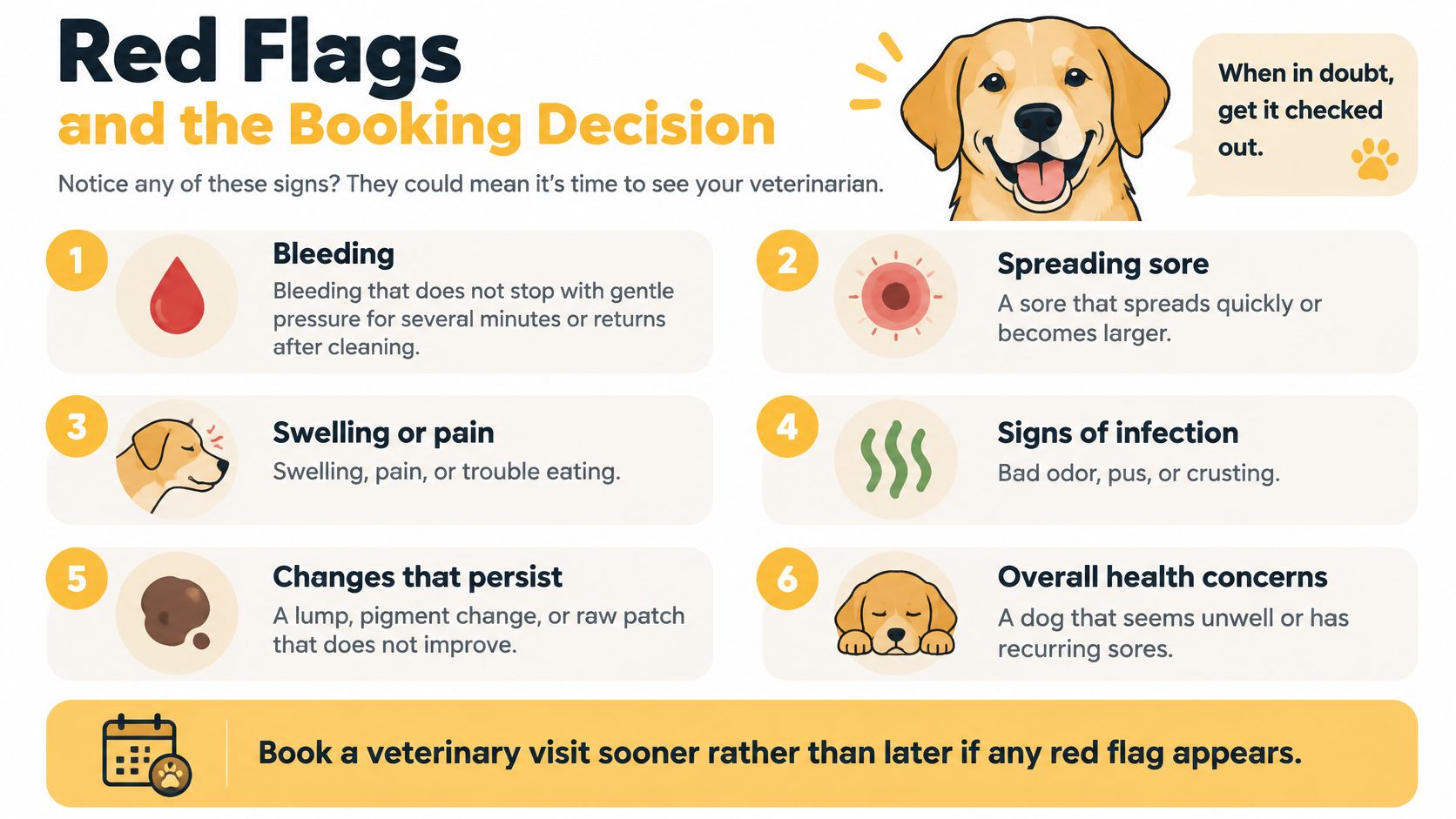
Pain, progression and your dog's overall condition guide the timing of a veterinary visit. Contact a clinic for same-day advice if you notice:
- Ongoing or recurrent bleeding: Gentle pressure with clean gauze doesn't stop it, or bleeding returns after light cleaning.
- Rapid spread: The sore enlarges or reaches the gums or deeper parts of the mouth.
- Marked pain: Your dog flinches, paws at the face repeatedly, refuses food or struggles to open the mouth.
- New oral changes: Drooling, pronounced bad breath or difficulty eating develops alongside the sore.
- General illness: Lethargy, vomiting, suspected fever or poor appetite accompanies the lesion.
- Several affected sites: Sores appear on the lips along with changes around the nose, eyelids or genital area.
- Suspicious tissue changes: You notice a firm lump, a growing ulcer or crusting with loss of normal nose color.
The clinic can advise whether your dog needs an urgent appointment or emergency care. Facial swelling with breathing difficulty is an emergency. Go to an emergency veterinary clinic immediately. Don't delay to clean the lip, take photographs or try an oral treatment.
When a routine appointment is appropriate
A small, stable sore in a comfortable dog who eats normally and seems well can usually be booked as a routine appointment. Describe its location, appearance and any symptoms when you call, so clinic staff can advise on timing. A dog that still eats can still have a persistent lesion that needs examination.
If a sore returns after treatment or doesn't improve with veterinary-directed care, arrange a reassessment. A temporary change in appearance may not resolve the underlying cause. The veterinarian may need to check for dental contact, irritation from a lip fold or another disease process.
General dog itchy skin remedies may be unsuitable for the lips. Products intended for intact body skin could be swallowed when applied near the mouth.
Prepare for a useful appointment
Bring photographs, the date you first noticed the sore, notes on eating and drooling, and a list of medications, topical products and supplements used. Include anything you stopped using; the response may help the veterinarian assess the lesion.
Pure Paw Labs' DA-1™ Daily All-in-One can generally be used alongside a dog's veterinary medications. If your dog takes medication, check with your veterinarian first. Use supplements alongside, not instead of, an examination to identify what is causing a lip sore. If your dog develops adverse effects after using a Pure Paw Labs product, stop giving it and consult a veterinarian.
At the appointment, ask: What result would change the plan? This helps clarify what to watch for and when to follow up.
At Pure Paw Labs, dog owners can explore DA-1™ Daily All-in-One and DD-1™ Dental Defense with their veterinarian. A veterinarian's examination can help determine whether a sore needs treatment for a dental-contact problem, a moisture-trapping lip fold or another cause.