


You spot it while your English Bulldog is sprawled beside you on the couch: a small pink bump under the chin, a raised spot between the toes, or a lump tucked into a wrinkle. It looks harmless in the dim light, but your dog keeps rubbing at it, and suddenly you're wondering whether you're seeing a pimple, an infection, an allergy, or something more serious.
That worry is reasonable. English Bulldog skin bumps often begin with breed anatomy, especially moisture and friction inside deep folds, but not every lump belongs to the same category. Some improve with careful cleaning and observation. Others need a skin sample, fine-needle aspiration, or biopsy because appearance alone can't identify them. This guide will help you make that distinction calmly and safely.
Table of Contents
- Why English Bulldogs Get Skin Bumps So Often
- How Bulldog Anatomy Shapes the Problem
- Common Types of Bumps and How to Tell Them Apart
- What a Vet Will Do to Diagnose the Bump
- Safe Home Care and What to Avoid
- Daily Prevention and Skin and Coat Support
- Red Flags That Need a Vet Right Away
Why English Bulldogs Get Skin Bumps So Often
At the kitchen table, you turn on a brighter light and gently separate the fold. The skin is damp, a little red, and has a sour smell. Your Bulldog pulls away, then licks the area as soon as you let go. That combination points more toward fold inflammation or infection than an isolated, harmless lump.
English Bulldogs carry a documented dermatologic burden. In a large UK VetCompass study, 29.3% of Bulldogs were recorded with skin disease compared with 12.4% of the general canine population, and the adjusted grouped-level odds ratio was 3.28 (Animal Friends summary of the findings). The same study identified skin fold dermatitis as the specific disorder to which English Bulldogs were most predisposed, with an odds ratio of 38.12.
That number doesn't mean every bump is an infection. It means the breed's structure makes recurring fold disease common enough that anatomy should be your first consideration, not an afterthought.
The short list behind most bumps
When owners describe “bumps,” they may be talking about very different lesions:
- Allergic bumps: Hives and allergy-related papules are often itchy and may appear alongside paw licking, ear trouble, or belly redness.
- Fold infection: Moisture, friction, bacteria, and yeast can produce papules, pustules, crusts, odor, and soreness.
- Parasites: Mites and other parasites can cause intense itching, hair loss, crusts, or scattered raised lesions.
- Blocked follicles: A small pustule or cyst can form where sebum and skin debris collect.
- Growths: Benign and malignant masses can look deceptively similar at home.
The key question isn't just, “Is this bump dangerous?” It's, “Does this bump behave like the surrounding skin problem, or does it behave like a separate mass?”
Practical rule: A moist, itchy, smelly cluster inside a fold is a different problem from a firm lump that stays in one place and grows.
You can learn more about the daily realities of caring for a wrinkled breed in this guide to dogs with wrinkly skin. For tonight, avoid squeezing the spot. Take a clear photograph, note where it is, and observe whether your dog is painful or determined to scratch it.
How Bulldog Anatomy Shapes the Problem
Think of each fold as a small pocket where skin touches skin. The pocket can hold warmth, moisture, saliva, tears, sebum, and debris. Air has difficulty reaching the deepest surface, while repeated movement creates friction. That local combination supports bacterial and yeast overgrowth, which is why English Bulldog skin bumps often appear in predictable places.
The mechanism is well described in veterinary literature on recurrent skin-fold pyoderma in English Bulldogs. Deep folds trap moisture and sebum, while friction, humidity, and retained secretions create a local environment that encourages inflammation and secondary infection (reviewed veterinary research).
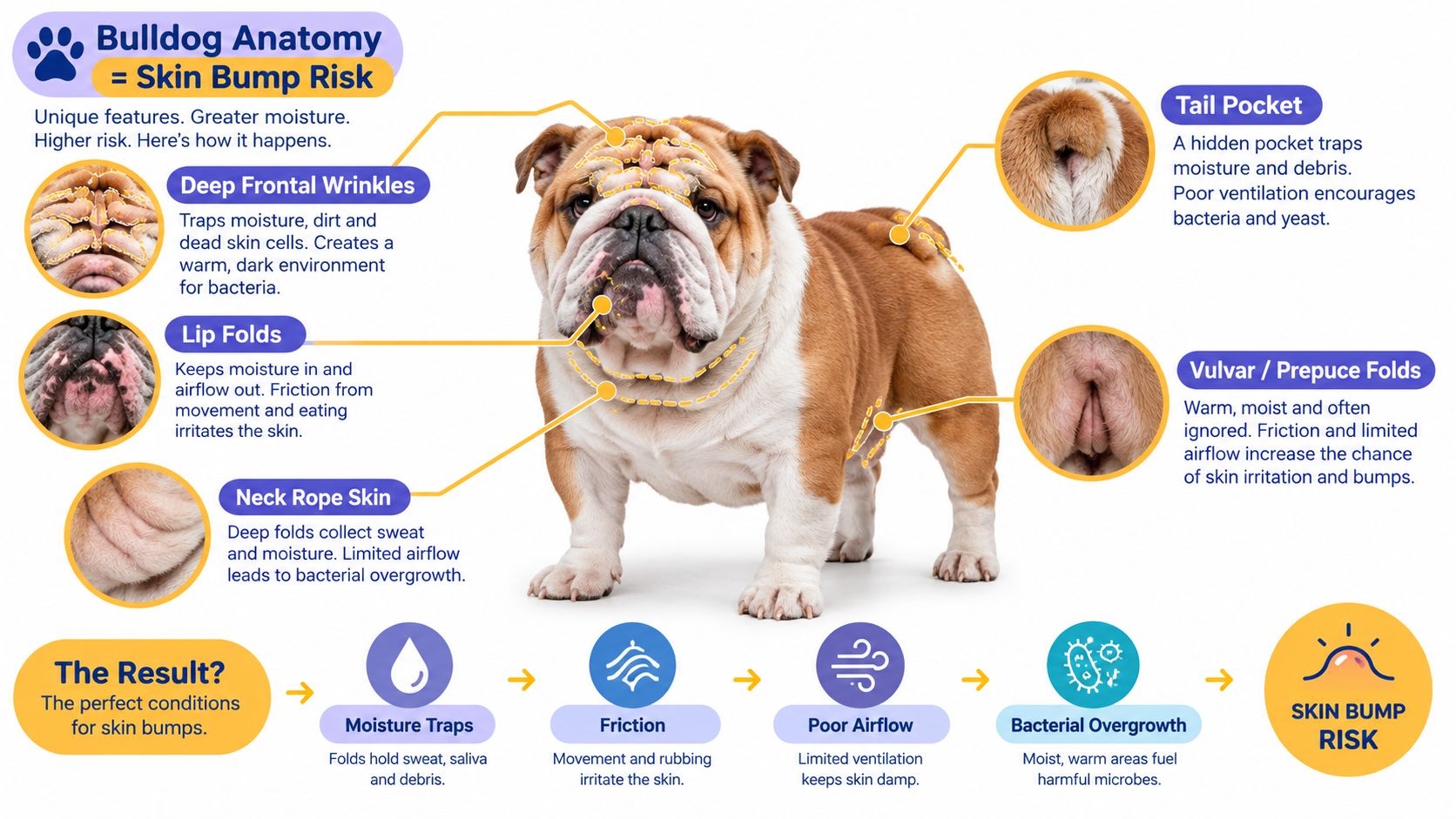
Check the fold map
Use a bright room and a gentle touch. Don't force open a painful fold.
- Facial wrinkles and the nose rope: Tears, saliva, and moisture collect in the creases around the nose. Red papules, crusts, odor, and raw skin can develop where the fold rubs.
- Lip folds: Food and saliva can remain along the loose lower lip, creating a damp area where pustules or inflamed patches appear.
- Neck rope and body folds: The neck, armpits, groin, and belly can become irritated where skin rubs, especially when the dog is itchy or carries excess weight.
- Tail pocket: A curled tail may leave a narrow pocket at its base. Owners often miss it because the opening is hidden, but trapped debris can cause painful swelling, discharge, and recurring bumps.
- Vulvar or prepuce folds: Moisture and urine residue can irritate these areas. A bump with odor, swelling, or discharge deserves veterinary attention rather than repeated wiping.
The Bulldog's short, bristly coat also leaves the skin exposed to friction and environmental irritants. Its sebaceous activity can contribute to a greasy surface that supports yeast overgrowth, especially when an allergy has already weakened the skin barrier.
Breed structure varies, so it helps to know what a Bulldog looks like compared with a related wrinkled breed. This comparison of French Bulldogs and English Bulldogs can help you understand why fold depth and tail shape differ from dog to dog.
For broader nutritional support, some owners consider a single daily supplement alongside veterinary care and a complete diet. DA-1™ Daily All-in-One - Senior Dog Support, Joints, Skin/Coat & More is described as a complete multi-system formula with 18 human-grade ingredients in one scoop, aimed at cells, gut, and joints. It isn't a treatment for an infected fold or an unidentified mass, so it shouldn't replace examination or prescribed therapy.
Common Types of Bumps and How to Tell Them Apart
A bump's location, surface, speed of change, and effect on your dog provide useful clues. They don't provide a diagnosis. A smooth nodule may be a cyst, but a different type of mass can look similar. A pimple-like lesion may be bacterial, allergic, or part of a deeper process.
The table gives you a quick comparison, followed by the details that matter most.
Common English Bulldog Skin Bumps at a Glance
| Bump Type | Appearance | Common Location | Action |
|---|---|---|---|
| Allergic hives | Raised, itchy welts that may appear and fade or shift | Face, belly, trunk | Call promptly if widespread or paired with swelling |
| Hot spot | Moist, red, painful patch that spreads quickly | Cheeks, neck, rump, body | Book a vet visit soon |
| Bacterial folliculitis | Small pimple-like bumps, pustules, crusts, or hair loss | Chin, belly, folds | Book a vet visit if persistent or infected-looking |
| Yeast overgrowth | Greasy, thickened, darkened skin with a musty odor | Facial, lip, neck, groin, tail folds | Arrange an exam for recurrent or painful disease |
| Interdigital cyst | Red, swollen lesion between toes, often painful | Paw webbing | Book a vet visit promptly |
| Sebaceous cyst | Smooth, dome-shaped, slow-growing nodule | Trunk or head | Monitor only if stable and your vet has assessed it |
| Histiocytoma | Sudden, button-like pink bump | Head or limbs | Have a vet identify it rather than assuming it's harmless |
| Mast cell tumor | Variable, sometimes soft or innocent-looking lump | Anywhere | Arrange veterinary sampling promptly |
Itchy and inflamed lesions
Hives tend to be raised, itchy welts rather than one fixed nodule. They can appear suddenly after an exposure and may change location. Facial swelling, vomiting, breathing changes, or sudden distress makes this an emergency.
A hot spot is usually wetter and more painful than a simple pimple. The hair may mat over a red, raw area, and the affected patch can enlarge quickly because the dog keeps licking or scratching.
Bacterial folliculitis often produces small papules or pustules around hair follicles. On a Bulldog, you may see them on the chin, belly, or near a fold. Brachycephalic dermatitis can also include alopecia, erythema, swelling, crusts, and severe pruritus, so persistent lesions need a differential diagnosis rather than a guess (clinical review of brachycephalic skin disease).
Yeast overgrowth usually has a greasy feel, thickened skin, a strong musty odor, and persistent itch. It often affects the same folds that develop bacterial inflammation, so owners can't reliably decide which organism is involved by smell alone.
Fixed lumps and paw lesions
An interdigital cyst appears between the toes as a swollen, red, often painful area. Limping, licking, drainage, or repeated recurrence should move this from home observation to a veterinary appointment.
A sebaceous cyst may feel smooth and rounded under the skin. It can remain quiet for a while, then become inflamed or rupture. Don't press it to see what comes out, because trauma can worsen inflammation and contamination.
A histiocytoma can look like a small pink button that appeared quickly, while a mast cell tumor may be soft, firm, smooth, or irritated. The appearance of either doesn't establish what it is. Skin lumps can represent abscesses, cysts, warts, pustules, ticks, or tumors, and many require fine-needle aspiration or biopsy for proper classification (veterinary guidance on lumps and masses).
For general coat-care principles, this guide to dog skin and coat can help you maintain a routine without treating every new bump as the same condition.
What a Vet Will Do to Diagnose the Bump
A good appointment starts before the examination table. Write down when you first saw the bump, whether it has changed, what your dog eats, where your dog walks, any new cleaning or grooming products, and whether similar lesions have appeared before.
The veterinarian will inspect the entire dog, not just the spot you circled with your finger. That usually includes gently examining facial wrinkles, lip folds, the tail pocket, belly, paws, ears, and genital folds. The clinician may also feel nearby lymph nodes and the abdomen, because the overall examination can reveal whether the skin problem is local or part of a wider illness.
Tests answer different questions
- Skin scrape: Helps look for mites and other microscopic causes of itch.
- Tape impression or cytology: Collects surface material so the clinician can look for bacteria, yeast, inflammatory cells, or abnormal cells.
- Fungal culture: May be used when ringworm is a concern.
- Fine-needle aspiration: Uses a small needle to collect cells from a solid mass. It can help distinguish inflammation from a tumor and may guide the next step.
- Biopsy: Removes a tissue sample when the bump is suspicious, recurring, deep, ulcerated, or not explained by simpler tests.
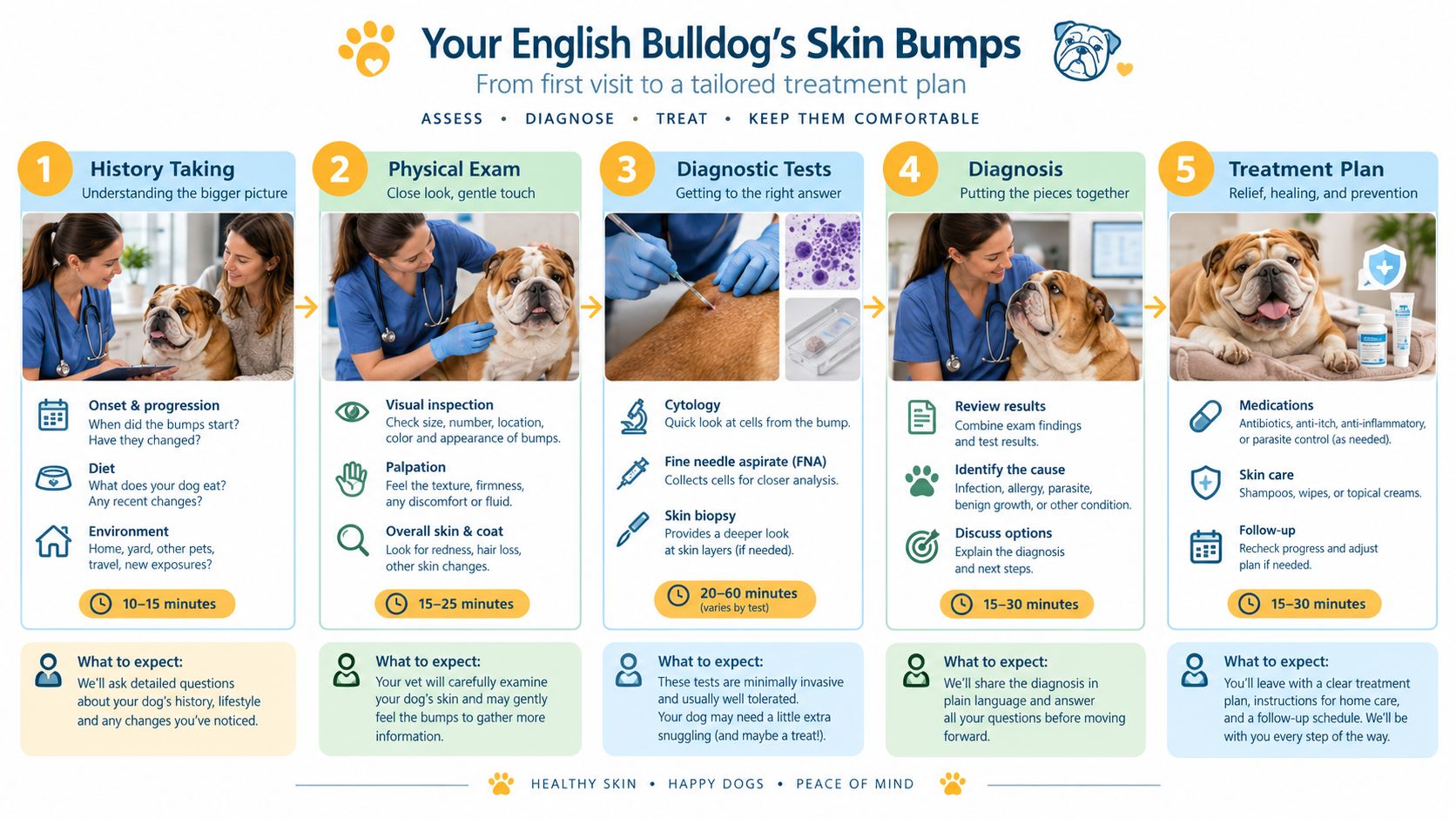
A cytology result can redirect treatment quickly. If the sample shows yeast, the plan differs from one for bacterial infection, mites, allergy-related inflammation, or a mass. Some Bulldogs have more than one problem at the same time, such as an allergy that damages the barrier and a secondary infection inside the folds.
A sample is not overreacting. It's how your veterinarian avoids treating the wrong problem for the wrong reason.
Turnaround depends on the test and the clinic. Some slide examinations happen during the visit, while cultures and laboratory pathology take longer. Costs vary with the number of tests, the location and depth of the lesion, and whether sedation is required. Because English Bulldogs can have airway concerns related to their brachycephalic anatomy, ask the clinic how it plans to monitor breathing if a deep biopsy or procedure needs sedation.
Safe Home Care and What to Avoid
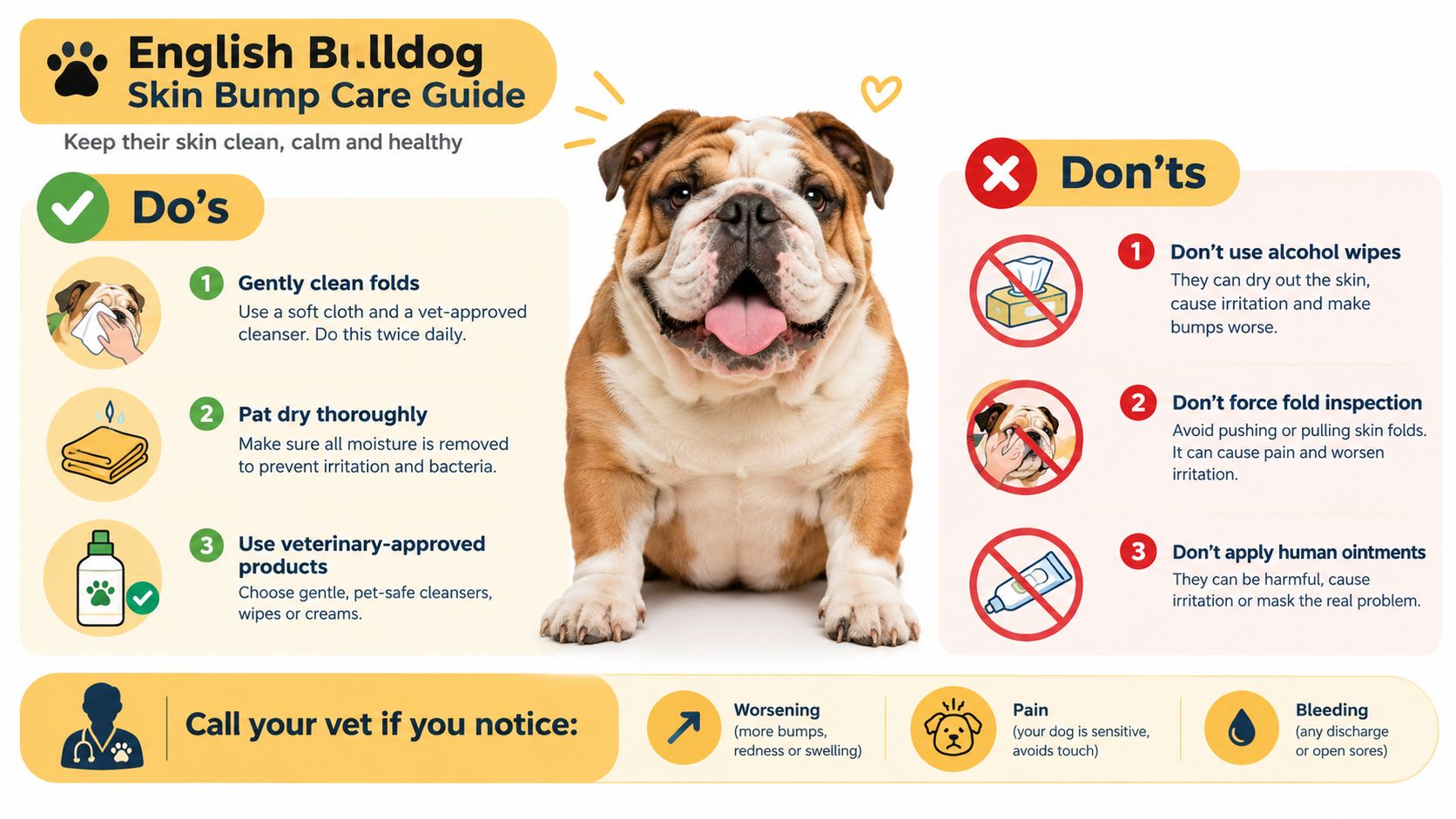
Home care is appropriate only for a mild, superficial problem that isn't rapidly changing, painful, bleeding, or producing significant discharge. If your Bulldog resists because the area hurts, stop. Forcing open a swollen fold can cause injury and make the next examination harder.
For a dog with mild fold irritation, use a veterinarian-approved chlorhexidine or acetic acid wipe as directed by your clinic. Gently clean the facial wrinkles, nose fold, and tail pocket, then pat every surface dry with a soft cloth. The drying step matters because leaving moisture behind recreates the environment that caused the irritation.
A gentle routine
- Prepare first: Have the approved wipe, a dry soft cloth, and treats ready.
- Open without pulling: Separate the fold only as far as your dog tolerates.
- Wipe softly: Remove debris without scrubbing raw skin.
- Dry completely: Pat rather than rub.
- Apply prescribed medication: Use only the cream, ointment, or solution your veterinarian recommended, and keep the applicator from touching contaminated skin.
A fragrance-free, pH-balanced dog shampoo may be suitable for routine bathing when your veterinarian agrees. Use lukewarm water, follow the product's contact instructions, rinse thoroughly with cool-to-neutral water, and dry the folds carefully. If self-trauma begins, an Elizabethan collar or a suitable alternative can prevent licking while the skin heals.
For owners exploring gentle supportive options for itch management, this overview of natural itch relief for dogs coconut oil offers context. Don't put coconut oil, or any home remedy, into a damp infected fold without veterinary guidance. Oily products can trap moisture and may complicate an active infection.
Avoid these common mistakes
- No hydrogen peroxide: It can irritate damaged tissue.
- No tea tree oil: Essential oils can be unsafe for dogs.
- No human acne creams: Ingredients and concentrations may harm pets if absorbed or swallowed.
- No over-the-counter steroid sprays: Steroids can mask infection and aren't suitable for every lesion.
- No squeezing cysts: Pressure can rupture tissue and spread inflammation.
- No indefinite waiting: A bump that grows, returns, bleeds, or becomes painful needs an examination.
Daily Prevention and Skin and Coat Support
Prevention for an English Bulldog is less about one perfect product and more about noticing small changes before they become painful. Make fold inspection part of feeding, walking, or bedtime so it doesn't depend on memory.
Build the routine around observation
Check the face, lip folds, tail pocket, belly, groin, and paws each day. Look for moisture, odor, redness, crusting, hair loss, swelling, or a new bump. A soft rubber curry brush used during a weekly grooming session can lift loose hair and debris without aggressive friction.
Wash bedding regularly and keep it fully dry before your dog uses it. If indoor humidity is a concern, a hygrometer can help you track the room rather than guessing. Parasite prevention also belongs in every season because fleas, mites, and other parasites can intensify itching and trigger secondary skin damage. For practical household guidance, see this resource on how to get rid of dog fleas.
Nutrition supports the skin barrier, but it doesn't replace diagnosis. Feed a complete diet with an appropriate balance of omega-3 and omega-6 fatty acids. If your veterinarian suspects a food allergy, follow a structured novel-protein or hydrolyzed-protein trial without unapproved treats or table food. Supplementary omega-3 products should be chosen with your veterinarian, especially for a breed that can gain weight easily.
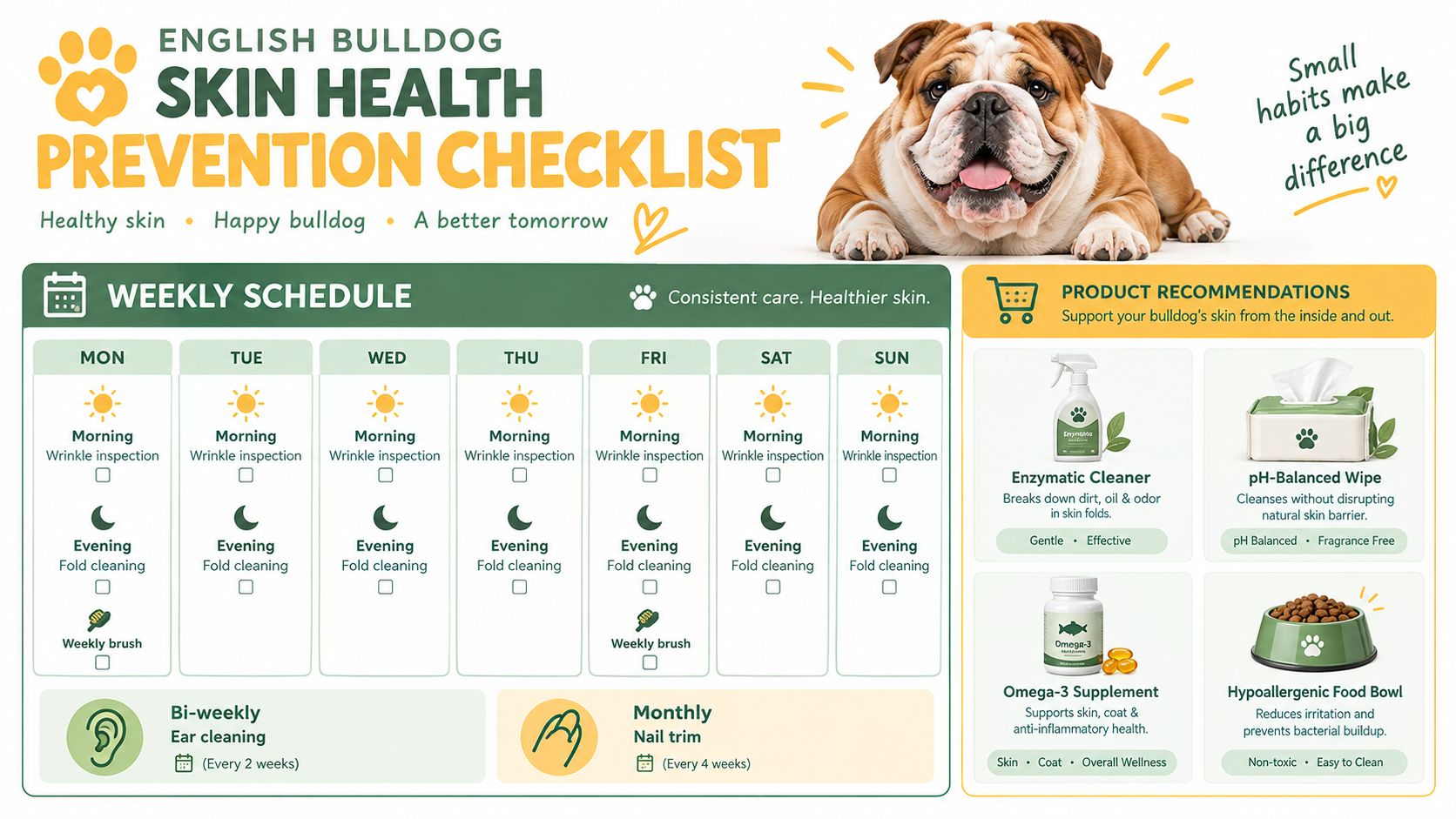
At the end of each month, review four questions:
- Diet: Has anything changed, including treats?
- Grooming: Are the same folds repeatedly damp, red, or smelly?
- Parasites: Is prevention current for your dog's exposure?
- Lesions: Has any bump persisted, grown, or returned?
That short review can reveal a pattern that's difficult to notice during a busy day.
Red Flags That Need a Vet Right Away
A stable, tiny bump on comfortable skin may not require an emergency visit, but it still deserves a record and a veterinary opinion if it persists. Use PERSIST as a quick check when you're standing in the bathroom with your Bulldog and a flashlight.
The PERSIST check
- Persist: The bump remains or returns after two weeks of appropriate home care. A recurring fold lesion may signal an underlying allergy or infection that needs a different plan.
- Grow: It becomes visibly larger over days or weeks, even if your dog doesn't seem bothered.
- Bleed: It is crusted, ulcerated, bleeding, or producing discharge.
- Hurt: Your dog flinches, licks, scratches, guards the area, limps, or refuses routine handling.
- Change: Its color, shape, surface, or texture changes, or it appears suddenly in an older dog.
A bump inside the nose wrinkle, tail pocket, vulvar fold, or prepuce is more concerning when it smells, swells, or oozes. Any lesion that interferes with breathing, swallowing, or eyelid closure needs prompt attention. A rapidly enlarging swelling after an injection or injury should also be assessed rather than watched at home.
Call urgently: Facial swelling, widespread hives, vomiting, breathing difficulty, collapse, or sudden distress can indicate a serious allergic reaction.
A painful, foul-smelling fold with pus or deep ulceration may represent a more advanced infection. If you're concerned about possible resistant bacterial infections, this MRSA warning guide from BacteriaFAQ.com provides general warning signs, but your veterinarian must diagnose and treat your dog.
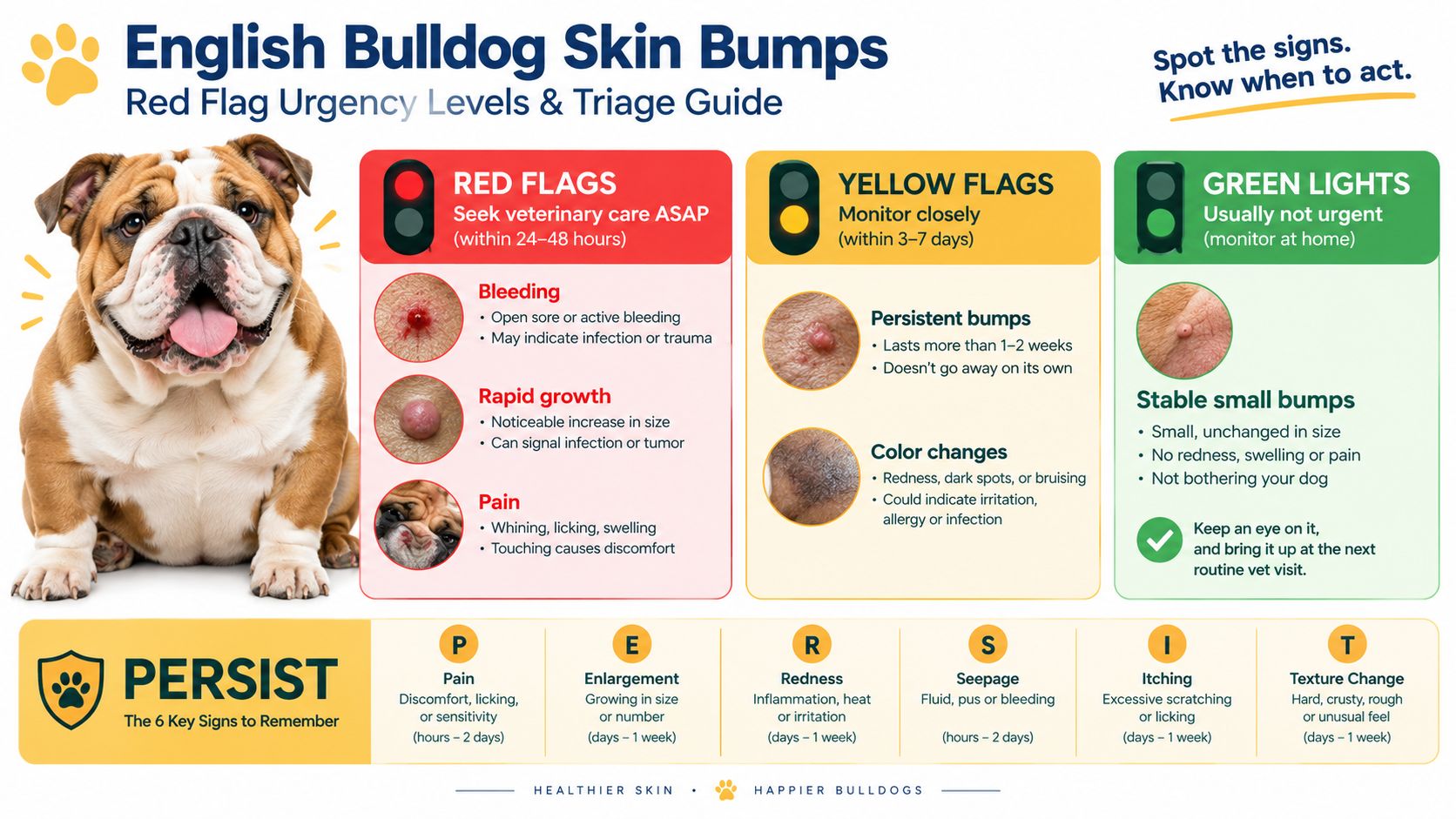
For a visual reminder of when a skin lesion needs professional attention, watch the following guide:
When you're unsure, photograph the bump beside a coin for scale, write down the date, and call the clinic. Don't apply products before the appointment unless your veterinarian has advised them, because a clean sample is often more useful than a temporarily altered lesion.
Pure Paw Labs offers science-backed, human-grade dietary supplements for dogs, including a daily formula designed to support skin and coat alongside other wellness needs. If your Bulldog's diet is complete and your veterinarian agrees that nutritional support fits the plan, visit Pure Paw Labs to review the available options.