


Most advice about male versus female puppies is too confident and too shallow. You'll hear that males are goofy and affectionate, while females are calmer, smarter, or easier to train. Those claims may sound familiar, but they're poor tools for choosing a dog who will share your home for years.
Sex matters in some specific biological and behavioral contexts. It doesn't determine personality. Breed tendencies, early handling, socialization, health, motivation, and individual temperament usually matter more when you're deciding whether a puppy fits your household. A bold female from a guarding breed may be far more demanding than a thoughtful male from a companion breed.
The practical question isn't “Which sex is better?” It's “Which individual puppy has the energy, resilience, sociability, and physical needs my household can meet?”
Table of Contents
- Choosing a Puppy's Sex: What Actually Matters
- Temperament and Behavioral Tendencies
- Health, Lifespan, and Early Development Milestones
- Training, Socialization, and Problem-Solving Differences
- The Neutering and Spaying Debate
- Cost, Care, and Daily Wellness Routines
- How to Choose the Right Puppy for Your Household
Choosing a Puppy's Sex: What Actually Matters
Choosing male or female before evaluating the litter puts the least useful fact first. Sex is visible immediately. The traits that shape daily life, including stress recovery, interest in people, persistence, sensitivity, arousal, and the ability to settle, require careful observation.
Hormones can also be mistaken for personality. An intact male may later mark, roam, or show greater interest in females in season. An intact female will experience reproductive cycles and needs careful management around intact males. These are genuine household considerations. They do not predict whether a puppy will be affectionate, emotionally steady, comfortable with children, or easy to live with.
Ask the breeder or rescue representative to help assess each puppy individually. Watch how the litter responds to gentle handling, unfamiliar surroundings, food, toys, mild frustration, and brief separation from littermates. Include simple problem-solving tasks, such as how a puppy works for a hidden treat or persists with an unfamiliar toy. A puppy that races toward you first is not automatically the best match. Check whether it can recover and settle after play.
| Decision factor | Male puppy | Female puppy |
|---|---|---|
| Personality | May be cuddly, playful, independent, sensitive, or bold | May be social, reserved, determined, easygoing, or intense |
| Training | Often shaped more by motivation and arousal than sex | Often shaped more by motivation and arousal than sex |
| Reproductive management | Neutering may affect reproduction-related behaviors, but timing needs individual planning | Spaying prevents heat cycles, but timing needs individual planning |
| Household fit | Depends on size, breed traits, energy, and temperament | Depends on size, breed traits, energy, and temperament |
| Best selection method | Observe the puppy's recovery, engagement, and handling response | Observe the puppy's recovery, engagement, and handling response |
The table's main point is straightforward: sex is background information, so let the individual puppy's behavior drive the decision. Rejecting a balanced, resilient puppy solely because of an arbitrary sex preference can leave you with a poorer household match.
Practical rule: Choose the puppy whose behavior matches your routine, not the puppy who matches a stereotype.
Breed genetics deserve serious attention. A herding puppy may track movement closely and become frustrated without enough work. A terrier may investigate every gap, scent, and sound. A guardian-type puppy may mature into a dog requiring careful visitor management. These tendencies can outweigh broad assumptions about males and females and should shape exercise, training, supervision, and daily wellness routines.
For a first-time owner, the strongest selection criteria are stable nerves, appropriate curiosity, physical soundness, and a realistic match with your activity level. Ask about the parents' behavior as well as their appearance, and meet the dam when possible. Sex may influence later reproductive decisions, including breed-dependent spay or neuter timing, but it should not cast the deciding vote at pickup.
Temperament and Behavioral Tendencies
Male and female puppies can show different tendencies, but owners often overstate them. The more useful distinction is between sex-linked behavior, hormone-related behavior, and individual temperament.
A male puppy may become more motivated to investigate scent trails, seek females, mark, roam, mount, or compete with certain dogs as he matures, especially if he remains intact. A female puppy may become more socially selective, protective of resources, or affected by reproductive cycles. Neither list predicts a fixed adult personality.
Breed traits can easily override sex-based expectations. A female guarding-breed dog may be more territorial than a male retriever. A male companion-breed dog may be delicate and reserved, while a female terrier may be relentless, vocal, and physically fearless. Read the breed standard as a starting point, then judge the actual puppy and family line.
What owners notice at home
Affection is one of the most unreliable stereotypes. Some males follow their people constantly, while some females prefer contact on their own terms. Other females are intensely people-oriented, and some males are content to nap across the room. The puppy who climbs into your lap during a visit isn't automatically going to be the easiest adult dog.
Roaming, mounting, urine marking, and attraction to reproductive cues are more closely connected to reproductive status and learning history than to a simple male personality label. Neutering can reduce some reproduction-related behaviors in males, but it isn't a dependable cure for fear, poor impulse control, or generalized anxiety.
Same-sex conflict also gets oversimplified. Two males may coexist beautifully, and two females may become difficult competitors. The deciding factors can include resource guarding, social maturity, breed tendencies, household structure, and whether the owners recognize tension early.

If you're caring for an older dog alongside a new puppy, DA-1™ Daily All-in-One - Senior Dog Support, Joints, Skin/Coat & More is described as a multi-system powder for aging dogs, with 18 human-grade ingredients targeting cells, gut, and joints. It isn't a substitute for a veterinary assessment, and a puppy's sex doesn't create a reason to use a senior-dog formula.
Behavioral tendencies by sex
| Behavioral trait | Male puppies | Female puppies |
|---|---|---|
| Attention seeking | Some become highly contact-seeking or playful | Some seek interaction intensely, while others disengage sooner |
| Roaming and marking | More likely to develop reproduction-related marking or roaming patterns when intact | May roam or attract males during reproductive cycles |
| Social style | May be persistent, physical, or exuberant | May be socially curious, selective, or more handler-oriented |
| Same-sex relationships | Can clash with another male, but compatibility depends on individuals | Can clash with another female, and compatibility still depends on individuals |
| Territorial behavior | Possible in any breed or individual | Possible in any breed or individual |
| Trainability | Depends on reinforcement, arousal, breed, and temperament | Depends on reinforcement, arousal, breed, and temperament |
Treat this table as a list of possibilities, not a forecast. If you're comparing breeds, the breed's working purpose and typical adult intensity deserve more weight than sex. Guidance on whether Australian Shepherds are aggressive is a useful reminder that labels like “aggressive” need context, triggers, genetics, and handling history.
Your job is to prevent predictable problems before they become habits. Use secure fencing, supervise interactions, interrupt mounting without drama, separate dogs around valuable resources, and reward calm behavior before excitement escalates. Don't wait for a puppy to become sexually mature before teaching household boundaries.
Health, Lifespan, and Early Development Milestones
Biological sex can produce measurable differences early in life, but a developmental difference isn't a verdict on intelligence, health, or future quality of life. It's one observation within a much larger picture that includes breed, birth conditions, maternal care, litter environment, disease, nutrition, and individual variation.
A neonatal-development study reported that female puppies opened their eyes at an average of 11.37 ± 0.28 days, while male puppies did so at 12.64 ± 0.14 days, with a statistically significant difference of P = 0.026. The reported average gap was approximately 1.27 days. These figures come from the studied population and shouldn't be used to judge a puppy who develops earlier or later than the averages. (Read the neonatal-development study)
Eye opening is a basic sensory milestone. It doesn't establish that one sex will be healthier, smarter, faster-growing, or easier to train. If a puppy's eyes remain closed unusually long, appear swollen, or show discharge, contact a veterinarian rather than trying to interpret the difference through sex.
Where sex matters medically
The most important health decisions involve the individual dog's expected adult size, breed risks, growth pattern, body condition, urinary and reproductive health, and future surgery plan. Sex can change the risk profile for some conditions, but it doesn't eliminate the need for routine preventive care.
Large and giant puppies need particular attention to controlled growth, appropriate nutrition, body condition, and exercise that doesn't repeatedly overload developing joints. Owners should also understand that growth plates matter when planning strenuous activity and orthopedic decisions. The guide to a dog's growth plate can help explain why a puppy's body needs gradual progression rather than forced athletic performance.
Don't choose a male because you assume he'll be sturdier, or a female because you assume she'll be healthier. Don't select supplements based on sex alone. A puppy with persistent diarrhea, poor weight gain, lameness, recurrent urinary signs, skin disease, or unusual fatigue needs a veterinary examination, regardless of whether the puppy is male or female.
The same discipline applies to lifespan. Broad sex stereotypes won't tell you how long an individual dog will live. Genetic screening, responsible breeding, vaccination, parasite prevention, dental care, safe weight management, early diagnosis, and appropriate exercise are more useful parts of a long-term plan.
A responsible owner tracks development without turning normal variation into a problem. Record appetite, stool quality, body condition, mobility, sleep, social responses, and recovery after exciting events. These observations give your veterinarian something useful to work with and prevent sex from becoming a lazy explanation for every difference.
Training, Socialization, and Problem-Solving Differences
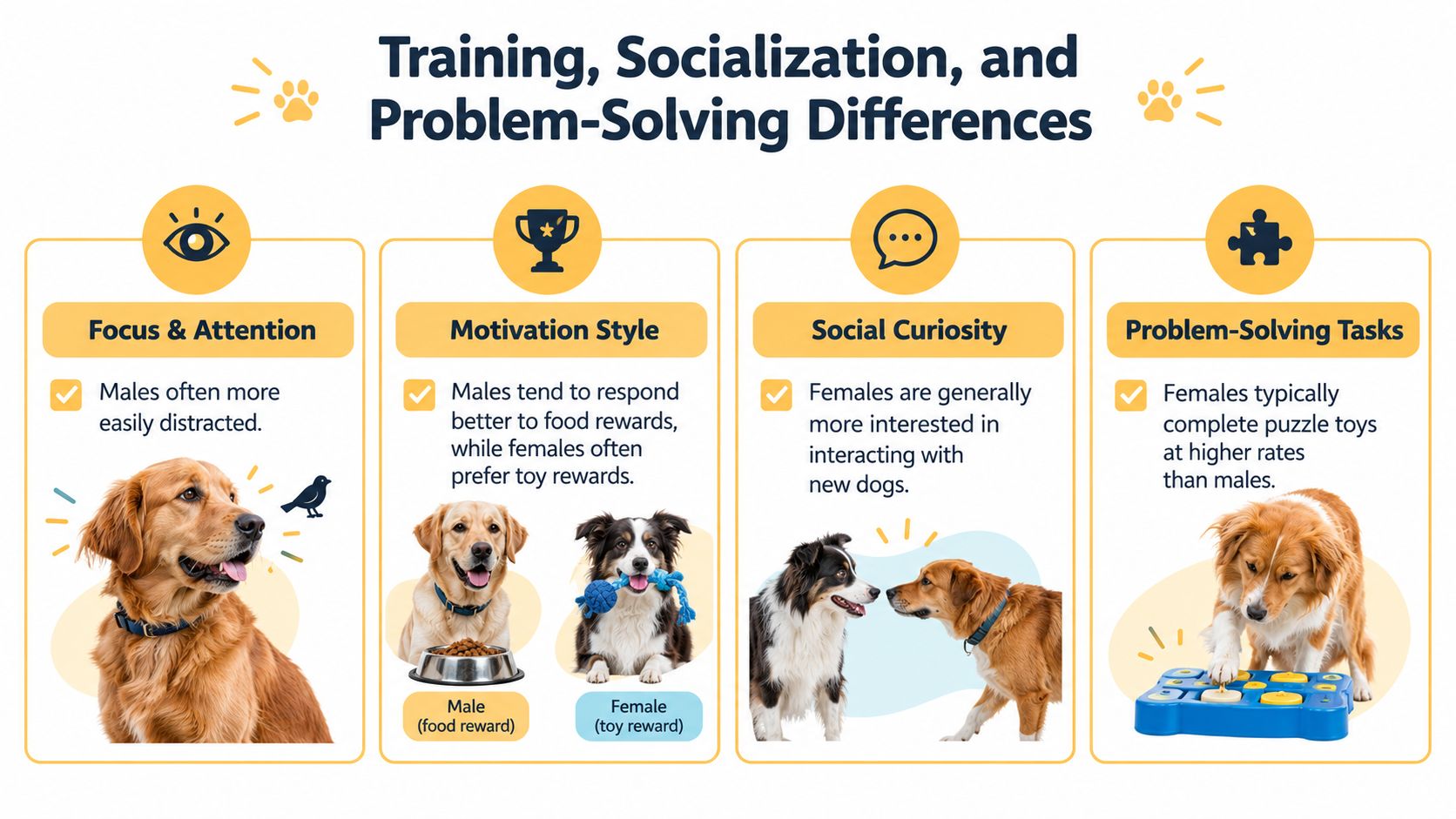
A 2023 observational, double-blind study examined 77 intact domestic dog puppies aged 3 to 6 months, including 39 males and 38 females. Male puppies solved the first physical food-retrieval problem faster, while female puppies showed greater and faster social interest in the experimental setting. (Review the puppy problem-solving study)
That result is interesting, but it doesn't justify saying males are smarter or females are naturally better trained. The task measured a particular physical problem-solving response, and performance can reflect motivation, prior experience, breed, persistence, and temperament. The social-interest finding also describes behavior in that testing context, not every female puppy in every home.
Train the puppy in front of you
Start by measuring behavior instead of guessing. Use the same simple setup across several sessions and note:
- Latency to engage: How long does the puppy take to approach a new task?
- Food retrieval time: How quickly does the puppy solve a familiar food puzzle?
- Prompt count: How many cues or demonstrations does the puppy need?
- Recovery after failure: Does the puppy try again, seek help, disengage, or become frantic?
- Social response: Does the puppy approach a person, investigate briefly, or prefer distance?
Male puppies who persist with physical tasks may benefit from short, varied puzzle sessions. Keep the difficulty modest, reward experimentation, and stop before frustration turns into frantic biting or vocalizing. Persistence is useful only when the puppy can remain emotionally regulated.
Female puppies who show strong social interest may respond especially well to cooperative, handler-mediated work. Teach eye contact, hand targeting, loose-leash movement, recall games, and calm greetings. Social motivation can make training efficient, but it can also create dependence on constant interaction if you never practice independent settling.
Socialization is not forced friendliness
Socialization means teaching a puppy that unfamiliar people, dogs, surfaces, noises, vehicles, handling, and environments can be handled safely. It doesn't mean allowing every stranger to touch the puppy or forcing a worried puppy into a crowded situation.
Use gradual exposure. Present a new experience at a distance where the puppy can still eat, look away, sniff, and respond to you. If the puppy freezes, hides, stops taking food, or repeatedly tries to escape, increase distance and reduce intensity.
Training principle: The best benchmark isn't how quickly a puppy performs. It's how calmly the puppy can think, recover, and try again.
Never use sex as an excuse for sloppy training. A male who is distracted can learn focus. A socially enthusiastic female can learn independence. Both need sleep, predictable routines, reinforcement-based training, safe chewing outlets, and carefully managed freedom.
If you're concerned that your puppy avoids interaction or seems uncomfortable around you, learn to distinguish ordinary tiredness, overstimulation, fear, and pain from the idea that the dog doesn't like you. A behavior log and veterinary check are more useful than a gender-based conclusion.
The Neutering and Spaying Debate
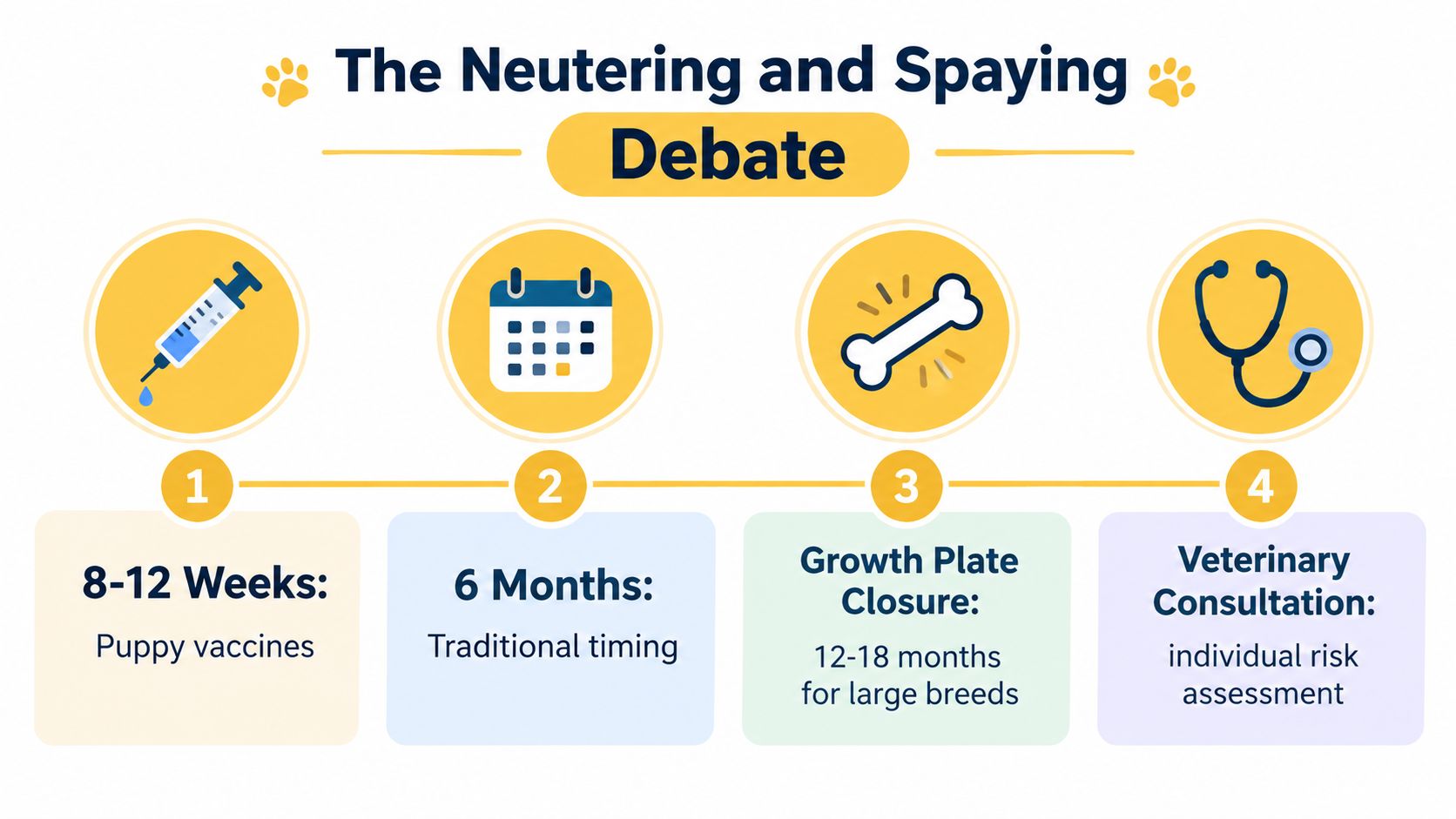
“Do it at six months” is too blunt to serve every puppy. Timing should reflect sex, expected adult size, breed-specific orthopedic concerns, behavior, reproductive-control needs, access to intact dogs, and the owner's ability to manage the dog safely.
A 2025 review describes lower roaming, fighting, mounting, and urine-marking behavior in males after neutering, while also discussing studies that associate neutering, especially in some contexts, with fear, anxiety, aggression, metabolic, urinary, and musculoskeletal outcomes. The evidence doesn't support a universal early-or-late rule, and it doesn't support treating neutering as a reliable cure for fear or generalized anxiety. (Read the 2025 review on neutering outcomes)
The review also reports that a service-dog study found no male-female difference in health-related dismissals, while neutering before seven months was associated with more health-related dismissals than neutering at seven to eleven months. That finding concerns a specific population and outcome. It isn't a prescription for every family dog.
Questions to take to your veterinarian
Bring concrete information, not a demand for a predetermined date.
- How large is this puppy expected to become? Growth and orthopedic considerations may affect the discussion.
- What risks are relevant to this breed or mix? A veterinary plan should account for inherited and conformation-related concerns.
- Can we reliably prevent an unwanted litter? Household access to intact dogs, fencing, daycare, boarding, and travel all matter.
- What behavior are we trying to change? Reproduction-related roaming and marking are different from fear, reactivity, or poor impulse control.
- What alternatives are feasible? Ask about management, delayed surgery, or temporary reproductive-control options where appropriate.
- What follow-up will we use? Body condition, urinary health, mobility, and behavior should be monitored after the procedure.
Spaying and neutering are medical decisions, not moral tests. Reproductive control matters, but so does preserving healthy development and avoiding an operation chosen solely because it's routine in your area.
For broader planning, use a dog preventive-care routine that includes veterinary examinations, vaccines, parasite control, dental care, nutrition, body-condition monitoring, and behavior support. Don't expect surgery to replace training, enrichment, or responsible supervision.
Cost, Care, and Daily Wellness Routines
The financial difference between raising male and female puppies isn't a simple fixed price list. Surgery costs vary by clinic, region, the dog's health, and the procedure required. A male may need management for marking or roaming, while a female owner must plan for heat-cycle management if surgery is delayed. Neither sex guarantees lower lifetime costs.
The more meaningful budget question is whether you can cover routine veterinary care, emergency treatment, quality nutrition, training support, grooming, containment, and breed-related needs. A larger adult dog may need more food, stronger equipment, and more space, but adult size is driven primarily by breed and individual structure, not by sex in isolation.
A realistic household routine
Consider a first-time owner bringing home a puppy while working a regular schedule. The daily plan needs to cover meals, toilet breaks, naps, brief training, supervised exploration, and calm time. The sex of the puppy doesn't reduce those responsibilities.
A useful routine might look like this:
- Morning: Toilet break, breakfast, brief training, then rest.
- Midday: Toilet break, gentle play, handling practice, and a quiet chew.
- Evening: Sniffing activity, short recall or leash work, dinner, and a predictable wind-down.
- Weekly: Review body condition, nails, ears, coat, stool quality, and behavior changes.
Keep the puppy's diet complete and appropriate for growth. Don't add supplements just because a puppy is male or female. If a veterinarian identifies a specific nutritional concern, follow that professional's advice rather than assembling a complicated stack from internet recommendations.
For an aging dog already in the household, a consolidated routine may be easier than managing multiple containers. The DA-1™ formula described by Pure Paw Labs is an all-in-one powder intended for older dogs, with support directed at joints, gut, and cellular needs. It's not a puppy-specific requirement, and any supplement should be reviewed for suitability with the dog's diet and medical history.

Don't let a product replace the basics. The best wellness routine is the one you can follow consistently, with veterinary care at the center. Track what you give, observe changes, and stop anything that causes digestive upset or other concerning symptoms until you've spoken with a professional.
How to Choose the Right Puppy for Your Household
If you already have a dog, don't assume the opposite sex guarantees harmony. Compatibility depends on the resident dog's temperament, age, activity level, resource habits, social preferences, and ability to tolerate puppy behavior. A careful introduction and ongoing management matter more than choosing a male for a female resident dog, or vice versa.
For homes with young children, prioritize a puppy who recovers quickly from ordinary household movement and accepts gentle handling. Don't choose based on the claim that one sex is automatically safer or more patient with children. Adults must supervise every interaction, teach children not to chase or restrain the puppy, and provide the dog with a protected resting area.
Apartment living also doesn't automatically favor females. A calm, adaptable male may fit better than an intense, vocal female, while a quiet female may fit better than a restless male. Evaluate noise sensitivity, exercise needs, recovery from novelty, and your ability to provide enrichment without relying on a yard.
Use this selection checklist
When visiting a breeder or rescue, watch each puppy in more than one context.
- Observe recovery: After a mild surprise or interruption, does the puppy investigate, seek support, and settle?
- Test engagement: Does the puppy willingly follow a person, take food, or play without becoming frantic?
- Notice handling: Can the puppy tolerate brief, gentle examination of paws, ears, mouth, and body?
- Compare energy: Is the puppy's activity level compatible with your schedule, space, and exercise plans?
- Ask about history: What has the puppy experienced, and how did the puppy respond to people, dogs, surfaces, and confinement?
- Inspect health: Look for clean eyes, appropriate body condition, comfortable movement, and normal behavior, then arrange a veterinary examination.
Avoid choosing the puppy who appears most dramatic just because the interaction feels exciting. A puppy who charges forward may be confident, or may be over-aroused and poor at self-regulation. A puppy who hangs back may be thoughtful, or may be fearful. Ask for repeated observations and let an experienced breeder or behavior professional interpret them in context.
If you're comparing a small, intense dog with a more easygoing companion, don't reduce the decision to sex. Even guidance about Beagles and Jack Russells points toward the larger issue, breed tendencies and household fit can create very different ownership experiences.
The best answer to “male vs female puppies” is usually the puppy who has the right temperament, health, and energy for your life. Keep sex in the decision, especially for reproductive planning and veterinary conversations, but don't let it overshadow the individual dog standing in front of you.
Pure Paw Labs offers science-backed, human-grade daily dog supplements designed to simplify support for areas such as joints, digestion, skin and coat, immunity, and stress-related needs. Review the ingredients and your puppy's or dog's veterinary needs, then visit Pure Paw Labs to explore the available options.