


Australian Shepherds are not defined by aggression, and a 2026 study of 215 Australian Shepherds found mean aggression-related scores below 1.5 on a 0 to 4 scale. What owners usually run into is reactive behavior, not an aggressive temperament.
That difference matters, because a dog that barks, lunges, or stiffens at a trigger is often trying to create space, not trying to hurt anyone. If you're staring at a dog who just snapped at a jogger, another dog, or the vacuum, you're probably dealing with a behavior pattern that can be understood, managed, and improved, not a breed that's “bad” by default.
Table of Contents
- What an Australian Shepherd's Temperament Really Looks Like
- The Core Traits Behind the Breed's Reputation
- Reactive Behavior vs True Aggression
- What Causes Aggression or Reactivity in Australian Shepherds
- Prevention Strategies Every Owner Should Start Early
- Managing Aggression Around Other Dogs and Animals
- When to Call a Vet or Behaviorist
- Frequently Asked Questions Aussie Owners Actually Ask
What an Australian Shepherd's Temperament Really Looks Like
A lot of people start asking are Australian Shepherds aggressive after one scary moment at the park. Your dog might have been friendly all morning, then suddenly stiffened when a stranger moved too close, and everyone around you looked at you like something was wrong with the breed. That moment feels dramatic, but it doesn't automatically mean your dog has an aggressive temperament.
The better read is that Australian Shepherds tend to be intense, alert, and quick to react to pressure. In the 2026 owner-questionnaire study, the breed showed generally low aggression toward both owners and unfamiliar people, with mean aggression-related scores below 1.5 on a 0 to 4 scale in the sample of 215 Australian Shepherds (study). That supports a practical conclusion many experienced handlers recognize, aggression is not the defining trait, but reactivity can absolutely show up when a dog feels crowded, overstimulated, or unsure.
The confusion comes from the fact that reactivity can look loud. A dog that barks, spins, lunges, or nips the air may seem “mean,” yet those behaviors often function as distance-increasing signals. The dog is saying, in dog language, “move back,” not “I want a fight.”
Practical rule: if the behavior gets better when the trigger moves away, you're usually looking at reactivity, not a fixed aggression problem.
That's the lens this topic needs. Breed traits matter, but so do socialization, fear, pain, home structure, and how owners read the dog's body language. If you keep those pieces separate, the picture gets much clearer.
The Core Traits Behind the Breed's Reputation
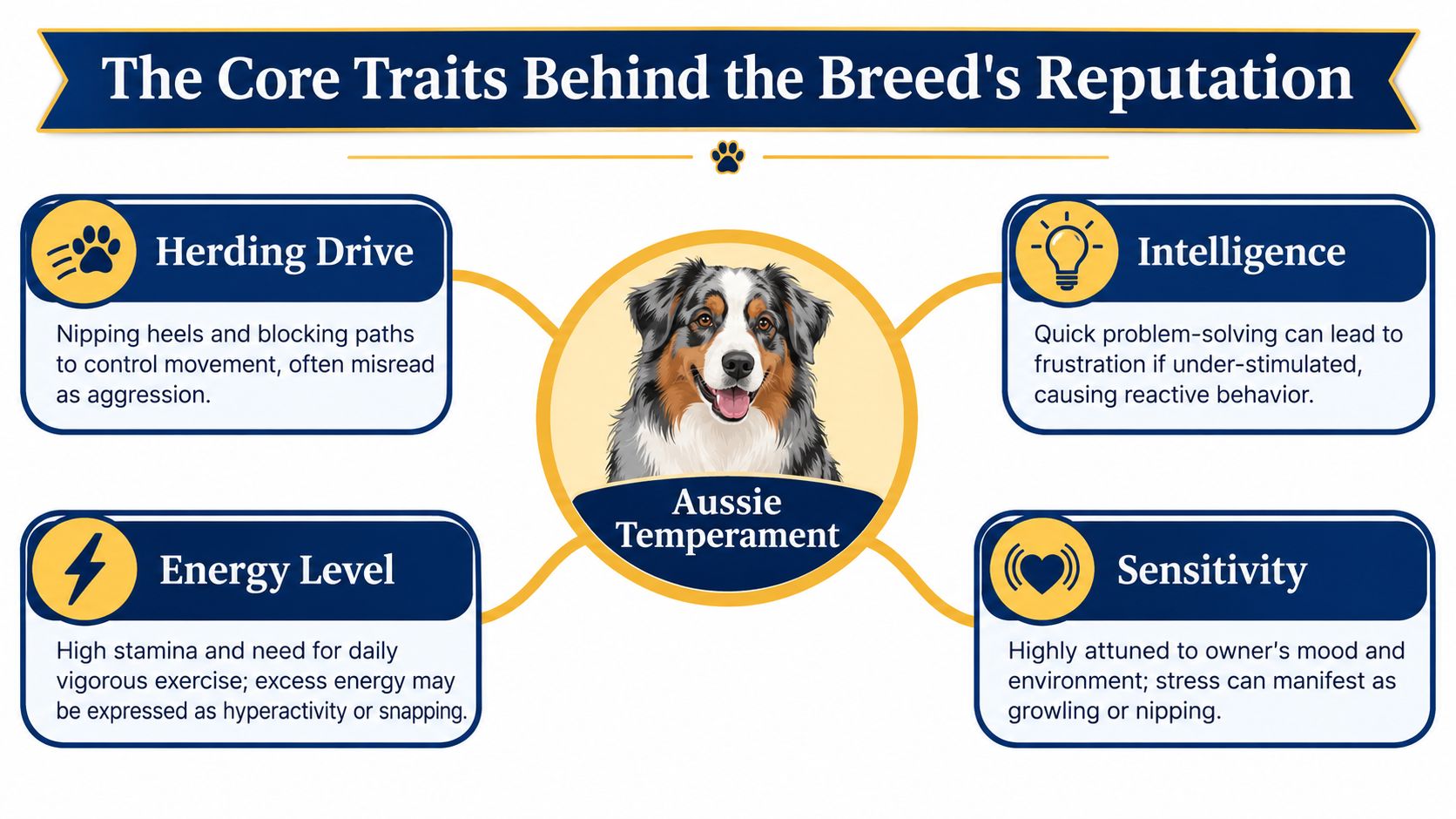
Australian Shepherds often get described as intense for good reason. Their herding drive, high energy, intelligence, and sensitivity can all be mistaken for hostility if you only judge the dog by the noise or speed of the reaction. None of those traits is aggression on its own. They are working-dog traits that need direction.
Herding drive can look pushy
Herding breeds are built to control movement. In a home, that can show up as heel-nipping, blocking a doorway, shadowing children, or circling a pet that is moving too fast. To a child or an unprepared adult, that can feel like bullying.
The dog is often following instinct, not looking for conflict. If a toddler runs, the dog may chase. If a cat darts across the room, the dog may fixate and try to manage the motion. Herding breeds like Aussies and even crosses such as the shepherd corgi mix share this intense working-dog wiring. Owners who recognize that pattern can redirect it into training games, structured fetch, or movement-based work instead of reading it as deliberate aggression.
High energy can spill into frustration
A bored Aussie rarely stays quiet for long. Under-exercised dogs often show frustration through barking, door-charging, pacing, and lunging at passing distractions. Those behaviors can look aggressive because they are sudden and intense, yet they often work like a pressure valve.
Intelligence makes patterns stick fast
Australian Shepherds learn quickly, which helps when the pattern is “sit when asked.” It is less helpful when the pattern is “the mail carrier makes the dog worried every afternoon.” Smart dogs can rehearse worry as quickly as they rehearse obedience. One repeated response can become a habit if owners do not interrupt it early.
Sensitivity turns tension into behavior
These dogs notice tone of voice, body posture, and handling style. Harsh correction or inconsistent rules can make a sensitive dog more defensive, not less. A dog that seems stubborn may be overwhelmed and unsure how to respond.
When comfort and movement become part of the bigger picture, owners sometimes consider a daily supplement such as DA-1™ Daily All-in-One for older dogs, although that does not treat behavior by itself.
The simplest read on the breed is this. What looks like aggression is often a working-dog instinct pointing to an unmet need.
Reactive Behavior vs True Aggression
The body language tells the story
A reactive Australian Shepherd is usually trying to increase distance. You'll often see ears pinned back, tail low, hard staring, barking, lunging, or frantic vocalizing when the trigger is too close. The behavior tends to ease when the trigger moves away or the dog gets space.
True aggression is different. The dog moves into contact, stays rigid, and keeps escalating even when a person backs off. That may include a hard, fixed stare, stiff muscles, quiet growling, and a willingness to close distance rather than avoid it.
A reactive dog says, “Get away from me.” An aggressive dog may say, “I'm coming through.”
That distinction matters because the response is different. A reactive dog usually needs threshold management, desensitization, and better handling of triggers. An aggressive dog needs a professional assessment, because the safety risk is different and the intent behind the behavior is less about space and more about confrontation.
Two real scenarios look nothing alike
One Aussie barks frantically at the vacuum, circles the room, and relaxes once the machine is turned off. That's classic reactivity to a specific trigger.
Another Aussie corners a visitor, holds a stiff posture, and bites when the person tries to move past. That's a much more serious picture and shouldn't be treated like ordinary nuisance behavior.
| Behavioral Cue | Reactive Dog | Aggressive Dog |
|---|---|---|
| Trigger response | Overreacts to a specific trigger | Advances toward contact |
| Posture | Often tense, alert, or defensive | Rigid, fixed, hard to interrupt |
| Vocalization | Barking, whining, lunging | Growling can be quieter, more threatening |
| Goal | Create distance | Escalate confrontation or control access |
| After the trigger leaves | Calms more easily | May continue escalating |
If a bite has already happened, the risk picture changes fast. In that situation, it can help to understand the legal and safety side of things too, including resources like dog bite injury attorney Cincinnati from Spivak & Sakellariou, especially when a severe incident has created injury or liability concerns.
The body language cue that owners miss most often is pinned ears. A clear visual guide such as the internal resource at https://purepawlabs.com/blogs/learn/dog-ears-pinned-back-3 can help you spot the difference between discomfort and a dog that's actively escalating.
What Causes Aggression or Reactivity in Australian Shepherds
An Aussie that seems calm in the living room but explodes at the front door is usually showing a stack of pressures, not one single flaw. Reactivity often builds when the dog's threshold gets low and the trigger arrives too fast.
Genetics can raise intensity, not destiny
The Australian Shepherd Health & Genetics Institute notes that fighting behavior can be learned, inherited, or both, and that older lines had more pugilistic tendencies, though selection has reduced this in modern dogs (breed behavior guidance). Some dogs start life with more drive, sharper responses, or less patience for frustration.
That can look like a young rescue who lunges at strangers even though no clear trauma is known. Genetics may shape the dog's starting point, but it does not write the whole story.
Missed socialization can leave the dog unsure
A puppy that grew up with too little variety may treat new dogs, odd flooring, loud equipment, or busy sidewalks as threats. The dog is not being stubborn. It is reacting as if the world is full of surprises it never learned to sort out.
Fear changes the whole threshold
Fear-based behavior is defensive. A dog that has been startled, punished, or pushed too hard may snap when someone reaches over its head or tries to move it off a bed. Dogs often signal distrust before they escalate, and the signs your dog doesn't like you can help you catch those early warnings with this guide.
Owners often miss the smaller warnings because they look ordinary. A tucked body, frozen mouth, or a hard stare can be the moment before the dog decides it needs distance.
Pain changes behavior fast
Pain lowers patience. An older Aussie that gets snappy when touched on the hips may be dealing with joint discomfort, and any sudden behavior change deserves attention. Pain, thyroid issues, and neurological problems can all reduce how much a dog can tolerate before reacting.
Bad environment teaches bad habits
Under-exercise, too much stimulation, and inconsistent routines create constant friction. A dog that never knows when rest, training, or activity is coming often stays on edge, and that tension can spill into barking, lunging, or guarding behavior. The dog is not choosing chaos, it is living inside it.
The pattern to watch is simple. If the behavior worsens around novelty, handling, or pressure, start with closer observation and a clearer management plan instead of punishment.
Prevention Strategies Every Owner Should Start Early
Build social confidence on purpose
Early socialization is really controlled exposure, not forced interaction. Puppies need to see different people, surfaces, sounds, and settings while still feeling safe. For a young Aussie, that means short, calm outings where the goal is neutrality, not greeting everybody.
A useful rhythm is simple. Introduce new sights and sounds early, then keep those experiences positive and low-pressure as the dog matures. If the puppy is overwhelmed, the session was too hard, too long, or too close.
Use exercise to lower the pressure
Australian Shepherds need both movement and mental work. A long walk by itself won't always solve frustration if the dog's brain still has nowhere to go. Puzzle feeding, scent games, short obedience drills, and tug with rules give the dog a job that matches its working-dog wiring.
If you're starting from scratch, think in two buckets. One bucket is physical outlet, the other is thinking work. When either bucket stays empty, reactivity usually gets louder.
Train the habits that interrupt escalation
Reward-based training helps the dog practice calm choices before trouble starts. Teach leave it, a reliable recall, and a settle cue on a mat. Those are not fancy tricks. They're emergency tools that give you a way to redirect the dog before the spiral begins.
A structured class makes sense once your dog can't stay under threshold around everyday motion without help. If the dog can't watch another dog from a safe distance without barking, that's a sign to work with a trainer before the pattern hardens.
Manage the environment like it matters
Sightlines, door routines, and predictable schedules matter more than many owners expect. If your dog can stare out a front window all day and rehearse barking, that window becomes part of the behavior problem. If every guest walks straight into the room and reaches for the dog, the dog has no chance to succeed.
A simple house rule helps: lower the number of surprise encounters. Use gates, crates, leashes, and planned greetings so the dog doesn't have to invent its own coping strategy.
Owner benchmark: if your Aussie is calmer after predictable routines, the issue is likely management plus training, not a fixed personality flaw.
Managing Aggression Around Other Dogs and Animals
A household with one Aussie, one older dog, and a cat can turn messy fast if nobody reads the early signals. One common pattern is barrier frustration, where the Aussie fixates on the other animal through a gate, fence, or baby gate and starts barking or pawing. Another is redirected herding, where the dog gets amped up by movement and starts stalking or nipping at the resident pet instead.
The first warning sign is usually not a bite. It's the stare. The dog goes still, the body stiffens, and the mouth closes. Owners often miss that because the dog hasn't “done” anything yet, but the decision point has already arrived.
Practical management starts with separation and controlled exposure.
- Parallel walks: walk the dogs at a safe distance before trying any shared space. The goal is calm proximity, not greetings.
- Crate rotation: give each dog turn-taking access to the living room or yard so no one has to compete for space.
- Scent swapping: exchange bedding so each dog gets used to the other's smell without direct contact.
- Decompression zones: give each pet a separate area where it can rest without being watched, chased, or crowded.
Punishing a stare usually backfires. The dog often learns that other animals predict correction, which adds stress to the original trigger. It's also a mistake to assume two dogs will sort it out by themselves, especially when one is young, intense, or resource-oriented.
If the home starts to feel tense around food, toys, or doorways, treat that as a management issue first. Safe cohabitation usually comes from consistency, not hope, and it becomes realistic when the dog can stay relaxed around the other animal in low-pressure settings before any freedom is expanded.
When to Call a Vet or Behaviorist
Sudden behavior change in an otherwise calm Aussie deserves a veterinary check first. If a dog starts snapping during handling, guarding a body part, moving stiffly, or acting different around food or sleep, pain has to be ruled out before anyone blames training. Appetite changes, mobility changes, or a new intolerance for touch all push the case toward medical evaluation.
Ask for a workup that looks at the whole dog, not just the behavior label. A good first pass often includes orthopedic assessment, pain screening, and lab work if the veterinarian thinks it's warranted. If the dog is older or the change is abrupt, don't wait to “see if it passes.”
A certified applied animal behaviorist or veterinary behaviorist is the right next step when the issue is escalating, there's a bite history, or the dog hasn't improved after 8 to 12 weeks of consistent training and management. Resource guarding, repeated reactivity, and fear-based aggression are all examples of problems that benefit from specialty help.
Daily structure still matters during that process. Predictable sleep, decompression walks, enrichment feeding, and a simple log of triggers help you see patterns faster and give the professional something useful to work with. The more stable the routine, the easier it is to measure what's improving.
If you feel stuck between “this is a training issue” and “this is a medical issue,” that uncertainty is itself a reason to escalate. You don't need to guess your way through a serious behavior problem.
Frequently Asked Questions Aussie Owners Actually Ask
Are neutered Australian Shepherds less aggressive
Not always in a simple, direct way. The 2026 study found neutered dogs had higher odds of aggression toward strangers approaching household members and more fear responses to loud noises (study). That means altered status doesn't automatically lower risk across every situation, and it can intersect with fear or barrier frustration instead.
Owners also notice that adolescence matters. Between roughly six and eighteen months, many dogs go through a stretch where arousal, confidence changes, and impulse control can all wobble. That phase doesn't create aggression by itself, but it can make an already sensitive dog seem more reactive.
Does living with two Aussies increase risk
It can, if the home has weak structure. Two herding dogs may feed off each other's motion, compete at doors, or trigger more chasing and barrier frustration. On the other hand, two well-managed dogs can coexist fine when resources, space, and routines are clear.
The deciding factor is usually not the breed pairing. It's whether each dog can relax without constantly rehearsing the other's energy.
Do supplements fix aggression
No supplement should be treated like a behavior solution. Some products may support comfort or routine, but they don't teach a dog how to tolerate triggers, and they don't replace management. If you're using anything at all, think of it as support for the training plan, not the plan itself.
Does routine really change stress
Yes, because the dog learns what happens next. Predictable walks, enrichment, and downtime reduce uncertainty, and uncertainty is a huge driver of reactivity. A dog that knows when it will eat, move, rest, and train usually shows less baseline tension than a dog living in a scramble.
The simplest answer to the original question is still the most accurate one. Australian Shepherds aren't naturally aggressive, but they are intense working dogs that need clear structure, early training, and careful reading of stress signals.
If you're sorting out whether your dog's behavior is reactivity, fear, pain, or something more serious, Pure Paw Labs offers a daily supplement routine you can pair with a stable care plan. Visit Pure Paw Labs to review their dog wellness options and see whether a simple daily scoop fits your dog's broader support needs.