


Are you researching a Shepherd Corgi mix as if it's one dog? That's the mistake most first-time owners make.
The label sounds simple, but it usually points to two different mixes with different bodies, different behavior patterns, and different health watchouts. One is the Corman Shepherd, a German Shepherd and Welsh Corgi mix. The other is the Auggie, an Australian Shepherd and Welsh Corgi mix. If you don't separate those two early, it's easy to get confused by conflicting advice.
That distinction matters in daily life. A heavier, deeper-chested dog can bring a different set of risks than a smaller, more compact one. A dog that leans German Shepherd may also feel very different to live with than one that leans Australian Shepherd. If you're choosing a puppy, adopting an adult, or trying to understand your current dog, specificity helps you make safer and kinder decisions.
Table of Contents
- What Exactly Is a Shepherd Corgi Mix
- Origins and Appearance of This Unique Hybrid
- Temperament and Personality Traits
- Training and Exercise Requirements
- Common Health Problems and Proactive Nutrition
- Grooming Needs and Daily Care
- Adoption Tips and Frequently Asked Questions
What Exactly Is a Shepherd Corgi Mix
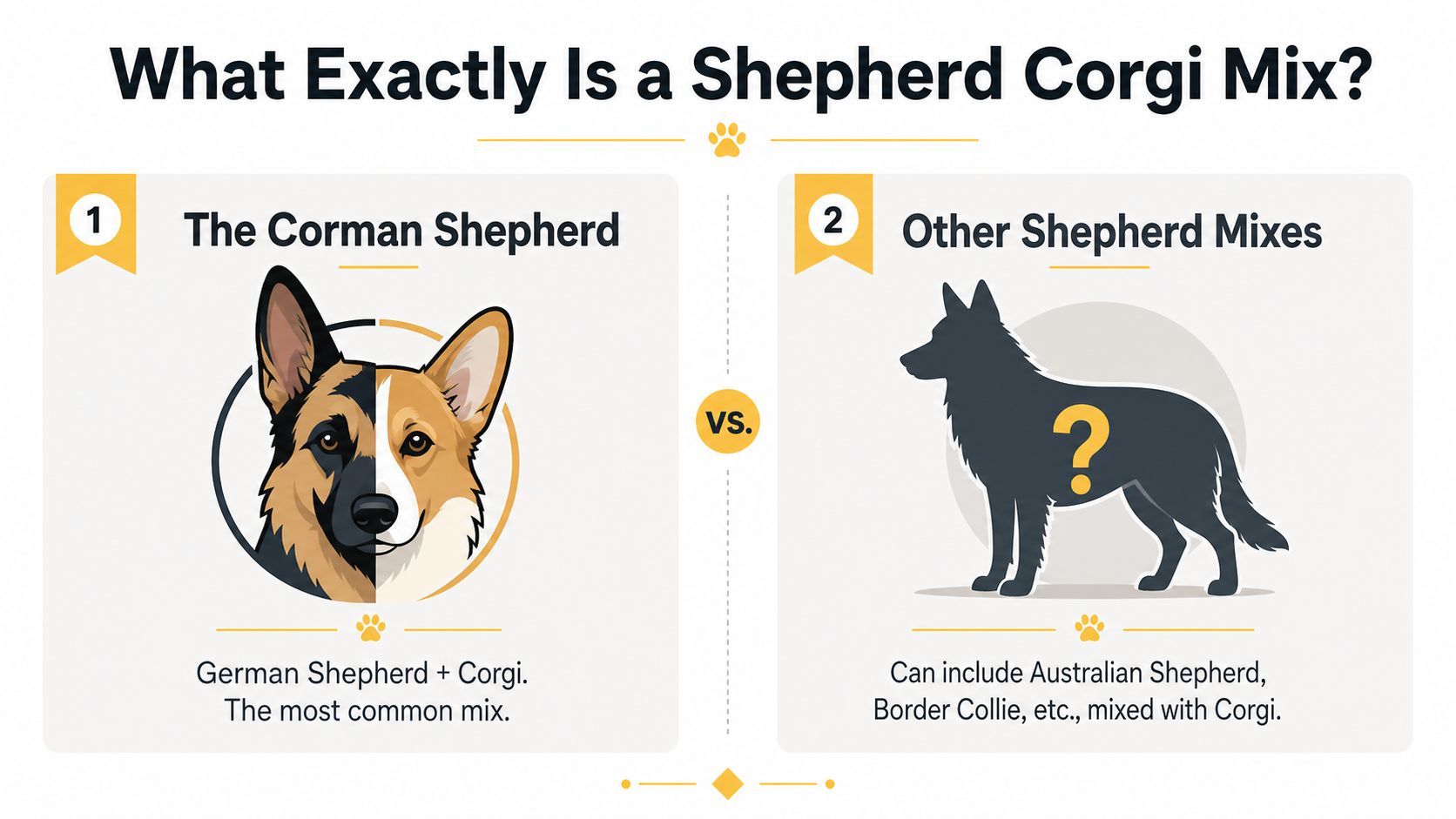
The phrase Shepherd Corgi mix is broad, and that's where confusion starts. In practice, people usually mean one of two dogs: the Corman Shepherd or the Auggie. According to this overview of Shepherd Corgi crossbreeds, the Corman Shepherd is a German Shepherd × Welsh Corgi mix, while the Auggie is an Australian Shepherd × Welsh Corgi mix.
The two mixes aren't built the same
The same source notes that the Corman Shepherd typically falls in the 20 to 70 pound range and stands 12 to 15 inches tall, while the Auggie is more consistent at 20 to 30 pounds and 10 to 13 inches tall. That's a big practical difference for housing, lifting, joint stress, and even what type of exercise feels safe and comfortable.
A first-time owner might hear “Corgi mix” and picture a compact, easy-to-manage dog. That isn't always true with the Corman. Some Cormans inherit a much heavier frame and deeper chest from the German Shepherd side, which can make them feel more like a low-riding medium dog than a small dog.
Why the distinction matters for health
The same comparison also explains why this isn't just a naming issue. The Corman's heavier mass and deeper chest can increase concern around gastric dilatation-volvulus, or bloat, and that condition carries a 15 to 20% mortality rate if untreated in the cited material. The Auggie's compact structure, by contrast, is associated there with concerns such as hip dysplasia and progressive retinal atrophy.
Practical rule: Before you ask “Are Shepherd Corgi mixes healthy?” ask “Which Shepherd Corgi mix am I talking about?”
That one question clears up a lot. It helps you choose the right breeder questions, the right exercise routine, and the right expectations for adulthood.
Here's a quick comparison:
| Mix | Parent breeds | Typical size | Main point to remember |
|---|---|---|---|
| Corman Shepherd | German Shepherd × Welsh Corgi | 20 to 70 lbs, 12 to 15 inches | More size variation, deeper chest, broader build |
| Auggie | Australian Shepherd × Welsh Corgi | 20 to 30 lbs, 10 to 13 inches | More consistent size, different inherited risk profile |
If your dog is a Corman Shepherd, the rest of this guide will feel especially relevant. If your dog is an Auggie, many care principles still apply, but your health and temperament research should stay specific to that mix.
Origins and Appearance of This Unique Hybrid
Some mixed breeds happen by chance. The Corman Shepherd didn't.
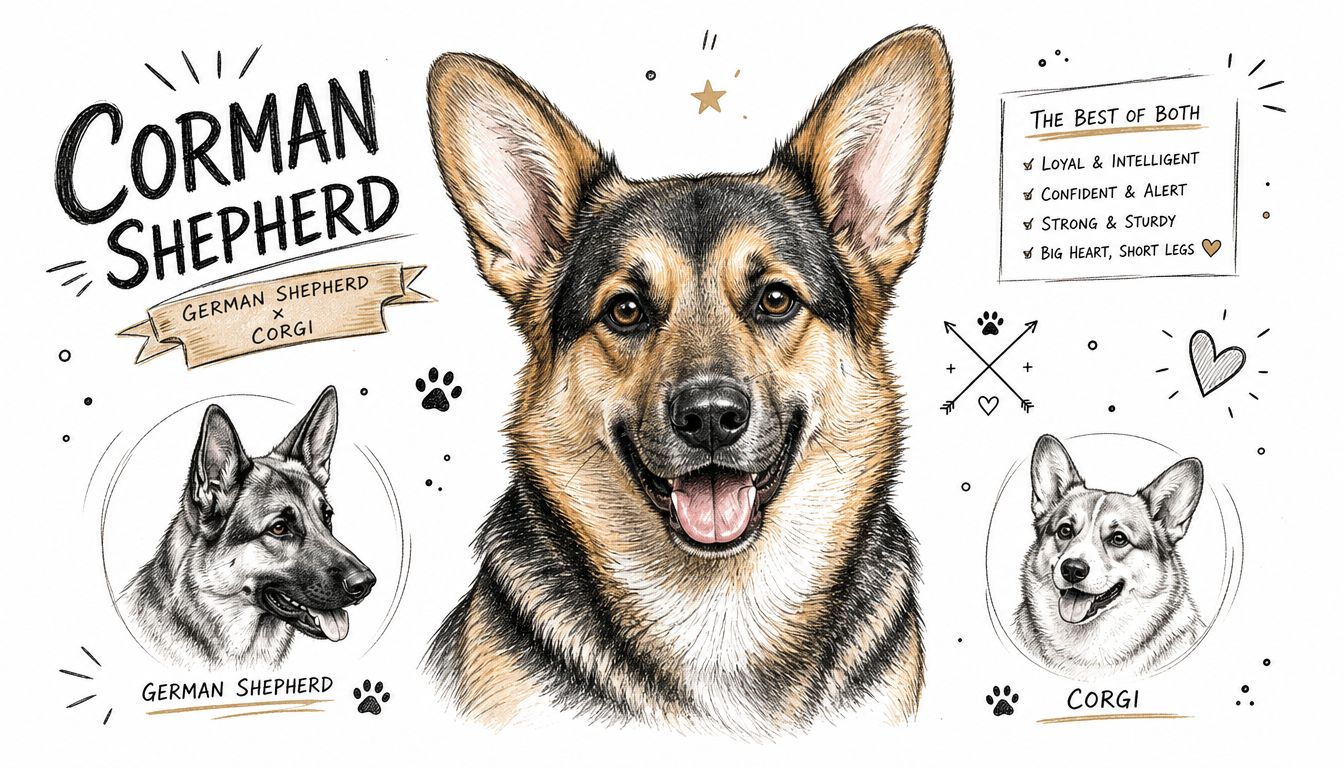
According to Petside's Corgi German Shepherd mix profile, the Corman Shepherd was created exclusively through artificial insemination because the size difference between a male Welsh Corgi and a female German Shepherd prevents natural mating. That detail matters because it places the Corman in the category of an intentionally created hybrid rather than a naturally occurring cross.
A designer dog with a very specific origin story
That same source describes the breed as a designer dog that blends the loyalty and intelligence of the German Shepherd with the bold, playful nature of the Corgi. For owners, that origin story explains why the Corman often feels like a dog of contrasts. You may see a long body and short legs paired with a more substantial head, alert expression, and a bigger-dog attitude.
The source also reports a typical Corman size of 20 to 70 pounds and 12 to 15 inches tall. That range is wide enough that two adult Cormans can look like distant cousins rather than littermates.
What they often look like in real life
Typically, the outline is noticed first. Many Cormans have a longer body, shorter legs, and a sturdy chest. Then the details start to vary.
You might see:
- Ears that stand up fully like a Corgi, or sit in a more mixed position
- A face that leans Shepherd with a serious expression, even in a playful dog
- A dense double coat that can look plush, straight, or slightly coarse
- Coloring that ranges widely depending on which parent traits come through more strongly
Some owners expect a miniature German Shepherd. Others expect a supersized Corgi. A Corman usually lands somewhere in between, and that's part of the appeal.
A good way to identify the mix is to look at the whole dog, not one trait. Short legs alone don't tell the story. Body length, chest depth, head shape, ear set, and movement give a clearer picture.
The same Petside source also notes that this hybrid bridges the gap between the German Shepherd lifespan of 9 to 13 years and the Corgi lifespan of 12 to 15 years through the mixed-breed combination. For a first-time owner, the bigger takeaway is simple. This is an intentionally created companion dog with a look that can vary a lot, even when the parent breeds are known.
Temperament and Personality Traits
Living with a Shepherd Corgi mix often means living with a dog who is smart, involved, observant, and not shy about having opinions. That combination can be delightful. It can also catch first-time owners off guard.
What the parent breeds often contribute
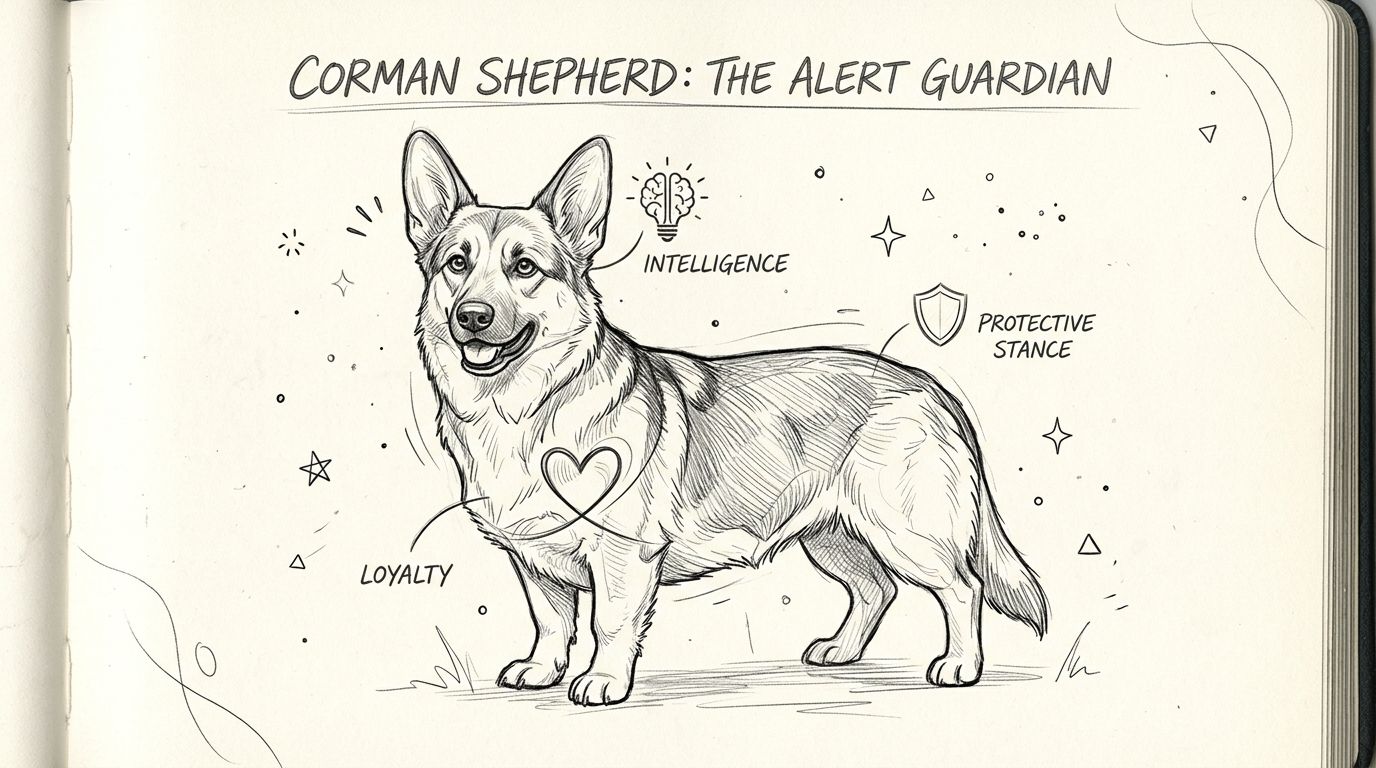
The Shepherd side often brings trainability, focus, alertness, and loyalty. The Corgi side often adds playfulness, confidence, boldness, and a stubborn streak. Put those together and you often get a dog who wants to be near their people, notices everything, and learns patterns fast.
That sounds ideal, and often it is. But intelligence doesn't automatically mean easy. Smart dogs also learn what gets your attention, what rules are flexible, and how to negotiate.
A Shepherd Corgi mix may decide that the delivery driver needs announcing, the children need supervising, and the cat needs gently herded away from the hallway. None of that means the dog is “bad.” It means the dog needs structure.
Daily life with this mix
Many owners describe these dogs as highly engaged with family life. They usually don't want to be decorative background pets. They want a job, a routine, or at least a reason to participate.
Common patterns include:
- Strong attachment to household members and a tendency to follow people room to room
- Watchful behavior around visitors until they understand the situation
- A playful streak that can look goofy one minute and serious the next
- Vocal habits such as alert barking or commentary during play and excitement
Some Shepherd Corgi mixes act like little supervisors. If your dog seems to monitor movement around the house, that's often a herding-breed trait showing up in a compact body.
Are they good with children and other pets
They can be, especially when adults guide interactions early and consistently. A well-socialized dog can become a wonderful family companion, but this isn't a mix I'd describe as effortlessly easy. Herding instincts can show up as circling, nudging, or trying to control motion. Young children running and squealing may be exciting in a way you'll need to manage.
With other pets, success usually depends on the dog's individual temperament, socialization history, and household routines. Many do well. Some are pushy at first. Some need careful introductions and ongoing boundaries.
A first-time owner does best when they expect a relationship-based dog, not an independent one. If you enjoy training, routine, and daily interaction, this mix can be a joy. If you want a low-input dog who entertains themselves without demanding attention, this probably isn't the right fit.
Training and Exercise Requirements
A Shepherd Corgi mix usually needs more than a quick walk and a soft bed. These dogs tend to be mentally quick and physically motivated. If you don't give them productive outlets, they often invent their own.

Start with structure, not intensity
First-time owners sometimes think exercise means making the dog tired at any cost. A better goal is balanced activity. You want a dog who can move, think, settle, and repeat that rhythm every day.
A useful routine often includes:
- Purposeful walks that let the dog sniff, observe, and practice loose-leash skills
- Short training sessions built into the day, not saved for one long session
- Interactive play such as fetch, tug with rules, or scent games
- Rest practice so the dog learns that calm behavior is part of the routine too
Training needs to be clear and consistent
This mix usually responds best to positive reinforcement. Rewards, timing, and consistency matter. Harsh handling often creates confusion, resistance, or over-arousal, especially in a dog that's already alert and reactive to movement.
Early socialization is also important. That means helping the dog calmly experience people, sounds, surfaces, routines, and polite canine interactions in a controlled way. The goal isn't to force friendliness. It's to build confidence and neutrality.
Here's a simple training priority list:
- Name response and recall: These are safety skills, not optional tricks.
- Leash manners: A low-built dog that pulls can still drag an owner into bad habits.
- Settle on cue: Many smart dogs need help learning how to turn off.
- Leave it and impulse control: Useful for doorways, food, visitors, and household chaos.
For a visual walkthrough of training ideas, this video gives a helpful starting point:
Exercise should respect the body they inherited
Not every Shepherd Corgi mix should exercise the same way. A dog with a longer back and shorter legs may enjoy activity but still need owners to be thoughtful about repetitive impact, rough twisting, and constant jumping on and off furniture.
Keep the dog busy, but don't make every activity high impact. For many of these dogs, steady conditioning and skill work are more useful than chaotic exercise.
A bored Shepherd Corgi mix may bark more, mouth at clothing, shadow people, or become pushy with other pets. Most of those problems improve when the dog gets consistent movement, clear rules, and mental work that feels meaningful.
Common Health Problems and Proactive Nutrition
When people fall in love with this mix, they often focus on the face, the ears, or the funny proportions. Responsible ownership starts somewhere less glamorous. It starts with the body mechanics.
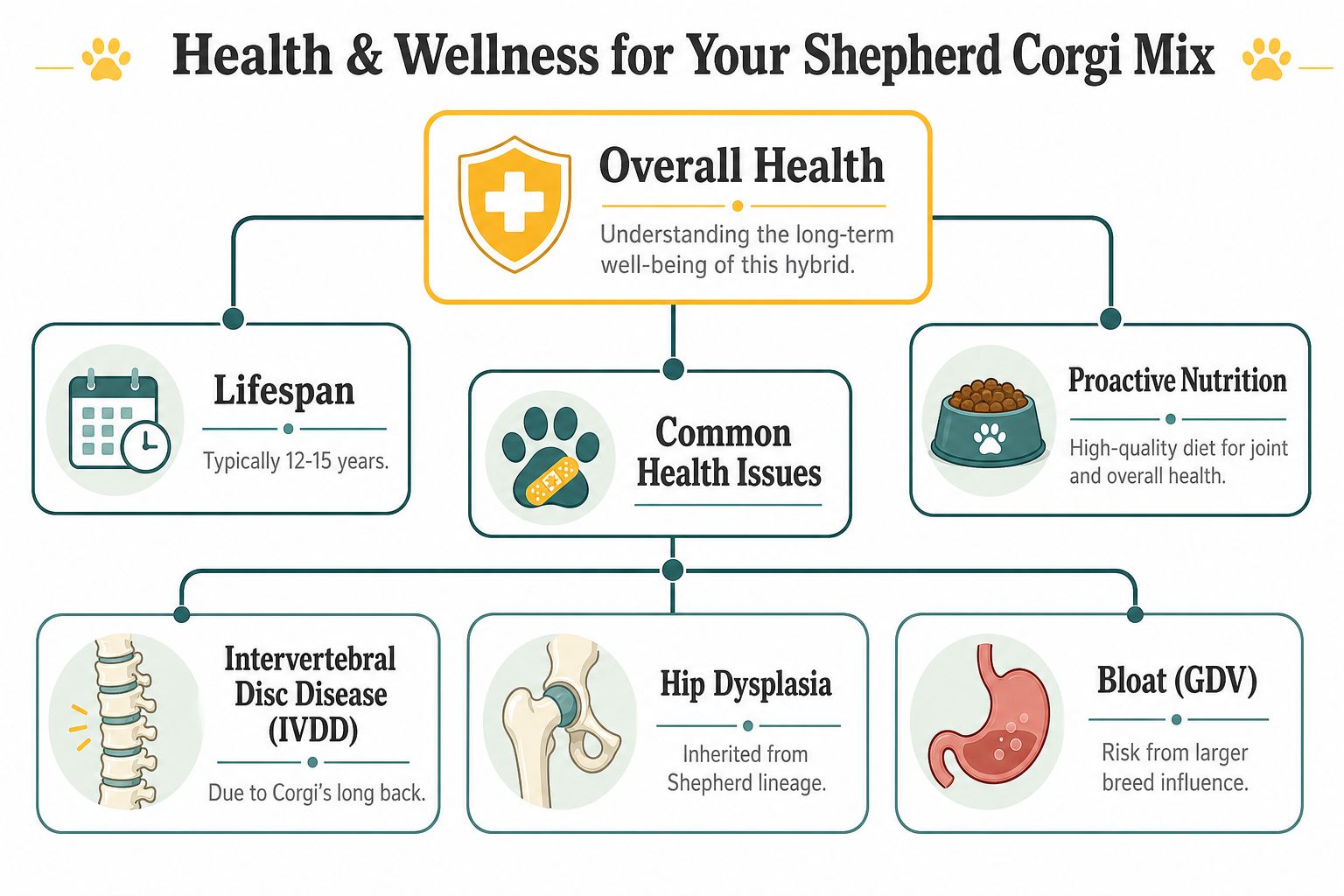
According to Animalso's Corgi German Shepherd mix profile, the Corman Shepherd has an average lifespan of 12 to 15 years. The same source identifies Intervertebral Disc Disease, or IVDD, as the most common and serious concern, and also notes hip and elbow dysplasia plus obesity as important risks.
Why IVDD gets so much attention
IVDD matters because body shape matters. A dog with a longer back can place extra stress on the spine. That doesn't mean every Corman Shepherd will develop serious spinal trouble, but it does mean owners should pay attention to movement habits, weight, and any sudden change in comfort.
Watch closely if your dog shows signs like:
- Reluctance to jump or climb
- Pain when picked up
- A hunched posture or sudden stiffness
- Weakness or wobbliness in the rear
Those signs deserve prompt veterinary attention. Waiting to “see if it passes” can be risky with spinal problems.
Joint stress and weight management
Hip and elbow dysplasia are also part of the conversation because the Shepherd side can contribute orthopedic strain. Then weight enters the picture. Extra body weight doesn't just change appearance. It can increase daily stress on joints and make existing structural weaknesses harder to manage.
That's why food choices, treat habits, and exercise routines all connect. Nutrition isn't separate from mobility. It supports mobility.
A practical approach usually includes:
- Body condition awareness: Learn what your dog looks like at a healthy weight.
- Measured meals: Guessing often leads to slow weight gain.
- Thoughtful treats: Use them in training, but count them as part of the day's intake.
- Consistency: Small daily habits shape long-term outcomes more than occasional “healthy weeks.”
Proactive nutrition can simplify care
Owners often build a patchwork routine over time. One product for joints, another for coat, another for digestion. That can get hard to maintain.
If your veterinarian thinks a supplement is appropriate, one option is DA-1™ Daily All-in-One - Senior Dog Support, Joints, Skin/Coat & More. Pure Paw Labs describes it as a complete multi-system formula for aging dogs, with 18 human-grade ingredients targeting cells, gut, and joints in one scoop, with no fillers, no pills, and no juggling multiple supplements. That kind of all-in-one format may appeal to owners who want a simpler routine for mobility, skin, and digestive support.
For dogs who may benefit from fatty acid support as part of a broader nutrition plan, this guide on whether dogs can have fish oil is a useful companion read.
Health management works best when owners think in layers. Weight control, sensible exercise, veterinary exams, and nutrition all support the same goal.
Cost is part of health planning too
The same Animalso source reports that a Corman Shepherd puppy may cost $250 to $750, with some breeders charging up to $1,500 depending on pedigree and location. That purchase price can feel manageable. Long-term care is the bigger commitment.
A dog with joint or spinal vulnerabilities may need owners who budget for regular checkups, quality food, environmental support at home, and prompt care if mobility changes. That's the mindset to bring to this mix from day one.
Grooming Needs and Daily Care
This mix often inherits a coat that sheds with enthusiasm. If you've lived with a Shepherd, a Corgi, or both, that won't surprise you. If you haven't, prepare for fur on floors, clothes, furniture, and corners you didn't know dog hair could reach.
Coat care that stays manageable
Most Shepherd Corgi mixes do well with a steady brushing routine. The goal isn't perfection. The goal is controlling loose undercoat, keeping skin visible enough to monitor, and preventing neglected areas from compacting.
A practical routine usually looks like this:
- Regular brushing: This helps remove dead coat before it spreads through the house.
- Check high-friction spots: Behind the ears, under the collar, and around the hindquarters can collect loose coat fast.
- Bath only when needed: Too much bathing can leave skin unhappy, especially in dogs prone to sensitivity.
If you're trying to understand what heavy shedding can look like from the Shepherd side, this article on whether German Shepherds shed gives useful context.
Daily care beyond the coat
Grooming is only one part of maintenance. These dogs also need owners who notice the small things before they become bigger problems.
Keep an eye on:
- Nails: Long nails can change how a dog stands and moves.
- Ears: Upright or semi-upright ears still need checks for debris and irritation.
- Teeth: Consistent dental care supports comfort and overall wellness.
- Paws and skin folds: Low-built dogs may pick up mud and moisture more easily in some environments.
A clean, brushed dog is easier to inspect. You're more likely to notice irritation, tenderness, lumps, or changes in movement when hands-on care is part of your routine.
For daily living, many of these dogs thrive in homes where people are present and engaged. A large yard can help, but it doesn't replace walks, training, or interaction. Apartment living can work for some individuals if owners stay committed to exercise, enrichment, and noise management.
Adoption Tips and Frequently Asked Questions
A good match starts with good questions. If you're buying a puppy, ask which Shepherd Corgi mix you're considering, what the parent dogs are like in temperament, and what health screening the breeder has done on the parent breeds. If you're adopting, ask the rescue what they've observed about energy level, handling, sociability, and movement.
How to choose responsibly
A careful owner should look for signs that the dog has been raised or evaluated with thought, not speed.
Useful checkpoints include:
- Parent breed clarity: Don't accept vague answers about whether the dog is a Corman Shepherd or an Auggie.
- Health discussion: A responsible breeder or rescue should talk openly about back and joint concerns.
- Temperament honesty: You want accuracy, not sales language.
- Support after placement: Good organizations usually want updates and offer guidance.
Rescue is also worth serious consideration. Mixed-breed dogs with herding traits sometimes end up in rescue because people underestimated their energy or training needs. If you'd like to compare another Corgi cross before deciding, this guide to the Boston Terrier Corgi mix can help sharpen what type of personality and care profile fits your home.
Frequently asked questions
How much does a Corman Shepherd puppy cost?
Animalso reports a common range of $250 to $750, with some breeders charging up to $1,500 depending on pedigree and location.
Are they good for first-time owners?
They can be, but they're usually best for first-time owners who are ready to train consistently, manage stimulation, and stay proactive about health.
Do they get along with cats?
Some do very well. Some need careful introductions and supervision, especially if herding instincts or chase behavior show up.
Are they small dogs?
Not necessarily. Some look compact, but the Corman Shepherd in particular can vary a lot in build and overall substance.
If you're preparing for life with a Shepherd Corgi mix and want to keep daily care simple, Pure Paw Labs offers dog nutrition products built around an all-in-one approach. That can be useful for owners trying to support joints, skin and coat, digestion, and overall wellness without managing a complicated supplement routine.