


87.8% of dogs improved in an owner-assessed itch evaluation after receiving lokivetmab in a retrospective analysis of dogs with allergic dermatitis, according to a Veterinary Dermatology study. That's evidence for a veterinary injection, not a shampoo or nutritional chew. It reframes the search for the best product for dogs' itchy skin: choose something that addresses the problem, then measure scratching rather than judging the coat alone.
A soothing bath can help a mildly itchy dog feel more comfortable. It won't eliminate fleas, diagnose food allergy, or reliably control severe allergic inflammation. The useful shortlist includes products for comfort, products for ongoing support, and treatments that require a veterinarian.
Table of Contents
- Why the Right Product Depends on the Cause
- Best Itchy Skin Products for Dogs at a Glance
- Shampoos, Topicals, Supplements and Prescription Options Compared
- When to Stop Self-Treating and Call the Vet
- Matching the Product to Your Dog's Situation
- Buying Guide for Itchy Dog Products
- Your 30-Day Plan to Verify Relief
Why the Right Product Depends on the Cause
In a 2024 Veterinary Dermatology survey, 52% of surveyed owners had experience caring for a dog with atopic dermatitis, 35% with allergic dermatitis, and 29% with food allergy, according to the published study. These are surveyed owners' experiences, not estimates of how many dogs in the general population have those conditions.
Say your dog starts chewing its feet after spring walks. A soothing wash might remove surface irritants and improve comfort. If the same dog develops smelly ears and sore paws, buying a stronger shampoo without an examination could miss an infection.
The symptom is itching; the cause determines the purchase. Fleas need parasite control, food reactions need dietary investigation, and infected skin needs targeted treatment. Our guide to dog skin allergies explains why similar-looking flare-ups can require different care.
Practical rule: Choose the product's job before choosing its ingredients. Cleansing, itch suppression, nutritional support, and infection treatment aren't interchangeable.
For a dog with mild symptoms and intact skin, a measured home-care trial can be reasonable. For a dog that's painful, bleeding, or losing sleep, the actionable shortlist starts with veterinary care.
Best Itchy Skin Products for Dogs at a Glance
| Product type | Best for | Typical speed | Key ingredients | Main limitation |
|---|---|---|---|---|
| Medicated or soothing shampoo | Widespread mild itching, or diagnosed skin disease requiring bathing | Assess comfort after bathing and whether relief lasts between washes | Colloidal oatmeal, aloe, or vet-selected antimicrobial ingredients | Repeated washing can irritate; soothing formulas don't treat every cause |
| Anti-itch spray or cream | A small, intact patch of itchy skin | Local relief after application; assess each use | Pet-formulated hydrocortisone, pramoxine, or aloe | Easily licked off; unsuitable for deep wounds or extensive disease |
| Omega-3 fish-oil supplement | Nutritional support for dry skin and a dull coat | Gradual rather than rescue relief | EPA and DHA | Needs an appropriate dose; excess can cause digestive upset |
| All-in-one daily supplement | Combining skin, coat, digestive, joint, and immune support | Assess tolerance first, then changes during consistent use | Check the actual formula and quantities | Convenience doesn't establish an effective allergy-treatment dose |
| Prescription allergy treatment | Significant or diagnosed allergic dermatitis | Review response on the veterinarian's schedule | Lokivetmab, oclacitinib, or cyclosporine | Requires veterinary selection and monitoring |
| Elimination diet trial | Suspected food allergy | A supervised diagnostic course, followed by a food challenge | An appropriate hydrolyzed or genuinely novel-protein diet | Treats, scraps, and flavored products can invalidate the trial |
Start with the Best for column, then read the limitation before spending money. A greasy, foul-smelling coat isn't a dry-coat problem, and a topical spray isn't an appropriate substitute for examining a painful, moist lesion.
The all-in-one category includes DA-1™ Daily All-in-One - Skin/Coat, Joints, Gut Health 2026, a human-grade powdered food topper designed to consolidate several daily support categories. Its role here is nutritional support, not diagnosis or prescription itch control.
Pair products only when they have different jobs
A veterinarian may combine a bathing routine with allergy medication or nutritional support. That makes sense when each component has a defined purpose; buying several overlapping anti-itch products makes it harder to identify irritation or know what helped.
- For immediate discomfort: Consider whether a suitable topical or bath can safely reach the affected skin.
- For ongoing support: Evaluate nutrition without expecting it to rescue an active flare.
- For a suspected underlying disorder: Spend on the examination or diagnostic plan before another supplement.
Keep a baseline itch log for every category. Review it at the scheduled checkpoints rather than automatically replacing an unfinished bottle with the next product.
Shampoos, Topicals, Supplements and Prescription Options Compared
An itchy dog doesn't automatically have atopic dermatitis. A peer-reviewed review of canine atopic dermatitis describes the disease as involving skin-barrier dysfunction and abnormal immune responses, while emphasizing uncertainty in population-wide prevalence estimates. That's a good reason to avoid treating every scratch as the same condition.
Shampoos and targeted topicals
Soothing shampoo is a reasonable starting point for mild, dry, intact skin. Its practical advantage is coverage: you can wash the belly, feet, legs, and coat instead of chasing individual itchy patches. Wet through the coat, work the product down to the skin without scrubbing sore areas, and rinse thoroughly with lukewarm water.
Medicated shampoo requires more precision. Use a timer for the product's stated contact period, and ask the veterinarian to specify bathing frequency when treating diagnosed disease. A quick lather-and-rinse may not deliver the intended treatment, but leaving a product on longer isn't automatically better.
| Active ingredient | What it does | Best for | Use caution if |
|---|---|---|---|
| Colloidal oatmeal | Helps soothe irritation and retain moisture | Dry, mildly itchy skin | Your dog reacts to the formula or becomes redder after bathing |
| Aloe vera | Provides a soothing, hydrating component in pet formulations | Mild irritation on intact skin | The product isn't intended for dogs or the skin is damaged |
| Chlorhexidine | Antiseptic used in veterinary skin-care plans | Certain diagnosed bacterial or yeast-associated skin problems | Skin is very sensitive; keep out of eyes and ear canals unless specifically directed |
| Pramoxine | Provides local surface-itch relief | Limited itchy areas | Skin is broken or the area is extensive |
Chlorhexidine isn't a universal answer to greasy skin, and oatmeal isn't infection treatment. Our guide to moisturizers for dogs with dry skin is useful when dryness, rather than an actively infected lesion, is the main concern.
Sprays and creams suit small, accessible areas. Part the fur so the product reaches skin, avoid eyes and mucous membranes, and prevent licking as directed. Don't seal an unidentified rash under a thick layer of cream.
Main limitation: Topicals can improve comfort without controlling the underlying disease. Stop if redness or discomfort increases.
Supplements and veterinary treatment
For a fish-oil product, read the EPA and DHA content, not just the total amount of oil. Ask your veterinarian for a weight-based target that accounts for your dog's food, medical history, and other supplements; an oil quantity alone doesn't provide enough information to calculate a therapeutic dose.
Our all-in-one powder supports joint, skin, digestive, and immune health and contains 20 mg of omega-3 from fish oil per scoop, plus postbiotics from Saccharomyces cerevisiae. Those facts describe its composition. They don't establish equivalence to a concentrated EPA/DHA regimen or demonstrate prescription-level itch relief.
Prescription options belong in a different category. A veterinarian may select lokivetmab injections, oclacitinib, or another treatment based on the diagnosis and the dog's health. Severe scratching that damages skin deserves that discussion rather than a prolonged supplement experiment.
For budgeting, The Vet Price Comparison Site breakdown offers context on the different components of allergy care. Compare the whole management plan, including examinations and follow-up, rather than assuming the cheapest bottle produces the cheapest outcome.
Mild dryness may justify supportive care. Persistent inflammation needs a diagnosis. Severe itch needs relief that's appropriate to its severity.
When to Stop Self-Treating and Call the Vet
Check the skin before applying anything. Separate the coat under good light and examine the paws, belly, armpits, and areas your dog keeps licking. A damp, painful patch hidden under fur changes the decision from shopping to veterinary assessment.
Use this visual checklist to distinguish mild home-care situations from signs that need professional attention.
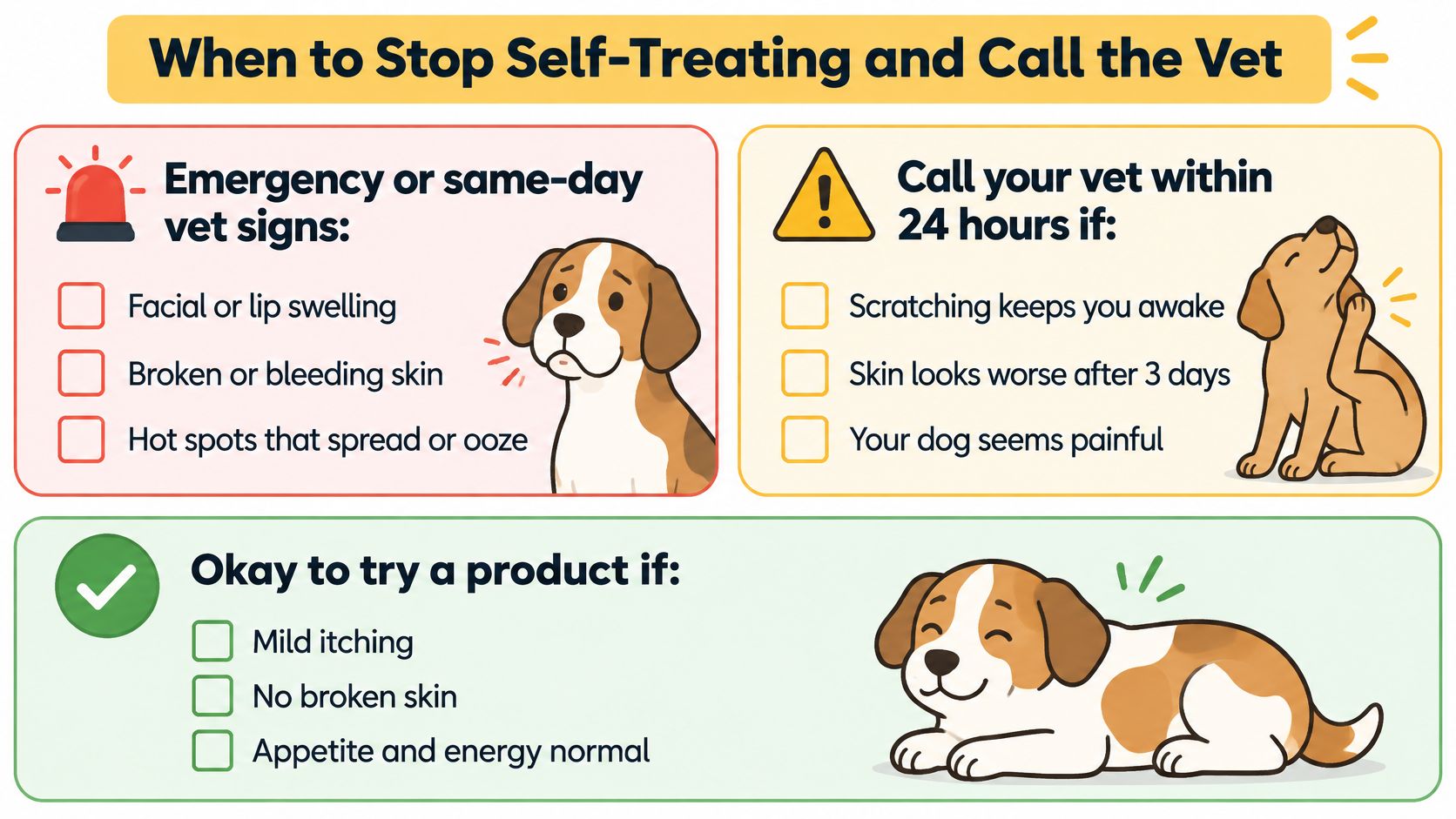
Seek urgent help for swelling or damaged skin
- Emergency signs: Facial swelling with breathing difficulty, collapse, or marked distress requires emergency veterinary care.
- Same-day concerns: Broken or bleeding skin, spreading or oozing hot spots, significant pain, or rapidly worsening itching need prompt advice.
- Possible infection: Foul odor, greasy discharge, pus, or a very tender patch shouldn't be covered up with repeated soothing products.
Book an examination for recurring symptoms
- Ear trouble: Repeated head shaking, ear odor, discharge, or recurrent ear problems need examination.
- Skin and paw changes: Patchy hair loss, persistent paw chewing, or limping warrant investigation.
- Disrupted rest: Scratching that regularly wakes your dog means the discomfort isn't adequately controlled.
AAHA allergic-skin-disease guidance emphasizes that itching can involve allergy, parasites, infection, and other causes. Skin-barrier products have a supportive role, particularly in mild disease and maintenance; shampoos can also dry or irritate susceptible skin.
If you're unsure what your dog's pattern means, use our explanation of why dogs scratch so much to organize observations for the appointment, not to make a diagnosis yourself.
Stop a new product if symptoms worsen. Vomiting, diarrhea, increased itching, or new redness deserve veterinary advice. For our supplement, stop giving it and consult your veterinarian if your dog develops adverse effects.
Matching the Product to Your Dog's Situation
| Your dog's situation | First-line product or action | Add for support |
|---|---|---|
| Seasonal itching, otherwise healthy | Soothing oatmeal shampoo; vet-directed hydrocortisone when appropriate | A suitable daily omega-3 supplement |
| Localized hot spot or belly rash | Examine first; vet advice for moist, painful, or damaged skin; suitable spray only on appropriate intact areas | A properly fitted protective collar if needed |
| Dry winter skin and dull coat | Review diet and consider omega-3 or all-in-one nutritional support | Less drying bathing practices and appropriate indoor humidity |
| Paw chewing and recurrent ear trouble | Veterinary examination | Nutritional support compatible with the treatment plan |
| Suspected food allergy | Veterinary elimination diet trial | A controlled routine without unapproved extras |
| Diagnosed atopic dermatitis | Vet-prescribed treatment | Selected medicated bathing and skin support |
A seasonal paw chewer versus a dog with painful ears
Say a Labrador chews its paws each spring but has intact skin, normal energy, and no odor. A reasonable starting discussion is a soothing bathing routine, cleaning and drying the paws after exposure, and reviewing whether nutritional support fits the existing diet. A hydrocortisone-containing product may have a role, but only when suitable for that dog and skin condition.
Don't assume the routine worked because the coat feels softer. Record whether the dog chews less, settles more easily, and leaves its feet alone between applications. Our omega-3 guide for dogs can help you assess that support category without confusing it with immediate itch treatment.
A Bulldog with a red belly and gunky, uncomfortable ears needs a different first step: a veterinary examination. That pattern can occur with allergic disease and secondary infection, and appearance alone won't distinguish the causes. Adding a supplement while leaving painful ears untreated isn't a useful trial.
When food becomes the question
The Merck Veterinary Manual's food-allergy review reports food allergy in approximately 1%–2% of dogs receiving veterinary care, compared with 9%–40% among dogs with pruritus; the accompanying diagnostic guidance supports a 4–12-week elimination diet followed by a food challenge. Those different populations explain why food allergy is worth investigating in selected itchy dogs but shouldn't be assumed in every case.
The practical requirement is strict control. Your veterinarian needs to approve the trial diet and account for treats, chews, flavored medications, and food used to give tablets. A nutritional topper can interfere if it introduces ingredients outside the prescribed trial.
Keep the trial interpretable: Don't introduce a new food, shampoo, and supplement together unless your veterinarian deliberately needs a combined treatment plan.
For elective home-care changes, start with a single major variable. Necessary treatment takes priority over a tidy experiment, but optional product changes shouldn't make your observations impossible to interpret.
Buying Guide for Itchy Dog Products
Compare cost per usable treatment, not the container price. A shampoo's value depends on how much your dog's coat requires and whether you can complete the bathing routine. A supplement's cost depends on the actual daily serving, so a large dog may use the same bag much faster than a small dog.
Read the active-ingredient panel before the claims on the front. For a medicated product, look for named actives and their concentrations; for fish oil, look for EPA and DHA quantities. A blend name without quantities doesn't let you assess what your dog receives.
Check evidence, disclosure, and practical fit
- Dose transparency: Look for clear serving instructions and usable measuring tools. Our guide to reading supplement labels explains what to compare.
- Quality checks: Favor accessible batch-testing information over vague purity language. Human-grade ingredients don't, by themselves, prove that a formula treats itching.
- Evidence: Ask whether a claim concerns the finished product or merely an ingredient used elsewhere at another dose.
- Return terms: Read what must be returned, which purchases qualify, and whether the policy allows a fair evaluation period.
The Merck Veterinary Manual's discussion of nutritional approaches also reinforces the importance of controlled dietary evaluation rather than relying on marketing language. Pet supplements generally don't require FDA premarket review or approval, so testing and disclosure deserve scrutiny.
Check the household routine, too. Eco Clean Solutions' guidance on keeping pets away until surfaces dry is a useful reminder when reviewing potential contact exposures.
Don't buy a larger product stack to compensate for an unclear diagnosis. Buy the category your dog needs and a routine you can consistently carry out.
Your 30-Day Plan to Verify Relief
Use the first month as a decision period, not a promise of a cure. A randomized placebo-controlled lokivetmab study reported treatment success at day 28 in 57% of dogs receiving 2 mg/kg, compared with 14% receiving placebo. Even a studied veterinary treatment doesn't help every dog, and those results don't establish comparable effectiveness for supplements.
The tracking schedule below is a practical home-monitoring protocol, not a validated diagnostic test. The visual gives the overall rhythm; record checkpoint days from when the new product starts so baseline observations don't get mixed into treatment results.
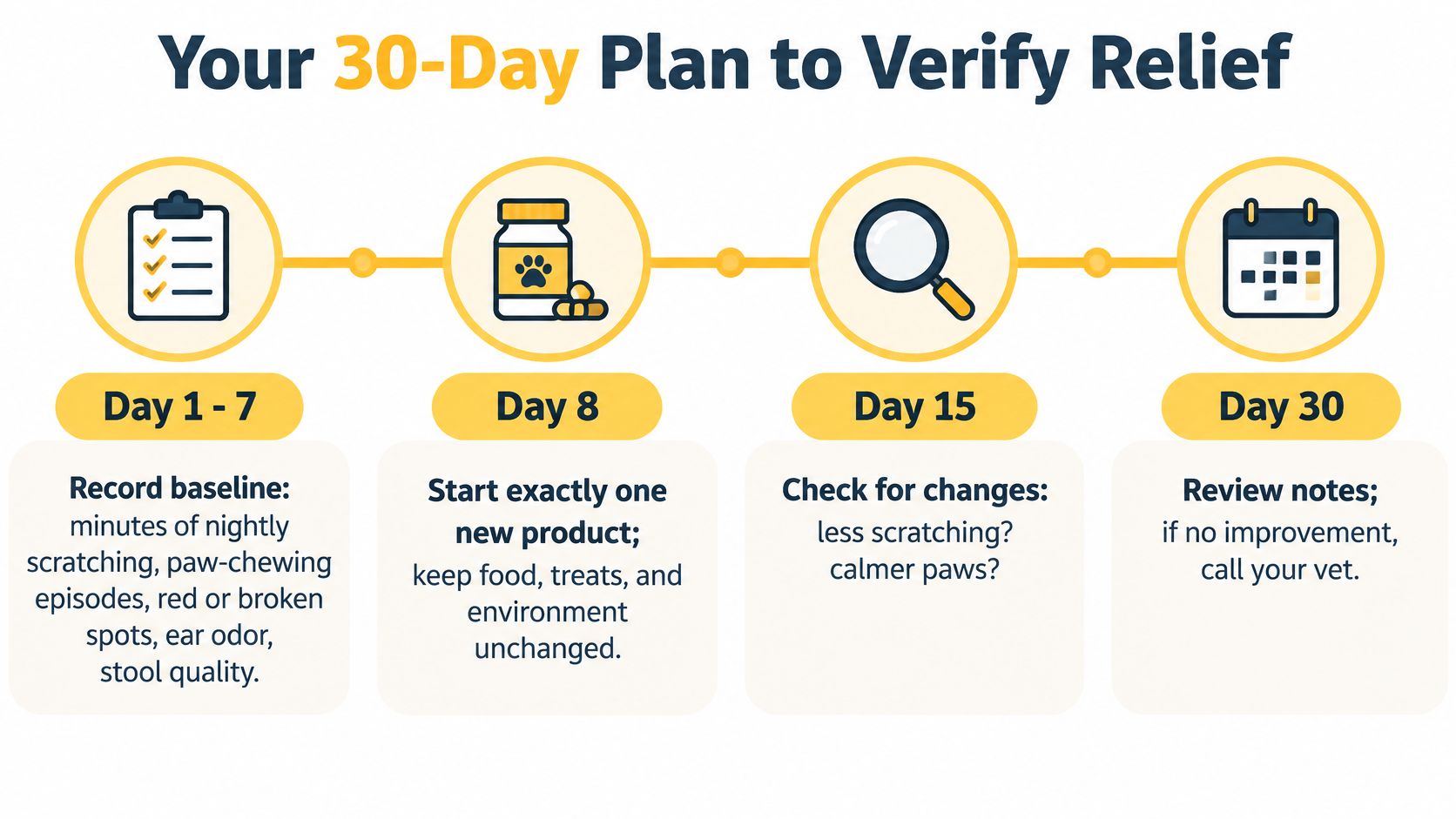
Establish a baseline and keep the comparison fair
- Record the starting pattern. Before an elective change, log nightly scratching, paw-chewing episodes, redness, ear odor, and stool quality over several ordinary days. Don't delay necessary care to collect a baseline.
- Start the selected product and write down the amount, application site, and time. Keep food, treats, detergent, and other optional products stable.
- Use the same observation method. Watch your dog during comparable quiet periods. Add photographs of the same skin areas under similar lighting, and use a veterinarian-provided itch scale if available.
Separate scratching, skin damage, and coat appearance in the log. A shinier coat doesn't prove the dog feels less itchy, and calmer scratching doesn't mean an infected lesion has resolved.
Apply the stop-or-continue rule to every category
| Checkpoint after starting | What to assess | Decision |
|---|---|---|
| Day 7 | Tolerance, correct use, scratching pattern, new redness or digestive effects | Stop for adverse effects; correct application problems with professional guidance |
| Day 14 | Whether comfort improves between applications, not just immediately afterward | Continue a tolerated plan with a useful trend; seek advice for persistent discomfort |
| Day 28 | Baseline versus current scratching, rest, skin condition, and treatment burden | Continue an effective plan; stop blindly purchasing replacements and reassess an ineffective one |
For shampoos and sprays, record how long comfort lasts after each use. For fish oil and all-in-one support, prioritize tolerance and a gradual trend without allowing significant itch to go untreated. For prescriptions and elimination diets, share the log with the veterinarian and follow the prescribed review schedule rather than independently stopping or shortening treatment.
This video can accompany your written tracking routine.
Set a fair window for our powder
With our daily supplement, owners may notice a difference in as little as 2 weeks, with best results after 6–8 weeks of daily use. The month-end review therefore checks safety and direction of change; it doesn't replace the full evaluation window.
Our published daily serving bands are ½ scoop for 0–15 lbs, 1 scoop for 15–30 lbs, 2 scoops for 30–70 lbs, and 3–4 scoops for 71+ lbs. Because the published bands overlap at some boundaries and leave a gap between others, confirm the serving with us if your dog falls at an unclear boundary rather than guessing.
Use the powder only for dogs over 12 weeks, during or after food, and consult your veterinarian before combining it with prescribed medication. If hoped-for results don't appear within 60 days, you can contact us for a full refund of the first bag, with no questions asked.
Start tonight: Open the itch log, confirm flea prevention is current with your veterinarian, choose a single appropriate product, and arrange prompt care if any red flag appears. The useful outcome is less discomfort with a clear plan, not a cupboard full of unfinished treatments.
Pure Paw Labs offers a daily powdered supplement for skin and coat, joint, digestive, and immune support, intended to complement appropriate care rather than diagnose itching. Visit Pure Paw Labs to review the formula and serving information, then use your itch log to decide whether it earns a place in your dog's routine.