


Osteoarthritis affects up to 20% of dogs older than one year, according to the veterinary literature discussed in the Journal of the American Veterinary Medical Association. That makes joint support a practical health question, not just a concern for very old dogs. But the most useful question at the supplement shelf isn't how many ingredients a tub contains. It's whether the product supplies an evidence-backed ingredient in an amount that makes sense for your dog.
Table of Contents
- Why Dogs Need Joint Support Supplements
- Which Ingredients Have Real Evidence
- Dosing Joint Supplements by Body Weight
- How to Start Your Dog on a Joint Supplement
- Reading Results at 6 to 12 Weeks
- All-in-One Formula or Separate Supplements
- Choosing the Right Joint Plan for Your Dog
Why Dogs Need Joint Support Supplements
Say your dog still wants to walk but takes longer to get up from bed. You might blame age, buy a joint powder, and wait for a change. A better starting point is to find out why movement has become uncomfortable, because stiffness alone doesn't tell you which treatment your dog needs.
Joint support supplements are nutraceuticals, nutritional ingredients used with the aim of supporting joint health. Common examples include glucosamine, chondroitin, omega-3 fatty acids, collagen, hyaluronic acid, and turmeric. Manufacturers may position them around cartilage, joint fluid, or inflammatory balance, but those purposes don't establish that every ingredient improves mobility.
Think beyond worn cartilage
Cartilage is a little like tire tread: its condition matters when a joint carries weight. The analogy has limits, though. Osteoarthritis involves the whole joint, including its lining, surrounding tissues, and fluid, rather than a cushion wearing thin.
That's why a dog's movement matters more than a reassuring ingredient list. Hesitation on stairs, difficulty settling comfortably, and altered walking patterns deserve attention. Our guide to dog mobility issues can help you organize those observations before an appointment.
The illustration below summarizes the joint-support conversation, with an important distinction: supplement use isn't proof of prevention or benefit.
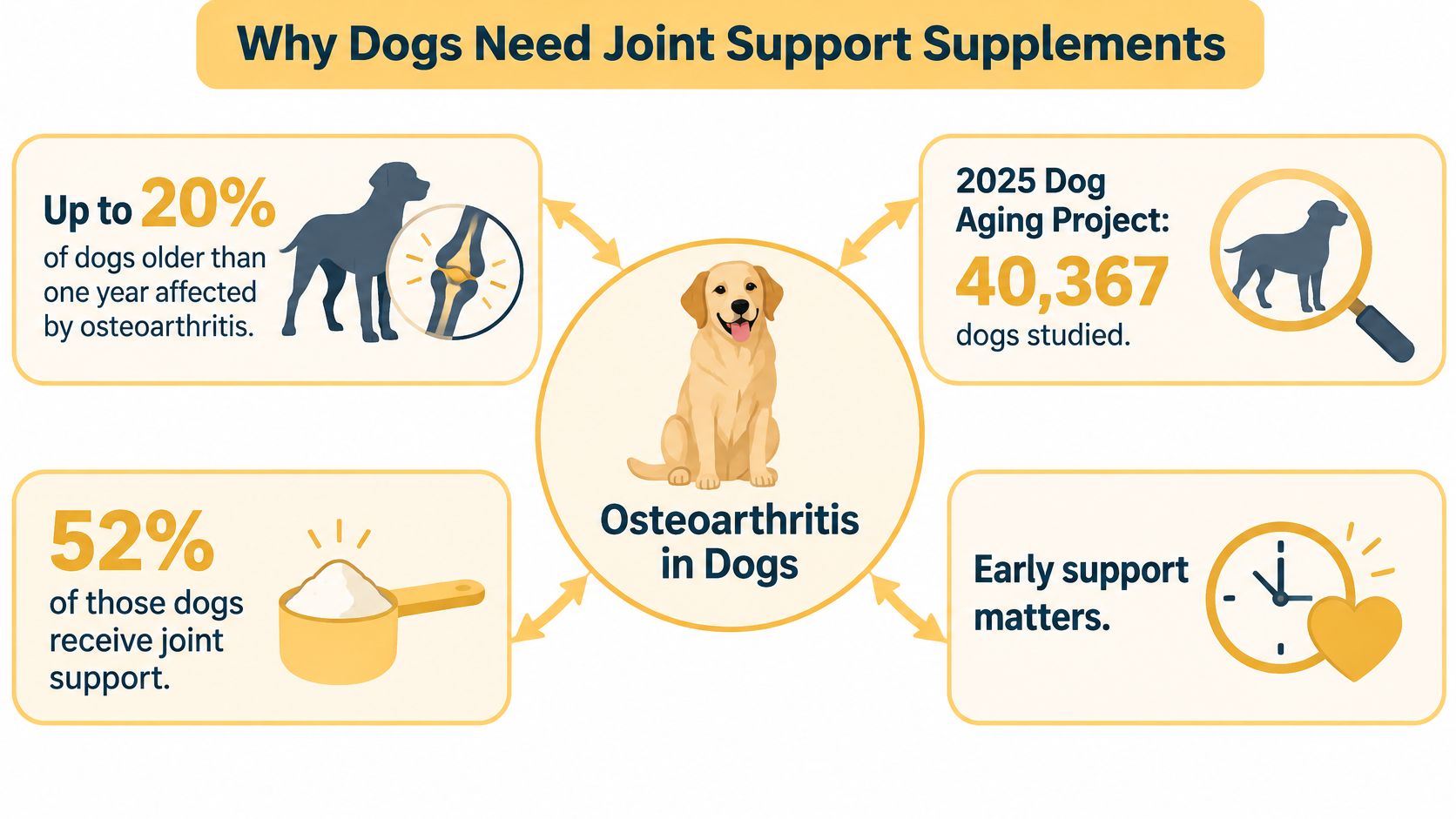
The graphic's supplement-use branch should be read cautiously: the population finding concerns dogs receiving supplements generally, not all receiving joint support. Likewise, early veterinary attention is valuable, but preventive supplement benefits aren't established by starting early.
Set the right expectation: A supplement may support comfort and function. It shouldn't be presented as a way to regrow cartilage or as permission to leave pain untreated.
A useful plan connects the ingredient to a measurable problem. For the dog struggling to rise, that means choosing a justified formulation, checking its active dose, introducing it carefully, and comparing the same movement later. Diagnosis, appropriate body condition, and prescribed pain relief remain part of care, not competing alternatives.
Which Ingredients Have Real Evidence
Joint supplement ingredients ranked by evidence in dogs
| Ingredient | Evidence in dogs | What studies show | Label check |
|---|---|---|---|
| Omega-3 EPA/DHA | Strongest among the options discussed here | Controlled dietary trials support improvements in weight bearing and other clinical outcomes | Combined EPA+DHA milligrams per serving, not just fish oil |
| Glucosamine + chondroitin | Mixed, with disappointing pooled findings | Evidence summaries report no significant improvement in osteoarthritis signs in a canine meta-analysis | Disclosed amounts and realistic expectations |
| Green-lipped mussel | Limited or inconsistent | Reliable clinical benefit isn't established across formulations | Its stated EPA+DHA contribution, if any |
| Collagen / bone broth | Insufficiently established here | These sources don't establish a dependable osteoarthritis treatment effect | Collagen source and amount per serving |
| Turmeric / curcumin | Weak or inconsistent | An anti-inflammatory rationale doesn't establish reliable canine clinical benefit | Standardized curcumin content |
| Hyaluronic acid | Insufficiently established here | These sources don't establish a dependable oral treatment effect | Milligrams per serving |
The table separates evidence of clinical benefit from a plausible biological purpose. An ingredient can occur naturally in cartilage or joint fluid without an oral supplement reliably improving a dog's pain or movement.
Why EPA and DHA stand out
A 2020 JAVMA review of nutritional interventions describes a randomized, blinded trial involving 177 dogs with chronic hip or stifle osteoarthritis: the diet containing 2.9% EPA-DHA produced significantly better clinical outcomes than the diet containing 0.8%. The same review describes a 12-week trial of 109 dogs receiving carprofen, in which medication reduction occurred significantly earlier in the fish-oil-enriched group.
The first finding is useful because investigators compared different dietary concentrations, rather than merely asking whether a product contained fish oil. They assessed outcomes such as lameness and weight bearing, which connect more directly to daily function than a broad wellness claim.
The medication finding needs careful interpretation. It supports discussing nutritional support within a veterinary treatment plan; it doesn't justify reducing carprofen yourself. Any change in prescribed pain medication belongs with the veterinarian managing the dog.
These were also diet trials, not proof that every capsule, chew, or powder will produce the same result. Formulation, intake, and the rest of the diet matter. A supplement label needs enough detail to make a meaningful comparison possible.
Why familiar ingredients deserve scrutiny
Glucosamine and chondroitin are recognizable names, but recognition isn't an evidence ranking. The pooled findings summarized for canine osteoarthritis don't support promising owners a dependable improvement from those products.
That doesn't mean you should dismiss every dog who seems better while taking one. It means you shouldn't assume that ingredient caused the improvement, especially when exercise, medication, weight, or other care changed at the same time.
For less-established options, ask a narrower question: Was this particular formulation tested in dogs with a relevant diagnosis? A study of an isolated compound doesn't automatically validate a blend containing an undisclosed amount. The same scrutiny applies when exploring ingredients such as eggshell membrane for dogs.
A practical evidence check includes:
- Population: Were the subjects dogs with confirmed osteoarthritis?
- Formulation: Was the tested ingredient comparable to what's in the tub?
- Outcome: Did investigators measure comfort or function, rather than only laboratory changes?
- Dose disclosure: Can you tell how much active ingredient your dog would receive?
The strongest buying argument is a clear connection between the ingredient, the dose, and a relevant canine outcome. A longer label doesn't provide that connection by itself.
Dosing Joint Supplements by Body Weight
For dogs with osteoarthritis, the canine osteoarthritis guidance available through Frontiers in Veterinary Science cites approximately 75–100 mg/kg/day of combined EPA and DHA as a starting or minimum range, while also discussing a body-weight-based upper safety limit. Treat that as a veterinary planning reference, not a universal instruction to increase every dog's supplement.
The active amount is the key distinction. Fish oil, total omega-3, and combined EPA+DHA aren't interchangeable label quantities. A large fish-oil number can sit beside a much smaller amount of the fatty acids you're trying to dose.
Turn the label into an active amount
Use this calculation:
Daily combined EPA+DHA = EPA per serving + DHA per serving, multiplied by daily servings.
If the label states each fatty acid separately, add them. If it gives only total fish oil, you don't yet have enough information to calculate an EPA+DHA dose.
Consider a hypothetical label listing 1,000 mg of fish oil standardized to 30% combined EPA+DHA. That serving supplies 300 mg of active EPA+DHA, not the full fish-oil amount. For a hypothetical 20 kg dog, applying the cited range gives 1,500–2,000 mg daily, equivalent to five to about six and two-thirds servings of that example product.
That arithmetic isn't a recommendation to multiply a mixed supplement's scoop size. Doing so would also increase every other ingredient. A more concentrated, appropriately selected omega-3 product may make more sense.
Daily combined EPA+DHA target by dog weight
The following values are arithmetic applications of the cited range, not independently established doses for every dog.
| Dog weight | EPA+DHA per day at 75 mg/kg | EPA+DHA per day at 100 mg/kg |
|---|---|---|
| 5 kg | 375 mg | 500 mg |
| 10 kg | 750 mg | 1,000 mg |
| 20 kg | 1,500 mg | 2,000 mg |
| 30 kg | 2,250 mg | 3,000 mg |
| 40 kg | 3,000 mg | 4,000 mg |
Check the whole feeding plan
Your veterinarian should account for relevant EPA+DHA already supplied by food and other products. Bring the food label, supplement label, serving instructions, and your dog's current weight rather than relying on a product name.
Higher omega-3 intakes can cause diarrhea and may affect coagulation in dogs with bleeding disorders. Introduce increases gradually under an individualized plan, and don't mistake the top of this reference range for a universal safety ceiling. Preventive dosing for dogs without clinical osteoarthritis is not firmly established.
Glucosamine requires its own assessment; our discussion of glucosamine dosage for dogs addresses that separate label question. You can't substitute glucosamine milligrams for EPA+DHA milligrams.
Before buying, also look for third-party testing that verifies the stated EPA+DHA content. A printed number helps you calculate a dose, but it isn't, by itself, confirmation of what the product contains.
How to Start Your Dog on a Joint Supplement
Owners often rewrite the starting point once they hope a supplement is helping. A short clip from day one is the record that stays fixed.
This visual summarizes the routine; the details below make it useful for an individual dog.
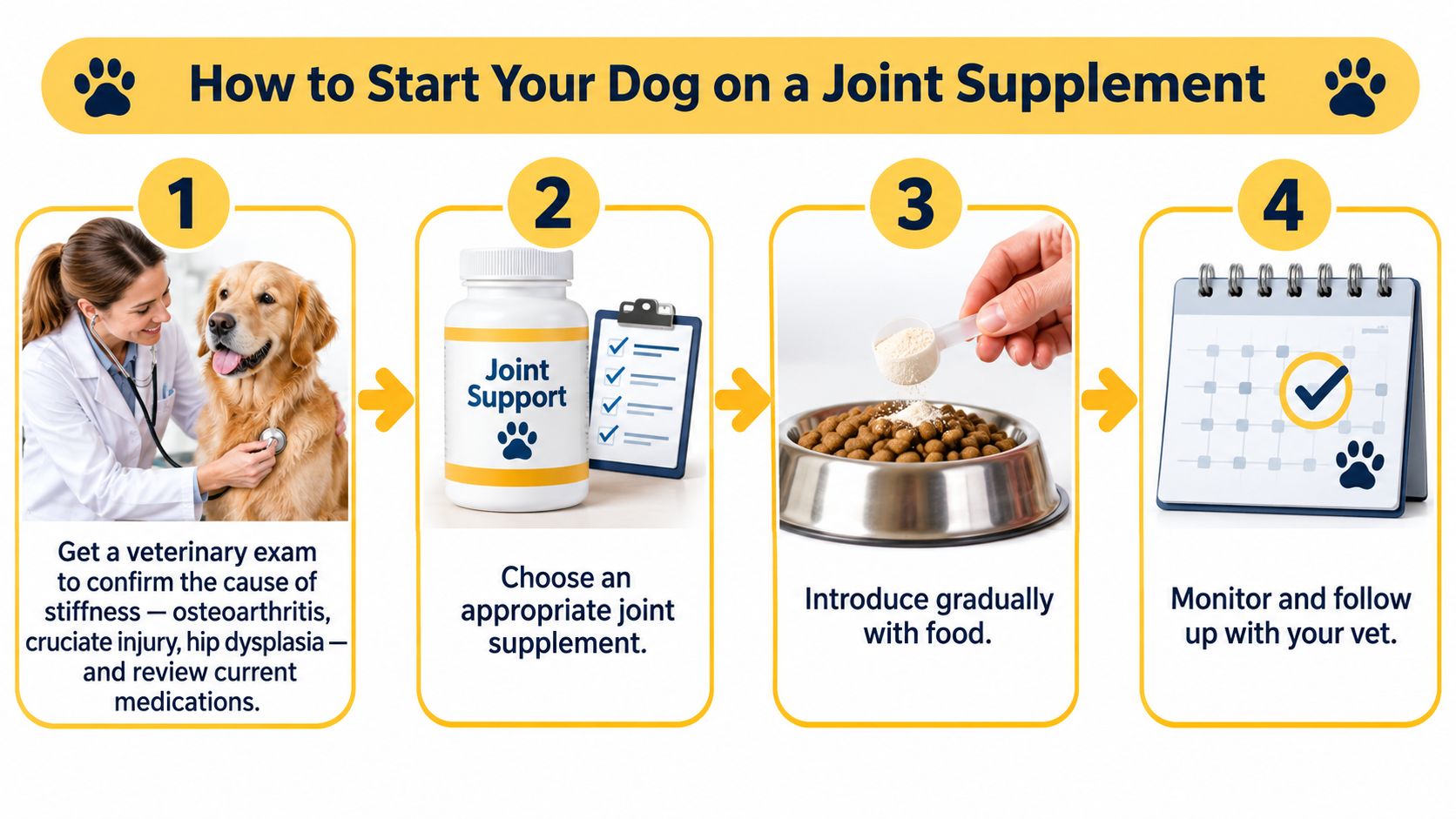
Build a repeatable routine
A joint tub works like a measuring cup with the lines rubbed off if you never write down what “before” looked like, or how many milligrams of active fat your dog gets. Ingredient lists are long. The number that matters is the active amount per day for that dog.
- Record the starting point. Film your dog rising from a familiar bed and walking on a level, nonslip surface. Record stairs only if your dog can manage them comfortably. Use the same location and camera angle for later comparisons.
- Confirm the cause of stiffness. Ask your veterinarian to distinguish osteoarthritis from problems such as a ligament injury or hip disease. Bring a list of medications and supplements, including products you don't think of as joint treatments.
- Choose the active ingredient and target. Write down the veterinarian-approved daily amount and the exact quantity your product supplies. The common slip is treating a serving of oil as if it were a serving of active EPA+DHA. Read the label for those actives, then match them to your dog's weight instead of counting how many ingredients appear on the front.
- Agree on a gradual introduction. Give the supplement with a meal if that fits its instructions and your veterinarian's advice. Ask for a reduced starting amount and clear increase points rather than improvising a universal loading schedule.
- Log tolerance before increasing. Note appetite, stool consistency, vomiting, and whether your dog finishes the food containing the supplement. If your dog leaves the meal behind, the amount served isn't the amount consumed.
- Keep other changes identifiable. Don't add several optional supplements together. Record necessary medication or rehabilitation changes so you can interpret progress without withholding appropriate care.
- Arrange follow-up. Put a 6 to 12 week reassessment on your calendar when you start. A supplement trial shouldn't become an indefinite purchase with no decision point.
Make safety part of the setup
Tell your veterinarian about bleeding disorders, anticoagulant medication, and planned procedures before adding fish oil. Don't substitute a human joint supplement without approval: ingredients, sweeteners, and concentrations may be unsuitable for dogs.
Loose stool doesn't prove that the introduction was too fast. The product, another dietary change, medication, or an unrelated problem may be responsible. Pause the increase and ask for advice if signs persist or your dog seems unwell.
Successful introduction means your dog tolerates the routine. It doesn't mean you should already expect a visible mobility transformation.
Watch the part of the video that shows how to film the rise from bed and the level walk. Use those clips as your baseline, then follow the written dose your veterinarian set for your dog rather than a generic scoop on screen.
Reading Results at 6 to 12 Weeks
Monitoring signals and what to do about them
| Signal | What it suggests | What to do |
|---|---|---|
| Rises easier after rest | Comfort or function may be improving | Continue the agreed plan and compare recordings at reassessment |
| Longer walks, more play | Daily function may be improving | Maintain appropriate activity and body condition |
| Loose stool early in the introduction | Poor tolerance, an overly rapid increase, or another cause | Stop increasing, review feeding instructions, and contact your veterinarian if it persists |
| No change by the planned final checkpoint | Dose, ingredient, diagnosis, or treatment plan needs review | Book a veterinary re-evaluation |
| Worsening lameness or pain | Disease progression or a new problem is possible | Seek veterinary assessment, with imaging if indicated, rather than adding more supplement |
A randomized, double-blind, placebo-controlled multicenter study published in 2025 followed 52 dogs with confirmed osteoarthritis for 90 days and reported improvements in the supplement group across pain, mobility-related LOAD scores, discomfort, and clinical assessment. That supports a defined observation period, but it doesn't establish that every mixed formula works or that every dog will respond.
Use 6 to 12 weeks as a practical reassessment window, agreed with your veterinarian, rather than a guarantee of when benefits must appear. Group averages from a trial can't predict your dog's individual response, and the overall size of nutraceutical effects remains uncertain.
Compare tasks, not impressions
Repeat the baseline recordings under similar conditions. Compare the effort needed to stand, hesitation before moving, stride consistency, and willingness to participate. Don't encourage a painful dog to repeat stairs just to produce a comparison clip.
Keep a consistent written rating of stiffness, using the same descriptions each time. A note such as “stood without pausing after the afternoon nap” is more useful than “seems younger.”
Look for a pattern across ordinary days, not a single energetic outing. Weather, excitement, activity, and other treatment changes can alter what you see. Our explanation of joint support benefits can help frame realistic functional goals.
Know when waiting isn't appropriate
Rapidly worsening lameness, persistent pain, reduced appetite, new gastrointestinal signs, or declining function warrant veterinary contact. A dog who won't bear weight shouldn't wait for the supplement checkpoint.
Multimodal care means matching different tools to different needs. Weight management reduces unnecessary loading, rehabilitation supports useful movement, and prescribed medication addresses pain when indicated. A supplement can contribute to that plan, but it shouldn't delay the parts your dog needs most.
All-in-One Formula or Separate Supplements
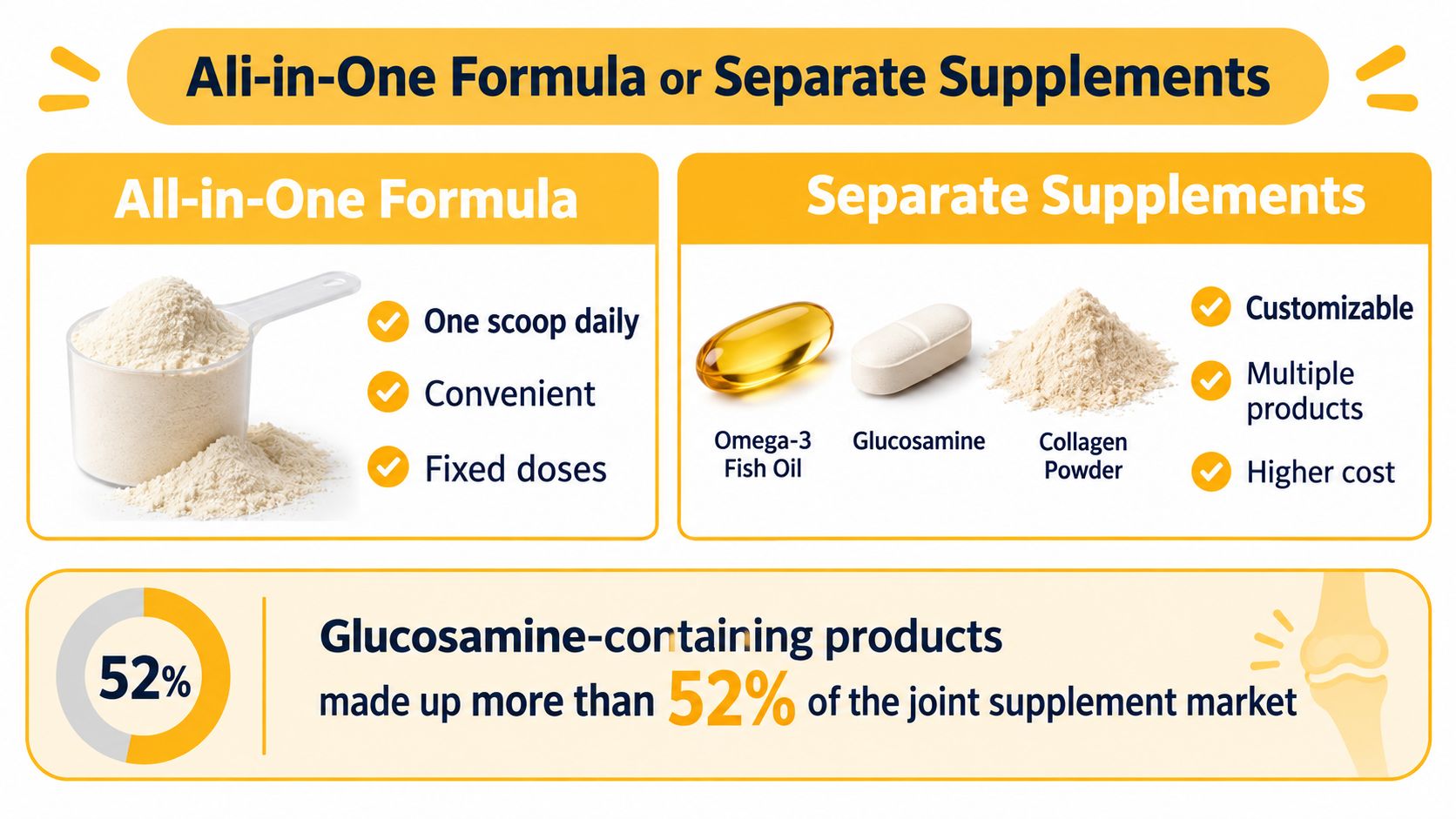
Glucosamine-containing products accounted for more than 52% of the joint-support pet-supplement market in 2024, according to Dataintelo's joint-support pet-supplement market report. A crowded shelf shows what owners buy. It does not show how many milligrams of an active your dog gets per kilogram of body weight.
An all-in-one formula works like a fixed recipe: one scoop, set ratios. Separate products work like measuring cups you can change one ingredient at a time. The format does not decide the result. The label does, if it states the active amount per serving and you review the dog at a fixed 6 to 12 week point.
All-in-one versus separate supplement stack
| Criterion | All-in-one formula | Separate stack |
|---|---|---|
| Dosing precision | Fixed ingredient ratios per scoop | Individual active amounts can be adjusted |
| Convenience | A consolidated routine | Separate measuring and administration |
| Cost | Compare cost at the actual daily serving | Add the daily cost of every product |
| Overlap risk | Actives share one serving, so a second tub is not part of the routine | Duplicate ingredients are easier to introduce |
| Best fit | Broad support when the disclosed amounts suit the plan | A need to change one active amount without changing the rest |
Choose by the dosing problem
For broad daily support, a clearly labeled all-in-one can be practical when the scoop already holds the amounts you meant to give. Early stiffness still deserves assessment. No confirmed arthritis diagnosis does not prove a general blend is the right tool.
The harder case is a larger dog whose plan calls for a specific EPA+DHA amount per kilogram. In a fixed blend, extra scoops raise every ingredient, not only the omega-3. You pay for, and the dog receives, more of the unrelated powders too.
Cost follows the serving, not the price printed on the tub. One formula has a single daily serving cost. A stack costs the sum of every product used that day. Compare those totals. Separate products are not automatically cheaper or more expensive.
Apply the same standard to this formula
DA-1™ Daily All-in-One - Senior Dog Support, Joints, Skin/Coat & More is a one-scoop-a-day supplement for joint, skin, digestive, and immune health. The formula includes glucosamine, probiotics, omega-3s, and turmeric, and it can stand in for several separate tubs when those disclosed amounts fit the plan. Each scoop contains 200 mg of glucosamine, 20 mg of omega-3 from fish oil, and 20 mg of hyaluronic acid.
Read those numbers as label facts, not as a treatment claim. The 20 mg is omega-3 from fish oil, not a split of EPA and DHA per kilogram of dog. The 200 mg of glucosamine stays fixed unless the whole scoop changes. A list of 18 human-grade ingredients does not fill that gap. The same active-dose test applies here as to any other option. The guide to an all-in-one dog supplement explains the consolidated routine.
Whatever you choose, look for separately disclosed EPA+DHA and glucosamine amounts per serving when those ingredients are included. Do not raise an entire blend to chase an omega-3 target unless your veterinarian has checked the whole formula.
Choosing the Right Joint Plan for Your Dog
The right joint plan is the one you can justify, administer consistently, and evaluate fairly. A convenient routine matters, but convenience shouldn't hide an active-dose gap.
Use these checks before committing to a product:
- Evidence fit: Choose an ingredient with relevant canine evidence, not just a familiar name or a plausible purpose.
- Dose fit: Match the active amount to your dog's veterinary plan and account for other dietary sources.
- Tolerance fit: Introduce the product gradually and keep your dog's appetite and digestion in view.
- Outcome fit: Decide which everyday movement you want to improve and when you'll review it.
Match the format to the dog
A dog without diagnosed osteoarthritis may need assessment and basic management changes more than a complex supplement stack. If you choose broad nutritional support, favor transparent labeling and a routine you can maintain.
A dog with confirmed osteoarthritis may need a targeted product to meet an individualized EPA+DHA plan. If the all-in-one supplies less than the agreed active amount, any shortfall must come from a suitable additional source, not from the length of its ingredient list. Check for overlap before combining products.
Keep the purchase decision separate from the treatment decision. You can decide that a powder is convenient without assuming it's sufficient for pain management, and you can stop an unhelpful supplement without abandoning the rest of your dog's care.
Take action this week
- Make baseline recordings. Capture rising from rest and comfortable level walking, adding stairs only when safe.
- Audit your current label. Find the actual combined EPA+DHA amount and write down what your dog consumes, not merely what you serve.
- Arrange a baseline exam. If stiffness is new or worsening, book the veterinary assessment before buying another tub.
Bring the recordings, labels, and medication list to that conversation. Those details give your veterinarian something concrete to work with and give you a clearer basis for judging whether the plan helps.
Pure Paw Labs offers a daily all-in-one powder for dogs that combines joint, skin, digestive, and immune support in a single routine. Visit Pure Paw Labs to review the formula and ingredient information, then compare it with your dog's veterinarian-approved joint plan before choosing broad daily support or a targeted addition.