


No single proven therapeutic glucosamine dose exists for dogs. Published practical guidance commonly starts around 15 to 30 mg/kg/day for a 4 to 6 week loading phase, then reduces to approximately 7.5 to 15 mg/kg/day for maintenance, with every plan individualized with veterinary input.
That directly challenges the most popular advice about dosage glucosamine for dogs: there isn't one universally correct number that applies to every dog with osteoarthritis. Weight, product form, other ingredients, health conditions, and the quality of evidence all affect what a sensible starting plan looks like.
A supplement label can make dosing seem precise, but a precise label doesn't mean the dose has been clinically proven for every dog. Use the calculations below as a way to understand the amount in a product and prepare better questions for your veterinarian, not as a substitute for diagnosis or treatment.
Table of Contents
- What Glucosamine Does and Why Dogs Take It
- Why There Is No Single Proven Glucosamine Dose
- Typical Dose Ranges by Dog Weight
- Comparing Glucosamine Forms and Combinations
- How to Calculate a Dose Step by Step
- Loading Phase, Maintenance, and Duration
- Safety, Side Effects, and Administration Tips
- Reassessing Results and When to Call Your Vet
What Glucosamine Does and Why Dogs Take It
The surprising truth is that no universally proven therapeutic mg/kg dose of glucosamine has been established for dogs with osteoarthritis. Glucosamine is a naturally occurring amino sugar involved in making proteoglycans, structural components that help cartilage retain its shape and resilience. Supplementation is intended to provide joint-supporting material and may support chondrocyte activity and synovial fluid quality, but it isn't a fast-acting painkiller.
That distinction matters. A dog with painful arthritis may need veterinary assessment, pain relief, weight management, controlled exercise, or physiotherapy. Glucosamine can be considered as one part of that plan, rather than a replacement for interventions that directly address pain and inflammation.
Why owners consider it
Owners commonly ask about glucosamine when a dog shows age-related stiffness, hesitates on stairs, tires sooner on walks, or takes longer to rise after resting. It also comes up with hip or elbow dysplasia, recovery support after cruciate injury or surgery, and longer-term joint care for dogs whose conformation or previous injuries increase mechanical stress.
The biological reasoning is straightforward. Cartilage and joint fluid need ongoing maintenance, and glucosamine is associated with substances used in that maintenance. That doesn't prove that a supplement will reverse established joint disease, but it explains why veterinarians and owners may consider it within a broader mobility plan.
Practical rule: Treat glucosamine as an adjunct. A dog that remains painful, lame, or reluctant to move needs a veterinary plan even if a supplement is already being given.
A useful starting resource for understanding the wider supplement category is this guide to dog joint supplements. It can help owners distinguish a single ingredient from a broader formula, but the product label still needs to be checked for the actual glucosamine form and amount.
Why There Is No Single Proven Glucosamine Dose
The most accurate answer to “what dose should I give?” is uncomfortable: there is no universally confirmed therapeutic dose for canine osteoarthritis. A 2017 review of glucosamine and chondroitin use in dogs examined 16 canine studies, including 7 randomized controlled trials and 9 non-randomized studies, yet found no dose that could be confirmed as the standard. Only 4 of the 7 randomized trials and all 9 non-randomized studies reported a positive effect. The mixed results do not support one rule for every dog.
The studies were not identical experiments. They used different glucosamine formulations, dosing schedules, outcome measures, and combinations with other ingredients. One trial might assess lameness, while another uses an owner questionnaire or force-plate gait analysis. These measures are like different rulers: each may capture a real part of mobility, but they do not produce directly interchangeable results. That makes it difficult to turn the research into one exact mg/kg prescription.
Why practical ranges still appear
Loading and maintenance ranges remain useful as clinical conventions and practical starting points. They are not regulatory approvals or evidence-locked instructions. Their basis includes weight-based trial regimens, pharmacokinetic observations, product guidance, and veterinary experience.
A veterinary evidence summary reported that a single 1,500 mg oral dose reached a maximum plasma concentration of 8.95 μg/mL at 1.5 hours, with mean bioavailability of about 12% after single dosing. The same veterinary review of glucosamine and chondroitin noted that systematic reviews reached different conclusions, describing the evidence as low, moderate, or inconclusive. Blood exposure also does not prove improved comfort or movement.
| Source type | Example | Dose level | Evidence strength |
|---|---|---|---|
| Canine clinical trial | Weight-based twice-daily regimen reported in the 2017 review | 475 mg twice daily for dogs weighing 5 to 19.9 kg, 712.5 mg twice daily for 20 to 40 kg, and 950 mg twice daily above 40 kg | Limited and mixed |
| Pharmacokinetic study | Single oral administration in dogs | 1,500 mg once in the cited study | Shows exposure, not clinical benefit |
| Practical veterinary protocol | Higher initial amount followed by a lower amount | Often discussed as 15 to 30 mg/kg/day, then 7.5 to 15 mg/kg/day | Convention-based, not universally validated |
| Combination product | Glucosamine alongside chondroitin or other ingredients | Depends on the complete label | Product-specific |
Weight-based dosing still has a practical role. It gives owners and clinicians a consistent measuring stick when comparing products and planning a veterinary discussion. The calculated range is only a starting estimate. The dog's medical history, the product's actual glucosamine content, and observable changes in comfort should guide the next decision.
Typical Dose Ranges by Dog Weight
There is no universally proven therapeutic glucosamine dose for canine osteoarthritis. Weight-based ranges can still provide a practical starting point, much like a map that helps you plan a route without guaranteeing the final destination. Convert body weight to kilograms, calculate the range, then check the product label and discuss the result with your veterinarian.
For a loading phase, multiply the dog's weight by 15 to 30 mg/kg/day. For maintenance, multiply it by 7.5 to 15 mg/kg/day. These figures are reference points for a veterinary conversation, not prescriptions.
| Weight class | Example breeds | Loading phase, 15 to 30 mg/kg/day | Maintenance phase, 7.5 to 15 mg/kg/day |
|---|---|---|---|
| Small, 5 to 10 kg | Chihuahua, small terrier | 75 to 300 mg/day | 37.5 to 150 mg/day |
| Medium, 15 to 25 kg | Border Collie, medium spaniel | 225 to 750 mg/day | 112.5 to 375 mg/day |
| Large, 30 to 45 kg | Labrador, German Shepherd | 450 to 1,350 mg/day | 225 to 675 mg/day |
| Giant, 50+ kg | Giant-breed dogs | 750 mg/day or more, depending on exact weight | 375 mg/day or more, depending on exact weight |
For example, a 20 kg dog falls in the medium range. Its loading estimate is 300 to 600 mg/day, while its maintenance estimate is 150 to 300 mg/day. Those totals refer to glucosamine itself, not the full weight of a chew or powder.
A chew may also contain chondroitin, MSM, hyaluronic acid, or other ingredients. Read the label for glucosamine per chew or scoop. A product weighing 1,000 mg does not necessarily provide 1,000 mg of glucosamine.
A historical clinical regimen used 475 mg twice daily for dogs weighing 5 to 19.9 kg, 712.5 mg twice daily for dogs weighing 20 to 40 kg, and 950 mg twice daily for dogs above 40 kg. This example shows how published protocols can differ from weight-based ranges. It does not establish a suitable dose for every dog. The details are reported in the 2017 canine osteoarthritis evidence review discussed earlier.

For owners who prefer one food topper rather than several separate powders, DA-1™ Daily All-in-One - Skin/Coat, Joints, Gut Health & More is described as a human-grade powder used as one scoop on food. Since it contains more than glucosamine, follow its serving directions and ask your veterinarian how it fits with other supplements.
Large dogs may require several chews daily, so serving size can become difficult to manage. This guide to a dog joint supplement for large breeds can help owners assess serving practicality, while the product label must determine the actual glucosamine total.
Comparing Glucosamine Forms and Combinations
The form printed on the label affects how owners interpret the milligram number. Common options include glucosamine hydrochloride, glucosamine sulfate, and combination products that add chondroitin. The active glucosamine content, stabilizing salts, serving size, and product format can all differ.
A product with 600 mg of one form shouldn't automatically be treated as equivalent to 600 mg of another form without checking the manufacturer's specification. The supplied verified material describes glucosamine HCl as approximately 99% glucosamine and glucosamine sulfate potassium salt as approximately 88%, so the chemical form matters when comparing labels.
| Form | Approximate glucosamine purity | Typical pairing | Practical dosing impact |
|---|---|---|---|
| Glucosamine HCl | About 99% | Often used alone or in joint blends | More glucosamine per stated milligram, subject to label verification |
| Glucosamine sulfate potassium salt | About 88% | Often paired with chondroitin | The salt component contributes to the product weight |
| Glucosamine and chondroitin | Depends on both ingredients | Classic combination formula | Owners must track each active separately |
| Powder, liquid, or chew format | Depends on the formula | May include MSM, hyaluronic acid, or other compounds | Changes measuring convenience and total serving volume |
Chondroitin can make a combination product more substantial because it has its own target amount and isn't interchangeable with glucosamine. Other additions, such as MSM, hyaluronic acid, or green-lipped mussel, can also change how much powder or how many chews a dog receives each day. Don't increase a combination product because its glucosamine number appears lower than a single-ingredient product.
Bioavailability is another reason not to compare products by label arithmetic alone. A tracer study in dogs used 250 mg/day for 3 weeks, followed by 500 mg/day for 2 weeks, with the higher regimen corresponding to about 50 mg/kg/day in that study design. The canine pharmacokinetic study supports dose-dependent exposure, but it doesn't establish a universally effective clinical dose.
For additional background when comparing supplements for mobility and recovery, focus on the complete ingredient panel, the amount per serving, sourcing, and whether your dog can take the product consistently. A liquid may suit a dog that refuses chews, while a powder may be easier to divide accurately for a small dog.
How to Calculate a Dose Step by Step
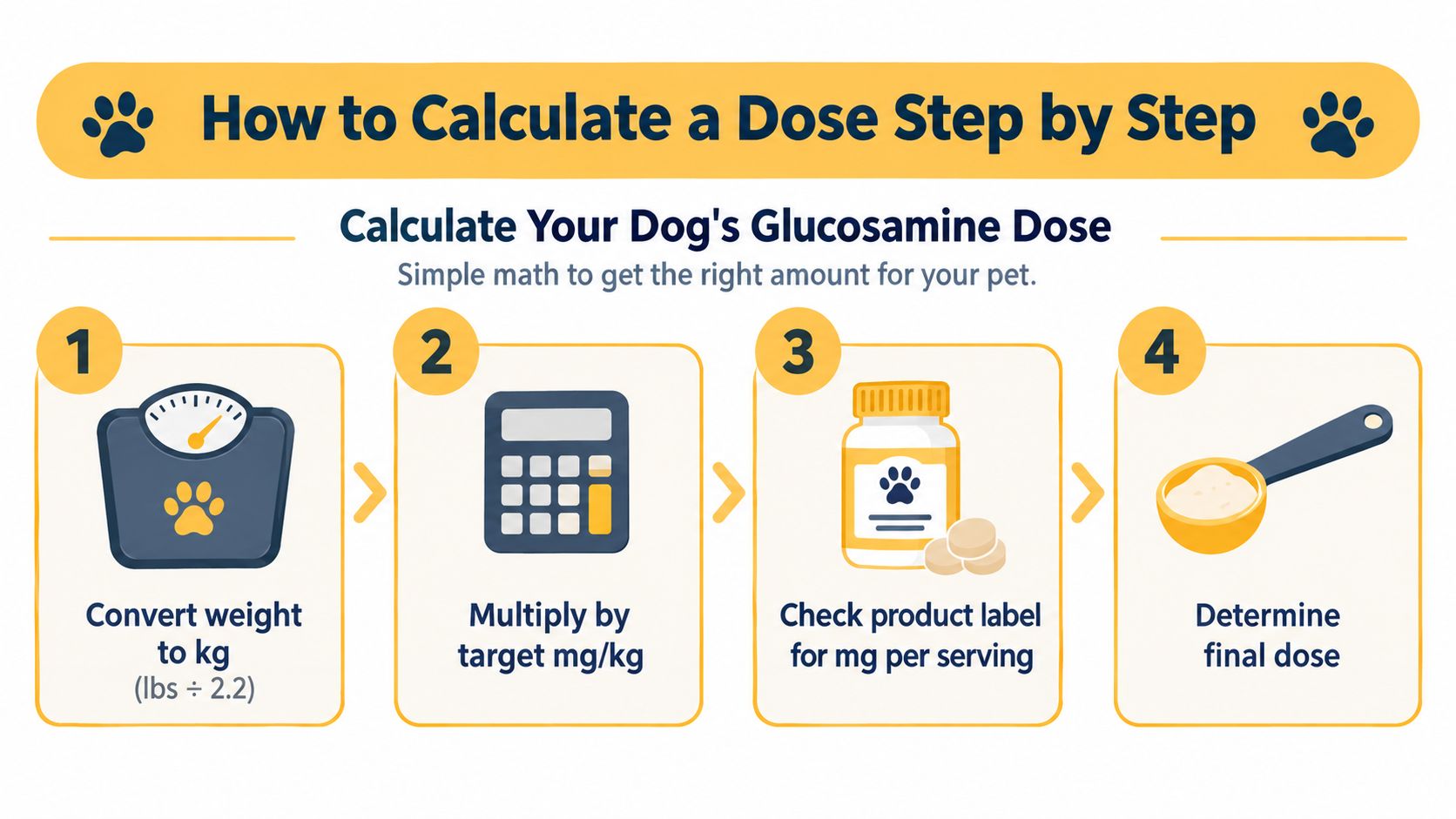
Use four pieces of information: current body weight, weight in kilograms, target mg/kg, and glucosamine per serving.
The calculation
- Convert pounds to kilograms by dividing pounds by 2.2.
- Multiply kilograms by the selected target, such as 15 mg/kg/day or 30 mg/kg/day.
- Read the label to find the glucosamine amount per chew, scoop, or measured volume.
- Divide the required daily milligrams by the amount in one serving.
Consider three examples. A 6 kg Chihuahua calculates to 90 mg/day at 15 mg/kg or 180 mg/day at 30 mg/kg. A 20 kg Border Collie calculates to 300 mg/day at 15 mg/kg or 600 mg/day at 30 mg/kg. A 40 kg Labrador calculates to 600 mg/day at 15 mg/kg or 1,200 mg/day at 30 mg/kg.
If the label says each chew contains 600 mg of glucosamine HCl, the 20 kg dog would reach the lower example target with half a chew and the higher example target with one chew. The 40 kg dog would reach the lower example target with one chew and the higher example target with two chews. Those are mathematical examples, not instructions to cut or increase a product without confirming that the chew can be divided accurately and that the veterinarian agrees.
Measure the active ingredient, not the scoop size. A teaspoon can contain different amounts depending on powder density, so a small milligram scale is more reliable than a kitchen spoon.
For powders, use a scale designed to measure small quantities when practical. If the product provides a calibrated scoop, follow its instructions, but don't assume a level scoop equals the same weight across different products. Dividing a daily amount into morning and evening servings can make administration easier and may improve tolerance in dogs with sensitive stomachs.
The calculation gives you a defensible starting estimate. The final plan depends on the product's complete formulation, your dog's health, and what changes your veterinarian wants you to monitor.
Loading Phase, Maintenance, and Duration
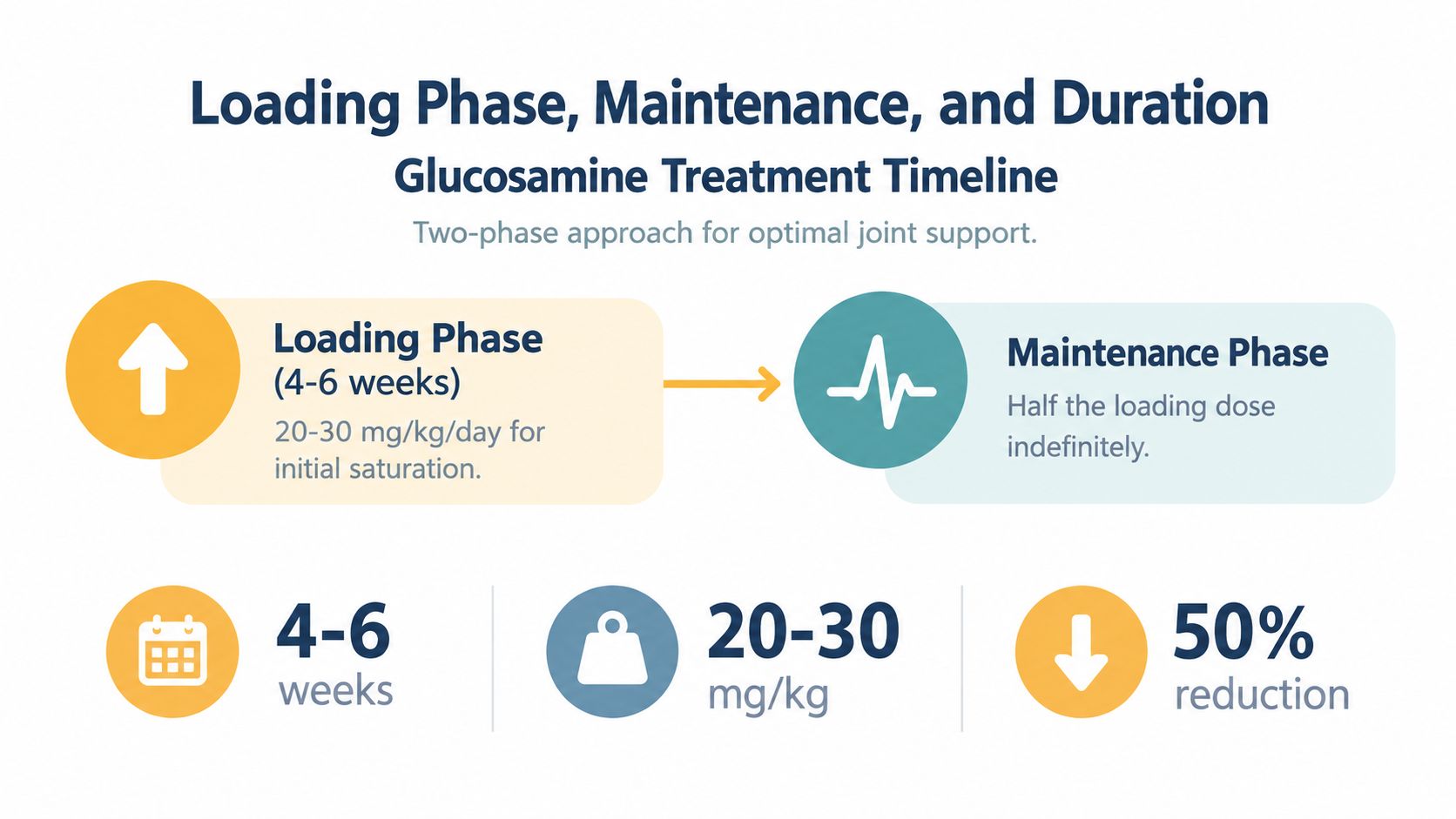
Many protocols use a higher initial amount because oral absorption is incomplete. In the canine pharmacokinetic evidence, a single oral dose had mean bioavailability of about 12%, and the tracer work showed greater systemic availability with the higher regimen. That helps explain why clinicians sometimes use a loading period, although it doesn't prove that every dog needs one.
A practical approach is to discuss 15 to 30 mg/kg/day for 4 to 6 weeks, then consider a reduction toward 7.5 to 15 mg/kg/day if the dog is stable and the veterinarian sees a reason to continue. Some protocols use the lower end from the beginning, while others divide the daily amount between two meals. The best choice depends on tolerance, label directions, and the dog's broader treatment plan.
Choosing the next step
Don't treat maintenance as an automatic lifelong instruction. After the initial trial, ask whether the dog's movement, comfort, and daily function have changed enough to justify continuing. If there is a clear improvement, your veterinarian may recommend maintaining the current plan, reducing the amount, or continuing it alongside other care.
If the dog has had orthopedic surgery, the duration may depend on healing, rehabilitation, and the underlying injury. A stable dog may eventually need a different routine, but tapering or stopping should be a planned decision rather than an experiment made during a flare.
The evidence doesn't establish one correct once-daily versus split-dose schedule. Dividing the amount can be useful when a dog develops digestive upset, while once-daily administration may improve adherence. Reassess rather than judging the supplement after only a brief period, and don't increase the dose just because improvement isn't immediate.
Safety, Side Effects, and Administration Tips
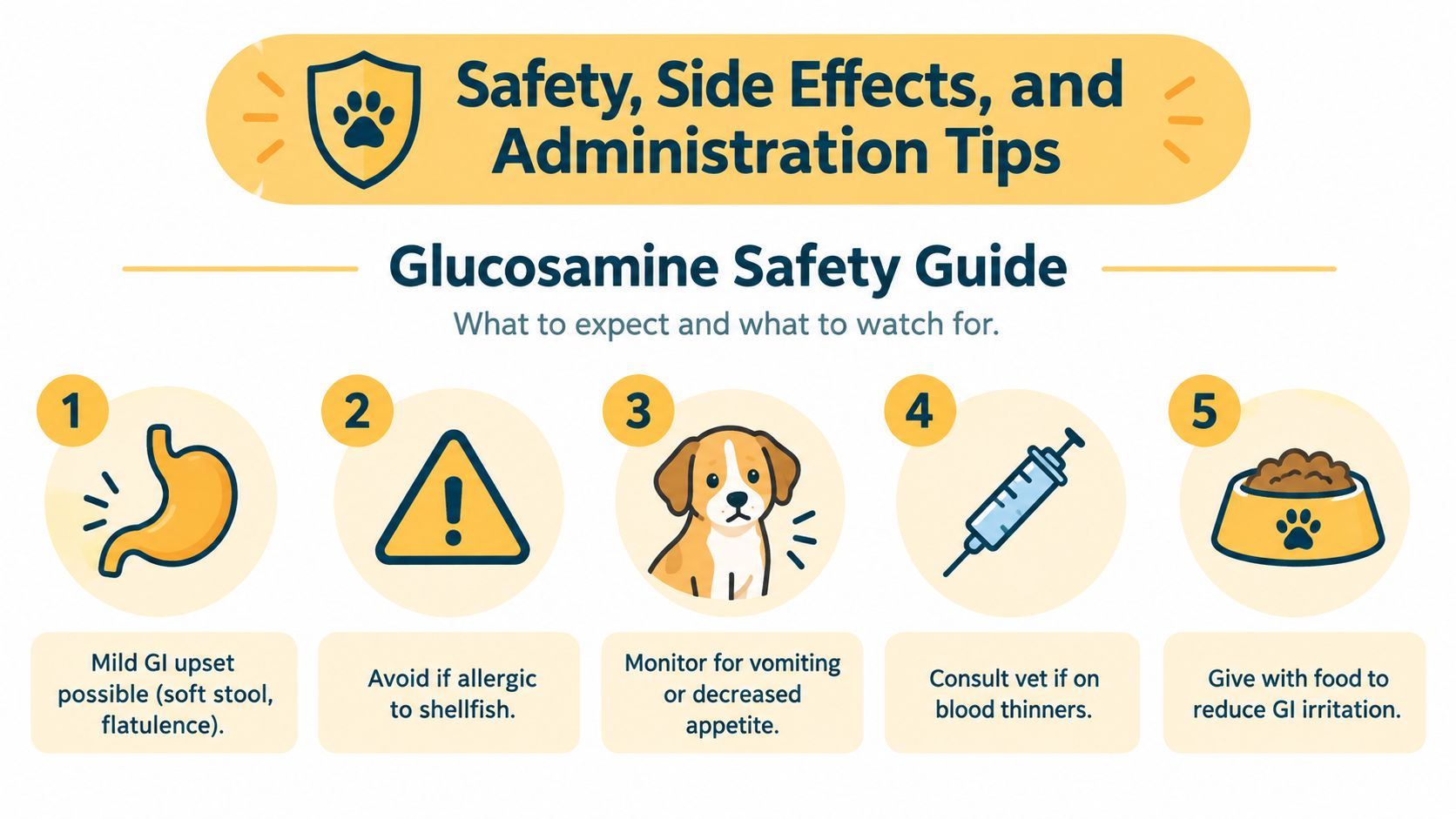
Most reported problems with glucosamine are mild digestive effects, such as soft stool, flatulence, or occasional vomiting. Starting with food and using a measured amount can make the routine easier to tolerate. A new symptom still deserves attention, especially if the product contains several active ingredients rather than glucosamine alone.
Dogs with known shellfish allergies may need a different source because some glucosamine is shellfish-derived. Diabetic dogs should start only with veterinary guidance and appropriate glucose monitoring, since glucosamine may affect glucose regulation in some circumstances. Dogs with kidney or liver disease, dogs scheduled for surgery, and dogs receiving blood-thinning medication also need individual advice before supplementation.
Medication and warning signs
Glucosamine is generally considered compatible with NSAIDs, but that doesn't mean owners should alter an NSAID dose independently. A veterinarian should consider the dog's gastrointestinal and kidney tolerance across the entire regimen. Extra caution is appropriate with anticoagulants such as warfarin because of a possible additive effect on bleeding.
Stop and contact a veterinarian promptly if you see:
- Persistent vomiting or appetite loss: Don't assume the dog is only adjusting to the supplement.
- Sudden lameness or worsening pain: A supplement won't explain away a new injury or rapidly progressing disease.
- Jaundice or marked lethargy: These signs need medical assessment.
- Bleeding abnormalities: Unusual bruising, blood in stool, or other bleeding is urgent.
- Facial swelling or breathing difficulty: Treat this as a possible allergic reaction.
Give powder or a chew with wet food, or use a suitable pill pocket if the product allows it. Split the daily amount across meals when stomach tolerance is a concern, and use a small scale for powders rather than estimating with an unmarked spoon. Keep the container secured, since flavored chews and powders can be attractive to dogs.
For additional context about digestive reactions and administration, see this guide to dog joint supplement side effects.
Reassessing Results and When to Call Your Vet
A supplement trial should have a defined review point. During the first 4 to 8 weeks, record the same observations each week instead of relying on memory. Useful markers include how easily the dog rises after rest, willingness to use stairs, walk duration before fatigue, interest in play, and whether limping appears after particular activities.
A simple monitoring record
Write down the date, the product amount, and a short mobility note. A change such as “rose without hesitation and completed the usual walk” is more useful than “seems better.” Video recorded on similar routes and at similar speeds can also help your veterinarian compare movement over time.
By around 4 to 6 weeks, some dogs may show a noticeable functional change if the overall plan is helping. Lack of improvement doesn't prove that glucosamine alone has failed, because weight control, exercise adjustment, prescription pain control, and physiotherapy may be more important contributors to comfort. Recent evidence remains conflicting, including a review of canine osteoarthritis nutraceutical evidence that emphasizes the lack of evidence confirming a specific therapeutic dose.
Call your veterinarian sooner if mobility worsens, pain behavior appears, your dog becomes unusually withdrawn or irritable, or any suspected adverse effect develops. Don't use glucosamine to postpone an examination for new lameness, difficulty bearing weight, severe stiffness, or a sudden change in behavior.
Bring your notes, product label, ingredient list, and serving record to the appointment. That gives the veterinarian a clearer basis for deciding whether to continue, reduce, stop, or replace the supplement within a broader joint-care plan.
Pure Paw Labs offers science-focused, human-grade dietary supplements for dogs, including DA-1™ Daily All-in-One, a once-daily powder intended to combine joint, skin and coat, digestive, immune, and stress support. Visit Pure Paw Labs to review the formula and serving information, then discuss whether it fits your dog's glucosamine plan with your veterinarian.