


Most advice about a dog joint supplement large breed starts in the wrong place. Owners get told to look for glucosamine, chondroitin, and a cheery chew shape, then they buy a bottle that looks right and underdoses a 90-pound dog by design. The smarter question is not “what's on the label,” it's “what has evidence, and what dose does a big dog really need?”
| What matters | What most buyers look at | What you should look at |
|---|---|---|
| Ingredient evidence | Long ingredient lists | Which ingredient class has the strongest support |
| Dose delivery | Number of chews or capsules | Per-day milligrams for the dog's body weight |
| Format | Flavor and packaging | Whether the format makes accurate daily dosing realistic |
| Fit | “All-in-one” marketing | Whether the formula matches the dog's actual needs |
Large-breed joint care is a different category because the orthopedic risk is different and the dose arithmetic is different. A supplement can support mobility, but it can't erase the structural burden that comes with a big frame. That's why the right buying process starts with evidence, not branding.
Table of Contents
- Why Large-Breed Joint Care Is Not Just Joint Care
- The Orthopedic Reality Behind Large-Breed Supplements
- Which Ingredients Have Evidence for Large Dogs
- Dosing Math for a 60 to 100 Pound Dog
- Powder, Chew, Softgel, or Liquid for a Big Dog
- Where DA-1 Fits in a Large-Breed Regimen
- Choosing Between a Joint-Only and an All-in-One
- Large-Breed Joint Supplement Decision Checklist
Why Large-Breed Joint Care Is Not Just Joint Care
A big dog isn't just a scaled-up small dog. The orthopedic load is different, the risk is more concentrated in certain breeds, and the supplement dose has to be high enough to matter in a 60 to 100 pound body. If you don't adjust for that, you end up paying for comfort marketing while the active ingredients stay too low to be useful.
The commercial reason this matters is simple. Osteoarthritis is common enough to shape the market in large dogs, and the breed burden is uneven, with Golden Retrievers at 7.7%, Labrador Retrievers at 6.1%, Rottweilers at 5.4%, and German Shepherd Dogs at 4.9% in one UK primary-care study, while the overall annual period prevalence was 2.5% of all dogs, or about 200,000 affected dogs per year source. A separate review also put North American osteoarthritis prevalence at 20% of dogs over 1 year of age source. That isn't niche territory, it's routine chronic care.
The buying mistake most owners make
They shop by package size and chew count. That's backwards. A bottle that looks generous for a 25-pound dog can be grossly short on active ingredients for a 90-pound dog, even if the front panel screams “large breed.”
Practical rule: If the supplement doesn't tell you the daily delivered milligrams for your dog's weight, it's not giving you a decision tool, it's giving you a marketing accessory.
The better lens is three-part. First, judge the ingredient evidence. Second, check the per-pound dose. Third, decide whether the format makes it realistic to keep feeding that dose every day.
The Orthopedic Reality Behind Large-Breed Supplements
Large breeds carry a structural burden that smaller dogs do not. Hip dysplasia is the clearest example. In one breed-effects study, rates ranged from 5% in Siberian Huskies to 83% in English Bulldogs source. Another retrospective study reported canine hip dysplasia incidence at 31.79% in large-sized breeds and 19.29% in giant breeds, versus 5.59% in medium breeds and 4.29% in small/toy breeds source. A separate radiographic review found incidence as high as 47.4% in Saint Bernards source.
That is the core framework for large-breed supplement use. You are not trying to fix a joint with a chew. You are supporting cartilage, comfort, and daily movement in a body that loads those tissues harder for longer.
A supplement cannot change the dog's skeleton, growth history, or breed-linked risk. It can support symptoms and maintenance, but it cannot override genetics or conformation.
Large-breed owners also make the same mistake over and over. They buy by bottle size, chew count, or the front-panel promise of “joint support,” then assume the formula is scaled for a 70-pound or 100-pound dog. It usually is not. The label may look generous. The delivered dose can still be thin.
The smarter approach is to ask a simpler question. Does the product deliver enough active ingredient for a dog this size, day after day, without relying on wishful thinking?
For a practical way to sanity-check the label, start with the daily milligram total and compare it against a large-dog mobility dosing guide. That is the part marketing tends to hide.
Breed risk matters, but so does dose reality. A formula that looks fine for a smaller dog can fall apart fast once the dog gets heavier. In that sense, large-breed joint care is not just joint care. It is long-term orthopedic management, and the supplement only earns its place if it can deliver what the dog needs.
Which Ingredients Have Evidence for Large Dogs
The biggest mistake in joint-supplement shopping is treating every familiar ingredient as equally useful. It isn't. Some ingredients have usable evidence as add-ons. Others are mostly label decoration unless the dose is right, and a few appear in formulas without much oral-dose support at all.
Start with the evidence tiers
A 2022 systematic review found clear analgesic benefit for omega-3-enriched diets and omega-3 supplements, while reporting a “very marked non-effect” for chondroitin-glucosamine nutraceuticals in canine and feline osteoarthritis source. That makes omega-3s the first place to spend money. They are not a miracle, but they have the cleanest case behind them.
The rest comes down to dose delivery. Clinical literature supports glucosamine and chondroitin as adjuncts, especially when NSAIDs are not well tolerated, but that support is symptom relief, not a cure source. For large dogs, the only number that matters is the per-day delivered milligrams. Chew count is marketing, not dosing. Published dosing frameworks commonly use weight-tier tables, and split dosing is sometimes used for GI tolerance and adherence source.
What I'd prioritize in a big dog
If you want a blunt ranking for long-term large-breed use, I'd put the ingredients like this, from strongest evidence base to weakest:
- Omega-3 fatty acids
- Glucosamine and chondroitin
- Undenatured type II collagen
- Green-lipped mussel
- MSM
That order reflects evidence value, not label popularity. It also explains why so many formulas look busy without really doing much. Hyaluronic acid and generic joint matrix blends may show up on the front panel, but oral-dose support is often thin or unclear, so they should not drive the buying decision.
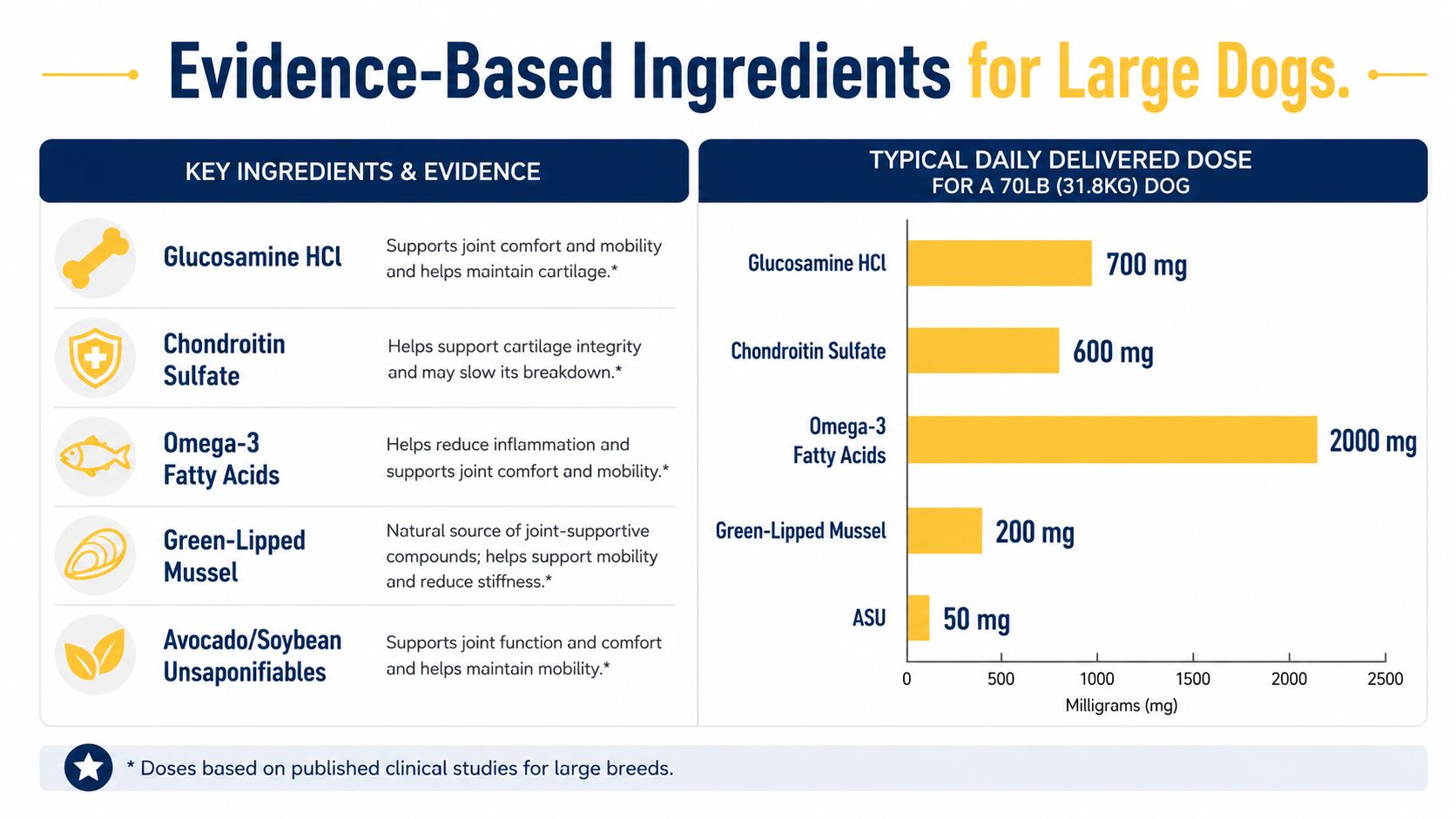
The image above shows the issue. A big dog's daily target is measured in milligrams delivered, not in “one tasty chew.”
Bottom line: If a formula does not get omega-3s right, it is hard to defend as a serious joint product for a large dog.
For fish-oil specifics and formulation logic, this fish oil guide is the right companion read.
Dosing Math for a 60 to 100 Pound Dog
The label does not matter until the numbers work. A 75 to 90 pound dog needs a joint formula that delivers enough active ingredient every day to match body weight, not one that only looks good on the front of the tub. For glucosamine, common adult guidance for large dogs lands around 20 mg per pound of body weight per day, which puts a 75 to 90 pound dog near 1,500 to 1,800 mg/day for maintenance source. Older guidance also places a 75-pound dog around 500 to 1,000 mg/day maintenance, and 90+ pound dogs around 1,500 mg/day source. That is the first reality check.
A simple way to read any label
Start with body weight. Then look for the daily amount of glucosamine, chondroitin, and omega-3s the product delivers at that weight. If the label only lists “per chew” amounts and expects a giant dog to eat one chew a day, the dog is probably underdosed.
A 70-pound Labrador and a 95-pound German Shepherd should be judged by delivered milligrams, not by “large breed” on the front panel. Products built around chew count often look generous until you divide the active ingredients by body weight. That is where the gap shows up.
| Per-Day Ingredient Targets vs Typical Chew Delivery for a 70-lb Dog | Target for 70-lb dog | Typical large-chew delivery | Gap |
|---|---|---|---|
| Glucosamine | About maintenance-level large-dog dosing | Often below target once spread across chew count | Underdelivery risk |
| Chondroitin | Enough to match the dog's weight tier | Often lower than the glucosamine-side claims imply | Underdelivery risk |
| Omega-3s | Should be treated as the priority ingredient class | Frequently present, but not always in meaningful daily amounts | Underdelivery risk |
| Green-lipped mussel | Useful only when the daily amount is clear | Often label-decorative | Underdelivery risk |
The table stays qualitative because the verified data do not support pretending every formula lands in the same place. That is the honest way to shop. The problem is not that every chew fails. The problem is that many chews are designed around palatability first and dose adequacy second.
Loading versus maintenance
A loading phase can make sense if you are starting from zero and want to front-load support. Many veterinary sources use 2x maintenance for 4 to 6 weeks before dropping back to maintenance source. That matters most if the dog is clearly stiff, aging, or already showing early mobility changes.
Use this shortcut: multiply the dog's weight by the per-pound target, then divide that total across the actual number of servings the label recommends. If the math looks stingy, the product is stingy.
For omega-3 basics and formulation logic, this fish oil guide and this salmon oil dosing guide are the right companion reads.
For MSM, green-lipped mussel, and other niche ingredients, be more cautious. The more specialized the ingredient, the more important it is to confirm the dog's medical history and medication list before daily use.
Powder, Chew, Softgel, or Liquid for a Big Dog
Format determines whether a supplement gets used. Large dogs need larger, steadier doses, and a formula can look solid on paper while failing in the bowl because the delivery form makes dosing awkward, expensive, or inconsistent.
Chews sell well because dogs will eat them. That same convenience often hides an underdose, because “one chew a day” sounds complete even when the math does not support it. Softgels can work cleanly for omega-3s, but they become annoying fast when a big dog needs several capsules every day. Liquids are flexible, yet taste and stability can turn them into a daily hassle. Powders scale best because they let you dose into the meal according to body weight.
Adherence in practice
One dog, one properly dosed chew, and the format can be fine. In a multi-dog home, chews get traded, stolen, or eaten by the wrong animal. Powder is harder to steal and easier to measure against the meal that dog already eats.
Powder also fits the way large dogs are fed. You are already dealing with a bigger food volume, so mixing a scoop into the bowl does not create extra work. You do not have to split capsules, chase chews, or wonder whether the full daily serving went down.
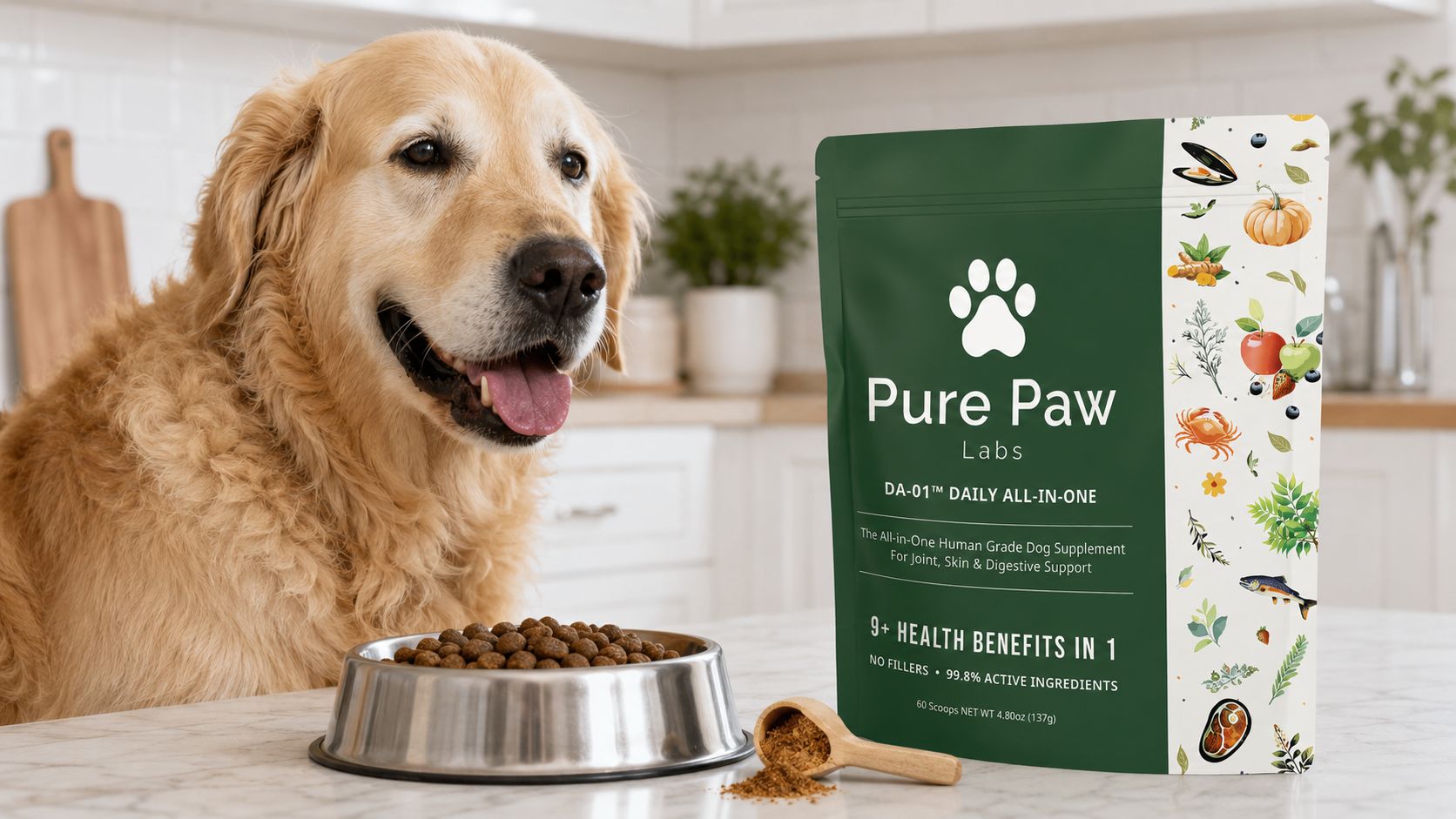
DA-1™ Daily All-in-One - Senior Dog Support, Joints, Skin/Coat & More is a powdered multi-system formula, and format is the first thing that matters here, not hype. One scoop delivers 18 human-grade ingredients targeting cells, gut, and joints, with no fillers and a 60-day money-back guarantee according to the product snapshot. For a large dog, that solves the dose-precision problem that chews create, before you even ask whether the ingredient mix fits the dog's actual needs.
The format tradeoff is simple. Powders give you the cleanest control over serving size. Chews are easier to sell than to dose well. Softgels make sense when you are using a single ingredient. Liquids can be practical, but only if the dog tolerates the taste and you keep the bottle stable.
The right format is the one you can keep using without dose drift. A perfect formula that ends up on the kitchen counter half the week does nothing for a 90-pound dog.
Where DA-1 Fits in a Large-Breed Regimen
A stacked supplement plan looks smart on paper and messy in a busy house. You buy one product for joints, another for omega-3s, another for gut support, and another for coat quality, then you spend the next month trying to remember whether the dog got all of them. For a big dog, that kind of regimen usually fails on compliance before it fails on theory.
DA-1 fits as a single daily powder when the goal is to simplify the routine without collapsing the ingredient stack into chew math. The product snapshot describes it as a complete multi-system formula with 18 human-grade ingredients, designed to help aging dogs move easier and back it with a 60-day money-back guarantee. That makes it a reasonable option for owners who want one scoop instead of four separate bottles.
Where it makes sense
A powder all-in-one is strongest when the dog already needs more than joint support. If you're also trying to manage skin, coat, gut, or general senior maintenance, one daily scoop is cleaner than a supplement pile. It also fits large dogs well because the serving can be tied to the meal, which is easier to maintain than daily chew counting.
The limitation is just as important. DA-1 is not a prescription substitute for pain control, and a dog with confirmed orthopedic disease may still need a more targeted plan from a veterinarian. If the dog's joint issue is the main problem and every other system is already handled, a narrower joint-only approach can be more efficient.
My take on product fit
I'd use an all-in-one powder for a healthy adult large breed that needs broad support, a senior that already benefits from a simplified routine, or an owner who knows they won't keep up with a supplement stack. I'd avoid it if the dog needs tightly targeted medical management and you're just looking for one more daily add-on.
If you're choosing between formulas, compare the daily delivered ingredients, not the number of functions printed on the tub. That's the only comparison that survives contact with a 90-pound dog.
Choosing Between a Joint-Only and an All-in-One
The choice is situational. A healthy 3-year-old Labrador on a complete diet doesn't need the same regimen as a 7-year-old German Shepherd with early hip dysplasia, and neither looks like a senior Great Dane already taking multiple products. One size doesn't fit these dogs, and pretending it does is how owners overspend.
Use the dog's actual problem to pick the format
If the dog is young, healthy, and already on a complete diet, a joint-only product can be enough if you want prevention and a clean, narrow formula. If the dog has early orthopedic findings and you're trying to support mobility while keeping the rest of the regimen simple, an all-in-one powder can be the better adherence play. If the dog is a senior and you're already stacking several supplements, simplify before you add more.
| Joint-Only vs All-in-One by Dog Profile | Best Format | Key Ingredients Needed | Estimated Daily Cost |
|---|---|---|---|
| Healthy 3-year-old Lab | Joint-only or no supplement, depending on risk tolerance | Focus on omega-3s if you supplement at all | Lowest effective spend |
| 7-year-old German Shepherd with early hip dysplasia | All-in-one or targeted joint powder | Joint support plus omega-3s | Moderate, depends on dose delivery |
| Senior Great Dane on multiple products | All-in-one powder | Broad support, including joint and non-joint needs | Often lower than stacking several products |
The mistake is judging cost by container price. Large-breed dosing inflates the daily spend fast, so the only number that matters is the cost per effective dose. A cheap bottle that underdoses a Great Dane isn't cheap. It's waste with packaging.
Decision rule: Choose the format that gets the right daily milligrams into the dog's bowl with the fewest missed days.
Large-Breed Joint Supplement Decision Checklist
You don't need a shelf full of options. You need a filter. Use this checklist before you buy any dog joint supplement large breed formula, and ignore anything that can't pass all six steps.
- Confirm the milligrams Check the per-day delivered milligrams of glucosamine, chondroitin, and omega-3s against your dog's weight bracket.
- Check the format Powder usually gives better dosing accuracy than a tablet, and a properly dosed chew beats a pretty label every time.
- Verify testing Look for third-party purity and label-accuracy testing, especially if you're feeding the supplement daily for months.
- Match the breed and routine Make sure the product is built for a large or giant breed, and that you can give it every day without a fight.
- Review medications Cross-check current meds before using anything with green-lipped mussel, MSM, or other add-ons that may not fit every dog.
- Calculate the cost Price the supplement at the large-breed daily dose, not at the container price.
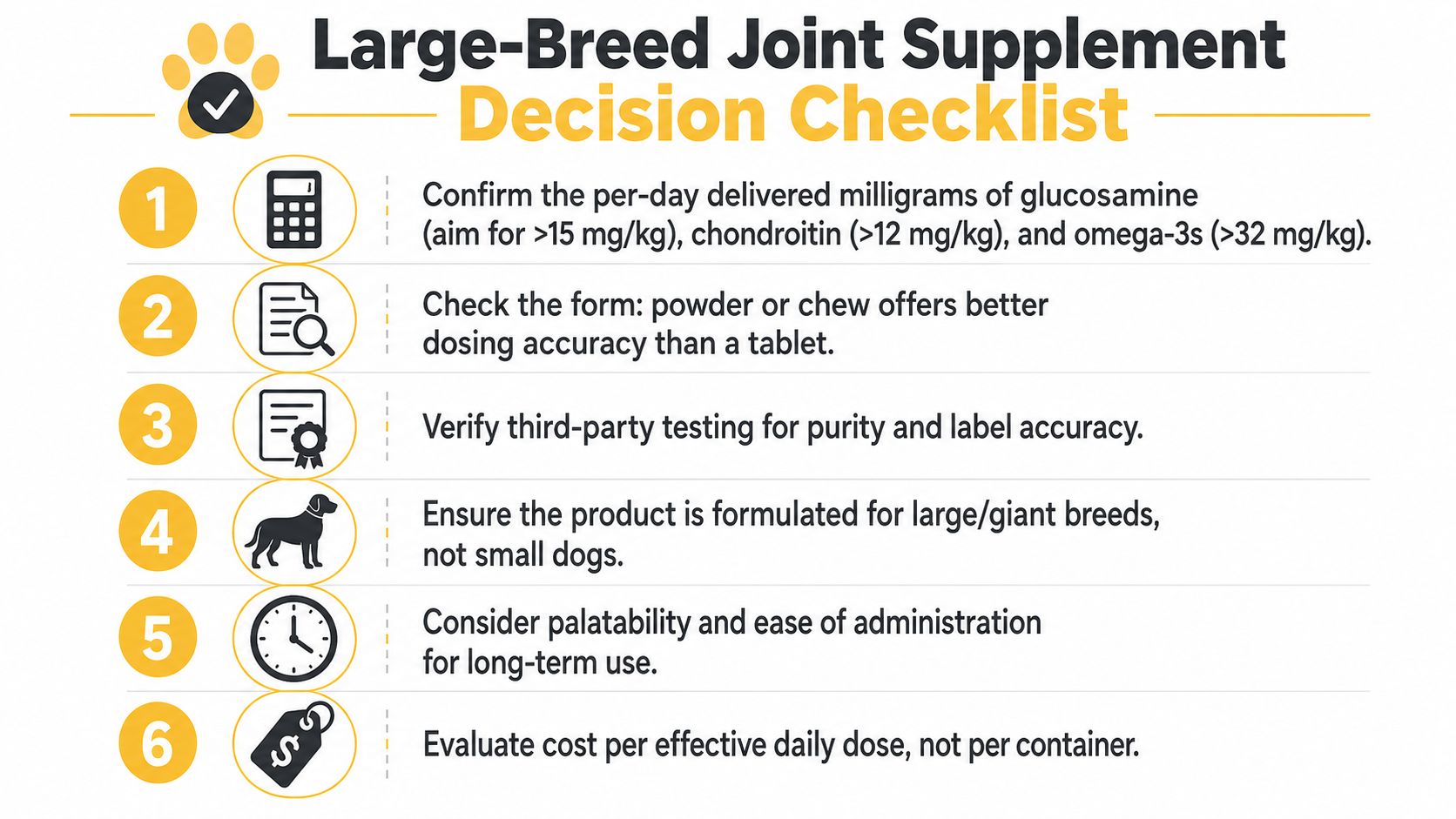
That checklist is the whole game. If the product can't deliver the right daily amount, it doesn't matter how many ingredients it lists. If the format makes you skip doses, it's the wrong format. If the cost only looks good before you scale it to a 90-pound dog, it isn't a good buy.
The right supplement for a large dog is the one you can dose correctly, every day, without guessing. If you want a powder-based option that consolidates joint support with broader daily care, visit Pure Paw Labs and compare the regimen against your dog's actual weight, age, and routine.