


You're standing in the pet aisle with a bottle in one hand and your dog's leash in the other. The label says “omega-3,” “fish oil,” or “skin and coat support,” but the number on the front doesn't tell you how much of the fatty acids your dog may receive. The most useful question isn't whether a dog omega supplement contains oil. It's how much EPA and DHA it delivers, how that amount fits your dog's diet, and whether it matches the health goal you're addressing.
That distinction helps prevent two common mistakes: giving too little to affect a specific concern, or adding more than your dog needs because the product's total oil weight looks impressive. The safest approach combines careful label reading, simple dosing math, and veterinary guidance when your dog has a diagnosed condition, takes medication, or eats a therapeutic diet.
Table of Contents
- Understanding Dog Omega Supplements and Fatty Acids
- Proven Benefits for Skin, Coat, and Joint Health
- Decoding Labels to Find Actual EPA and DHA Levels
- Calculating the Right Dosage for Your Dog
- Safety, Contaminants, and When to Pause
- Choosing Between Oils, Capsules, and All-in-One Powders
- Building a Sustainable Daily Supplement Routine
Understanding Dog Omega Supplements and Fatty Acids
The bottles may look similar, but “omega-3” describes a family of fats rather than one interchangeable ingredient. The three names owners encounter most often are ALA, EPA, and DHA. Their chemical roles differ, and a label listing one of them doesn't automatically tell you how much of the others your dog will receive.

ALA is not the same as EPA and DHA
Plant ingredients such as flaxseed provide alpha-linolenic acid, or ALA. Marine oils provide the long-chain fatty acids eicosapentaenoic acid, or EPA, and docosahexaenoic acid, or DHA. For many condition-specific veterinary plans, EPA and DHA are the figures that matter because they're the forms used when researchers evaluate skin and mobility outcomes.
That's why a plant-based omega claim shouldn't be treated as an equivalent substitute for a measured EPA-plus-DHA amount. A product can contain omega-3 fat and still provide little or no directly listed EPA or DHA. If the label doesn't separate those amounts, you can't calculate the active payload with confidence.
Label principle: “Omega-3” tells you the category. EPA and DHA tell you what you're actually dosing.
From generic fish oil to a targeted supplement
A bottle marked “fish oil” may contain a large total amount of oil, but the oil includes more than EPA and DHA. The concentration depends on the formulation, so two products with the same serving size may provide very different quantities of the fatty acids used in clinical research.
The dog's starting point matters too. A complete diet may already contribute fatty acids, while treats, toppers, capsules, and liquid oils can add more. The right product therefore depends on the dog's food, body weight, health objective, and medical history, not just on the most prominent number on the bottle.
For a healthy dog, an owner might be considering general nutritional support. For a dog with itchy skin or stiff movement, the veterinarian may recommend a more specific plan. Those situations shouldn't be collapsed into one universal scoop because the goal changes the relevant dose and the level of monitoring.
Proven Benefits for Skin, Coat, and Joint Health
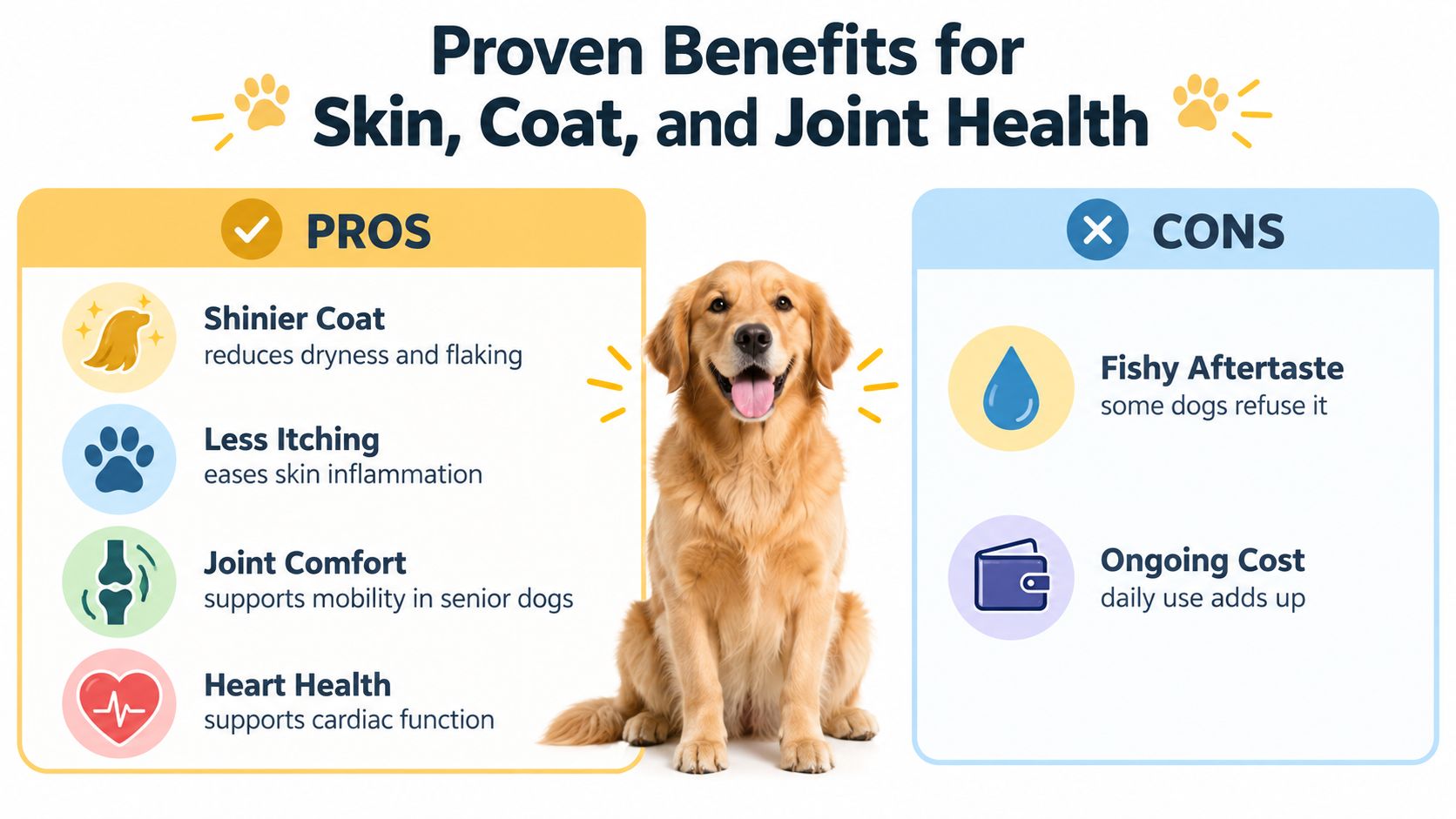
Omega-3 supplementation in dogs has been investigated most directly for dermatologic and joint-related outcomes, rather than as a universal solution for every health concern. That distinction matters when an owner is hoping to improve a dull coat, reduce scratching, or help an older dog move more comfortably.
What the skin research shows
A clinical trial involving 40 dogs with atopic dermatitis used approximately 43 mg/kg of EPA and 30 mg/kg of DHA. The dogs showed reductions in validated dermatitis severity scores, itching, and inflammation, along with improved skin condition, as reported in the reviewed canine omega-3 evidence.
A separate double-blind crossover study involving 16 dogs with pruritic dermatitis associated fish-oil supplementation with improvements in itching, hair loss, self-trauma, and coat quality, according to the same evidence review. Controlled trials are useful because they provide more than owner impressions, but they still don't prove that every formulation or dose will work for every dog.
Skin signs also have many possible causes. Parasites, infection, allergies, hormonal disease, and dietary problems can all produce itching or coat changes. An omega supplement may support a veterinary treatment plan, but it shouldn't replace diagnosis when scratching is persistent, intense, or accompanied by redness, wounds, odor, or hair loss.
For practical background on choosing a product for appearance-related goals, see this guide to the best supplement for dog coat. Use its label-reading principles alongside your veterinarian's assessment rather than treating coat shine as proof that an underlying disease has been resolved.
What joint evidence can and cannot promise
Joint-support formulations focus on EPA and DHA because those are the specific long-chain fatty acids studied for mobility concerns. The evidence supports omega-3s as a researched adjunct for selected dogs with osteoarthritis or related mobility issues. It doesn't make an oil a replacement for diagnosis, weight management, rehabilitation, pain control, or prescribed treatment.
Expectations should also be realistic. A coat may look different before a dog's movement changes, and an older dog with established osteoarthritis may need a broader plan than a supplement alone. Track one clear outcome, such as willingness to climb stairs, comfort during a walk, or a veterinarian's mobility assessment, instead of relying on a vague impression of “wellness.”
An all-in-one option, such as DA-1™ Daily All-in-One - Senior Dog Support, Joints, Skin/Coat & More, is described by its manufacturer as a multi-system powder with 18 human-grade ingredients for cells, gut, and joints. If you consider a combined formula, still identify its actual EPA and DHA contribution and count any other supplements your dog receives.
Decoding Labels to Find Actual EPA and DHA Levels
Your dog's supplement label says “1,000 mg fish oil,” but that figure alone cannot tell you how much active omega-3 your dog receives. The front of the bottle may highlight total oil, while the back panel shows the information needed for dosing.
For canine joint support, the clinically studied targets are EPA and DHA, not total fish oil, as described in this review of omega-3 efficacy and dosing in companion animals. Total oil is the container's weight. EPA and DHA are the active contents you need to measure.
Four steps for label auditing
- Confirm the serving size. Identify whether one serving means a pump, capsule, teaspoon, or scoop. EPA and DHA values apply to that stated amount, so the serving definition sets the foundation for every later calculation.
- Find separate EPA and DHA amounts. Record both figures, including their units. A label that lists only “total omega-3,” “fish oil,” or ALA does not show the specific EPA and DHA payload needed for a precise plan.
- Add EPA and DHA. If one serving contains separate amounts of EPA and DHA, combine them to find the total active delivery. Do not substitute the total oil weight for this sum.
- Compare the combined amount with the veterinary target. Your veterinarian can match the desired daily milligrams to the product's pumps, capsules, teaspoons, or scoops. This prevents a concentrated product from being given as though it were a weaker one, or a dilute product from being mistaken for a full dose.
Label reading example
| Product label claim | Total oil weight | Active EPA + DHA | Therapeutic value |
|---|---|---|---|
| Product A states “fish oil” only | Listed, but not enough by itself | Not disclosed | Cannot be calculated reliably |
| Product B lists fish oil plus separate EPA and DHA | Listed | Can be calculated by adding both values | Suitable for a measured discussion with a veterinarian |
| Product C lists “total omega-3” only | Listed or partially listed | EPA and DHA not separated | The relevant dose remains unclear |
Keep a running total if your dog receives more than one omega-3 product or a diet that already supplies these fatty acids. A clearly stated EPA-plus-DHA concentration makes that audit possible, even when the bottle itself is smaller or contains less total oil. For more detail, see this guide on how to read supplement labels, then apply the calculation to the exact product and serving size in your home.
Calculating the Right Dosage for Your Dog
A 10-kilogram dog may receive omega-3 from its food, treats, and supplement, so the dose on the bottle is only one part of the calculation. Start with the dog's purpose, then match the product's actual EPA and DHA delivery to a veterinary target.
Veterinary reviews describe approximate osteoarthritis ranges of 48–100 mg/kg of EPA per day and 20–32 mg/kg of DHA per day, with EPA-to-DHA ratios of about 1.5–3.4 to 1 in the reviewed joint-support literature. These are condition-specific research ranges, not universal instructions. Use them as context for a discussion with your veterinarian, not as a self-prescribed dose.
Start with the dog's objective
General wellness and therapeutic mobility support require different calculations. The reviewed evidence describes lower approximate EPA and DHA ranges for dermatology than for osteoarthritis, while evidence for gastrointestinal disease is weak or absent, as summarized in this recent evidence review.
Record the following:
- Dog's body weight: use kilograms, not only pounds.
- Health goal: identify general support, skin, mobility, or another veterinarian-defined purpose.
- Target amount: ask for the desired combined EPA and DHA per day.
- Product concentration: write down EPA and DHA per serving.
- Serving calculation: divide the desired daily EPA-plus-DHA amount by the product's combined amount per serving.
For example, if one serving supplies 300 mg of combined EPA and DHA and the plan calls for 600 mg per day, the arithmetic is two servings. The example demonstrates the method, not a recommendation for a particular dog. A concentrated oil may require less volume than a dilute product even when both labels show the same total oil weight.
Count the whole diet
Keep an intake ledger. Add EPA and DHA from complete food, fortified treats, toppers, other oils, and capsules. If the food manufacturer does not provide those amounts, request the information before setting a therapeutic dose.
The National Research Council safe upper limit cited for dogs is 2,800 mg of combined EPA and DHA per 1,000 kcal of diet, equivalent to approximately 370 mg/kg^0.75 per day. For a 10-kg dog, that corresponds to about 2,080 mg per day, according to the veterinary study discussing dietary EPA and DHA limits. Because this benchmark is based on dietary energy, the same scoop can create different exposure levels in dogs with different sizes or calorie needs.
Practical rule: Add the supplement's EPA and DHA to the food's contribution, then compare the total with the veterinary plan and safe upper limit.
For mobility products, introduce the chosen amount gradually and seek professional review if your dog takes NSAIDs, has pancreatitis risk, has a bleeding disorder, or is approaching surgery. This guide to salmon oil for dogs can clarify common product questions, but individualized dosing still belongs with your veterinarian.
Safety, Contaminants, and When to Pause
“Natural” doesn't mean universally harmless. Marine oils are concentrated fats, and a product can be inappropriate because of its contaminants, freshness, calorie contribution, dose, or interaction with the dog's medical care.
Quality checks before the first serving
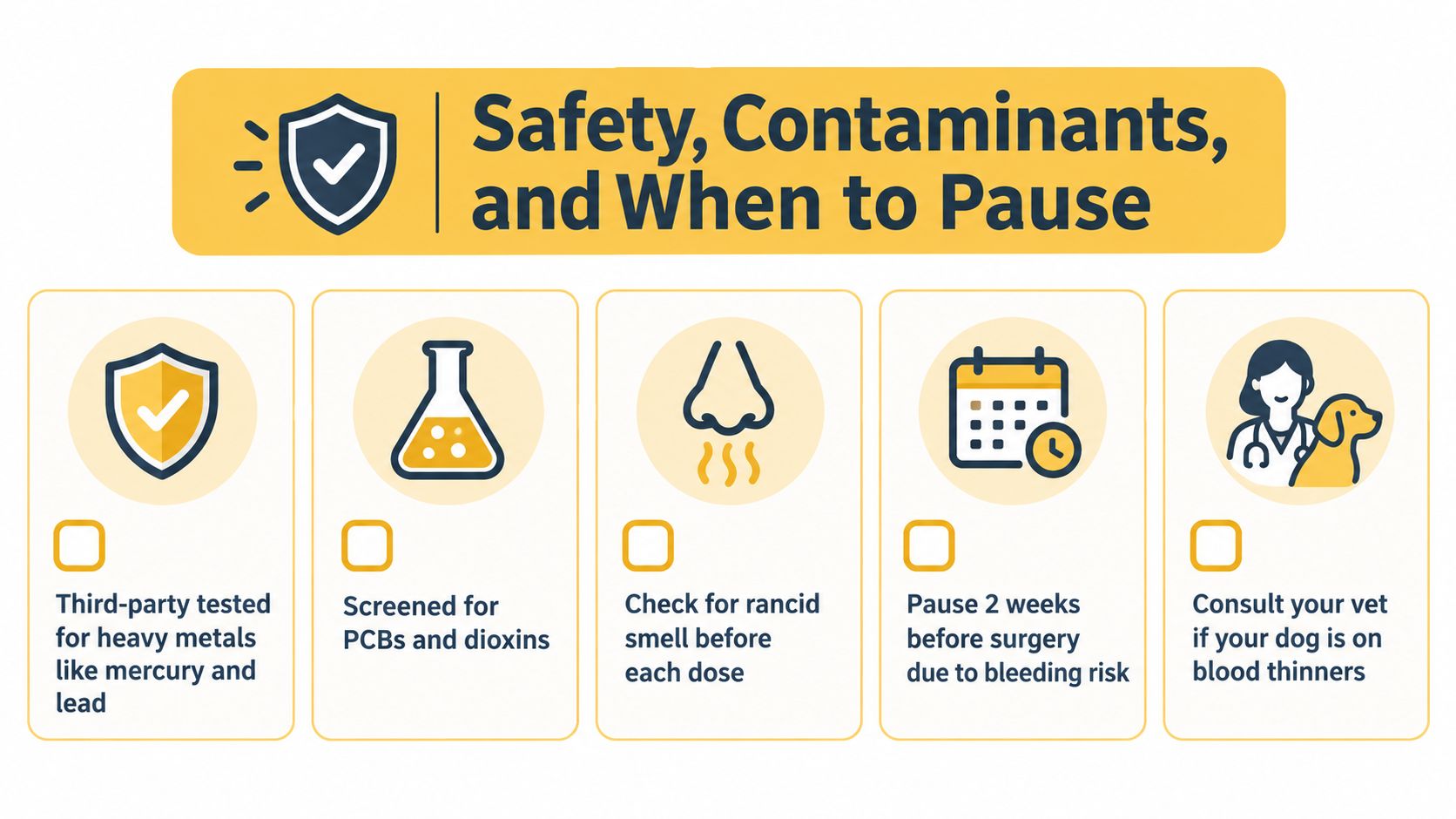
Look for transparent information about manufacturing controls, batch identity, freshness, and testing for contaminants relevant to marine ingredients. A company that can't explain what it tests and how it identifies a batch gives you less information for evaluating the finished product.
Store the oil exactly as directed and inspect it before use. A sharp or rancid odor is a reason to stop and ask the manufacturer or veterinarian about the product rather than trying to disguise it in food. Also check the full ingredient list, especially if you're considering a human product, because flavorings and added ingredients may not suit dogs.
Medical situations that deserve extra caution
Veterinary guidance identifies vomiting, diarrhoea, and belching with higher-dose use, while recommending caution for dogs with bleeding disorders, long-term diarrhoea, allergies, pregnancy, or diets already fortified with fatty acids. Omega-3s can affect platelet function, which matters before surgery and when a dog receives anticoagulant or antiplatelet medication, as described in this veterinary safety guidance for fish oil.
Ask your veterinarian before starting or continuing a supplement if your dog:
- Takes medication: disclose NSAIDs, blood-thinning drugs, antiplatelet medication, and every other supplement.
- Has a relevant history: mention bleeding problems, pancreatic risk, chronic diarrhoea, allergies, or a sensitive digestive system.
- Faces a procedure: ask whether supplementation should be paused before surgery rather than making the decision independently.
- Eats a fortified diet: include therapeutic food and treats in the cumulative intake calculation.
Pause the product and seek veterinary advice if persistent vomiting or diarrhoea develops, your dog becomes unusually lethargic, or you notice suspected overdose, unusual bruising, or bleeding. A simple batch-testing guide can help you understand the quality documentation a supplement company should be able to discuss.
Choosing Between Oils, Capsules, and All-in-One Powders
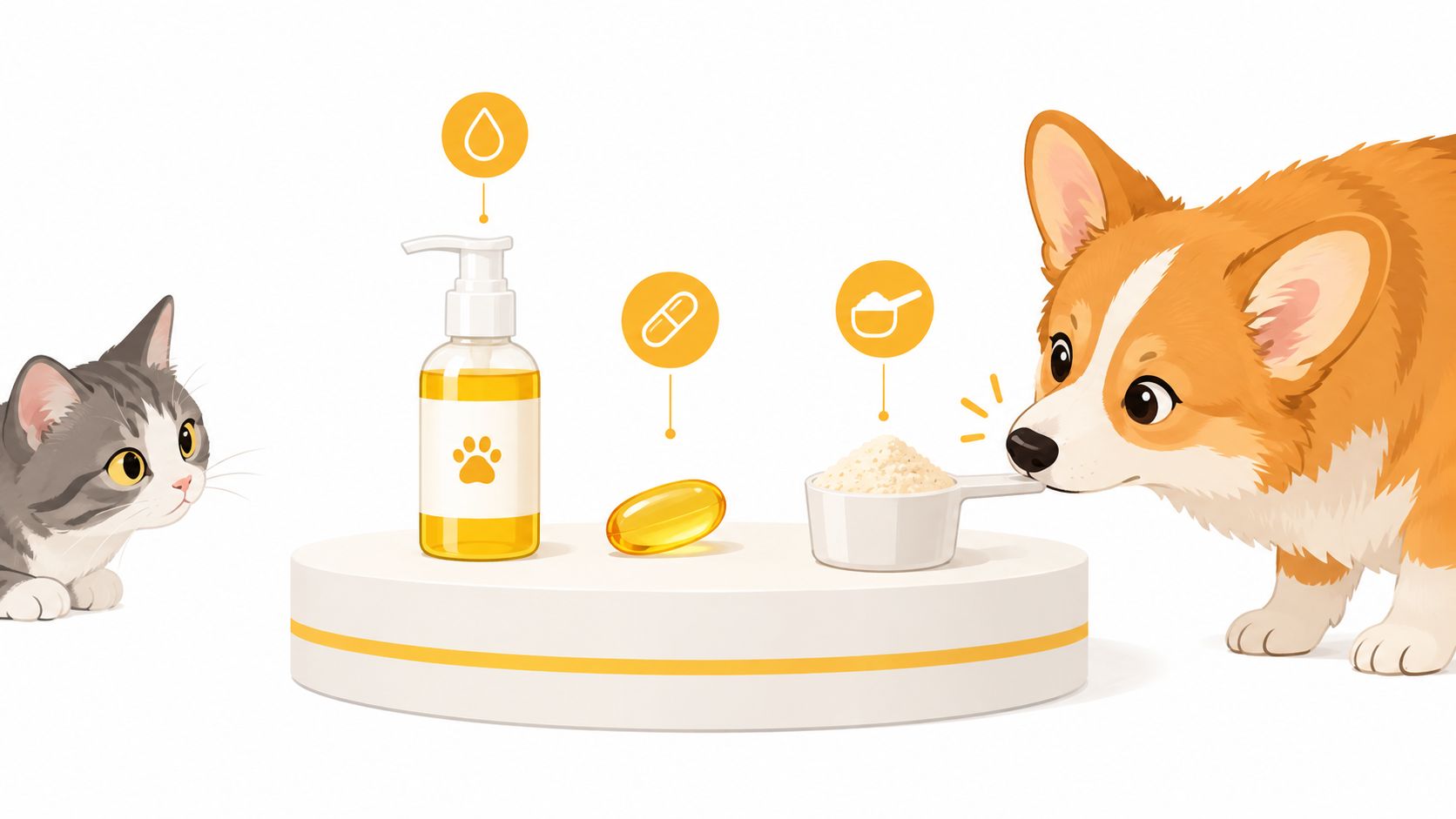
The delivery form affects convenience, measurement, storage, and adherence. There isn't one format that's automatically right for every dog. The best choice is the one that provides a clearly calculated EPA-plus-DHA amount and fits the dog's food, preferences, and medical plan.
Liquid oils
Liquid oils are easy to mix into food and can offer flexible serving adjustments. That flexibility becomes useful when a veterinarian gives a target that falls between capsule sizes, but pumps and teaspoons still need accurate measurement.
The trade-offs include messy handling, added calories, exposure to air after opening, and the possibility that a dog rejects the taste. A large bottle can also encourage owners to pour by eye, which undermines the careful math required for EPA and DHA dosing.
Capsules
Capsules are portable and can protect the oil from repeated exposure to air until opened. They may work well for dogs that swallow them or accept them hidden in food, but a fixed capsule amount can be awkward when the dog needs a smaller or more precise serving.
Always calculate the capsule's EPA and DHA rather than assuming the capsule's total oil weight is the active dose. If the dog refuses capsules, opening them into food may affect palatability and storage, so follow the product instructions.
Powders and combined routines
Powdered toppers can be convenient for owners who already add supplements to meals. An all-in-one formula may also reduce the number of separate products in a routine, but it creates a different responsibility: audit every active ingredient and confirm the EPA and DHA amounts rather than assuming the formula provides a therapeutic omega dose.
This matters when multiple oils, joint products, and fortified foods are used together. Consolidation can simplify administration, but it doesn't remove the need to count cumulative intake or check compatibility with medication.
Here's a short visual explanation of the differences between common delivery formats:
Choose the format that your dog will accept consistently and that lets you measure the intended EPA-plus-DHA amount. Convenience is useful only when it supports accurate, repeatable dosing.
Building a Sustainable Daily Supplement Routine
A good routine starts with a baseline, not a full scoop. Record your dog's current food, treats, weight, medicines, stool quality, appetite, scratching, coat condition, and mobility. If the dog has a diagnosed condition, share that record with the veterinarian before changing the diet.
A careful introduction plan
- Confirm the product math. Write down EPA per serving, DHA per serving, combined EPA plus DHA, serving size, calories if listed, storage instructions, and expiry date.
- Begin conservatively. Introduce the product gradually rather than changing the serving abruptly. A slow introduction gives you a better chance of identifying whether loose stool, vomiting, reduced appetite, or refusal is linked to the supplement.
- Keep the rest stable. Don't start several oils, treats, diets, and supplements at the same time. One meaningful change makes the dog's response easier to interpret.
- Track one or two outcomes. For skin, record scratching, redness, coat texture, and self-trauma. For mobility, note getting up, walking, stairs, and willingness to play. A simple daily note is more useful than trying to remember impressions from several weeks ago.
- Review the plan. If signs worsen, stop and contact the veterinarian. If nothing changes, don't automatically increase the dose. Recheck the diagnosis, product concentration, food contribution, and clinical objective first.
The all-in-one supplement guide can help you think through regimen simplicity, but a combined product still needs the same label audit as a standalone oil. Look for clear ingredient disclosure, batch information, appropriate storage guidance, and manufacturing details you can verify.
Regulatory status also deserves context. In the United States, animal supplements don't have a separate legal category equivalent to human dietary supplements. Depending on the ingredients and marketing claims, a canine product may be regulated as animal food or as a new animal drug, and lawful marketing doesn't prove clinical effectiveness for a particular condition, as explained in this review of animal supplement regulation.
Pure Paw Labs offers daily powdered supplements, including a multi-system formula designed to combine support for areas such as joints, skin and coat, and gut health in one routine. Visit Pure Paw Labs to review the available formula information, then compare its EPA and DHA details with your dog's complete diet and veterinary plan before starting.