


Your dog used to spring up when you reached for the leash. Now there's a pause before standing, a careful step at the bottom of the stairs, or a shorter walk that gets explained away as normal aging. These changes can be easy to miss because they often appear gradually, and many dogs continue to act cheerful even when movement has become uncomfortable.
Dog mobility issues aren't limited to obvious limping. A dog may compensate by shifting weight, moving more slowly, avoiding certain activities, or resting longer after ordinary exercise. The most useful response isn't waiting for a dramatic decline. It's learning to notice small changes, recording them consistently, and building a daily plan that combines veterinary guidance with sensible movement, weight control, home adjustments, and carefully selected support.
Table of Contents
- Recognizing Early Dog Mobility Issues at Home
- Understanding the Main Causes of Canine Mobility Problems
- Early Warning Signs That Require Attention
- What to Expect During a Veterinary Mobility Evaluation
- Building a Daily Mobility Care Routine
- Choosing the Right Supplement Support for Your Dog
- Red Flags That Need Urgent Veterinary Care
- Long-Term Mobility Prevention and Monitoring Plan
Recognizing Early Dog Mobility Issues at Home
A golden retriever may still greet you enthusiastically while gradually changing how he moves. Perhaps he no longer jumps onto the sofa, takes longer to rise from the rug, or stops halfway up the stairs and looks back. None of these signs proves a specific diagnosis, but together they tell you that his usual movement pattern has changed.

Watch the ordinary moments
Early mobility loss often appears during familiar routines rather than during strenuous activity. Pay attention to whether your dog:
- Rises differently: He may push up with his front legs first, hesitate, or need several attempts.
- Approaches stairs cautiously: A dog that once moved freely may avoid stairs, take them one at a time, or refuse them altogether.
- Changes walking speed: He might lag behind, stop more often, or seem reluctant to continue on a familiar route.
- Plays for less time: Reduced chasing, turning, roughhousing, or jumping can signal discomfort even without a visible limp.
- Sleeps more after activity: Longer recovery after an ordinary day matters, especially when it becomes a pattern.
- Uses a different posture: A tucked abdomen, rounded back, widened stance, or uneven weight distribution deserves attention.
Keep a simple weekly log. Record the activity, the surface, how easily your dog rose, whether he used stairs, and how he behaved later that day. Short videos of walking, turning, sitting, and getting up can be especially useful because dogs often move differently in a clinic.
Early recognition gives you more choices. You may be able to adjust activity, improve traction, address body condition, and investigate pain before your dog loses substantial muscle or avoids movement altogether. Early monitoring is also becoming more practical, with owner-focused tools such as the GenPup-M questionnaire receiving attention for identifying subtle changes sooner, as discussed by canine arthritis professionals.
Understanding the Main Causes of Canine Mobility Problems
A dog can compensate for a painful joint long before he shows an obvious limp. Mobility problems often develop through several interacting causes, so identifying the source early gives you more useful options than waiting for severe arthritis.
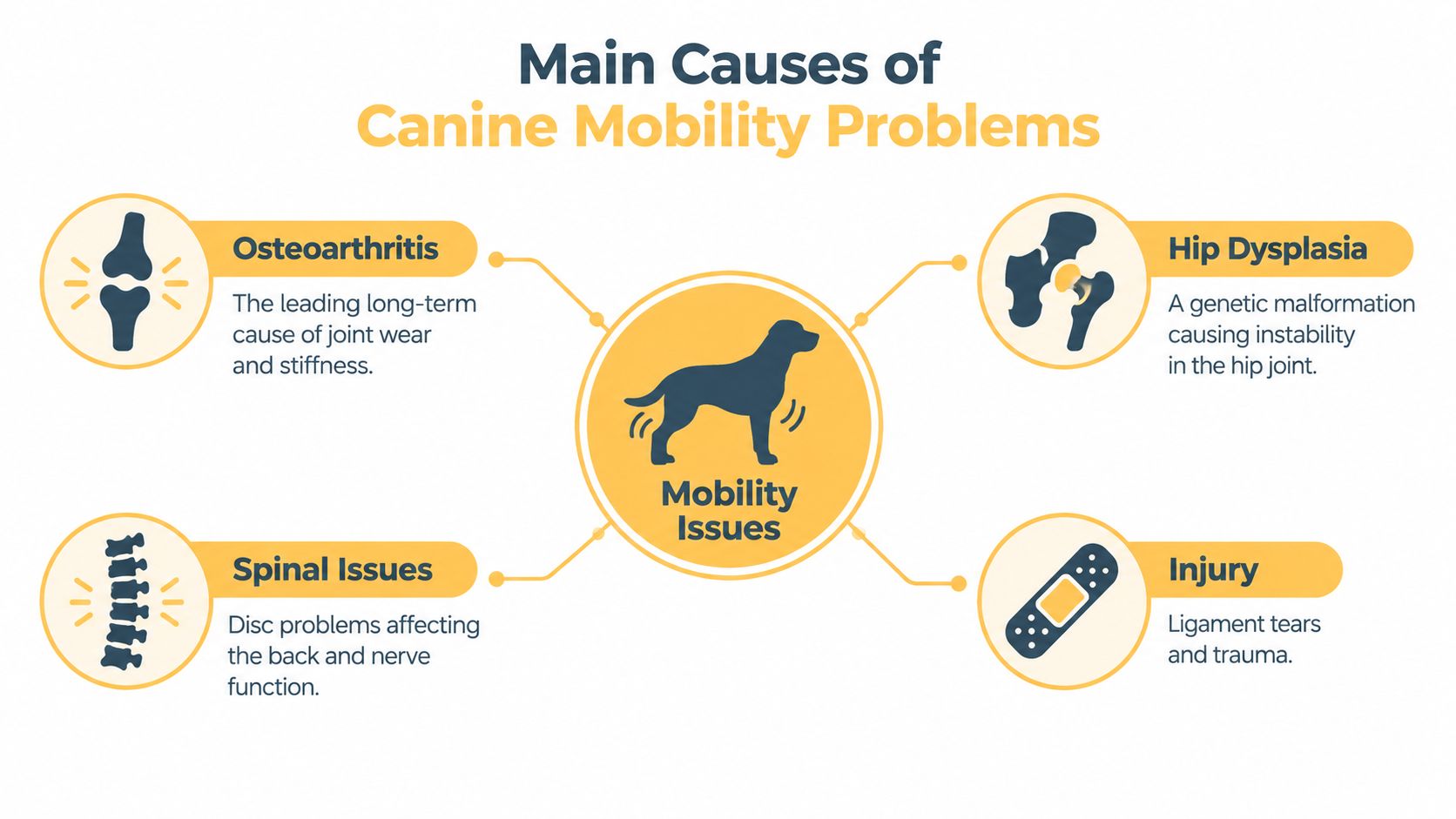
Osteoarthritis is a common long-term cause of canine mobility problems, but it is a progressive joint disease rather than a synonym for old age. In a synovial joint, cartilage becomes thinner and develops fissures. Joint fluid and inflammation change, while osteophytes, commonly called bone spurs, may form alongside changes in the underlying bone.
Cartilage normally provides a smooth, resilient surface that helps distribute load. As it deteriorates, the joint handles force less efficiently. Pain and restricted movement can lead a dog to use the limb less, which weakens the surrounding muscles and reduces the joint's dynamic support. This creates a cycle in which pain, muscle loss, and reduced activity reinforce one another.
Reported prevalence varies because studies use different populations, definitions, and methods. A major veterinary overview of arthritis in dogs reports that around 30% to 50% of dogs and cats may be affected by osteoarthritis at some point, another veterinary source places lifetime joint issues at roughly one in five dogs, UK primary-care records report figures ranging from 6.6% in 3,884 dogs to an annual estimate of 2.5% across 455,557 dogs, and a questionnaire-based U.S. study across nine practices found 37.3% when veterinary examination and/or radiographs confirmed disease. The figures should not be compared directly, but they show that mobility disease is common and may go unrecognized in routine care. veterinary overview of arthritis in dogs
Look beyond arthritis
Other conditions can start or accelerate joint deterioration:
- Orthopedic injury: A cranial cruciate ligament rupture, fracture, or other trauma can alter how a dog loads the limb.
- Developmental conditions: Hip dysplasia and osteochondrosis can create instability or abnormal forces before arthritis becomes obvious.
- Spinal disease: Disc problems and nerve dysfunction may cause weakness, poor coordination, or difficulty placing the feet.
- Systemic illness: Metabolic or neurologic disease can resemble orthopedic stiffness but requires a different treatment plan.
Management should match the cause. A sustainable plan may combine controlled exercise, healthy weight, better traction or access around the home, and appropriate supplement support, but supplements cannot correct instability, nerve involvement, or an untreated injury. A veterinarian needs to determine whether pain, muscle loss, joint instability, nerve dysfunction, or several problems are contributing.
Early Warning Signs That Require Attention
The first useful change is often not a limp. It's a difference in effort. Your dog may still complete an activity, but he takes longer, chooses an easier route, or stops volunteering for something he once enjoyed.
Use this daily checklist for a few weeks rather than relying on memory:
- Observe rising: Notice whether your dog gets up smoothly after sleeping or pauses before placing weight on a limb.
- Watch transitions: Sitting, lying down, turning in a tight space, and stepping over a threshold can expose reduced range of motion.
- Compare familiar walks: Look for a slower pace, more stopping, less sniffing, or a reluctance to walk the usual distance.
- Check jumping choices: Refusing the car, sofa, or a low step may reflect discomfort rather than stubbornness.
- Notice grooming and licking: Repeated licking near a joint or difficulty reaching the hindquarters can accompany pain or restricted movement.
- Review the following hours: Stiffness after exercise, increased sleep, irritability, or reluctance to move later may be more revealing than the walk itself.
Record observations at home, on leash, and on the same flooring when possible. Slippery floors can make a dog look weaker than he is, while excitement can temporarily mask discomfort. A phone video can show a veterinarian how your dog moves in his normal environment.
Muscle loss deserves special attention. If one thigh looks smaller, your dog may have been protecting that limb for some time. This guide to muscle atrophy in dogs can help you understand why visible muscle changes warrant professional assessment rather than just more exercise.
Practical rule: A repeated small change is more useful than one dramatic observation. Write it down, film it when safe, and share the pattern with your veterinarian.
Book an appointment if the change persists, progresses, or affects normal activities. Don't try to provoke pain by forcing stretches, repeated jumping, or intense play to “test” the joint.
What to Expect During a Veterinary Mobility Evaluation
A mobility appointment usually starts with your history, not the X-ray. Your veterinarian will want to know what changed, when it started, whether it varies after rest or exercise, and which activities your dog now avoids. Bring your observation log and a few short home videos if you have them.
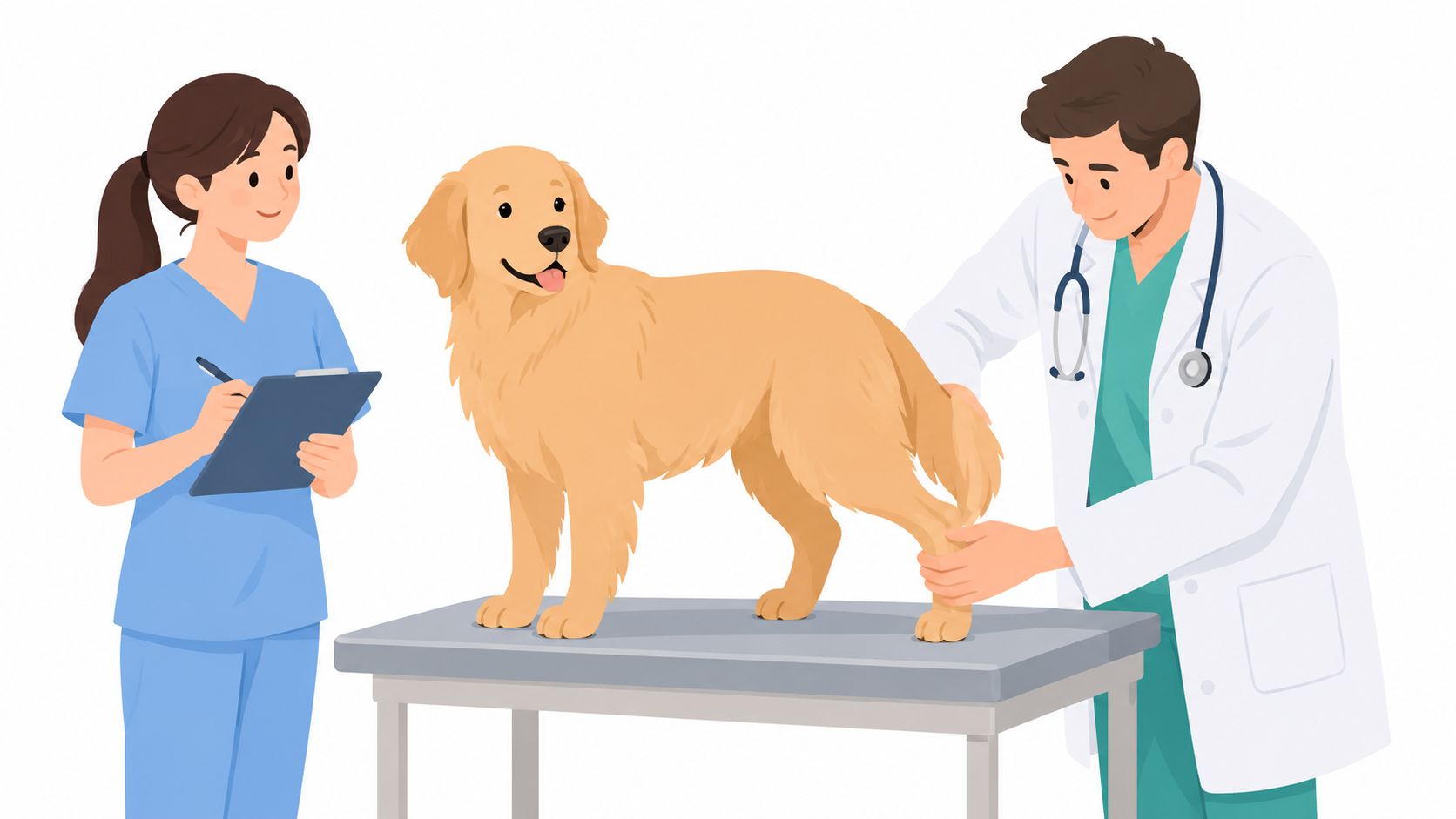
The physical examination may include watching your dog walk, trot, turn, sit, and stand. The veterinarian may palpate the spine and limbs, compare muscle size, assess joint range of motion, and look for instability or pain responses. A dog that appears comfortable in the room may move differently at home, so your descriptions matter.
Why several measurements matter
Radiographs can show structural changes such as narrowed joint spaces, osteophytes, and subchondral sclerosis. However, early functional decline may not match what appears on an X-ray. Objective gait assessment and clinical measurements can detect changes that imaging alone may miss, which is why experts recommend combining owner-reported function with gait analysis, examination, and imaging for serial monitoring.
The Canine Osteoarthritis Staging Tool uses a 0–4 scale that brings together risk factors, owner observations, physical examination, and radiographs. Staging doesn't replace clinical judgment. It gives the care team a consistent way to describe the current state and compare future assessments.
Questions worth asking
Ask your veterinarian:
- Which limb, joint, muscle group, or neurologic pathway appears affected?
- What activities should continue, and which should be restricted?
- Does my dog need pain relief, rehabilitation, imaging, blood testing, or referral?
- How will we measure progress at home?
- What signs would mean the plan needs to change?
A normal-looking early radiograph shouldn't automatically end the investigation if your dog's function is declining. Conversely, visible joint change doesn't dictate the same plan for every dog. The useful diagnosis connects structure with comfort, movement, behavior, and quality of life.
Building a Daily Mobility Care Routine
A sustainable routine has to fit real life. The aim isn't to keep your dog completely still, nor is it to recreate the activity level of a younger dog. It's to provide regular, controlled loading that maintains muscle without creating painful spikes in joint stress.
Start with predictable movement
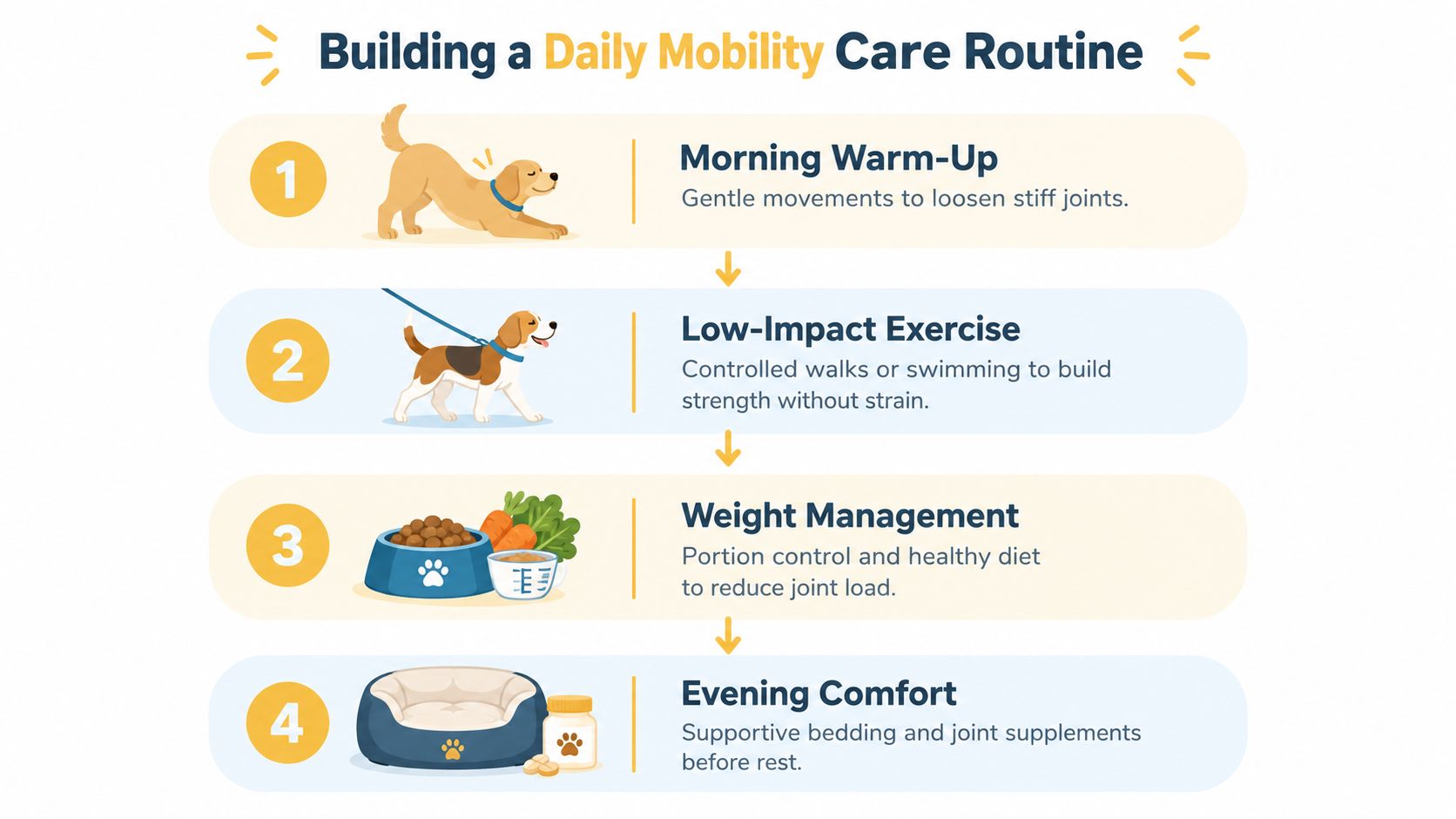
Begin the day with a calm warm-up. Allow your dog to walk slowly on a secure, nonslip surface before asking for a longer outing. Controlled leash walking and swimming can preserve periarticular muscle, which supports the joint dynamically. Rehabilitation research also reports improvements in passive range of motion after appropriately structured therapeutic exercise. The research on exercise and canine mobility supports movement that is low impact, repeatable, and adjusted to the individual dog.
Avoid the boom-and-bust pattern. A dog may chase a toy enthusiastically one afternoon and then struggle to rise the next morning. Replace frantic fetch, sharp turns, repeated jumping, and sudden bursts with steady walks, gentle strengthening prescribed by a professional, and rest periods before fatigue changes your dog's form.
Reduce load and improve the home
Body condition is part of mobility care. Work with your veterinarian to set an appropriate feeding plan and monitor portions, treats, and weight trends. Even a well-designed exercise plan becomes harder on painful joints if the dog is carrying more body mass than is appropriate.
At home, use rugs or runners over slippery flooring, place food and water where your dog doesn't need to climb, and provide a firm, supportive bed away from cold drafts. A ramp may be safer than stairs for a dog that struggles with jumping, but introduce it gradually and never force a frightened dog onto it.
A simple weekly plan might include:
- Daily: Gentle movement, a traction check, and a note on rising and recovery.
- Several times weekly: Controlled strengthening or rehabilitation exercises prescribed for your dog.
- Weekly: Review walking tolerance, appetite, sleep, gait, and any licking or reluctance.
- At every adjustment: Change one major variable at a time so you can identify what helped or caused a setback.
Assistive devices can be useful for selected injuries or periods of instability, but a brace isn't a substitute for diagnosis. Read about choosing a dog knee support brace and discuss fit, wear time, skin checks, and the underlying condition with your veterinary team.
Choosing the Right Supplement Support for Your Dog
Supplements can sit inside a mobility plan, but they shouldn't carry the whole plan. They don't correct an unstable ligament, replace prescribed pain control, rebuild lost muscle without exercise, or explain why a dog suddenly can't bear weight. Their practical value is greatest when the product is appropriate, safe for the individual dog, and easy to give consistently.
A single-purpose joint formula may suit a dog with a narrow, clearly defined need. A broader daily formula may be more convenient when an aging dog also has skin, coat, digestive, immune, or stress-related concerns. The trade-off is that broader support can make it harder to identify which ingredient is helping, so introduce products carefully and review them with your veterinarian, especially if your dog takes medication or has chronic disease.

| Support Area | Common Goal | Typical Ingredients |
|---|---|---|
| Joint support | Support comfortable movement and joint function | Glucosamine, chondroitin, omega-3 fatty acids |
| Skin and coat | Support the skin barrier and coat condition | Fatty acids, selected vitamins, antioxidant compounds |
| Gut balance | Support normal digestion and stool quality | Probiotic or postbiotic ingredients, digestive support compounds |
| Immune support | Complement normal immune function | Vitamins, minerals, and antioxidant ingredients |
| Stress support | Support calm behavior and daily resilience | Nutritional compounds selected for nervous-system support |
For owners comparing products, this guide to choosing the right joint chew offers a useful way to think about purpose, ingredients, and routine fit. Look for clear labeling, feeding directions, batch or quality information, and a company that explains what the product is intended to support without promising to diagnose or cure disease.
DA-1™ Daily All-in-One - Senior Dog Support, Joints, Skin/Coat & More is described as a multi-system powder with 18 human-grade ingredients targeting cells, gut, and joints, with one scoop intended to simplify a daily routine. It may fit owners who prefer one product rather than several separate supplements, but it should still be considered alongside veterinary assessment, exercise, body-condition management, and prescribed treatment. This overview of dog mobility supplements provides additional context for evaluating supplement support without treating it as a replacement for diagnosis.
Red Flags That Need Urgent Veterinary Care
Most chronic mobility decline is gradual. A sudden change is different and deserves prompt attention because it may indicate an acute injury, severe inflammation, neurologic problem, or another condition that can't be safely managed with home adjustments.
Contact a veterinarian urgently if your dog:
- Cannot stand or walk: Inability to rise, repeated collapse, or sudden weakness needs immediate assessment.
- Has severe or escalating pain: Crying, panting at rest, trembling, snapping when touched, or being unable to settle are not signs to watch at home.
- Develops sudden lameness: A dog that suddenly refuses to bear weight may have a serious orthopedic injury.
- Shows visible swelling or deformity: A hot, enlarged joint, abnormal limb position, or rapidly changing appearance requires professional care.
- Loses coordination: Dragging the feet, crossing the limbs, falling, or suddenly knuckling over can point to neurologic involvement.
- Stops eating or seems systemically ill: Mobility changes paired with marked lethargy, vomiting, feverish behavior, or refusal of food need more than routine arthritis management.
Don't massage a swollen area, force a range-of-motion exercise, give human pain medication, or encourage your dog to “walk it off.” Keep movement restricted, support your dog during transport, and call the clinic for instructions. If your regular veterinarian is closed, use an emergency service.
Long-Term Mobility Prevention and Monitoring Plan
Mobility care works best as a partnership, not a single appointment. Your veterinarian identifies the likely source of the problem and sets safe boundaries. You provide the daily information that shows whether the plan is helping in the home where your dog lives.
Use a repeating check-in rather than waiting for a crisis. Once a month, review:
- How easily your dog rises and lies down.
- Whether walking speed, distance, or enthusiasm has changed.
- Whether stairs, jumping, turning, or getting into the car have become difficult.
- Whether muscle size looks different between limbs.
- How long your dog takes to recover after normal activity.
- Whether the current food, exercise, supplement, or medication routine is realistic to maintain.
Record short videos under similar conditions, such as walking on the same path or rising from the same bed. Bring those observations to scheduled veterinary reviews and mention both improvements and setbacks. A plan that looks sensible on paper may still need adjustment if your dog is consistently tired, painful, or unwilling to participate.
Prevention doesn't mean eliminating every risk. It means avoiding repeated activity spikes, maintaining an appropriate body condition, protecting traction, treating injuries promptly, and preserving strength through safe movement. If your dog is already showing subtle changes, don't wait for a pronounced limp before asking for help.
Consistency matters more than perfection. A modest routine that your household can follow every day is more useful than an ambitious program that lasts briefly and leaves your dog sore.
Pure Paw Labs offers daily dietary supplement support designed to fit into a broader mobility routine, including joint, gut, skin and coat, immune, and stress-related support in a single scoop. Review the options and see whether Pure Paw Labs fits your dog's needs alongside guidance from your veterinarian.