


You're watching your dog pause at the bottom of the stairs she used to take two at a time. She's still keen for her walk, but she rises more slowly, settles with a sigh, and sometimes asks to turn for home early. You've already tried a joint chew and fish oil, and now a new phrase keeps showing up on labels and in owner groups, eggshell membrane for dogs. It sounds simple, almost kitchen scrap simple, which makes it hard to judge. Is it a serious ingredient, a marketing sprinkle, or something that belongs alongside what you're already doing?
Table of Contents
- Why Owners Are Hearing About Eggshell Membrane for Dogs
- What Eggshell Membrane Actually Is
- What the Veterinary Research Actually Shows
- Safety, Contraindications, and Dosing in Plain Numbers
- How to Read an Eggshell Membrane Supplement Label
- Where Eggshell Membrane Fits in a Daily Routine
- A Practical Four-Week Plan Owners Can Follow
- Putting It All Together for Your Dog
Why Owners Are Hearing About Eggshell Membrane for Dogs
Most owners meet this ingredient at a shelf or on a phone screen, not in a vet clinic. The dog in front of them is often middle aged or senior, still bright and willing, but moving more carefully after rest or after a longer walk. A glucosamine chew is already in the cupboard. Fish oil may be in the fridge. The question isn't really curiosity about eggs. It's whether adding one more thing will help, duplicate what's already there, or just complicate breakfast.
That hesitation is reasonable, because early stiffness can have several causes and supplements don't diagnose any of them. If you're noticing slower rising, shorter walks, or reluctance with stairs, it helps to understand common patterns behind dog mobility issues before you shop for ingredients. A limp, sudden pain, or rapid change needs a veterinarian first. Gradual stiffness is where owners usually start exploring daily support.
The Question Behind the Search
Eggshell membrane keeps appearing because it offers something different from a single nutrient. Instead of delivering one compound in a large dose, it provides a small natural package of collagen, glycosaminoglycans, and hyaluronic acid, all of which also occur in connective tissue and joints. That package idea is appealing, but it also creates confusion. Owners can't tell from the front of a jar how much membrane is present, whether it was tested, or whether the dose resembles anything studied in dogs.
Treat the name on the label as the start of your checking, not the answer.
A useful approach has three parts. First, learn what the membrane contains. Second, look at what canine studies measured, and what they didn't prove. Third, learn to compare labels and fit the product into a routine you'll keep. By the end, you should be able to explain eggshell membrane in plain language, spot a transparent label, and decide with your vet whether it earns a place in your dog's bowl.
What Eggshell Membrane Actually Is
Crack an egg and peel back a piece of shell. That thin, slightly papery film clinging between the hard shell and the egg white is the membrane. In a supplement, that film isn't scraped in raw. It's separated, cleaned, dried, and processed into a measured ingredient. The key point for owners is simple. Eggshell membrane isn't ground shell, so it isn't mainly a calcium source. It's a protein rich material built like connective tissue.
Think of it as a sponge and scaffold combined. The scaffold is made of structural proteins that give tissue its shape and tensile strength. The sponge like parts hold water, cushion pressure, and help surfaces glide. Your dog's cartilage and joint fluid use a related arrangement, which is why researchers became interested in the membrane for mobility support.
The visual below maps that structure before we name each part.
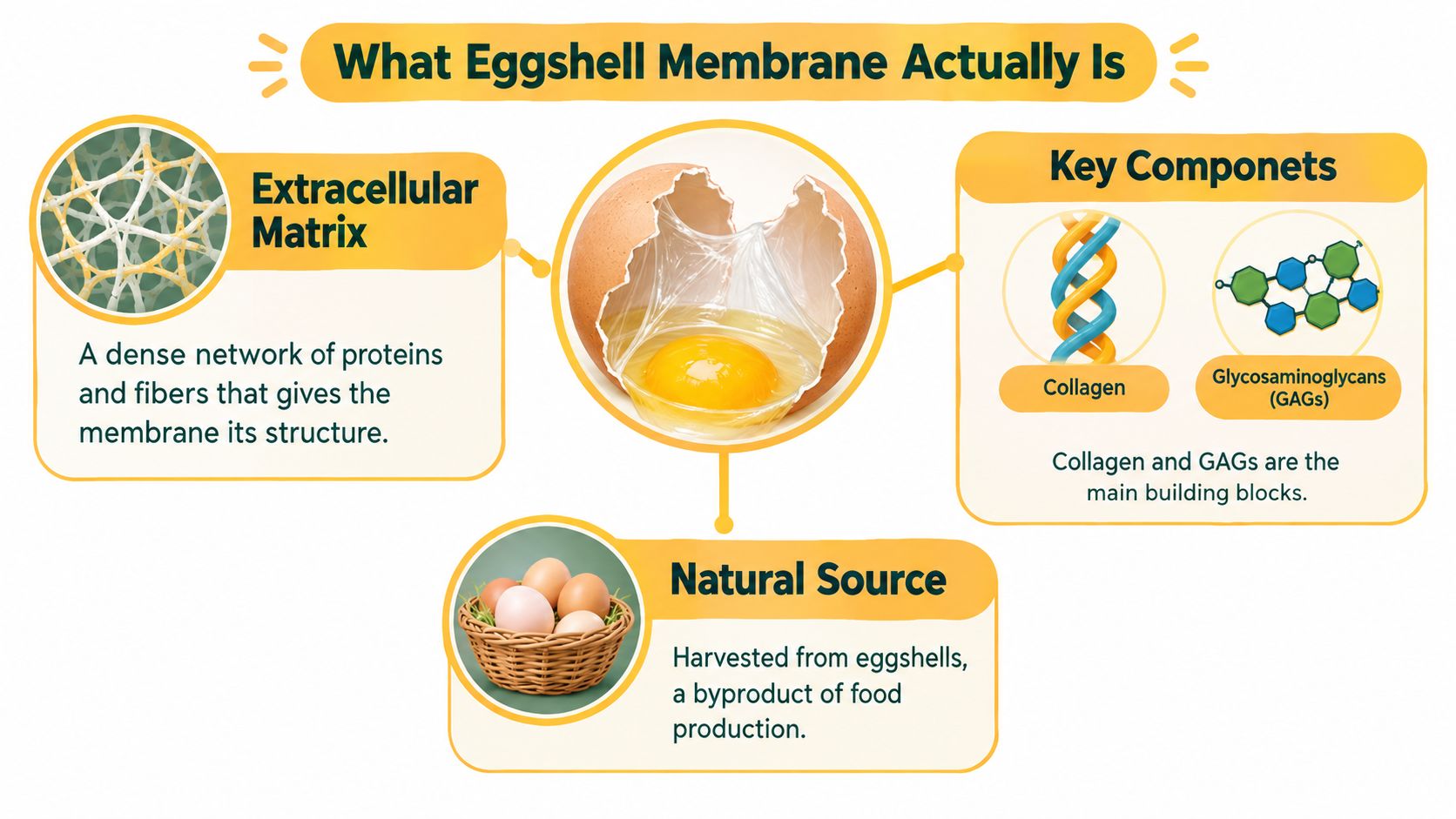
The Scaffold and the Sponge
The scaffold side includes collagen types I, V, and X. Collagen forms the fibrous framework in tendons, ligaments, skin, and cartilage related tissue. The membrane also contains elastin and amino acids such as proline, glutamic acid, and glycine, which the body uses when it maintains connective tissue. Canine cell research describes eggshell membrane as containing approximately 35% native collagen and roughly 6% glycosaminoglycans, according to a Frontiers in Veterinary Science review of eggshell membrane composition.
The sponge side is the glycosaminoglycans, often shortened to GAGs. This family includes chondroitin sulfate, hyaluronic acid, keratan sulfate, and dermatan sulfate. Chondroitin helps cartilage handle compression, while hyaluronic acid is associated with joint lubrication. A separate analysis of natural membrane reported approximately 54.4% total protein, 3.1% collagen, 1.2% sulfated glycosaminoglycans, and 1.1% hyaluronic acid, as detailed in a 2024 compositional analysis of natural eggshell membrane.
Those two sets of figures look different because processing and measurement methods differ. Don't treat that as a contradiction to solve at home. Treat it as your first label lesson. Raw membrane weight alone doesn't tell you how much collagen or GAGs a finished product delivers. Composition explains why the ingredient is plausible for joint support. It doesn't, by itself, prove a particular chew or powder will change how your dog moves.
What the Veterinary Research Actually Shows
Two canine studies give owners the clearest anchor, and they're encouraging without being definitive. Both used control groups, which matters. When owners expect a supplement to work, they may naturally notice good days more than bad ones. Blinded, placebo controlled designs reduce that bias, so the results deserve more weight than testimonials.
The timeline below summarizes the study designs before we walk through what each one can and can't support.
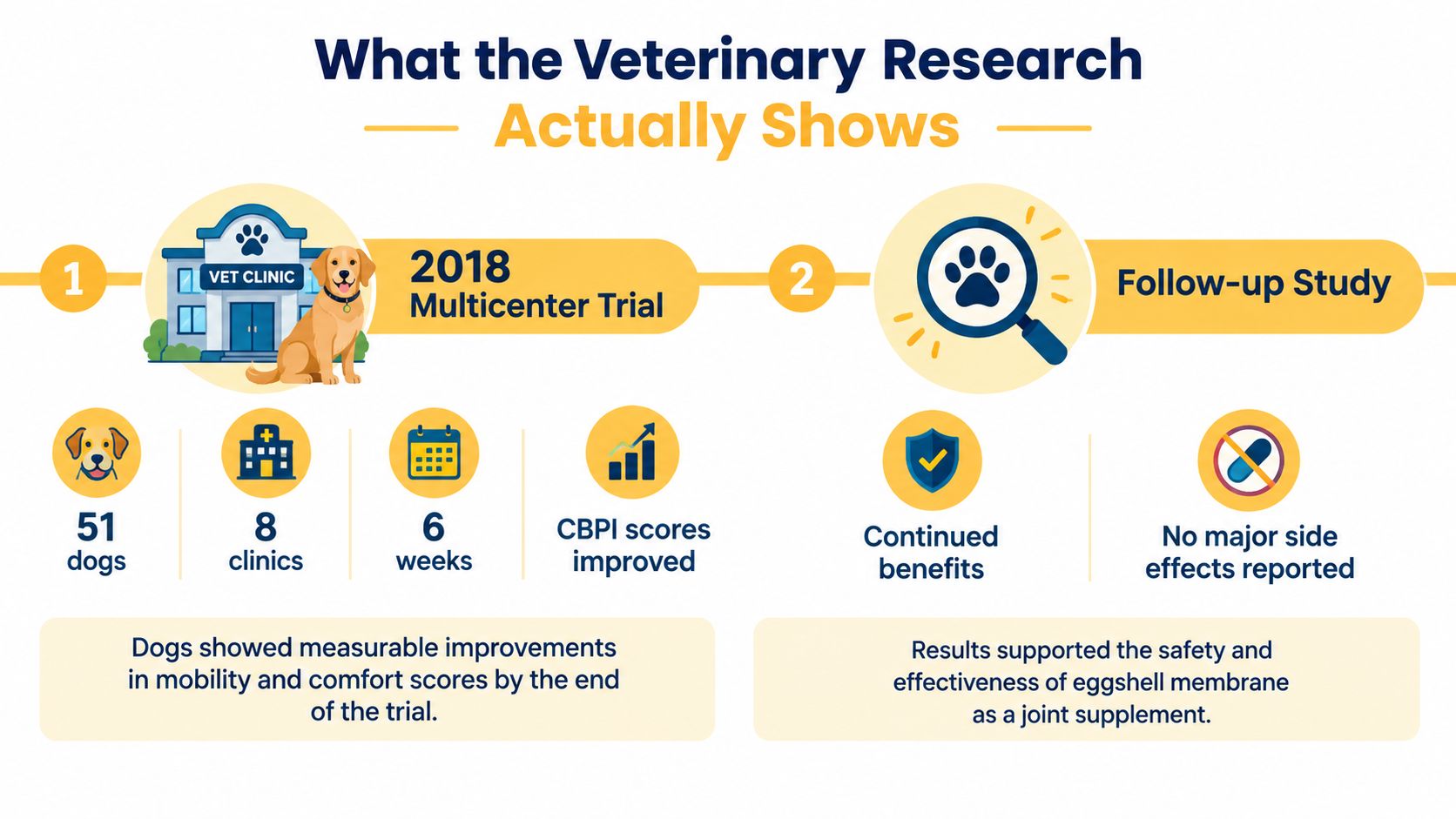
The 2018 Multicenter Trial
The larger foundational trial enrolled 51 dogs across eight veterinary clinics for six weeks. Dogs received eggshell membrane at approximately 13.5 mg per kilogram of body weight daily, equivalent to 6 mg per pound, or a placebo, as reported in the 2018 multicenter randomized canine trial on PubMed. Researchers tracked pain and function with the Canine Brief Pain Inventory, owner specific outcomes with the Veterinary Client Specific Outcome Assessment, and cartilage related biology with the biomarker CTX-II.
Improvements on the pain inventory appeared after one week, while owner specific findings showed sustained improvement by week six. The CTX-II results at six weeks supported a pronounced chondroprotective effect in that study population. In plain terms, owners and scoring tools detected better comfort and function, and a blood marker linked to cartilage breakdown moved in a favorable direction. That's a meaningful signal, especially because it came from dogs rather than only lab work.
That trial still has boundaries. It tested a specific membrane ingredient, at a specific dose, in a specific group of dogs. It doesn't prove every product with eggshell membrane on the label will perform the same way. It also doesn't show that the ingredient cures osteoarthritis, rebuilds a damaged joint, or replaces prescribed pain control.
The Smaller Osteoarthritis Pilot
A second randomized, double masked, placebo controlled pilot enrolled 27 dogs with osteoarthritis associated pain, and 22 dogs completed 12 weeks of supplementation. By day 84, the eggshell membrane group had significantly lower LOAD mobility scores than placebo, with P = 0.034, according to the osteoarthritis pilot study indexed on PubMed. Interleukin-2 also decreased relative to placebo, although that biomarker effect was marginal at P = 0.069.
The investigators characterized the overall changes as small and preliminary. That's the honest summary. There's a measurable mobility signal over 8 to 12 weeks, not proof of immediate pain relief or disease modification. If you're comparing categories, an overview of dog joint supplements can help you place eggshell membrane alongside other ingredients your vet may discuss.
This short video gives a visual walkthrough of the ingredient in a daily feeding context.
Read together, the studies justify interest and a monitored trial for suitable dogs. They don't justify promises. Conditions such as cruciate ligament injury, hip dysplasia, infection, or spinal pain need diagnosis and treatment on their own terms, and no membrane study changes that.
Safety, Contraindications, and Dosing in Plain Numbers
Start with the clearest stop sign. Egg allergy is a contraindication, and possible reactions include rash and itching, while documented dosing spans approximately 13.5 mg/kg once daily to around 2 g per 10 kg of body weight daily depending on the preparation, according to VCA Hospitals guidance on eggshell membrane for pets. If your dog has a known egg allergy, don't test the theory at home. Choose a different joint strategy with your vet.
Dogs without an egg allergy still deserve a careful start. Chronic itching, a food elimination trial, a sensitive stomach, pregnancy, nursing, or a crowded supplement routine all change the decision. A flavored chew may contain other proteins or carriers that matter for an allergic dog, even when the headline ingredient looks fine. That's why owners should review possible dog joint supplement side effects and bring the full label to the appointment, not just the product name.
Why Two Doses Can Both Appear in Print
The gap between 13.5 mg/kg and 2 g per 10 kg confuses many owners. Those figures come from different preparations, so they aren't automatically interchangeable. One product may use a concentrated, standardized membrane ingredient. Another may express dose as a larger amount of a less concentrated preparation, or include the membrane within a blend. Processing, accompanying ingredients, and labeling conventions all affect what the number means.
- Do the label math first: Find the quantified amount of eggshell membrane per serving, then check whether that serving matches your dog's actual weight.
- Don't convert across brands: A study dose for one preparation doesn't authorize you to scale a different powder or chew by the same arithmetic.
- Follow the product direction: Use the manufacturer's weight based serving unless your veterinarian advises otherwise.
For a broader view of how different joint ingredients and doses fit together, Denver Dog's dog joint health supplements guide is a useful companion when you're comparing categories rather than single products.
Practical rule: Natural describes the source, not the safety profile for your individual dog.
Introduce any new supplement gradually and watch stool, appetite, skin, and comfort. If itching, rash, vomiting, or persistent digestive upset appears, stop and contact your veterinarian. Dogs receiving prescription medication or managing kidney, liver, or other chronic conditions need individual clearance, because every added product becomes part of that dog's total intake and care plan.
How to Read an Eggshell Membrane Supplement Label
Put two jars side by side and ignore the front panel for a minute. The back panel tells you whether you're buying a quantified ingredient or a vague promise. Your goal isn't to find perfection. It's to answer four questions quickly. How much membrane is in each serving, what else is in the product, who tested it, and can your vet assess it from the information provided?
The checklist below turns those questions into a repeatable audit you can use in a store or online.
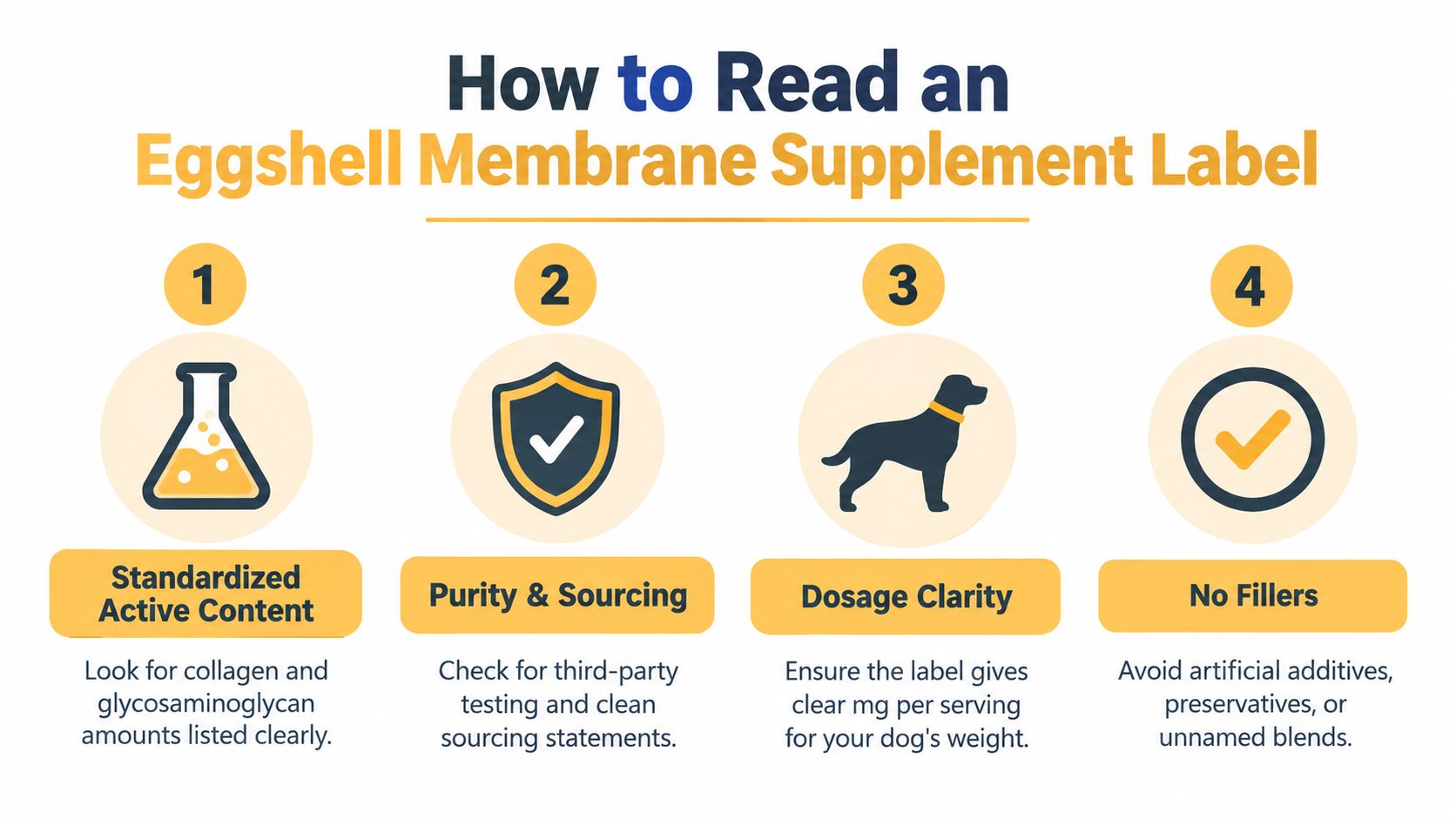
A Four Part Label Audit
1. Quantified active content. Look for the amount of eggshell membrane per chew, capsule, or scoop, not only its presence in a proprietary blend. Stronger labels go further and standardize active markers such as collagen and glycosaminoglycan content. Raw membrane weight alone can hide wide variation between preparations.
2. Full ingredient and allergen disclosure. Read every inactive ingredient, flavoring, and carrier. An egg derived active should be obvious, and other animal proteins matter if your dog has food sensitivities. If you're building general label confidence, guidance on how to read supplement labels helps you separate guaranteed analysis, active ingredients, and marketing copy.
3. Testing documentation. Ask whether independent laboratory testing supports the product. A certificate of analysis should verify identity, actual eggshell membrane amount, microbial contamination, heavy metals, allergens, and batch consistency. A lot number on the package should connect to that documentation. If a company can't explain its testing, that's useful information too.
4. Form and dosing clarity. Powders allow flexible serving sizes but require measuring. Chews are convenient but may limit fine adjustment and add flavoring ingredients. Capsules can be precise, though some dogs reject them. Choose the form you'll give consistently, at the weight appropriate serving, without turning every meal into a negotiation.
| Label approach | What you gain | What to watch |
|---|---|---|
| Single ingredient product | Clearer dose control and easier troubleshooting | You may need separate products for other goals |
| Multi ingredient formula | Fewer products to manage each day | Harder to tell which ingredient helps or causes a reaction |
Neither format wins automatically. A transparent multi ingredient label with quantified actives can be easier to assess than a single ingredient product that hides behind a blend. Transparency is the deciding feature.
Where Eggshell Membrane Fits in a Daily Routine
Eggshell membrane rarely needs to carry the whole joint plan by itself. It supplies connective tissue related compounds, while other ingredients address different parts of daily support. Owners often discuss it alongside omega-3 fatty acids, green-lipped mussel, glucosamine and chondroitin, and gut focused ingredients such as probiotics or postbiotics. That doesn't mean every dog needs every category. It means joint comfort, body weight, digestion, activity, and veterinary treatment interact, so a multimodal plan is often more realistic than hunting for one hero ingredient.
The comparison below frames the practical choice most owners face, one targeted product or a consolidated routine.
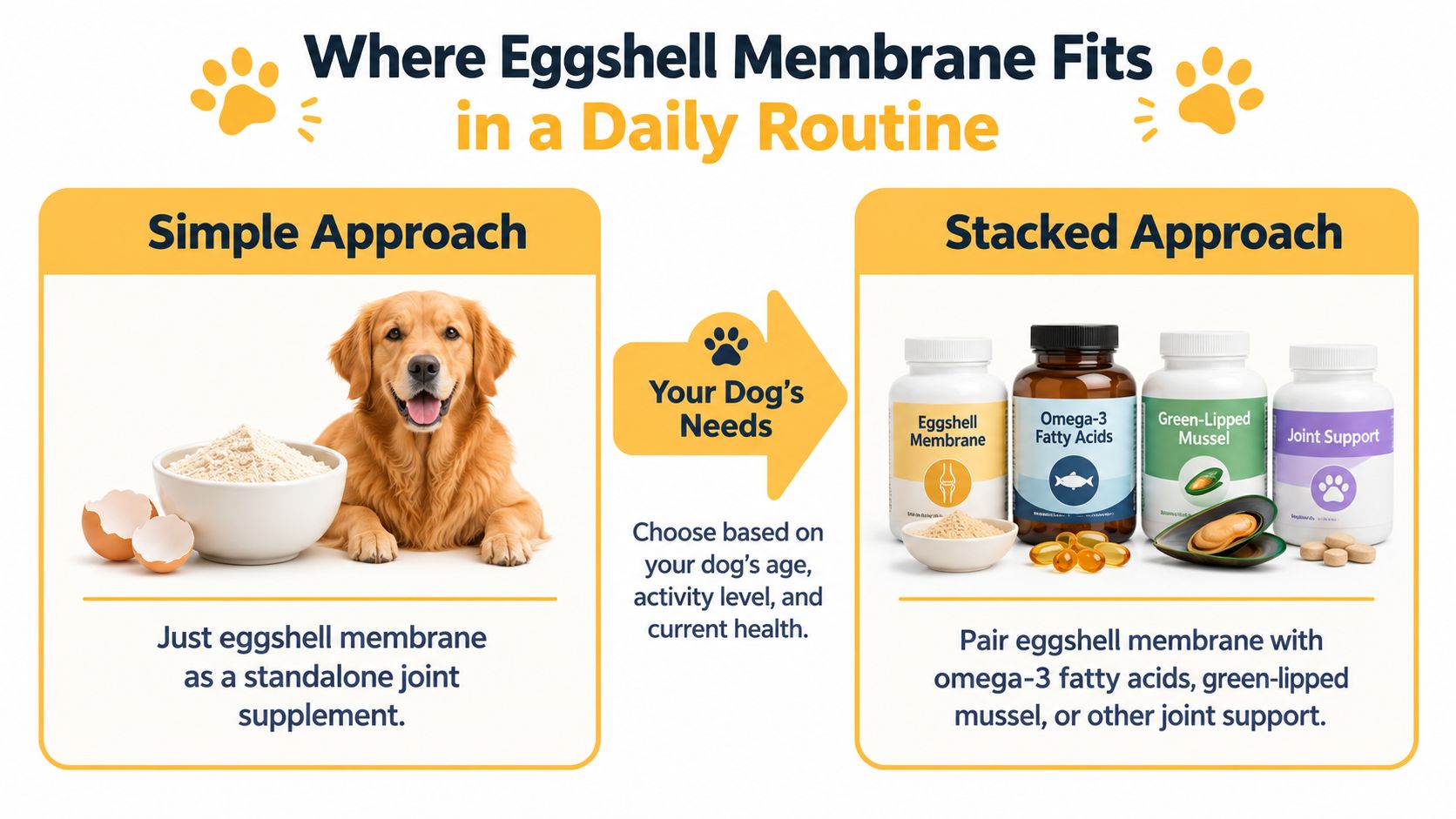
Single Ingredient Control Versus One Daily Scoop
A standalone eggshell membrane product suits owners who want to change one variable at a time. If mobility improves, or if itching appears, you have a clearer suspect. It's also useful when a dog already receives a veterinary diet or medication and the vet wants additions kept narrow and measurable.
An all in one formula suits a different household problem, routine fatigue. Owners who juggle separate joint, skin, gut, and immune products may miss doses or abandon the plan. For example, DA-1™ Daily All-in-One - Senior Dog Support, Joints, Skin/Coat & More is described as a multi system powder with 18 human-grade ingredients in one scoop, targeting cells, gut, and joints, with a 60-day money-back guarantee. Treat that as an example of the consolidated category to compare on label transparency and fit, not as a shortcut around veterinary advice.
Your dog's routine also includes unglamorous basics that supplements can't replace. Keep weight lean, use controlled low impact exercise, provide traction and comfortable bedding, and maintain prescribed treatment. If you're organizing those habits, a framework for daily dog joint and mobility care can help you connect feeding, movement, and monitoring into one repeatable day.
Choose based on your dog's diagnoses, allergies, current products, and your ability to stay consistent. The best routine on paper fails if it's too complicated to follow on a busy Tuesday.
A Practical Four-Week Plan Owners Can Follow
A short, structured trial prevents the most common mistake, giving a supplement sporadically and then guessing whether it helped. Four weeks won't capture every outcome measured in longer studies, but it's enough to establish tolerance, consistency, and a useful baseline for a conversation with your vet. Before day one, note three observations you can repeat. How easily does your dog rise after rest, how willingly does she take stairs or a familiar slope, and how long is a comfortable walk?
The photo below reflects the goal, a calm daily habit your dog accepts as part of normal life.

Weeks One to Four
Week 1 is for tolerance. Start according to the label, and introduce gradually if your dog has a sensitive stomach or your vet recommends a slower transition. Give it with food unless directed otherwise, and log appetite, stool, itching, and willingness to eat the product.
Week 2 is for consistency. Keep dose, walk length, and other supplements stable where possible. Changing three things at once makes your notes hard to interpret. Repeat your baseline checks at the same time of day, because many stiff dogs look different first thing in the morning than after they've warmed up.
Weeks 3 and 4 are for pattern spotting. Look for trends across several days, not one energetic afternoon. Is rising easier more often? Is your dog choosing the longer route, settling more comfortably, or recovering better after ordinary activity? Share the log with your veterinarian and decide whether to continue toward a longer assessment window.
- Pause and call sooner: Stop the new product and contact your vet if you see rash, new itching, repeated vomiting, appetite loss, or worsening stool.
- Seek care promptly: Sudden lameness, yelping, inability to bear weight, or rapid reluctance to move shouldn't wait for a supplement trial to finish.
Eggshell membrane is supportive, not curative. Don't reduce prescribed medication because a week looks better. Your four week log is evidence for a shared decision, not a reason to manage diagnosed osteoarthritis alone.
Putting It All Together for Your Dog
Return to that dog at the bottom of the stairs. Your decision now has three checkpoints, and each one protects you from a different kind of mistake.
First, confirm suitability. A dog with an egg allergy shouldn't receive eggshell membrane, and dogs with chronic conditions, pregnancy, complex medication plans, or unexplained lameness need veterinary input before any new product. Second, choose transparency over front label promises. You want a quantified membrane dose, full ingredients, allergen information, and testing documentation your vet can review. Third, set a realistic trial. Canine studies measured change over weeks, so track specific movements, stay consistent, and reassess rather than expecting immediate pain relief.
A good supplement decision is boring in the best way. Clear label, suitable dog, steady routine, honest notes.
Eggshell membrane for dogs is best understood as a well described, biologically plausible ingredient with early canine evidence for mobility support. It isn't a diagnosis, a cure, or proof that every membrane product is equal. Used inside a broader plan that includes weight control, sensible exercise, and veterinary oversight, it can be a thoughtful option. Your label literacy matters as much as the ingredient name, because that's what turns a promising concept into a product you can evaluate for the individual dog in front of you.
If you're comparing daily options after checking suitability and label transparency with your vet, explore how Pure Paw Labs approaches multi system support for joints, gut, skin, and everyday vitality in a single routine. Bring your shortlist, your dog's current medications, and your mobility notes to that conversation, then choose the simplest plan you can follow consistently.