


You're probably here because your dog has started moving a little differently, maybe pausing before the stairs, rising slower after a nap, or shortening a walk that used to feel easy. That change can look small at first, but with joint problems, small changes are often the first clue that a chronic issue is building in the background.
A daily dog joint and mobility routine makes sense when you think in terms of time, not just symptoms. In a large UK primary-care study of 455,557 dogs, the estimated annual period prevalence of appendicular osteoarthritis was 2.5%, which the authors translated to roughly 200,000 affected dogs in a single year based on an 8 million-dog national estimate, and the average duration was about 2 years, meaning the condition can occupy around 11% of a dog's life span (PMC5884849). That's why daily support matters. You're not trying to solve a one-day problem, you're supporting a body that may be managing wear, inflammation, and compensation for months or years.
Table of Contents
- Why Daily Support Matters for Your Dog's Joints
- What Joint and Mobility Support Means
- The Evidence Behind Daily Joint Ingredients
- Safe Dosing and What to Expect on a Daily Routine
- How an All-in-One Daily Scoop Simplifies Care
- Common Misconceptions About Daily Mobility Supplements
- Choosing a Daily Routine You Will Stick To
Why Daily Support Matters for Your Dog's Joints
A dog that pauses on a slick floor before standing, or slows halfway through a familiar walk, is sending a timing clue. Joint trouble usually does not arrive as one dramatic event. It builds in the background, and the body starts compensating by moving less, shifting weight, or shortening stride.
The timeline is the point
That is why daily support matters. Joint problems often last a long time, so care has to match that pace rather than treat every flare as a one-off problem. Older veterinary data suggest osteoarthritis may affect around 20% of dogs over 1 year old, while later reviews report a wide range, from 2.5% to more than 80%, depending on study design and the dogs sampled (PMC5884849). The spread is wide, but the message is steady. Joint disease shows up differently across dogs, ages, and settings, so age alone does not tell the full story.

A newer imaging-based study found radiographic osteoarthritis in 39.8% of dogs aged 8 months to 4 years, with clinical osteoarthritis rates of 16.3% to 23.6% depending on the pain threshold used (Nature, 2024). That is the part many owners miss. Joint change can appear before a dog looks obviously old or severely stiff, and the visible problem often lags behind the biological one.
Practical rule: if your dog's mobility has changed in a repeatable way, do not wait for obvious lameness before you act.
A daily routine fits that reality because it works like maintenance. It supports comfort over time, instead of waiting for a flare to reshape the whole day.
What Joint and Mobility Support Means
A dog with sore joints often looks fine at rest, then stiffens when rising, hesitates at stairs, or shortens a walk. That pattern matters because joint care is usually about preserving daily motion, not chasing a quick fix.
Cartilage provides a smooth contact surface, and synovial fluid helps the joint glide with less friction. When inflammation or wear changes that environment, movement gets less efficient, a bit like a hinge that no longer swings cleanly.
Support is about lowering strain, not reversing time
That is the basic role of a daily supplement. It may supply nutrients the body can use or support a calmer joint environment, but it does not rebuild lost cartilage overnight. Joint turnover is slow, so any routine built around it has to be steady too.
A newer clinical study found osteoarthritis patterns in older dogs across several joints, including the shoulder, elbow, hip, and stifle (Nature, 2024). The important point is not one joint number. It is that joint disease can show up in different places at the same time, and the muscles around the joint, the dog's movement habits, and the joint itself all affect what owners notice day to day.
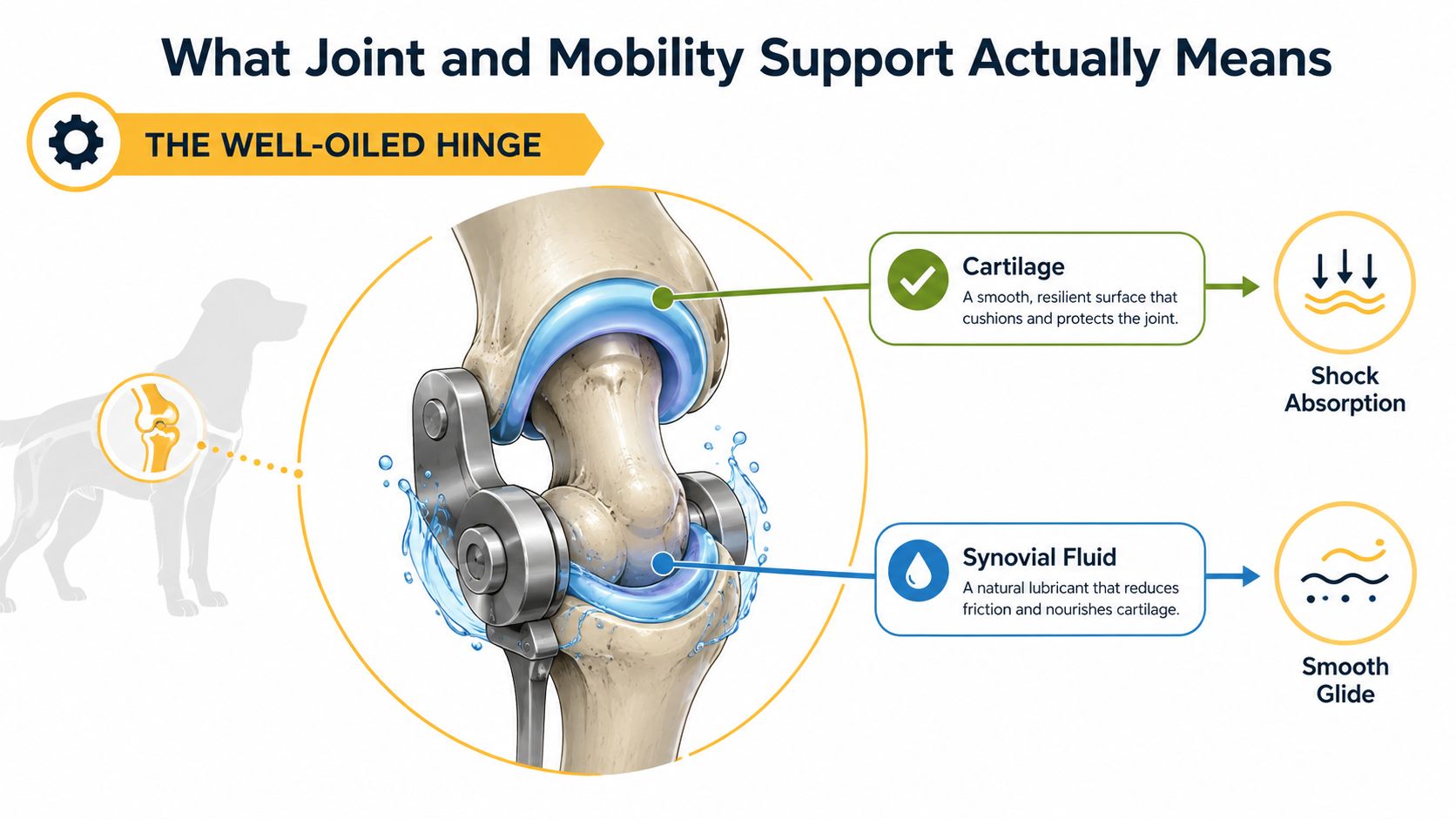
That is why daily support is usually framed as maintenance. It aims to help keep the motion a dog still has, so the day feels less stiff and less effortful. When distance still matters but impact needs to be gentler, some owners also look at compare pet jogging strollers, since reducing strain during activity can be part of the same care plan.
If an owner wants a compact daily formula, one example is DA-1™ Daily All-in-One - Senior Dog Support, Joints, Skin/Coat & More, described as a once-daily multi-system powder with 18 human-grade ingredients and a 60-day money-back guarantee. That format only makes sense with realistic expectations. It supports routine care. It does not promise to erase chronic joint change in a week.
Support works best when the goal is steadier movement, not a dramatic overnight transformation.
The Evidence Behind Daily Joint Ingredients
A dog can live with joint disease for years, so the daily question is not whether a supplement can erase the problem. It is whether it can support movement in a way that fits a chronic condition. That is why the ingredient list matters, but only after you know what each ingredient has shown.
Omega-3s have the clearest signal
A 2022 systematic review and meta-analysis found a strong signal for omega-3 products, concluding that they beneficially modulate painful osteoarthritis conditions in dogs and cats (MDPI, 2022). That matters because omega-3s point toward inflammation modulation, which is one of the few daily levers that matches the biology of joint discomfort. In plain terms, they aim at the irritation that makes movement feel rough.
The same review described chondroitin-glucosamine nutraceuticals as showing a “very marked non-effect” and said they should no longer be recommended for pain management. That does not mean those ingredients are harmful. It means their reputation is stronger than the evidence behind their pain claims.
The familiar ingredients are not all equal
Veterinary evidence reviews have also found that objective gait studies in dogs with osteoarthritis did not show consistent benefit from glucosamine and chondroitin, including a randomized trial where ground-reaction-force measurements and owner and vet assessments did not improve versus placebo (PMC9929184). That is the kind of result owners rarely hear on a supplement label, but it is the kind that matters if a product is meant for daily use.
A newer multisite randomized study reported improved mobility and quality of life in osteoarthritic dogs using a blend with eggshell membrane, krill meal, astaxanthin, hyaluronic acid, and Boswellia, which suggests that multi-target formulas can be more promising when they address inflammation and lubrication together. Results like that are part of the reason ingredient quality matters more than name recognition alone.
| Evidence Strength of Common Daily Joint Ingredients | Canine Evidence | What It Shows | Practical Implication |
|---|---|---|---|
| Omega-3 fatty acids | Stronger support | Beneficially modulate painful OA conditions | Prioritize this when judging the daily scoop |
| Glucosamine and chondroitin | Mixed to weak | Objective studies haven't shown consistent benefit | Treat as supportive, not decisive |
| Multi-ingredient formulas | Emerging support | Some newer blends show mobility gains | Look for objective endpoints, not label hype |
If you want a clearer way to sort a label before you buy, the guide to choosing a dog mobility supplement walks through what to look for and what to ignore. The practical takeaway is simple. Judge the product by what it is built to do for movement, not by how familiar the ingredients sound.
Safe Dosing and What to Expect on a Daily Routine
Daily dosing sounds simple until you're standing at the bowl wondering whether your dog needs a full scoop, a half scoop, or something in between. The right answer depends on the dog's size, the product's concentration, and whether you're using the supplement as routine support or as part of a veterinary plan.
Match the routine to body size
Small dogs usually need less volume to get a useful amount of active ingredient. Mid-size dogs often fit a standard serving, and larger breeds usually need more product to reach a meaningful daily intake. That's not about feeding more for the sake of it, it's about matching the formula to the dog in front of you.
Most quality products work best once daily mixed into food because that makes consistency easier. A food-topper format also helps owners see whether the dog consumed the dose, which matters more than perfect timing. If a product can't fit into the meal routine, it's much easier to miss days without noticing.
A supplement that's simple enough to use every day usually beats a “better” product that sits on the shelf.
That's also the point of reading the label carefully before you start. Some formulas look generous on paper but spread their active ingredients too thin, while others are built for a clear daily habit and a defined serving path. If you're comparing options, the walkthrough at how to read supplement labels helps you see whether the serving logic matches the dog's size.
Don't judge it too early
Owners usually need a real trial window before they know whether a mobility routine is helping. If the dog is comfortable enough to rise more easily, handles stairs with less hesitation, or moves with a more even gait over time, that's more meaningful than looking for dramatic energy changes in the first few days.
| Daily Supplement Dosing by Dog Weight Range | Typical Serving | When to Evaluate Results | Key Safety Check |
|---|---|---|---|
| Smaller dogs | Lower daily amount or rounded scoop | After a steady trial period | Check the label for food mixing and medication overlap |
| Mid-size dogs | Standard serving | After a steady trial period | Confirm the serving fits the dog's actual body size |
| Larger breeds | Higher daily amount if the formula calls for it | After a steady trial period | Review other supplements so you don't stack the same ingredients |
For dogs on multiple medications, the safest move is to run any new supplement past your veterinarian first. That's especially true if your dog already has a confirmed joint diagnosis or another chronic condition that changes what “daily support” should look like.
How an All-in-One Daily Scoop Simplifies Care
A lot of supplement fatigue starts with good intentions. One dog gets a joint chew, fish oil, a skin product, something for digestion, and then a calming chew for stressful days. By the end of the week, the owner is managing half-empty bottles and trying to remember whether anything was skipped.

That's where consolidation helps. One daily scoop cuts down the number of decisions, and fewer decisions usually means fewer missed doses. It also makes travel easier, because you're packing one container instead of rebuilding the whole routine from memory.
The routine gets simpler, not just shorter
For a six-year-old retriever with joint support, skin support, gut support, and an owner who's tired of juggling separate products, a single daily formula can reduce the mental load even when the household budget stays roughly the same. That kind of simplification matters because the best supplement plan is the one that gets used.
One option built around that idea is DA-1™ Daily All-in-One, which is presented as a daily powder that combines multiple support categories into one scoop. The value there isn't magic, it's routine design. When one habit replaces several, consistency becomes much easier to maintain.
You can see the same logic in the product video below, where the focus is on a single daily serving instead of a pile of separate containers.
Consolidation is most useful when the ingredients overlap anyway, and when the goal is daily adherence rather than a stack of disconnected fixes. It's less useful if a dog needs a separate therapeutic dose prescribed for a confirmed condition, because then “one scoop for everything” can hide a dosing problem instead of solving it.
Common Misconceptions About Daily Mobility Supplements
The supplement aisle rewards confident shortcuts, but joint care rarely works that way. Three beliefs show up again and again, and all three can lead owners in the wrong direction.
More ingredients is not automatically better
A long label can look reassuring. In practice, stacking too many ingredients often dilutes the ones that matter most, especially if the formula underdelivers on the evidence-backed parts like omega-3s. A product with a crowded label is not necessarily a product with a useful daily dose.
Human supplements are not a clean swap
People sometimes assume a human joint product can be shared with a dog. That's a risky leap because dog-safe dosing is different, ingredient absorption isn't interchangeable, and some human products can include ingredients dogs should never have. The smart move is to use a formula intended for dogs, not to improvise from the bathroom cabinet.
The safest supplement is the one built for the species that will actually eat it.
Results usually aren't instant
A dog might seem a little brighter right after you start a new supplement, but that isn't the same as a real mobility change. The joint environment changes slowly, and the routine needs time to show whether it's helping. If you expect a one-week miracle, you'll probably quit before you've given the product a fair trial.
The practical correction is straightforward. Choose targeted support, stay with it long enough to judge it, and treat visible movement changes as the key signal, not the front-label promises.
Choosing a Daily Routine You Will Stick To
The best mobility plan is the one you can repeat without turning every meal into a negotiation. Dogs with chronic joint issues live with that reality day after day, so the question is not which label looks most impressive. It is which routine fits a real household, survives busy mornings, travel days, and the occasional missed alarm, and still gets used.
Use a simple checklist
Start with three questions. Is the product easy to mix into food? Does it give a clear once-daily serving? Can you tell what is in it without decoding vague language?
Those questions matter because consistency drives the result. If the routine is annoying, it falls apart, and a joint supplement that sits unused cannot help anyone. A transparent label and a realistic serving plan make it easier to keep going month after month.
Keep the decision grounded
Look for quality signals that reduce guesswork, like third-party testing or a clear manufacturing standard. Then ask whether the serving fits the dog's actual meal routine. A supplement that never gets used is the most expensive one you can buy. A 60-day trial window also helps, because it gives the body enough time for a fair read on the routine.
| What to Check Before You Buy | Why It Matters | What Good Looks Like |
|---|---|---|
| Palatable and easy to mix | Owners are more likely to give it daily | The dog eats it without a fight |
| Simple once-daily dosing | Fewer missed doses | One feeding, one serving, repeatable |
| Transparent ingredient list | You can judge the formula clearly | Clear active ingredients and serving logic |
If you want one place to start, Pure Paw Labs offers a daily supplement approach built around routine simplicity and multi-system support. Bring any new supplement plan to your veterinarian first, especially if your dog already takes medication or has a diagnosed condition. The goal is not a quick fix, it is a daily habit that supports movement through the months and years ahead.