


Yes, French Bulldogs do shed. Veterinary guidance classifies their shedding as average, not heavy and not zero; their short coat releases dead hairs continuously, and brushing manages that hair without eliminating shedding.
You might be discovering this after lifting your Frenchie off your lap and finding pale hairs across your trousers. Their coat looked so neat that you expected less cleanup. That surprise is understandable, but the useful question isn't just how much hair reaches the sofa. It's whether your dog's skin looks healthy and your dog feels comfortable.
Table of Contents
- Do French Bulldogs Shed? The Short Answer
- Why French Bulldogs Shed, Coat Type and Hair Cycle
- How French Bulldog Shedding Compares to Other Breeds
- Practical Grooming and Coat Care Strategies
- When Shedding Signals a Skin or Health Problem
- The Hypoallergenic Myth and What Really Causes Allergies
- Final Takeaways for French Bulldog Owners
Do French Bulldogs Shed? The Short Answer
Your Frenchie jumps down from the couch, leaving a scattering of hairs behind. You look at their back and don't see anything missing. How can a dog with such a close-fitting coat leave visible fur around the house?
The answer is that coat length and shedding level aren't the same thing. Short hairs can be easy to overlook while they're still on your dog, then become obvious against clothing, furniture, and bedding. VCA's French Bulldog breed guidance classifies shedding as average and describes routine grooming needs rather than intensive coat maintenance.
What average shedding means at home
Think of average shedding as a reason to plan for regular cleanup, not a promise about how many hairs you'll find. Individual dogs differ, and seasonal coat changes can make loose hair more noticeable. Age, nutrition, stress, skin condition, and general health can also influence what you observe.
For a first-time owner, a useful starting point is to separate these expectations:
- Hair around the house is expected. Finding loose hairs doesn't automatically mean your dog has a skin disorder.
- A short coat isn't a no-shed coat. A tidy appearance doesn't guarantee hair-free upholstery.
- Grooming has limits. You can collect loose fur before it spreads, but you can't brush your way to a dog that never sheds.
Practical rule: Judge the coat and the skin together, rather than judging your dog's health by the sofa alone.
Look beyond the cleanup
Suppose you notice hairs on a blanket, but your Frenchie's coat still looks evenly covered and they're resting comfortably. That's a different situation from finding a thinning patch while your dog repeatedly scratches the same area.
This distinction matters more than deciding whether the amount of hair seems inconvenient. You don't need to count hairs or compare every grooming session. Instead, get familiar with your own dog's usual appearance, comfort, and shedding pattern. That gives you a more useful baseline when something changes.
Why French Bulldogs Shed, Coat Type and Hair Cycle
A French Bulldog's coat isn't a specialized non-shedding feature. The breed's history centers on its development as a compact companion, not on eliminating ordinary hair turnover.
The breed developed from small English Bulldogs brought to France by lace workers displaced during the Industrial Revolution. The American Kennel Club's French Bulldog history records recognition in 1898. That history helps explain why you shouldn't interpret the breed's distinctive appearance as evidence of a low-shedding coat.
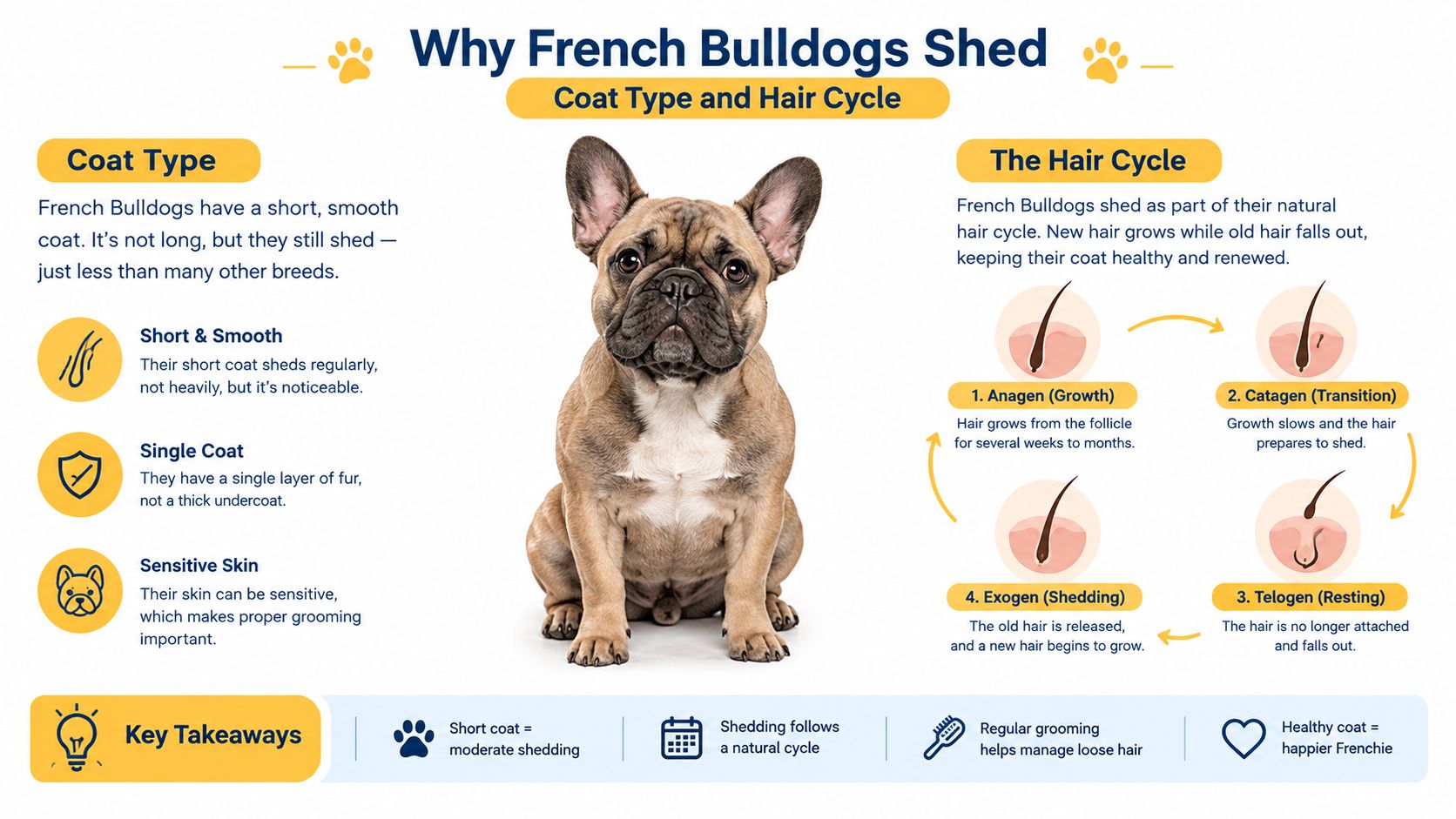
The coat-and-cycle overview below provides a useful way to connect appearance with normal hair release.
Hair doesn't remain in place forever
Hair grows through a repeating cycle. Understanding the terms makes shedding less mysterious, especially when the coat looks unchanged despite the hair you're collecting.
| Hair-cycle stage | Plain-language meaning |
|---|---|
| Anagen | The hair is actively growing. |
| Catagen | The follicle transitions away from active growth. |
| Telogen | The hair is in a resting stage. |
| Exogen | The hair is released. |
These stages explain why removing loose hairs doesn't switch off future shedding. You're collecting hair that's ready to leave, not changing the follicle into a permanently non-shedding structure.
Nutrition, hormones, temperature, and daylight exposure influence hair-cycle activity. Indoor lighting and climate-controlled housing can make shedding appear relatively continuous rather than confined to obvious seasonal changes. The veterinary grooming guidance cited below describes this normal turnover and its practical implications.
Why understanding the cycle changes your approach
Once you recognize hair release as a biological process, the goal becomes clearer: support healthy skin and manage loose hair, rather than chase a zero-shedding result. A grooming session can be useful even when more hair appears later.
For broader context, the guide to dog skin and coat care can help you organize questions about coat appearance separately from questions about skin comfort.
For a visual companion to the coat-care discussion, you can watch the following video.
Don't treat an apparently unchanged coat as proof that nothing is happening. Normal replacement can continue while your Frenchie looks much the same from day to day.
How French Bulldog Shedding Compares to Other Breeds
If you've lived with a heavily shedding double-coated dog, a Frenchie's loose hair may feel manageable. If you've only lived with lower-shedding dogs, the same amount may surprise you. Your previous experience strongly influences what you consider “a lot.”
The most useful comparison isn't a rigid ranking. It's a practical distinction between hair release, the visibility of that hair, and the care the dog needs. Those aren't interchangeable measures.
Use comparisons to set expectations
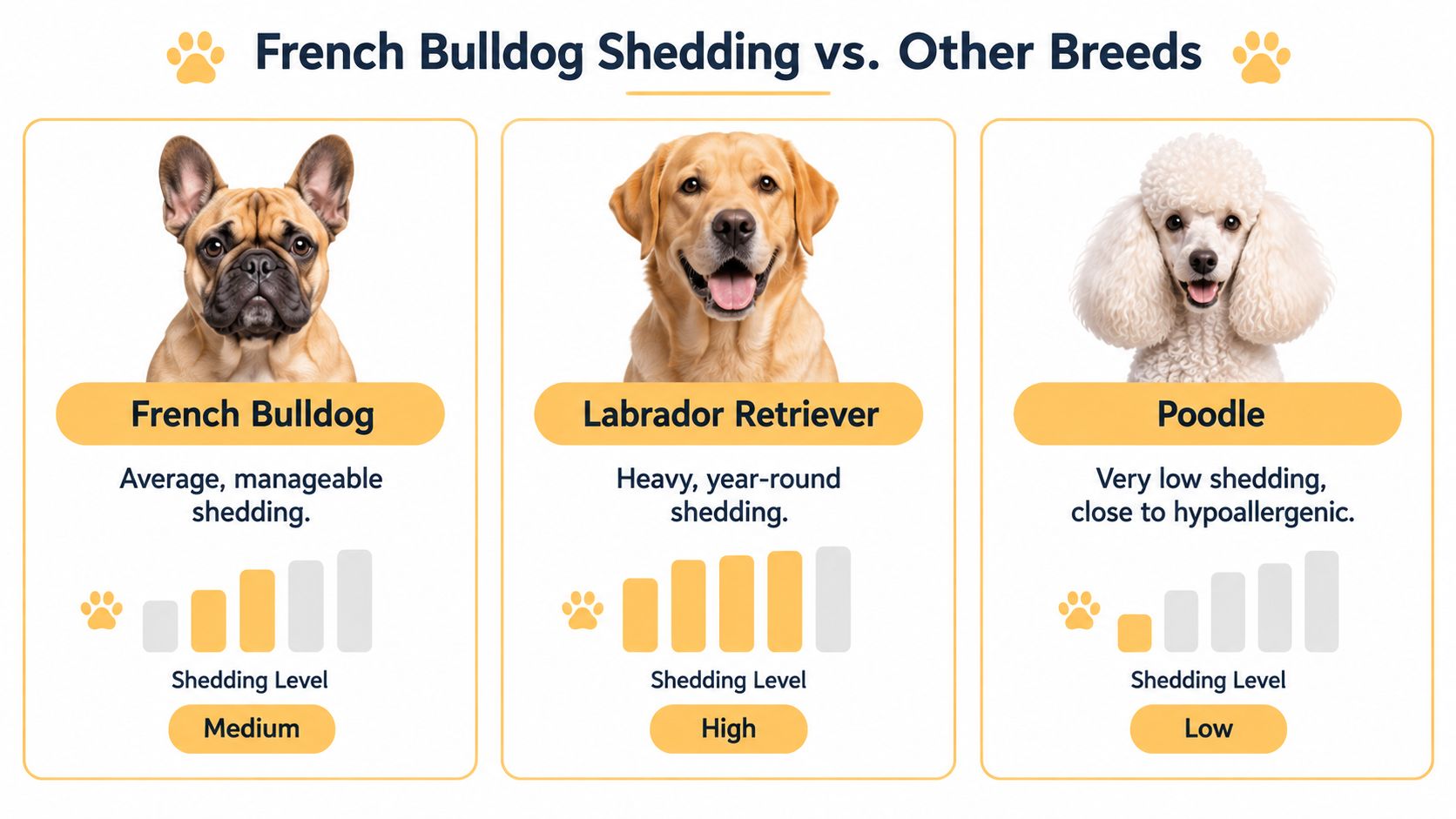
French Bulldogs fit the average-shedding category described earlier. Broadly, that differs from the heavier shedding associated with double-coated breeds and from the reduced hair release of lower-shedding coats.
| Coat-care comparison | Useful expectation |
|---|---|
| French Bulldog | Expect ordinary loose hair despite the short, smooth appearance. |
| Heavier-shedding double-coated dog | Prepare for a different scale of fur cleanup. |
| Lower-shedding dog | Less loose hair doesn't establish an allergy-safe home. |
The chart below illustrates the broad comparison. Its allergy wording needs an important qualification: low shedding doesn't establish hypoallergenic status.
For another coat-care perspective, the guide explaining whether German Shepherds shed offers a separate breed comparison. Use comparisons to plan care, not to predict exactly what your individual dog will leave behind.
Compare the work, not just the appearance
A useful way to evaluate a prospective dog is to ask what you're willing to do routinely. Can you accept visible hair on a favorite blanket? Are you comfortable checking skin folds, rather than considering brushing the whole grooming job?
A compact dog with short hair can still need attentive daily care. Conversely, a dog that leaves less hair around the house isn't automatically the simpler choice for every household.
A coat can look easy to maintain while the dog still needs a thoughtful care routine.
For French Bulldog owners, the expectation is manageable fur, not invisible fur. Choose your routine around your dog's actual condition and your household's tolerance for cleanup. A breed comparison can orient you, but it shouldn't override what you see on your own dog.
Practical Grooming and Coat Care Strategies
Make grooming a predictable opportunity to remove loose hair and inspect the skin. You don't need to turn every session into a search for the last remaining hair.
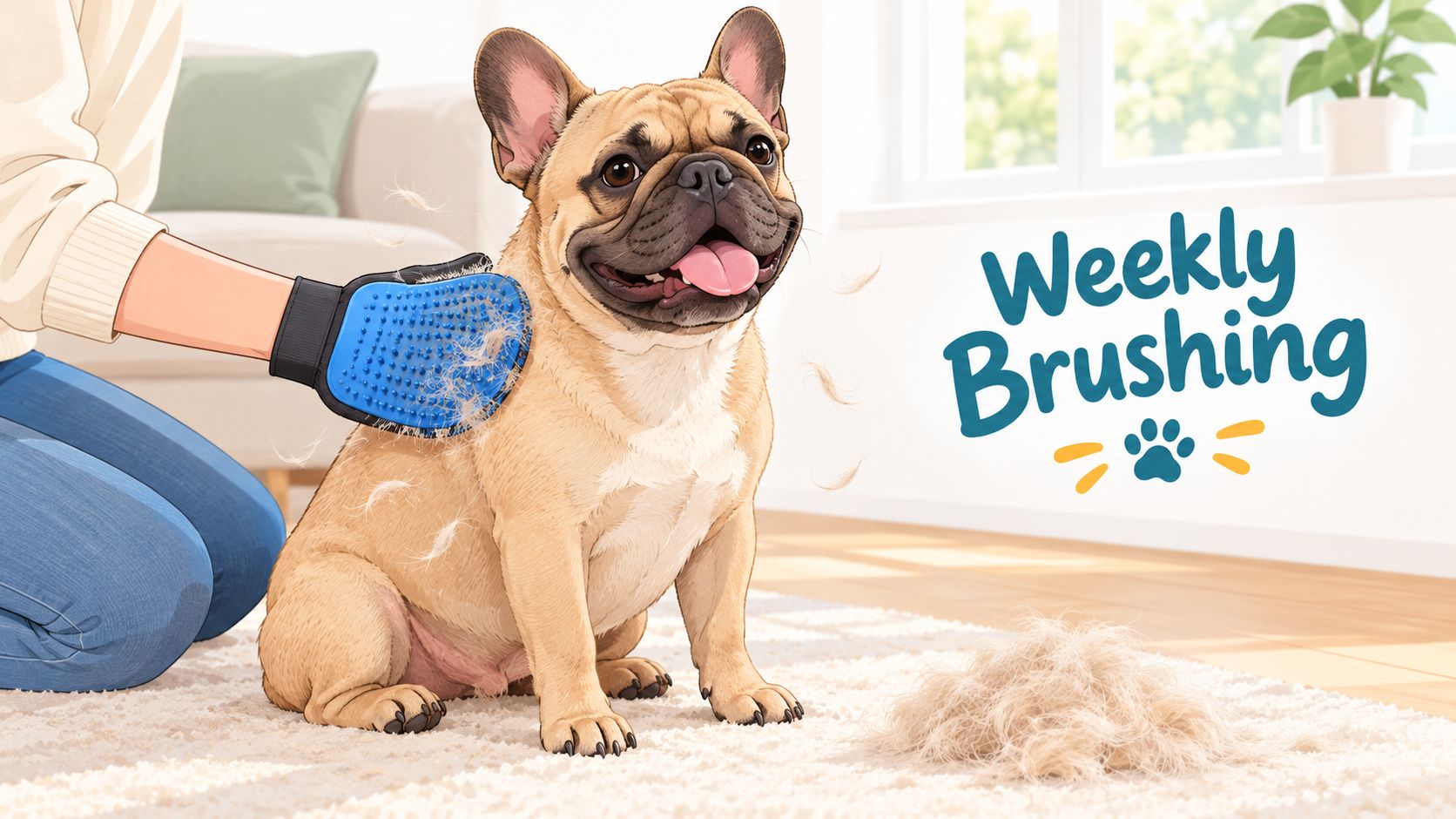
VCA's coat-care guidance recommends brushing approximately once per week to remove loose and dead hairs, improve coat condition, and reduce the amount deposited on furniture and clothing. Gentle handling matters more than trying to make each session produce a large pile of fur.
Give brushing and wrinkle care separate jobs
Use a gentle grooming tool suited to your dog's short coat, and stop if the skin looks irritated or your dog becomes uncomfortable. Part the coat as you work so you can see the skin instead of focusing only on what collects on the brush.
A practical routine includes distinct tasks:
- Brush the coat gently. Collect loose hair without repeatedly working over an irritated area.
- Inspect facial and tail wrinkles daily. Clean and thoroughly dry them as advised in the earlier breed guidance, rather than assuming coat brushing addresses fold care.
- Notice changes during handling. Record redness, odor, crusting, thinning, or repeated attempts to scratch or lick an area.
- Ask about bathing needs. Have your veterinarian help choose a canine-formulated shampoo and a schedule appropriate for your dog's skin.
Wrinkles deserve their own attention because moisture and debris can promote irritation or infection. A clean-looking back doesn't tell you whether a hidden fold is comfortable.
Keep nutrition in a supporting role
Nutrition influences coat health, but increased shedding isn't proof that a dog needs a supplement. Before changing food or adding several products, discuss your dog's current diet and symptoms with your veterinarian.
For owners already considering senior-dog supplementation, DA-1™ Daily All-in-One - Senior Dog Support, Joints, Skin/Coat & More is described as a multi-system formula targeting cells, gut, and joints. Treat it as an optional supplement discussion, not a treatment for unexplained hair loss or a way to stop the normal hair cycle.
You can also use the practical guide on how to reduce dog shedding to organize household coat management. The useful goal is a comfortable dog and a manageable routine, not progressively more brushing, bathing, or supplementation whenever you find another hair.
When Shedding Signals a Skin or Health Problem
The assumption that all French Bulldog hair loss is ordinary shedding can delay appropriate care. Alopecia means hair loss, and visible thinning or bald areas call for a different response from loose hairs on an otherwise evenly covered dog.
The MSD Veterinary Manual's overview of dermatological problems distinguishes abnormal hair loss and describes potential causes including infection, parasites, inflammatory disorders, endocrine problems, and self-trauma from scratching or licking. A veterinarian needs to determine the cause; the appearance alone doesn't establish a diagnosis.
Check the pattern and your dog's comfort
Inspect the areas where you notice hair loss, then compare them with the surrounding coat. Look for changes in coverage and skin condition, not just a larger amount of loose hair.
| More consistent with ordinary shedding | Arrange veterinary evaluation |
|---|---|
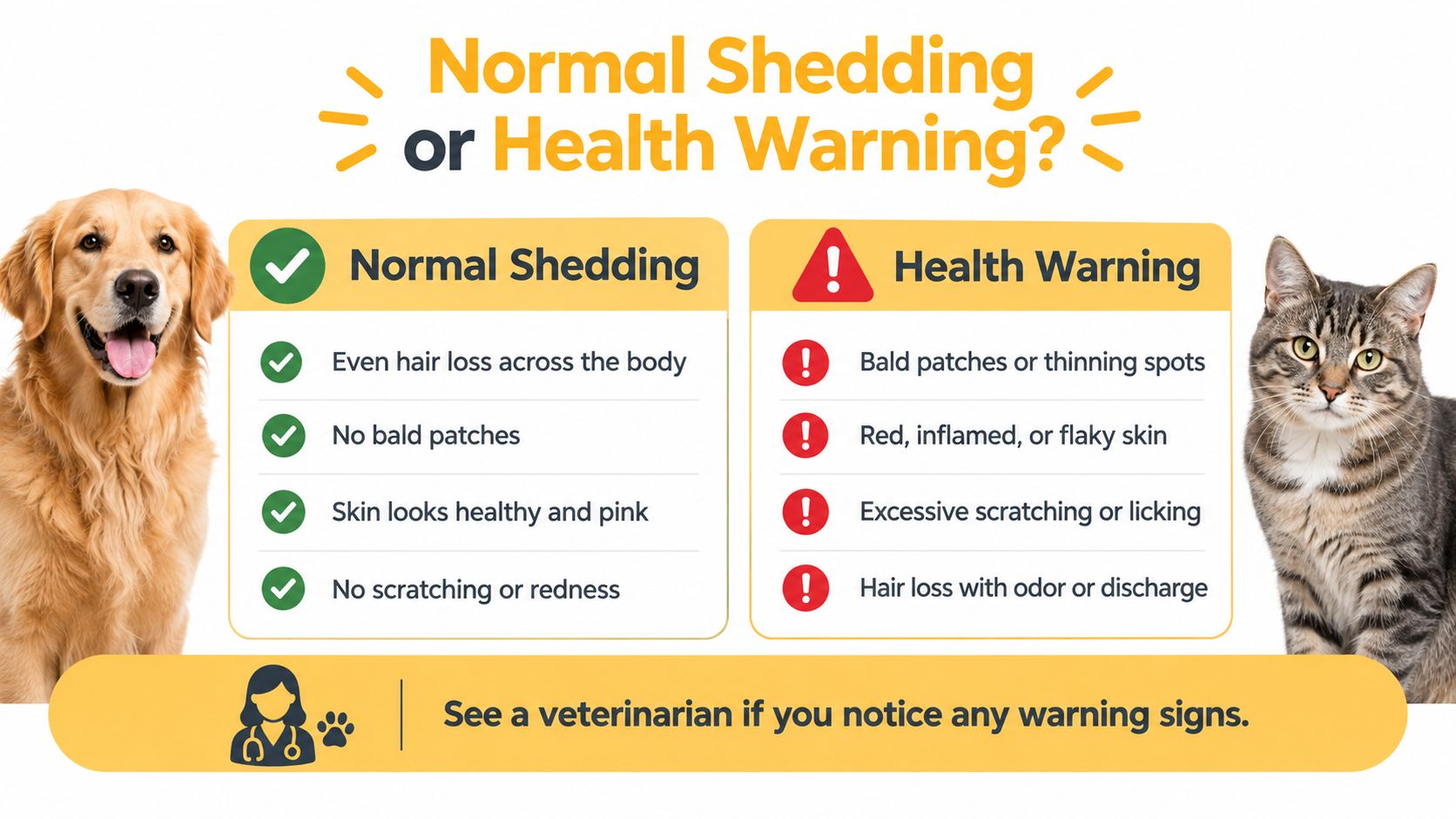
| Even coverage without obvious gaps | Bald patches or distinct thinning, including symmetrical thinning |
| Comfortable behavior without persistent irritation | Repeated scratching, licking, rubbing, or biting |
| Skin that looks usual for your dog | Redness, scaling, crusting, odor, or inflammation |
| A familiar shedding pattern | A sudden or unexplained change |
The checklist below reinforces the distinction. Compare skin with your dog's usual appearance, rather than expecting every healthy area to be pink.
Why Frenchie owners should pay attention
A 2025 German study of French Bulldogs found skin or hair abnormalities in 54% of the dogs and alopecia in 21%, with reported causes including allergies or hypersensitivity, Demodex infection, and color-mutant alopecia. These findings describe that study population, not the probability that your individual dog has a particular condition.
The practical lesson is to investigate symptoms rather than assume every coat change is nutritional. The guide to French Bulldog allergies offers related reading, while Get Pet Vet's 2026 French Bulldog health checklist can help you organize broader questions for an appointment.
Take clear photographs of the affected area and note when you first noticed it. Don't postpone veterinary advice while testing a new supplement.
Tell your veterinarian whether the change appeared suddenly, whether your dog seems itchy, and whether you've noticed ear problems or paw licking. Brushing can collect loose hair, but it can't diagnose or correct an underlying allergy, parasite problem, infection, or fold disorder.
The Hypoallergenic Myth and What Really Causes Allergies
A short coat doesn't make a French Bulldog hypoallergenic. The confusion comes from treating visible fur as though it were the entire allergy problem.
Ohio State veterinary guidance on dog allergies explains that the primary dog allergen is produced in saliva. Licking transfers it to fur, and dried particles can become airborne. Even hairless dogs produce allergens, so reducing loose hair doesn't guarantee reduced exposure.
Separate the person's needs from the dog's care
These are related jobs, but they aren't the same job. You might improve your grooming routine and still experience allergy symptoms because the relevant exposure isn't limited to the hair you can see.
| Care goal | Appropriate focus |
|---|---|
| Manage the dog's coat | Remove loose hair and monitor skin comfort. |
| Manage human allergen exposure | Address sleeping areas, cleaning practices, and indoor air. |
| Investigate human symptoms | Seek guidance from a qualified human healthcare professional. |
| Investigate canine itching | Arrange veterinary assessment rather than assuming a shared cause. |
The visual below introduces common hypoallergenic claims. Treat such labels as something to evaluate, not as a guarantee that a dog or household product will prevent symptoms.

Build an exposure-management plan
Keep the dog out of bedrooms, use damp or statically charged cleaning tools rather than methods that disperse particles, and consider ventilation or filtration. Washing the dog with an appropriate canine shampoo can be part of care, but don't respond to human symptoms by escalating baths without veterinary guidance.
If you're reviewing bedroom materials, Protect-A-Bed's guide to find a hypoallergenic bed provides a related starting point. Bedding choices belong within an exposure-management plan, not a promise of an allergen-free room.
The same distinction is useful when considering whether Boston Terriers are hypoallergenic dogs. Comparing breeds by hair length alone doesn't resolve the human allergy question.
If someone sneezes after cuddling your Frenchie, that doesn't prove the dog is shedding abnormally. Likewise, your dog's itchy skin doesn't establish why a person is reacting. Each deserves its own assessment rather than a shared assumption or a shopping list of supposed fixes.
Final Takeaways for French Bulldog Owners
The answer to “Do French Bulldogs shed?” is straightforward, but good care requires looking beyond the fur. Your most useful skill isn't estimating how much hair is on the floor. It's recognizing the difference between your dog's usual pattern and a change that deserves attention.
Think of ownership as a set of separate responsibilities. Coat care handles loose fur. Fold care addresses areas brushing doesn't reach. Veterinary assessment investigates concerning changes, while human allergy management addresses the needs of the people sharing the home.
Turn information into a workable routine
Use the earlier brushing recommendation and daily fold-care guidance as a starting point, then adapt with your veterinarian when your dog's skin needs something different. A simple routine you're comfortable maintaining is more useful than an elaborate one you only follow when shedding becomes frustrating.
- Learn your dog's baseline. Notice how the coat normally looks and how comfortable your dog seems.
- Respond to symptoms. Treat bald areas, inflammation, persistent itching, or an abrupt change as reasons to seek advice.
- Keep expectations realistic. Support products and grooming tools have roles, but neither makes a Frenchie a zero-shed companion.
- Plan separately for allergies. Don't use the amount of visible fur as your only measure of human exposure.
Choose comfort over a perfect sofa
For someone considering the breed, the better question is whether you're prepared for the care described above, not whether you can eliminate every stray hair. For an existing owner, a few hairs after a cuddle needn't turn into a worry spiral.
A comfortable dog with an evenly covered coat is a very different situation from a dog repeatedly scratching a thinning patch. Recognizing that difference helps you accept normal shedding without overlooking a health concern.
Pure Paw Labs offers dog nutrition supplements intended to support skin and coat alongside broader wellness needs. Visit Pure Paw Labs to review the product information and bring any supplement questions to your veterinarian, especially if your Frenchie's shedding has changed or their skin looks irritated.