


You notice it in the small moments first. Your Frenchie is scratching again after dinner, rubbing their face on the carpet, then licking at the paws until the fur starts looking stained and damp. By the time the ears are waxy again and the belly looks pink and warm, it stops feeling like an occasional itch and starts feeling like a pattern you can't ignore.
That pattern matters, because French Bulldog allergy is usually not a one-off skin problem. It's a chronic, breed-predisposed disease process shaped by the skin barrier and the immune system, and it tends to come back in waves unless the trigger and the maintenance plan both make sense. The goal isn't to chase each flare in isolation, it's to understand what your dog's body is doing so you can stay ahead of it.
Table of Contents
- What French Bulldog Allergy Actually Looks Like Day to Day
- The Three Main Trigger Categories in French Bulldogs
- Reading the Symptoms to Tell Triggers Apart
- How Vets Actually Diagnose French Bulldog Allergies
- Treatment Options Compared Over the Long Run
- Why Short-Term Fixes Rarely Solve Frenchie Allergies
- When to See a Vet and Your First 7 Days of Action
What French Bulldog Allergy Actually Looks Like Day to Day
A lot of owners think allergy starts with a dramatic rash. More often, it starts with tiny repeats that slowly become impossible to miss, a paw chewed on the way to bed, a face rubbed across the rug, a dog that seems calmer for a few days and then suddenly starts itching again. That back-and-forth is why allergy is better understood as a chronic disease phenotype than as a single bad reaction.
French Bulldogs are repeatedly identified as a high-risk breed for allergic skin disease, including canine atopic dermatitis, which is a chronic, itchy, inflammatory condition tied to both genetic risk and environmental exposures. In real life, that means the visible signs keep cycling. One week the skin looks nearly normal, the next the ears are dirty again, the paws are slick with saliva, and the belly feels warmer than it should.
The signs owners usually notice first
The day-to-day picture is often more telling than any single flare. You might see a dog that:
- Licks the paws until the fur turns brown, then settles for a while and starts again.
- Rubs the face on furniture or carpet, especially after coming inside.
- Builds ear wax quickly, even when you clean the ears regularly.
- Looks pink in the belly, groin, or armpits, then seems fine for a short stretch.
Practical rule: if the itch keeps returning in the same spots, think pattern, not accident.
A useful mindset shift is to stop asking, “What made him itch today?” and start asking, “What keeps setting off the cycle?” That question leads you toward the essential work, which is identifying the trigger mix and building a plan that fits a chronic condition. For a broad overview of breed traits that can make this harder to read, this guide on French Bulldog shedding helps explain why the coat and skin can hide early changes.
The Three Main Trigger Categories in French Bulldogs
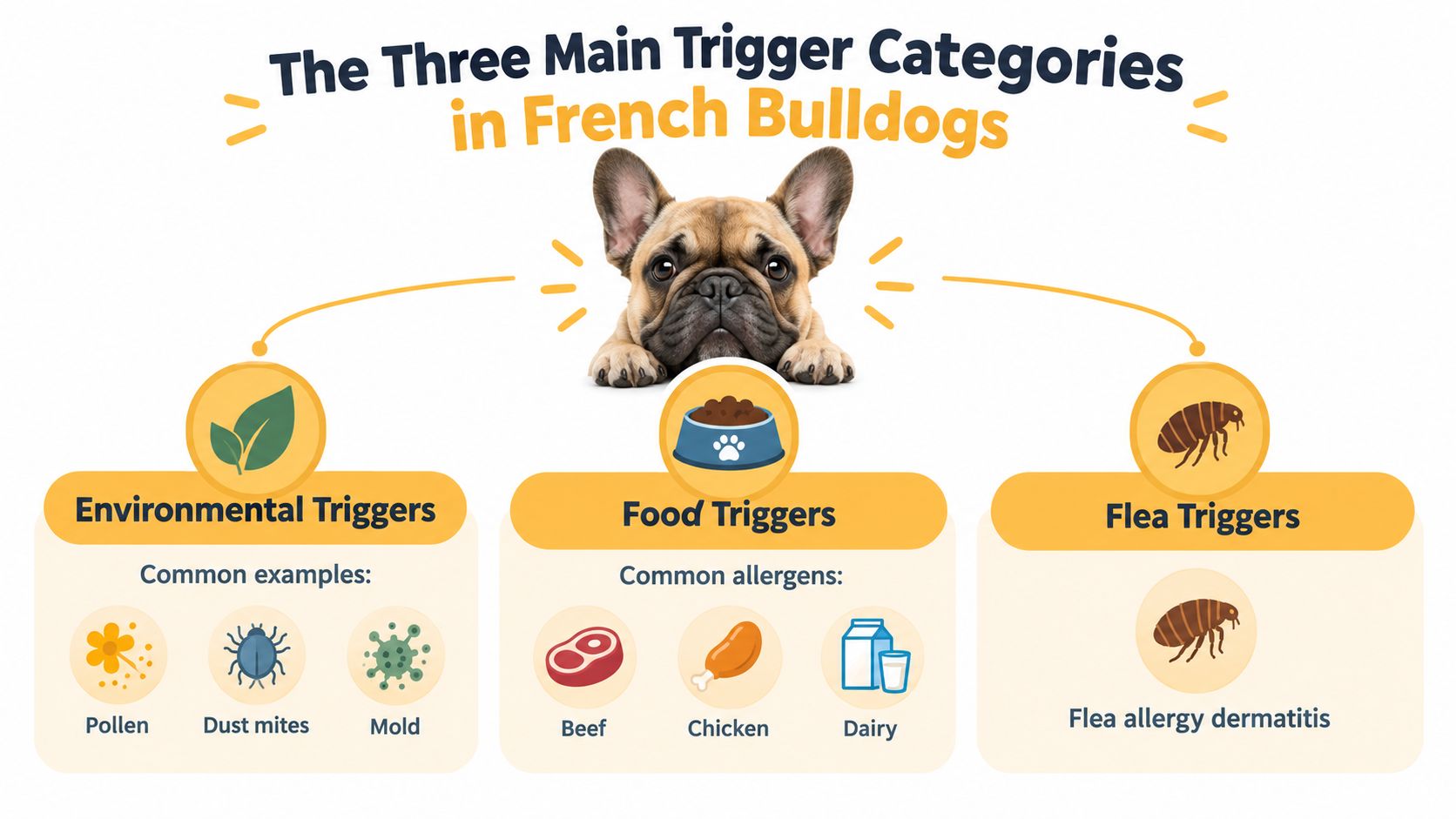
Frenchie allergies usually fall into three buckets, but the buckets can overlap. That's why a dog can seem to improve with one change and still keep itching, because the underlying problem may be a mix of environmental exposure, food sensitivity, and flea reaction. One trigger rarely explains everything on its own.
Environmental triggers show up where the dog meets the world
Environmental allergy, often called atopy, is the most familiar pattern for many Frenchies. Think grass pollen on the belly after a walk, dust mites in bedding, mold spores in damp rooms, and seasonal tree pollen settling into folds, ears, and paws. In a UK primary-care study, allergy was recorded in 3.2% of French Bulldogs, compared with 1.6% in non-French Bulldogs, and after adjustment the breed had 2.77 times the odds of an allergy diagnosis (study).
That doesn't mean every itchy Frenchie has the same trigger. It means the breed is overrepresented in allergy workups, so environmental exposure deserves serious attention instead of being treated as a minor possibility. If travel is part of your life, it also helps to think about how environmental exposure changes on the road, especially for brachycephalic dogs, so a planning resource like travel your dog with Ferried can be useful when you're trying to reduce avoidable flare-ups during transport.
Food triggers usually follow the dog, not the season
Food hypersensitivity tends to show up as a year-round problem, not a spring-only or summer-only one. The issue is usually a protein, not the idea of “grains” in general, so owners can get misled by random food swaps that don't really test anything. A real food trial has to be structured, because guessing rarely clears the picture.
Flea triggers can look dramatic after a tiny exposure
Flea allergy dermatitis often concentrates on the lower back, tail base, and inner thighs. A dog may react hard even after brief exposure, then keep scratching long after the flea is gone. That's why a Frenchie can look like they have “random” hotspots when the underlying pattern is highly consistent.
A note on maintenance support
Some owners also look at daily support products when they're trying to manage a chronic pattern rather than a one-time flare. One example is DA-1™ Daily All-in-One, which is described as a single daily powder with 18 human-grade ingredients aimed at broader multi-system support. It's not a substitute for trigger identification, but it fits the kind of maintenance conversation many owners end up having once they realize allergy care is ongoing.
Reading the Symptoms to Tell Triggers Apart
The body usually gives clues if you know where to look. French Bulldogs can be visually tricky because wrinkles hide redness, short coats hide scaling, and thick little paws can hide irritation until the itch is already established. Owners need to inspect the whole map, not just the most obvious sore spot.
Where the itch points matters
Environmental atopy often affects the paws, muzzle, ear flaps, armpits, and periocular skin. Food hypersensitivity can look similar on the skin, but it more often travels with recurrent ear trouble, anal gland irritation, or digestive signs that keep showing up alongside the itch. Flea allergy tends to cluster over the dorsal lumbosacral area and tail base, which is why the scratch pattern can be a useful clue even before a vet visit.
| Symptom Patterns That Help Differentiate Allergy Triggers | Environmental (Atopy) | Food Hypersensitivity | Flea Allergy |
|---|---|---|---|
| Body Area Affected | Paws, muzzle, ear flaps, armpits, periocular skin | Skin plus ears, with possible gut signs | Lower back, tail base, inner thighs |
| Timing | Often seasonal or exposure-linked | Often year-round | After flea exposure, then persistent |
| Common Clues | Face rubbing, paw chewing, ear irritation | Recurrent ear issues, anal gland problems, digestive upset | Hot spots near the tail base |
Useful shortcut: if the itch is seasonal and tracks with outdoor exposure, start thinking environmental first. If it never really leaves, food deserves a closer look.
This kind of pattern reading doesn't diagnose the problem by itself, but it saves time. It also keeps you from overreacting to the wrong clue, like assuming every paw lick means the food is wrong when the actual issue may be grass on the walk route.
How Vets Actually Diagnose French Bulldog Allergies
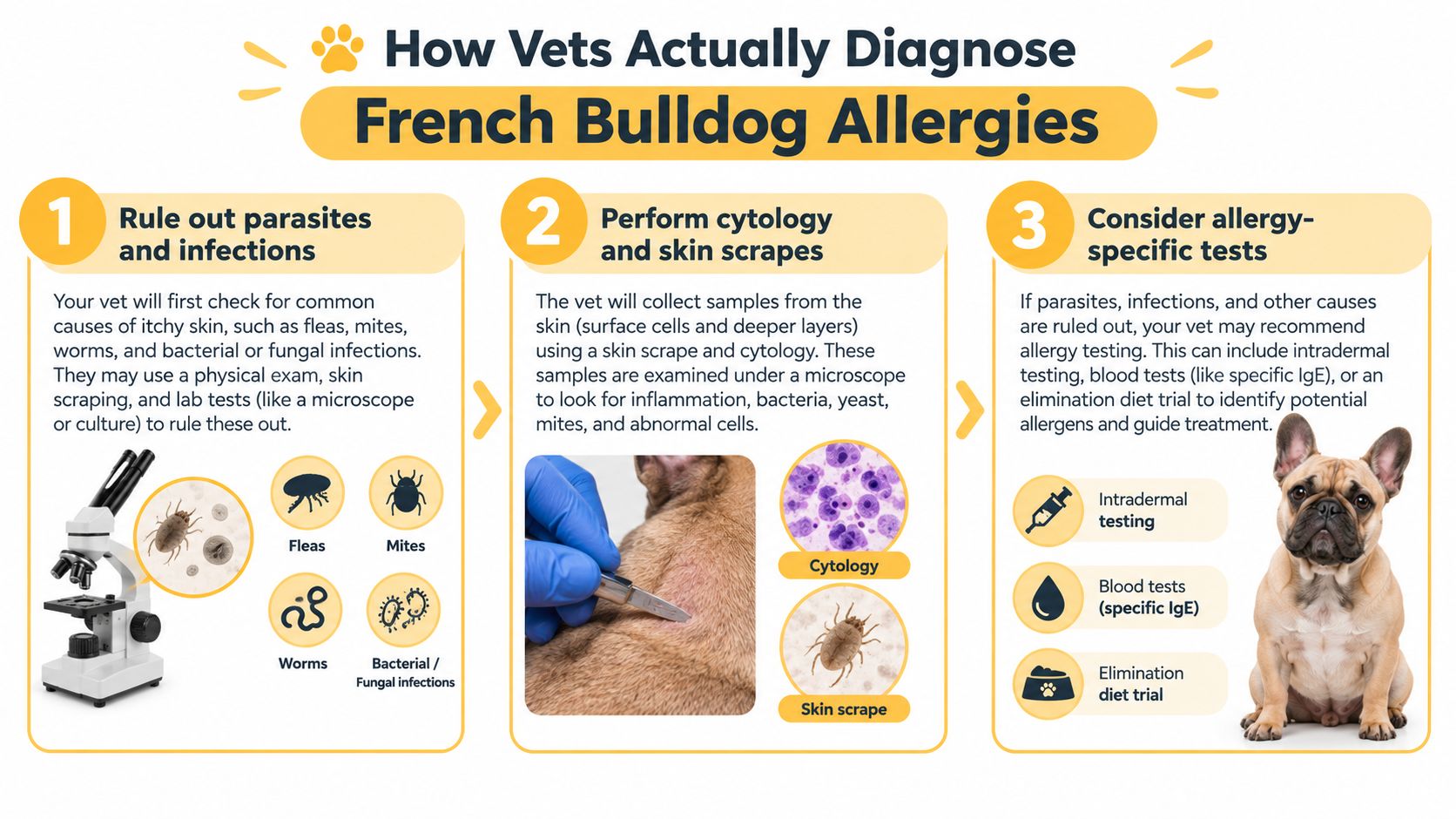
A good diagnosis starts by ruling out the things that can imitate allergy. Parasites and skin infections can make a Frenchie miserable on their own, and they can also ride along with allergy, which is why vets usually check for the basics before calling something allergic skin disease. The point is to avoid guessing while the skin is actively inflamed.
The first tests are about exclusion, not certainty
Cytology helps a vet look for yeast or bacteria on the skin or in the ears. Skin scrapes help rule out mites and other parasites. Those tests don't say, “This dog is allergic to X,” but they do tell you whether infection or parasites are part of the problem, which changes treatment right away.
Food allergy can't be confirmed by guesswork
A true elimination diet has to be strict and long enough to matter, usually 8 to 12 weeks, because random switching from one food to another doesn't prove anything. If the symptoms improve and then return when the old diet is reintroduced, that pattern is more meaningful than a single optimistic week. Allergy tests for food don't confirm food allergy on their own, so the diet trial is the part that carries the weight.
Environmental testing has a different job
Intradermal skin testing and serum IgE blood panels are used to help identify environmental allergens, not to prove food allergy. Skin testing can require sedation and a clinic visit, while blood testing is often easier to collect but still has to be interpreted in context. A positive test matters most when it matches the dog's story, because a test result without the right symptom pattern can mislead you.
The diagnosis is a working map of triggers, not one magic number or one positive panel. That map is what lets you decide whether exposure control, diet work, and long-term therapy should be layered together.
Treatment Options Compared Over the Long Run
Owners usually want the same answer first, “What will make life easier month after month?” The honest answer is that chronic Frenchie allergy care is usually a layered plan, not a single fix. When you compare the options over time, the right choice depends on how much effort you can sustain, how quickly you need relief, and how much symptom control you're aiming for.
The big maintenance choices
| Long-Term Allergy Management Options for French Bulldogs | Monthly Cost | Time to See Results | Best For | Limitations |
|---|---|---|---|---|
| Allergen-specific immunotherapy | Varies by formulation and follow-up | Slow, because it's built for long-term change | Dogs with confirmed environmental triggers | Takes commitment, not a quick reset |
| Prescription or hydrolyzed diets | Varies by food type | Weeks, if the trial is done strictly | Suspected food hypersensitivity | Only useful when the diet is followed without extras |
| Medicated bathing and skin-barrier repair | Varies by products and schedule | Often faster for comfort, slower for deeper control | Dogs with oily, itchy, or reactive skin | Needs consistency, especially in wrinkly skin |
| Targeted anti-itch medication or short steroid courses | Varies by medication and dosing | Often the quickest relief option | Dogs in active flare-ups | Helps control symptoms, not the underlying trigger |
How to think about the real tradeoff
Immunotherapy is the long game for environmental allergy. Diet trials are the long game for food hypersensitivity. Bathing and skin-barrier support help the outside of the skin do its job better, which matters because barrier dysfunction keeps the itch cycle alive. Targeted medication can be a useful layer when the dog is uncomfortable now and needs relief while the slower pieces catch up.
The strongest plans usually combine layers, they don't ask one product to do everything.
That's why the conversation should sound more like a yearly budget and routine discussion than a one-time purchase decision. If you're reviewing supplement-style support as part of that plan, this allergy supplement guide can help you think in practical terms about what belongs in a maintenance routine and what doesn't.
Why Short-Term Fixes Rarely Solve Frenchie Allergies
A sensitive shampoo can help, but it can't erase a chronic immune response. An antihistamine may blunt part of the itch, but it doesn't fix the barrier damage or the trigger exposure keeping the cycle going. A food change without a real elimination trial can feel hopeful and still leave you stuck in the same loop.
Frenchie skin gets trapped in a self-reinforcing pattern. Itch leads to scratching, scratching damages the barrier, the damaged barrier lets more irritants in, and then the skin gets even more reactive. That's why short-term fixes often look promising for a few days and then fade.
The layered approach is the one that usually holds
A durable plan usually includes four parts:
- Parasite control, so fleas aren't adding fuel to the fire.
- Trigger reduction, so the dog is exposed to less of what sets off the skin.
- Skin-barrier support, so the surface of the skin can resist irritation better.
- Immunomodulating treatment when needed, so the immune system doesn't keep overreacting.
None of those pieces works as well alone as they do together. That's the frustrating part for owners, but it's also the reason many dogs improve once the plan stops trying to do everything with one product.
When to See a Vet and Your First 7 Days of Action
Some signs need a vet visit right away, not next week. Open sores, hot spots, face or throat swelling, hives, recurrent ear infections, persistent vomiting or diarrhea, and any breathing change deserve prompt attention, especially in a Frenchie, because airway issues can make a bad reaction harder to ignore. If the skin looks infected or the dog seems distressed, don't try to ride it out at home.
A calm first-week plan that gives your vet useful information
Start with an appointment, then build a simple record of what the dog is doing each day. Take photos of the ears, paws, belly, and folds, and write down when the scratching is worst, after walks, after meals, or during the night. Stop treats and table food for now, unless your vet has already told you to use them in a controlled diet plan.
If your vet agrees, switch to a bland or hypoallergenic diet, begin parasite prevention, and bathe on a regular schedule with a gentle shampoo that won't strip the skin. Remove obvious irritants too, like scented cleaners, heavily fragranced laundry products, or dusty bedding. For more help on the home-care side, this guide to itchy-skin remedies for dogs gives a practical place to start while you're waiting to be seen.
What week one is really for
Week one is about stabilization and information, not a cure. If you collect clean observations now, the vet visit is more productive later, because the pattern will be easier to see and the next step will be based on evidence instead of panic. That's the fastest way out of the repeated-flare cycle.
If your Frenchie is stuck in the same itch cycle, Pure Paw Labs offers a simple daily supplement option designed to support skin, gut, and joint needs in one routine. Visit Pure Paw Labs to review the product details and decide whether a broader maintenance approach fits your dog's long-term allergy plan.