


More than half of U.S. dog owners now hand their dog a pill, powder or chew with breakfast, and joint formulas sit near the top of the shopping list. The American Pet Products Association reported that 53% of U.S. dog owners gave their dogs vitamins or supplements in 2024, a 6% increase from 2023, with joint-health and mobility products among the most popular categories.
That spending has run ahead of the science, not behind it. The research on joint support is uneven. A few benefits are well supported, some rest on a single small trial, and a couple are pure marketing. The question worth asking isn't whether joint supplements work. It's which benefit you're buying, how long it should take, and what you'd see at home if it were working.
Table of Contents
- Joint Support Benefits at a Glance
- Which Joint Ingredients Work and How They Act
- How Long Joint Support Takes to Work
- Measurable Signs Owners Can Track at Home
- Safety Limits and When Supplements Are Not Enough
- Your Decision Checklist Before Continuing
Joint Support Benefits at a Glance
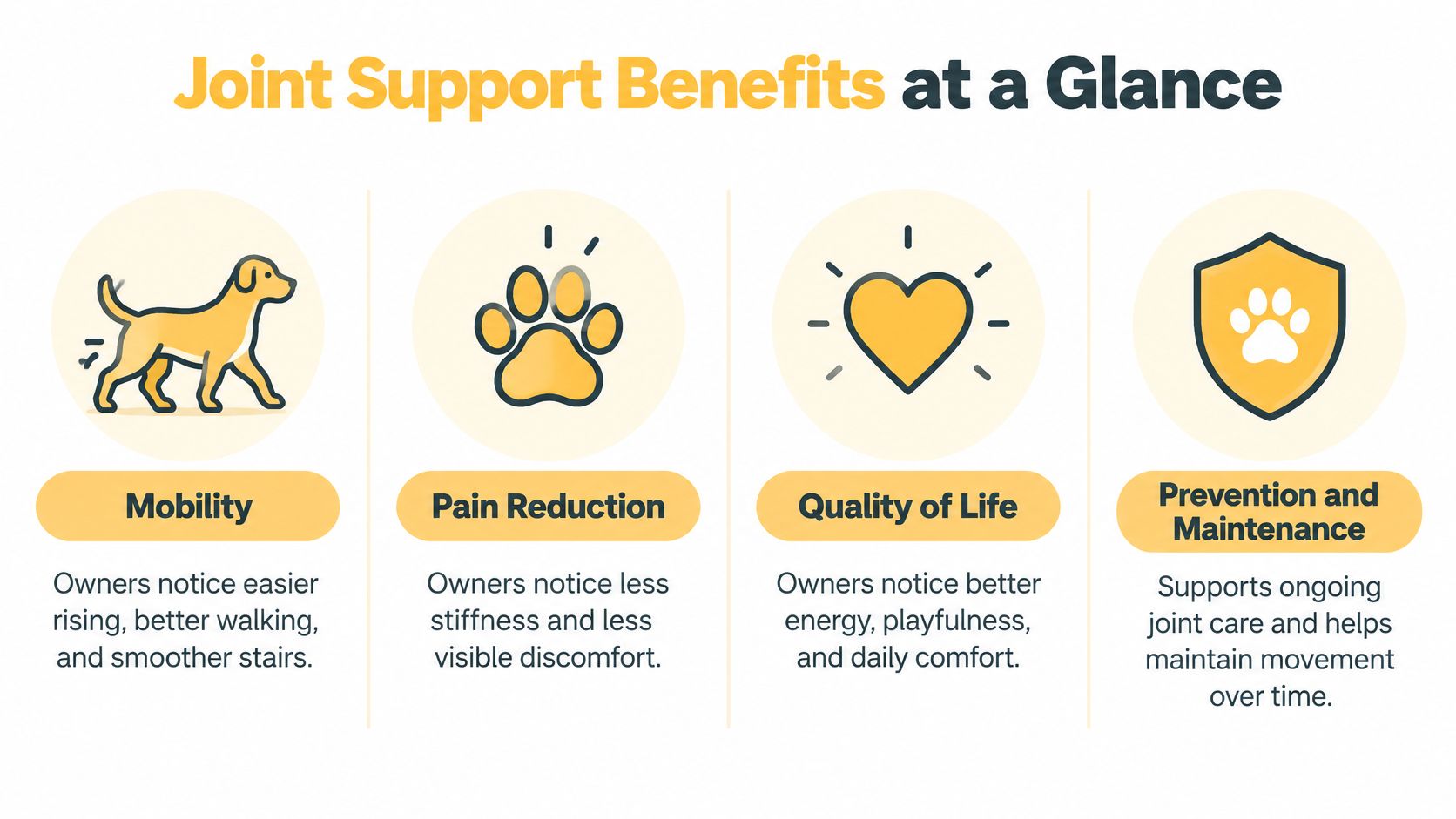
Joint support can mean easier movement, less pain, or better day-to-day comfort. Evidence differs by benefit, so match the claim to an observable change.
| Benefit area | What owners notice | Evidence strength |
|---|---|---|
| Mobility | Easier rising, smoother stairs, longer walks | Mixed, because glucosamine and chondroitin trials show inconsistent objective gains |
| Pain reduction | Less stiffness after rest, fewer reactions to touch | Strongest evidence in this comparison, from omega-3 fatty acids in systematic reviews |
| Quality of life | More play, more interest in walks, settled sleep | Mostly owner-reported, harder to verify independently |
| Prevention and maintenance | Steady comfort in young or at-risk dogs | Limited direct trials; early imaging findings do not establish that supplements prevent disease |
The visual summary below maps those four areas the way owners usually describe them.
Why the Prevalence Numbers Disagree
Reported prevalence depends on the population studied and how disease is identified. A peer-reviewed review of canine osteoarthritis reports North American prevalence at approximately 20% among dogs older than one year, based on data from 200 veterinarians. The same review reports UK primary-care estimates of roughly 2.5% to 6.6% across all ages and breeds. Clinical records can miss dogs whose owners do not report reduced activity, difficulty rising, or an occasional limp.
Imaging can identify changes that are not obvious from a dog's behavior. The review also cites a study finding radiographic osteoarthritis in at least one appendicular joint in 39.8% of 123 dogs; 23.6% had at least mild joint pain, and 16.3% had moderate-or-greater pain. Structural changes, observable pain, and a clinical diagnosis are related, but they are not interchangeable.
What the Table Is Actually Telling You
A benefit is easier to assess when it has a concrete home measure. For mobility, note how readily your dog rises or manages familiar stairs. For comfort, watch for stiffness after rest or reactions to touch. Play, walking interest, and sleep can add context, but they rely more on owner observation.
Prevention claims need particular caution: evidence that joint changes may exist before owners notice symptoms does not show that a supplement prevents those changes. Use the table to set expectations, then judge any claimed benefit by the change you can observe.
Which Joint Ingredients Work and How They Act
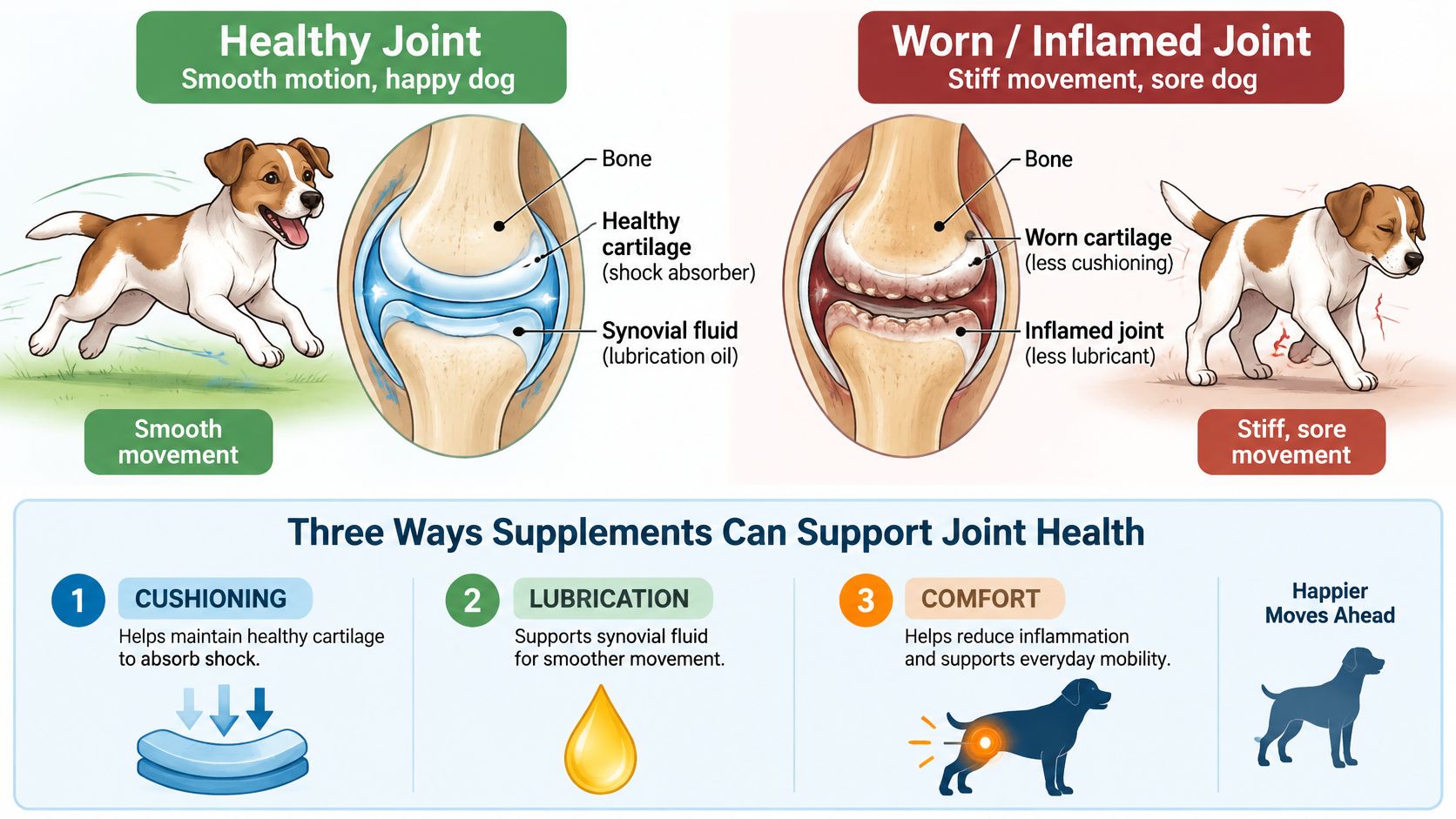
Joint supplements target different parts of the problem. Omega-3 fatty acids such as EPA and DHA may affect inflammatory pathways and help reduce inflammation around the joint. Glucosamine, chondroitin and collagen are used to support joint tissues, but evidence that they rebuild damaged cartilage is limited. Some plant-based ingredients, including turmeric, are also marketed for inflammation, though dog-specific evidence varies.
The clearest signal in a 2022 systematic review and meta-analysis came from omega-3-enriched diets and supplements. Across the reviewed trials, glucosamine and chondroitin showed little evidence of pain relief. That distinction matters: an ingredient's role in supporting tissue does not establish that it reduces pain or restores cartilage.
Research on newer ingredients is less settled. A trial of an eggshell-membrane combination reported improvements in pain, mobility and clinical scores, but results for one formulation cannot establish the effect of every product containing that ingredient.
Reading the Label Without Being Fooled
“Fish oil” alone does not tell you how much EPA or DHA a serving provides. Check those amounts separately, then consider whether the serving size is practical for your dog. This guide to omega-3 for dogs explains the difference between total fish oil and its active fatty acids.
| Ingredient | Outcome it targets | Evidence strength | Label detail to check |
|---|---|---|---|
| Omega-3 fatty acids (EPA and DHA) | Pain and inflammation | Strongest signal in the reviewed evidence | EPA and DHA amounts, not total fish oil |
| Glucosamine and chondroitin | Joint-tissue support | Mixed; limited evidence for pain relief | Dose per serving and whether the product was tested |
| Collagen | Joint-tissue support | Limited dog-specific evidence | Collagen type and amount per serving |
| Eggshell membrane | Pain, mobility and clinical scores | Limited; one formulation has reported trial results | Whether the product matches the tested formulation |
| Turmeric (curcumin) | Inflammation | Limited dog-specific evidence | Curcumin content per serving |
| Green-lipped mussel | Joint comfort | Limited controlled-trial evidence | Source and quantity per serving |
A label that lists amounts makes it easier to compare ingredients and serving sizes. DA-1™ Daily All-in-One combines joint, skin, digestive and immune support in one scoop. Its joint-support ingredients include glucosamine, omega-3s, turmeric and beef bone broth.
How Long Joint Support Takes to Work
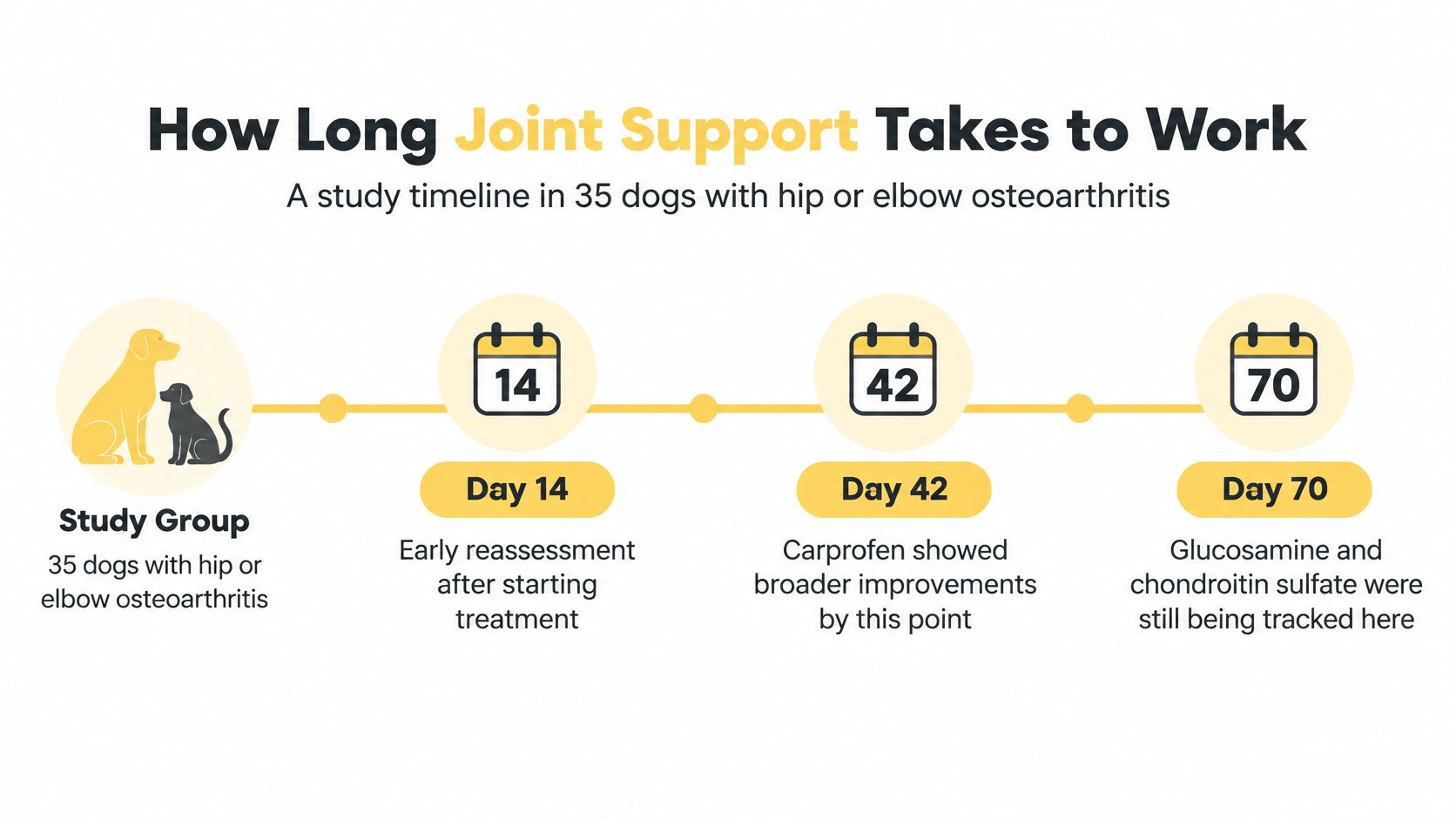
In a 2006 multicenter, randomized, double-blind, positive-controlled trial of 35 dogs with confirmed hip or elbow osteoarthritis, researchers compared glucosamine hydrochloride and chondroitin sulfate with carprofen, a nonsteroidal anti-inflammatory drug. Dogs were reassessed on days 14, 42 and 70.
By day 70, the supplement group showed statistically significant improvements in veterinarian-assessed pain, weight-bearing and overall disease severity. The trial reported P<0.001 for these improvements. Carprofen produced broader improvements by day 42, while the supplement combination reached significance only at the final assessment.
Other evidence is less encouraging. A 2017 double-blind, placebo-controlled study of 60 dogs over roughly 90 days found no significant increase in activity counts versus placebo. A later meta-analysis of joint supplements for canine osteoarthritis found no significant overall effect on clinical signs. Taken together, these findings mean that a trial's timeline is a guide, not a promise that every dog will improve.
A Week-by-Week Plan for Judging Response
Major improvements with Pure Paw Labs products typically start to appear in 4 to 6 weeks, though some dogs may feel benefits sooner. For joint support generally, the research above suggests that meaningful changes may take longer to show. A guide to glucosamine for dogs explains why trial results for this ingredient are mixed.
| Window | What to expect | What to do |
|---|---|---|
| Day 42 (trial) | Carprofen showed broader improvements | Treat this as an NSAID comparison, not a supplement target |
| Day 70 (trial) | The glucosamine and chondroitin group showed significant gains | Use as one trial-specific reference point |
| Weeks 1 to 2 | A clear change may not yet be apparent | Record a baseline and avoid judging too early |
| Weeks 4 to 6 | Early changes may appear; some dogs respond sooner | Note when a change first appears |
| Weeks 8 to 10 | A longer trial gives more time to assess a response | Compare with the baseline using the same measures |
Why the Clock Restarts Every Time You Stop
Daily use matters. If a dog takes a supplement for three weeks, stops for two weeks and then starts again, the routine has not provided a continuous trial. Keep dosing consistent, and address practical barriers to the routine before deciding the product has not helped.
The video below discusses how long an owner might wait before drawing a conclusion.
Assess the response after a consistent trial, not after the first scoop or bag.
Measurable Signs Owners Can Track at Home
A prospective randomized trial of 71 client-owned dogs weighing over 20 kg with lameness and radiographic osteoarthritis makes the case for measurement better than any argument. A glucosamine and chondroitin combination improved pain, weight-bearing and overall condition by about day 70. Lameness and objective joint mobility did not improve significantly by the end of the trial.
Read that again. The same dogs, on the same product, improved on some scales and not on others. An owner watching from the couch would have called it one way or the other without knowing which.
Why Your Impression Is a Poor Instrument
Caregiver expectation bends perception, and it bends it in the direction of whatever you paid for. Veterinary guidance from the University of Illinois osteoarthritis management team recommends a defined reassessment period built on observable measures such as stairs, walking duration, or stiffness after rest, rather than a general sense that the dog seems better.
That's the whole trick. Pick three or four things you can count or time, write them down before the first dose, and check them the same way each time.
Building a Two-Week Baseline
Spend two weeks recording before you buy anything. Use the same time of day, the same walking route and similar weather, because cold mornings and slick floors change gait on their own. Film a 20-second walk from the same angle every fortnight so you can compare stride rather than memory.
| Measure | How to record it | Baseline sign | Improvement sign |
|---|---|---|---|
| Rising from rest | Count attempts to stand after a 20-minute nap | Needs two or more tries | Stands in one try |
| Stair use | Count steps taken before stopping or going around | Avoids stairs or hops up | Climbs with a normal rhythm |
| Walk duration | Time or distance on the same route each week | Walks cut short | Completes the full route |
| Stiffness after rest | Note limping or hesitation in the first five minutes | Stiff gait for over 10 minutes | Warms up within a few minutes |
| Daily activity | Note play sessions and sprints per day | Reduced or no play | Returns to regular play |
| Gait | Video a walk every two weeks from the same angle | Visible hitch or uneven stride | Steady, even stride |
Note the confounders in the same log: a weather change, a weight shift, a new game that left the dog sore. A genuine improvement shows up across several sessions, not on one unusually good Tuesday.
Bring the log to every appointment. It turns a vague impression into something your vet can weigh against dog mobility issues and other diagnoses. Owners juggling multiple pets and clinics may find a system for organizing vet records for Indian pet parents helps keep the history in one place between visits.
Safety Limits and When Supplements Are Not Enough
Natural does not mean harmless or dose-free. Joint products are sold as food, not medicine, and that changes what you have to do yourself.
Omega-3 formulas are the clearest example. Reaching a dose that affects joints often means a relatively high intake, which can cause diarrhea, and these fatty acids can affect coagulation, so caution is warranted for dogs with bleeding disorders. Supplements can also be overdosed. Store them the way you'd store medication, out of reach and off the counter.
A supplement should never delay a diagnosis. Lameness can come from a cruciate injury, an infection or a bone problem that needs imaging, not a powder.
The Care That Does More Than a Pill
Weight management, exercise modification, rehabilitation and veterinarian-prescribed pain relief all outrank supplements in impact, and they work better alongside them than instead of them.
- Weight: carrying less mass through the same joints lowers the load on every step, and it's the single highest-return change most owners can make.
- Exercise: swap repeated high-impact jumping and long ball sessions for controlled leash walks and swimming where it's available.
- Rehabilitation: a vet physiotherapist can build a home program of slow leash walks, weight shifts and controlled standing exercises.
- Prescribed analgesia: if your dog is uncomfortable now, comfort comes from veterinary treatment, with the supplement as background support.
Dogs on NSAIDs or anticoagulant-related medication need a veterinary review before anything new goes in the bowl. Senior dogs deserve the same check even when they seem fine.
Practical Administration
Giving the product during or after a meal may reduce gastrointestinal upset, and it's the simplest fix if your dog has a sensitive stomach. Budget matters too, since a big dog costs more to keep than a small one before you add anything. German Shepherd breed cost estimates give a sense of where long-term joint care sits inside a large dog's total cost.
Stop and call your vet for sudden limping, a dog that won't bear weight, visible swelling, or vomiting and diarrhea that persist. The common side effects owners report are covered in more depth in this guide to dog joint supplement side effects.
Your Decision Checklist Before Continuing
Use this checklist to turn the evidence and observations from the earlier sections into a practical decision.
- Book a veterinary appointment. Ask your vet to assess the stiffness and advise whether further evaluation or treatment is appropriate.
- Check the product label against your dog's needs. Use this guide to read supplement labels and assess the ingredients and amounts.
- Choose a home measure you can track consistently. Refer to the signs in the owner-tracking section and record the same measure in the same way.
- Set up a daily routine you can maintain. Choose a product and administration time that fit your household, and follow the label directions.
- Review your observations against the expected timeframe. Use the timing section to decide when to assess progress.
- Bring your notes to the next veterinary appointment. Discuss what changed, what stayed the same, and any side effects before deciding whether to continue or adjust the plan.
Daily use helps maintain optimal results, so choose a routine you can sustain. If you are considering DA-1™ Daily All-in-One, it combines joint, skin, gut, allergy, and immune support in one scoop. Book the appointment, then bring your notes and the product label for your vet to review.