


You notice it during a cuddle. Your dog leans against you, you lift a facial fold or glance beneath a tail, and there it is, a red crease, damp skin, or an unfamiliar smell. The dog may still be cheerful and hungry, so it's easy to assume the problem can wait.
A dog with wrinkly skin needs more than occasional wiping. The right routine depends on the breed's shape, the location and depth of its folds, body condition, age, allergies, and how quickly moisture returns after eating, drinking, exercise, or bathing. Some dogs need a brief daily check, while others need careful attention to several areas every day and veterinary support when inflammation keeps returning.
The good news is that wrinkle care becomes much easier once you know what you're looking for. Clean, dry folds, regular observation, sensible weight management, and early veterinary advice can help a wrinkly dog stay comfortable and active.
Table of Contents
- What Living With a Wrinkly-Skinned Dog Really Looks Like
- The Most Common Wrinkly Dog Breeds and Their Risk Profiles
- Why Wrinkly Skin Creates Measurable Health Risks
- A Practical Cleaning and Hygiene Routine for Skin Folds
- Lifestyle Factors That Change Your Dog's Risk
- Warning Signs That Mean It's Time to Call the Vet
- Preventive Care Framework for Wrinkly Dogs
What Living With a Wrinkly-Skinned Dog Really Looks Like
The first lesson usually arrives in an ordinary moment. Your Bulldog finishes dinner, rubs its face against your leg, and leaves a faint smell on your trousers. You look more closely and find food and saliva inside the lip fold. Or your Shar-Pei comes back from a damp walk with the skin between its rolls still wet, even though the coat looks dry from the outside.
Those small checks become part of life with a wrinkly dog. You'll gently lift facial folds, inspect the lips, glance under the tail, and look through body rolls for redness, moisture, debris, or a change in smell. After meals, a quick face and lip-fold wipe can remove food before it sits against the skin. After rain, swimming, heavy panting, or a bath, drying matters as much as cleaning because moisture can remain hidden between layers.
The routine is more than face wiping
A dog's folds don't all behave in the same way. Facial and nose folds collect saliva, tears, and food. Lip pockets can trap debris. Tail folds may be difficult to see and can stay humid. Neck and body rolls create broader areas where skin rubs against skin, especially if a dog carries excess body fat.
Your dog may also attract attention in public. Strangers often want to touch prominent wrinkles, but not every dog enjoys unfamiliar hands near its face or tail. Ask people to let your dog approach first, and protect handling sessions if your dog shows discomfort. Calm, cooperative inspection at home is far more useful than forcing contact.
Practical rule: A fold that looks normal from the outside can still be damp or irritated underneath. Lift it gently and check the skin itself.
Care intensity varies sharply. A lightly folded dog may need simple monitoring, while a Bulldog with facial folds and a tail pocket may need separate checks for both areas. A Shar-Pei's extensive wrinkles create a different inspection pattern from a Pug's concentrated facial folds. These dogs are rewarding companions, and their care isn't mysterious. Once the checks become familiar, wrinkle maintenance becomes a small, predictable part of a satisfying relationship.
The Most Common Wrinkly Dog Breeds and Their Risk Profiles
Wrinkly breeds are easier to understand when grouped by where their anatomy traps moisture, rather than placed in an alphabetical list. Brachycephalic breeds, including English Bulldogs, French Bulldogs, and Pugs, often concentrate risk around facial, nose, and lip folds. Their shortened facial structure can also make eye protection more difficult. A clinical review found that dogs with nasal folds were nearly five times more likely to have corneal ulcers, while brachycephalic dogs were 20 times more likely than non-brachycephalic dogs to have them, as reported in this veterinary review of skin-fold disease and related risks.
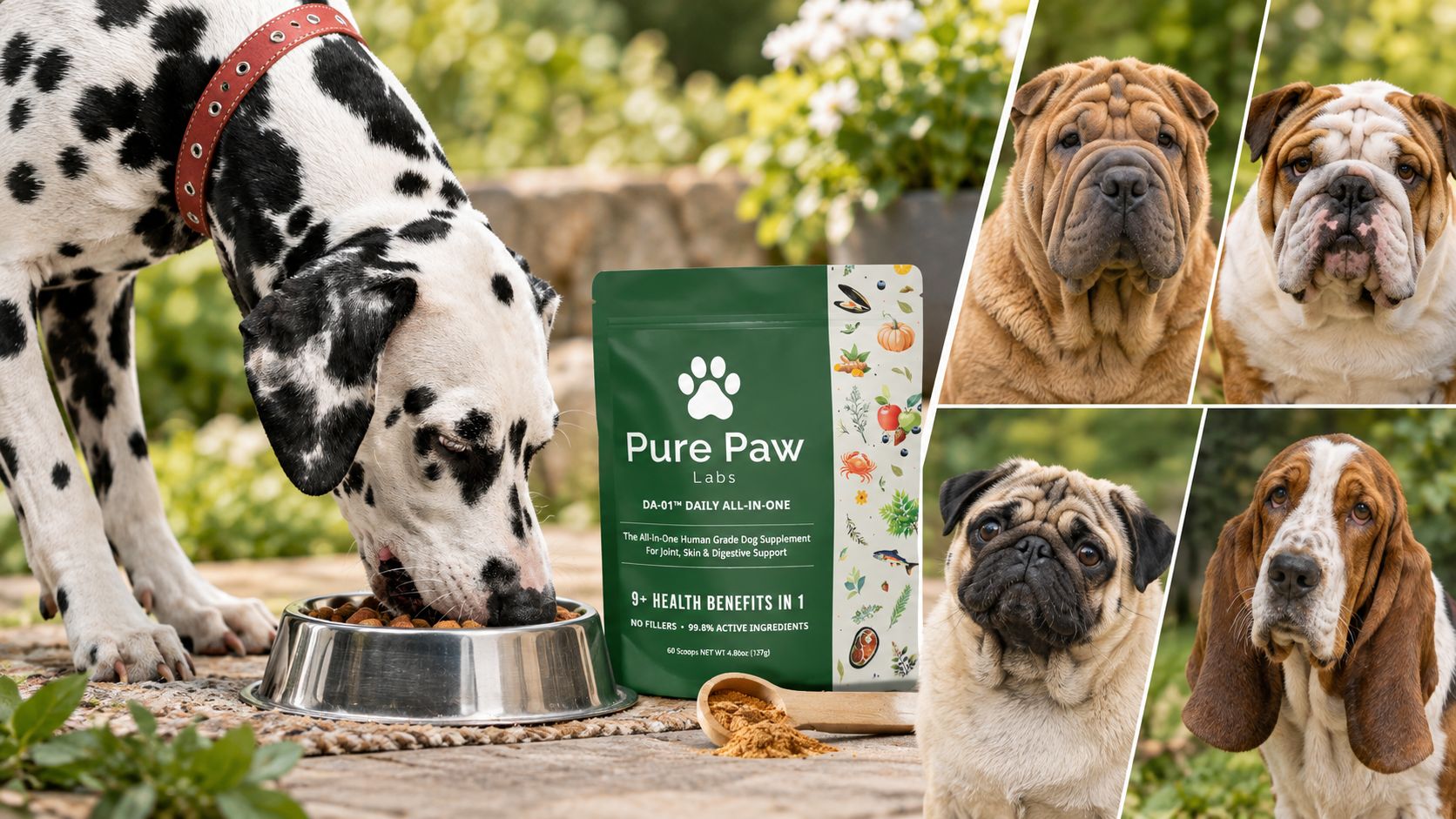
Compare the main fold patterns
Shar-Peis, Bloodhounds, and Basset Hounds have a different profile. Shar-Peis may have wrinkles across the head, neck, and body, while Bloodhounds and Basset Hounds often need attention around facial folds, lips, neck skin, and other hanging areas. Their risk isn't identical to that of a Pug because the fold locations, airflow, and amount of skin differ.
Large, heavily folded breeds such as Neapolitan Mastiffs and Dogue de Bordeaux may develop problems in facial folds, lip folds, neck rolls, and body creases. A heavy body can also make inspection physically harder, so owners need a calm handling routine and good lighting.
| Breed | Primary Fold Locations | Risk Level |
|---|---|---|
| English Bulldog | Facial folds, nose fold, lip folds, tail pocket | High, with several separate moisture-trapping sites |
| French Bulldog | Facial and nose folds, lip folds, neck area | High, especially around the face |
| Pug | Facial and nose folds, lip folds | High, with concentrated facial and eye-related concerns |
| Shar-Pei | Facial, neck, and body wrinkles | High, but distributed across more of the body |
| Bloodhound | Facial, lip, and neck folds | Moderate to high, depending on depth and moisture |
| Basset Hound | Facial, lip, and neck folds | Moderate to high, with hanging skin that needs regular checks |
| Neapolitan Mastiff | Facial folds, lip folds, neck and body rolls | High, because of extensive heavy skin |
| Dogue de Bordeaux | Facial, lip, neck, and body folds | High, particularly where skin surfaces rub |
A Pug's facial routine shouldn't be copied blindly for a Shar-Pei, and nose-fold care doesn't replace tail-pocket care in an English Bulldog. Owners considering wider wellness support for an aging dog may also review DA-1™ Daily All-in-One - Senior Dog Support, Joints, Skin/Coat & More, which the catalog describes as a single-scoop formula with 18 human-grade ingredients targeting cells, gut, and joints. It's a dietary supplement, not a treatment for infected folds.
For owners managing a Pug's recurring irritation, this guide to Pug skin allergies can help separate allergy-related itching from simple surface debris.
Why Wrinkly Skin Creates Measurable Health Risks
Wrinkles themselves aren't an illness. The problem starts when adjacent skin surfaces create a warm, damp, low-airflow space where friction, secretions, and debris remain in contact with the skin. That environment can support overgrowth of organisms that normally live on the body, including yeast such as Malassezia and bacteria such as Staphylococcus species.
Every fold adds mechanical stress. Skin rubs against skin, moisture softens the outer barrier, and sebum or saliva can accumulate in the crease. Once the barrier becomes irritated, the dog may scratch or rub the area, causing more inflammation and creating a cycle that routine wiping alone may not stop.
The epidemiology explains the difference
A large UK primary-care study found annual skin-fold dermatitis prevalence of 1.02% in brachycephalic breeds, compared with 0.26% in mesocephalic breeds and 0.22% in dolichocephalic breeds, according to the published epidemiological study. The same pattern produced the highest breed-level prevalence in English Bulldogs at 6.05%, French Bulldogs at 2.69%, and Pugs at 2.11%.
Another large study found that skin-fold dermatitis affected 0.37% of dogs overall each year, but risk differed dramatically between breeds. English Bulldogs had an odds ratio of 49.07, French Bulldogs 25.92, and Pugs 16.27, while Yorkshire Terriers and Border Collies were comparatively protected, as described in the primary-care risk analysis.
A clean-looking fold isn't necessarily a healthy fold. Moisture and friction are the drivers, so prevention must focus on the hidden conditions inside the crease.
These figures don't mean every Bulldog or Pug will develop dermatitis, nor do they make every other breed low risk. They show why a one-size-fits-all routine fails. A dog with deep facial folds, frequent drooling, allergies, or excess weight may need closer monitoring than a dog with shallow, well-ventilated wrinkles.
Yeast can be part of a wider allergy problem rather than the only cause. Owners who notice recurrent itching, paw licking, ear trouble, or repeated fold flare-ups may find this overview of probiotics for dogs with yeast useful background, but persistent disease still calls for veterinary assessment.
A Practical Cleaning and Hygiene Routine for Skin Folds
A reliable routine has five parts: inspect, clean gently, reach each fold type, dry completely, and record changes. Use a well-lit area and let your dog see and smell the cloth before you touch the face. If your dog resists, stop and ask your veterinary team to demonstrate safer handling.
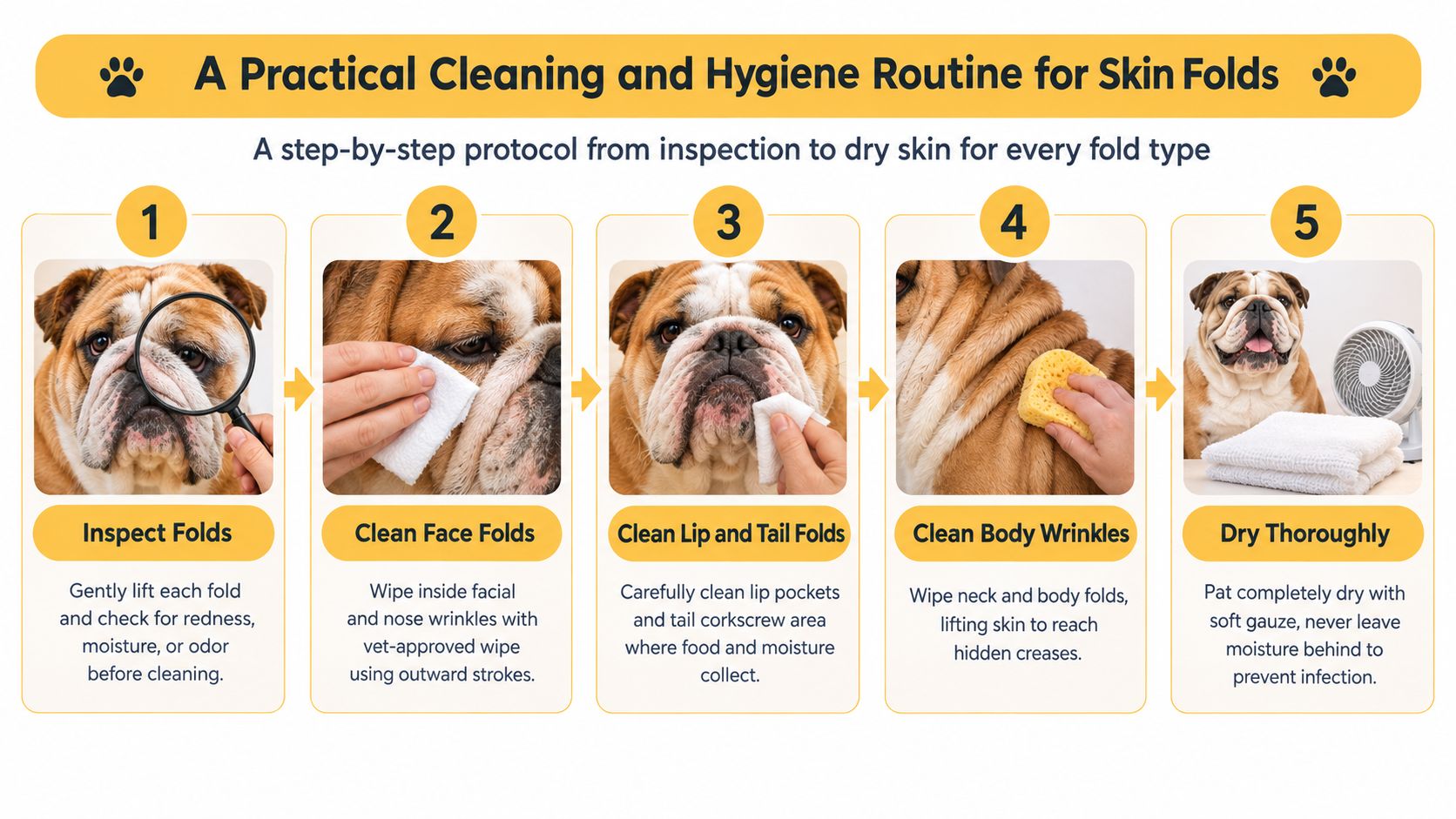
Start with inspection
Lift each fold without pulling. Look for redness, dampness, swelling, discharge, crusting, bleeding, or a new smell. A soft cotton pad, gauze square, or clean cloth is usually easier to control than a cotton swab, which can push debris deeper or leave fibers behind.
For routine cleaning, use a veterinary-approved wipe or a properly diluted antiseptic such as chlorhexidine, following the product directions and your veterinarian's advice. Don't use hydrogen peroxide or alcohol on irritated skin. They can sting and damage already fragile tissue. Never place cleanser directly into the eyes, and don't use a product near the eye unless it's specifically intended for that area.
Match the method to the fold
- Face and nose folds: Wipe outward with a soft, damp pad, using a fresh surface for each pass. Pay attention after meals, drinking, and heavy panting.
- Lip folds: Open the lip gently and remove food, saliva, and greasy residue without scrubbing. If the pocket is painful or smells strongly, arrange a veterinary check.
- Tail folds: Lift the tail carefully and inspect the entire pocket, including the skin hidden beneath the curl. A tail pocket needs its own check, even when the face looks clean.
- Neck and body wrinkles: Separate the layers with your fingers, wipe visible debris, then use dry gauze or a soft towel to reach the crease. Don't leave damp skin beneath a thick coat.
Pat rather than rub. If hair at the fold margin stays wet or mats easily, ask a groomer or veterinary professional whether careful trimming is appropriate. Don't cut close skin yourself, especially in a deep or painful fold.
Here's a simple rhythm:
- Every day: Inspect high-risk folds and wipe areas soiled by food, saliva, rain, or drool.
- Several times through the week: Complete a thorough clean of every fold your dog has, adjusting frequency to moisture and veterinary advice.
- After bathing: Dry each crease before your dog settles down.
- After meals and walks: Perform quick spot checks instead of waiting for the next full routine.
Use this dog itchy skin remedies guide for broader questions about itching, but don't use home care to postpone evaluation of painful or spreading lesions.
The video below provides a visual demonstration of gentle handling and drying:
Lifestyle Factors That Change Your Dog's Risk
A fold is shaped by more than breed. Body condition, allergies, age, and activity can change how deep the crease becomes and how long it stays damp. Extra body fat can deepen neck, facial, and body folds, while scratching from environmental or food allergies damages the skin barrier and adds saliva and moisture.
Brachycephalic dogs may also pant heavily during ordinary activity. Repeated wetting around facial folds can make a previously manageable routine inadequate, especially in warm or humid conditions. Older dogs can develop looser skin and may be less willing to move away from damp bedding or change position, so their folds need closer observation.
Adjust the plan to the individual dog
If your dog is gaining weight, ask your veterinarian to assess body condition and set a safe feeding and exercise plan. Don't restrict food abruptly or choose a weight target without professional guidance. A healthier body condition may reduce rubbing and make folds easier to inspect, but it won't replace cleaning or treatment for existing dermatitis.
Allergies deserve a separate conversation. Repeated paw licking, face rubbing, ear problems, or seasonal flare-ups can keep fold inflammation active. Your veterinarian may discuss a carefully controlled diet trial, allergy investigation, parasite control, or medication rather than treating each red crease as an isolated infection.
| Lifestyle Factor | Effect on Fold Skin | Recommended Owner Adjustment |
|---|---|---|
| Body condition | Extra fat can deepen rolls and increase contact between skin surfaces | Monitor body condition with your veterinary team and adjust food and activity safely |
| Allergies | Scratching and licking weaken the skin barrier and add moisture | Track patterns and ask about allergy evaluation or a supervised diet trial |
| Age | Looser skin and reduced mobility can make drying and self-care harder | Increase visual checks and include skin changes in wellness visits |
| Humidity and heat | Dampness lasts longer and panting can wet facial folds | Dry folds after outdoor activity and improve airflow in resting areas |
| Activity level | Exercise, drooling, rain, or water exposure can leave hidden moisture | Add a post-activity inspection rather than waiting for the next scheduled clean |
Bedding also matters. Wash and dry resting fabrics regularly, keep water areas as dry as practical, and avoid letting your dog remain on damp surfaces. These small environmental changes reduce the time folds spend in contact with moisture.
Warning Signs That Mean It's Time to Call the Vet
Wrinkles don't cause every skin problem. Trapped moisture, friction, allergy, infection, and an impaired skin barrier create the trouble. That distinction matters because cleaning a fold may remove surface debris while leaving an underlying allergy, bacterial infection, yeast overgrowth, painful tail pocket, or eye problem untreated.
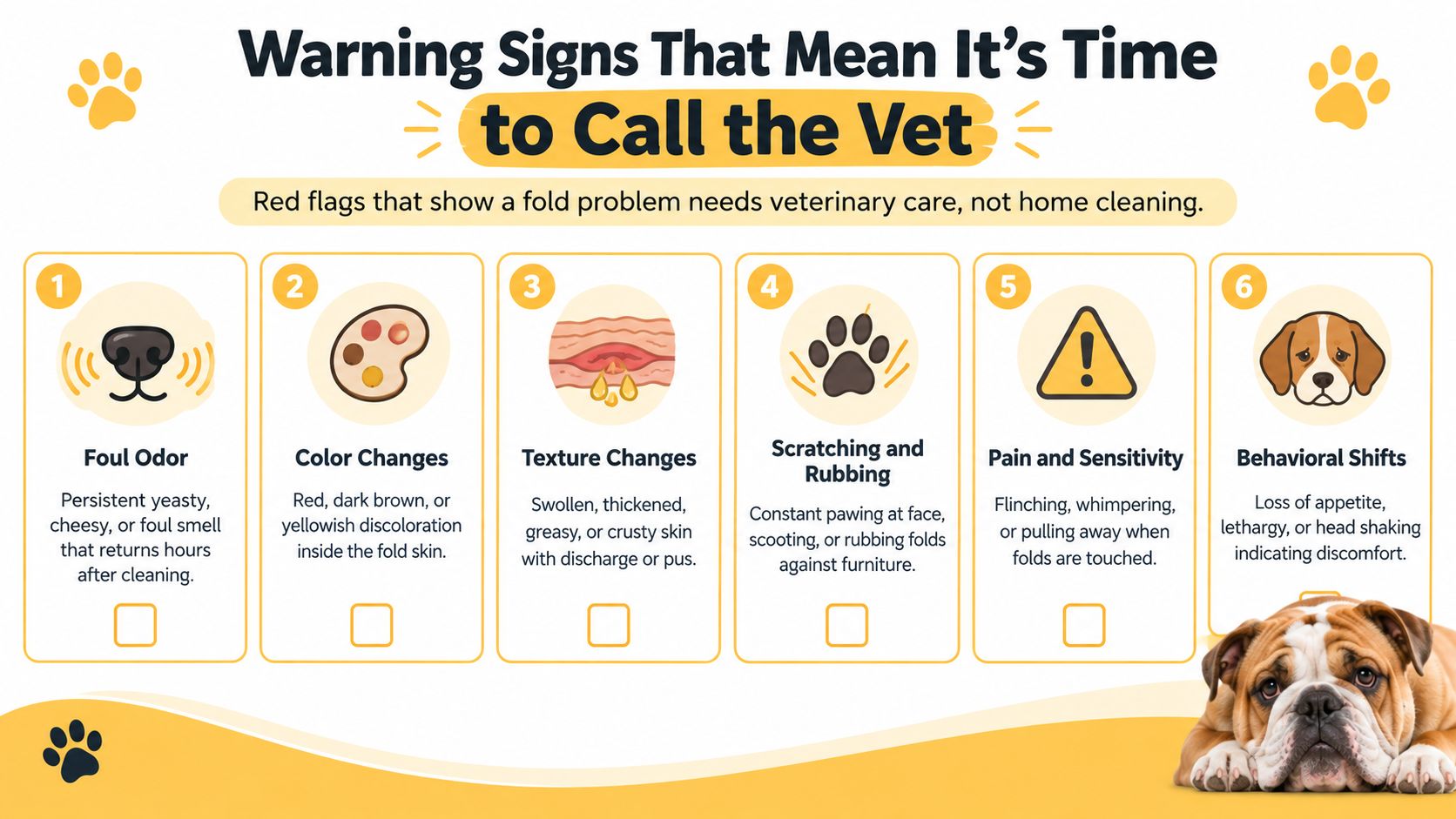
Know the difference between mild and concerning changes
A brief dampness after drinking may improve with gentle cleaning and drying. Persistent odor, repeated redness, or a crease that becomes thick, greasy, crusty, swollen, or painful needs more than repeated home wiping.
Contact your veterinarian promptly if you notice:
- Persistent odor: A yeasty, cheesy, or foul smell returns soon after cleaning.
- Color change: The fold becomes intensely red, darkened, brown, or yellowish.
- Texture change: Skin feels swollen, thickened, greasy, hot, crusted, or wet with discharge.
- Pain behavior: Your dog flinches, whimpers, pulls away, paws at the face, scoots, or rubs against furniture.
- Bleeding or rapid spread: Open skin, blood, sudden swelling, or quickly expanding irritation should not be watched at home.
- Eye or behavior changes: Head shaking, squinting, reduced appetite, lethargy, or sudden sensitivity can signal a problem beyond a superficial crease.
When in doubt: Pain, heat, bleeding, discharge, foul odor, or fast progression deserves veterinary advice rather than stronger cleaning products.
At an appointment, the veterinarian may examine the fold, eyes, ears, teeth, and surrounding skin. They may recommend cytology to look for yeast or bacteria, culture when infection is recurrent or resistant, or biopsy when a lesion is chronic, unusual, or failing to respond. Treatment can include prescription topical antimicrobials, anti-inflammatory care, management of an underlying allergy, or systemic medication when the infection is extensive.
Some dogs with severe, recurrent folds may eventually need surgical fold reduction. That decision depends on comfort, recurrence, anatomy, and response to medical care. It isn't the first step for every dog, but ongoing pain or repeated infection deserves a broader plan.
Preventive Care Framework for Wrinkly Dogs
The most useful routine is flexible rather than rigid. A lightly folded dog with dry, healthy skin may need brief daily checks, while a Bulldog with facial folds, lip pockets, and a tail pocket may need several targeted checks each day. A Shar-Pei with widespread wrinkles requires a wider inspection, and an overweight or allergic dog may need more frequent drying and veterinary review.
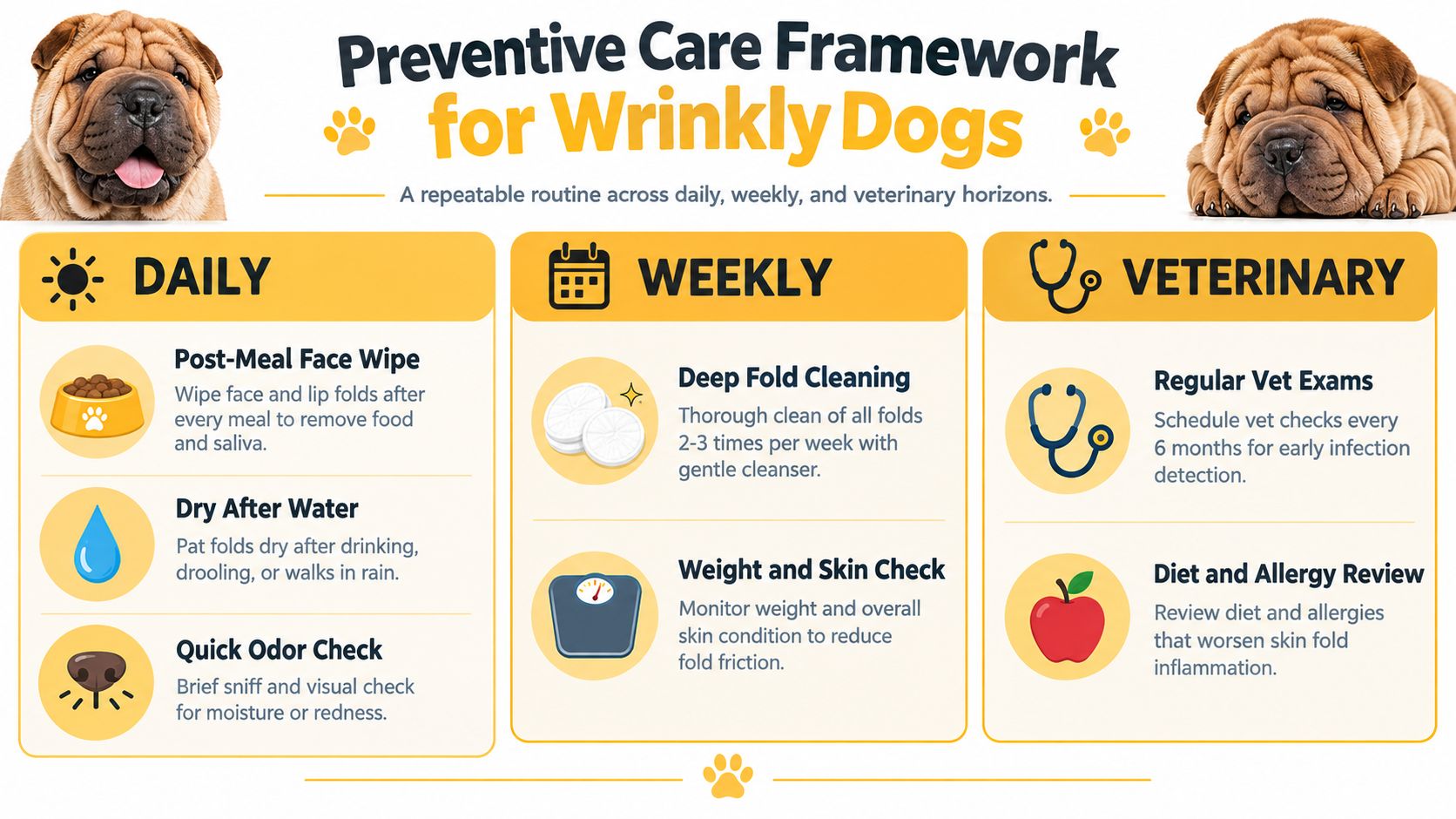
Daily care
Make the quick check part of an existing habit, such as feeding or returning from a walk.
- After meals: Wipe food and saliva from facial and lip folds, especially on short-faced dogs.
- After moisture exposure: Pat folds dry after drinking, drooling, rain, bathing, or vigorous activity.
- Visual and smell scan: Check the tail, lips, face, vulvar area where applicable, neck, and body wrinkles for a change from normal.
- Watch cooperation: Note whether your dog suddenly resists a fold that was previously comfortable to handle.
Weekly care
Choose a calm time for a complete inspection. Clean each fold with the appropriate gentle product, dry every crease, and check whether hair is trapping moisture at the margins. Wash bedding and feeding-area fabrics as needed, and monitor body condition so weight changes don't go unnoticed.
Keep a simple record for dogs with recurring problems. Write down the fold location, odor, appearance, recent activities, and whether the change improved after drying. Photos taken in consistent lighting can also help your veterinarian assess progression.
Veterinary care
Ask for a professional plan if inflammation returns despite careful hygiene. The appointment may include skin cytology, allergy discussion, ear and eye checks, dental assessment, or advice about the tail pocket and other difficult-to-see areas.
Schedule wellness reviews often enough for your dog's age and medical history, and arrange advice before hot or humid periods if those conditions trigger flare-ups. Regular veterinary guidance lets you increase care when risk rises and avoid unnecessary products when the skin is healthy.
Pure Paw Labs offers dietary supplements for dogs, including DA-1™ Daily All-in-One, a single-scoop formula positioned to support areas such as joints, gut health, and skin and coat as part of a broader wellness routine. Visit Pure Paw Labs to review the product information and choose whether that type of nutritional support fits your dog's needs alongside proper fold hygiene and veterinary care.