


No single food is best for every dog with skin and coat problems. For a suspected food allergy, the best choice is a vet-selected novel-protein or hydrolyzed-protein diet fed exclusively for 8-12 weeks.
That's different from the popular advice to buy salmon kibble, go grain-free, or choose the shortest ingredient list. Those choices might change your dog's nutrition, but they don't necessarily answer the question that matters: Is food causing the itching?
A shinier coat after switching foods is encouraging, but it isn't proof of an allergy. The useful starting point is a controlled plan that separates nutritional support from diagnosis.
Table of Contents
- Which Dog Food Fits Skin and Coat Allergies
- What Really Triggers Itchy Skin and Dull Coats
- Confirm the Diet Plan With Your Vet Before Switching
- Ingredients and Nutrients to Look For or Avoid
- How to Read a Dog Food Label for Allergens
- Running an Elimination Trial Without Common Mistakes
- Supplements and Lifestyle Support That Actually Helps
Which Dog Food Fits Skin and Coat Allergies
The best dog food for skin and coat allergies is the food that fits your dog's diagnostic needs, ingredient history, and nutritional requirements. Choose the purpose before choosing the bag.
A dog whose food history is unclear needs a different approach from a dog with a confirmed trigger. Likewise, a dog with a dull coat but no allergic disease may need nutritional assessment rather than ingredient restriction.
Diet types for skin and coat allergies
This table compares use cases, not brands.
| Diet type | Best used when | Main limitation | Who should choose it |
|---|---|---|---|
| Hydrolyzed prescription diet | Dog has eaten many common proteins or has an unclear diet history | Requires veterinary authorization and may cost more than standard food | Veterinarian |
| Novel-protein diet | Dog has never eaten the protein in the food | Works as intended only if the protein is genuinely new to that dog | Veterinarian or veterinary nutritionist |
| Limited-ingredient commercial food | Owner wants a simpler formula after veterinary assessment | The label alone doesn't make it a diagnostic diet; known allergens may remain | Owner, after vet review |
| Homecooked balanced diet | Owner needs control over every ingredient | An improvised recipe can leave nutritional gaps | Veterinary nutritionist |
| Marketed skin and coat food | Owner wants general coat support within a complete feeding plan | Doesn't confirm a food cause or demonstrate allergy control | Owner, for maintenance after vet review |
A skin and coat label describes a nutritional purpose, not a diagnostic result. Limited-ingredient and grain-free labels also can't tell you which ingredient, if any, your dog reacts to.
Don't add a complete skin-support food on top of the existing ration without adjusting portions. It's still food, not a calorie-free supplement.
Plan the cost before committing
Ask your vet to estimate the full trial cost, including food, follow-up appointments, and compatible rewards. For context, NielsenIQ figures presented by Petfood Industry reported an average dry-kibble price of $2.52 per pound during the 52 weeks ending October 5, 2024; that's a general market figure, not a prescription-diet quote.
Your first practical task is an ingredient history. Write down every protein, treat, chew, flavored medicine, supplement, and table food your dog has eaten over the past year, as far as you can remember.
Include occasional exposures, not just the main food. A dental chew or training reward can change which protein qualifies as novel.
What Really Triggers Itchy Skin and Dull Coats
Itching works like a smoke alarm: several different problems can set it off. Food is one possible source, but changing dinner won't silence an alarm caused by fleas, infection, or environmental allergy.
Use this diagram to keep the possible causes separate.
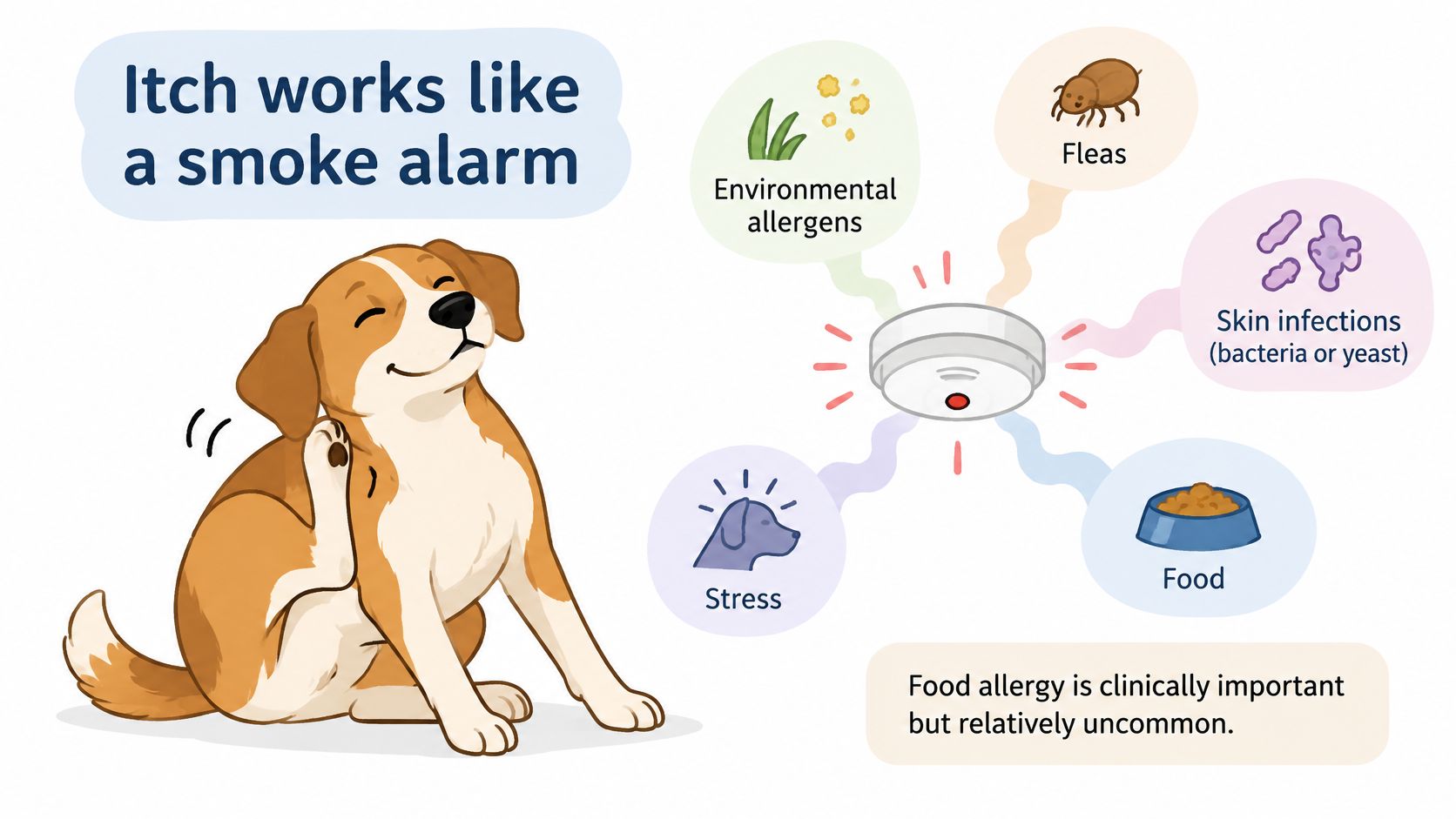
The Merck Veterinary Manual summarizes a review finding food allergy in approximately 1-2% of dogs receiving veterinary care overall, compared with 9-40% of dogs presenting with itching. These are different patient groups, not a prediction of your individual dog's diagnosis.
Food allergy deserves investigation when appropriate. It just shouldn't become the automatic explanation for every scratch.
Several problems can overlap
Environmental allergy, also called atopic dermatitis, can involve reactions to substances such as pollen or dust mites. Flea allergy and other parasites, including mites, also belong on the veterinary checklist.
Bacterial or yeast infections can intensify discomfort and complicate the picture. A dog may have an underlying allergy plus an infection, so treating only the presumed dietary cause can leave considerable itching behind.
Record observations rather than trying to diagnose from appearance:
- Timing: Note whether flares track seasons, travel, grooming, or changes at home.
- Location: Photograph affected ears, paws, belly, rear, and any areas of hair loss.
- Skin changes: Record redness, odor, scabs, discharge, and scratching even when skin looks normal.
- Other symptoms: Mention digestive changes, appetite changes, or reduced activity.
Seasonality can help your vet investigate environmental exposure, but year-round itching doesn't prove food allergy. Body location isn't a dependable separator either.
This video offers another way to think about the symptom pattern.
Coat appearance isn't an allergy test
A dull coat can reflect nutrition, grooming, or general health rather than allergy. More brushing or a better-balanced ration might improve appearance without identifying the source of an itch.
For help organizing symptoms, use this guide to dog skin allergies. While arranging an appointment, guidance on safe home care for canine rashes can help you think through supportive care, but home measures shouldn't delay assessment of painful or worsening skin.
Practical rule: Treat itching as a symptom to investigate, not a reason to start removing ingredients at random.
Confirm the Diet Plan With Your Vet Before Switching
A veterinary examination helps identify what needs treatment now and what needs testing over time. It can't, by itself, settle whether an allergic dog reacts to food or environmental triggers.
The American Animal Hospital Association guidelines explain that clinical history and examination alone cannot distinguish atopy from food allergy and describe a 4-12-week elimination diet followed by food challenge for confirmation. Your vet selects the duration appropriate to the symptoms and circumstances.
Why improvement alone isn't enough
Say you change food while your vet treats an ear infection and starts effective flea control. Your dog becomes more comfortable, and the coat starts looking better.
That improvement is real. But because several things changed, you can't attribute it confidently to removing an ingredient.
Blood, saliva, and hair food-allergy tests aren't dependable substitutes for a controlled dietary trial. An apparently convenient ingredient blacklist can lead you to restrict foods unnecessarily without resolving the cause.
Warning signs that need a vet visit
| Sign | Why it matters | Action |
|---|---|---|
| Patchy hair loss, open sores, or scabs | May indicate infection or another significant skin disorder | Arrange a prompt appointment; seek faster care if painful or spreading |
| Repeated ear infections or head shaking | Can accompany allergic skin disease or other ear problems | Request an ear examination, including cytology when indicated |
| Vomiting, diarrhea, or weight loss | May reflect dietary intolerance or a broader illness | Contact the vet promptly |
| Lethargy, fever, or facial swelling | May signal a serious illness or reaction | Seek urgent veterinary advice; breathing difficulty is an emergency |
| Itching unchanged after the prescribed strict trial | Food may not be the cause, or the trial may need review | Return for reassessment rather than switching foods repeatedly |
Don't wait for a diet to work while your dog is injuring their skin. Ask how discomfort will be managed during testing and which medication changes need to be documented.
Bring photographs of food labels, the ingredient history, and a list of current treatments. Agree on the diet, parasite-control plan, infection treatment, and follow-up date.
Before leaving, ask what counts as a meaningful response and how a challenge will be conducted if your dog improves. A clear endpoint prevents an expensive trial from becoming indefinite guesswork.
Ingredients and Nutrients to Look For or Avoid
The best protein isn't necessarily the rarest, most expensive, or most prominently advertised. For a novel-protein trial, it must be a protein your dog hasn't eaten before.
Commonly implicated ingredients include beef, dairy, chicken, and wheat, with lamb also appearing in veterinary references. That doesn't make these ingredients unhealthy for dogs that tolerate them.
A prospective regional study discussed by Royal Canin Academy's veterinary review identified chicken as the most frequent allergen in 65% of cases in Malaysia, 31% in Singapore, and 63% in Indonesia. Those findings describe the study's cases, not all dogs in those countries, and illustrate why a universal ingredient ranking can mislead.
Exposure history beats ingredient reputation
Say your dog eats chicken kibble but receives salmon treats and beef dental chews. Switching to salmon doesn't create a novel-protein diet just because salmon wasn't the main meal.
A previous exposure doesn't prove an ingredient is an allergen. It does mean you shouldn't assume that ingredient is new.
Likewise, a hydrolyzed formula follows a different selection rule from an intact novel-protein food. Let the vet assess the complete formulation rather than rejecting it solely because its original protein source sounds familiar.
Nutritional features worth checking
Restriction mustn't come at the expense of adequacy. A diet intended for ongoing feeding needs to supply more than a tolerated protein.
- Complete nutrition: Choose a complete and balanced formula suitable for your dog's life stage.
- Essential fatty acids: Look for adequate dietary fats, including linoleic acid from appropriate oil sources.
- Micronutrient adequacy: Ensure zinc and other required nutrients come from a balanced formulation.
- Protein transparency: For an intact novel-protein approach, identify the named source throughout the recipe.
- Marine fatty-acid details: Use this guide to omega-3 for dogs to understand EPA and DHA labeling.
Avoid adding isolated minerals or vitamins to a complete diet unless your vet recommends them. More supplementation isn't automatically better nutrition.
Ingredients to question during selection
These aren't universally harmful ingredients. They're points that need clarification when you're trying to control exposure.
- Unnamed animal sources: Ask what animal supplies meat meal, animal digest, or other broad descriptions.
- Unclear flavorings: Confirm the source of natural flavor rather than assuming it's compatible.
- Previously fed proteins: Don't treat them as novel because the new bag highlights a different ingredient.
- Unreviewed extras: Include homecooked additions, chews, medicines, and supplement flavors in the assessment.
Grain-free doesn't mean allergen-free, and fish-based doesn't mean hypoallergenic. The useful question is whether the whole recipe fits your dog's controlled plan.
How to Read a Dog Food Label for Allergens
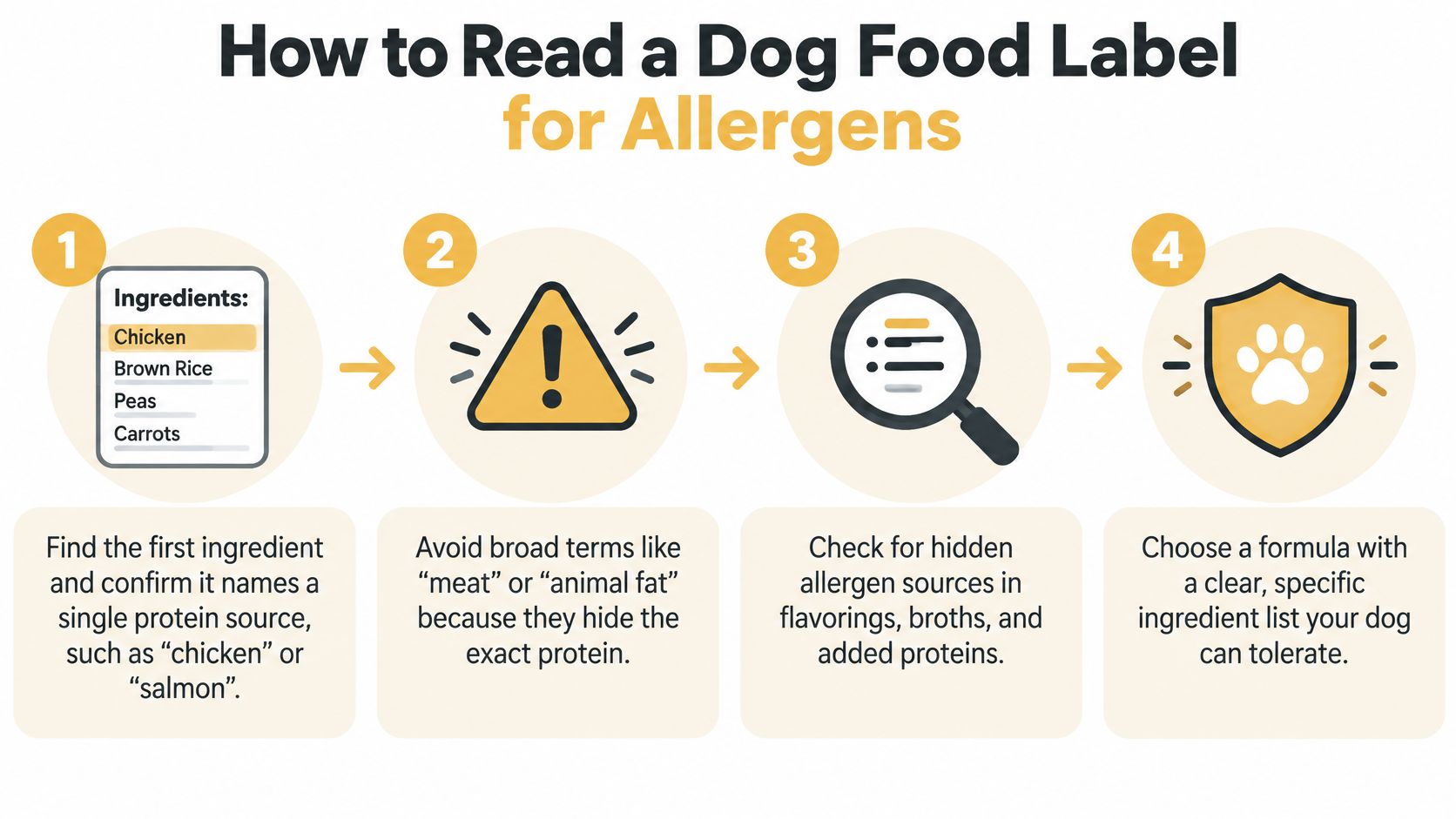
Read the ingredient panel, nutritional adequacy statement, and feeding information together. Front-of-bag wording is a starting description, not enough information to select a diagnostic food.
This visual highlights the initial ingredient checks.
Work through the whole package
- Identify the named protein sources. Start with the first ingredient, but don't stop there. Chicken or salmon identifies a source more clearly than poultry or meat, while ingredients farther down may introduce additional proteins.
- Check broths, flavors, fats, and digest ingredients. Ask about their animal origins and compatibility with the trial. A named fat isn't equivalent to an intact protein, so don't assume every ingredient from the same animal presents the same risk.
- Find the nutritional adequacy statement. Check that the food is complete and balanced for your dog's life stage rather than intended only for intermittent or supplemental feeding. A short ingredient list doesn't compensate for an incomplete diet.
- Verify hydrolyzed wording when that's the prescribed approach. Sensitive digestion and hydrolyzed protein aren't interchangeable descriptions. Confirm the exact product with the clinic rather than choosing a similarly packaged formula.
- Read the calorie information and guaranteed analysis. Use them with your vet's feeding recommendation to establish portions. Equal scoops of different foods don't necessarily supply equal calories.
- Ask about manufacturing controls. For a diagnostic diet, ask how the manufacturer manages unintended protein exposure on shared production equipment. Your vet can help judge whether the answers support the intended use.
- Save identifying details. Photograph the product name, ingredient panel, lot information, and any formula-version details. Compare replacement bags before feeding, because an unnoticed recipe change complicates interpretation.
Turn the checks into a shopping decision
A maintenance food may pass your ingredient review yet still be unsuitable for a diagnostic trial. Ingredient transparency, nutritional adequacy, and manufacturing controls answer different questions.
For general feeding considerations, this guide to dog food that supports skin and coat can help you separate coat maintenance from allergy-focused selection. Take the exact label to your vet rather than relying on a product category.
A label helps you assess declared ingredients and nutritional purpose. It can't tell you whether your dog reacts to the food or guarantee the absence of undeclared trace exposure.
Running an Elimination Trial Without Common Mistakes
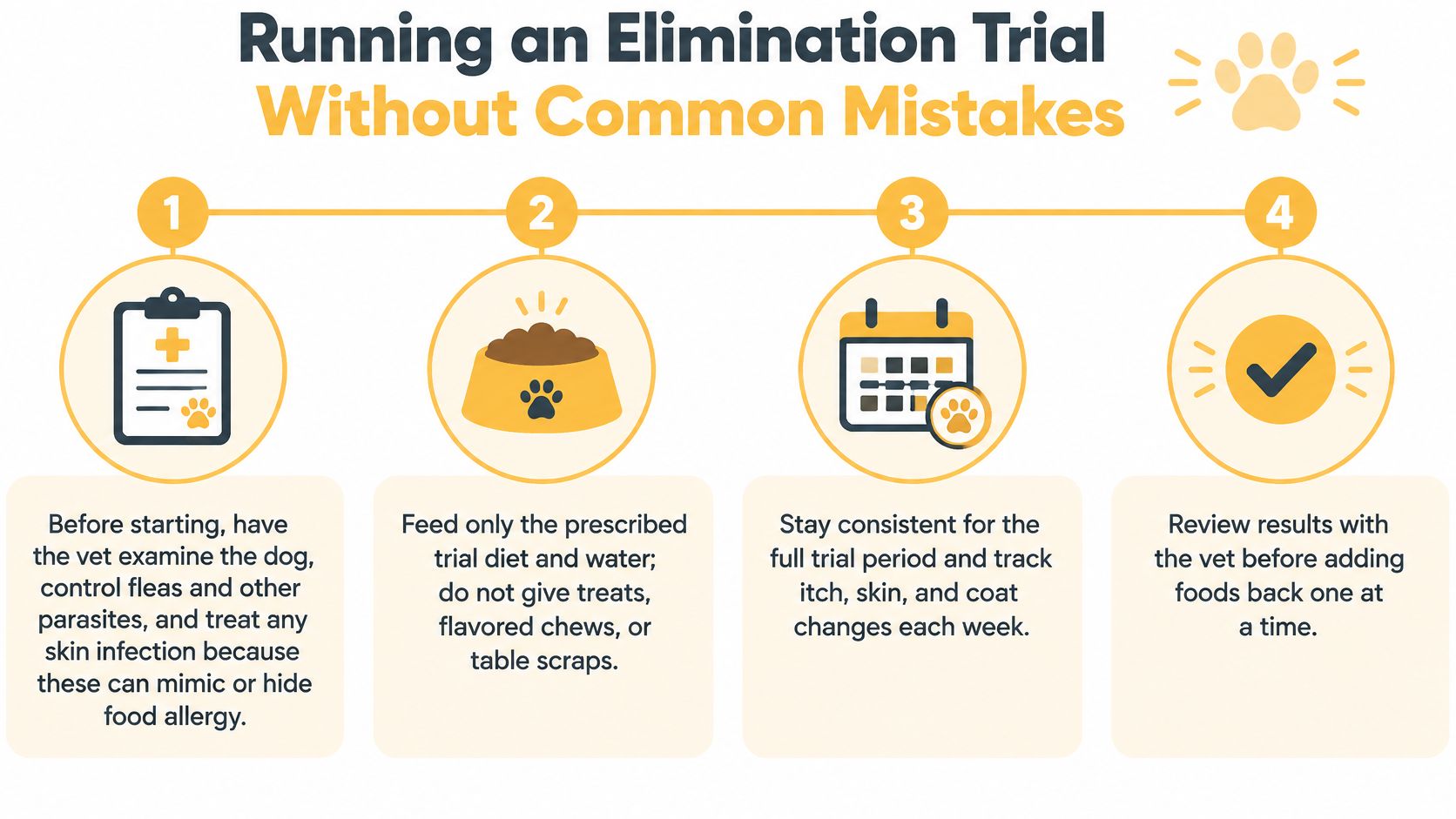
- Prepare the dog and household. Have your vet assess the skin, address parasites, and treat infection as needed. Tell everyone who feeds the dog, including walkers and visitors, that food access must be controlled.
- Choose the test diet with the vet. A novel-protein formula may suit a reliable ingredient history; a veterinary hydrolyzed formula can be more useful when that history is broad or uncertain. Hydrolysis breaks proteins into smaller peptides, reducing the likelihood of immune recognition.
- Agree on the switch before starting. A gradual transition may help digestive tolerance, while some vets prefer a direct switch for a particular patient. Don't improvise a different schedule because the dog's stool changes.
- Feed exclusively for the prescribed duration. The Merck Veterinary Manual's nutrition guidance supports a veterinary-supervised novel or hydrolyzed elimination diet, generally requiring 8-12 weeks for dermatologic signs. Skin inflammation and hair-cycle changes take time to settle.
- Remove incompatible extras. Clear away table scraps, chews, flavored supplements, and ordinary rewards unless approved. Don't stop essential medication or parasite prevention; ask the vet for compatible formulations.
- Track symptoms consistently. Record itching, licking, sleep disruption, stool quality, and medication changes. Take dated photographs in similar lighting and use the same written itch-rating descriptions each time.
The timeline below captures the discipline needed for an interpretable result.
Transition schedule before the trial clock starts
The following is a hypothetical gradual-transition example, not a mandatory clinical schedule. Use it only if your veterinarian approves; the exclusive-feeding clock begins when the old food is fully removed.
| Days | New diet share | Old diet share | What to record |
|---|---|---|---|
| 1-2 | 25% | 75% | Appetite and stool quality |
| 3-4 | 50% | 50% | Stool quality and itch score |
| 5-6 | 75% | 25% | Stool quality and itch score |
| 7 onward | 100% | 0% | Begin the vet-prescribed exclusive trial and continue records |
In this example, the trial clock starts on day 7, not when you first open the bag. Ask the vet how to measure portions if the foods have different calorie densities.
If digestive symptoms complicate feeding, this guide to what to feed a dog with a sensitive stomach can help you prepare questions. Don't add an unapproved bland diet halfway through testing.
Protect the trial from everyday mistakes
An occasional treat can introduce the very exposure you're trying to remove. Use reserved portions of the approved food as rewards, and prevent access to other pets' bowls, dropped food, and scavenging opportunities.
Changing brands mid-trial or judging the result after a brief improvement makes the outcome harder to interpret. Record accidental exposures and ask whether the schedule needs adjustment.
Keep the result usable: A trial without improvement doesn't reliably exclude food involvement if feeding wasn't strict.
Confirm a response with rechallenge
If your dog improves, your vet should direct a controlled return to the previous food and specify what to watch for and when to stop. Recurrence of itching or dermatitis supports dietary causation more convincingly than improvement alone.
Don't attempt an unsupervised challenge if previous reactions were severe. Once a food-related response is confirmed, the vet can help decide whether identifying individual ingredients would improve long-term feeding options.
Supplements and Lifestyle Support That Actually Helps
Supplements may support skin-barrier function and coat condition, but they don't identify or remove an allergen. Their place is alongside an appropriate diet and veterinary plan, not instead of diagnostic testing.
For fish oil, the useful label information is EPA and DHA, not total oil weight. Different formulations can deliver very different amounts of these fatty acids.
Use the EPA and DHA amounts
A technical review's supplementary evidence describes canine randomized, double-blind clinical data using approximately 43 mg/kg EPA and 30 mg/kg DHA, with reductions in itching and inflammatory skin severity. It also summarizes a crossover study using approximately 39 mg/kg EPA and 26 mg/kg DHA, reporting improvements in itching, alopecia, self-trauma, and coat quality.
These are study doses, not a universal dosing instruction. Your vet needs to account for body weight, fatty acids already present in the food, medical conditions, and concurrent treatment.
- Declared amounts: Look for EPA and DHA listed separately.
- Total intake: Include the existing diet when reviewing the dose.
- Tolerance: Watch for digestive upset and account for added calories.
- Storage: Follow storage instructions and check how the product controls oxidation.
Keep supportive care compatible
Maintain veterinarian-recommended flea prevention and use a bathing routine chosen for your dog's skin condition. Brush gently, wash bedding, and reduce avoidable indoor dust without introducing irritating cleaning residues.
A guide to dog supplements for allergy support can help organize product questions. Bring the complete ingredient label, including flavors, to your appointment.
For broader senior wellness, DA-1™ Daily All-in-One - Senior Dog Support, Joints, Skin/Coat & More is a multi-system supplement positioned for aging dogs. It isn't a diagnostic diet, and compatibility with an elimination trial requires veterinary review.
Comfort measures and nutritional support can be worthwhile without proving why the dog was itchy. Keep that distinction clear when deciding what to continue long term.
Pure Paw Labs offers canine dietary supplements intended to support everyday wellness, including skin and coat needs. Visit Pure Paw Labs to review product ingredients, then bring the label to your veterinarian to check whether a supplement fits your dog's diet and diagnostic plan.