


In the US, human grade applies to the finished dog treat and its whole handling chain under human-food rules, not to a few premium ingredients. The useful test is whether that finished product meets the human-food chain and still fits inside about 10% of daily calories.
Shelf language moved faster than that test. Training bits, long chews, and freeze-dried snacks can wear the same words while the plant, the truck, and the calorie math stay completely different.
Table of Contents
- Why Human Grade Dog Treats Spread Faster Than the Rules
- The Finished Product Test for a Human Grade Claim
- Benefits and Risks That the Claim Does Not Cancel
- A Daily Treat Budget That Protects the Main Meal
- Labels Certifications and Sourcing Cues Worth Checking
- Storage Special Diets and Home Kitchen Treats
- Vet the Next Bag Before It Stays
Why Human Grade Dog Treats Spread Faster Than the Rules
A six-month-old is learning “sit,” and three treat bags sit side by side: soft training bits, a dense chew, and freeze-dried cubes. The wording may look similar, but the products are different. A phrase on the front does not tell you how the treat was made or how it fits into your dog's day.
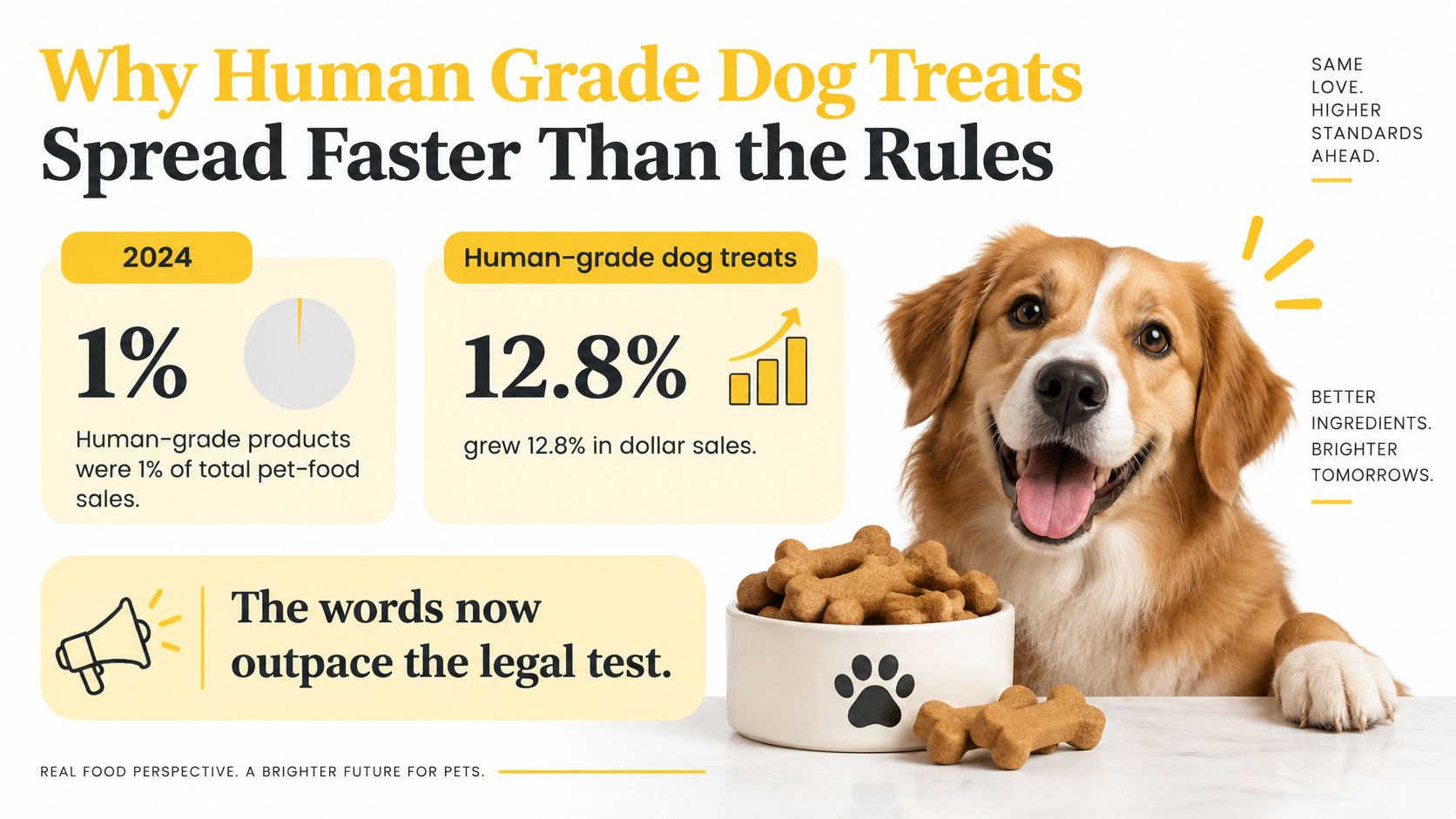
In 2024, human-grade products represented 1% of total pet-food sales, while human grade dog treats grew 12.8% in dollar sales that year, according to NIQ data reported by Petfood Processing. A small share of the overall market can still grow quickly within one shelf category.
The label language can blur four different ideas: natural, premium, made with human-grade ingredients, and a human-grade claim about the finished product. Those phrases do not mean the same thing. The first three may describe ingredients or marketing; the finished-product claim concerns how the treat is handled and made.
This article follows US practice from the Association of American Feed Control Officials and the Food and Drug Administration. Since other countries may use different rules, judge an imported product by the information on its own label rather than assuming the US meaning applies.
The Finished Product Test for a Human Grade Claim
A human-grade claim applies to the complete finished treat, not just an ingredient pictured on the bag. The Association of American Feed Control Officials' guidelines define the claim around the finished product and its handling.
Every ingredient and the resulting treat must be stored, handled, processed, and transported in a manner consistent with applicable human-food requirements under 21 CFR Part 117 and other relevant federal food laws.
That chain runs from ingredient storage through processing, packing, and transport. A chicken breast fit for human food does not establish that the finished treat meets the standard; every step must follow applicable human-food requirements.
The product remains animal food. Its intended use should be clear, such as “human grade dog treats” or “human grade dog food.” A plant making ready-to-eat human-grade pet food is expected to register with the US Food and Drug Administration in both human-food and animal-food categories.
Pet treats must also meet the baseline requirements of the Federal Food, Drug, and Cosmetic Act: they must be safe, made under sanitary conditions, free from harmful substances, and truthfully labeled. The human-grade claim concerns the handling of the finished product; it does not establish that a treat is nutritionally complete.
What the phrase on the bag proves
| Phrase on the bag | What it claims | What must be true | Usual gap |
|---|---|---|---|
| Human grade dog treats | The finished product is human grade and remains dog food | Every ingredient and the treat are stored, handled, processed, and transported under human-food rules | The wording alone may not explain the facility or transport chain |
| Made with human-grade ingredients | Selected ingredients could be human food | The finished treat and its full handling chain must also qualify for a finished-product claim | Sounds like the full claim |
| Natural or premium | A marketing description of quality | The human-grade handling chain is not established by these words | Confused with human grade |
| People-food scraps or table leftovers | Kitchen extras, not a packaged-product claim | The finished-product standard is not established; calorie and hazard concerns remain | Treated as automatically safe |
| Complete and balanced | A separate nutritional-adequacy claim | The diet must meet nutritional adequacy requirements; this does not establish human-grade handling | Implies the treat can replace meals |
Read the table as a filter before you read the marketing. “Made with human-grade ingredients” describes selected ingredients, while a finished-product claim covers the treat and its chain of handling. “Natural” and “premium” do not establish that chain. “Complete and balanced” addresses nutritional adequacy, a separate question from how a product was handled.
Shopper's one-line test: Look for finished-product wording, a clear dog-food identity, and a specific account of how the product was handled. An ingredient photo cannot establish the whole chain.
Benefits and Risks That the Claim Does Not Cancel
A treat can meet human-food handling standards and still be a poor fit for a particular dog. Human grade describes how the finished product is made, not its health effects. A calorie-dense snack can crowd out a balanced meal, while an otherwise well-made treat can contain a protein a sensitive dog does not tolerate.
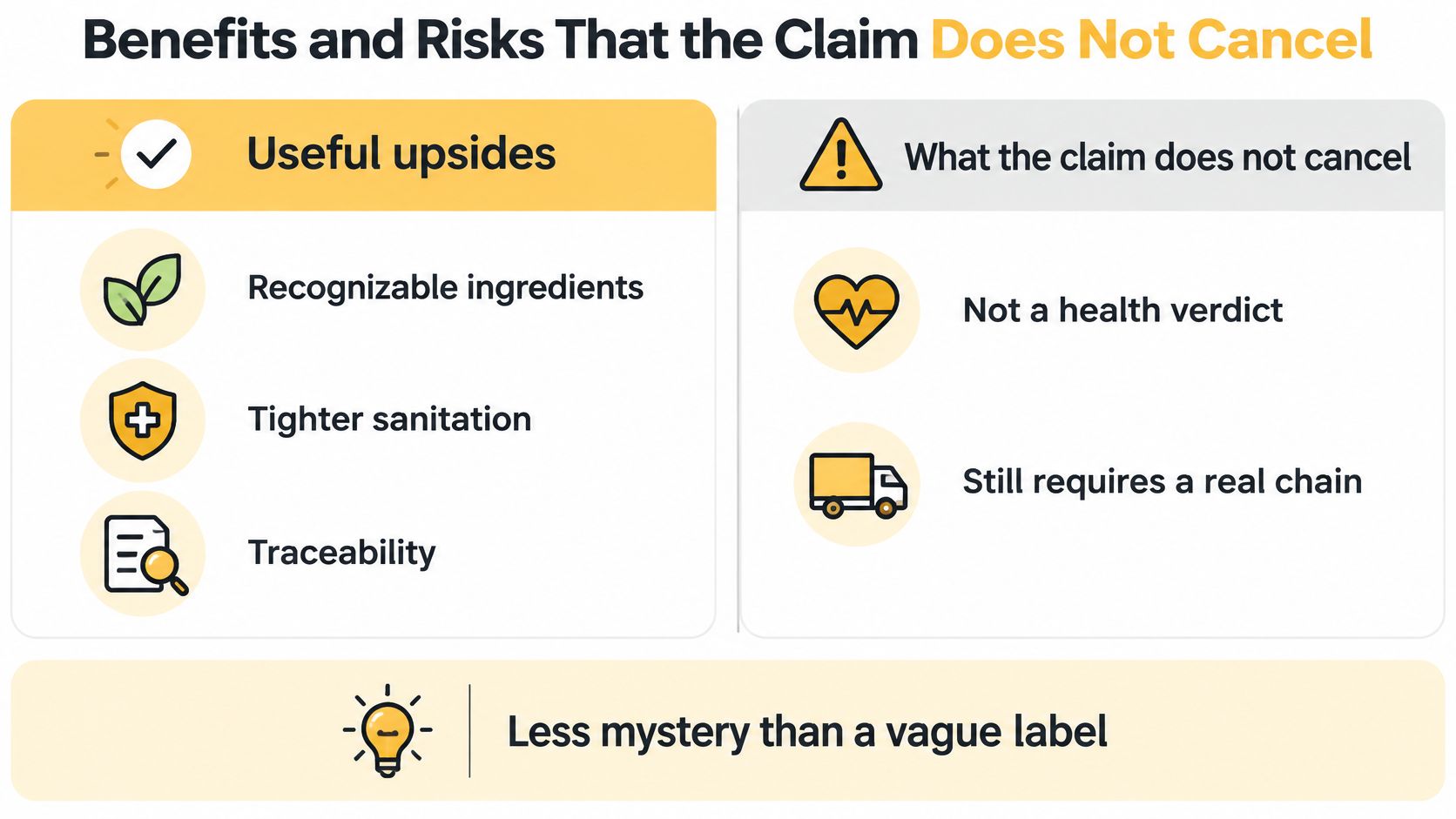
A documented production chain can make ingredients easier to identify, provide records for traceability, and clarify where a product was handled. Those details may help owners compare treats or avoid a known trigger. They do not make the treat more nutritious by themselves.
AAFCO's human grade guidelines describe human-grade products as animal foods subject to inspection under FDA 21 CFR Part 507. Ready-to-eat products may also require registration in both human-food and animal-food categories. The claim does not establish that a treat is nutritionally complete, therapeutic, or suitable as a main diet, and it does not demonstrate disease prevention.
Risks a clean label does not erase
Calories still count, and a rich treat can displace food from the regular meal. High-fat extras may be a poor fit for dogs with sensitive digestion or a history of pancreatic problems. Moist treats can mold if left out, and shared equipment can create allergen cross-contact.
Some foods used in people's kitchens are unsafe for dogs, including xylitol, grapes and raisins, onion, garlic, and cooked bones. Cream cheese may seem like a small training reward, but cream cheese for dogs is a rich extra that still contributes calories.
Price alone cannot show whether a product has better documentation. A brand's claims about itching, joints, or digestion also require support separate from its human-grade wording; handling standards do not establish those health effects. For example, a treat that fits a dog's known food sensitivities may still be too rich or calorie-dense for frequent rewards.
A Daily Treat Budget That Protects the Main Meal
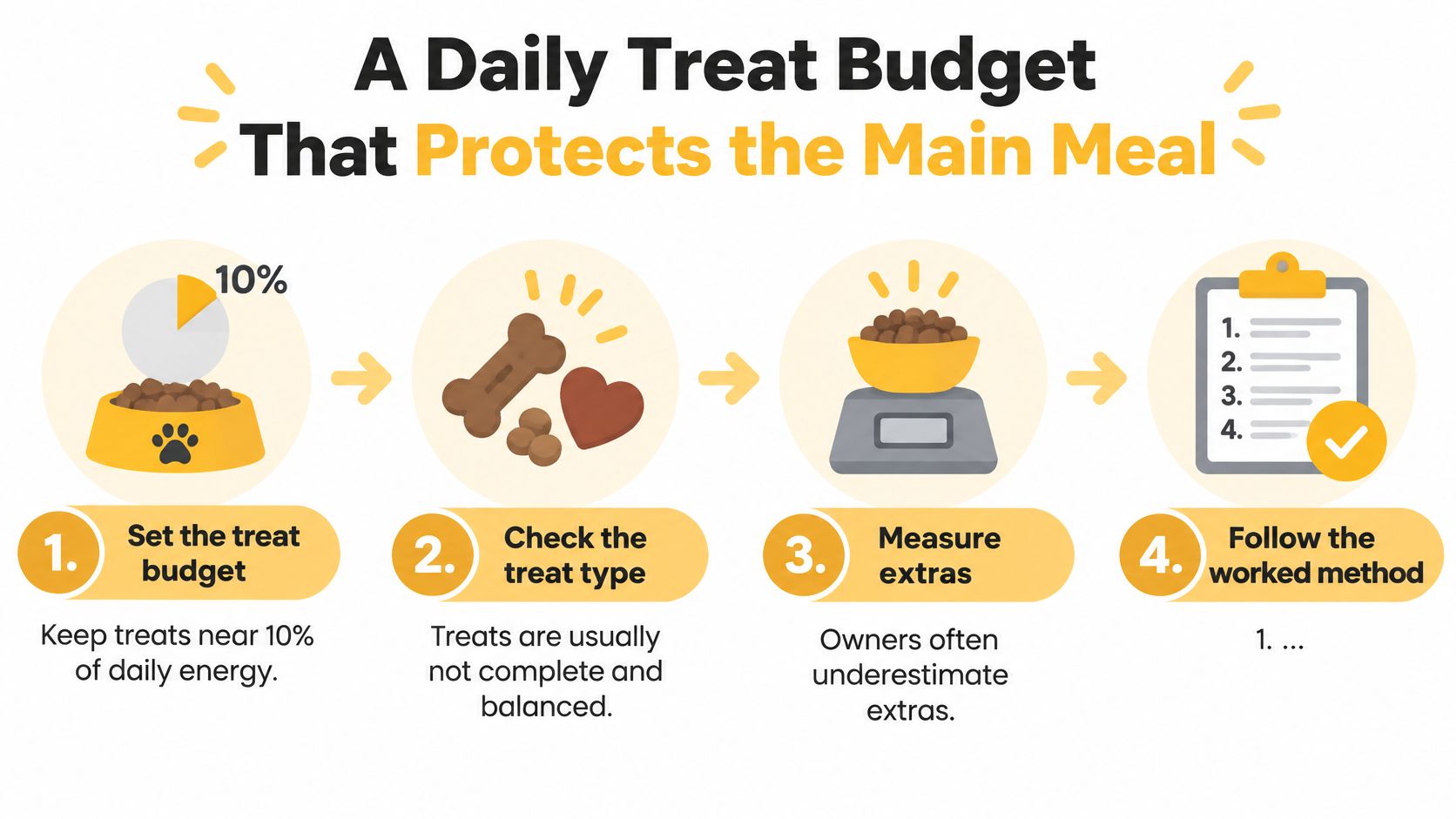
A dog's treat allowance is a small slice of the day's calories: veterinary feeding advice generally keeps treats near 10% of daily energy, as summarized in this review of treat feeding and weight. Treats often are not complete and balanced foods, so extra calories can also crowd out nutrients in the main meal. “A few pieces” is not a useful measure unless you know their calories.
Use five steps, in this order.
- Estimate daily calories from body weight, age, and activity. For an overweight dog, use the calories for target weight, not the weight on the scale today.
- Take 10% of that figure as the treat budget. That slice is the ceiling for all extras, not a target you must hit.
- Divide the budget by the kcal printed per piece or per ounce. Piece-counting without that number is a guess.
- Subtract those calories from the same day's meal so the bowl shrinks instead of the day growing.
- Split what is left into low-calorie bits for training, and save any dense chew for a day with fewer reps.
Say a dog is allowed 300 kcal a day. The treat budget is 30 kcal. A 150 kcal chew is five times that budget. Bits at 7 to 10 kcal leave room for three or four pieces. That 300 kcal figure is a teaching example, not a chart for every dog. Your own number comes from weight, age, activity, and, when weight loss is the goal, the target weight.
Where the math usually breaks
Treats vary widely in calories per item, so two pieces that look equally small can use very different shares of the budget. Count calories from the label when available, and measure the pieces you give. A chew can use the whole allowance before training treats enter the picture.
Puppies, dogs on a weight-loss plan, and dogs eating a home-prepared diet need a veterinarian's check, because extras can dilute essential nutrients even when the ingredients look wholesome. For a home-prepared diet, use a guide to home-cooked dog-food portions to understand the meal's measured portion, then fit treats within the remaining calorie allowance. If the label has no calorie figure, do not invent a daily count.
Labels Certifications and Sourcing Cues Worth Checking
Once the finished-product claim checks out, use the lot code and batch records to judge whether the bag in your hand is traceable. A lot code works like a parcel tracking number: it connects a specific package to production and testing records.
| Cue | Where to look | What to check |
|---|---|---|
| Calories and amount | Guaranteed panel or feeding block | Kcal per piece or ounce, plus a suggested amount |
| Testing | Batch certificate or quality note | A named test scope, such as pathogens or contaminants, tied to the batch |
| Ingredients and lot | Ingredient list and package | Identifiable foods, a named protein, and a lot code |
Follow the lot code to the test
A useful batch certificate identifies the lot it covers and names what the lab tested for. “Lab tested” alone leaves the scope unclear. A guide to third-party lab testing explains why the test scope and batch connection matter.
Check that the certificate's lot matches the code on the bag. If the brand shares a certificate without a lot number or named test scope, ask which production batch it applies to.
Ask for the papers behind the sourcing
A short email can clarify what the label leaves out. Ask the brand which suppliers provided the listed ingredients, whether supplier documentation is available, and how the company connects those records to the product's lot. The answers should make it possible to follow the ingredient trail, rather than relying on a broad quality phrase.
For a familiar example of a rating that depends on its underlying test, see Manuka honey ratings explained by Everti. Treat other certifications as supporting evidence, and check the finished-product claim first.
Use the calorie figure to compare pieces, then set the portion against your dog's daily treat budget. If the lot cannot be traced or the test scope stays vague after you ask, choose a bag with clearer batch records.
Storage Special Diets and Home Kitchen Treats
A treat can be stored correctly and still be the wrong choice for a dog's diet. Keep packaged treats according to their texture and label, and match every extra to the dog's existing food plan.
Packaged bags
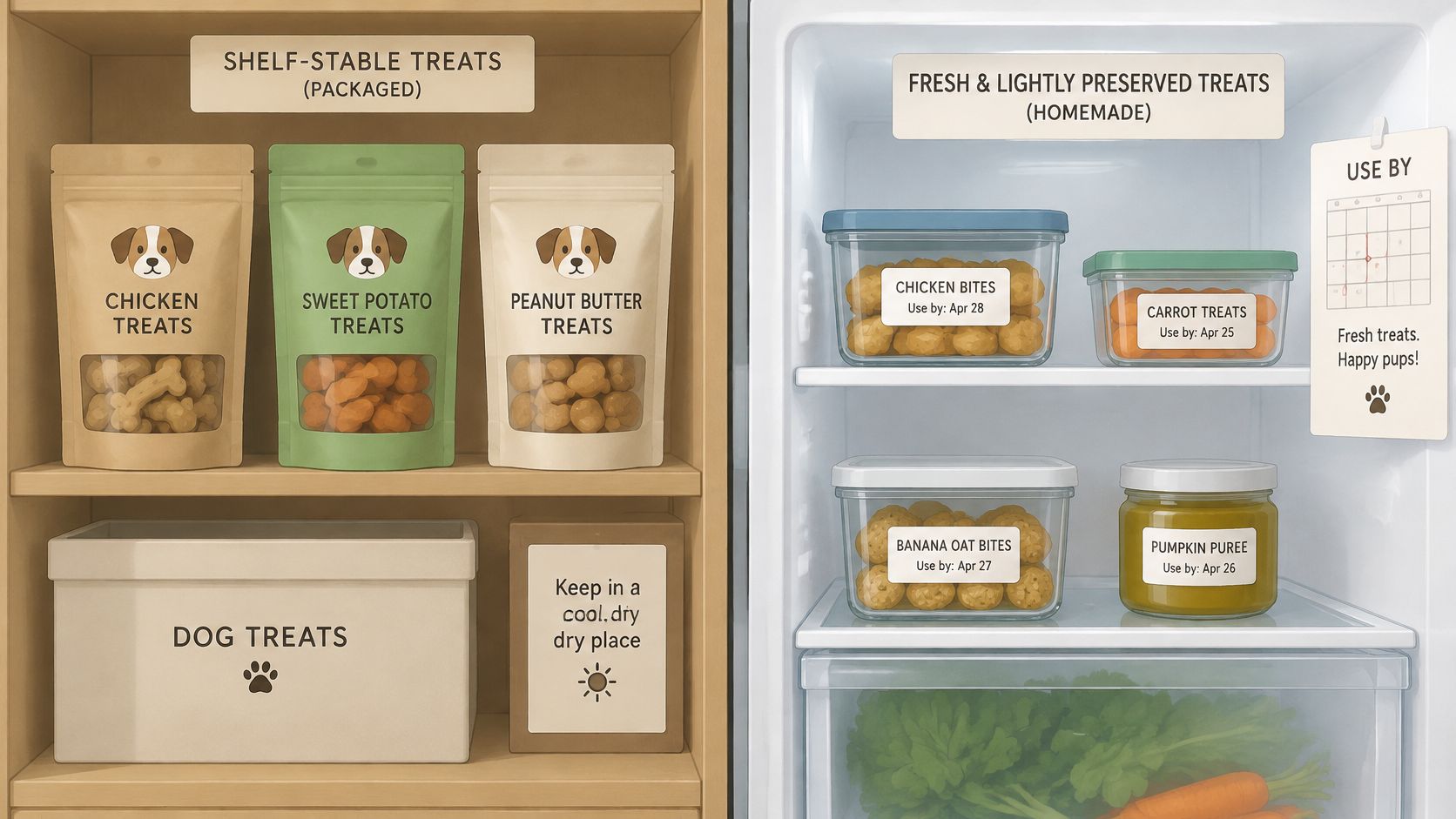
Keep shelf-stable treats sealed in a cool, dry place, and follow the package's storage directions after opening. Refrigerate moist, fresh, or lightly preserved pieces when the label calls for it. Discard treats with a sour smell, visible mold, or unusual moisture in the bag.
Diets that conflict with a "nice" treat
A food restriction applies to treats, too. During a food trial using a novel or hydrolyzed diet, a treat with a different protein can undermine the plan. Choose one that matches the prescribed diet or skip treats until the trial is complete.
For a low-fat plan, a rich chew may not fit, even if its ingredient list is short. Dogs eating a veterinarian-balanced home-prepared recipe also need extras kept within the daily calorie allowance, so treats do not displace too much of the meal. For dogs with gut or skin limits, use a diet plan suited to those needs, such as guidance on food choices for gut health and allergies.
A daily topper is not a treat
A powdered supplement is intended to be measured into a dog's routine, while treats are usually given as rewards. Neither should take the place of a complete meal or override a therapeutic diet. Product statements are not evaluated by the FDA to diagnose, treat, cure, or prevent disease.
One example is DA-1™ Daily All-in-One - Senior Dog Support, Joints, Skin/Coat & More, a once-daily powdered supplement for joints, skin and coat, gut health, immunity, and stress. Check its directions and discuss it with your veterinarian, especially if your dog follows a prescription diet. Do not compensate for a missed serving by adding extra treats.
Treats you make at home
Use foods already known to suit your dog, and refer to the earlier warning list before choosing ingredients. Keep track of the approximate calories in each piece so homemade snacks fit the day's allowance. Refrigerate portions for short-term use or freeze them for later, and label the container clearly as dog treats.
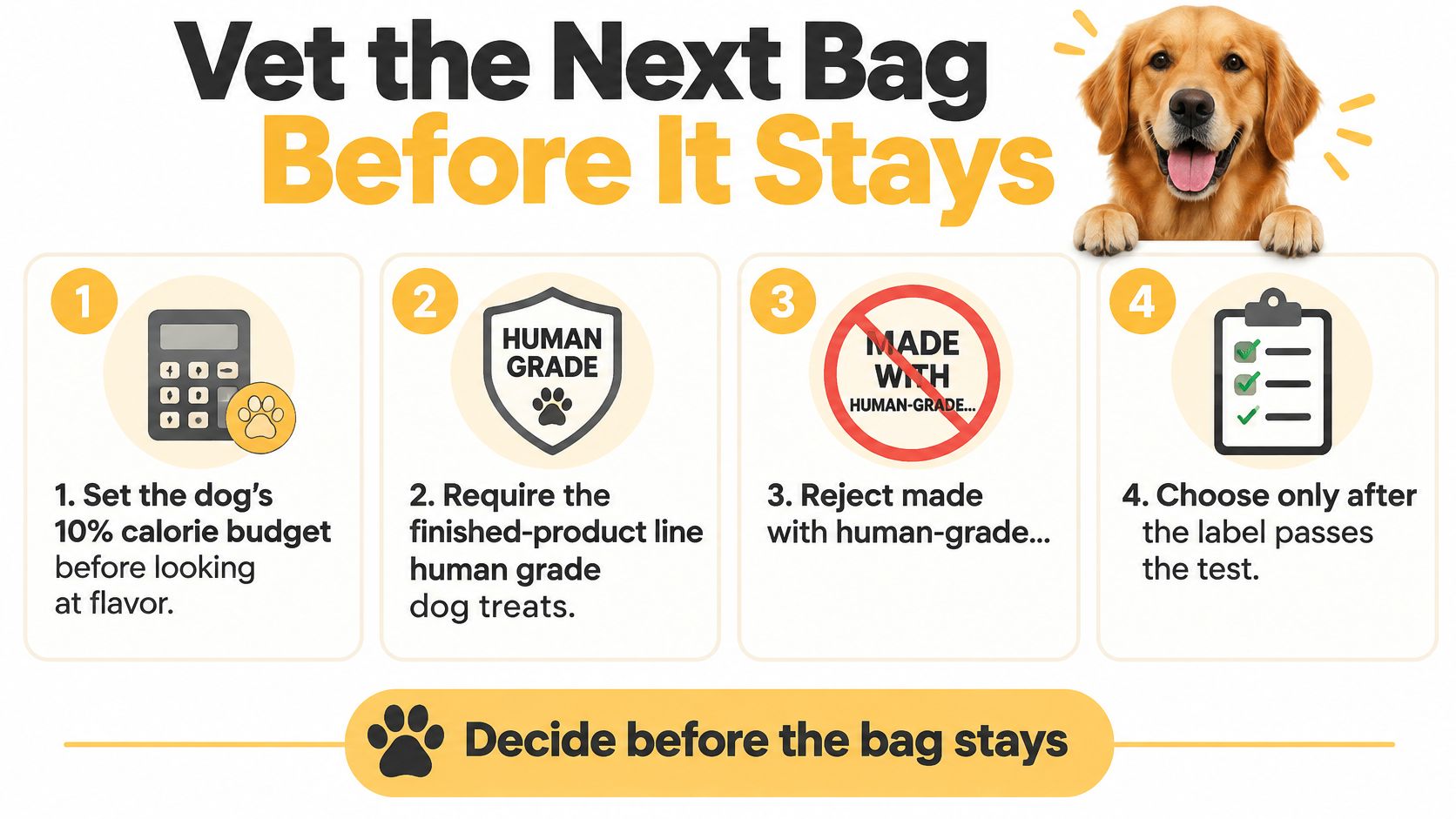
Vet the Next Bag Before It Stays
Decide whether a treat belongs in the cupboard by checking its label, fit, and handling requirements. Flavor comes last.
- Set the calorie budget using the 10% method above. Check that the treat fits without cutting too far into the main meal.
- Check the finished-product claim. Look for a statement that the treat itself is human grade; “made with human-grade ingredients” describes the ingredients, not necessarily the finished product.
- Find the calories per piece and information about where and how the treat is handled.
- Review the ingredients for known allergies and anything your dog should avoid.
- Check the storage directions against your household routine. A fresh chew may not suit a household where treats are left in a warm car.
- Ask your veterinarian before changing treats if your dog is a puppy, overweight, on a prescription diet, or eating a home-prepared recipe. A guide to homemade dog food nutrition can help frame questions about extras and a balanced recipe.
- Introduce one product at a time. Watch for changes in stool, itching, or weight, and reconsider the treat if fitting it in means reducing the main meal too much.
For daily support aimed at joints, skin, gut, immunity, or stress, a measured supplement is another option. Treats vary in calories and nutrients from piece to piece, so they are a less steady way to deliver a daily dose, and they still use part of the calorie budget. Judge a supplement by its own label, and ask your veterinarian before making it part of your dog's routine.
Treats work best as rewards and training tools. A polished ingredient list does not replace checking the finished-product claim, calorie fit, and your dog's current diet.
Pure Paw Labs makes human-grade daily supplements for dogs, including a single-scoop formula intended to support joints, skin and coat, digestion, immunity, and stress. Read the formula, testing information, and feeding directions before deciding whether a measured supplement fits your dog's routine.