


Most owners start with the wrong question. They ask how much food by weight, then wonder why the dog gains, loses, or stalls on a homemade diet that looked “right” on paper. The better question is simpler and harder to ignore, how many calories does your dog need, and how calorie-dense is the recipe in the bowl?
That shift matters because home cooked meals are not interchangeable. A cup of one recipe can deliver very different energy from a cup of another, so an ounce-per-pound shortcut can be wildly off the moment you change protein, fat, or moisture. If you want home cooked dog food how much to feed to make sense, you have to stop thinking in volume and start thinking in calories plus body condition score.
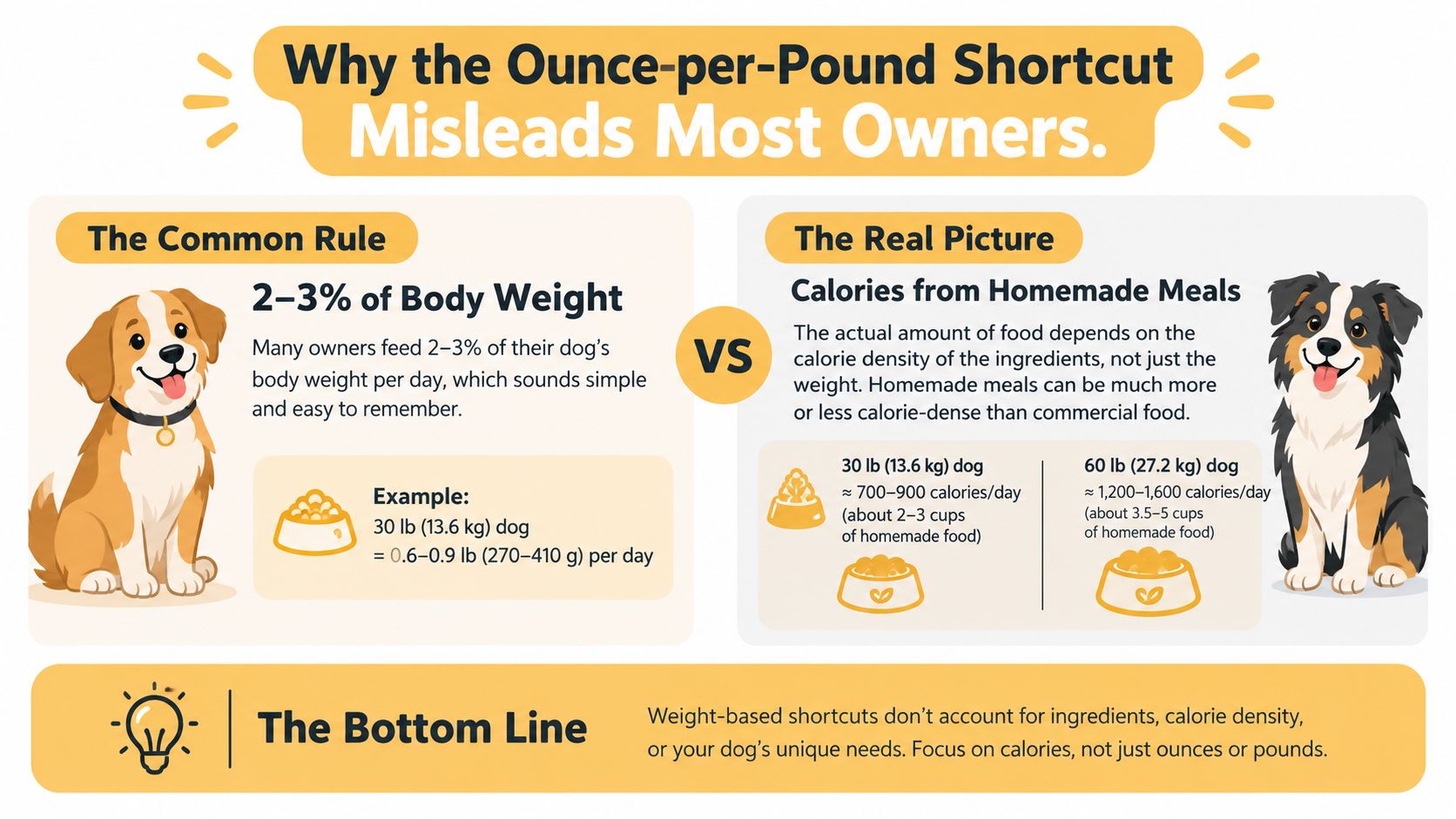
Table of Contents
- Why the Ounce-per-Pound Shortcut Misleads Most Owners
- Calculating Your Dog's Daily Calorie Target
- Matching the Formula to Your Dog's Real Life
- Turning Your Recipe's Calories Into a Daily Portion
- How the Same Recipe Feeds a Puppy, Adult, and Senior Differently
- Home-Cooked Dog Food Feeding Chart by Weight and Activity
- Adjusting Portions the Right Way Over Time
Why the Ounce-per-Pound Shortcut Misleads Most Owners
The popular 2% to 3% of body weight rule is a rough starting point, not a feeding law. It can be useful when you need a first pass, but it breaks down fast because homemade recipes vary in calorie density, moisture, and fat content. The same weight of food can leave one dog underfed and another overweight.
The more useful starting point is the calorie range behind the food. A common homemade-feeding reference says most adult dogs start around 2% to 3% of body weight per day, with smaller or more active dogs sometimes needing the higher end, but that same guidance also says portions should be adjusted in small increments based on body condition, not guessed from volume alone (Dog Cancer). Tufts' veterinary nutrition guidance makes the same point in a different way, because a cooked chicken-and-rice meal can sit far below kibble in calories per cup, so a dog may need about twice the volume to get the same energy when the recipe changes.
The real issue is recipe density
A chicken-and-rice recipe with vegetables might be lean enough that the old portion looks generous but still falls short on energy. A richer recipe can do the opposite and overshoot without warning. That's why “just feed a little more” is sloppy advice on homemade diets.
Practical rule: if the recipe changes, the portion math changes with it.
The smarter frame is calorie-first. You need to know your dog's daily calorie target, then convert that target into cups or grams using your actual recipe density. That approach also fits what recent review work says about home-prepared diets, because energy density and nutrient balance vary too widely for one universal ounce rule to hold up (Frontiers in Animal Science).
Calculating Your Dog's Daily Calorie Target
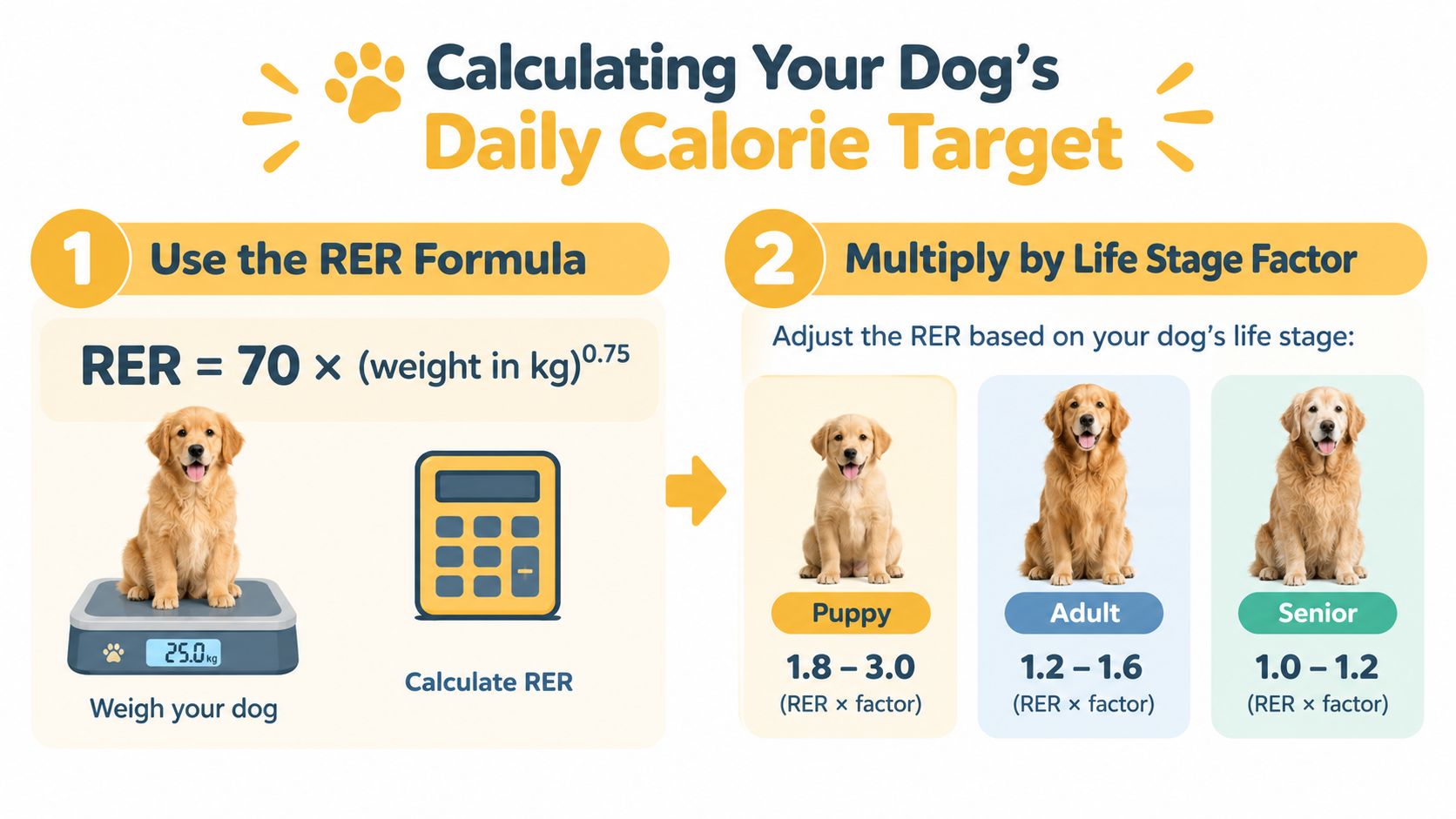
Every honest feeding plan starts with the same two-step math. First, calculate Resting Energy Requirement, or RER. Then multiply that by a life-stage factor to get Maintenance Energy Requirement, or MER. That MER number is the calorie target you feed to.
The formula for RER is 70 × (body weight in kg)^0.75. For a 30-pound dog, that's 13.6 kg. The calculation looks like this, step by step, 13.6^0.75 = about 6.74, then 70 × 6.74 = about 472 kcal RER per day. If that dog is a typical adult, you multiply by 1.4, which gives about 661 kcal per day.
Use the target, not the guess
That number is the anchor. Once you know it, you can turn any recipe into a real portion instead of a vague scoop count. A 30-pound adult that needs about 660 kcal can eat very different volumes depending on whether the recipe is dense or light.
The same logic applies to older dogs, active dogs, and puppies. The weight on the scale doesn't tell you the portion by itself. The calorie target does.
If you want a practical support option while you're building a homemade routine, DA-1™ Daily All-in-One - Senior Dog Support, Joints, Skin/Coat & More is a once-daily powdered supplement described as a multi-system formula for aging dogs, with 18 human-grade ingredients and a 60-day money-back guarantee in the product snapshot.
Here's the calculator you should have in mind while you portion meals.
Matching the Formula to Your Dog's Real Life
Two dogs with the same weight can need very different meal sizes because activity level changes the MER multiplier. Typical adult dogs often sit around 1.4, sedentary or weight-loss-prone adults around 1.2, active or intact adults around 1.6, and puppies or working dogs can climb to 2.0 to 3.0. The multiplier matters more than breed labels, because the dog's real life drives the burn rate.
A dog that lounges on the couch doesn't need the same bowl as a dog that runs trails all weekend. The table below shows why the same recipe can look completely wrong if you ignore activity.
Same weight, different needs
| Activity Profile | MER Multiplier | Daily Calorie Target (50-lb dog) |
|---|---|---|
| Sedentary adult | 1.2 | about 950 kcal |
| Typical neutered adult | 1.4 | about 1,100 kcal |
| Active or intact adult | 1.6 | about 1,250 kcal |
| Working dog or young puppy | 2.0 to 3.0 | about 1,575 to 2,365 kcal |
A 50-pound couch-potato Beagle and a 50-pound hiking Border Collie can eat the same recipe and still need very different bowl sizes. The first may live near the lower end of the range, the second near the higher end, and both can be “right” if their body condition stays steady.
Breed, neuter status, age, and seasonal activity all nudge the multiplier. A winter that brings shorter walks can justify a lower target. A dog who starts agility or hiking needs a stronger one.
For deeper recipe planning, the internal guide on homemade dog food nutrition is the right companion read.
Start at the higher plausible multiplier if you're unsure, then let body condition decide whether you pull back.
Turning Your Recipe's Calories Into a Daily Portion
Once you know the calorie target, the next job is simple math. Total the calories in the batch, divide by the cooked yield, and you get kcal per cup. That number is what turns a feeding goal into an actual scoop size.
A basic chicken-and-rice recipe might land near 200 kcal per cup once cooked, depending on the fat level and added vegetables. If your dog needs 553 kcal per day and your recipe provides 195 kcal per cup, the daily portion is 2.8 cups. If that cup weighs about 225 grams, the same day's food comes to roughly 630 grams, split into two meals.
Why grams matter too
Cups are useful, but grams make your portion more repeatable. Moisture changes cup volume, and cooked rice can fool people because it weighs far more after cooking than it did dry. That's how owners think they're feeding the same amount while drifting higher or lower every week.
The important move is to keep the recipe math tied to the actual batch you made. Total the ingredient calories, divide by final cooked volume, and stop using “one cup” as if every homemade bowl is the same. It isn't.
Don't chase the bowl size. Chase the calories. The bowl is just the container.
If you're building a recipe from scratch, the same logic applies to ingredients like chicken, rice, and vegetables. Low-calorie add-ins can change grams per cup without changing the calorie target, so measure the finished food, not just the raw ingredients.
How the Same Recipe Feeds a Puppy, Adult, and Senior Differently
The same recipe can work for three dogs and still produce three different bowls. That's normal. Life stage changes the calorie target, and the calorie target changes the portion.
A 4-month-old, 15-pound Labrador puppy needs far more energy than a 10-year-old, 12-pound senior terrier that's trending toward weight gain. If both eat a recipe that delivers 200 kcal per cup, the puppy may need about 5 cups, the adult German Shepherd around 8.75 cups on a much larger frame and higher demand, and the senior closer to 1.5 cups. The recipe didn't change. The dog did.
Three dogs, one recipe
- Puppy: Growth drives the highest demand. A young dog often needs more frequent meals, usually 3 to 4 meals per day, because a large single serving is harder to manage.
- Adult: Maintenance is the easiest case. A 4-year-old dog on stable weight usually needs a steady portion, then a slow correction if the body drifts up or down.
- Senior: Older dogs often need less energy, and many do better when the same meal framework is kept in place but the total volume is trimmed.
The biggest mistake is assuming “senior” means “feed tiny amounts” or “puppy” means “pile it on.” The right portion always comes back to the dog in front of you.
For pet parents who want a broader nutrition backstop alongside home cooking, the internal guide on best supplement for homemade dog food is worth reading before you lock in a routine.
The point is simple. One recipe can fit multiple dogs, but only if you portion it for the dog's age, size, and body condition, not for the recipe label.
Home-Cooked Dog Food Feeding Chart by Weight and Activity
This chart gives you a practical starting point for a 200 kcal per cup recipe. It's not a finish line. It's a way to avoid guessing on day one, then adjust based on how your dog looks and feels after a couple of weeks.
| Body Weight (lbs) | Ideal Weight (kg) | Activity Level | MER (kcal/day) | Grams per Day | Cups per Day |
|---|---|---|---|---|---|
| 5 | 2.3 | Sedentary adult | 133 | 150 | 0.7 |
| 5 | 2.3 | Typical adult | 155 | 175 | 0.8 |
| 5 | 2.3 | Active adult | 177 | 200 | 0.9 |
| 5 | 2.3 | Puppy or working dog | 220 to 330 | 250 to 375 | 1.1 to 1.9 |
| 15 | 6.8 | Sedentary adult | 305 | 345 | 1.5 |
| 15 | 6.8 | Typical adult | 355 | 400 | 1.8 |
| 15 | 6.8 | Active adult | 406 | 460 | 2.0 |
| 15 | 6.8 | Puppy or working dog | 508 to 762 | 575 to 860 | 2.5 to 3.8 |
| 30 | 13.6 | Sedentary adult | 513 | 580 | 2.6 |
| 30 | 13.6 | Typical adult | 598 | 675 | 3.0 |
| 30 | 13.6 | Active adult | 684 | 775 | 3.4 |
| 30 | 13.6 | Puppy or working dog | 855 to 1,282 | 965 to 1,450 | 4.8 to 7.3 |
| 50 | 22.7 | Sedentary adult | 950 | 1,075 | 4.8 |
| 50 | 22.7 | Typical adult | 1,110 | 1,255 | 5.6 |
| 50 | 22.7 | Active adult | 1,270 | 1,435 | 6.4 |
| 50 | 22.7 | Puppy or working dog | 1,585 to 2,378 | 1,790 to 2,690 | 8.0 to 12.0 |
| 100 | 45.4 | Sedentary adult | 1,600 | 1,810 | 8.1 |
| 100 | 45.4 | Typical adult | 1,870 | 2,115 | 9.4 |
| 100 | 45.4 | Active adult | 2,140 | 2,420 | 10.7 |
| 100 | 45.4 | Puppy or working dog | 2,675 to 4,010 | 3,020 to 4,530 | 13.4 to 20.1 |
| Any weight | n/a | Senior with reduced needs | Use the next lower activity tier first | Reduce by about 10% to 15% from the matching adult row | Reduce accordingly |
| Any weight | n/a | Lower-fat homemade recipe | Same calorie target, more food by volume | Portions often rise because density drops | Recalculate from the new recipe density |
Starting portions only. Recheck body condition after 2 to 4 weeks and adjust from there. If you switch to a lower-fat recipe, the grams per day can shift even when the calorie target stays the same.
For topping strategies that fit a home-cooked bowl without turning the portion math into a mess, the internal guide on healthy dog food toppers is the cleaner next step.
Adjusting Portions the Right Way Over Time
Portion math is a starting estimate, not a verdict. The dog's body is what confirms whether you got it right, and the easiest way to check that is to watch weight, shape, and condition together over time.
Weigh your dog weekly on the same scale. Take a top-down photo and a side photo from the same angles every time. Score body condition on the 1 to 9 scale each week, then compare the trend instead of obsessing over one reading.
When to change the bowl
A change of about 3% weight loss or gain in 14 days is enough to justify a 10% portion increase or decrease. If the dog is losing too fast, feed more. If the dog is creeping up, feed less. Keep the recipe ratio intact and trim from the fat and carb portion first so protein intake stays steadier.
The true danger is assuming precision solves a bad recipe. It doesn't. A perfectly measured homemade meal still fails if it lacks calcium, trace minerals, or essential fatty acids, and those gaps show up over months, not overnight. Recent coverage of homemade diets has made that weakness hard to ignore, because only 6% of 1,726 homemade dog diets had the potential to be nutritionally complete, while earlier recipe studies found 95% of 200 recipes lacked at least one essential nutrient and 83.5% had multiple deficiencies (Texas A&M).
If the recipe is incomplete, exact portions only make the problem more consistent.
Your job is to feed the right calorie target, then verify the dog's body responds the way you want. That's the whole game.
Pure Paw Labs makes it easier to support a homemade feeding routine without turning your kitchen into a supplement shelf. If you want a simple daily add-on while you dial in portions, visit Pure Paw Labs and look at the options built for dogs on real-world diets.