


You run a hand over your dog's coat and notice that it feels rough instead of soft. A little later, your dog scratches behind one ear, licks a paw, or leaves more loose hair on the couch than usual. The first instinct is often to buy a food labeled “skin and coat” or add an omega-3 supplement, but a glossy front label doesn't tell you whether the diet supplies enough protein, fatty acids, zinc, vitamins, and other supporting nutrients.
The better question isn't, “Which dog food has omega-3?” It's, “Does this complete diet provide the broader nutrition that skin, follicles, and hair need?” A shinier coat can be encouraging, but it doesn't automatically mean that itching, flaking, allergies, or a damaged skin barrier has been resolved. This guide will help you read the label, build a sensible feeding routine, recognize when food may help, and know when your veterinarian needs to investigate further.
Table of Contents
- Why Your Dog's Coat Tells a Bigger Story Than You Think
- The Core Nutrients Behind a Healthy Coat
- How to Read a Dog Food Label for Skin and Coat Claims
- Building a Feeding Routine That Actually Delivers Results
- When a Shinier Coat Isn't Really Healthier Skin
- Skin and Coat Problems That Food Alone Won't Fix
- Your 6-Week Action Plan for a Better Coat
Why Your Dog's Coat Tells a Bigger Story Than You Think
Maya noticed the change while brushing her young dog after a muddy walk. Under the kitchen light, the coat looked dull, the ends felt brittle, and white flakes traced the back. Her dog scratched more often too, though not enough to seem seriously unwell. She blamed the weather and bought a fish-oil topper.
That was a reasonable first thought, but it addressed only one part of the picture. A dog's coat reflects the skin surface, the hair follicle, and the nutrients supplied over time. Grooming can spread natural oils and remove debris. It cannot provide the raw materials needed for new hair or repair a weakened skin barrier.
Hair needs more than shine
Start with the whole diet, especially its protein supply. Veterinary nutrition guidance identifies protein as a core skin-and-coat nutrient, and protein makes up about 95% of each hair in a dog's coat, as explained in this veterinary nutrition overview of skin-and-coat nutrients. Hair grows from living follicle tissue, so the coat visible today reflects recent nutrition and health rather than only the last meal.
A nutrition gap may appear as slow regrowth, rough texture, excess scale, or uneven coverage. These changes usually develop over time instead of arriving as an immediate, dramatic shift.
The coat is useful evidence, not a diagnosis. Genetics, parasites, allergies, hormonal conditions, grooming, hydration, and illness can all alter its appearance. A food labeled for skin and coat may support nutrition, yet it cannot explain every reason a dog scratches or sheds.
The skin barrier is part of the answer
Essential fatty acids help form the lipid layers that reduce water loss from skin. Zinc supports skin maintenance and repair, while vitamins and antioxidants help cells manage normal renewal and oxidative stress. The 2007 AVMA review of canine skin and coat nutrition reported that dogs fed increased linoleic acid and zinc had less scaly skin, greater coat luster, and lower transepidermal water loss than dogs fed a basal diet meeting only National Research Council minimums.
The practical lesson is broader than “add omega-3.” Skin and coat results can reflect the combined nutrient pattern, including protein, fatty acids, zinc, and antioxidant support. A highlighted oil may be useful, but it does not prove that the complete food covers the rest.
Practical rule: Treat coat quality as a clue. Use the label to examine the diet, and use a veterinary exam to investigate disease.
A suitable dog food good for skin and coat should provide a complete nutritional foundation, not just a prominent oil on the bag. Check the adequacy statement and nutrient details before trusting the front-panel claim.
The Core Nutrients Behind a Healthy Coat
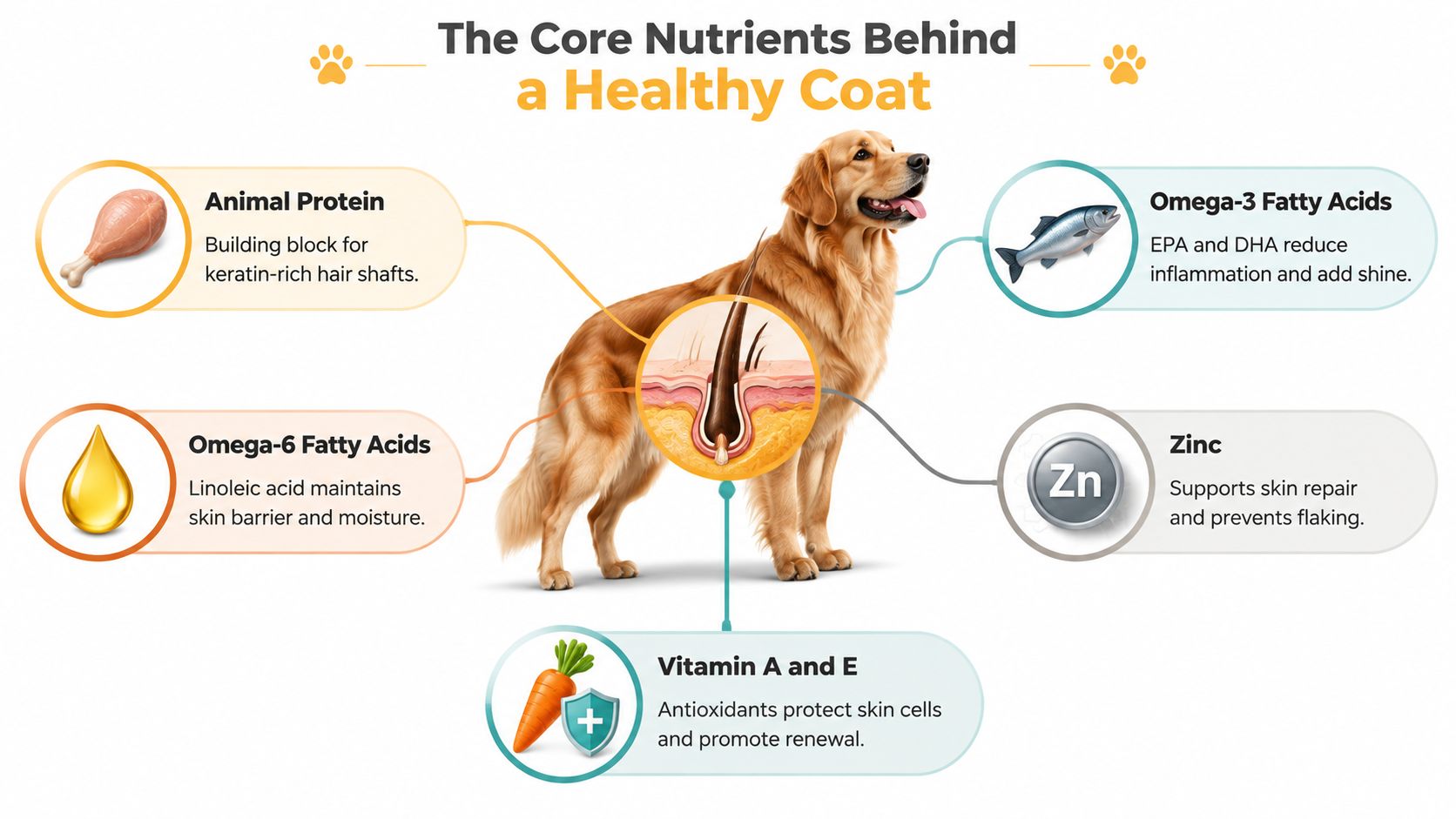
A dog with a dull coat may need more than an omega-3 supplement. Coat quality depends on several connected jobs: protein supplies the structure, fatty acids help maintain the skin barrier, zinc supports repair, and vitamins help protect cells. Adding more of one nutrient cannot compensate for a weak overall diet.
Protein builds the hair
Hair is mostly keratin, a protein-based material. A diet providing appropriate, digestible protein supplies amino acids for hair shafts, skin cells, enzymes, and immune function. Inadequate protein intake or quality may show up as brittle hair, weak regrowth, or a coat that recovers poorly after shedding or clipping.
The guaranteed-analysis protein percentage provides useful context, yet it does not reveal digestibility or amino-acid balance. Look for clearly identified protein ingredients, then confirm that the food is complete and balanced for your dog's life stage.
Fatty acids support the surface and barrier
Omega-3 fatty acids, particularly EPA and DHA, support inflammatory balance and coat texture. Omega-6 fatty acids, including linoleic acid, help maintain the skin's lipid barrier. In the house comparison, omega-6 helps fill the mortar between skin cells, while omega-3 helps create a calmer environment around the structure.
A controlled zinc and linoleic acid feeding study reported better objective coat gloss and less coat scale with zinc and linoleic acid together. Groups receiving zinc, with or without linoleic acid, also showed reduced transepidermal water loss.
That result supports a wider lesson: skin and coat nutrition is a team effort. An oil highlighted on the package may help, but it does not prove the food supplies enough protein, zinc, or antioxidant support.
Zinc and vitamins complete the system
Zinc supports cell turnover, skin repair, and normal follicle function. It should not be treated as an isolated ingredient. Excess supplementation can interfere with other minerals and may be unsuitable for a dog with a medical condition.
Vitamin A supports normal skin-cell development and sebum regulation. Vitamin E helps protect cell membranes as an antioxidant, while B vitamins participate in cellular metabolism and normal follicle activity. These nutrients work alongside protein and fatty acids, rather than replacing them.
Nutrition guidance commonly discusses product targets such as omega-3 around 0.4% to 1.4%, omega-6 around 2.2% to 2.5%, zinc around 150 mg/kg or higher, and DHA around 0.05% to 0.4%. Those figures require context because interpretation depends on the formulation, life stage, and feeding basis. Do not compare isolated numbers without checking how the manufacturer reports them. For more background, see this guide to vitamins for dog skin.
For owners considering a multi-system supplement, DA-1™ Daily All-in-One - Senior Dog Support, Joints, Skin/Coat & More is described as a once-daily formula with 18 human-grade ingredients for cells, gut, and joints. Treat it as a supplement to a sound diet, not evidence that the base food is complete.
How to Read a Dog Food Label for Skin and Coat Claims
The front of a bag is designed to attract attention. The back tells you what you're feeding. Start with the nutritional adequacy statement, then examine the guaranteed analysis, ingredient list, feeding directions, and any specific nutrient disclosures.
Start with adequacy and guaranteed analysis
First, confirm that the food is labeled complete and balanced for your dog's life stage. A puppy, adult, and senior dog may have different nutritional needs, so a food that looks appealing for coat shine still needs to match the animal eating it.
Next, review crude protein and crude fat in the guaranteed analysis. These figures provide context, but percentages can mislead when foods contain different moisture levels. A moist food and a dry food shouldn't be compared by label percentage alone without converting them to a comparable dry-matter basis or asking a veterinary nutrition professional for help.
The label may not list EPA, DHA, zinc, or linoleic acid in a way that makes comparison easy. If the bag highlights omega-3 but doesn't identify the amount or source, contact the manufacturer rather than assuming the claim tells you enough.
Then inspect the ingredient list
Ingredients are listed by weight before cooking. A named animal protein near the beginning can provide useful information about the formulation, while vague descriptions such as generic meat ingredients or unspecified animal fat give you less detail about the source.
That doesn't mean a single ingredient decides whether the food works. The complete nutrient profile matters more than judging the bag by one attractive ingredient. Still, unclear sourcing makes it harder for an owner to evaluate a dog with suspected food sensitivity or to compare formulas consistently.
Use this quick comparison while reading the package:
| Label Claim | What It Usually Means | What to Verify on the Bag |
|---|---|---|
| Skin and coat formula | The manufacturer is positioning the food around dermatological or cosmetic support | Complete-and-balanced status, protein, fat, fatty-acid details, zinc, and life-stage suitability |
| With omega-3 | The food contains an omega-3 source or has added omega-3s | Whether EPA or DHA is identified, the amount provided, and the source |
| Natural | A broad marketing or ingredient-description term | The full ingredient list and nutritional adequacy statement |
| High protein | The formula contains a relatively prominent protein declaration | Protein source, digestibility considerations, fat level, and whether the diet suits your dog |
| Added vitamins and minerals | Micronutrients have been included in the recipe | Which nutrients are listed, their amounts where provided, and whether the full diet is balanced |
A more detailed guide to checking supplement information is available in how to read supplement labels. The same habit applies here: look for identifiable quantities and purpose, not just reassuring words.
Label-reading habit: If a claim appears on the front but the supporting nutrient information is absent from the back, treat the claim as a prompt for questions, not as evidence by itself.
Building a Feeding Routine That Actually Delivers Results
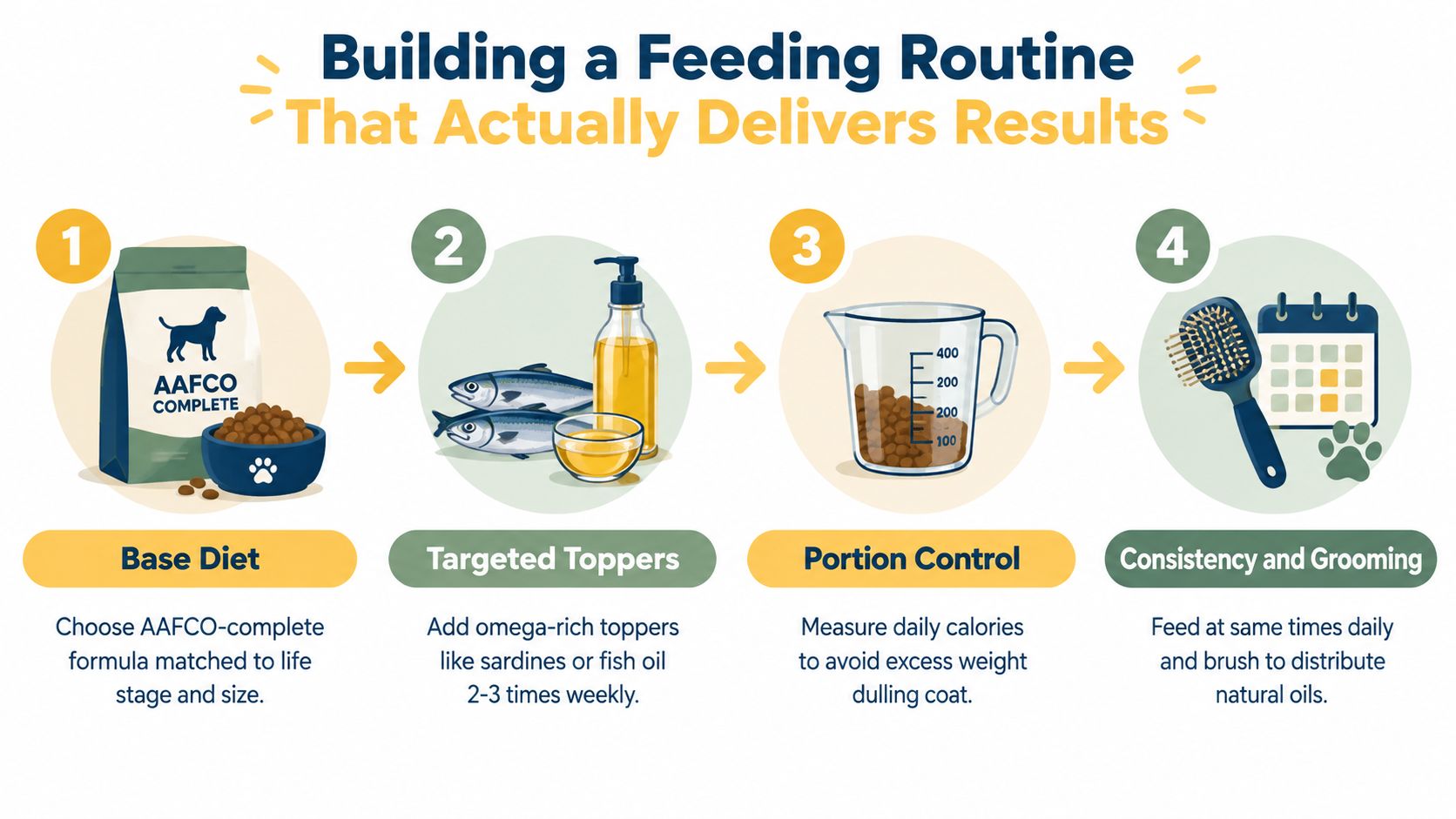
A carefully chosen food cannot help much if meals are inconsistent, portions drift, and extras hide the cause of a coat change. Build the routine around a complete-and-balanced diet matched to your dog's life stage. Then add only what you can identify, measure, and track.
Build around the base food
Choose the main food before choosing toppers or supplements. Check the nutritional adequacy statement, confirm that the formula fits your dog's age and size, and measure each portion instead of keeping the bowl full. Measured meals make it easier to connect a change in coat, stool, or itching with a diet switch, extra treats, or overfeeding.
For many adult dogs, dividing the daily ration into two meals provides a predictable pattern. Puppies usually need meals more often because they are growing and have smaller stomach capacity. Follow your veterinarian's advice and the food's feeding directions rather than applying an adult schedule automatically.
The label is only the starting point. A routine works like a simple test: change one meaningful factor, keep the rest steady, and record what happens.
Use toppers as targeted additions
A small amount of an appropriate omega-rich topper can add variety, but it should not replace the balanced food. Plain cooked pumpkin may provide fiber. A carefully selected fish-based addition may provide EPA and DHA. Introduce any topper gradually, and ask your veterinarian first if your dog has pancreatitis, digestive disease, allergies, or another condition affected by fat intake.
Treats need the same attention. Frequent snacks can crowd out nutrients from the complete diet and make weight control harder. Record every extra, including toppers and chews, so the daily intake reflects the whole routine rather than only the food in the bowl.
Add supplements only when they solve a real problem
An all-in-one product may simplify feeding when an owner wants broader nutritional support without managing several containers. Pure Paw Labs describes DA-1™ as a once-daily powder with ingredients intended to support joints, skin and coat, gut health, immunity, and stress-related needs. Use it only after checking the base diet and other supplements for overlapping nutrients. A supplement cannot correct an inadequate main food.
The plant-oil study found that camelina, flaxseed, and canola oils were each associated with improvements from baseline in several visible coat measures during the study period, including softness, shine, softness uniformity, color intensity, and follicle density. Some laboratory skin and inflammatory measures did not change significantly. The findings, reported in this study on plant oils and canine coat quality, support observing the whole dog instead of chasing one ingredient.
Each week, record the food, portion, treats, toppers, stool quality, scratching, and coat feel. This record can expose patterns and gives your veterinarian clearer information if the problem continues.
When a Shinier Coat Isn't Really Healthier Skin
A dog can look glossy while still feeling uncomfortable. A diet or supplement may make hair smoother and more reflective, yet the skin underneath can remain irritated. Research on dietary oils and canine hair-coat quality found improvements in visible coat characteristics, while several measures related to skin barrier function, inflammation, and oxidative status did not show the same change. A shinier coat is useful information, but it is not a complete health assessment.
Oil works like a polish on the hair shaft. It may improve appearance without resolving itching, paw licking, flakes, redness, infection, or an allergy. Check the dog's comfort and skin condition alongside the coat, rather than treating shine as proof that the food is working.
Track comfort as well as appearance
Use the same observations each week:
- Scratching: Is your dog scratching less, or does the coat only look shinier?
- Flaking: Are dandruff and scale decreasing, unchanged, or spreading?
- Redness: Inspect between the toes, in the armpits, around the ears, and within skin folds.
- Regrowth: After a veterinary-approved clip or a normal shedding cycle, does fur return evenly?
- Texture: Does the undercoat feel softer and less brittle, rather than oilier?
Comfortable skin usually has little visible scale. You can gently observe skin elasticity during routine handling, but a home check cannot replace a veterinary examination.
Use a realistic timeline
Dietary changes rarely transform a coat overnight. Earlier canine nutrition research reported visible skin-and-coat improvement after 28 days, with glossiness and softness becoming significantly better at 7 weeks or later on higher-fat test diets. Use those findings as a guide, not a guarantee, because the response depends on the dog, the starting diet, and the reason for the coat problem.
At about four weeks, review scratching, flakes, and softness. Around seven weeks, assess the quality and evenness of new growth. By twelve weeks, decide whether the change is lasting and whether shedding or irritation has settled. A brighter coat with continuing discomfort suggests that appearance improved while the underlying cause remains. For additional guidance, see this explanation of flaky skin and hair loss in dogs.
Skin and Coat Problems That Food Alone Won't Fix
Nutrition supports normal skin function, but it can't identify a flea infestation, remove an allergen, or treat an endocrine disorder. A dog may eat a well-formulated dog food good for skin and coat and still need medication, testing, parasite prevention, or a prescription diet.
Allergies are a common source of confusion. Environmental allergies may require control of exposure and veterinary treatment, while suspected food allergies usually need a structured elimination trial designed with a veterinarian. Switching between several retail foods at random can make the result harder to interpret.
Parasites require a different response. Fleas, mites, and ringworm can cause itching, scale, broken hair, or bald areas, and changing food won't remove the underlying organism. Skin-fold infections, bacterial overgrowth, and yeast problems may also need medicated shampoos or systemic treatment.
Watch for medical patterns
Endocrine conditions can resemble nutritional problems. Hypothyroidism and Cushing's disease may affect hair growth, skin quality, body condition, thirst, or energy, but diagnosis requires veterinary assessment and appropriate testing. Some inherited or seasonal disorders can also produce coat changes that nutrition alone won't reverse.
| Condition | Key Signs | Action Needed |
|---|---|---|
| Allergic skin disease | Itching, paw licking, ear problems, recurrent irritation | Veterinary assessment and a structured allergy plan |
| Fleas or mites | Intense scratching, small crusts, hair loss, visible parasites or flea debris | Prompt parasite evaluation and targeted treatment |
| Ringworm | Circular hair loss, scale, broken hairs, possible spread to people or animals | Veterinary testing and prescribed treatment |
| Bacterial or yeast overgrowth | Odor, redness, greasy skin, darkened areas, recurrent ear irritation | Skin or ear examination and appropriate medication |
| Endocrine disease | Coat thinning, changes in weight, thirst, energy, or skin texture | Veterinary examination and bloodwork |
| Breed or seasonal disorders | Patterned hair loss or recurring seasonal changes | Diagnosis before selecting a nutrition strategy |
Arrange a veterinary visit if scratching persists beyond two weeks, open sores or hot spots appear, hair loss follows a symmetrical pattern, or the coat change occurs with unusual thirst or weight shifts. Nutrition is the foundation that helps the body cope with treatment, but it isn't a replacement for diagnosis.
Your 6-Week Action Plan for a Better Coat
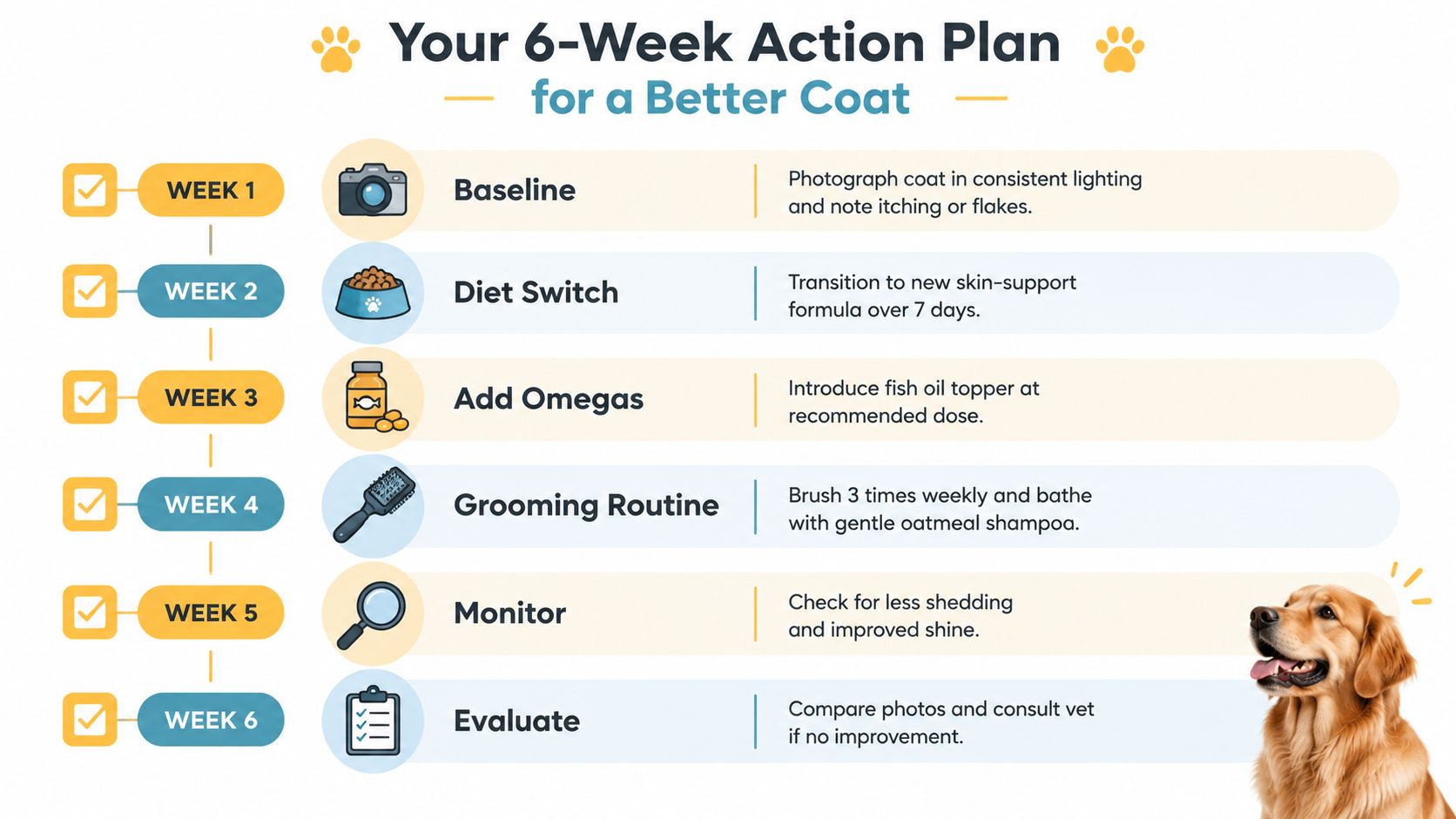
A six-week plan works best when it limits variables. Change one major part of the routine at a time, record what happens, and involve your veterinarian early if there's active disease.
Weeks 1 and 2 establish the baseline
During week one, photograph your dog's coat in consistent lighting. Take a top view, side view, and close image of any flakes, thin areas, redness, or bald patches. Record the current food, treats, toppers, grooming products, stool quality, scratching, licking, and shedding.
Schedule veterinary care promptly if your dog has open sores, hot spots, active bald spots, or significant itching. A baseline photo is useful, but it shouldn't delay treatment.
In week two, audit the current bag. Check the adequacy statement, life-stage match, protein and fat information, identified omega sources, and available details about zinc and vitamins. Ask the manufacturer for clarification when the front label promises skin-and-coat support but the back doesn't explain the relevant nutrients.
Weeks 3 and 4 make one careful change
If you decide to change foods, transition gradually over 7 to 10 days rather than switching abruptly. Track appetite, stool quality, scratching, coat feel, and any new reaction. Avoid introducing a new food, several treats, a topper, and a supplement simultaneously, because you won't know which change helped or caused trouble.
If your veterinarian agrees that a supplement fits, introduce one targeted option according to its label and your dog's circumstances. A powder may be easier to maintain than several separate products, but convenience doesn't remove the need to check for duplicated nutrients.
Weeks 5 and 6 reassess the whole dog
At week five, repeat the same coat photographs and compare them with the baseline. Look for reduced scale, more even regrowth, softer texture, and changes in scratching rather than focusing only on shine.
By week six, decide whether the routine is producing a meaningful pattern. Continue if your dog is comfortable and improving, adjust portions if weight is moving in the wrong direction, or contact your veterinarian if there's no progress or the skin is worsening.
Pin this checklist near the food:
- Baseline: Photograph the coat and record symptoms.
- Label audit: Confirm adequacy, life stage, protein, fats, and nutrient details.
- Slow transition: Change food gradually and monitor digestion.
- One variable: Add only one topper or supplement at a time.
- Weekly review: Compare comfort, flakes, regrowth, shedding, and stool quality.
- Medical boundary: Seek veterinary care when red flags persist or appear.
Pure Paw Labs offers daily powdered nutritional supplements for dogs, including a multi-system formula that combines support for skin and coat with other areas such as joints and gut health. Visit Pure Paw Labs to review the available formula information, then compare it with your dog's complete base diet and discuss fit with your veterinarian before adding it.