


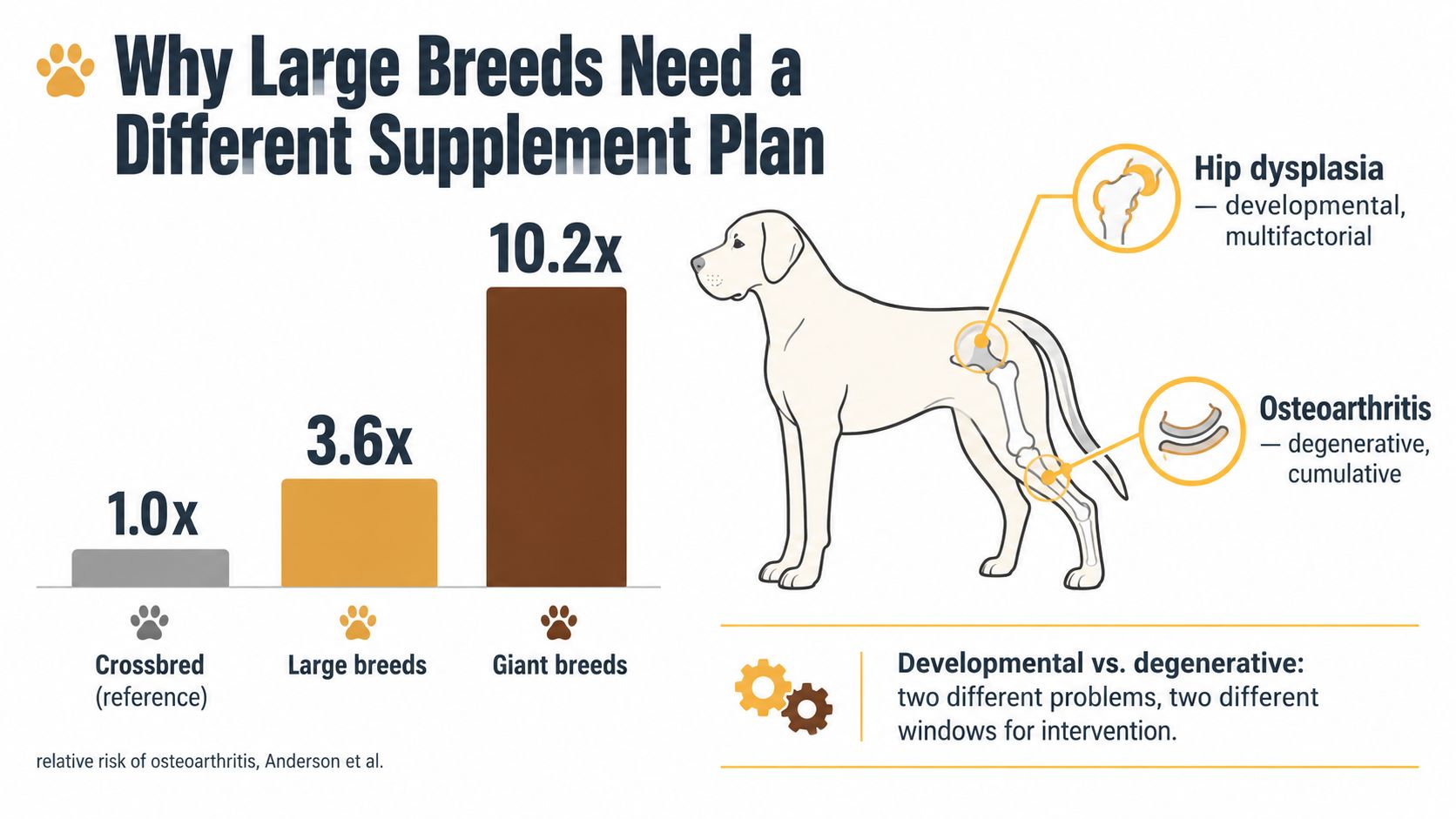
Large and giant breeds carry a 3.6 times and 10.2 times greater relative risk of osteoarthritis, respectively, compared with reference groups. Yet for a large-breed puppy, the most serious supplement mistake may be adding too much calcium rather than failing to add enough.
That contrast changes how you should think about large breed dog supplements. The right choice isn't a shopping list of popular ingredients. It's a risk-management decision based on age, growth stage, body weight, diet, symptoms, and veterinary findings.
A large adult dog may need carefully dosed mobility support, while a growing puppy may be safer with no mineral supplement at all. Even an all-in-one product can be inappropriate if it adds nutrients that the dog's complete diet already supplies. The useful question is not “What supplement should every large dog take?” but “What risk am I trying to manage, and does this product address it without creating another one?”
Table of Contents
- Why Large Breeds Need a Different Supplement Plan
- The Four Systems That Matter Most in Large Dogs
- Growth and Calcium Balance in Large-Breed Puppies
- Joint and Mobility Support for Adult Large Breeds
- Dosing by Weight and Reading the Label
- All-in-One Versus a Multi-Supplement Stack
- A Vet-Ready Checklist for Evaluating Any Product
- Matching the Supplement to the Dog in Front of You
Why Large Breeds Need a Different Supplement Plan
The osteoarthritis risk figures provide the starting point. A veterinary review reports historical relative-risk estimates of 3.6 for large breeds and 10.2 for giant breeds compared with reference groups, while osteoarthritis affects approximately 20% of dogs older than one year in North America. These estimates describe disease burden and breed-associated risk, not proof that a supplement can prevent or treat osteoarthritis. The veterinary review explains the evidence and its limitations.
Breed isn't destiny, but it changes the starting point. In UK primary-care data covering 455,557 dogs, diagnosed appendicular osteoarthritis affected 2.5% of the overall population in 2013, compared with 7.7% in Golden Retrievers, 6.1% in Labradors, 5.4% in Rottweilers, and 4.9% in German Shepherd Dogs. Those figures are diagnosis rates, so age, veterinary access, reporting, and clinical detection influence the results. They still show why joint health deserves early attention in many large and giant breeds.
Size changes the calculation
A supplement dose that suits a smaller dog may provide too little active ingredient for a giant breed. Conversely, a product containing minerals or fat-soluble vitamins can become excessive when owners combine it with complete food, treats, fortified chews, and other supplements. Body weight changes both the amount needed and the amount that could become unsafe.
Growth introduces a separate problem. A puppy's bones, joints, and growth plates are developing while its nutritional tolerance remains narrow. The nutritional priority is controlled growth, not maximum growth. That means a product designed for an adult's mobility needs may be a poor choice for a puppy, especially if it contains calcium, phosphorus, or vitamin D.
Use four questions before choosing
Ask four questions in order:
- What is the life stage? A growing puppy, adult, and senior have different nutritional priorities.
- What is the target system? Joint, growth, digestion, skin, or immune support should each have a clear reason.
- What does the existing diet already provide? A complete diet may make extra vitamins and minerals unnecessary.
- Is there a diagnosis or symptom? A limp, painful joint, repeated vomiting, or sudden decline needs veterinary assessment rather than a stronger supplement.
Owners looking for broad educational material can also browse Hemp Well Ireland tags as a general reference point, but any product decision still needs to match the individual dog's diet and health status.
The Four Systems That Matter Most in Large Dogs
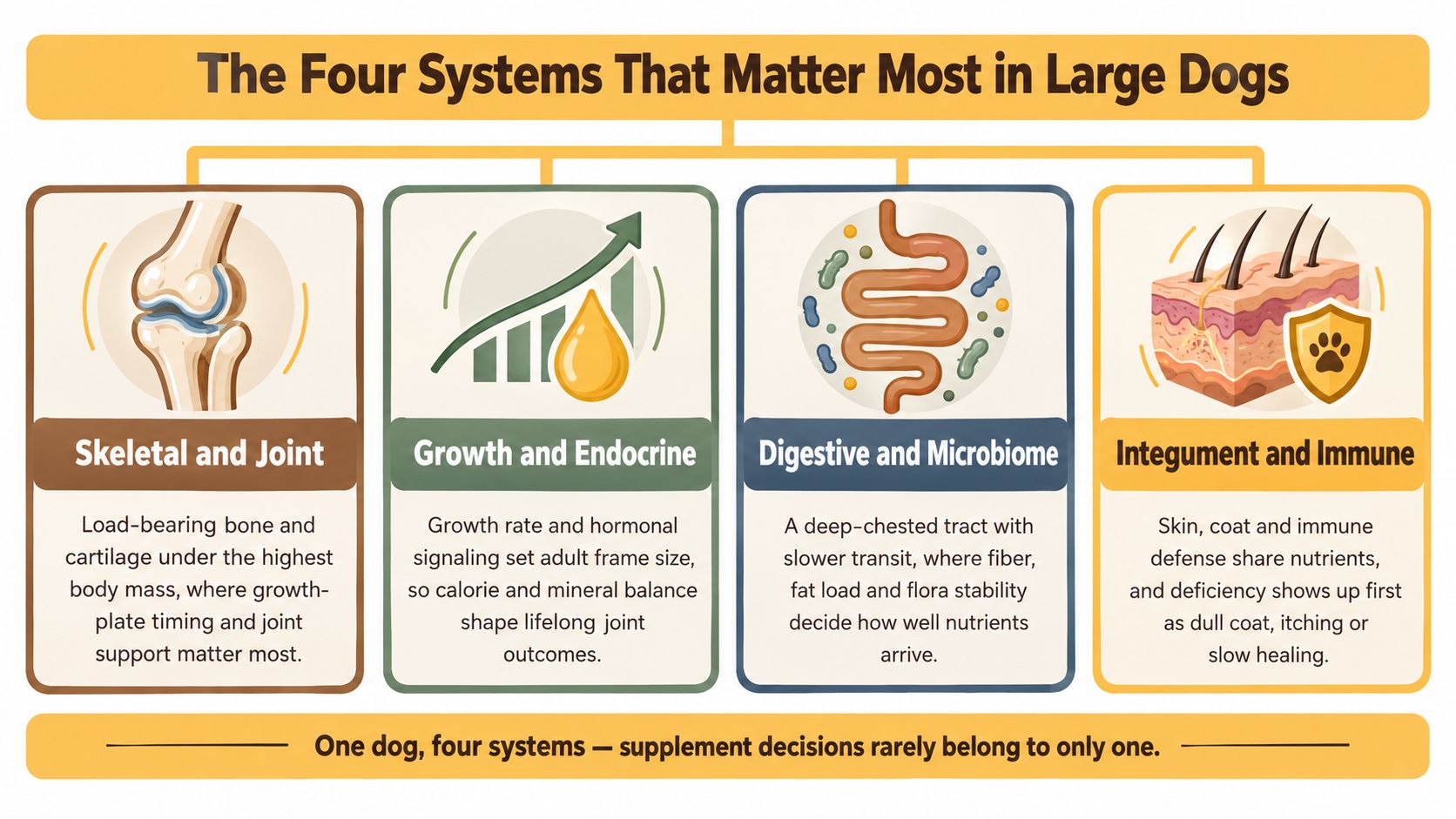
Large dogs don't have one “supplement system.” Their size affects several connected areas, and a change in one can alter the demands placed on another. A dog carrying excess body weight puts more load on its joints, while a dog with poor digestion may not tolerate a high-fat product well. A puppy with an unbalanced mineral intake can develop skeletal problems that no later joint chew can undo.
1. Skeletal and joint health
Large frames place substantial mechanical demand on bones, cartilage, ligaments, and supporting muscles. This pillar matters most when a dog is growing rapidly, carrying excess weight, working hard, or showing stiffness, reluctance to climb, or difficulty rising. Adult mobility products belong here, but they should complement weight control, appropriate exercise, rehabilitation, and diagnosis.
2. Growth and endocrine balance
Growth rate determines how quickly the skeleton reaches adult size, while calcium and phosphorus balance influences mineralization. This system dominates the puppy stage because excess energy and inappropriate mineral supplementation can create developmental risk. The goal isn't to make a puppy grow as quickly as possible. It's to support steady development through a diet formulated for large-breed growth.
3. Digestion and the microbiome
Large dogs may consume substantial meals, and individual dogs vary in their tolerance of fat, fiber, new proteins, and concentrated powders. Digestive support should therefore focus on what the dog experiences, such as inconsistent stools or poor tolerance, rather than adding a probiotic automatically. A product that causes loose stool won't provide meaningful support if the dog refuses it or absorbs it poorly.
4. Integument and immune function
Skin and coat changes can reflect diet, allergies, parasites, infection, or another medical problem. Omega-3 fatty acids may be relevant to a broader nutrition plan, but itching or recurring skin disease still needs a proper workup. “Skin support” on a label shouldn't replace investigation of the underlying cause.
Practical rule: Rank the systems by the dog's current risk. For a puppy, controlled growth comes first. For an adult with mobility concerns, joints and body condition move higher. For a senior, several systems may need coordinated support, but each ingredient still needs a reason.
Growth and Calcium Balance in Large-Breed Puppies
The common assumption is simple: a bigger puppy needs more calcium to build a bigger skeleton. That logic is unsafe. Large-breed puppies can have limited ability to reduce intestinal calcium absorption during rapid growth, so extra calcium can push an already complete diet out of balance.
Veterinary nutrition guidance places the typical calcium-to-phosphorus target near 1.2 to 1.4 to 1, while the broader AAFCO range is 1 to 1 through 2.1 to 1. The same guidance identifies excess calcium as particularly concerning from weaning through approximately one year, when large breeds are developing quickly. Merck Veterinary Manual outlines the relevant calcium, phosphorus, and skeletal-growth considerations.
More mineral isn't more protection
Merck reports that excessive supplementation above 3% calcium on a dry-matter basis produces more severe osteochondrosis signs and reduced skeletal remodeling than diets containing approximately 1% to 3% calcium. These findings don't mean calcium is harmful in itself. They show why the dose and the complete diet matter.
AAFCO growth guidance places calcium for large-breed puppies at approximately 3.0 to 4.5 grams per 1,000 kilocalories, and an exploratory analysis found that only 40% of evaluated diets fell within that stated range. Both deficient and excessive diets were represented. The exploratory analysis discusses this narrow nutritional margin and the risks of unbalanced puppy diets.
| Nutrient | Large-Breed Puppy Guidance | Standard Adult Dog Food | Risk If Exceeded |
|---|---|---|---|
| Calcium | Keep within the diet's large-breed growth guidance and calculate total intake from food, treats, and supplements | May not be formulated for large-breed growth | Developmental skeletal imbalance and orthopedic risk |
| Phosphorus | Keep balanced with calcium rather than adding it separately | Intended for adult maintenance, not necessarily rapid growth | An inappropriate calcium-to-phosphorus balance |
| Vitamin D | Provide through a properly formulated diet unless a veterinarian identifies a specific need | Already present in complete diets at formulated levels | Unnecessary excess and mineral-regulation problems |
| Bone meal or calcium products | Generally avoid on top of complete large-breed puppy food | Not a substitute for a growth-formulated diet | Adds minerals without correcting energy or growth-rate errors |
For a puppy eating complete large-breed growth food, the safest default is usually not adding calcium carbonate, bone meal, phosphorus, or vitamin D. A homemade diet, suspected deficiency, persistent lameness, or diagnosed orthopedic condition calls for veterinary review, ideally with a veterinary nutritionist. This guide to dog growth plates can help owners understand why development deserves separate treatment from adult joint maintenance.
Joint and Mobility Support for Adult Large Breeds
Adult mobility support should begin with the ingredient that has the clearest pain-modulation evidence in the available veterinary review: omega-3 fatty acids, especially EPA and DHA. A systematic review and meta-analysis concluded that omega-3 products beneficially modulate painful osteoarthritis in dogs and cats, while the analyzed chondroitin-glucosamine evidence showed no analgesic effect. The review compares the clinical evidence for enriched diets and nutraceuticals.
That doesn't make glucosamine and chondroitin irrelevant. Their rationale is different. They are commonly included as cartilage-related ingredients, while long-chain omega-3 fatty acids can alter inflammatory lipid mediator production and cell-membrane substrate availability. The distinction matters because a plausible mechanism isn't the same as a demonstrated pain outcome.
Read the active dose, not the front label
Fish-oil labels often list total oil and total omega-3, but the actionable information is the actual daily EPA plus DHA amount. If the label only reports capsule weight or says “omega-3 blend” without identifying EPA and DHA, you can't reliably compare it with a veterinary plan.
Dose selection should be weight-based and coordinated with the dog's veterinarian. Extra caution is appropriate when a dog takes anticoagulant medication, has a history of pancreatitis or gastrointestinal sensitivity, or is approaching surgery. Omega-3 support is not a replacement for weight management, controlled exercise, diagnosis, or prescribed pain control.
| Factor | Omega-3, EPA and DHA | Glucosamine and Chondroitin |
|---|---|---|
| Main rationale | Modulates inflammatory lipid mediators and pain signaling | Supplies compounds associated with cartilage matrix support |
| Evidence emphasis | Stronger pain-modulation evidence in the analyzed osteoarthritis review | Weaker analgesic outcome in the analyzed evidence |
| Label requirement | Actual EPA and DHA amounts per serving | Actual glucosamine and chondroitin amounts and forms |
| Best use | Adult mobility plans where inflammation and comfort are priorities | A targeted adjunct when the veterinarian considers cartilage support appropriate |
| Main caution | Medication interactions, digestive tolerance, pancreatitis history, and surgery | Don't assume inclusion proves an effective dose or pain benefit |
An adult large breed may reasonably receive more than one mobility ingredient, but only if the combined plan is transparent and justified. This guide to joint supplements for large breeds offers additional context for evaluating that decision.
Dosing by Weight and Reading the Label
Start with the dog's current weight, not its breed name. A Labrador and a Great Dane may both be called large breeds, but their supplement requirements can differ substantially. For any dose-dependent product, the label should let you translate the recommendation into an amount per kilogram of body weight.
Do the calculation before opening the container
Use this sequence:
- Record body weight in kilograms. If the label provides a target amount per kilogram, convert the dog's weight before calculating.
- Identify the active ingredient. For fish oil, separate EPA and DHA from total oil.
- Multiply the target dose by body weight. This gives the daily active amount to compare with the label.
- Divide by the active amount per serving. The result tells you how many servings would be required.
- Check the total diet and other products. Include fortified treats, mineral products, multivitamins, and separate oils.
For an omega-3 label, the important equation is:
Daily EPA plus DHA target × body weight in kilograms = required daily EPA plus DHA.
Then perform the inverse check:
EPA plus DHA supplied per serving ÷ body weight in kilograms = actual amount per kilogram.
This prevents a common mistake. A scoop can look generous while delivering an unclear or inadequate amount of the active ingredient, or it can supply multiple overlapping nutrients that the dog doesn't need.
Ingredients that deserve extra caution
Some categories have a narrower safety margin than a basic joint ingredient:
- Fat-soluble vitamins: Vitamins A, D, E, and K can accumulate more readily than water-soluble nutrients.
- Minerals: Calcium, phosphorus, copper, and vitamin D can disrupt a carefully balanced diet.
- Oils: High-fat products may be unsuitable for dogs with certain digestive or pancreatic histories.
- Blended actives: Several products may duplicate the same ingredient under different names.
Red flags include proprietary blends that conceal individual amounts, IU-only declarations without the vitamin form, and a single scoop recommendation for puppies, adults, and giant breeds alike. A label should also state serving size, active amounts, cautions, manufacturer details, and batch information. This label-reading guide can help you build a more reliable review habit.
All-in-One Versus a Multi-Supplement Stack
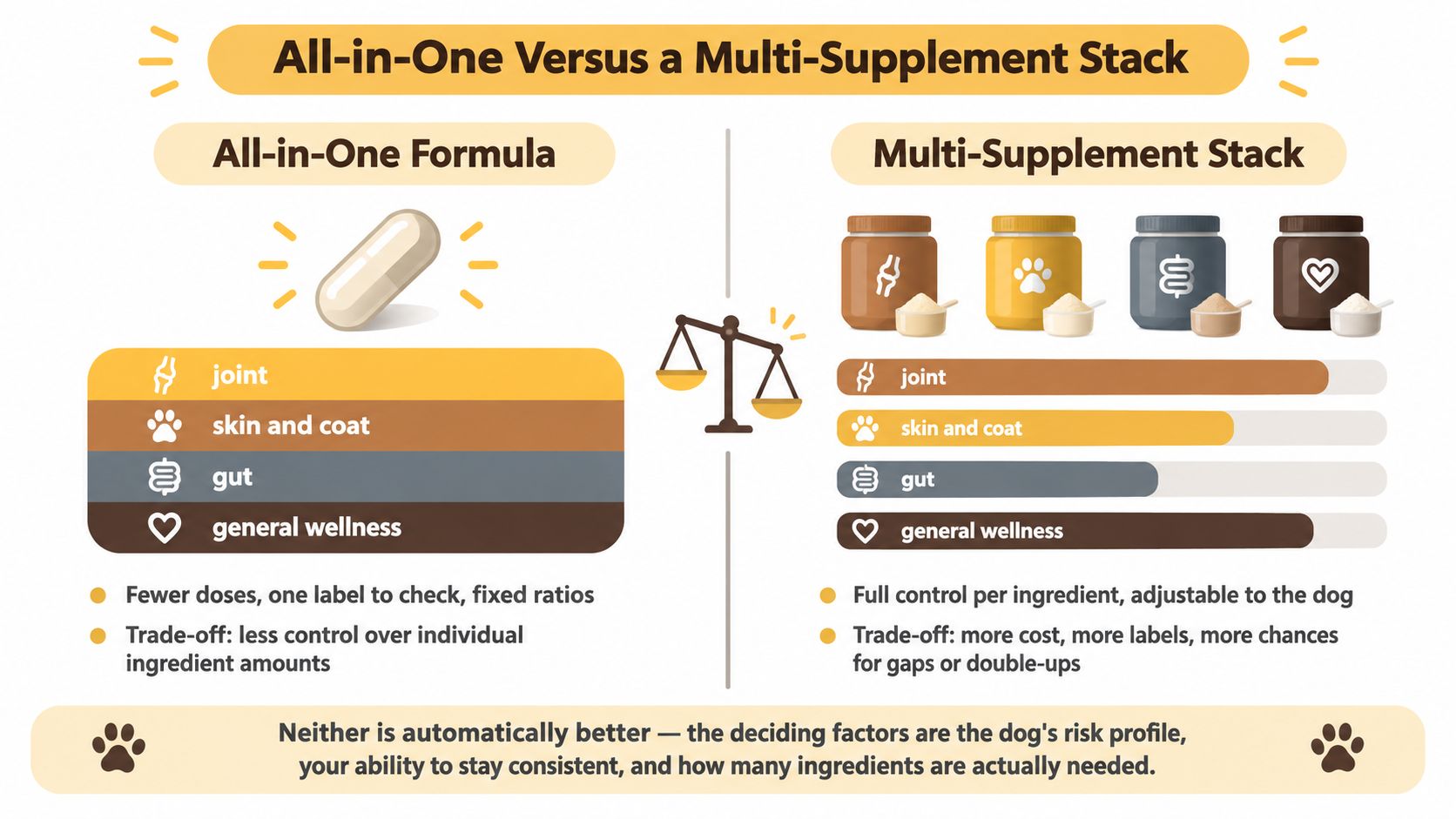
An all-in-one formula combines several support categories in one product, such as joint, skin and coat, gut, and general wellness ingredients. A multi-supplement stack uses separate products so the owner can adjust each ingredient independently.
Neither format is automatically safer. The better choice depends on how many targets the dog has, whether each active dose is visible, and whether the owner can give the product consistently.
Compare the practical trade-offs
| Decision factor | All-in-one formula | Multi-supplement stack |
|---|---|---|
| Cost per day | One product makes the total easier to calculate, but the formula may contain ingredients the dog doesn't need | Separate products make each cost visible, though several products can raise the overall daily expense |
| Adherence | Fewer containers and doses can simplify routine feeding | More bottles create more opportunities for missed doses |
| Dosing control | Fixed ratios limit adjustment of individual ingredients | Each active can be changed or removed independently |
| Duplication risk | Overlap is easier to miss if the blend isn't transparent | Multiple labels increase the chance of duplicate vitamins, oils, or joint ingredients |
| Clinical flexibility | May not supply a targeted therapeutic amount | Better suited to a documented need requiring a specific ingredient dose |
A stack can make sense when a dog has a diagnosed orthopedic or dermatologic condition and needs a targeted amount that a general formula cannot provide. For a healthy adult, an all-in-one may be easier to maintain, but only if the label shows meaningful amounts and doesn't add unnecessary minerals.
For context, DA-1™ Daily All-in-One - Senior Dog Support, Joints, Skin/Coat & More is described as a multi-system formula with 18 human-grade ingredients in one scoop, targeting cells, gut, and joints. It contains no fillers and is presented as a daily routine for aging dogs, so owners should still check its formulation against the dog's age, diet, health conditions, and veterinary recommendations.
The useful decision isn't “one product or many” in the abstract. It is whether the chosen format supplies the needed actives, avoids duplication, and fits a routine the household can follow. This overview of all-in-one supplements provides another way to think about convenience without treating convenience as proof of efficacy.
A Vet-Ready Checklist for Evaluating Any Product
A product can have attractive ingredients and still be a poor fit. Before buying, turn the label into a series of yes-or-no decisions. If the answer fails at the life-stage or safety step, don't move on to marketing claims.
Life stage and risk profile
- Is the dog growing? If yes, treat calcium and mineral additions as veterinary decisions.
- Is the dog an adult or senior? Match mobility support to symptoms, body condition, and diagnosed risk.
- Is there a reason for supplementation? Identify a specific concern instead of relying on a generic wellness promise.
- Does the product suit that stage? A formula made for adult mobility shouldn't be assumed safe for a puppy.
Formulation and ingredient transparency
- Is every active ingredient named? Reject labels that hide meaningful ingredients inside a proprietary blend.
- Is the amount stated per serving? You need milligrams or another usable quantity, not only a marketing category.
- Are forms identified? Look for EPA and DHA rather than only “fish oil,” and named probiotic strains rather than only “probiotics.”
- Can you calculate the daily intake? If the serving instructions don't scale clearly by weight, pause before purchasing.
Safety and interaction screening
- Has the veterinarian reviewed the product? This matters more when the dog takes medication or has a diagnosed condition.
- Does the label include cautions? Look for guidance involving pregnancy, nursing, surgery, digestive disease, and medications.
- Could another product duplicate it? Add the totals for oils, vitamins, minerals, and joint ingredients across the whole routine.
- Is the puppy receiving extra calcium or vitamin D? If the answer is yes, ask whether the complete diet truly requires it.
Practical use and follow-through
- Will the dog eat it consistently? An unpalatable product delivers no useful dose.
- Can the household give it as directed? A complicated routine can fail even when the formula is appropriate.
- Is there a way to monitor response? Track rising from rest, stair use, gait, appetite, stool quality, and body condition.
- Is there a review point? Reassess rather than automatically increasing the dose when results are unclear.
Third-party testing can add useful information, but it doesn't prove that an ingredient will help every dog. It primarily addresses identity, purity, and batch quality. This explanation of third-party lab testing can help you distinguish manufacturing verification from clinical efficacy.
Matching the Supplement to the Dog in Front of You
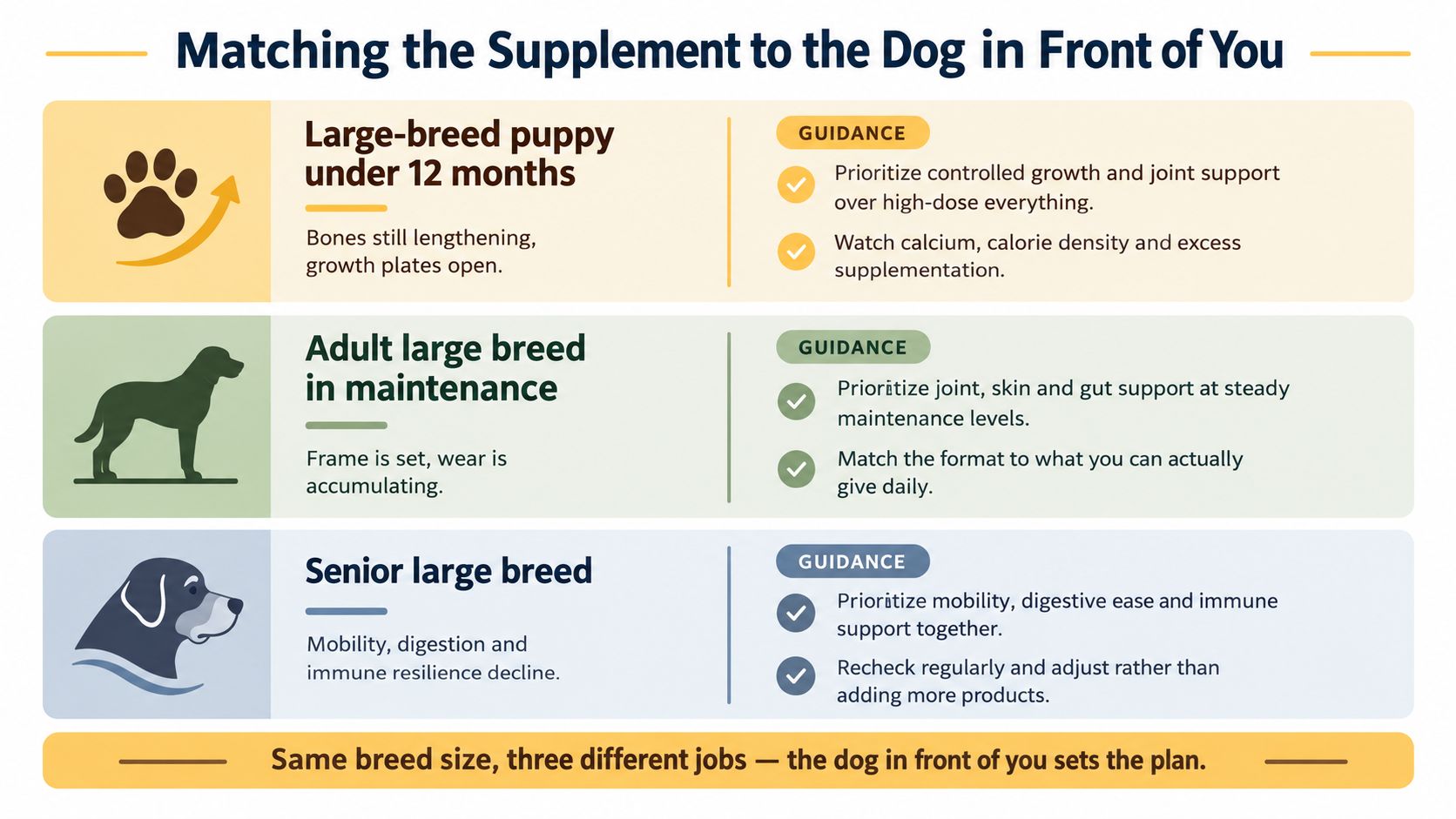
The same breed category can contain three very different supplement decisions. A growing puppy, an adult in steady condition, and a senior with stiffness shouldn't share one automatic protocol.
Large-breed puppy
Start with restraint. Use a complete diet formulated for large-breed growth, keep calorie intake controlled, and avoid extra calcium, phosphorus, or vitamin D unless a veterinarian identifies a medical reason. A joint ingredient cannot compensate for rapid growth or an unbalanced mineral profile.
Adult large breed
Make body condition and steady exercise the foundation. If mobility support is appropriate, an omega-3-focused plan with a clearly stated EPA and DHA amount is more evidence-aligned than choosing a product because its ingredient list is long. Add other actives only when their role and dose are clear.
Senior or predisposed large breed
Use an evidence-weighted plan that reflects the dog's actual problems. Mobility, digestion, skin, and immune support may all matter, but a senior with pain, lameness, or declining function needs veterinary assessment rather than a supplement-only response.
Omission is a valid choice. When a complete diet meets the dog's needs and no specific gap or clinical target exists, adding another product may create complexity without adding value. The best large breed dog supplements plan is the one that matches the dog's life stage, body condition, diet, and risk profile, not the one with the most ingredients.
Pure Paw Labs offers daily dog nutrition products designed to consolidate support areas such as joints, skin and coat, digestion, and general wellness into a simpler routine. Review the formulation and serving guidance for your dog's age and diet, then visit Pure Paw Labs to explore whether its approach fits your veterinary-informed plan.