


The most popular advice about the best shampoo for English Bulldogs is usually wrong in the most important way. It treats the breed like any other short-haired dog and asks which bottle has the strongest scent, the most appealing label, or the highest place on a generic list. That misses the core issue: an English Bulldog's shampoo must work with facial folds, tail pockets, trapped moisture, and a skin barrier that may already be irritated.
The right choice depends on what your dog's skin looks and smells like today. A healthy bulldog needs a mild cleanser and a disciplined drying routine. A dog with recurring yeast or bacterial overgrowth may need a medicated formula. A dog with crusting, pain, oozing, or persistent odor needs veterinary attention, not another round of product shopping.
Table of Contents
- Why Bulldog Shampoo Is a Different Question
- What Actually Matters in a Bulldog Shampoo
- Comparing the Three Shampoo Families
- Matching the Shampoo to Your Bulldog's Skin
- The Bath and Fold Routine Around the Shampoo
- Why Bathing Frequency Matters as Much as the Bottle
- Building a Long-Term Skin and Coat Plan
Why Bulldog Shampoo Is a Different Question
English Bulldogs are not generic short-coated dogs. Their wrinkles and body folds can hold moisture, debris, and skin oils against the surface, creating conditions that encourage irritation and odor. The skin-fold care guidance for wrinkly dogs is more useful than a broad “best dog shampoo” ranking because it treats cleaning and drying as one job.
The risk is not theoretical. A Royal Veterinary College VetCompass study covering more than 900,000 dogs in UK primary-care records found that skin-fold dermatitis affected 6.1% of English Bulldogs annually, compared with 2.7% of French Bulldogs and 2.1% of Pugs. Across all dogs, the annual diagnosis rate was 0.37%. The most common affected locations in the study were the lips and facial folds, while common signs included redness, inflammation, moistness, malodour, and pain. The breed-specific skin-fold data explains why bulldog shampoo selection can't be separated from wrinkle care.
Practical rule: Choose the shampoo for the skin state underneath the coat, not for the coat color, breed marketing, or fragrance.
Three factors matter more than brand recognition:
- The wrinkle microenvironment: Deep folds can stay damp after a bath even when the visible coat feels dry.
- The condition of the skin barrier: Fragrance, aggressive cleansing, and residue can make already-sensitive skin less comfortable.
- Your bathing habits: The same formula can be reasonable in a controlled routine and irritating when used too frequently or rinsed poorly.
This is why a shampoo that works well for a Labrador or Beagle may not suit your bulldog. The issue isn't that every bulldog needs a medicated product. It's that every bulldog needs a product and routine that account for moisture retention.
Start by examining the skin. Healthy folds should not be persistently red, wet, painful, or strongly odorous. If those signs are present, a gentle cosmetic cleanser may wash the surface without addressing the underlying problem. If the skin is calm but dry or reactive, a heavily active formula may be unnecessary.
The best answer is therefore conditional. Gentle for stable skin, medicated for diagnosed or strongly suspected overgrowth, and veterinary care for active lesions is a more useful framework than choosing one permanent bottle.
What Actually Matters in a Bulldog Shampoo
Ignore labels that rely on words such as “natural,” “premium,” or “hypoallergenic” without clearly showing the formula. Those terms don't tell you how the shampoo cleans, whether it contains fragrance, or whether it's intended for infection management.
Read the ingredient panel in this order:
Start with the cleansing system
A cleanser should remove grease and debris without leaving the folds tight, flaky, or irritated. Look for a formula described as gentle and suitable for dogs, with a clear explanation of its cleansing ingredients. Be cautious with strongly perfumed products, harsh-feeling formulas, and anything that leaves a film in deep wrinkles.
Dog skin has its own surface chemistry. Research on canine shampoos indicates that pH and bathing frequency can affect hydration and barrier function, and that products shouldn't disturb the skin's normal balance. The canine shampoo research supports judging the bottle alongside the calendar, not in isolation.
Separate gentle support from active treatment
Ingredients such as glycerin and oat-based components can fit a mild routine for skin that needs comfortable cleansing. By contrast, chlorhexidine, miconazole, and benzoyl peroxide signal a more treatment-oriented formula. Those actives may be appropriate when a veterinarian has identified bacterial or yeast-related disease, but they aren't automatically better for a dog with healthy skin.
Avoid treating “stronger” as synonymous with “better.” A medicated shampoo used without a clear reason can add complexity to a routine that only needed mild cleansing and complete drying. A gentle shampoo used against an active infection can also waste time.
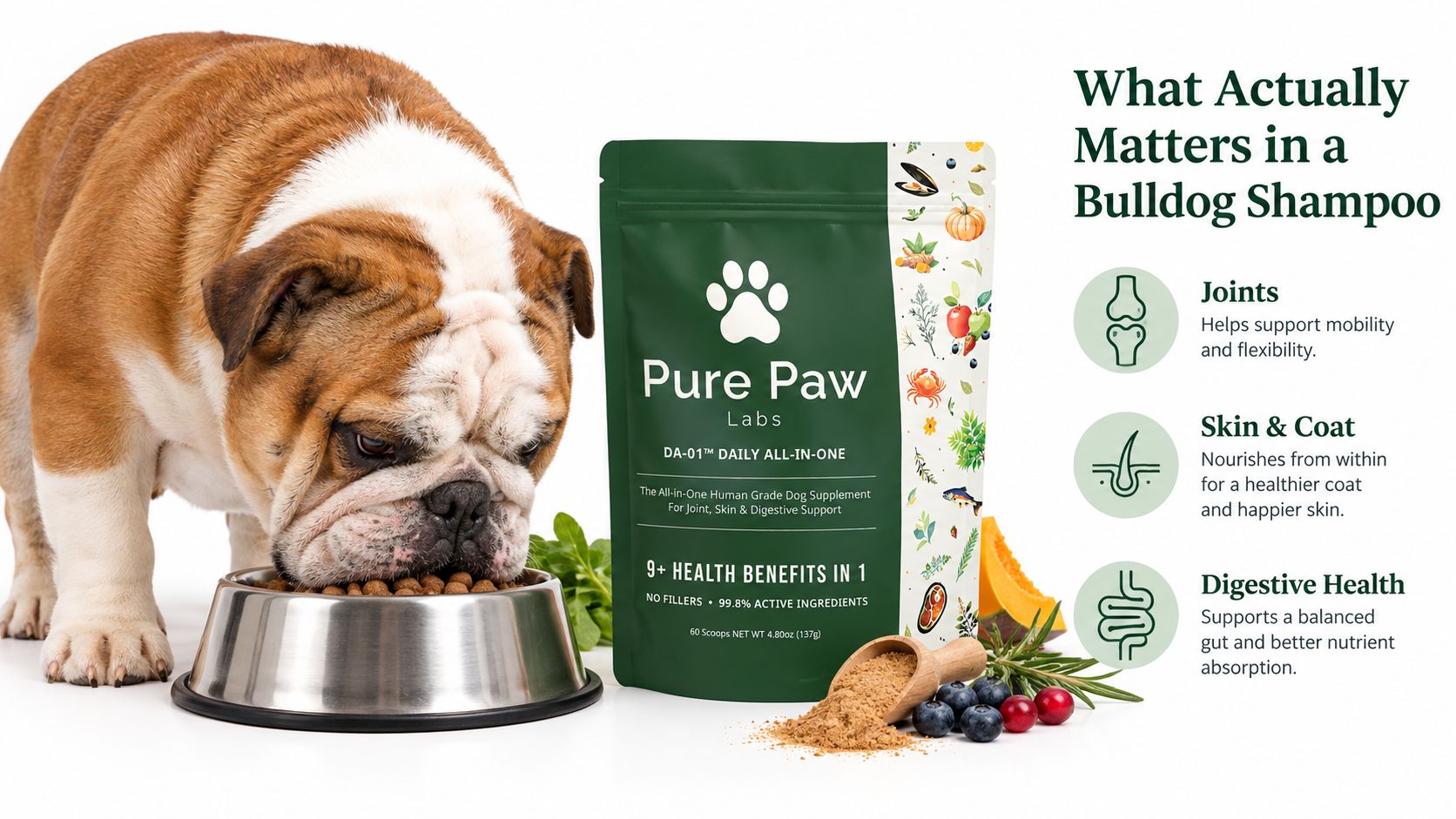
If you're also reviewing broader skin and coat support, DA-1™ Daily All-in-One - Senior Dog Support, Joints, Skin/Coat & More is a daily powder with 18 human-grade ingredients aimed at cells, gut, and joints. It isn't a shampoo or a treatment for skin-fold infection, so keep its role separate from cleansing decisions.
Use this label checklist
| Criterion | Look For | Avoid |
|---|---|---|
| Skin compatibility | A dog-specific formula with clear use guidance | Human shampoo or unclear skin claims |
| Cleansing strength | Mild cleansing suited to repeat use | A harsh-feeling formula that leaves skin tight |
| Fragrance | Fragrance-free or very lightly scented | Strong perfume used to mask odor |
| Colorants | A simple formula with minimal extras | Artificial color that adds no skin benefit |
| Moisture support | Glycerin, oat, or other clearly identified supportive ingredients | A formula that leaves folds dry or rough |
| Treatment actives | Chlorhexidine or antifungal ingredients when medically appropriate | Active ingredients chosen only because they sound powerful |
| Rinsing | A formula that rinses cleanly from folds | Sticky residue in facial folds or the tail pocket |
For more practical ingredient guidance, review this dog skin and coat care resource. The bottle should make sense for your dog's skin, your bathing cadence, and the amount of fold maintenance you can realistically perform.
Comparing the Three Shampoo Families
There are three useful shampoo families for English Bulldogs. None wins in every situation. The mistake is buying a product from the wrong family and then blaming the breed when the result disappoints.
Gentle everyday formulas are the default for a bulldog whose skin is stable. Choose this category when the folds aren't persistently red, wet, painful, or malodorous. A simple, fragrance-light cleanser is easier to use repeatedly and less likely to turn routine bathing into a source of irritation.
Medicated antibacterial or antifungal formulas belong in a more deliberate plan. Veterinary dermatology commonly uses chlorhexidine for superficial bacterial disease, while miconazole, ketoconazole, and chlorhexidine may be used for Malassezia-related problems. Combination formulas can be useful, but the right active ingredient depends on what is affecting the skin. The veterinary dermatology overview describes routine shampooing every 1 to 2 weeks as common for dogs with dermatologic disease and identifies chlorhexidine as a frequently used antimicrobial ingredient.
Natural or plant-based formulas can appeal to owners who want a simpler-feeling product. They may suit mild sensitivity, but “plant-based” doesn't prove that a formula will control bacterial or yeast overgrowth. Natural fragrance can still bother reactive skin, and a pleasant botanical scent doesn't solve moisture trapped inside a fold.
| Feature | Gentle Everyday | Medicated | Natural/Plant-Based |
|---|---|---|---|
| Main role | Routine cleansing | Targeted management of skin disease | Mild cleansing with a simpler ingredient profile |
| Best fit | Calm, stable skin | Recurrent or active bacterial or yeast concerns | Mild sensitivity when no infection is suspected |
| Active ingredients | Usually limited | May include chlorhexidine or antifungal ingredients | Often relies on botanical or soothing components |
| Fold suitability | Good when rinsed and dried well | Useful when the active matches the problem | Variable, depending on formula and fragrance |
| Use pattern | Regular maintenance | Follow label and veterinary direction | Maintenance, not a substitute for treatment |
| Main trade-off | May not address infection | Can be unnecessary for healthy skin | Evidence and treatment strength may be limited |
Price per bath is difficult to judge without a product's size, concentration, and the amount your dog needs. A concentrated formula may last longer, while a dilute product may require more liquid to cover the folds. Compare the instructions and intended use rather than the bottle price alone.
The practical ranking is straightforward. Gentle is the everyday default. Medicated is the intervention category. Natural is an optional middle path, not a cure-all. If odor returns quickly, redness persists, or your bulldog keeps rubbing the face, stop rotating random formulas and ask whether the skin problem needs diagnosis.
Matching the Shampoo to Your Bulldog's Skin
Your bulldog's current skin profile should determine the shampoo family. Don't use the same formula just because it worked during a different season or before a flare developed.
Profile one is healthy but wrinkle-prone
The folds look calm, there's no persistent dampness or strong odor, and your dog tolerates cleaning well. Choose a gentle, dog-specific cleanser with a simple formula and minimal fragrance. The priority is removing debris without making the routine itself irritating.
Keep fold cleaning separate from full-body bathing. A stable dog may need regular maintenance of the wrinkles even when the rest of the coat doesn't look dirty.
Profile two is recurrently musty or yeast-prone
Repeated redness, a musty smell, greasy material, or brownish discharge from a fold deserves more attention than a stronger fragrance. A chlorhexidine or antifungal shampoo may be appropriate, but the active should match the suspected problem and be used according to professional guidance.
A skin-fold care guide reports that a 3% chlorhexidine shampoo reduced Malassezia yeast counts by at least 88% in 21 of 22 dogs in a randomized trial, with no statistically significant difference in recovery time compared with a chlorhexidine-miconazole combination. The skin-fold guidance and trial summary gives useful context, but it doesn't make every red fold a self-diagnosis.
Profile three has active lesions
Crusting, oozing, marked pain, hot spots, spreading redness, or a strong odor calls for a veterinary examination. Retail shampoo changes can delay the treatment your dog needs. A veterinarian may recommend an appropriate chlorhexidine, benzoyl peroxide, antifungal, or other prescription approach after assessing the skin.
| Skin Profile | Shampoo Family | Key Actives to Look For | Fold Treatment | Bathing Rhythm |
|---|---|---|---|---|
| Calm, stable folds | Gentle everyday | Mild cleanser, supportive ingredients | Clean and dry carefully | Use a consistent maintenance schedule |
| Recurrent odor or suspected yeast | Medicated | Antifungal or chlorhexidine, as appropriate | Follow professional directions and dry fully | Use the treatment label or veterinary plan |
| Crusting, oozing, painful, or spreading lesions | Veterinary-directed | Prescribed according to diagnosis | Examination first, then targeted care | Follow the prescribed protocol |
If your bulldog develops unusual bumps, review this guide to bumps on an English Bulldog's skin, then arrange veterinary care when the signs are persistent or severe. The correct shampoo can't compensate for an untreated infection, allergy, parasite problem, or deeper skin disorder.
The Bath and Fold Routine Around the Shampoo
A good shampoo fails inside an English Bulldog's wrinkles when the routine around it is careless. Owners often wash the coat thoroughly, rinse quickly, and assume the dog is dry because the back feels dry. The face fold, lip fold, tail pocket, armpits, and spaces between the toes can still hold moisture.
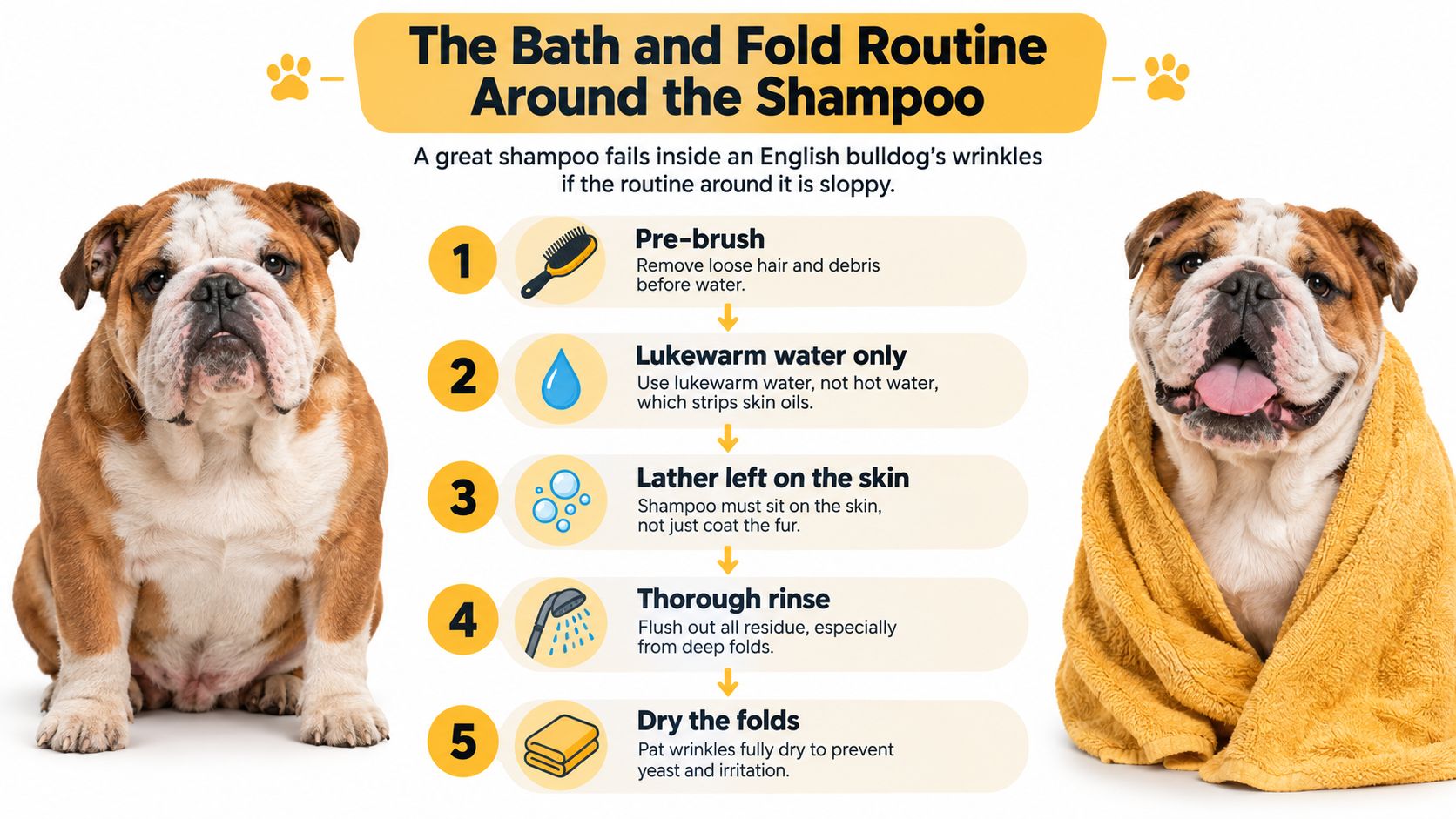
Use this sequence:
- Pre-brush and inspect. Remove loose hair and debris before adding water. Check the folds for redness, dampness, odor, or tenderness so you don't mistake an active skin problem for ordinary dirt.
- Wet with lukewarm water. Hot water can make sensitive skin less comfortable and may strip useful surface oils. Saturate the coat and folds rather than splashing only the back.
- Lather the skin, not just the coat. Work the formula into the facial folds, lip folds, armpits, tail pocket, and other affected areas. Medicated products need the contact time stated on their label. Rinsing immediately can reduce the value of the active ingredient.
- Rinse until no residue remains. Pay special attention to deep folds and the armpits. Shampoo left behind can irritate skin just as surely as a harsh formula can.
- Dry every fold. Press with a clean towel rather than rubbing aggressively. Follow with a low-heat or cool dryer setting if your dog tolerates it, keeping the airflow at a safe distance and moving constantly.
Don't leave the head until the very end if your dog becomes restless. Don't skip the tail pocket because it isn't visible from above. And don't put a damp bulldog into a crate, where limited airflow can keep the folds wet.
Between baths, use a clean cotton pad or a veterinary-appropriate wipe when needed, then dry the area. Avoid turning every wipe into a vigorous scrub. The goal is to remove moisture and debris while leaving the skin calm.
If the skin is dry rather than infected, review guidance on moisturizer for a dog's dry skin before adding a product to the folds. More products aren't automatically better, especially in creases that already retain residue.
Here's the routine in action:
Why Bathing Frequency Matters as Much as the Bottle
Over-bathing is a common attempt to control bulldog odor. It can also create the irritation that keeps the cycle going. Frequent commercial shampoo use may affect the skin's outer barrier, hydration, and pH, while insufficient cleaning allows debris and moisture to remain in folds. The calendar has to match the skin state.
For many dogs with stable skin, the evidence discussed in canine shampoo research points toward bathing every 5 to 8 days, rather than shampooing every other day. The functional bathing study found that shampooing every other day significantly changed skin hydration and pH and suggested a less frequent interval.
That interval isn't a universal prescription. It's a useful starting point for a healthy adult bulldog whose owner also cleans and dries the folds between full baths. A dog with diagnosed dermatologic disease may follow a different treatment schedule, while a dog with dry, irritated skin may need the routine simplified.
| Bulldog Skin State | Recommended Bath Interval | Supporting Logic |
|---|---|---|
| Healthy and stable | Start with a measured, less frequent routine | Limits unnecessary disruption while maintaining cleanliness |
| Mildly sensitive or dry | Increase the time between full shampoo sessions if the coat allows | Gives the skin barrier more opportunity to settle |
| Recurrent yeast or bacterial concern | Follow the treatment label or veterinary plan | Active disease may require a targeted schedule |
| Persistent odor, pain, crusting, or oozing | Seek veterinary assessment | The issue may not be solved by bathing frequency |
Don't chase odor with more fragrance. First inspect the folds, improve drying, check whether the shampoo rinses cleanly, and assess whether the interval is too aggressive. A bottle that smells pleasant can hide the fact that the skin underneath remains inflamed.
The best bathing schedule is the one that keeps the skin clean without forcing you to scrub away the consequences of the previous bath.
Building a Long-Term Skin and Coat Plan
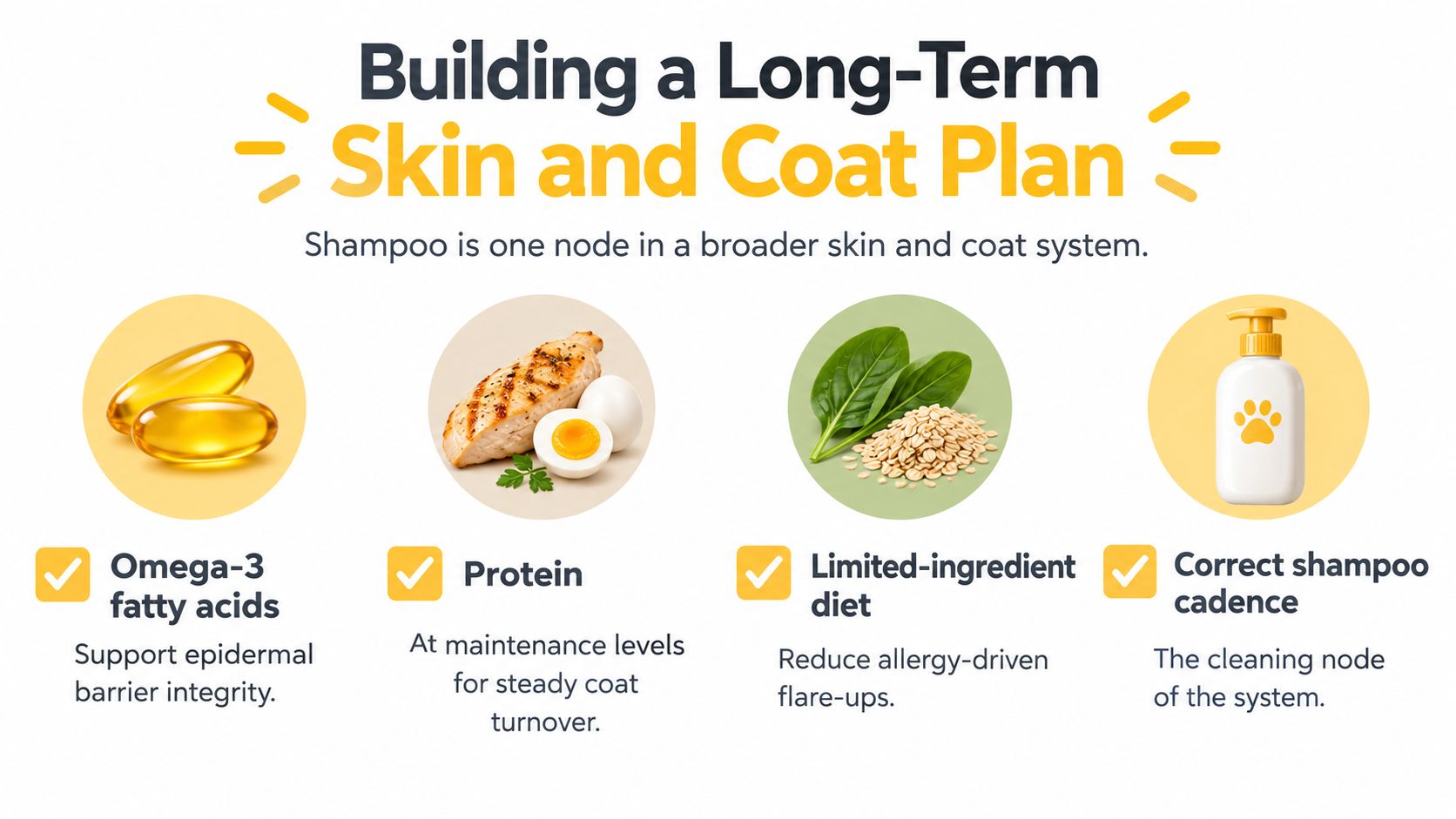
Shampoo is only one part of bulldog skin care. The strongest routine combines appropriate cleansing with nutrition, weight management, environmental awareness, and regular observation. A dog whose skin stays inflamed may need more than a different bottle.
Support the basics first
Feed a complete diet appropriate for your dog's life stage and keep treats from displacing balanced nutrition. Discuss omega-3 supplementation with your veterinarian if your dog has ongoing skin concerns, particularly if you're already using other supplements or your dog has medical conditions.
Weight also matters to wrinkle management. Excess body weight can make folds deeper and harder to ventilate, so maintaining a healthy body condition supports the same drying routine that shampoo depends on. This isn't a reason to put a dog on a restrictive diet without guidance. It's a reason to treat body condition as part of skin care.
Indoor humidity, bedding cleanliness, seasonal allergens, and outdoor exposure can all influence when a flare appears. Keep notes rather than relying on memory. If odor returns after a particular environmental change, the shampoo may be revealing a pattern rather than causing the problem.
Review the plan on a simple timeline
- At 30 days: Record redness, odor, moisture, scratching, and how the dog responds after bathing. If the signs are unchanged, reassess whether the shampoo family fits.
- At 60 days: Review food, treats, supplements, bedding, fold-cleaning habits, and drying technique. Look for non-bath triggers that could be maintaining irritation.
- At 90 days: Persistent pyoderma, hot spots, pain, crusting, or recurring lesions deserve veterinary review rather than another product rotation.
You can also use this guide to manage an itchy dog's skin, but don't use general home-care advice to postpone an examination when your bulldog has active or worsening lesions.
The most useful question isn't “Which shampoo is best forever?” It's “What does my dog's skin need right now, and can I maintain the routine correctly?” For a calm dog, choose gentle and simple. For confirmed disease, use the appropriate medicated plan. For persistent or painful symptoms, involve your veterinarian.
Pure Paw Labs offers daily dietary supplements designed to support areas such as skin and coat, joints, and gut health, which can complement but never replace appropriate shampooing or veterinary treatment. Visit Pure Paw Labs to review its dog wellness options and build the nutrition side of your bulldog's long-term care routine.