


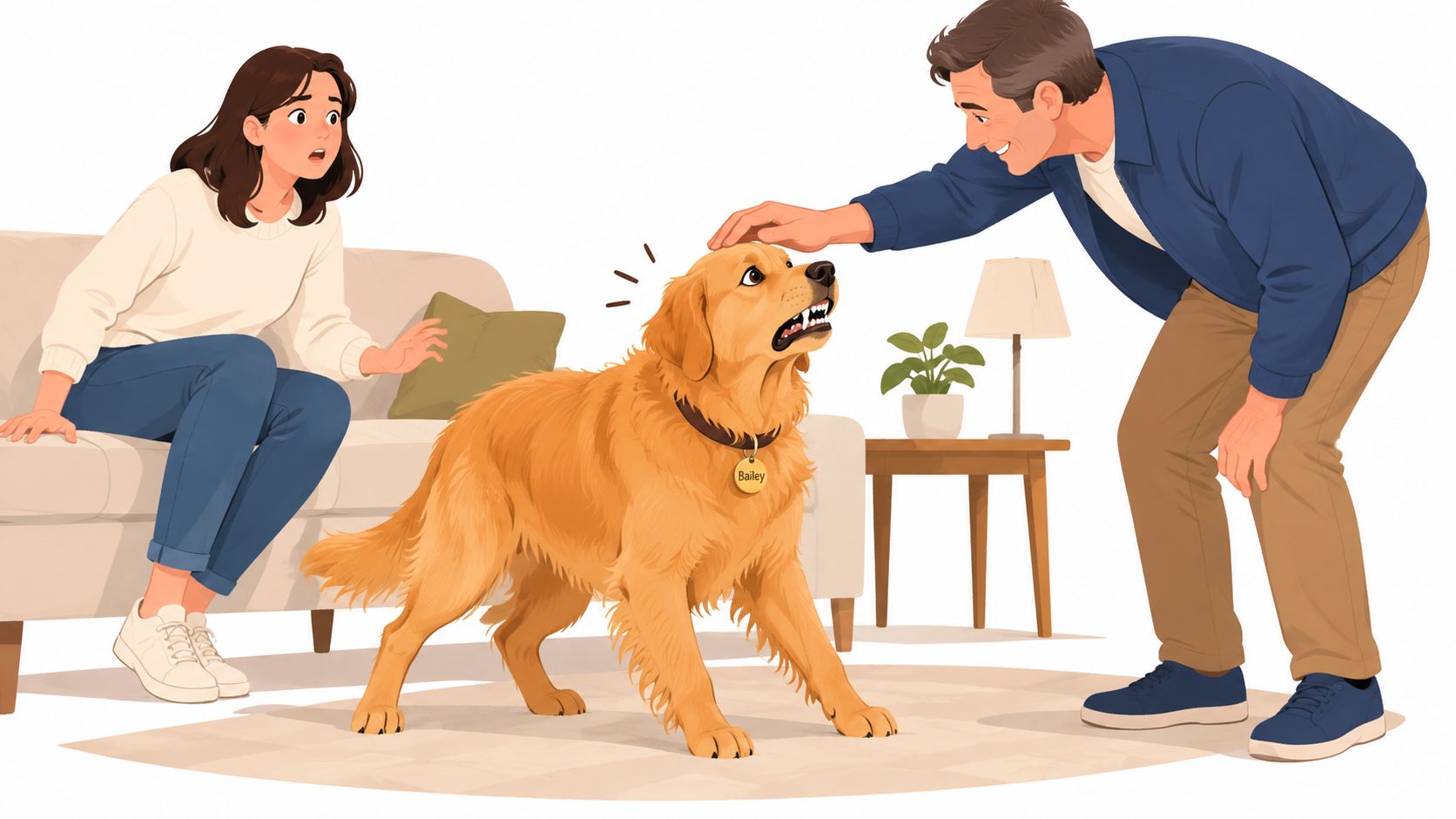
Bailey is usually the dog who greets everyone with a loose body, a sweeping tail, and a toy in his mouth. Then a visiting neighbor reaches over his head, Bailey freezes, snaps, and backs away. The room goes quiet. His family feels a quick pulse of fear, followed by confusion: how can a dog known for being gentle suddenly act dangerous?
That moment doesn't prove Bailey is a bad dog, and it doesn't overturn the Golden Retriever's generally sociable reputation. A snap is information. It tells you that the dog reached a point where discomfort, fear, pain, learned expectations, or accumulated stress outweighed his ability to cope.
Owners often search for explanations after an incident and find advice that treats aggression as a simple temperament flaw. A calmer approach starts with better questions. Was Bailey reacting to a person or another dog? What happened immediately before the snap? Was he in pain? Had he already shown quieter signs of stress? Learning to read those details gives you a safer path forward. Guidance on signs your dog doesn't like you can also help owners notice discomfort before it becomes obvious.
Table of Contents
- When a Golden Retriever Acts Out of Character
- What Aggression Really Means in This Breed
- The Triggers Behind Golden Retriever Aggression
- Reading the Early Warning Signs Owners Often Miss
- The Vet and Behavior Evaluation Sequence That Works
- Training and Management Strategies That Help
- Preventing Aggression in Puppies and Young Dogs
- When It's Time to Call in a Professional
When a Golden Retriever Acts Out of Character
A Golden Retriever can be affectionate, playful, and still have situations in which he feels unable to cope. Friendly behavior is a pattern, not a permanent promise that every interaction will feel safe to the dog.
The incident is a message
Suppose Bailey freezes when the neighbor leans over him. His freeze may be easy to miss because it lasts only a moment. His head lowers, his mouth closes, and his body becomes still. The snap follows when the person continues.
From the human perspective, the neighbor was offering a friendly greeting. From Bailey's perspective, a person moved into his space from above, possibly while he couldn't retreat. The same dog might welcome a person who turns sideways, crouches at a distance, and lets Bailey approach first.
Aggression in golden retrievers includes behavior shaped by genetic predispositions, learning history, physical condition, and stress thresholds. A dog may tolerate several small pressures, such as noise, poor sleep, unfamiliar guests, and handling, until one final interaction pushes him past his coping limit. That doesn't make the reaction harmless, but it does make it understandable enough to investigate.
A warning is not a character verdict. It's a request for distance that arrived later than you wanted.
The safest first response is to create space, separate the dog from the person or animal involved, and write down what happened while the details are fresh. Don't force another greeting to “test” Bailey, and don't punish the snap. Punishment may suppress the visible warning while leaving the fear, pain, or expectation underneath unchanged.
The rest of the evaluation depends on identifying the behavior accurately. Human-directed and dog-directed aggression are related safety concerns, but they aren't interchangeable problems, and treating them as one can send training in the wrong direction.
What Aggression Really Means in This Breed
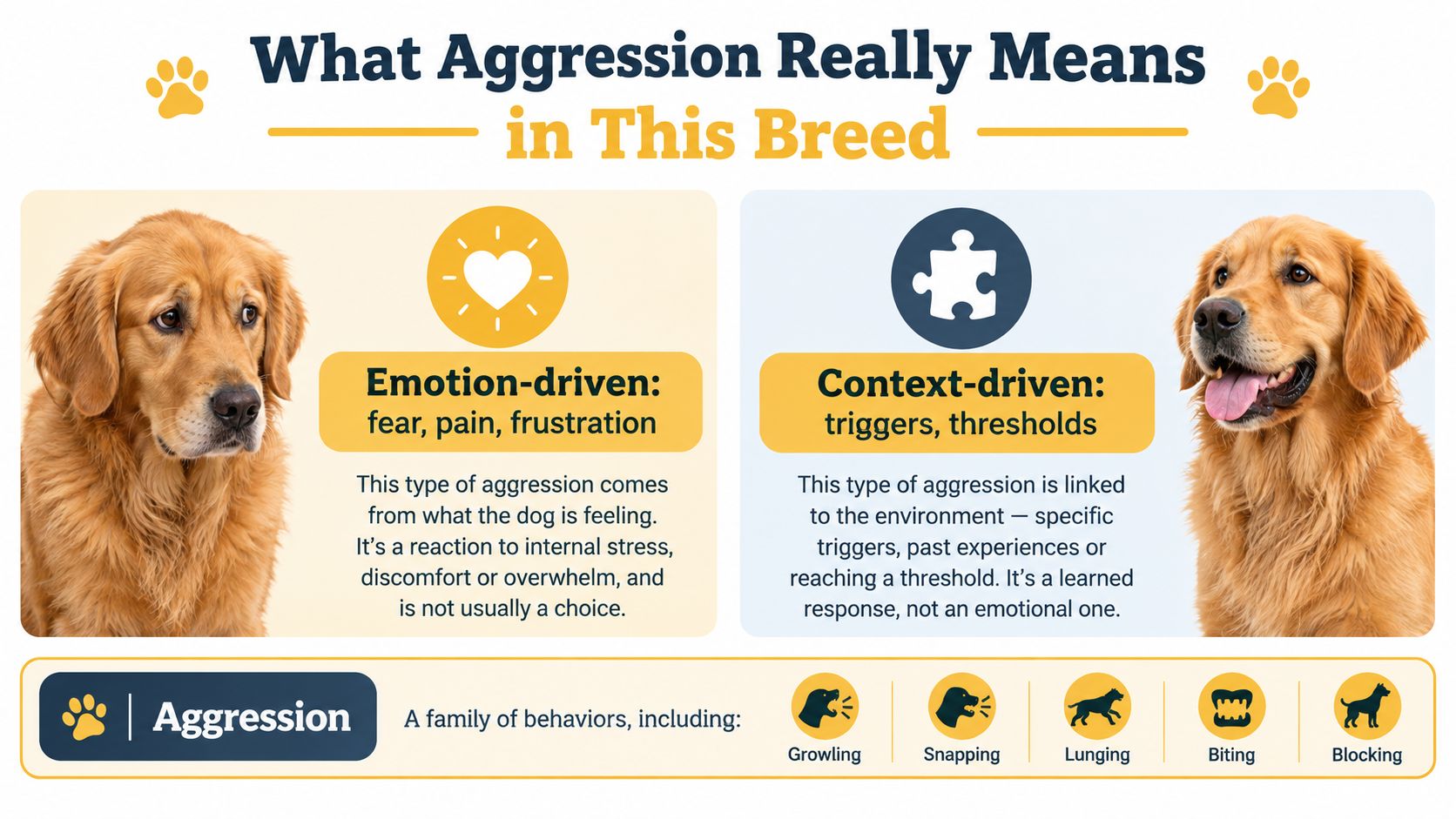
Aggression is a family of behaviors, not one personality type. Growling, blocking, stiffening, lunging, snapping, and biting can all serve the same broad purpose, creating distance or controlling access to something important. The outward behavior matters, but so does the emotion and context behind it.
The most useful first division is between two phenotypes:
- Human-directed aggression: behavior aimed at familiar people, visitors, children, or strangers.
- Dog-directed aggression: behavior aimed at unfamiliar dogs, household dogs, or a particular category of dogs.
A Golden Retriever who guards a resting place from a child has a different problem from one who lunges at dogs behind a fence. The triggers, immediate safety arrangements, and behavior plan may differ even when both dogs growl.
What inheritance can and can't tell you
Research supports a strong inherited component, but not a single aggression switch. A study of 325 Golden Retrievers estimated heritability of owner impressions of human-directed aggression at 0.77, with a standard error of 0.09, and dog-directed aggression at 0.81, with a standard error of 0.09 (Liinamo and colleagues, 2007). The low correlation between those traits suggests that a dog can carry risk for one pattern without expressing the other in the same way (the quantitative genetic study).
That evidence changes how owners should think about pedigree and breed reputation. A generally friendly breed lowers the expectation of severe aggression at the population level, but it doesn't guarantee a particular dog's response in every context. Family line, early experiences, health, and reinforcement history all still matter.
Candidate-gene research also failed to find a meaningful association between several serotonin-related loci and aggression in Golden Retrievers. A follow-up analysis of 41 single-nucleotide polymorphisms in 49 aggressive and 49 non-aggressive dogs found no association either (World Journal of Experimental Medicine review). The practical conclusion is simple: there isn't one biomarker that explains every case. Ask which phenotype you're seeing, then investigate the conditions that bring it out.
The Triggers Behind Golden Retriever Aggression
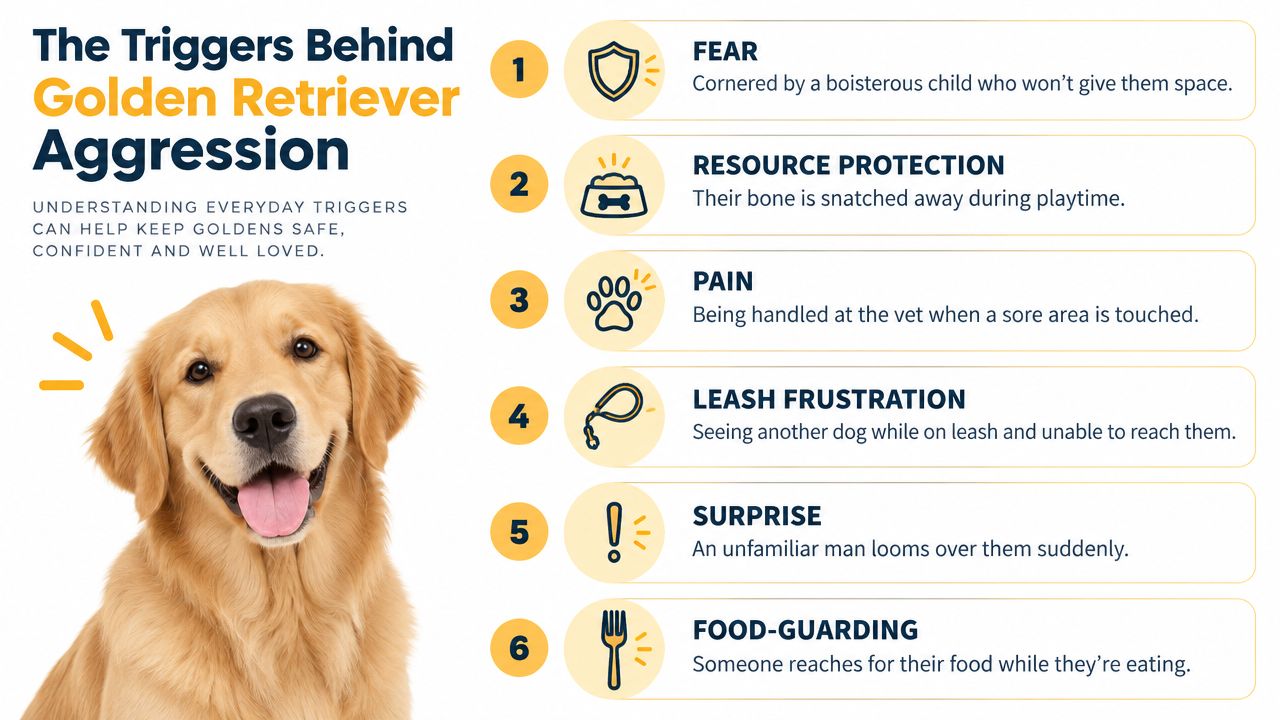
The same snap can look mysterious until you identify what the dog was trying to avoid, protect, or control. Common triggers include fear, guarding, discomfort, frustration, redirected arousal, and protection of young puppies.
Six patterns to watch
- Fear and feeling trapped. A boisterous child corners a Golden Retriever in a hallway. The dog lowers his body, turns away, and snaps when the child reaches toward him. The underlying emotion is anxiety. A dog with no escape route may use aggression to make the person stop.
- Resource guarding. A dog lifts his lip over a stolen sock, freezes beside a food bowl, or blocks someone from a chew. The resource may be food, an object, a resting place, or access to a person. Taking items by force can teach the dog that human approach predicts loss.
- Pain or physical discomfort. A normally tolerant older dog growls during grooming when someone touches a sore joint or mouth. Arthritis, dental pain, injury, and other medical problems can make handling feel threatening. A sudden behavior change deserves a veterinary assessment before a training label.
- Frustration and barriers. A Golden Retriever lunges at a dog passing the fence or strains against a leash during a greeting. The barrier prevents approach or retreat, while arousal rises. Repeated rehearsal can make the pattern faster and more intense.
- Redirected aggression. During a fight, a dog may bite the nearest hand instead of the original target. The person wasn't the source of the arousal, but the person became the available object when the dog couldn't reach the other dog.
- Maternal protection. A normally tolerant mother may warn visitors away from her puppies. Her behavior reflects heightened protective motivation and a need for a quiet, secure area, not a permanent change in her social identity.
Why older dogs need special attention
Pain-related cases can intensify when owners keep repeating the handling that hurts. If an aging dog is also showing stiffness or reduced willingness to move, DA-1™ Daily All-in-One, Senior Dog Support, Joints, Skin/Coat & More is described by its maker as a daily formula with 18 human-grade ingredients aimed at cells, gut, and joints. It should be considered only as one supportive option alongside veterinary care, not as a treatment for aggression or a substitute for finding pain.
The risk rises when a dog repeatedly practices a response without relief. Prevent the rehearsal, identify the emotional trigger, and record what happens before the behavior. Those notes will help you spot the quieter signals that often come first.
Reading the Early Warning Signs Owners Often Miss
Many owners notice the growl because it's loud. Dogs often communicate well before that point. Their earlier signals resemble a polite conversation becoming uncomfortable: the smile fades, the person stops leaning in, and the body turns toward the exit.
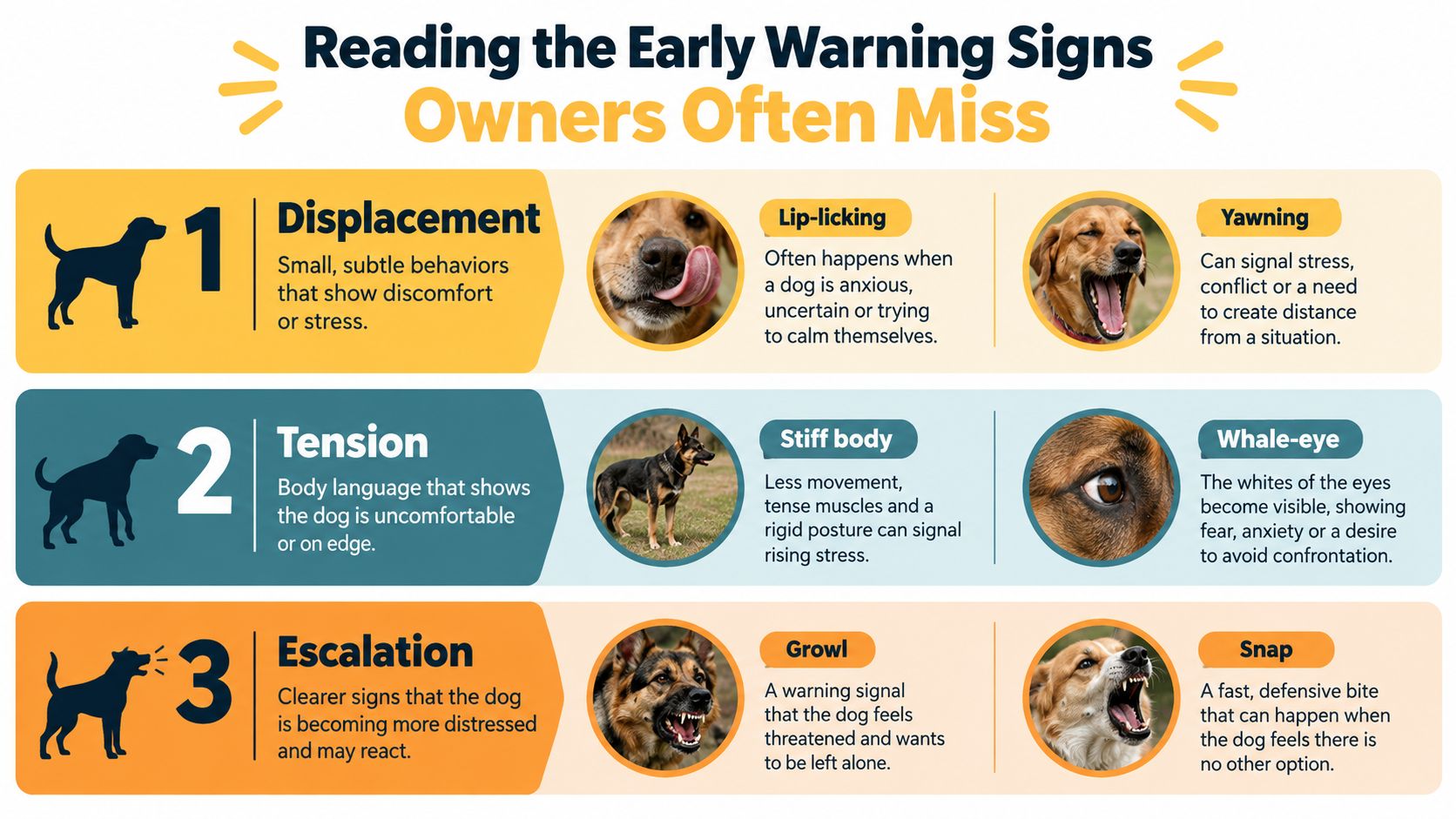
A practical three-tier checklist
Tier one, displacement behaviors, includes lip licking, yawning, shaking off, sudden sniffing, or turning away when nothing obvious needs investigation. These signals can reflect mild stress or conflict. At home, stop the handling and offer a break. Around guests, ask the person to ignore the dog rather than calling him closer.
Tier two, distance-increasing signals, includes whale eye, a stiff body, weight shifted forward, a closed mouth, and a hard stare. The dog is communicating more clearly now. Create distance, move behind a gate, or guide him to a quiet area without pulling him into another interaction.
Tier three, escalation cues, includes freezing, growling, snarling, snapping, and biting. A freeze deserves the same respect as a growl because the dog may be deciding whether his earlier signals worked. End the interaction immediately and review the setup that allowed the pressure to build.
You can also use this short visual guide to reinforce how ear position and other body-language details fit into the wider picture.
Don't silence the warning
A growl is communication, not disobedience. If an owner scolds the dog every time he growls, the dog may learn that warning is unsafe while the underlying fear remains. That can produce a dog who appears quiet until he feels forced to snap.
Read why a dog's ears may be pinned back as one part of a larger body-language picture. No single signal gives a complete diagnosis. Look at the whole body, the distance between the dog and trigger, and whether the dog can move away.
The Vet and Behavior Evaluation Sequence That Works
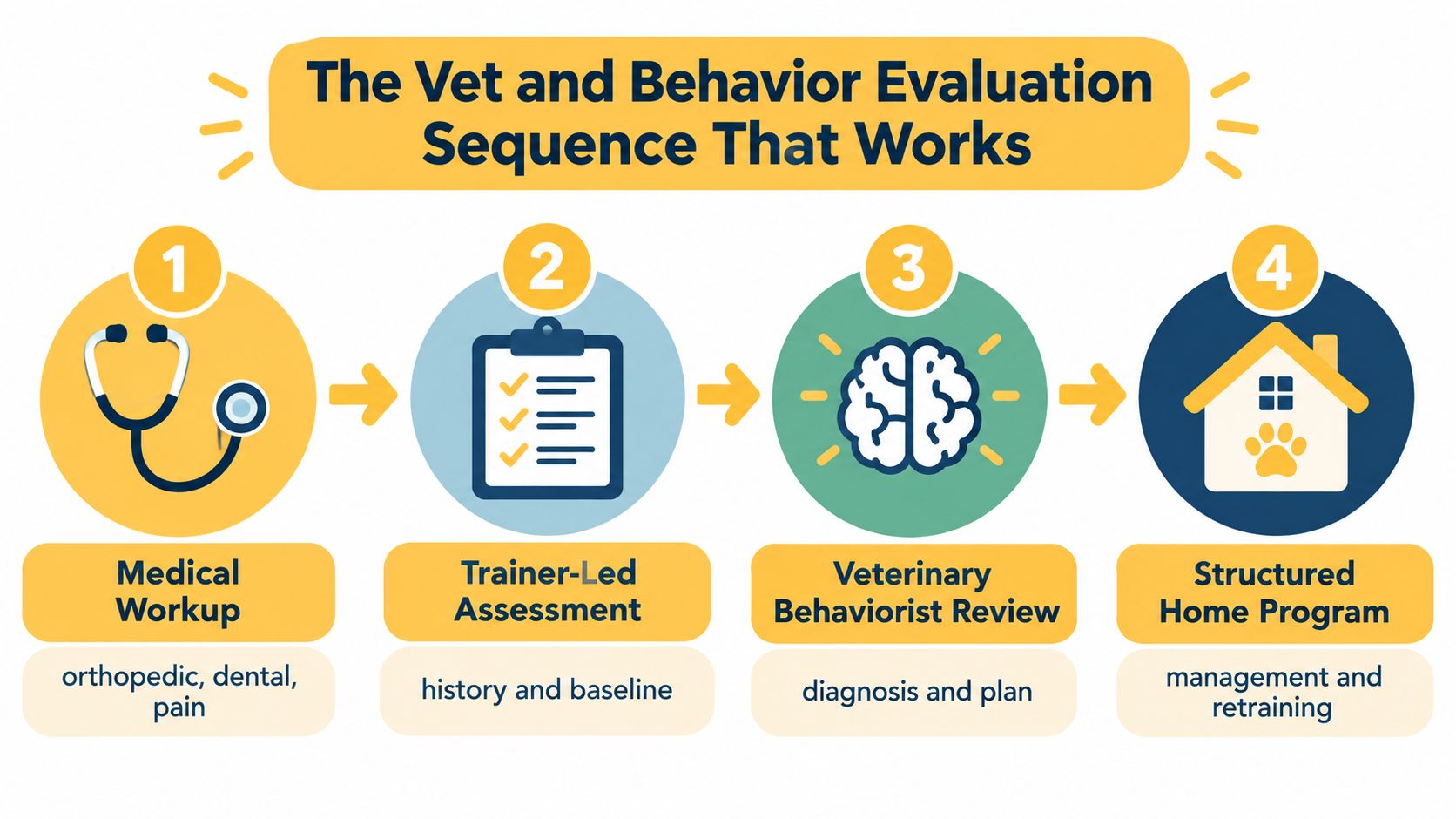
Owners often start with obedience exercises because they want an immediate behavior solution. The safer sequence begins with the body, then documents the behavior, and only then builds a targeted plan.
Step one is medical
Book a veterinary appointment, especially if the behavior is new, worsening, or connected to touch. Ask the veterinarian to consider an orthopedic examination, dental evaluation, appropriate bloodwork, thyroid testing where indicated, and neurological screening. The exact workup depends on the dog's age, history, and symptoms.
Pain can lower a dog's tolerance for handling and make an ordinary interaction feel threatening. Treating a medical cause may improve the behavior quickly, but it won't automatically erase a learned response that has been rehearsed repeatedly.
Build a useful behavior history
Bring a written incident log rather than a general statement such as “he's aggressive.” Record:
- What happened immediately before the behavior.
- Whether the target was a person or a dog.
- The distance and setting.
- The first warning signal you noticed.
- What the dog did, how intense it was, and how long recovery took.
- What helped the dog settle.
A short video can help if it can be captured safely, but don't recreate a dangerous situation for documentation.
Match the professional to the case
A qualified trainer can help with management and foundation skills. A certified applied animal behaviorist can assess learning patterns and design behavior modification. A board-certified veterinary behaviorist can evaluate behavior alongside medical causes and discuss medication when appropriate.
Severe bites, repeated incidents, aggression toward household members, or multiple overlapping triggers justify early specialist involvement. Medical issues may settle on a short timeline. Behavior change usually takes consistent work over months, with progress measured by safer choices, lower intensity, and better recovery rather than by one perfect greeting.
Training and Management Strategies That Help
Management stops another rehearsal while training changes the underlying emotional response. Both matter, but the emphasis should reflect the dog's phenotype. Human-directed aggression calls for careful control of handling, visitors, and household routines. Dog-directed aggression requires safer distances, controlled encounters, and protection from repeated confrontations. Heritable risk can influence either pattern, yet genes are not a fixed prediction. Because aggression is polygenic, several inherited tendencies may combine with learning, pain, fear, and stress.
Start with predictable surroundings. Use baby gates, closed doors, separate feeding areas, and controlled greetings. Keep the dog apart from visitors during difficult arrivals. On walks, choose routes and distances where the dog can notice another dog or person without being pulled into conflict. A front-clip harness or head halter may support physical management when introduced gradually and used with professional guidance.
A secure yard can reduce fence-line charging and repeated arousal. Owners comparing dog-proof fence solutions Ottawa may want to assess sight-line control, gate security, and whether the layout prevents rehearsals with passing dogs.
Change the association, not only the behavior
Desensitization presents a trigger at an intensity low enough for the dog to eat, move, and respond. Counterconditioning pairs that trigger with something valuable. A person might appear at a distance, food arrives, and the person leaves before tension rises.
Change one variable at a time as the dog improves. Increase distance slowly, shorten exposure, or reduce the trigger's movement. If the dog stops eating, stiffens, or scans intensely, the exercise is too difficult.
Reinforce an alternative behavior that cannot occur alongside lunging. A dog who touches your hand, turns away, or settles on a mat earns reinforcement while the trigger remains at a workable distance. Structured behavior approaches can offer a framework, but the plan must fit the dog's human-directed or dog-directed pattern, safety needs, and learning history.
Training rule: If the dog cannot think, the exercise is already too hard.
Avoid flooding, punishment for warnings, confrontational handling, and promises of rapid results. Meaningful change usually takes months of consistent work, and progress is not linear. Setbacks may reflect a difficult environment rather than failure. Stress-supportive nutrition and enrichment can help lower the overall load, but they are one part of a broader plan, as described in this guide to stress relief for dogs.
Preventing Aggression in Puppies and Young Dogs
Prevention doesn't mean creating a puppy who enjoys every person, dog, surface, and situation. It means helping the puppy learn that novelty can be approached gradually, that retreat is allowed, and that people respond to communication.
Use the early socialization period thoughtfully
A commonly discussed socialization window runs from roughly 3 to 14 weeks. During that period, introduce varied people, calm dogs, household sounds, surfaces, car travel, handling, and ordinary environments in low-stress doses. Keep exposures short enough that the puppy can remain curious rather than overwhelmed.
Choice matters. Let the puppy approach a visitor instead of passing the puppy from lap to lap. Pair a new sound with food, then lower the intensity or increase distance if the puppy licks his lips, shakes off, lowers his body, or hides.
A puppy who backs away isn't being stubborn. He's providing information about the current difficulty level.
Practice gentle handling before it matters
Touch paws briefly, offer food, and stop before the puppy pulls away. Repeat with ears, lips, collar, tail area, and grooming tools. The lesson is not “humans can hold me whenever they want.” The lesson is “handling is predictable, brief, and followed by something good.”
At meals, walk past the bowl at a comfortable distance and add food rather than taking the bowl away. Use the same approach with chews and resting spots. Children should be taught to leave a dog alone while eating, sleeping, chewing, or moving away.
Build frustration tolerance without creating frustration
Puppies need calm separation from littermates and people. Offer short periods behind a gate with a chew or food puzzle while the household remains predictable. Reinforce quiet waiting, relaxed settling, and returning attention to you.
A puppy who always receives immediate access may struggle when a leash, door, fence, or person blocks the desired outcome. The goal isn't to frustrate the puppy harshly. It's to teach that waiting and choosing another behavior can work.
Watch adolescence closely
Adolescent dogs may show hard stares, stiffening, intense barking, or sudden difficulty around dogs and strangers. Owners sometimes dismiss these signs as a phase. They deserve attention, particularly when the behavior is becoming faster, more frequent, or harder to interrupt.
Golden Retriever research gives a useful reason to avoid simplistic labels. The breed's aggression-related traits show substantial heritable variation, and human-directed and dog-directed patterns appear partly distinct (the breed genetics research). Prevention lowers environmental pressure and helps learning, but it can't guarantee a worry-free dog because inherited risk still varies between individuals.
Design the home for recovery
Give the dog a rest area away from foot traffic, children, and other pets. Use furniture, curtains, gates, or room access to reduce unwanted visual pressure from visitors and passing dogs. Let the dog opt out rather than requiring him to remain in the center of every household event.
Enrichment should fit the Golden Retriever's need to search, carry, chew, and work with people:
- Sniffing games: Scatter part of a meal in a safe area or hide food for a simple search.
- Short retrieval tasks: Use calm, structured fetch with pauses rather than endless high-arousal repetition.
- Durable chewing: Offer an appropriate chew in a protected rest space.
- Search-and-find work: Ask the dog to locate familiar objects or food containers.
- Decompression walks: Allow relaxed sniffing and recovery after stimulating outings.
Sleep, regular meals, and physical comfort belong in the same plan. Poor rest and unstable energy can make a reactive dog less able to cope, but nutrition isn't a stand-alone cure. Stress-supportive options such as L-tryptophan, alpha-casozepine, milk protein hydrolysate, or omega-3 fatty acids should be discussed with a veterinarian who can consider the individual dog's diet, health, and medications. They may support a broader plan, but they don't replace distance management, training, or medical evaluation.
Research is also examining whether protein content in commercial dry food is associated with owner-reported aggression in Golden Retrievers, as summarized in a 2025 discussion of work involving UC Davis and the Morris Animal Foundation (Scientific Reports study). That is an area of investigation, not a reason to make abrupt dietary changes or treat food as the explanation for every incident.
When It's Time to Call in a Professional
Don't wait for the second serious incident to seek help. A growl deserves attention, and actual skin contact with a person creates a clear safety threshold. So do escalating intensity, a shorter distance before the reaction begins, faster recovery problems, or new triggers that weren't previously present.
Choose a professional who can explain the plan in plain language and coordinate with your veterinarian. Appropriate credentials may include a board-certified veterinary behaviorist, a certified applied animal behaviorist, or a certified professional dog trainer who uses force-free, science-based methods.
Avoid anyone whose program centers on dominance claims, alpha rolls, shock, prong collars, choke tools, intimidation, or deliberately provoking the dog. Those methods can increase fear and may make human-directed incidents more dangerous by adding conflict to an already difficult situation.
Ask for a written management plan before training begins. It should identify trigger distances, visitor procedures, equipment, emergency steps, training goals, and how progress will be measured. A professional should also tell you what they can and can't safely address and when veterinary involvement is needed.
Golden Retriever aggression is not one fixed condition, and it isn't solved by proving that the dog is friendly. The useful work is specific: identify whether the pattern is directed toward people or dogs, rule out medical contributors, reduce rehearsal, and teach safer responses.
Pure Paw Labs offers daily dietary supplements for dogs, including an all-in-one formula designed to support areas such as joints, digestion, skin and coat, immunity, and stress as part of routine care. Visit Pure Paw Labs to review the product information and consider whether a stress-supportive nutrition layer belongs in your veterinarian-guided behavior plan.