


Your dog hears the doorbell and freezes. Or they pace at night, lick their lips after visitors leave, or seem “fine” one moment and unravel the next. That's the frustrating part of stress relief for dogs, the signs don't always look dramatic, and the cause usually isn't one thing.
What caring owners often call “anxiety” is usually a mix of behavioral, environmental, and physiological stress signals. Dogs can look restless, shut down, or even calmer on the outside while their body is still reacting underneath. A modern approach works better when it treats stress as a whole-body problem, not a single bad habit to fix.
Table of Contents
- Understanding Canine Stress and Why It Matters
- Recognizing the Signs of Stress in Dogs
- Common Causes and Triggers of Canine Anxiety
- Environmental and Behavioral Stress Relief Strategies
- Supplements and Nutritional Support for Stress Relief
- When to Consult a Veterinarian or Behaviorist
- Building Your Dog's Personalized Stress Relief Plan
Understanding Canine Stress and Why It Matters
A dog can seem fine after a trigger passes, then carry that tension into the next walk, meal, or bedtime. That lingering pattern is what wears on families, because it affects sleep, appetite, responsiveness, and how safe the dog feels in everyday life.
Stress relief works best when you look at the full picture. A kennel study from 2015 found that 7 days of classical music exposure changed several heart-rate variability markers in directions consistent with reduced stress, including μRR, RMSSD, pNN50, SD1, and SD2 (PubMed). Mean heart rate and LF/HF also dropped from the first silent day to the first music day, while salivary cortisol did not follow one clear pattern. That is a useful reminder that no single signal tells the whole story.

Why chronic stress deserves attention
Chronic stress is different from a bad afternoon. Over time, it can shape how a dog responds to new places, handling, noise, and separation. One dog may recover quickly after a storm, while another carries that tension forward into the next routine.
Families often normalize the signs. Pacing, barking, clinginess, or shutting down can start to feel like personality instead of a message from the body. Sometimes it is temperament. Sometimes it is a dog saying the environment no longer feels predictable.
Practical rule: If the same stress pattern keeps appearing in the same situations, treat it as a training and management problem, not a wait-and-see issue.
A calmer dog usually starts with more than one change. Routine, space, handling, and physical comfort all matter, and they work together like parts of a bridge, if one part is weak, the whole structure feels it. A broader overview of canine wellness is available in Pure Paw Labs' comprehensive dog health guide.
Recognizing the Signs of Stress in Dogs
Stress rarely shows up as one neat symptom. Some dogs get loud, some get clingy, and some withdraw. That's why owners often miss the early picture, especially when the dog still eats, still walks, and still seems “normal” between episodes.
A controlled 2022 study of dogs during kennelling and a physical exam found that salivary cortisol, IgA, and infrared temperature all increased significantly from baseline to post-kennel and post-exam timepoints, confirming that ordinary veterinary handling can trigger measurable stress responses (PMC). The same study found that music didn't reduce cortisol, but music-exposed dogs had lower core body temperature and lower odds of showing relaxed lips. That's a useful reminder that behavior and body signals don't always move together.
The body language most owners miss
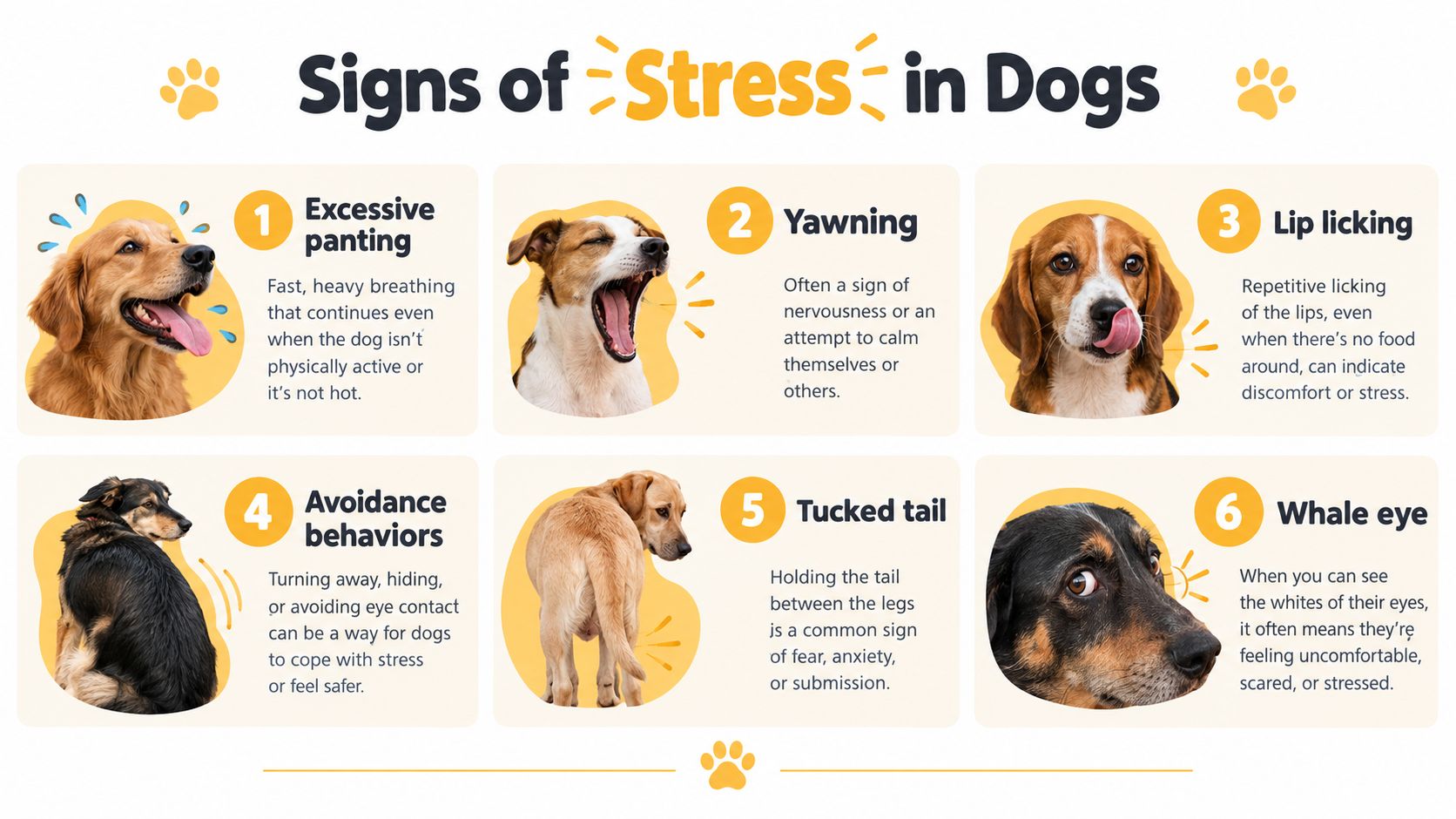
Look for excessive panting when the dog hasn't been exercising, repeated yawning in a tense context, lip licking when food isn't present, and avoidance behaviors like turning away, moving behind furniture, or refusing eye contact. Tucked tails and the classic whale eye, where you can see the whites of the eyes, are also common stress cues.
Some dogs don't look “anxious” at all. They get busy. They may bounce, bark, mouth at hands, or move constantly because their body is trying to discharge tension. That's why hyperactivity can be a stress signal, not just excess energy.
When stress looks like a medical problem
Stress can mimic illness, and illness can mimic stress. Appetite changes, digestive upset, and sleep disruption can happen with worry, pain, or a medical condition. If your dog's behavior changes suddenly, seems severe, or comes with vomiting, diarrhea, coughing, limping, or obvious discomfort, a veterinary exam should come first.
Dogs often tell the truth with patterns, not single moments. One yawn doesn't mean anxiety. Five yawns during a grooming session, paired with lip licking and retreating, tells a different story.
If your dog's ears also seem pinned back when they're tense, the body language breakdown in this guide on pinned-back ears can help you read the whole picture more clearly. The goal is to notice the combination, not one isolated behavior.
Common Causes and Triggers of Canine Anxiety
Stress in dogs usually makes more sense when you sort triggers into groups. Environmental triggers hit the senses. Social triggers involve strangers, animals, or handling. Routine triggers happen when the world stops feeling predictable. A dog can be fine with one of these and overwhelmed by another.
The 2022 kennel-and-exam study showed that routine veterinary handling can activate measurable stress pathways, which fits what many owners see at home, too, ordinary events can be hard when they happen in unfamiliar settings (PMC). That's why the trigger itself matters as much as the dog's reaction.
Different dogs, different trigger maps
A noise-sensitive dog may panic at thunder, fireworks, or construction. Another dog might only struggle when left alone. A third dog may be steady in both cases, then unravel when a new baby arrives or a family schedule changes. The same symptom can come from very different causes.
Past experience matters. Dogs learn quickly what predicts discomfort, pressure, or uncertainty. If a dog has been startled repeatedly by a specific event, they may begin reacting before that event even fully arrives. That anticipatory stress is why some dogs seem to “know” a trigger is coming.
Why small stressors add up
A single minor stressor might not matter much. Several minor stressors in one day can create a bigger load. For example, a late meal, a rushed walk, a busy visitor window, and a loud evening can stack up, even if each one looks manageable on its own.
Key takeaway: The trigger profile is personal. One dog needs more predictability. Another needs more distance from the trigger. Another needs both, plus training that changes the emotional response.
When families understand that stress has layers, they stop reaching for one-size-fits-all answers. That's where real progress begins, because the right fix for a separation issue isn't the same as the right fix for noise fear or handling discomfort.
Environmental and Behavioral Stress Relief Strategies
The best stress relief usually starts with changing the dog's day, not just reacting to the dog's emotions. If the environment keeps saying “unpredictable,” the nervous system stays on alert. If the environment says “safe and repeatable,” the dog has room to settle.
A useful place to begin is with one quiet space that belongs to the dog. It doesn't need to be fancy. It needs to be consistent, low-traffic, and paired with calm experiences rather than being used only when things are already going wrong.
Build the room before you build the behavior
Start with predictable feeding, walks, and rest periods. Then add enrichment that keeps the brain occupied without flooding the dog. Food puzzles, sniff-based games, and short training sessions often work better than random bursts of activity because they give the dog a job without adding chaos.
Music can be one part of the setup. The earlier kennel study is a good reminder that sound exposure can shift stress physiology in useful ways, but the effect should be treated as one tool, not the whole answer (PubMed). For some dogs, it helps lower the background noise level of the home.
Calm doesn't happen by accident. It usually comes from repeated, boring, predictable routines that tell the dog what happens next.
Use training that changes the feeling, not just the behavior
Desensitization and counterconditioning are the two most useful behavioral tools for specific fears. The dog is exposed to a very small version of the trigger, then something good happens before panic starts. The goal is not to “flood” the dog until they give up. It's to change the prediction attached to the trigger.
Avoid accidentally rewarding panic with overexcitement. Some dogs do better with quiet, matter-of-fact support. Others need more space and less talking. Read the dog, then adjust.
The embedded video below can help owners visualize how calming routines fit together in real life.
Supplements and Nutritional Support for Stress Relief
Supplements fit best when stress is mild, situational, or one part of a wider plan. They fit poorly when a dog is panicking, in pain, or getting worse quickly. That is the line owners often miss.
A recent controlled study reported that a CBD + L-tryptophan + alpha-casozepine treat produced only a mild stress-reducing effect during car travel (Frontiers). The same study showed that CBD-only arms did not show the same benefit. Ingredient choice matters, and the setting matters too.
| Ingredient | Best For | Evidence Level | Time to Effect |
|---|---|---|---|
| L-tryptophan | Situational support in some dogs | Limited, mixed | Not well established |
| CBD | Some situational stress profiles | Mixed, product-dependent | Not well established |
| Alpha-casozepine | Short-term calming support in some dogs | Limited | Not well established |
| Probiotics and microbiome-focused ingredients | Dogs where gut support is part of the plan | Emerging | Not well established |
| Broad “calming blends” | Hard to predict | Variable | Variable |
The table stays cautious on purpose. Canine evidence is concentrated in a few ingredients, not in broad promises, and no supplement is approved to treat anxiety. If you want help sorting through labels, this guide to dog anxiety supplements is a useful next read.
Nutrition-based support is also drawing attention through the gut-brain axis. A 2025 kennel-dog study reported that resveratrol improved stress-related behaviors and increased serotonin, BDNF, IgA, antioxidant capacity, and gut-microbiome markers tied to tryptophan metabolism (PubMed). That does not mean every anxious dog needs the same ingredient. It means stress support may need to address the body as well as the behavior.
For dogs already on a layered routine, one daily formula can be easier to keep up with than several separate products. DA-1™ Daily All-in-One - Senior Dog Support, Joints, Skin/Coat & More is described as a once-daily powdered supplement that combines multiple wellness supports into one routine. It is presented as a multi-system powder with no fillers and a 60-day money-back guarantee. That kind of structure may suit owners who want one routine instead of several, but it still works best with training and environmental support.
When to Consult a Veterinarian or Behaviorist
Some stress patterns need more than home management. If the change is sudden, intense, or tied to aggression, self-injury, or refusal to eat, it's time for professional input. That's not overreacting. It's good triage.
A 2023 diffusion MRI study found that anxious dogs had a sparse, low-efficiency structural connectome, which points to stress being more than a “bad habit” in some dogs (Nature). The same source also notes that there are still no universally accepted quantitative stress indicators or standardized cortisol reference ranges for routine use. That's why serious cases deserve individualized assessment, not guesswork.
Who to see and what to bring
A veterinarian can rule out pain and medical causes. A veterinary behaviorist can build a treatment plan for more complex fear, anxiety, or aggression patterns. A trainer can help with skills and behavior modification, ideally working from a veterinary plan when the issue is more than basic training.
Bring a short log with the trigger, the setting, what the dog did, how long it lasted, and what helped or made it worse. Video can be useful if the behavior happens at home and the dog changes when they enter the clinic. The point is to show patterns, not just labels.
Practical rule: If you're seeing aggression, self-harm, or a dog who can't eat, sleep, or settle, don't keep trying random calming tricks. Get an exam and a plan.
Medication may be appropriate in some cases, especially when a dog is too distressed to learn. That doesn't mean the plan is “just drugs.” It means the dog may need enough relief to make training and environmental work possible.
Building Your Dog's Personalized Stress Relief Plan
A good plan starts with one simple question, what's the main stress pattern in this dog? From there, pick one change in the environment, one behavior strategy, and one physiological support if needed. Don't change everything at once, because then you won't know what helped.
Use a short daily check-in with three notes, the trigger, the response, and recovery time. If the dog recovers faster, the plan is moving in the right direction. If the dog escalates sooner or recovers more slowly, the plan needs adjustment.
A practical order to follow
- Stabilize the day. Keep meals, walks, and sleep cues consistent.
- Remove obvious stressors. Reduce exposure to known triggers when possible.
- Add skill-building. Use calm training, enrichment, and controlled exposure.
- Layer support carefully. Consider nutrition or supplement support only if it fits the dog's pattern and your vet agrees.
A routine like that is more effective than chasing every new calming trend. It respects the fact that stress in dogs is multi-dimensional, so the solution has to be too.
The goal isn't a perfectly unflappable dog. It's a dog that can recover faster, cope better, and feel safer more often. That's a realistic target, and for many families, it changes the whole mood of the home.
If you want a simpler, science-minded way to support your dog's daily wellness, explore Pure Paw Labs for human-grade canine nutrition designed to fit real routines. Their all-in-one approach can pair well with the environmental and behavioral steps in this guide, especially for owners who want less juggling and more consistency.