


Is a daily supplement helping your dog, or are you paying for a longer ingredient list? That question matters because a multivitamin with probiotics for dogs can combine useful nutritional support with a fragile live ingredient, and the label's promise doesn't always reveal whether both parts remain effective.
A thoughtful decision starts with three separate questions. Does your dog have a genuine nutritional or digestive need? Does the product provide clear, dog-appropriate amounts? And can the probiotic organisms survive manufacturing, storage, and the time the container sits in your kitchen? The answers matter more than the words “complete wellness” on the front of a tub.
Table of Contents
- Why Dog Owners Are Combining Probiotics and Multivitamins
- What Probiotics Actually Are and How They Work
- Real Benefits for Dogs From Joints to Skin to Immunity
- The Honest Case Against Routine Use in Healthy Dogs
- Reading the Label Like a Quality Inspector
- All-In-One Powder Versus a Stack of Separate Supplements
- Choosing the Right Product for Your Specific Dog
Why Dog Owners Are Combining Probiotics and Multivitamins
Maya's senior terrier takes a joint chew with breakfast. A fish oil capsule follows, hidden in a small piece of food. There's also a multivitamin, a separate probiotic packet for sensitive digestion, and a reminder on her phone for the days when the dog stays at a boarding facility. None of these products seems unreasonable by itself. Together, they create a daily routine that's easy to interrupt and surprisingly difficult to manage.
That's the practical appeal of a combined formula. One scoop can reduce the number of products on the counter, simplify travel, and make it easier for an owner to remember a consistent routine. A picky dog may accept one flavored powder more readily than several chews or capsules, while a household with multiple caregivers has fewer opportunities to miss a dose.
Why the category has grown
The commercial logic is also clear. Probiotics have moved well beyond a niche ingredient. One market report values the global probiotics market at about USD 73.13 billion in 2025 and projects USD 134.50 billion by 2034, with a 7.15% CAGR across that period. Another report estimates USD 113.97 billion in 2025 and forecasts USD 301.17 billion by 2033, using a 12.8% CAGR from 2026 to 2033. These estimates cover broad applications, including supplements, functional foods, and animal health, but they show why brands increasingly position probiotics inside broader wellness formulas.
A combined product can therefore make sense as a routine-management tool. It doesn't automatically make sense as a treatment, a disease-prevention strategy, or a substitute for a complete diet.
Practical rule: Convenience is valuable, but it shouldn't hide trade-offs in dose, stability, ingredient transparency, or the ability to identify what helped your dog.
The central decision is simple to state, even if the answer varies by dog: does consolidation improve adherence without weakening the support your dog needs? An all-in-one product may be sensible for one healthy adult. A dog with recurrent diarrhea, a diagnosed deficiency, food sensitivities, or medication needs may require a more targeted plan.
What Probiotics Actually Are and How They Work
A probiotic is a live microorganism that can provide a health benefit when given in an adequate amount. That definition has two important conditions. The organism must remain alive in a meaningful quantity, and the specific organism must have a plausible benefit for the host receiving it. A vague “probiotic blend” doesn't tell you enough to judge either point.
Think of the gut microbiome as a busy garden. Probiotics are added seeds, but adding seeds doesn't guarantee that they'll grow or behave the same way in every garden. Prebiotics are the food or compost that can nourish selected microbes. Postbiotics are useful products of microbial activity, such as compounds produced when bacteria process available nutrients.

The label terms that change the meaning
CFU, or colony-forming units, refers to the estimated number of viable organisms capable of forming colonies under testing conditions. A larger CFU number isn't automatically better. The useful question is whether the product provides an appropriate amount of a documented strain, and whether that amount is guaranteed through expiration.
Strain identity matters because organisms within the same species can act differently. Lactobacillus rhamnosus GG and Bifidobacterium animalis AHC7 aren't interchangeable because both belong to familiar probiotic groups. A label that lists only a genus, or only the word “probiotics,” gives you little information about which research may apply.
Probiotics also don't necessarily permanently colonize the digestive tract. Their effects may involve temporary interaction with the existing microbial community, the intestinal environment, digestion, or immune signaling. That's why a product that helped one dog may produce no obvious change in another.
The scientific and commercial history of probiotics helps explain their popularity. Industry analysis describes an evolution since the late 1980s from limited validation toward strain-specific identification, stronger regulatory frameworks, and broader professional acceptance. A separate market estimate places the global probiotics market at USD 76.59 billion in 2025, with a projection of USD 114.95 billion by 2030 at an 8.5% CAGR.
For a dog owner, the practical lesson is straightforward. Read the organism's full name, look for the strain designation, and treat “blend” language as a reason to ask more questions. A plain-language overview of canine probiotic use is available in this guide to a probiotic supplement for dogs.
A short visual explanation can also help clarify the difference between live microbes, their food, and their byproducts:
Real Benefits for Dogs From Joints to Skin to Immunity
Combined products often group several goals under one lid, but the evidence doesn't have equal strength across those goals. A dog may receive a reasonable digestive aid while gaining little from an included vitamin blend, or benefit from a joint ingredient that has no connection to the probiotic component. Evaluate each body system separately rather than accepting “whole-body support” as one proof of effectiveness.
Gut support
Digestive support is the most obvious reason owners consider probiotics. A carefully selected strain may be more plausible during a temporary disruption, such as stress-related loose stool or recovery from an acute digestive episode, than as a guaranteed daily improvement in an otherwise normal dog. The outcome to watch is practical, including stool consistency, urgency, gas, appetite, and comfort.
That doesn't mean every loose stool needs a supplement. Vomiting, blood in stool, dehydration, persistent diarrhea, weight loss, or marked lethargy calls for veterinary assessment rather than a trial of an over-the-counter powder.
Skin and coat
A multivitamin may contain nutrients associated with normal skin-barrier function and coat maintenance. Omega fatty acids are often included for coat appearance and inflammatory support, while gut-focused ingredients are marketed around broader immune and digestive connections.
The cautious interpretation is important. A shinier coat may reflect improved diet quality, fewer irritants, better grooming, or time, not necessarily a probiotic effect. Persistent itching, ear problems, hair loss, or recurrent skin infections deserve a diagnostic workup because supplements can't identify the underlying allergy or infection.
Joints
Ingredients such as glucosamine, chondroitin, and MSM are commonly used in mobility formulas. Their inclusion may be reasonable for a dog showing stiffness or reduced activity, but a combined product may not provide the same flexibility as a targeted joint supplement. The owner may need a specific dose, a gradual response assessment, or a veterinary plan that includes weight management and exercise modification.
A vitamin blend also isn't a replacement for pain evaluation. Difficulty rising, reluctance to use stairs, sudden lameness, or a change in gait should be treated as clinical signs.
Immune support
Vitamins and minerals contribute to normal physiological functions, and the gut microbiota interacts with immune activity. A 2024 review describes a two-way relationship in which micronutrients can affect microbiota composition and function, while microbiota can influence the bioavailability of nutrients including B12, folate, calcium, zinc, and iron. The review supports careful formulation, not an assumption that mixing live microbes and micronutrients automatically creates synergy. (review of micronutrient and microbiota interactions)
| Benefit area | Active ingredients typically included | Strength of canine evidence |
|---|---|---|
| Digestive support | Named probiotic strains, prebiotic fibers | More plausible for selected digestive disruptions, but strain and context matter |
| Skin and coat | Omega fatty acids, vitamins, minerals | Some ingredients have a reasonable nutritional role, while broad probiotic claims remain less certain |
| Joint support | Glucosamine, chondroitin, MSM, supportive nutrients | Ingredient-specific and dog-specific, not proof that the complete combination works |
| Immune support | Vitamins A, C, and E, zinc, probiotics | Nutritionally relevant, but “immune boosting” is too broad to treat as a clinical outcome |
The Honest Case Against Routine Use in Healthy Dogs
A healthy dog eating a complete, balanced diet may not need a daily multivitamin. Adding more nutrients can sound protective, but nutrition works through balance, not through the length of a supplement label. The same caution applies to probiotics. A product can be safe and still provide little observable value for a dog with normal stool, appetite, energy, coat, and body condition.
The most useful evidence often relates to a specific situation, a defined strain, or a measurable problem. That doesn't justify turning a targeted finding into a universal recommendation for every healthy adult dog. Recent evidence reviews state that probiotic effects on canine clinical outcomes are mixed, identify only a limited and possibly clinically unimportant effect for gastrointestinal disease, and conclude that routine probiotic use in healthy dogs remains unproven and isn't an established preventive strategy. (evidence review on probiotics for canine gastrointestinal maintenance)
Why individual responses vary
A probiotic enters an existing ecosystem. Diet, prior illness, stress, medication exposure, age, and the dog's resident microbiome can all influence what happens next. Two dogs can receive the same powder and show different stool changes, or no change at all.
A combined supplement can also make interpretation harder. If stool improves, you may not know whether the probiotic, a fiber ingredient, a diet change, or natural recovery made the difference. If diarrhea worsens, several ingredients may need to be paused at once.
Skepticism isn't anti-supplement. It's a way to separate a documented need from a reassuring marketing story.
Routine use becomes more difficult to justify when the product hides doses, offers no strain information, or makes disease-prevention promises. Owners should track observable signals instead of assuming that a dog is healthier because a scoop was added. A veterinarian can also check whether a symptom reflects parasites, dietary intolerance, dental disease, pain, endocrine illness, or another problem that a supplement would only mask.
Reading the Label Like a Quality Inspector
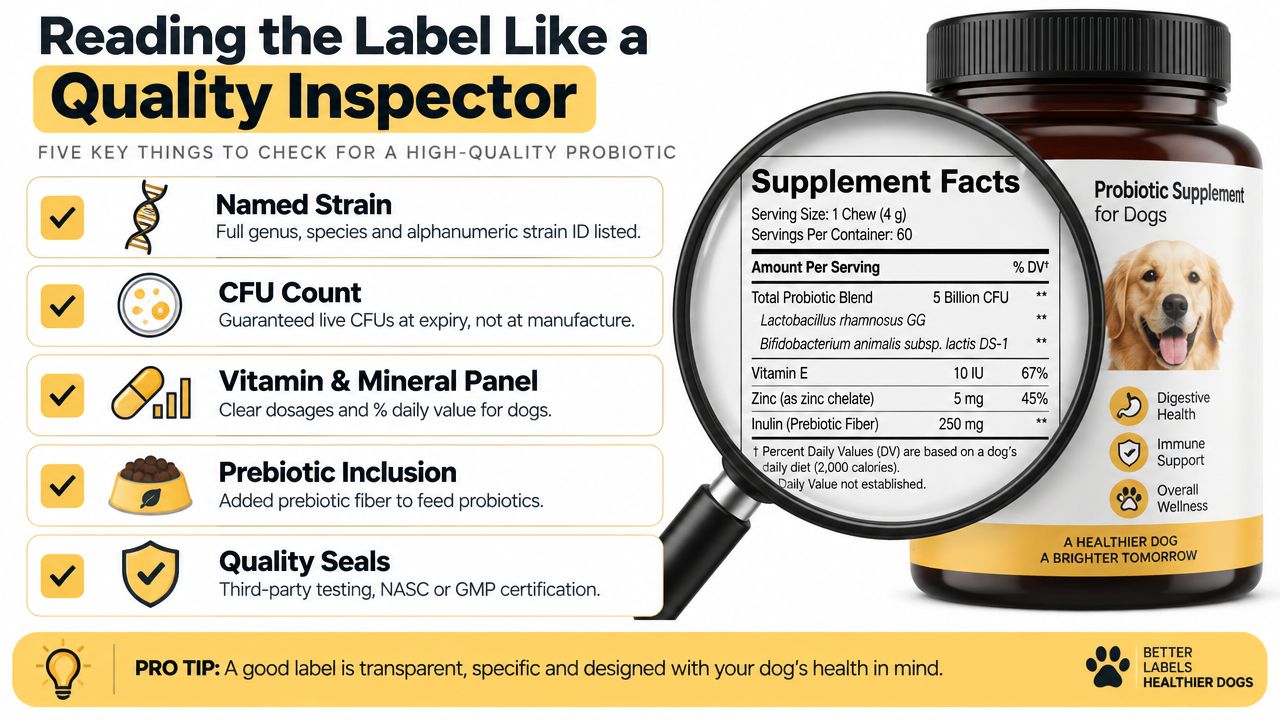
The front panel sells the concept. The supplement facts panel tells you whether the concept is testable. Start with the probiotic line, because live organisms create a shelf-life problem that ordinary vitamins don't share.
Look for the genus, species, and strain designation, not just “multiple probiotics.” Then find the CFU guarantee and determine whether it applies at expiration or only at manufacture. A manufacturing-time count can look impressive while saying little about what remains when the owner opens the container months later.
Five label checks that matter
- Named strain: A complete identity, such as a genus, species, and alphanumeric strain code, lets you distinguish one organism from another and assess whether the manufacturer is being specific.
- Viability at expiry: The label should state a live CFU amount through the product's expiration date. Storage directions should be realistic for the household using the product.
- Transparent nutrient doses: Each vitamin and mineral should have a stated amount. A proprietary blend that groups ingredients together prevents you from knowing whether a particular nutrient is present at a meaningful level or merely included for label appeal.
- Manufacturing and testing information: Look for clear statements about production standards, batch identification, country of origin, and independent testing. A quality seal can add assurance, but it shouldn't replace reading the actual ingredient panel.
- Expiration and lot details: An expiration date and lot number give the owner and manufacturer a way to identify a product batch and investigate a quality concern.
Stability is a formulation test
A 2022 stability study found that a multi-strain probiotic product retained 76.9% live-cell survival at 5°C and 61.5% at 25°C after 12 months. Storage at 40°C caused a sharp decline, with detrimental effects evident by 3 months. The study also notes that probiotic products conventionally target at least 1×10^9 live cells at the end of shelf life as a minimum effective dose. (probiotic stability and shelf-life study)
Those findings explain why moisture barriers, packaging, temperature control, and overage design matter. A mineral-dense powder can create a challenging environment for live organisms, so a “multivitamin with probiotics” needs compatibility testing rather than a simple ingredient pile.
Be cautious with artificial flavors, unnecessary fillers, and labels that use “human-grade” without explaining sourcing or manufacturing. These details don't prove efficacy, but missing details make the product difficult to evaluate. A practical walkthrough of ingredient panels and dosage information appears in this guide to reading supplement labels.
All-In-One Powder Versus a Stack of Separate Supplements
An all-in-one powder solves a real problem: owners forget routines. One measured serving can be easier to give than separate products, especially when a dog resists pills or eats inconsistently outside the home. Consolidation may also reduce duplicate ingredients and make subscription or travel planning simpler.
The compromise is precision. A fixed formula gives every dog the same ingredient relationship, even though a young dog, a large senior dog, and a dog with a sensitive stomach may need different priorities. The probiotic amount may be lower than a targeted standalone product, while the vitamin blend may include nutrients your dog already receives adequately from food.
What a combined formula does well
- Routine simplicity: One product creates fewer feeding decisions and fewer opportunities to miss a serving.
- Lower management burden: Owners can track one expiration date, one storage instruction, and one response pattern.
- Broad maintenance coverage: A formula may provide general nutritional support across digestion, coat, mobility, and immune function.
- Easier acceptance: Powder mixed into food can work for dogs that reject capsules or multiple chews.
The potential weakness is that the same convenience can conceal formulation compromises. Probiotics are sensitive to moisture and temperature, while minerals and other ingredients can affect the environment inside a powder. The viability data discussed above make the manufacturing and storage plan more important than the number of organisms printed on the front.
What separate products make possible
A stack allows targeted dosing. You can pause the probiotic while continuing a joint ingredient, change one component after a response, or select a formula designed around a clearly identified need. That control helps when a veterinarian has identified a deficiency, digestive condition, mobility issue, or ingredient sensitivity.
The cost is effort. More containers increase the chance of duplicate nutrients, inconsistent dosing, and accidental interactions with medications or prescription diets. Owners also pay for several products and must judge each label independently.
| Decision lens | All-in-one powder | Separate supplements |
|---|---|---|
| Convenience | Strongest advantage | Requires more daily organization |
| Dose control | Fixed combination | Easier to tailor |
| Troubleshooting | Harder to identify the active component | Easier to change one item |
| Formulation risk | Must verify compatibility and probiotic stability | Each product can be assessed independently |
| Best fit | Routine simplicity when needs are broad | Specific deficiencies, sensitivities, or clinical goals |
A broader explanation of the convenience and limitations of consolidated formulas is available in this guide to all-in-one supplements. Neither format wins automatically. The better choice is the one that preserves appropriate dosing and that the owner can administer consistently.
Choosing the Right Product for Your Specific Dog
Start with the dog, not the product category. A puppy, adult, and senior dog don't share identical nutritional priorities, and breed size can affect serving practicality and joint demands. Diet matters too. A dog eating kibble, a complete fresh diet, a home-prepared recipe, or a mixed feeding plan may have very different gaps.
Medication and health history belong on the same checklist. A dog with recurring diarrhea needs a different conversation from a dog whose only issue is a dull coat, and a dog receiving medication shouldn't begin a multi-ingredient supplement without veterinary review.
A four-step selection process
First, define the goal. Write down the problem you want to address, such as inconsistent stool, stiffness after rest, or a diagnosed nutrient gap. If you can't describe the desired change in observable terms, the product may be answering a marketing question rather than your dog's need.
Second, match the formula to the dog. Confirm that the product is made for dogs, provides species-appropriate directions, and identifies its probiotic strains. Check serving instructions for your dog's size instead of assuming that a “small scoop” is automatically suitable for every animal.
Third, audit the formula. Compare the active ingredients with your dog's existing food and current supplements. Look for clear amounts, expiration-date CFU guarantees, storage directions, lot information, and meaningful manufacturing or third-party testing details. A shorter, transparent panel can be more useful than a long blend with hidden quantities.
Fourth, run a controlled trial. Introduce one new product at a time and keep the rest of the routine stable. Track stool quality, appetite, energy, coat appearance, scratching, and mobility in a simple log, so you can tell whether the change is meaningful rather than relying on memory.
A four-to-six-week observation window is often used by owners to judge whether a routine change is worth continuing, but the right duration depends on the product, the goal, and veterinary advice. Stop and seek guidance if your dog develops vomiting, worsening diarrhea, a new skin reaction, marked lethargy, or another concerning change.
For dogs eating a home-prepared diet, a multivitamin should not be used as a guess-based attempt to “complete” the recipe. Ask a veterinary professional to assess the diet, because adding a broad product can still leave important imbalances or create excesses.
Pure Paw Labs offers DA-1 Daily All-in-One, a once-daily powdered dog supplement that combines probiotic support with ingredients positioned for digestive, joint, skin and coat, immune, and stress-related needs. Its product information states that it uses human-grade ingredients, is produced in the USA, includes 99.8% active ingredients with no fillers, and undergoes batch-level third-party testing. Those are product claims to verify against the current label and your dog's needs, not reasons to skip professional advice.
A balanced diet and veterinary relationship remain the foundation. Choose an all-in-one powder when it simplifies an appropriate routine, and choose separate products when your dog needs more precise, evidence-led support.
Pure Paw Labs provides science-backed, human-grade daily supplements for dogs, including an all-in-one option with probiotic support for owners seeking a simpler routine. Visit Pure Paw Labs to review the formula, quality information, and daily-use details before deciding whether it fits your dog.