


You open the back door and your dog's nose hits the ground before his paws reach the grass. A few seconds later, he's following an invisible trail toward the fence, ignoring your recall while his short legs work under a heavy, determined body. Then a child runs past, and the same dog may switch roles completely, barking, circling, or reaching toward moving heels.
That's the central challenge of a Corgi Bloodhound mix. This rare crossbreed combines the Bloodhound's scent-tracking persistence with the Pembroke Welsh Corgi's herding instincts, alertness, and low-slung anatomy. You aren't getting a smaller Bloodhound or a larger Corgi. You're getting a dog whose working drives can be powerful even when its body doesn't have the stride, back length, or joint structure of a conventional large working hound.
Table of Contents
- A Scent Hound With Short Legs
- Where the Corgi Bloodhound Mix Comes From
- What a Corgi Bloodhound Mix Looks Like
- Temperament and the Two Working Instincts
- Exercise and Training That Fit the Mix
- Health Risks Worth Planning Around
- Is This the Right Dog for Your Home
- Bringing It All Together as an Owner
A Scent Hound With Short Legs
At sunset, a Corgi Bloodhound mix can look as if two jobs are competing inside one dog. The long ears may sweep through the grass while the nose stays pinned to a scent trail. The body remains close to the ground, and the legs have to keep pace with a brain that wants to travel farther and faster than the frame comfortably allows.
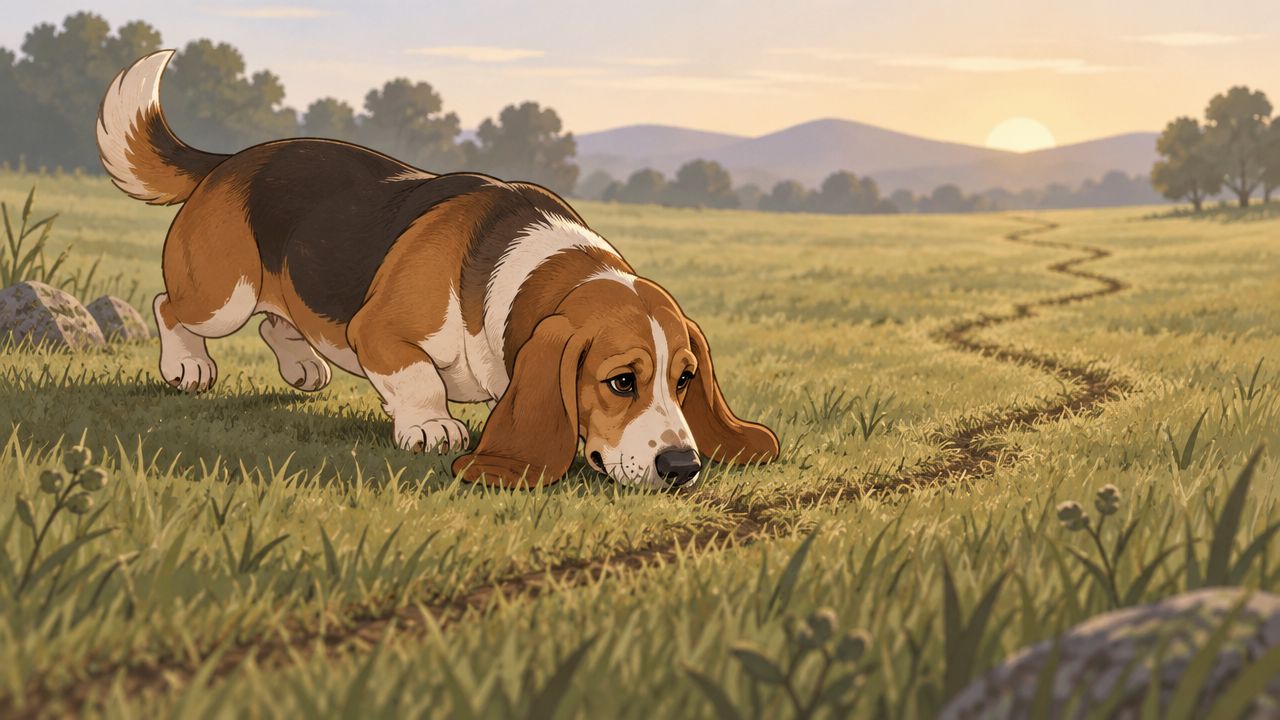
That image is useful because it explains many owner surprises. The dog may need meaningful mental work even when its short legs make repetitive impact, jumping, or uncontrolled running a poor choice. Its nose can pull it toward a trail, while its herding side tries to control movement around the home. Learning more about dog leg bones and structure can help owners understand why body shape matters when planning exercise.
The working tension
The Bloodhound contribution is a strong inclination to investigate scent. A trail may matter more than a person calling from across the yard, especially if recall training has not been built carefully. The Corgi contribution can appear as heel-directed behavior, sharp alert barking, and a desire to keep people or animals moving together.
Those instincts don't cancel each other out. They stack. A dog may spend part of the morning tracking a smell, then spend the afternoon trying to manage household traffic near the kitchen.
Practical rule: Treat the mix as a working dog in a compact, variable body. Give the brain an outlet, then protect the back and joints that carry it.
The rest of ownership follows from that principle. Parent-breed history explains why puppies vary so widely. Body structure affects feeding and exercise. Temperament determines how guests, children, and outdoor distractions are handled. Health planning has to consider both a short-backed herding frame and a large scent-hound inheritance.
Where the Corgi Bloodhound Mix Comes From
A puppy may look like a compact herder at first, then grow into a much heavier scent hound. That uncertainty comes from the parents, which contribute two very different working systems rather than one fixed blueprint.
The Corgi side brings a low-set herding dog with a compact body, a relatively long back, and an instinct to influence movement. The Bloodhound side brings a large scent hound developed for persistent investigation and tracking over distance. In daily life, those instincts can stack: the nose searches outward while the herding instinct tries to organize movement close to home.
Published guidance places an adult Corgi Bloodhound mix at approximately 12 to 18 inches tall and 30 to 80 pounds, with an estimated lifespan of 10 to 13 years. These are projections for an uncommon cross, not a formal breed standard. The wide range reflects the marked physical difference between the parents, as described in independent breed summaries.
| Trait | Corgi, Pembroke or Cardigan | Bloodhound |
|---|---|---|
| General function | Herding and alert work | Scent tracking |
| Adult size | Roughly 10 to 12 inches and 24 to 30 pounds | Commonly 23 to 27 inches and 80 to 110 pounds |
| Common lifespan guidance | Around 11 to 13 years | Around 10 to 12 years |
| Likely influence in the cross | Low frame, movement control, vocal alerting | Nose-led persistence, loose skin, large-breed structure |
The size contrast explains why littermates can mature along different lines. One may retain a compact, Corgi-like frame, while another inherits more Bloodhound mass and a longer muzzle. Feeding portions, crate dimensions, harness fit, and exercise limits may need adjustment as adult structure becomes clearer.
This mix also lacks the predictability of a standardized breed. Guidance generally treats it as an uncommon cross rather than a kennel-club-defined breed, so breeder transparency matters. Ask for records on both parents, including health screening, adult size, temperament, and lineage. A puppy's appearance alone cannot show which working instincts or body structure will become most prominent.
What a Corgi Bloodhound Mix Looks Like
A mature Corgi Bloodhound mix can stand around 12 to 18 inches at the shoulder and weigh about 30 to 80 pounds. That span is unusually broad for one cross. A smaller dog may fit comfortably into a compact companion routine, while a heavier individual may need the feeding, transport, crate, and mobility planning used for a much larger dog.
Body shape comes first
The working stack shows up in the silhouette. The Corgi side may contribute a low center of gravity, shorter legs, and a long-backed body that carries weight close to the ground. The Bloodhound side may add a deeper chest, heavier bone, longer muzzle, loose facial skin, and more substance through the neck and shoulders.
The result can be compact and low, taller and leggier, or balanced between those forms. Body proportions matter more than height alone. A short-legged dog with a broad chest may place different demands on movement and weight control than a lighter dog with longer limbs.
The coat is often short to medium, dense, and moderately shedding. Texture varies between individuals. Some dogs may inherit looser skin or facial folds, while others show a tighter facial outline. Pendulous ears are possible, but ear length and set can differ substantially depending on which parent's features are most visible.
Puppy proportions are poor predictors of the finished dog. In a first-generation cross, one puppy may have a compact body and Corgi-like tail carriage, while a littermate develops a longer muzzle, heavier ears, and a larger frame. That variation is expected in this pairing.

For owners who want a food-topper routine alongside veterinary-guided nutrition, DA-1™ Daily All-in-One - Skin/Coat, Joints, Gut Health & More is described as a human-grade powder used as one daily scoop over food. Its listed support categories include joints, skin and coat, digestion, immunity, and stress.
Features to inspect as the dog grows
Assess the whole dog rather than choosing based on one striking feature. Very loose facial skin calls for careful skin and ear observation. A heavier body on short legs makes consistent weight management especially important. Long ears can hold moisture and debris, and a long back can make uncontrolled jumping more demanding on the body.
Color and pigmentation may also vary. Expect a blend of parent-breed possibilities rather than one fixed pattern. Prioritize comfortable movement, clear breathing, healthy skin, and stable behavior over a particular head shape or coat marking.
Temperament and the Two Working Instincts
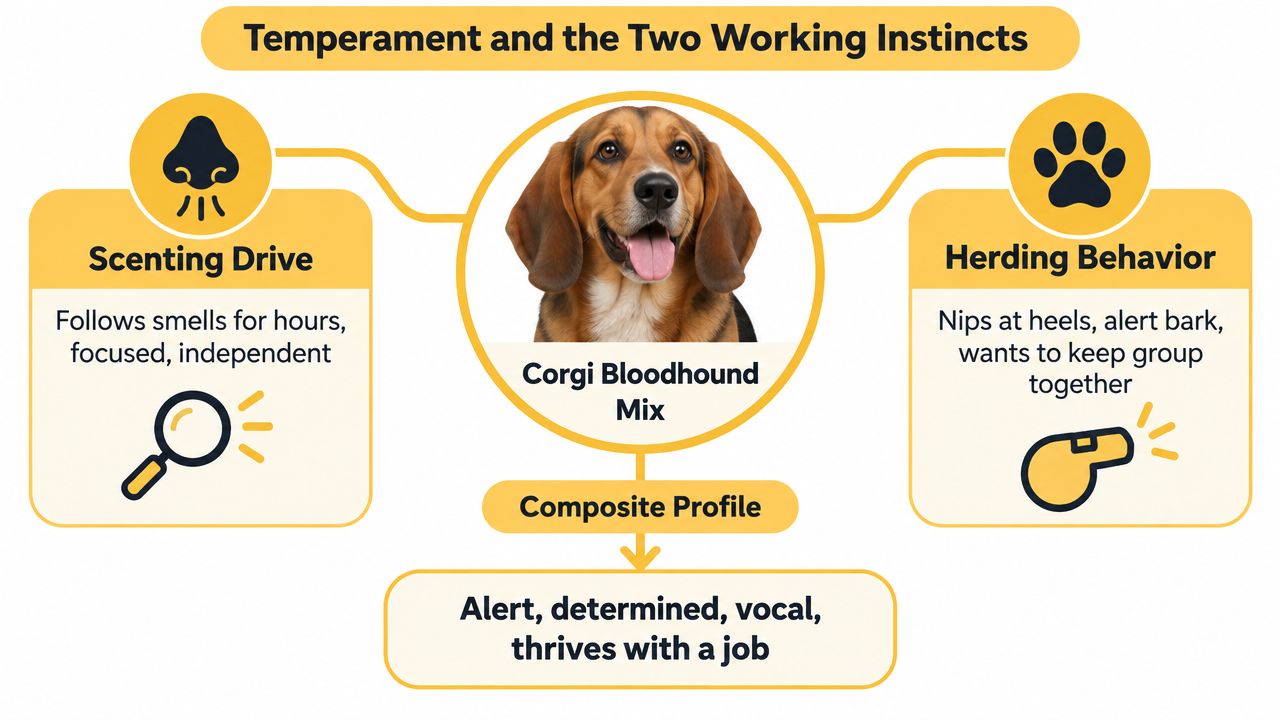
The easiest way to understand this mix is to watch what happens when the environment changes. In the yard, a Bloodhound-like scent drive may pull the dog into a focused, nose-down search. Inside the home, a Corgi-like herding impulse may appear when children run, guests move between rooms, or another dog crosses the hallway.
A scent session can look calm from a distance. The dog lowers its head, slows its pace, checks one patch of ground, then resumes the trail with surprising persistence. A herding episode feels different. The dog may bark, rush toward movement, circle, or reach toward heels as if trying to organize the group.
What the blend sounds like
Expect a dog that may be vocal, persistent, and socially engaged, but not always immediately obedient. Bloodhound persistence can look like independence when the nose finds something interesting. Corgi alerting can add sharp, repeated barking when the dog notices a delivery, unfamiliar person, or unusual sound.
Some individuals are warm with strangers, while others remain watchful until they have assessed the person. Early, positive exposure to handling, visitors, surfaces, vehicles, and calm dogs can help, but socialization doesn't erase inherited drives. It teaches the dog better responses when those drives activate.
Boredom often has a physical signature. You may see digging, counter-surfing, repetitive barking, persistent shadowing, or attempts to control household movement. Separation sensitivity is also possible, particularly when a dog has become dependent on constant access to its people without learning calm independence. Owners can use structured routines and stress-relief strategies for dogs as part of a broader behavior plan.
Children and guests
Children who run, squeal, or wave toys can trigger chasing and heel-directed behavior. Supervise every interaction, interrupt early, and give the dog a defined place to settle rather than waiting for excitement to escalate. Guests should enter calmly, and the dog should have a practiced alternative behavior such as going to a mat or waiting behind a barrier.
You're effectively raising a small tracking dog with strong opinions, not a quieter version of an average family pet. The dog may be affectionate and funny, but affection doesn't remove the need for management.
Exercise and Training That Fit the Mix
The best routine satisfies the nose without treating the dog like a long-distance runner. A Corgi Bloodhound mix may enjoy extended investigation, yet its back and joints may be poorly suited to repeated impact, high jumps, or uncontrolled stair work. Exercise should therefore be structured, low-impact, and mentally rich.
A practical daily pattern can include:
- A structured sniff walk: Spend about 20 minutes allowing loose-leash investigation, with the handler controlling direction and safety. The value comes from purposeful scent exploration, not speed.
- Focused training: Use about 15 minutes for recall, place, leash skills, and impulse control. Short, successful repetitions are more useful than drilling until the dog disengages.
- Low-impact enrichment: Hide food around a room, use a puzzle activity, or play scent-finding games. These tasks let the nose work without asking the spine to absorb repeated landings.
- Brief play periods: Fetch on a non-slip surface or tug with controlled starts and stops. Avoid launching the dog upward or encouraging sharp twisting.
Train both jobs
Nose-work activities channel the Bloodhound side. A dog that is allowed to search for a hidden treat, follow a simple scent path, or locate a family member indoors has a constructive task instead of inventing one.
The Corgi side needs equally clear boundaries. Build a reliable recall before allowing off-leash freedom, teach a firm place cue for visitors, and reinforce a dependable leave-it response around children, joggers, skateboards, and other moving targets. Everyone in the household should respond to heel-nipping and barking in the same way. Mixed signals make persistent dogs more persistent.
Protect movement quality by limiting couch launches, repeated stair sprints, and forced running over long distances. Controlled hill walking, harness-based leash work, and swimming when safely available can offer alternatives, provided your veterinarian agrees with the dog's structure and health.
The accompanying guide illustrates a short-spine-friendly approach to activity and enrichment.
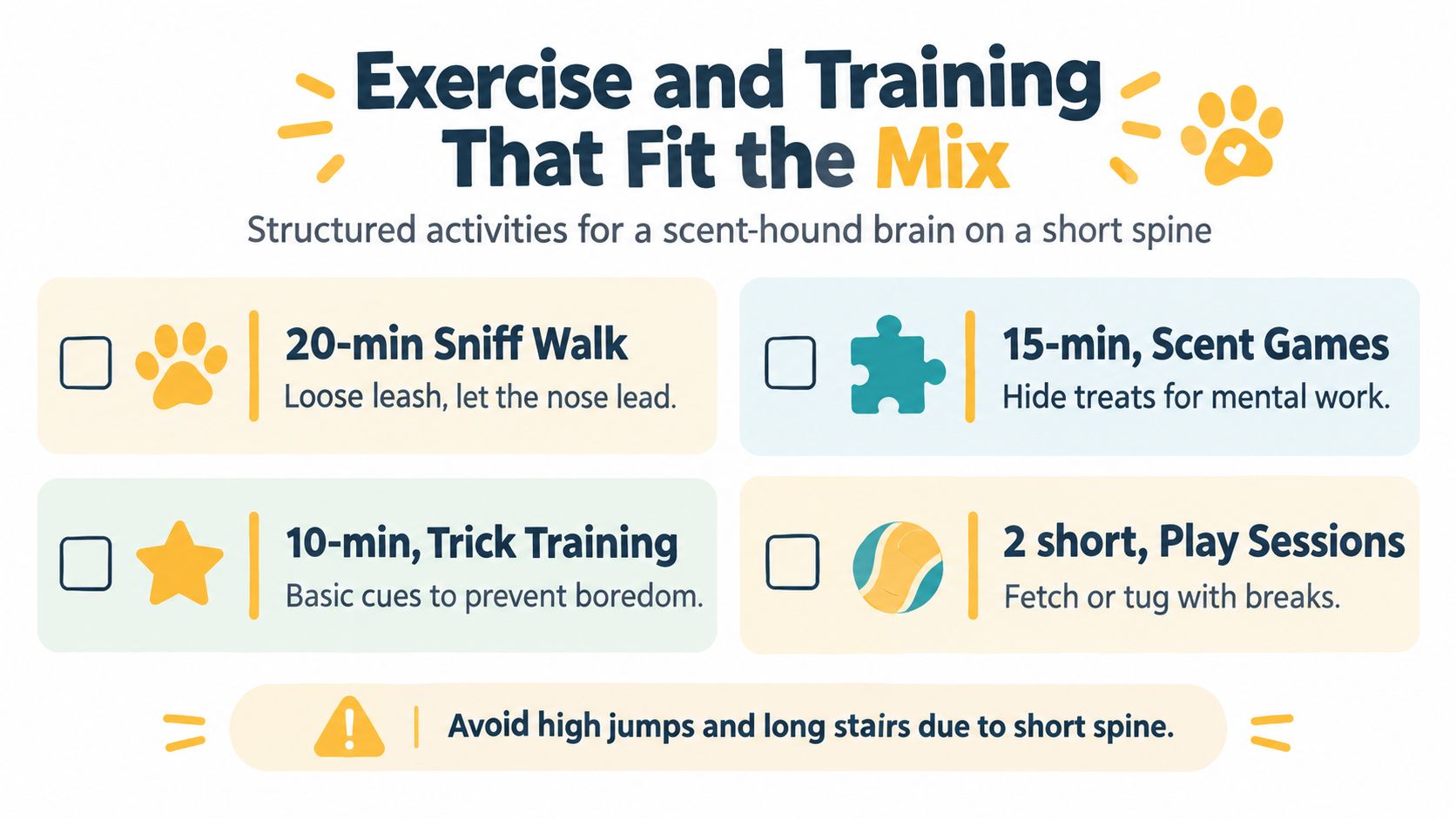
The exact routine should change with age, body condition, gait, and veterinary findings. A puppy, adult, and senior dog won't have identical exercise needs, even if they share the same working instincts.
Health Risks Worth Planning Around
A Corgi Bloodhound mix can inherit a working stack of health concerns from two very different bodies. The Corgi side is associated with intervertebral disc disease, hip dysplasia, degenerative myelopathy, and obesity risk. The Bloodhound side adds possible problems involving hip structure, eyelids, ears, and gastric dilatation-volvulus in dogs with deep-chested anatomy. Mixed ancestry does not remove the need for screening or routine observation.
Protect the spine and joints
Short legs supporting a heavier frame can place extra demand on the spine, hips, and other joints. Keep the dog lean according to a veterinary body-condition assessment, rather than judging by appearance alone. A broad, sturdy outline can hide excess weight that the skeleton handles poorly.
Watch for reluctance to climb, an altered gait, difficulty rising, sudden weakness, back sensitivity, or reduced interest in play. Sudden changes deserve prompt veterinary attention. Waiting for paralysis or collapse can delay treatment.
Safe footing and sensible body management matter throughout the dog's life. Ask your veterinarian whether the dog's structure calls for mobility monitoring or imaging, especially if movement changes.
Monitor ears, eyes, skin, and digestion
Long, pendulous ears can limit airflow and hold moisture. Inspect them routinely. Redness, odor, discharge, head shaking, or repeated scratching calls for an examination instead of repeated home treatment. Owners can review practical information about dog yeast ear infections, but a veterinarian still needs to identify the cause of an ear problem.
Bloodhound-associated eyelid concerns include ectropion and entropion. Loose skin can also form areas that need regular observation. Ask your veterinarian to demonstrate how to check the eyes and facial folds without causing irritation.
Deep-chested anatomy can raise concern about gastric dilatation-volvulus. Learn the emergency signs, including unproductive retching, abdominal enlargement, restlessness, heavy drooling, weakness, or collapse. Seek urgent veterinary care if these signs appear.
The expected lifespan is often projected at 10 to 13 years for the mix. Parent-breed references commonly place Bloodhounds around 10 to 12 years and Pembroke Welsh Corgis around 11 to 13 years. These ranges describe expectations, not a promise for an individual dog.
Ask for evidence before choosing a puppy
A responsible pre-purchase discussion should include:
- Orthopedic screening: Ask whether the parents have documented hip evaluations, including recognized imaging-based assessments.
- Eye and cardiac checks: Confirm which examinations were completed and request written results.
- DNA testing: Discuss what the panel covers, what it cannot predict, and whether results apply to conditions relevant to both parent breeds.
- Baseline veterinary planning: After adoption, ask whether imaging or mobility assessment suits the dog's build.
Routine ear care, controlled weight, safe flooring, and careful management of stairs and jumping begin at home.
Is This the Right Dog for Your Home
Use four filters before committing to a Corgi Bloodhound mix.
Home space matters less than access to safe outlets. Apartment living can work when the dog has nearby sniff-friendly routes, careful stair management, and daily training. A secure yard or nearby trail makes scent activities easier, but it doesn't replace supervision or recall work.
Daily time must cover more than a quick bathroom walk. The plan should include roughly 60 to 90 minutes of exercise, two training sessions, and small scent-enrichment tasks distributed through the day. The exact amount depends on age, health, and structure, but the working brain still needs regular engagement.
Training commitment isn't optional. A dog that can follow a compelling trail and react to fast-moving heels needs patient reinforcement, consistent household rules, and management around visitors and children.
Family composition deserves honest attention. Older children may be easier for this mix to live with than toddlers because they can follow instructions and recognize when the dog needs space. Every child interaction requires adult supervision. If your home borders wildlife habitat, learning how to deter coyotes safely can also support a safer outdoor plan.

Choose this cross if you enjoy teaching, scent games, supervised outdoor exploration, and a dog that participates loudly in family life. Choose another type of companion if you need effortless recall, silence, or a dog that can exercise hard without structural planning.
Bringing It All Together as an Owner
The Corgi Bloodhound mix is a short-legged scent specialist with a herder's brain and a hound's volume. Short legs don't automatically mean low exercise needs. A mixed dog won't necessarily be calmer than a Bloodhound, and shedding, loose skin, long ears, or drool may be more noticeable than a first-time owner expects.
The most reliable ownership plan has four pillars: keep the dog lean, provide structured scent outlets, build recall before freedom, and check the ears, eyes, gait, and spine regularly. Those habits don't suppress the dog's instincts. They give those instincts a safe place to go.
You're not dealing with a problem dog when the nose takes over or the heels become interesting. You're channeling two strong working drives into a daily partnership that requires preparation, patience, and boundaries.
If you're preparing to welcome a Corgi Bloodhound mix, visit Pure Paw Labs to explore its dog nutrition products, including a daily powder designed to support joint, skin and coat, digestive, immune, and stress-related needs. Use it as one part of a veterinarian-guided care plan alongside appropriate food, exercise, weight monitoring, and routine examinations.