


Your dog seems a little off, but not sick enough to make the answer obvious. He scratches more than usual, hesitates before jumping into the car, and has days when his energy dips for no clear reason. You ask friends, search online, and suddenly you're staring at powders, chews, fish oils, probiotics, joint blends, calming treats, and advice that doesn't agree.
That's where many people land when they start thinking about whole-dog health. They aren't looking to replace veterinary care. They're trying to make everyday care make more sense. Instead of chasing one symptom at a time, they want a plan that supports the whole dog: body, behavior, digestion, movement, skin, and daily comfort.
A holistic approach works best when it's practical. It should help you decide what matters every day, what belongs on a weekly checklist, and what changes mean it's time to call your veterinarian.
Table of Contents
- Introduction to Holistic Dog Health
- Understanding Core Concepts and Pillars of Holistic Dog Health
- Evidence Based Strategies for Each Pillar
- Daily and Weekly Routines for Holistic Dog Health
- Recognizing Health Red Flags in Your Dog
- Integrating a Daily All-in-One Supplement in Your Plan
- Conclusion and Next Steps for Holistic Dog Health
Introduction to Holistic Dog Health
A lot of dog owners start with one problem. Maybe it's itchy paws. Maybe it's slower walks. Maybe it's loose stool that comes and goes. Then another issue appears, and suddenly care feels scattered.
A holistic view asks a different question. Instead of “What can I give for this one symptom?” it asks, “What in my dog's full routine could be shaping this pattern?” That includes food, exercise, stress, sleep, enrichment, skin care, weight, gut health, and regular medical care.
For some families, comprehensive care also includes complementary practices. About 15% of the nearly 50,000 participants in the Dog Aging Project used some form of alternative or complementary health care during their dog's life, with massage being the most commonly used modality, according to ABC News coverage of the Dog Aging Project. The same report noted that the strongest basics still matter most: healthy body condition, parasite prevention, and consistent dental care.
Practical rule: Holistic care works best when you build it on proven daily care, not when you use it as a substitute for the basics.
That idea keeps this topic grounded. The goal isn't to make care more complicated. It's to make your dog's routine more coherent.
Understanding Core Concepts and Pillars of Holistic Dog Health
What holistic care actually means
An integrated approach to dog health means looking at your dog like a connected system, not a collection of unrelated parts. If the gut is irritated, the skin may flare. If joints are sore, activity drops. If activity drops, sleep, mood, digestion, and weight may shift. One change can ripple into several others.
Think of your dog like a house with shared plumbing and wiring. You can repaint a room, but if there's a leak behind the wall, the problem returns. In the same way, a shiny coat supplement won't do much if the dog is uncomfortable, under-exercised, stressed, or missing basic preventive care.
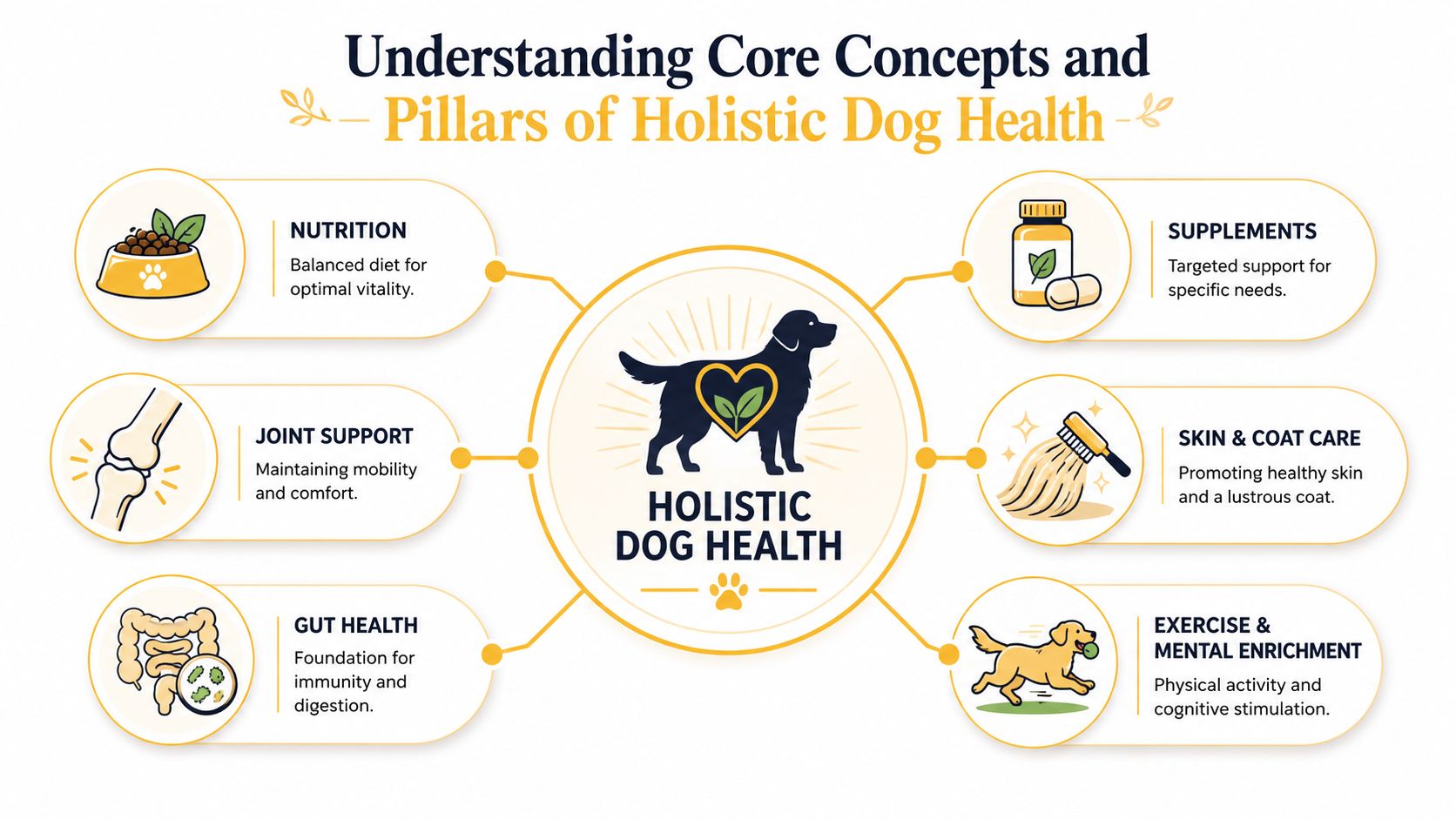
The six pillars that work together
These six pillars make the concept easier to use in real life.
- Nutrition Food is the daily foundation. A dog that eats consistently and tolerates meals well is easier to monitor. You'll notice appetite changes sooner, stool changes faster, and energy patterns more clearly.
- Supplements Supplements should support a specific need, not pile on confusion. Some dogs need help with joints, skin, or digestion. Others may not need much beyond a solid routine. A targeted product often makes more sense than grabbing five separate ones because each sounded helpful.
- Joint support Joint comfort affects almost everything. Dogs who move well usually engage more, maintain muscle better, and seem brighter in daily life. Joint care includes weight awareness, regular movement, traction at home, warm-up walks, and support products when appropriate.
- Skin and coat care Skin is a barrier organ. When it's unhappy, dogs scratch, lick, rub, and lose sleep. Owners often focus on the fur they can see, but healthy skin also depends on what's happening underneath, including inflammation and digestion.
- Gut health The gut does more than process food. It influences stool quality, comfort, routine predictability, and immune signaling. If your dog has occasional digestive upset, skin issues, or seems generally “sensitive,” the gut is worth paying attention to.
- Exercise and mental enrichment Many owners think exercise only means long walks. It also means appropriate movement, sniffing, training, problem-solving, and rest. A dog can be physically tired and still mentally under-stimulated. That mismatch often shows up as restlessness, chewing, barking, or clinginess.
Why consistency beats complexity
Owners often get lost because they try to upgrade everything at once. New food, new topper, new probiotic, new joint chew, more training, different treats. Then the dog improves or reacts, and nobody knows why.
A simpler approach usually works better:
- Start with the basics: Keep meals, potty times, walks, and sleep predictable.
- Add one change at a time: That lets you observe what helped.
- Track visible signals: Stool, scratching, movement, appetite, and mood tell you more than marketing language.
- Support, don't replace: Complementary care should sit beside veterinary guidance, not compete with it.
One practical example is DA-1™ Daily All-in-One - Senior Dog Support, Joints, Skin/Coat & More, which is described as a multi-system formula for aging dogs that delivers 18 human-grade ingredients targeting cells, gut, and joints in one scoop, without pills or fillers. In a holistic plan, a product like that fits the “simplify the routine” idea. It doesn't replace exercise, dental care, parasite prevention, or veterinary attention, but it may reduce the need to juggle multiple separate products.
A useful holistic routine should be easy enough to repeat on busy days, not just ideal days.
That's the test. If the plan only works when life is perfectly organized, it won't hold up long enough to help your dog.
Evidence Based Strategies for Each Pillar
What the evidence suggests about priorities
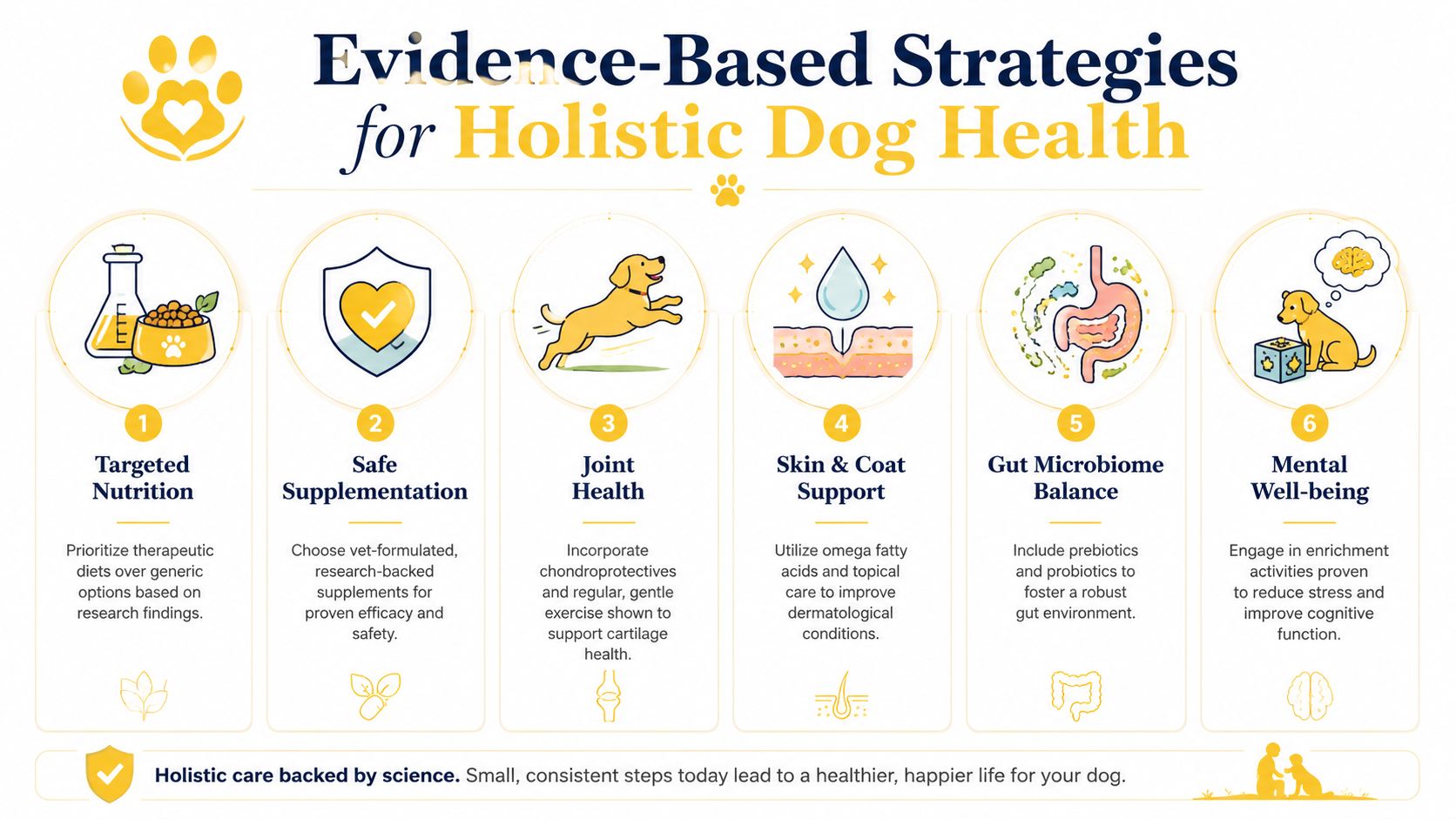
One of the most useful findings for dog owners is that not every wellness change carries the same weight. Research on owner-perceived dog health found that diet had limited statistical impact compared with factors such as dog age, veterinary visit frequency, and whether the dog received medication, as described in this PLOS One study on factors linked to perceived dog health. The same analysis highlighted “switching to a therapeutic diet” as an important variable.
That matters because it shifts the conversation. A vague promise to “improve nutrition” is less useful than a targeted nutritional intervention matched to a real problem.
Practical strategies with realistic expectations
Here's how that evidence translates into everyday choices.
| Pillar | Most practical approach | What to watch |
|---|---|---|
| Nutrition | Use purposeful feeding changes, especially when your veterinarian recommends a therapeutic direction | Appetite, stool, comfort after meals |
| Skin support | Focus on anti-inflammatory support and barrier care | Scratching, licking, redness, coat quality |
| Gut support | Add microbiome support thoughtfully and monitor digestion | Stool consistency, gas, urgency, appetite |
| Joint care | Pair gentle movement with support aimed at comfort and mobility | Rising, stairs, jumping, post-walk stiffness |
| Enrichment | Use short daily sessions rather than occasional long sessions | Restlessness, pacing, overexcitement |
For skin and coat support, specific fatty acids matter. EPA and DHA from marine sources have documented anti-inflammatory properties and are associated with reduced skin lesion scores and better coat condition in canine atopic dermatitis, according to this review of skin and gut nutrition in dogs and cats. The same article notes that visible skin improvement often takes 6 to 8 weeks, while gut-related changes such as stool consistency may show up within 3 to 4 days.
That difference prevents a common mistake. Owners often stop a skin-support plan too early because they expect the coat to look better in a few days. Skin usually needs longer.
For itch linked to the gut-skin axis, one clinical study found that an indole-rich postbiotic reduced scratching behavior in dogs by 20% within 14 days and produced a 27% reduction in PVAS itching score at Day 28 compared with placebo, as reported in this open-access paper on postbiotics and canine itching. The practical lesson is simple: oral gut support can influence skin symptoms, but you should monitor the right markers over the right timeline.
If you want a plain-language overview of that connection, this guide on dog gut health is a useful companion read.
Don't judge every intervention on the same clock. Digestion may change quickly. Skin and coat usually ask for more patience.
Mental well-being deserves a spot here too, even without a precise score attached. Dogs with regular sniff walks, predictable routines, and brief training sessions often cope better with daily stress. A calmer nervous system supports better sleep, more settled behavior, and easier recovery after stimulation.
Daily and Weekly Routines for Holistic Dog Health
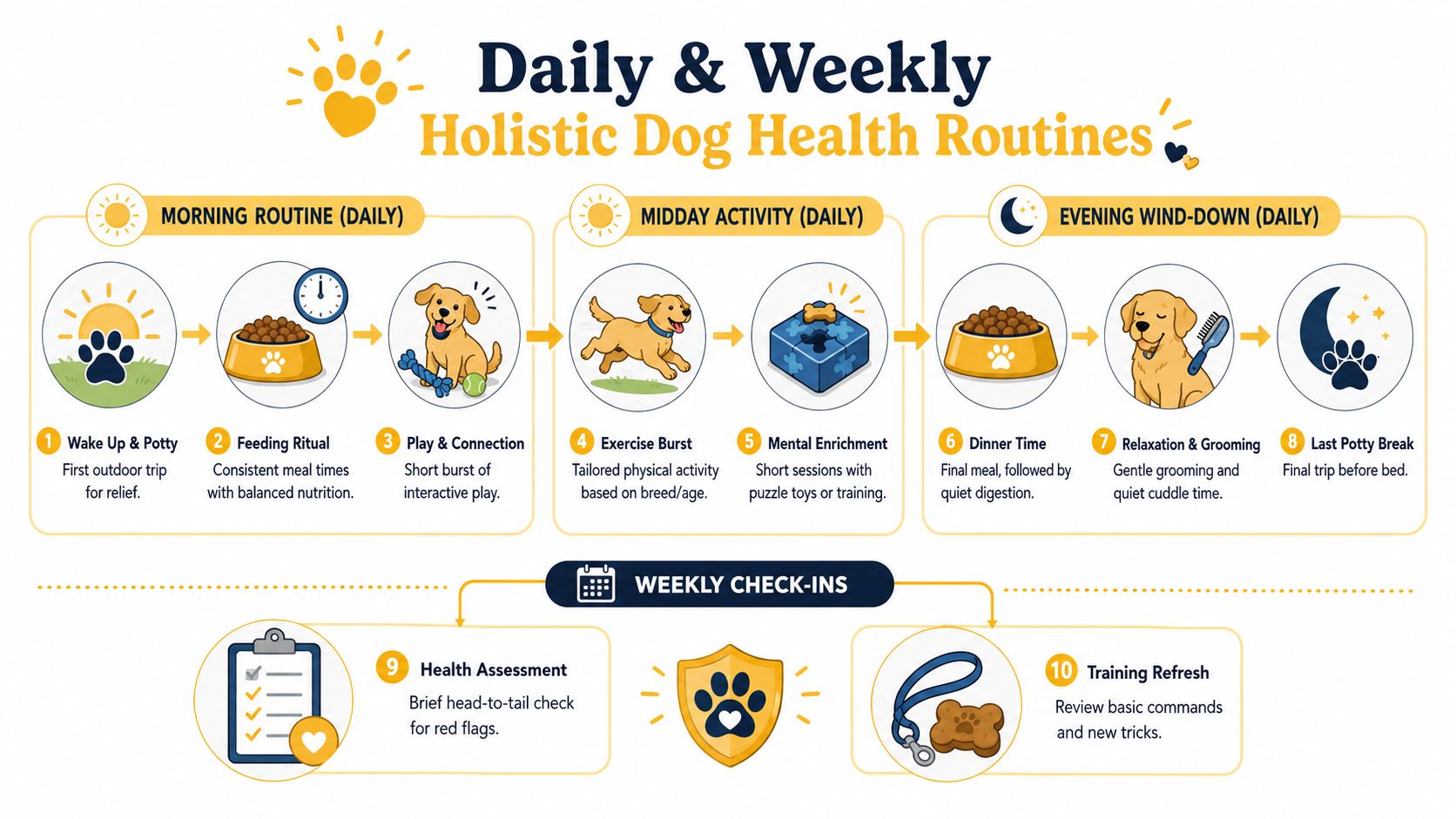
A simple daily rhythm
A good routine doesn't need to be elaborate. It needs to be repeatable.
Morning
- First potty trip: Let your dog relieve himself before asking for training or calm behavior.
- Breakfast at a steady time: Predictable meal timing helps you notice appetite changes sooner.
- Short movement session: For some dogs this is a brisk walk. For others it's a slow sniff walk or a few minutes of gentle mobility.
- Quick observation: Check eyes, ears, paws, and overall energy while the day is starting.
Midday
- Movement break: Match this to age and comfort. A young dog may need active play. A senior dog may do better with a slow loop and a few easy repetitions of sit, stand, and turn.
- Mental work: Use food puzzles, nose work, or short training games.
- Water and recovery: After activity, give your dog space to settle. Constant stimulation isn't the goal.
Evening
- Dinner and digestion time: Keep the evening meal consistent.
- Calm contact: Grooming, paw wiping, or a gentle body check gives you information while your dog relaxes.
- Last potty break: Finish the day with a predictable wind-down.
A daily rhythm like this helps because patterns become visible. If your dog normally springs up for breakfast and suddenly hangs back, that means more when the routine is stable.
A weekly reset for prevention
The weekly routine is where prevention becomes real.
- Head-to-tail check Run your hands over the body. Notice new lumps, tender spots, flaky skin, coat thinning, or debris between the toes.
- Mobility review Watch your dog rise from rest, turn, use stairs, and jump into familiar places. Subtle hesitation often appears before obvious limping.
- Skin and coat scan Look under the collar, around the groin, in the armpits, and around the paws. If your dog has chronic itch or dull coat concerns, this guide to dog skin and coat health can help you track what to watch at home.
- Enrichment rotation Change one or two activities each week. Rotate puzzle toys, hide-and-seek games, training goals, or sniff routes so your dog stays engaged.
- Care admin Refill preventive medications if prescribed, review brushing and dental habits, and note any vet questions before they pile up.
Here's a simple tracking format:
| Checkpoint | What you write down |
|---|---|
| Appetite | normal, eager, slow, skipped |
| Stool | formed, loose, hard, urgent |
| Skin | calm, red, flaky, licking |
| Movement | smooth, stiff after rest, reluctant |
| Mood | relaxed, clingy, restless, withdrawn |
This takes only a minute or two. Over time, it gives you a baseline, and baseline is what makes early changes easier to spot.
Recognizing Health Red Flags in Your Dog
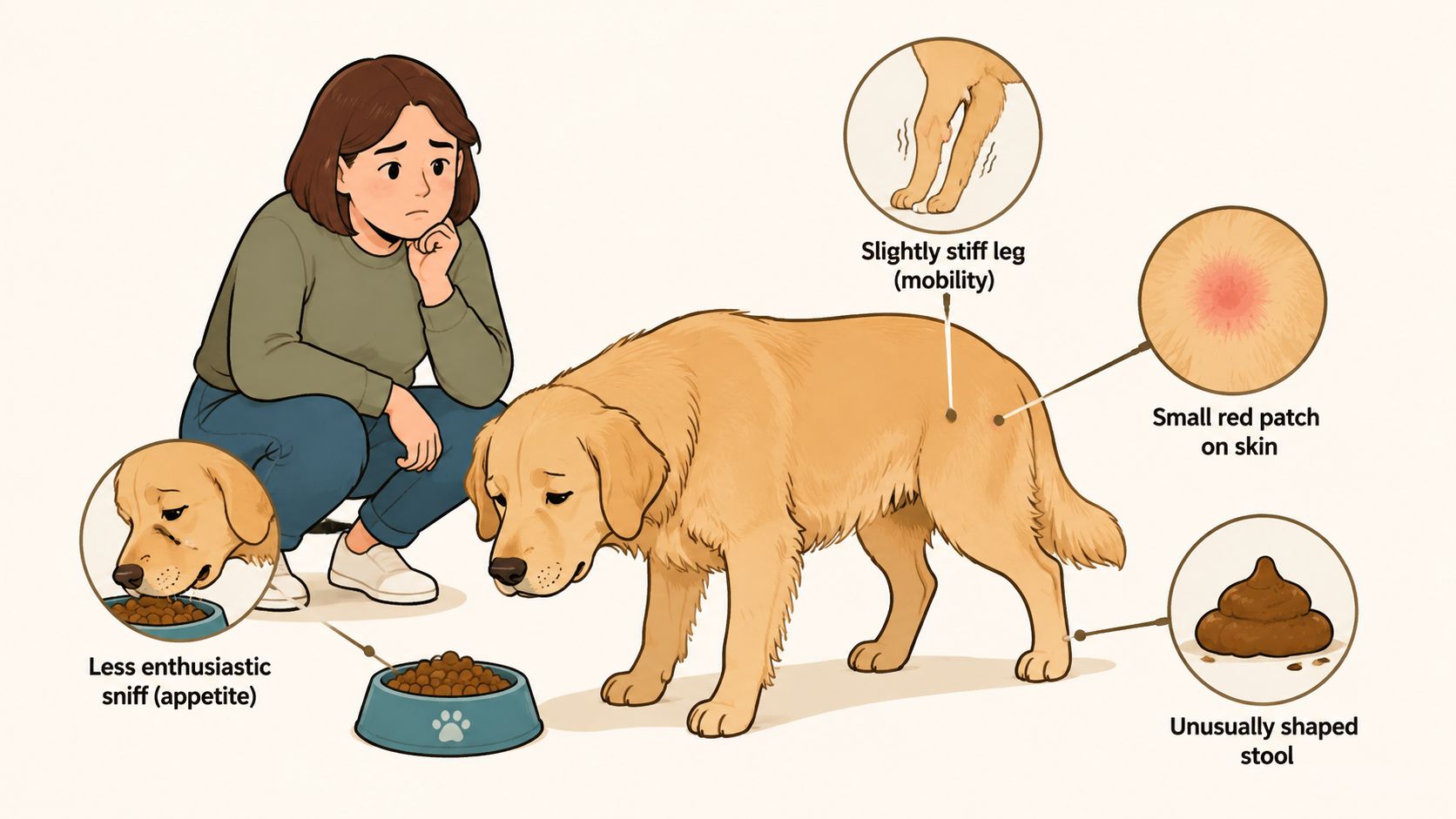
Changes that deserve attention
This type of care can make owners more observant, which is good. It can also make some people wait too long because they hope a natural tweak will fix everything. That's the line to watch.
Call your veterinarian sooner rather than later if you notice patterns like these:
- Appetite changes: Your dog skips meals, seems nauseated around food, or suddenly becomes much less interested in eating.
- Energy shifts: A normally social dog withdraws, sleeps much more, or doesn't want to join familiar activities.
- Mobility problems: Stiffness persists, stairs become difficult, or your dog yelps, limps, or resists being touched.
- Digestive changes: Ongoing loose stool, repeated vomiting, straining, or obvious abdominal discomfort shouldn't be brushed off.
- Skin escalation: Scratching, licking, ear irritation, hot spots, or redness keep building instead of settling.
Small changes matter most when they keep repeating. One odd day may be noise. A pattern is information.
Owners often get confused about itching and stiffness because both can fluctuate. A dog may be itchier after a bath or stiffer after a hard play session. That's why context matters. If the dog returns to normal quickly, it may be a routine variation. If the change lingers, spreads, or worsens, it deserves medical input.
When home monitoring is not enough
Use this simple rule. If your dog looks uncomfortable, distressed, painful, weak, or unlike himself in a way that worries you, don't keep experimenting at home.
A home plan supports health. It doesn't diagnose disease.
Watch especially closely for:
- Breathing changes
- Collapse or severe weakness
- Pale gums
- Repeated vomiting
- Sudden swelling
- Marked pain
- Neurologic signs such as disorientation or unusual movements
Those are not “wait and see” moments. Responsible dog health management includes knowing when the next best step is professional care.
Integrating a Daily All-in-One Supplement in Your Plan
Why fewer products can make a plan safer
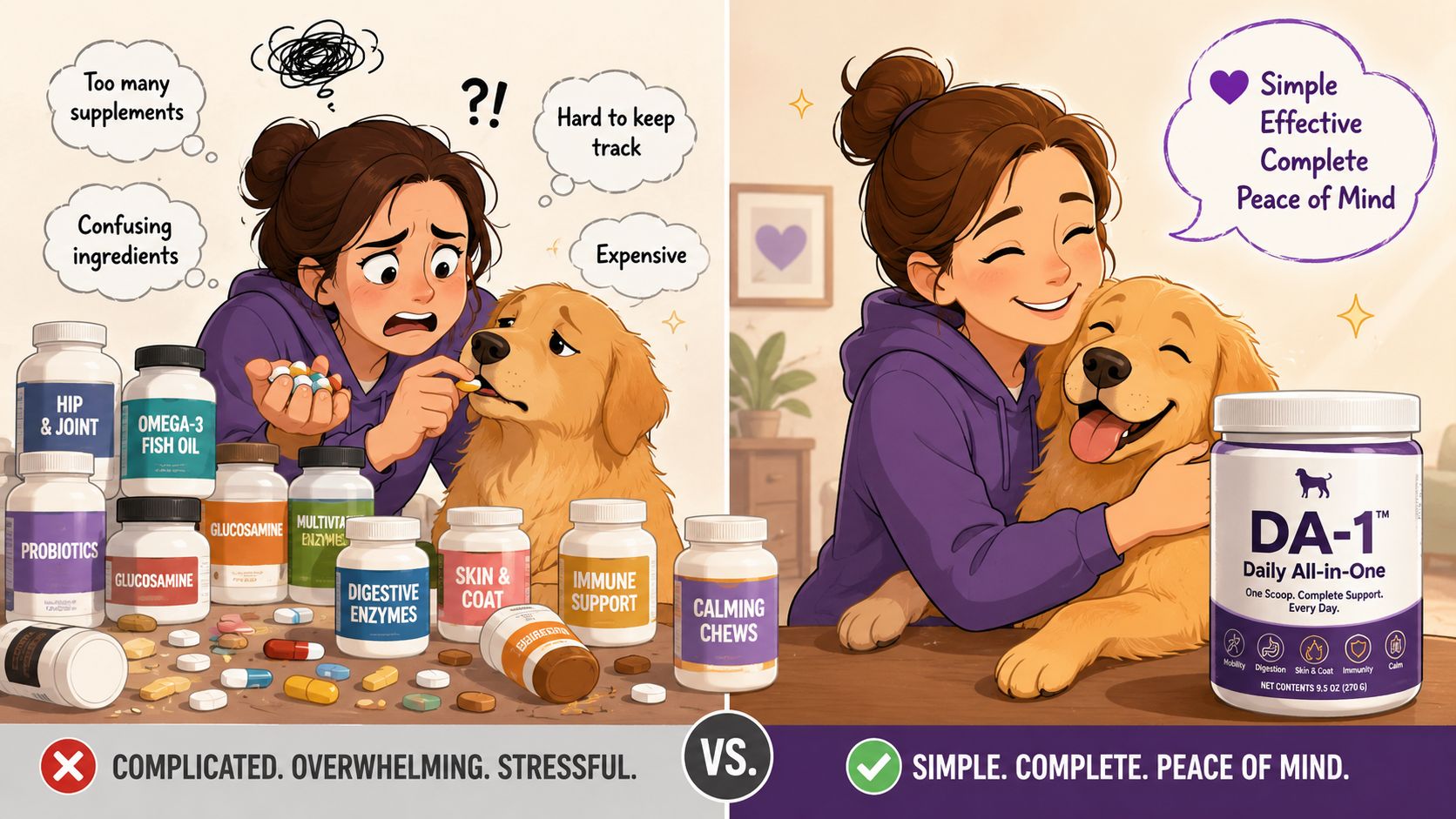
This is one of the least discussed parts of holistic care. Owners often layer products because each one targets a different concern. One for joints. One for skin. One for digestion. One for calming. One multivitamin just in case.
The problem is what some owners worry about: overlap. The stacking risk of multi-supplement regimens can create concern about ingredient conflicts, while a consolidated all-in-one formula can reduce that complexity and potential for overdose, as discussed in this AKC overview of holistic care for dogs.
That doesn't mean every dog needs one product. It means simpler plans are often easier to use correctly. They're also easier to discuss with your veterinarian because you can review one formula instead of a bag full of labels.
If you're evaluating a single-product option, Daily All-in-One Complete Care for your Dog multivitamin is one example of a consolidated daily supplement format.
How to fit one supplement into a real routine
Most dogs do best when a powder or topper becomes part of an existing meal ritual. Don't treat it like a special event. Attach it to breakfast or dinner so you're less likely to forget it.
A practical approach looks like this:
- Choose one meal: Pick the meal your dog finishes most consistently.
- Keep the rest of the routine stable: Don't introduce several other changes at the same time.
- Watch a few markers only: Movement, scratching, stool quality, appetite, and general brightness are enough.
- Write notes weekly: Daily memory is unreliable. Weekly notes are more useful.
Here's a closer look at the routine logic in video form.
Common mistake: Owners add a supplement, switch foods, change treats, and start a new grooming product in the same week. If the dog improves or reacts, nobody knows what caused it.
A single all-in-one can be especially helpful for households that struggle with missed doses or supplement fatigue. The less friction in the routine, the better the odds that the plan is followed every day.
Conclusion and Next Steps for Holistic Dog Health
The most effective holistic dog health plan is usually the least flashy one. It combines good daily habits, careful observation, preventive veterinary care, and a few well-chosen supports that match your dog's actual needs.
Start with a stable routine. Feed consistently. Build in movement and mental work. Track stool, skin, appetite, mobility, and mood. Use red flags as a signal to call your veterinarian, not just to buy another product. If supplements are part of the plan, keep the routine simple enough that you can follow it on ordinary days.
For the next month, focus on a short checklist:
- keep meals and walks predictable
- do one weekly head-to-tail check
- track the same few health markers
- avoid changing multiple variables at once
- schedule or prepare for your next veterinary discussion if something stays off
That's what long-term care looks like in real life. Not perfection. Not constant experimentation. Just steady, informed decisions that help your dog stay comfortable, active, and easier to understand.
If you want a simpler way to support joints, skin, coat, and gut health in one daily routine, Pure Paw Labs offers science-backed dog supplements designed to make consistent care easier.