


A lot of advice about vitamin C for dogs starts in the wrong place. It assumes dogs need vitamin C from food the way people do, then works backward to oranges, berries, powders, and chewables.
That baseline is off. For most healthy dogs, vitamin C food for dogs is optional support, not a nutritional requirement. That doesn't mean vitamin C-rich foods are useless. It means you need to understand the dog's built-in system first, then decide whether food has a practical role for that individual dog.
Table of Contents
- Why Vitamin C for Dogs Is Different Than for Humans
- How Dogs Make Vitamin C on Their Own
- Vet-Safe Vitamin C Foods Dogs Can Eat
- How to Prepare and Serve These Foods Safely
- Whole Foods Versus Vitamin C Supplements
- Dogs That May Actually Need Extra Vitamin C
- Overdose Risks and Medication Interactions
- When to Talk to Your Veterinarian First
Why Vitamin C for Dogs Is Different Than for Humans
People need vitamin C from food because our bodies can't make it. Dogs are different. Dogs generally synthesize their own vitamin C in the liver, which is why it isn't classified as a required dietary nutrient for healthy dogs according to this review indexed by PubMed.
That single biological difference changes the whole conversation.
When a person eats bell peppers or citrus, they're adding a nutrient their body must obtain from the diet. When a healthy dog eats those same foods, they're usually adding a nutrient the dog's body already produces on its own. So the usual human advice, “eat vitamin C every day,” doesn't transfer neatly to canine feeding.
The common confusion
Many owners hear “vitamin C supports immunity” and assume more must be better. That's understandable, but canine nutrition doesn't work that way. A complete commercial dog food is generally built around established nutrient standards without needing vitamin C to be included as an essential baseline nutrient.
Practical rule: Ask “Does my dog need this?” before asking “Which vitamin C food is best?”
What that means at the bowl
For a healthy adult dog eating a complete diet, vitamin C-rich foods are usually best treated as small extras. Think of them as fresh toppers or occasional snacks, not as something you must add to prevent deficiency in the average dog.
Where things get more nuanced is with dogs whose normal production may not match their needs. That can include some seniors, some hard-working dogs, some dogs recovering from illness, and some dogs eating poorly formulated home-cooked meals. In those narrower situations, vitamin C food for dogs can become more relevant, but only as part of the bigger nutritional picture.
How Dogs Make Vitamin C on Their Own
A simple way to picture this is a kitchen.
The body keeps glucose on hand like ingredients in a pantry. The liver acts like the cook. And one key enzyme, L-gulonolactone oxidase, works like the recipe card that lets the cook turn those ingredients into vitamin C.
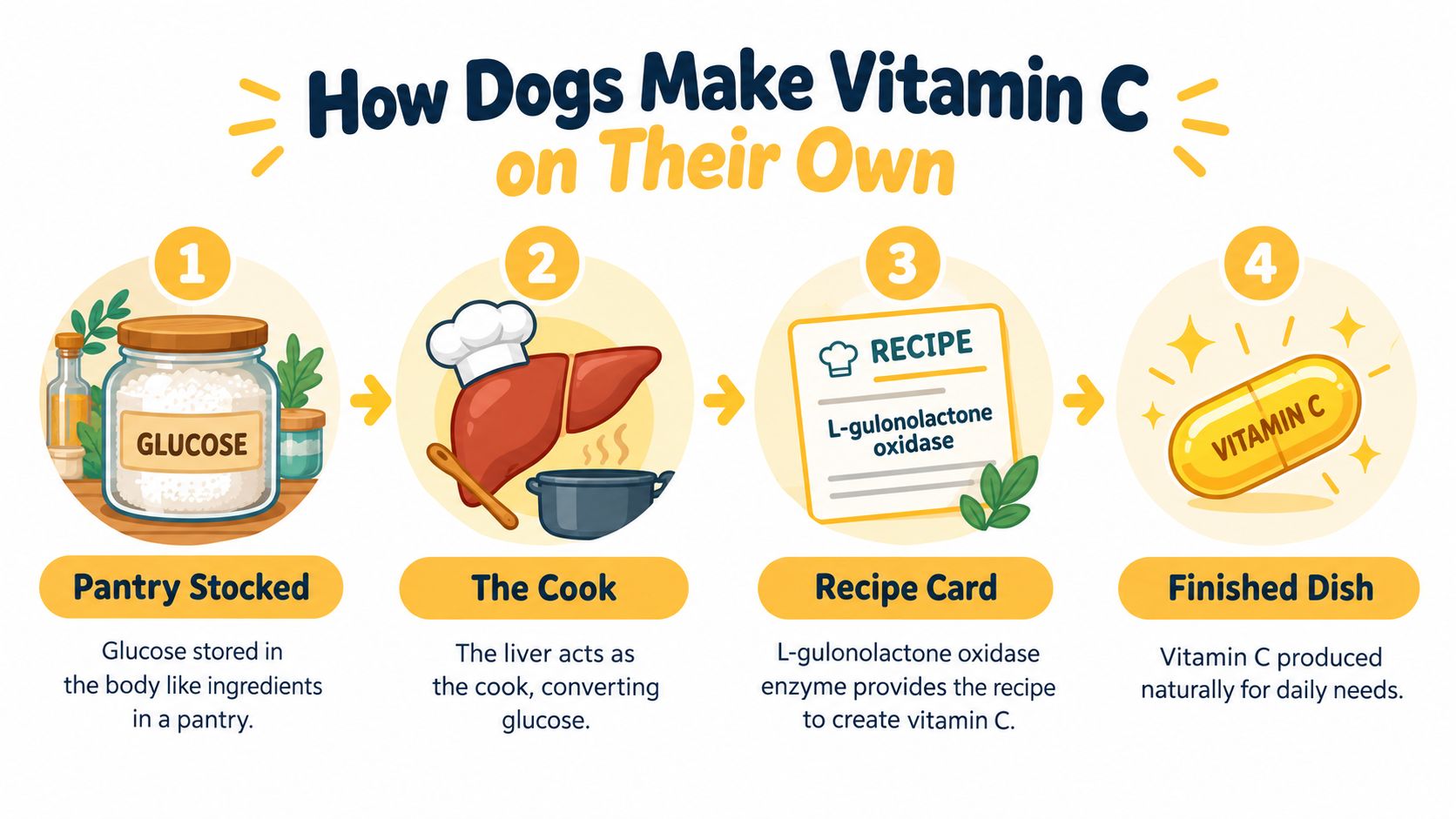
The four-step kitchen version
- Pantry stocked The dog's body has glucose available from normal metabolism.
- The cook gets to work The liver takes that glucose and begins a series of conversions.
- The recipe card matters Dogs retain the enzyme L-gulonolactone oxidase, which completes the final step needed to make vitamin C.
- Finished product The dog produces vitamin C internally and uses it for normal daily needs.
That enzyme is the major fork in the road between dogs and humans. Humans lost that function through evolution. Dogs kept it.
How much do dogs make
Healthy dogs can produce about 40 mg of vitamin C per kilogram of body weight per day, according to veterinary nutrition sources summarized in this canine vitamin C guide. Using that figure, a 20 kg dog could theoretically synthesize around 800 mg daily under normal conditions from the same source.
That doesn't mean every dog always makes the exact same amount, or that more is always helpful. It does show why healthy dogs usually don't need “orange juice logic” applied to their feeding plan.
Where owners often get mixed up
Dogs don't get their vitamin C mainly from gut microbes. This is primarily a liver process. That's one reason healthy dogs on complete diets rarely show obvious vitamin C deficiency problems in everyday practice.
A better question isn't “How do I force more vitamin C into my dog?” It's “Is there anything about my dog's health, stress load, or diet that could make normal production less reliable?”
Vet-Safe Vitamin C Foods Dogs Can Eat
If you want to add vitamin C food for dogs, choose foods that are safe, easy to portion, and unlikely to upset the stomach. I prefer starting with vegetables over fruit because they usually give you more control and less sugar.
The table below is organized from more cautious everyday options toward foods that need a bit more restraint. The serving ideas are intentionally small. They fit the role these foods should play: toppers and treats, not diet replacements.
For owners who want to compare complete food options that include plant ingredients often used in fresh-style formulas, the Vitamin Planet dog food range gives a useful example of how whole-food ingredients can appear in a broader feeding pattern.
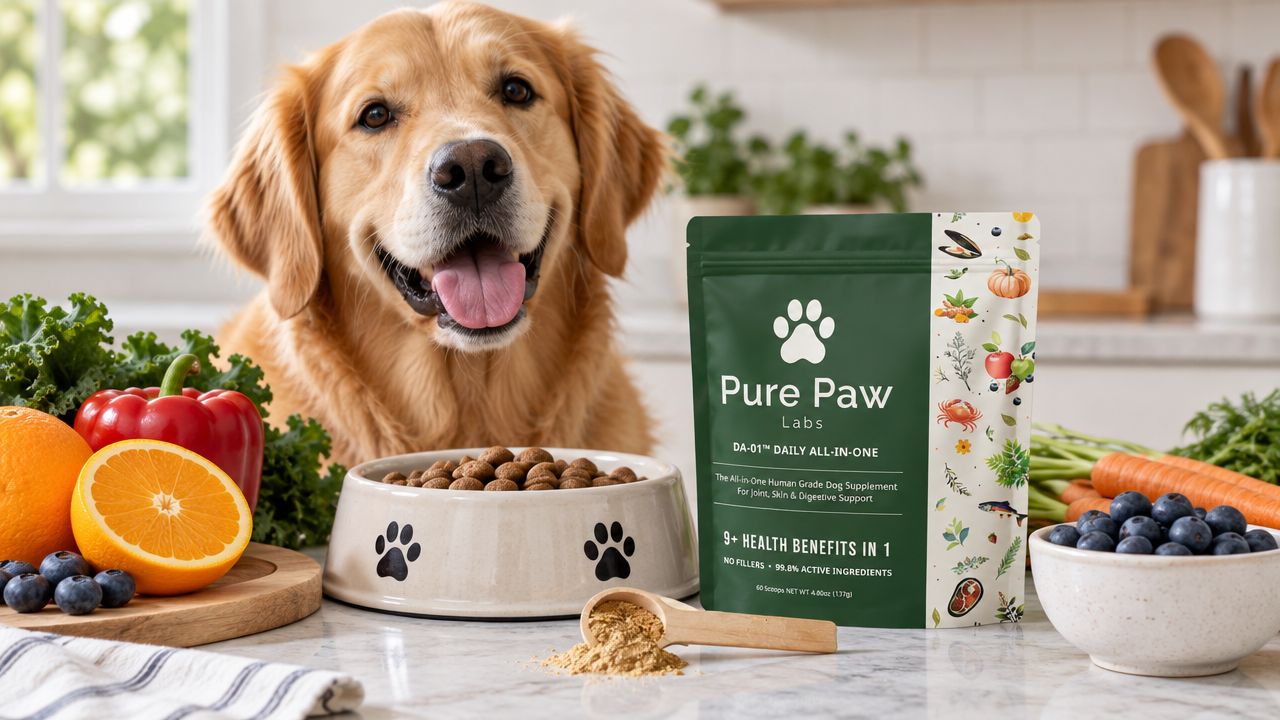
Good starter choices
Red bell pepper, parsley, broccoli, and kale are common places to begin because owners can portion them precisely and add very little at a time. Fruit can work too, but it tends to be better as a smaller garnish than a daily habit.
| Vet-Safe Vitamin C Foods for Dogs: Content and Serving Sizes | ||||||
|---|---|---|---|---|---|---|
| Food | Approx. Vitamin C | Toy Dog (under 10 lb) | Small Dog (10–25 lb) | Medium Dog (25–50 lb) | Large Dog (over 50 lb) | |
| Red bell pepper | High relative source | Very small finely chopped pieces | Small spoonful | Modest spoonful | Slightly larger spoonful | Prep & Cautions: Raw or lightly steamed. Remove stem and seeds. Cut thin to reduce choking risk. |
| Parsley | Concentrated in small amounts | Pinch, finely chopped | Small pinch to sprinkle | Larger pinch | Small scatter over food | Prep & Cautions: Fresh and finely chopped. Avoid large bunches. Use as a topper, not a salad. |
| Broccoli florets | Useful source | Tiny floret pieces | A few small pieces | Several bite-sized pieces | A few larger bite-sized pieces | Prep & Cautions: Light steam often improves tolerance. Serve plain. Too much may cause gas. |
| Kale | Useful source | Very small chopped amount | Small chopped amount | Small spoonful | Modest spoonful | Prep & Cautions: Finely chop or lightly steam. Use caution in dogs with kidney concerns because some greens contain more oxalates. |
| Strawberries | Moderate source | One small slice | A few small slices | Several slices | Small handful of slices | Prep & Cautions: Fresh, washed, stem removed. Keep portions modest. |
| Blueberries | Moderate source | One or two berries, mashed if needed | A few berries | Small spoonful | Slightly larger spoonful | Prep & Cautions: Fresh or thawed. Whole berries can be a choking risk for very small dogs. |
| Orange segments | Vitamin C-rich but more sugary and acidic | Tiny piece only | Small piece | One or two small pieces | A few small pieces | Prep & Cautions: Remove peel, pith, and seeds. Not ideal for dogs with sensitive stomachs. |
| Apple slices | Contains some vitamin C | Thin sliver | Thin slices | A few thin slices | Several thin slices | Prep & Cautions: Remove core and seeds. Serve plain. More useful as a crunchy treat than a vitamin C strategy. |
How to think about portions
Use these foods within the familiar treat-and-topper range of about 10 percent of the daily intake, not as a major calorie source. If your dog already gets training treats, chews, and table scraps, the vitamin C-rich add-ins need to fit inside that same extra-food budget.
Fresh foods can support a diet. They shouldn't have to rescue a poorly balanced one.
If you want a topper format for broader daily support rather than chasing one nutrient at a time, DA-1™ Daily All-in-One - Skin/Coat, Joints, Gut Health & More is an all-in-one human grade powder designed to go on top of food once daily and combine support for joint health, skin and coat, digestion, immunity, and anxiety relief in one food topper.
How to Prepare and Serve These Foods Safely
Preparation changes how useful these foods are. Vitamin C breaks down fairly easily with heat, light, and water contact, so the same ingredient can offer more or less benefit depending on what you do in the kitchen.
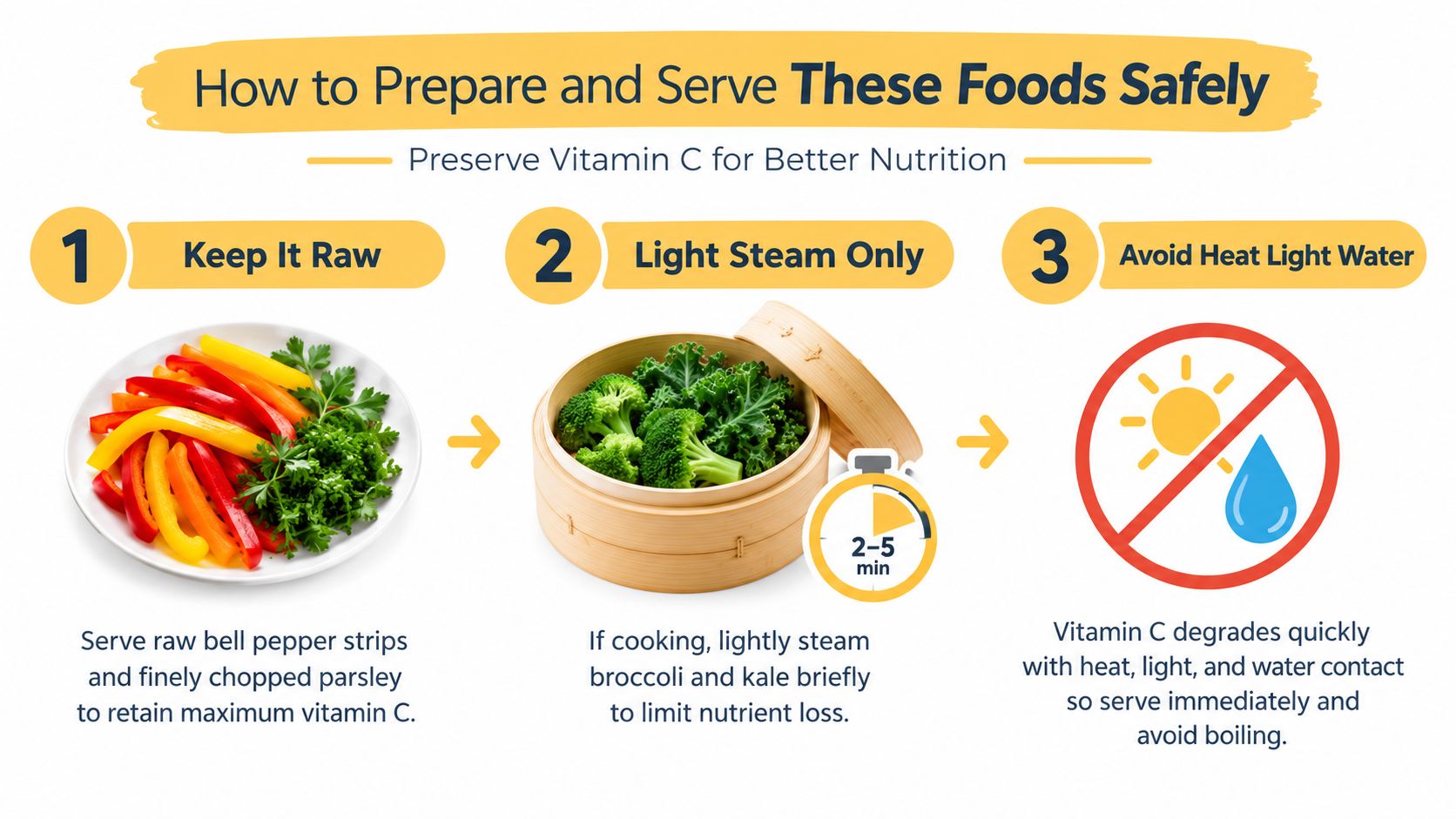
Raw, lightly cooked, or pureed
Raw works well for foods like thin bell pepper strips, finely chopped parsley, and blueberries that your dog can chew safely.
Light steaming is often better for broccoli or kale if your dog gets gassy from raw vegetables. Keep it brief. Boiling exposes food to more water and usually isn't my first choice when you're trying to preserve vitamin C.
Pureeing or blending can help picky dogs accept vegetables, but it also increases surface area. Once you've chopped, blended, or mashed a food, serve it promptly rather than letting it sit around.
Simple serving rules that prevent problems
- Match the cut size to the dog. Toy dogs need tiny pieces. Large dogs still need bite-sized pieces, not big slippery chunks.
- Serve soon after prep. If possible, offer the food within about 30 minutes of cutting.
- Keep extras cold. Refrigerate leftovers, ideally in glass rather than plastic.
- Don't let extras take over the bowl. These foods should stay under about 10 percent of daily calories.
- Use frozen fruit carefully. Flash-frozen produce can work well, but once thawed, don't refreeze it.
A practical guide to topper ideas can help you fit these foods into a normal meal instead of turning feeding into guesswork. This roundup of healthy dog food toppers is a good starting point for that bigger picture.
Here is a quick visual walk-through of prep basics:
A slow introduction works best
Try a five-day ramp-up instead of dropping a full serving into the bowl on day one.
- Day one Start very small. A teaspoon-sized amount for smaller dogs or a tablespoon-sized amount for larger dogs is a practical starting point.
- Days two and three Repeat the same amount if stool stays normal.
- Days four and five Increase slightly only if your dog is doing well.
Log what you see. Loose stool, gas, face rubbing, itchiness around the muzzle, or a lower appetite at the next meal all count as useful feedback.
Whole Foods Versus Vitamin C Supplements
Whole foods and vitamin C supplements solve different problems. Food gives you a broad, low-intensity way to add variety. Supplements give you tighter control, but they also raise the stakes if the dog doesn't need them.
That tradeoff matters because veterinary guidance notes there's generally no accepted general benefit to vitamin C supplementation in veterinary medicine for healthy animals, according to the Canadian Veterinary Medical Association discussion of vitamin C in veterinary medicine.
Side-by-side comparison
| Whole foods versus vitamin C supplements for dogs | ||
|---|---|---|
| Criterion | Whole Foods | Vitamin C Supplements |
| Dosage control | Less exact. Ripeness, storage, and prep change how much vitamin C ends up in the bowl. | More exact. Tablets, powders, or capsules allow tighter portioning. |
| Palatability | Often easier because dogs may accept vegetables or berries mixed into food. | Mixed. Some dogs refuse powders or chewables. |
| Nutrition beyond vitamin C | Adds fiber and plant compounds alongside the vitamin. | Usually focuses mainly on ascorbic acid. |
| Risk of overdoing it | Lower in normal feeding because fiber and bulk tend to limit how much owners give. | Higher if used casually or layered on top of a complete diet without a reason. |
| Use case | Best for owners who want gentle food-based variety. | Better reserved for situations a veterinarian has reviewed. |
Which route makes more sense
If your dog is healthy and you're trying to add fresh foods, start with food. It's easier to keep portions modest, and you're less likely to drift into “more is better” thinking.
If you're comparing supplement formats with your veterinarian, buffered forms sometimes come up in those discussions. For reference, The Patients Guide's buffered vitamin C is an example of the kind of product owners may encounter when looking at ascorbic acid options for themselves or asking what buffered vitamin C means.
A broader look at dog multivitamin supplements can also help if your question isn't really about vitamin C alone, but about whether your dog's overall diet needs support.
Dogs That May Actually Need Extra Vitamin C
“Dogs make their own vitamin C” is true, but it isn't the whole story for every dog in every condition.
Current owner questions often cluster around stress, aging, joint issues, illness, and home-prepared diets. The important nuance is that concern shifts away from classic deficiency and toward whether a dog might have subclinical insufficiency under higher demand or illness, a point discussed in this overview on vitamin C for dogs.

Dogs with a plausible reason for extra support
Some dogs deserve a closer look:
- Senior dogs may have less reserve when liver function declines or overall resilience changes with age.
- Working and sport dogs can face heavier metabolic demand during sustained training, competition, travel, or heat stress.
- Dogs recovering from surgery or illness may be dealing with a temporary mismatch between demand and normal production.
- Dogs on home-cooked diets can run into broader formulation gaps, and vitamin C questions often show up alongside those bigger issues.
These aren't automatic supplement candidates. They're dogs that may justify a more careful nutrition review.
Dogs who usually don't need the extra fuss
A healthy adult dog eating a complete commercial diet is still the least likely to benefit from routine vitamin C add-ons. That's the group most internet content skips over because “possible support” sounds more exciting than “probably unnecessary.”
The narrower the reason for using vitamin C, the more important it is to be precise.
If your dog falls into one of the higher-demand categories, it's smarter to review the whole immune and recovery picture rather than fixating on one nutrient. This guide to immune support for dogs can help frame that bigger discussion before you speak with your veterinarian.
Overdose Risks and Medication Interactions
Most food-based vitamin C mistakes are minor. A dog gets too much broccoli, develops gas, and reminds you the next day that enthusiasm isn't a feeding plan.
The bigger concern is supplement-driven excess, especially when owners combine multiple products without realizing vitamin C may already be present somewhere in the stack.
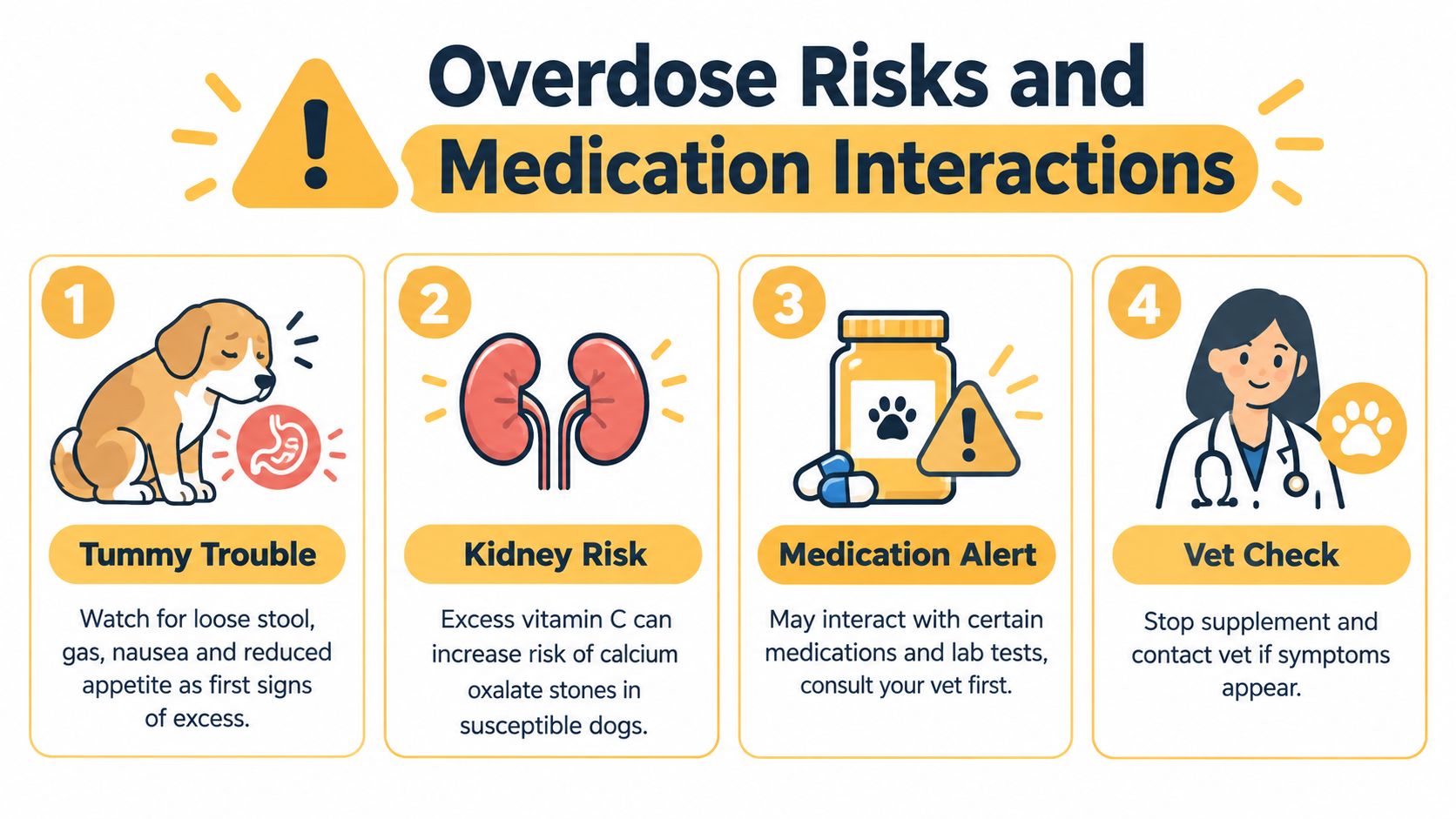
Early signs owners notice first
Watch for digestive changes before anything else:
- Loose stool
- Gas
- Nausea or lip licking
- Reduced appetite
- Vomiting
Those signs don't prove vitamin C is the cause, but they are common reasons to stop the new add-in and reassess.
Why chronic excess can matter
Long-term oversupplementation can affect the urinary environment in ways that may raise concern for dogs prone to calcium oxalate stones. That's one reason food-based use is usually gentler than casual supplement use. A dog is less likely to eat extreme amounts of pepper or berries than to receive repeated scoops, tablets, or chews because the label looked harmless.
Medication questions matter too. Vitamin C may affect how some drugs behave or how they are excreted. Caution is especially sensible with:
- NSAIDs
- Some antibiotics, including tetracyclines and sulfonamides
- Dogs on prescription regimens where urine acidity or excretion patterns matter
Stop the new supplement first. Then call your veterinarian if symptoms continue or your dog has any urinary history.
Red flags that need a vet call
Don't try to solve these at home with more diet tweaking:
- Persistent vomiting
- Blood in stool
- Lethargy with dehydration
- Any urinary straining
- A dog that seems painful, weak, or suddenly off
If you suspect an overdose or interaction, call your veterinarian or a pet poison hotline promptly.
When to Talk to Your Veterinarian First
Some dogs shouldn't start vitamin C foods or supplements casually, even if the idea sounds natural. Pause first and get guidance if your dog has a history of kidney or bladder stones, takes prescription medications, shows chronic digestive or urinary signs, or is a senior with declining organ function.
The same goes for puppies under twelve months and dogs eating home-cooked diets. In those cases, issue may be the full diet design rather than vitamin C alone.
A simple decision filter
Call your veterinarian before experimenting if any of these are true:
- Your dog has a urinary history. Stone-prone dogs need more caution.
- Your dog takes daily medication. Interactions are easier to prevent than fix.
- Your dog eats a homemade diet. Small nutrient questions often reveal larger formulation gaps.
- Your dog is ill, recovering, or slowing down with age. These cases need context, not guesswork.
What to ask during the appointment
Use direct questions:
- Is my dog's current diet already adequate without extra vitamin C?
- Should we review the whole diet instead of one nutrient?
- Would bloodwork or a urinalysis help before adding anything?
- If we do try a food-based approach, what signs should make me stop?
That last step matters most. The advice in this article assumes a healthy adult dog on a complete commercial diet. Once you move away from that baseline, a veterinary plan is safer than self-prescribing.
Pure Paw Labs focuses on science-backed, human-grade supplements for dogs, which is useful when you're trying to support the whole dog instead of chasing single nutrients in isolation. If you're weighing toppers, daily support, and how supplements fit alongside a complete diet, visit Pure Paw Labs to explore their approach.