


You're standing in the kitchen and a little dog trots in with the confidence of something twice its size. The body is low. The eyes are locked on everything. The ears seem to hear the mail carrier before you do. Then the dog launches into motion, quick like a ratting dog, sturdy like a herding dog, and suddenly “small mix” doesn't feel like a useful label anymore.
That's where many people start with a Min Pin Corgi mix. They expect a cute compact pet. What they meet is often a bold, busy, highly aware little worker in a small frame.
This mix gets attention because it blends two recognizable breeds, but the more useful way to understand it is simpler. Think herder plus ratter. That mental picture explains a lot of what owners notice right away: watchfulness, speed, opinionated behavior, and a body that may look short and manageable but still needs thoughtful care.
Some Min Pin Corgi mixes look sleek and fine-boned. Others look denser, longer, and more grounded. That variation is normal. Mixed breeds don't read a standard before they grow up.
Table of Contents
- Introduction to the Min Pin Corgi Mix
- Where the Parent Breeds Come From
- What a Min Pin Corgi Mix Looks Like and How Big It Gets
- Temperament and Personality to Expect
- Exercise Grooming and Daily Care Essentials
- Health Concerns and Preventive Screening
- Is This Mix Right for You and Next Steps
Introduction to the Min Pin Corgi Mix
A Min Pin Corgi mix often surprises people the first time they meet one. The dog may be short to the ground, but it doesn't carry itself like a lapdog. It usually moves with purpose, checks the room quickly, and seems ready to react to a toy, a sound, or a squirrel outside the window.

That first impression matters because it corrects a common mistake. People see “mini” in Miniature Pinscher and “small legs” in Corgi, then assume the mix will be easy, delicate, and content to lounge all day. In many homes, that's not how this dog behaves at all.
A compact dog with working roots
This isn't just a novelty cross with random traits. A Min Pin Corgi mix combines two parent types that were valued for doing jobs. One side brings alert, quick, barn-and-stable energy. The other brings control, movement, and the confidence to direct larger animals.
Put those together and you often get a dog that is:
- Small but intense when something catches its attention
- Fast to notice change at the door, yard, or window
- More athletic than fragile
- Best understood as active and sturdy, not ornamental
Practical rule: If you're choosing this mix because you want a tiny couch dog, pause and look again. The body may be small, but the working drive often isn't.
Why owners get confused
The confusion usually comes from appearance. A low body can make a dog look easygoing. A small frame can make owners underestimate exercise needs. A cute face can distract from the fact that this dog may want tasks, motion, and clear boundaries.
A better way to picture the Min Pin Corgi mix is this: a compact dog with a big engine. Not every individual will act the same, but that image sets better expectations than “designer small breed.”
If you're considering one, the key questions aren't just “How cute will it be?” or “How much will it shed?” The better questions are about structure, daily management, and whether you're ready for a dog that may stay busy in both body and mind.
Where the Parent Breeds Come From
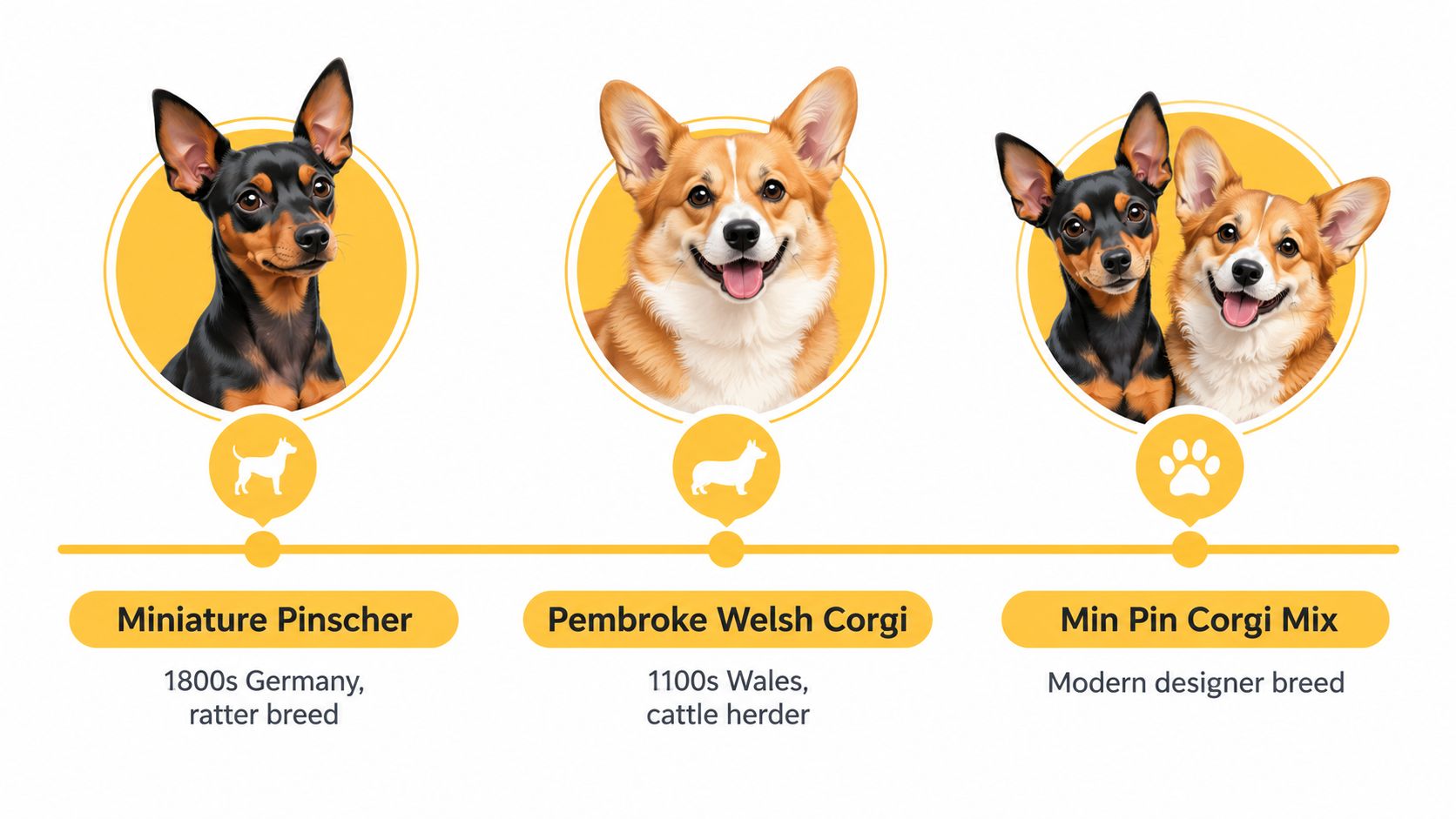
A Min Pin Corgi mix makes more sense once you look at the jobs behind the two parent breeds. This cross joins a small vermin hunter with a low-built cattle dog. That pairing helps explain why many of these dogs feel busy, sturdy, and far more work-minded than their size suggests.
The Miniature Pinscher side
The Miniature Pinscher comes from Germany and has a working background tied to ratting in barns and stables. Vetstreet's Miniature Pinscher breed history describes the breed as older than the Doberman Pinscher and links its development to dogs such as the German Pinscher, Dachshund, and Italian Greyhound.
That background matters because ratting dogs were built for quick reactions, sharp eyes, and repeated bursts of movement. In plain terms, this is the side of the mix that often brings the “spot it, chase it, investigate it” pattern.
It also helps explain why a Min Pin Corgi mix can look small yet act physically confident. A dog bred to clear vermin from working spaces was never meant to be delicate.
The Corgi side
The Corgi side brings a different kind of job. Bark Busters' Corgi breed background traces the Pembroke Welsh Corgi to old herding roots in Wales and notes that Pembrokes and Cardigans were later separated as distinct breeds.
Herding dogs work close to moving animals, often with quick changes in direction and a body that stays balanced near the ground. That low, sturdy outline is cute, but it is also functional. It was made for control and persistence, not idle lounging.
Owners need a more accurate picture. The Corgi contribution does not just change appearance. It can change how weight sits on the frame, how much stress lands on joints, and how carefully owners should manage growth, stairs, jumping, and body condition across life stages.
A related mix can make that easier to visualize. This look at a Corgi Sheltie cross shows how strongly Corgi structure and herding drive can shape a hybrid, even when the other parent brings a different working style.
Why the blend matters
Put those two histories together and the result is often a compact herder-ratter hybrid. One side contributes speed, vigilance, and prey interest. The other contributes a grounded build, pushy confidence, and the instinct to track movement.
That combination is why this mix should be evaluated like a small working dog with variable proportions. Some puppies will inherit a lighter, leggier frame. Others will carry more length, more bone, and more joint load. Understanding the parent breeds early helps owners plan better care from puppyhood instead of treating the dog like a simple toy-sized companion.
What a Min Pin Corgi Mix Looks Like and How Big It Gets
A Min Pin Corgi mix can fool people at first glance. The small size makes some owners expect a light little lapdog. In practice, many of these dogs are built more like compact workers, with a mix of speed, bone, length, and ground clearance that can vary a lot from one puppy to the next.
That variation is the first thing to plan for.
The parent sizes create a broad middle
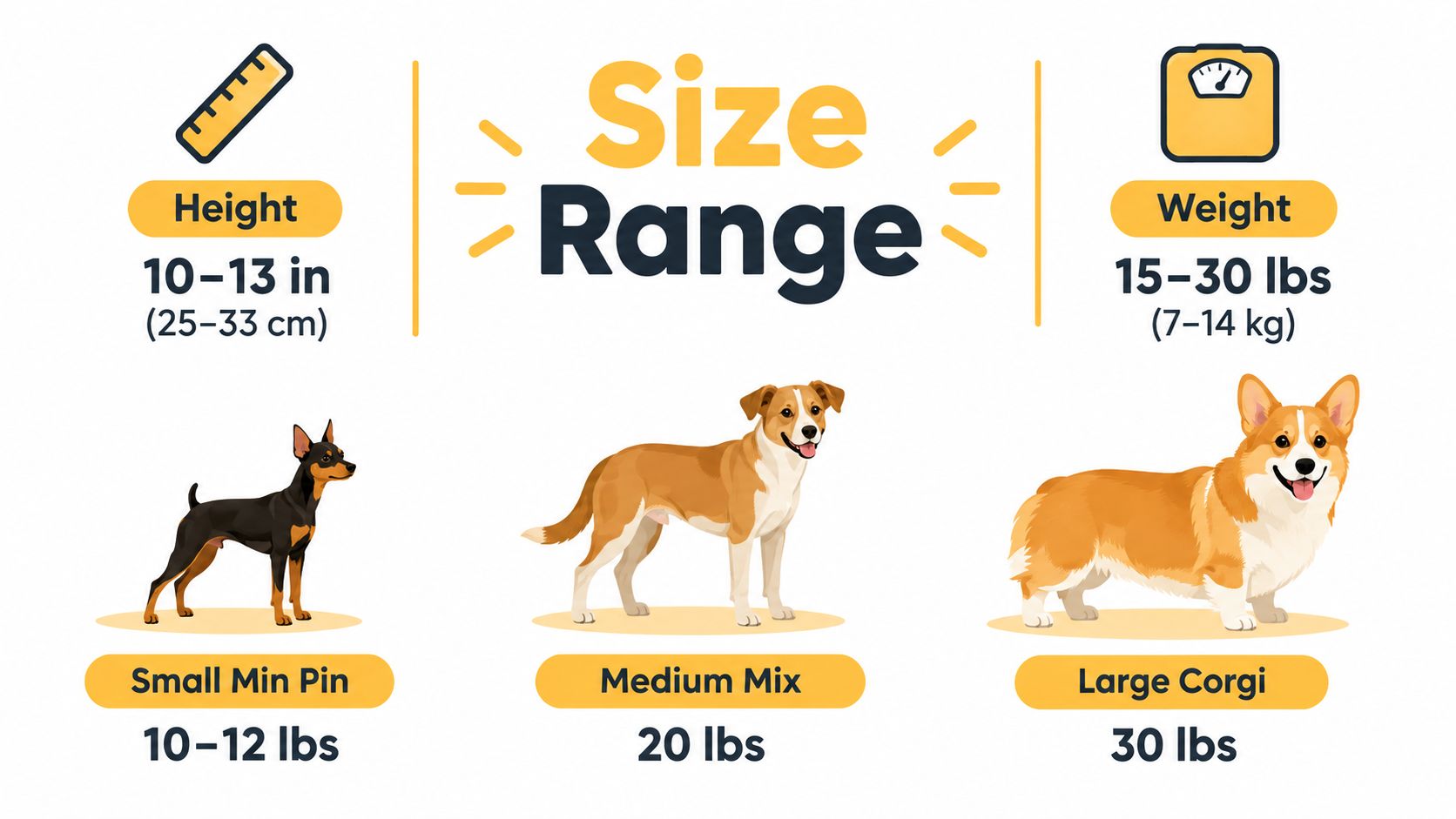
Miniature Pinschers usually stand about 10 to 12 inches at the shoulder and weigh about 8 to 11 pounds, according to Dimensions.com's Miniature Pinscher size reference. A Corgi mix can pull the outcome lower and longer, or leave the dog leggier and lighter through the body.
So the useful label here is small-to-medium with variable proportions.
That matters more than the number on a scale. Two Min Pin Corgi mixes can weigh about the same but move very differently. One may have longer legs and a narrow frame, like a quick little sprinter. Another may carry more body length, more chest, and more of its weight closer to the ground, like a short utility vehicle with a longer wheelbase.
What owners usually see
These are the features that tend to shift the most:
- Body length. Some dogs look compact and square. Others look stretched out through the back.
- Leg height. One puppy may stay fairly upright, while a littermate grows into a lower silhouette.
- Bone and chest. Some feel light in hand. Others feel dense and sturdy.
- Coat type. The coat may lie sleek and close, or come in fuller and softer.
This is why breed-label shopping often misses the mark. A harness made for a generic "small dog" may fit the neck but pinch the shoulder. A bed that seems roomy may still be too short for a longer-backed dog who likes to stretch out flat.
Buy for the dog's shape and measurements, not the mix name.
Why build matters as much as size
A low-set frame changes how force travels through the body. If your dog inherits more Corgi structure, extra pounds do not just make the dog look heavier. They can place more load on short limbs, joints, and the back, especially during jumping, stairs, and repeated hard landings.
A taller, lighter-built mix may handle the same routine more easily. A longer, lower dog often needs more thought about traction, body condition, and how often it launches off furniture. The difference is a lot like carrying a backpack. Weight carried on long, springy legs feels different from that same weight on a shorter frame with less clearance and more compression through each step.
Daily care choices add up fast:
| Daily item | Why it matters |
|---|---|
| Food portions | Small gains in body fat can change comfort and mobility in a low-built dog |
| Harness fit | Tight shoulder movement can alter gait and create rubbing |
| Furniture access | Frequent jumping can add repeated impact to a longer back and shorter front assembly |
| Floor traction | Slick floors can force twisting, scrambling, and awkward takeoffs |
For older dogs, some owners also look at support products aimed at mobility and whole-body aging. One example is DA-1™ Daily All-in-One - Senior Dog Support, Joints, Skin/Coat & More, which is described as a complete multi-system formula designed to help aging dogs move easier, feel brighter, and act like themselves again, with 18 human-grade ingredients targeting cells, gut, and joints, plus a 60-day money-back guarantee.
The safest assumption is simple. Expect a sturdy herder-ratter hybrid with an unpredictable blueprint. Measure the actual dog, watch how it carries its weight, and adjust care around the frame it grows into.
Temperament and Personality to Expect
Living with a Min Pin Corgi mix can feel like living with a very small supervisor. This dog often wants to know who's outside, what moved in the yard, why that cabinet opened, and whether everyone in the house is where they're supposed to be.
That's not bad behavior by default. It's usually a mix of awareness, confidence, and inherited workiness.

What each side may contribute
The Corgi side often brings a social, engaged, movement-oriented style. These dogs tend to notice patterns and can become very involved in household traffic. That may show up as following family members from room to room, trying to organize play, or getting excited when things become busy.
The Min Pin side often adds fearless alertness. That can look like quick barking at the door, bold reactions toward novelty, or a strong desire to investigate anything small and fast.
Put together, the blend may produce a dog that:
- Alerts quickly
- Chases readily
- Learns routines fast
- Can be independent when it wants to be
- Needs guidance, not just affection
Common real-life behavior
One Min Pin Corgi mix may bark when a delivery arrives, then calm down once you give a cue and redirect. Another may race toward the backyard fence because a squirrel triggered both prey drive and excitement.
Some also try gentle “herding” behavior with kids or other pets by circling, nudging, or shadowing movement. That doesn't mean the dog is aggressive. It means the dog may need clearer outlets and better interruption skills.
A household routine helps a lot. Dogs with this kind of energy often do better when they can predict walks, meals, training, and rest.
The goal isn't to suppress personality. It's to give that personality a job small enough to live with.
Training style matters
This mix usually responds best to short, clear sessions. Harsh handling can create pushback or make alert behavior louder. Calm repetition, reward-based training, and early social exposure tend to shape a steadier adult dog.
If your dog startles easily or stays keyed up after exciting moments, resources on stress relief for dogs can help you build a calmer routine around decompression, enrichment, and recovery time.
A Min Pin Corgi mix often does well with owners who enjoy interacting with their dog, not just owning one. If you want a pet that blends into the furniture, this probably isn't your match. If you enjoy a clever little dog with opinions, it may be.
Exercise Grooming and Daily Care Essentials
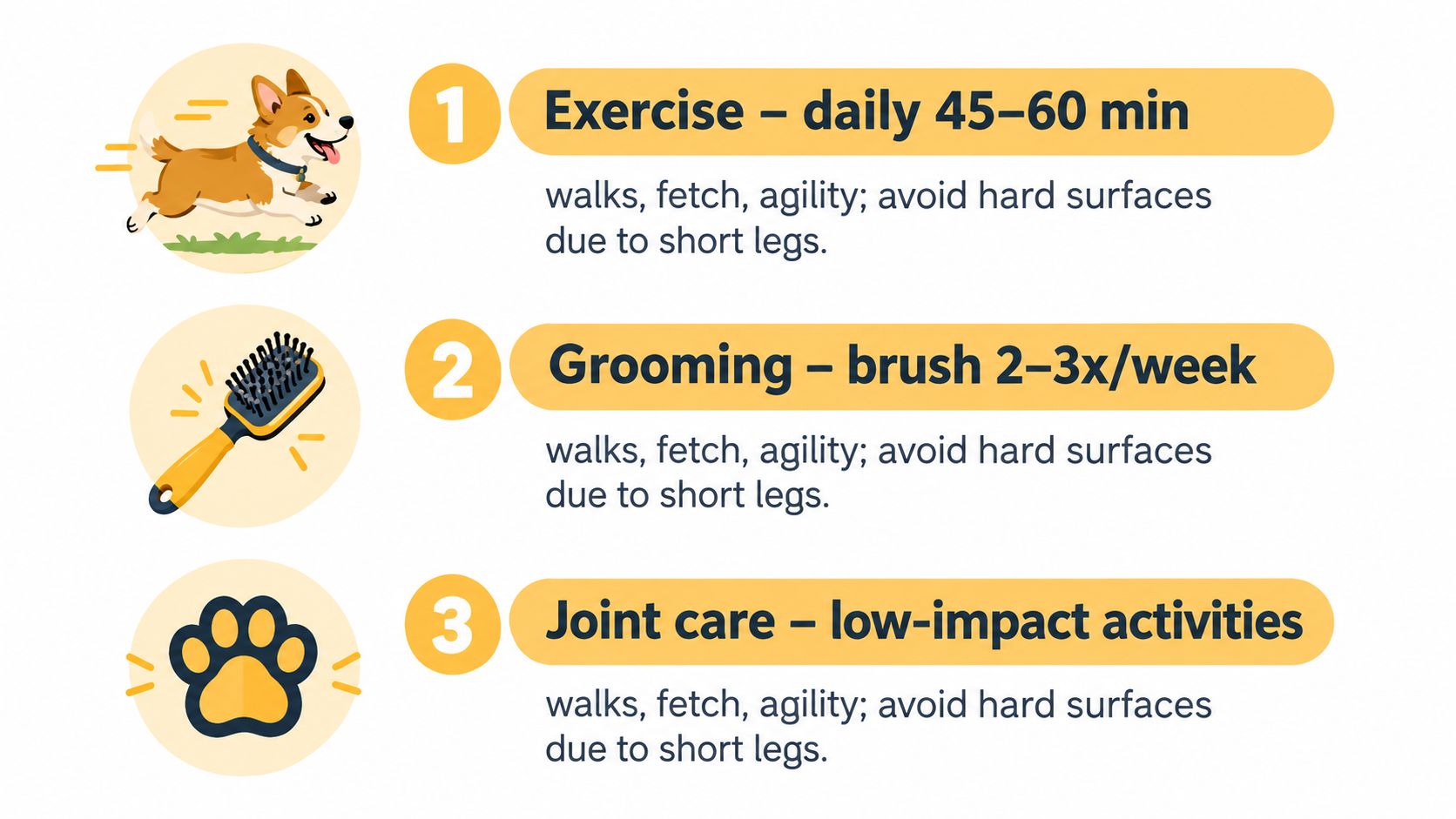
A Min Pin Corgi mix usually needs daily activity, but the best kind isn't endless pounding exercise. Think controlled bursts, steady walks, and brain work, not reckless repetition.
That distinction matters because this dog may act tireless while still having a body that benefits from low-impact choices.
Daily movement that helps instead of hurts
Good exercise for this mix usually looks like:
- Purposeful walks that let the dog sniff, track, and observe instead of just marching for distance
- Short play sessions with toys or recall games in a safe area
- Low jumps or no jumps when the dog is built longer and lower
- Frequent but manageable sessions rather than one chaotic workout
A useful way to think about it is this. You're not training for a marathon. You're managing a small athlete with a body that may have uneven proportions.
For owners who need fresh ideas, PawCraft's guide to mental stimulation activities for high-energy breeds is a helpful starting point for adding puzzle work, scent games, and task-based play.
Grooming tends to be straightforward
Coat care depends on what the dog inherits, but many Min Pin Corgi mixes fall into the short-to-medium coat range. That usually means regular brushing, checking ears, wiping paws after muddy outings, and keeping nails from getting too long.
A simple routine works well:
- Brush on a set schedule so loose hair doesn't build up.
- Check the feet and nails because low dogs pick up debris easily.
- Look over the skin and coat during handling so you notice changes early.
Many owners skip grooming until shedding becomes obvious. It's easier to think of grooming as inspection time, not just beauty care.
Home habits that make life easier
These dogs often thrive when owners make the house easier on the body and mind.
- Use rugs or traction runners on slippery floors when needed
- Teach settle time after exciting activity so arousal doesn't stay high all evening
- Rotate enrichment, such as sniffing games, simple obedience reps, food puzzles, or hide-and-seek
- Keep stairs and jumping in view, especially if your dog is long-backed or low to the ground
A dog can be energetic and still need impact management. Those two facts often live together in this mix.
A sample day owners can actually use
Morning might be a brisk walk with sniff breaks. Midday can be a short training session or toy search game. Evening can be another walk, a calm chew, and a settling routine.
That kind of rhythm usually works better than letting the dog get bored all day, explode with energy, then race around the house at night.
Health Concerns and Preventive Screening
A Min Pin Corgi mix can look small, but health planning should be closer to what you would do for a compact working dog than a lapdog. This cross often combines a low, sturdy frame with a quick, bold movement style. That mix of shape and drive is part of the appeal. It also means the body can carry force in uneven ways if proportions lean long-backed, short-legged, or both.
Mixed breeding does not erase inherited risk. A dog can still pick up health liabilities from either side, including concerns noted in WebMD's Miniature Pinscher health overview.
What owners should watch most closely
For this mix, the big picture is simple. You are watching the parts that absorb wear first.
The Miniature Pinscher side is associated with eye disease such as progressive retinal atrophy, kneecap instability, and seizure disorders, as noted in the source above. The Corgi side adds a separate structural question. If your dog inherits a longer back with shorter legs, the spine and joints may carry daily impact less efficiently than they would in a more square-built dog.
That is why the main watch list usually includes:
- Eyes and vision changes
- Knees and rear-leg tracking
- Gait, especially skipping, stiffness, or uneven steps
- Back comfort during normal movement
- Body weight over the dog's whole life
A useful way to picture it is this: some Min Pin Corgi mixes are built more like a small athlete on tall legs, while others are built more like a low toolbox on short supports. Both can be lively, sturdy dogs. The lower, longer build usually needs tighter impact management because each extra pound and each hard landing puts more load through the frame.
If you want a clearer visual for how limb structure affects movement, this plain-language guide to dog leg bones and weight-bearing structure helps connect anatomy to what you see at home.
Screening matters more when the dog looks "fine"
These dogs can compensate well. A young adult may still run, play, and race to the door while hiding the early signs of joint or back strain.
That is why preventive screening works best before there is an obvious problem. Eye checks, knee exams, gait assessment, and regular body-condition review give you a baseline. Once you know what normal looks like for your dog, small changes are easier to catch.
Ask your vet or breeder practical questions such as:
| Question | Why it helps |
|---|---|
| Is there any family history of eye disease? | Some eye problems are easy to miss early at home |
| Have the parent dogs had kneecap or gait issues? | Limb mechanics often run in lines, even in mixes |
| What body condition should this dog stay at? | A lean frame reduces joint and back load |
| Should this dog avoid frequent jumping from furniture or stairs? | Structure, not just size, affects impact tolerance |
Prevention changes with age
Puppies need controlled growth, steady footing, and reasonable exercise, not constant jumping and twisting. Adolescents need owners who do not mistake reckless speed for durability. Adults benefit from weight control, muscle maintenance, and prompt attention to stiffness or skipping. Seniors often need closer monitoring for vision changes, arthritis, and reduced confidence on slick surfaces.
That life-stage approach gets skipped in many breed profiles, but it matters here.
A Min Pin Corgi mix is often a herder-ratter hybrid in a small package. Treating that dog like a delicate toy misses the point. Treating it like a sturdy little worker with specific structural limits usually leads to better long-term care.
Is This Mix Right for You and Next Steps
A Min Pin Corgi mix can be a great match for the right home, but it's rarely the right choice for someone who wants a passive pet. This dog usually fits best with people who enjoy routine, interaction, and daily involvement.
If you like smart little dogs that stay mentally present, this mix can be a lot of fun. If you want a dog that asks very little of you, it may feel like more project than companion.
Homes where this mix often fits well
This mix may suit you if:
- You enjoy active daily engagement, not just quick potty walks
- You can manage training consistently and won't laugh off every alert bark as “cute”
- You're willing to watch body condition closely
- You can offer enrichment when the dog is home with you
- You understand that small doesn't always mean low maintenance
Situations that may be harder
A Min Pin Corgi mix may be less ideal if:
- You're gone for long stretches and the dog will spend many hours under-stimulated
- You want a very quiet dog
- You expect a classic lapdog temperament
- You aren't prepared to manage stairs, jumping, or weight if structure calls for it
A quick decision filter can help:
| If you want... | This mix may be... |
|---|---|
| A bold, interactive small dog | A strong candidate |
| A calm, low-energy companion | A weaker match |
| A dog with working-dog personality in compact form | A very plausible fit |
| A predictable standard look | Less reliable than a purebred |
Smart next steps before bringing one home
Meet the actual dog if you can. Watch how it moves, how it settles, and how it reacts to noise and novelty. Ask about eye history, knee issues, and any signs of back sensitivity in the parent dogs or close relatives.
Then prepare your home for the dog's likely reality, not its cute photo. That means traction where needed, a properly fitted harness, clear routines, and a plan for both exercise and recovery.
A Min Pin Corgi mix is often at its best when owners respect both halves of the dog. Not toy. Not fragile. More like a compact worker built for company, motion, and a little mischief.
Pure Paw Labs offers dog supplements made for practical daily support, including areas that matter for active, compact mixes such as joints, skin and coat, digestion, and overall wellness. If you're building a preventive care routine for a Min Pin Corgi mix, visit Pure Paw Labs to see products and educational resources designed for dog owners who want simple, consistent support.