


You're answering emails when the dog wedges himself between your feet, ears swiveling toward a delivery truck. A moment later, he's racing through the living room, turning sharply around the furniture and trying to organize everyone into one moving group. That's daily life with many Corgi Sheltie crosses, a compact herding mix that can be affectionate, clever, noisy, athletic, and structurally more delicate than its playful personality suggests.
This guide focuses on the practical questions that matter after the first meeting: how much the mix may shed, why barking and heel-nipping can appear, how to protect a long back carried on short legs, and why a mixed-breed label doesn't erase inherited health risks. The individual dog can vary considerably, so treat breed tendencies as planning information, not a guarantee.
Table of Contents
- Meet the Corgi Sheltie Cross
- Appearance Size and Coat Variations
- Temperament and Family Compatibility
- Exercise Needs and Mental Enrichment
- Common Health Issues and Lifespan
- Training Tips and Socialization
- Nutrition and Daily Supplement Support
- Is a Corgi Sheltie Cross Right for You
Meet the Corgi Sheltie Cross
The Corgi Sheltie cross, also called a Pembroke Sheltie or Sheltie Corgi, combines the Pembroke Welsh Corgi with the Shetland Sheepdog. Independent breed summaries describe it as a medium-sized dog, generally around 30 to 40 cm tall and 8 to 14 kg, with an expected lifespan of 12 to 15 years. Because it's a mixed breed, proportions and appearance can differ substantially between litters (breed overview).
The appeal is easy to understand. Families often want a dog that's smaller and more manageable than a large collie-type herder, while still offering the Sheltie's attentiveness and the Corgi's bold, companionable character. Apartment living can work, but only when the owner supplies daily activity, training, and noise management. A smaller body doesn't mean a low-work dog.
Two working histories in one dog
The Pembroke Welsh Corgi developed as a low-slung Welsh cattle dog. Its short legs helped it move beneath kicking cattle, while heel-nipping and quick directional changes helped drive livestock. That history can still appear as chasing feet, circling children, or intense interest in movement.
The Shetland Sheepdog originated as a compact Scottish farm dog associated with managing small livestock on the Shetland Isles. Its work favored watchfulness, responsiveness, and close cooperation with a handler. Historical references describe the Pembroke's roots reaching back to around 1100, while the Sheltie's history includes accepted crossbreeding practices in the United Kingdom, with offspring bred back for three generations before purebred registration (historical breed background).
The deliberate mix is modern rather than an established old breed. That matters because there isn't a long, standardized breed history establishing a consistent size, coat, temperament, or health profile. You're choosing a combination of inherited traits, not a uniform blueprint.
What each parent may contribute
| Trait | Pembroke Corgi influence | Sheltie influence | Result in the cross |
|---|---|---|---|
| Body | Long-backed, short-legged frame | Finer, more balanced structure | Compact dog with variable proportions |
| Working style | Heel-nipping, boldness, food motivation | Gathering, alertness, handler focus | Smart dog that may chase, circle, or bark |
| Coat | Dense double coat and seasonal shedding | Longer coat, mane, and feathering | Coat length can range from moderate to quite full |
| Communication | Expressive and persistent | Vocal and watchful | Alert barking may be prominent |
| Training | Clever but occasionally independent | Biddable but sensitive | Responds best to clear, reward-based guidance |
First-generation puppies can be relatively predictable in broad size, but coat texture and ear carriage may still surprise you. One puppy may look strongly Corgi-like, while a littermate has a longer Sheltie-style coat, finer features, or different tail carriage. Ask the breeder to show adult relatives, not just the parents, because family history gives a better sense of the range.
Appearance Size and Coat Variations
A Corgi Sheltie cross commonly falls into a compact medium range. One breed reference reports adult dogs around 12 to 15 inches in height and 14 to 30 pounds, while another describes the mix at roughly 30 to 40 cm and 8 to 14 kg (reported size range). Those ranges overlap but aren't identical, which reflects the mix's variable inheritance.
The scale matters less than the outline. Look for the long back, short legs, deep chest, and overall proportion. A dog with a Corgi-like frame may manage ordinary walking well but struggle with repeated jumping from furniture, fast stair use, or explosive turns on slippery floors. Body condition is more informative than a target number. You should be able to feel the ribs under a light covering, see a waist from above, and avoid a heavy abdominal roll.

Coat and color possibilities
Most dogs have a double coat, but the presentation may fall into three broad patterns:
- Corgi-dominant: Shorter, dense fur with moderate feathering.
- Sheltie-dominant: Longer, rougher hair with a mane, leg feathering, and a fuller tail.
- Intermediate: Medium-length coat with light feathering on the chest, legs, and tail.
Sable, red and white, black and tan with white markings, blue merle, and other combinations can occur. If merle is present, responsible breeding should avoid pairing two merle parents because that pairing can increase hearing and vision risks. Ear carriage may be fully erect, tipped, or uneven, and tail length can be full, bobbed, or long.
Coat care also depends on skin condition, not only length. A practical dog skin and coat guide can help you distinguish ordinary shedding from persistent itching, odor, scaling, or hair loss. For cold-weather decisions, use a breed and size warmth guide, especially if your dog has a shorter coat, low body fat, or reduced tolerance for cold.
For owners considering general support as a dog ages, DA-1™ Daily All-in-One, Senior Dog Support, Joints, Skin/Coat & More is described as a complete formula with 18 human-grade ingredients aimed at cells, gut, and joints. It's a supplement option, not a replacement for weight control or veterinary assessment.
Temperament and Family Compatibility
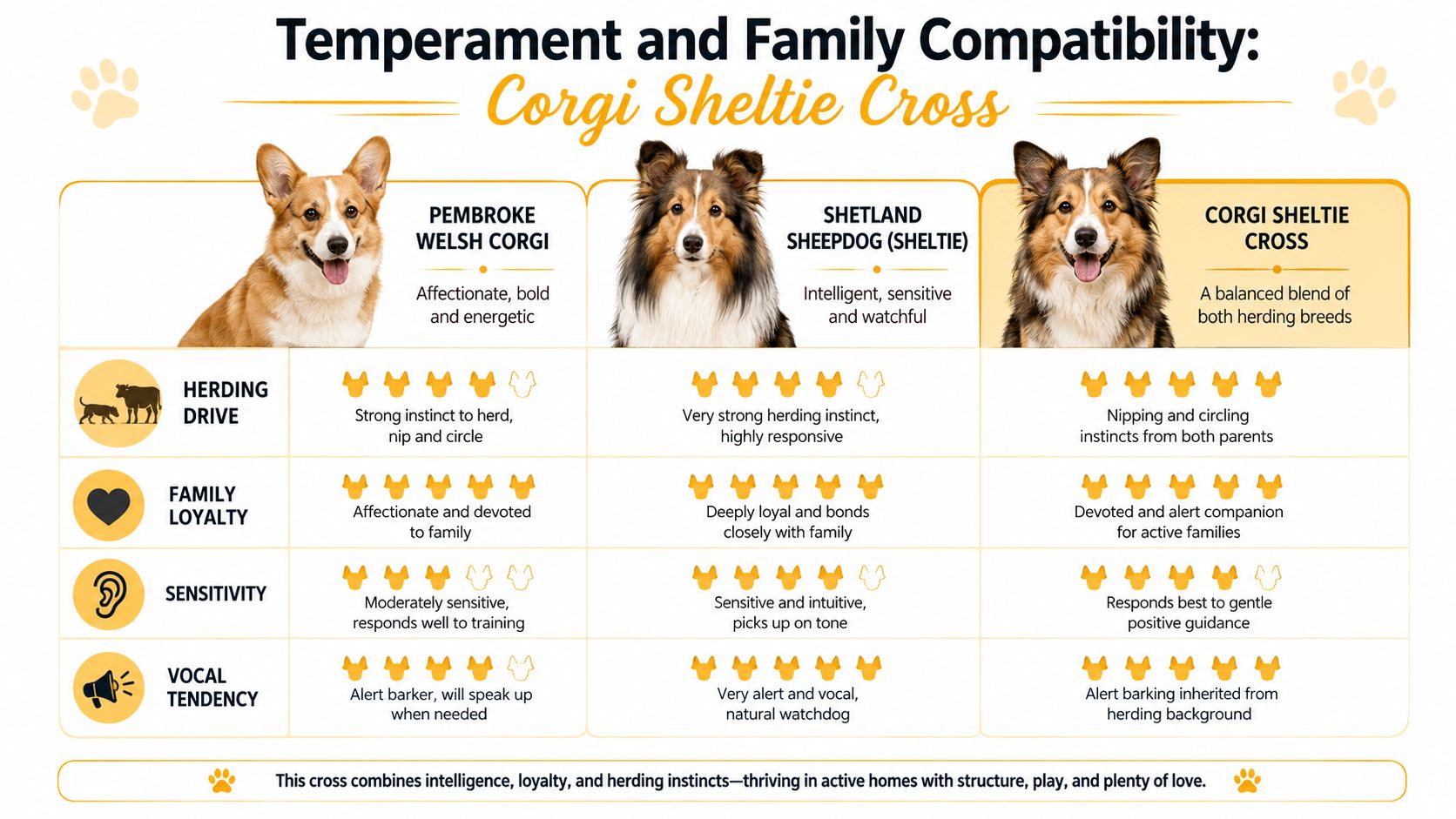
This mix doesn't produce a middle-of-the-road personality by averaging two breeds. It can combine the Corgi's direct, physical herding style with the Sheltie's watchful, sensitive approach. In practical terms, that may mean a dog that notices every movement, follows one or two people closely, and reacts quickly to sounds outside.
Children, visitors, and household movement
Respectful children can be a good match because the mix often enjoys interactive play and family involvement. The concern is movement control. Running children may trigger circling, chasing, barking, or heel-nipping, especially during puppyhood. Adults need to interrupt the behavior calmly, give the dog an alternative task, and teach children not to encourage chase games.
Alert barking is different from constant nuisance barking, but the first can become the second if every window reaction receives attention. Reward quiet observation, manage visual access to busy streets, and teach a predictable response to door sounds. Early exposure to people, surfaces, household noises, and calm dogs helps shape the dog's reactions, but socialization doesn't mean forcing contact.
Cats and small pets require careful introductions. A dog that wants to herd livestock may still chase a fast-moving cat or small animal. Use barriers, leashes, and short supervised sessions, then reward calm disengagement. Never assume that affection toward people guarantees safe behavior toward smaller animals.
The mix may be emotionally sensitive and behaviorally stubborn in the same afternoon. Harsh handling can make a Sheltie-influenced dog worried, while vague rules invite a confident Corgi-influenced dog to improvise. Owners who provide calm boundaries, regular work, and predictable rest usually get a more settled companion. For additional context on related herding mixes, see this guide to shepherd and Corgi mix traits.
Exercise Needs and Mental Enrichment
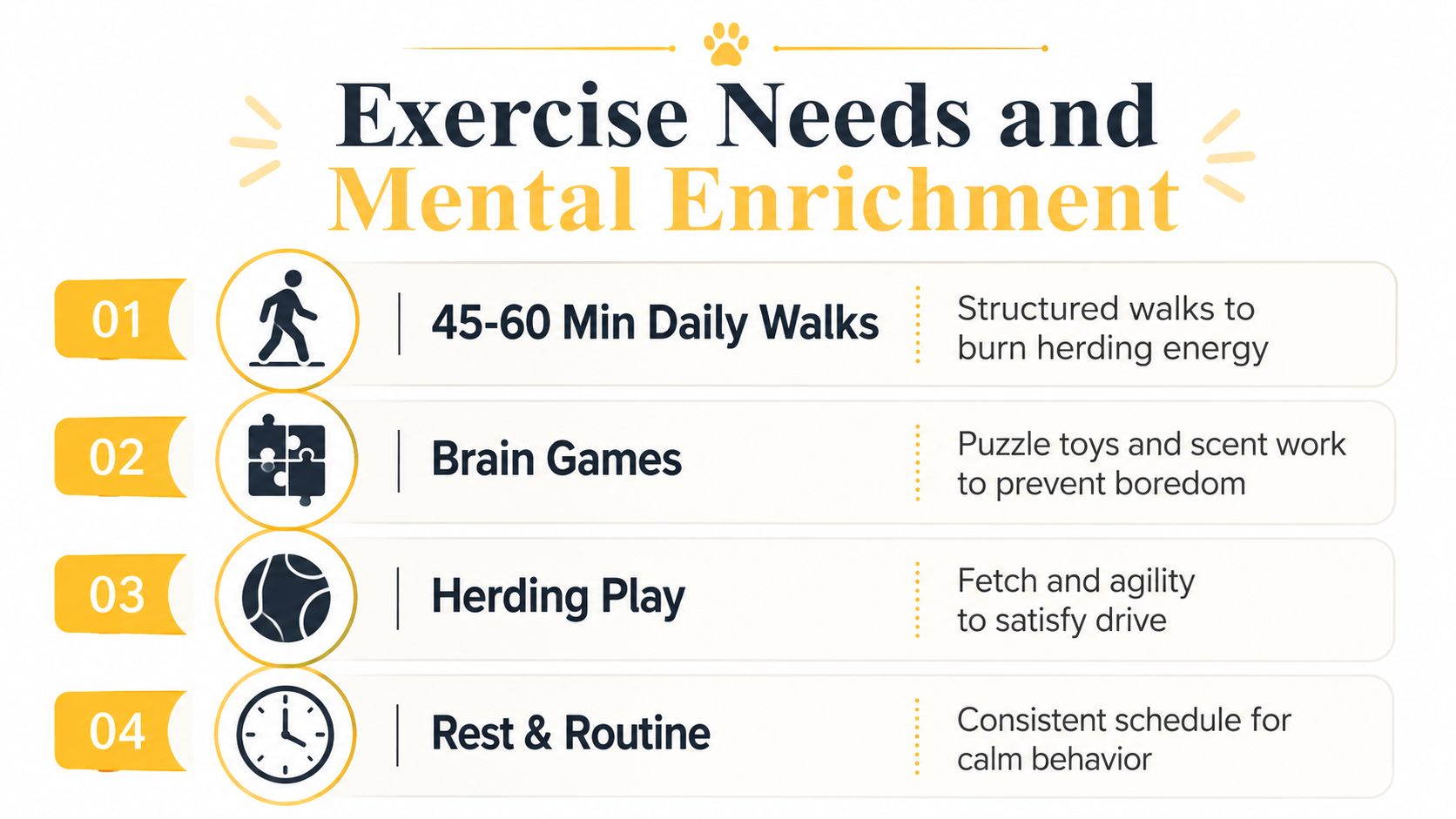
A healthy adult Corgi Sheltie cross needs more than a quick bathroom walk. Plan for roughly 45 to 60 minutes of structured walking daily, split into two or three outings, with adjustments for age, health, weather, and individual stamina. That structure matters because long sprint sessions and repeated jumping can place more stress on a long-backed, short-legged dog than steady movement does.
A useful day might include a calm morning walk with sniffing, a short midday training game, and an evening outing with controlled changes of direction. Moderate jogging may suit some adults, but stop if the dog shows stiffness, reluctance, shortened steps, or delayed soreness. Avoid encouraging repeated leaps from furniture, high-impact landings, and frantic ball chasing on slick ground.
Build work around decisions
Herding dogs often tire more effectively when they must think. Try rotating:
- Scent searches: Hide pieces of the regular meal around one room and let the dog locate them.
- Controlled chase: Use a flirt pole briefly, with pauses, releases, and a clear settle afterward.
- Food puzzles: Change the difficulty rather than leaving the same dispenser available every day.
- Obedience games: Practice name response, hand targeting, recall, place, and loose-leash turns.
- Trick intervals: Use short sessions during work breaks, ending before the dog becomes frantic.
Mental fatigue can reduce restlessness more efficiently than adding another repetitive walk. That's particularly important in an apartment, where a dog may have limited space but still needs meaningful tasks. A snuffle mat, a cardboard search setup, or a few minutes of shaping behavior can turn indoor time into useful work.
Grooming that prevents problems
Brush at least several times each week with a slicker or pin brush. During seasonal coat loss, add an undercoat rake, and work carefully behind the ears, in the armpits, and through the rear feathering, where tangles hide easily. Brush first against the coat in small areas to lift loose undercoat, then smooth with the grain.
Bathe when the coat is dirty, often around every 6 to 8 weeks, using a mild dog shampoo. Over-bathing can remove protective oils and aggravate irritated skin. Check ears weekly if they're tipped or partly folded, trim nails about every 3 to 4 weeks, and brush teeth daily when your dog accepts it.
Trim paw-pad and sanitary hair for cleanliness, but don't shave the body. The double coat helps with insulation, and clipping can change its texture and protective function. If you use exercise videos for ideas, adapt jumping and obstacle work to your dog's body rather than copying every movement.
Common Health Issues and Lifespan
Crossing two breeds doesn't automatically remove inherited disease. A large study covering 27,254 cases found no significant breed-status difference for 13 of 24 disorders, while some conditions were more common in purebreds and ruptured cranial cruciate ligament was more common in mixed-breed dogs (breed-status health study). More recent population work reported that only 20.74% of mixed-breed dogs had no medical conditions, compared with 22.3% of purebreds (comparative veterinary study).
For this mix, the most practical concern is the interaction between inheritance and body structure. A long spine supported by short legs can make back strain and intervertebral disc disease especially important to monitor. Hip dysplasia, eye disorders such as progressive retinal atrophy or cataracts, von Willebrand's disease, degenerative myelopathy, and MDR1-related drug sensitivity may also matter depending on family lines and testing.
Health risks by parent contribution
| Condition | Primary parent contribution | Prevention strategy |
|---|---|---|
| Back strain and disc disease | Corgi-like long back and short legs | Limit jumping, manage weight, use ramps |
| Hip dysplasia | Potential contribution from either parent | Ask for documented hip evaluation |
| Degenerative myelopathy | Possible Sheltie family-line concern | Discuss family history and testing |
| Progressive retinal atrophy and cataracts | Possible inherited eye risk | Request eye screening and veterinary exams |
| Von Willebrand's disease | Inherited clotting risk | Ask whether parent dogs received appropriate testing |
| MDR1 drug sensitivity | Possible herding-dog medication sensitivity | Tell every veterinarian the dog's breed mix |
The expected lifespan is 12 to 15 years according to breed references (lifespan and breed profile). Prevention starts at home: keep the dog lean, use ramps instead of repeated jumps, place rugs on slippery flooring, and seek veterinary care for sudden back pain, weakness, dragging toes, or reluctance to move. A discussion of joint support for dogs should complement, not replace, a veterinary plan.
Training Tips and Socialization
Train this mix as a sensitive working dog, not as a decorative small companion. Both parent breeds can learn quickly, but heel-nipping, chasing, circling, and alarm barking appear early when the puppy lacks an appropriate outlet.
The most valuable socialization period begins in puppyhood, commonly discussed as 3 to 14 weeks, with exposure to different people, surfaces, sounds, handling routines, and healthy vaccinated dogs. Keep experiences brief and positive. A puppy class can provide controlled practice, but the class should prioritize safe interactions and handler education over chaotic free-for-all play.
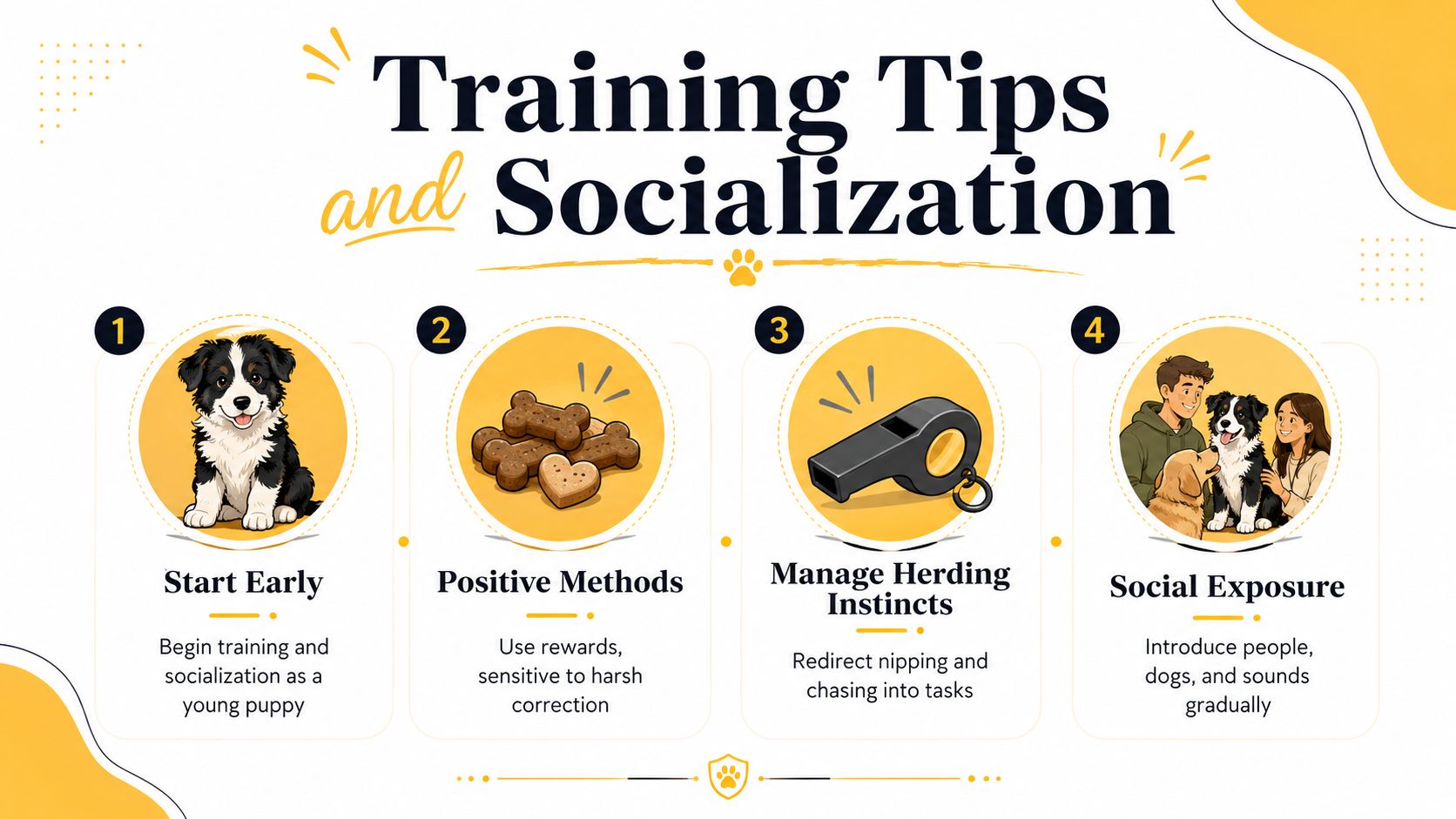
Use a marker such as a soft click or a consistent “yes,” then deliver a reward immediately. Five-minute sessions, repeated two or three times daily, are usually easier for a young dog than one long lesson. Practice name response, hand targeting, waiting at doors, dropping objects, settling on a mat, and looking back at you when a distraction appears.
For a rescue, allow decompression rather than demanding instant obedience. The familiar 3-3-3 rule can serve as a broad planning reminder, but individual dogs need individual pacing. Resource guarding, leash reactivity, and over-arousal deserve a qualified behavior plan, especially if the dog growls, snaps, or cannot recover after a trigger.
Harsh corrections often damage trust in a dog that already watches human emotion closely. Clear boundaries and reward-based redirection teach the behavior you want without making the dog afraid to try.
Nutrition and Daily Supplement Support
Nutrition should protect the dog's frame while supporting an active working temperament. Choose a complete and balanced food appropriate for the dog's life stage, then measure meals rather than estimating by eye. Calorie needs vary with ideal body weight, age, activity, reproductive status, and health, so your veterinarian's body-condition assessment should guide adjustments.
Protein quality and digestibility matter, but labels alone don't determine whether a diet suits your individual dog. Watch stool quality, coat condition, appetite, energy, and body shape. Keep treats controlled, use part of the regular meal for training, and weigh the dog regularly enough to notice a gradual change before extra weight burdens the back.

Supplement decisions should follow the dog
A supplement may be reasonable when a veterinarian identifies a specific need, but it shouldn't compensate for an unbalanced diet, excess weight, poor exercise design, or untreated itching and pain. Puppy formulas require particular caution because unnecessary calcium or high-dose vitamin D can be harmful. Senior dogs may need a different approach from growing dogs, and medication interactions should always be reviewed professionally.
Some owners prefer one daily product instead of several separate powders. Pure Paw Labs' DA-1™ Daily All-in-One is described by the manufacturer as a human-grade powder intended to support joints, skin and coat, digestion, immunity, and stress through a once-daily food topper. Use any supplement according to its label and your veterinarian's advice, particularly if your dog has a diagnosed condition or takes medication.
The central nutrition rule is simple: feed for the dog's ideal body condition, not for the begging face. A lean, well-muscled dog has a better foundation for comfortable movement than a dog carrying extra weight, regardless of how premium the food or supplement appears.
Is a Corgi Sheltie Cross Right for You
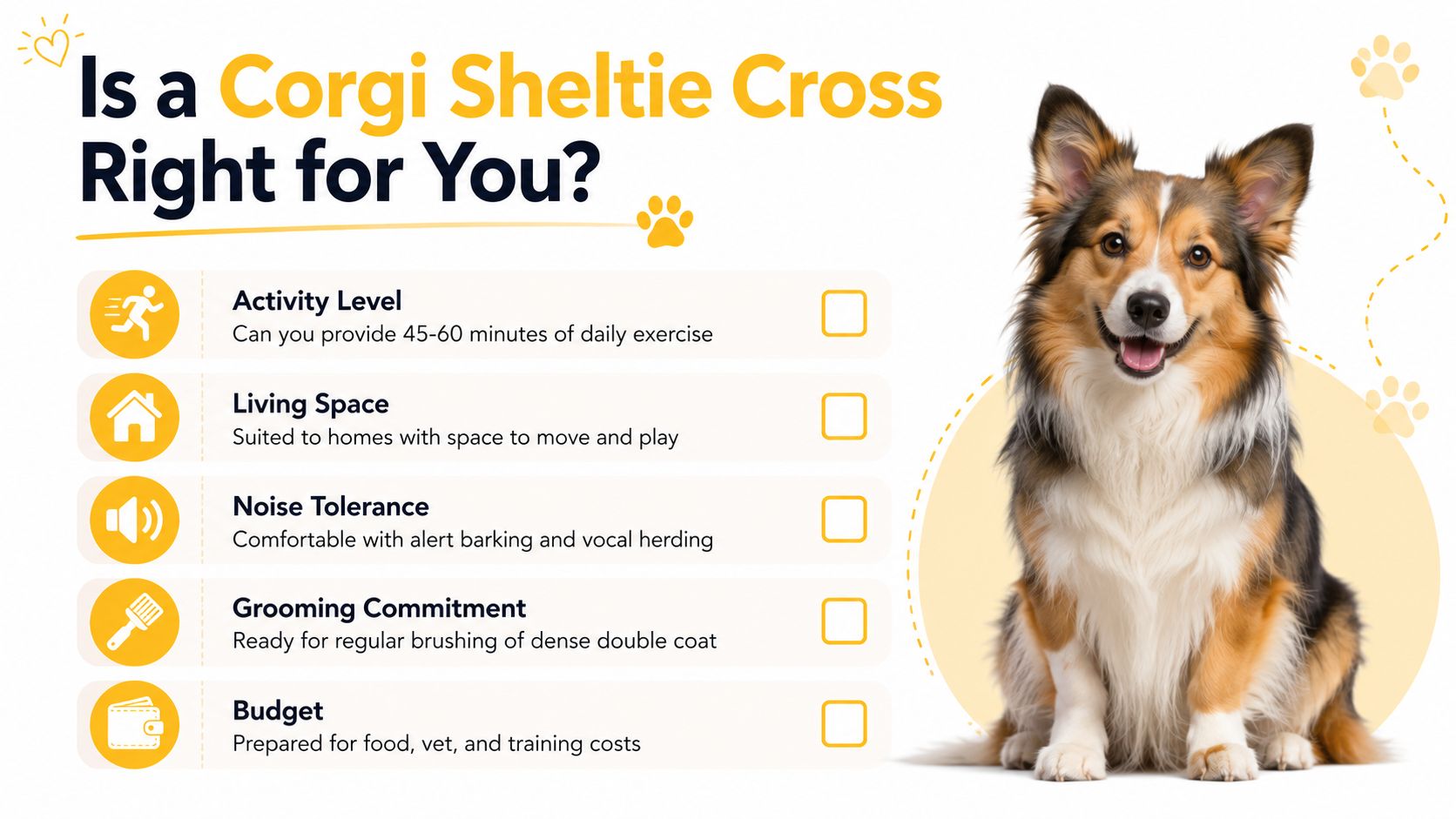
This mix can thrive with an owner who enjoys training, accepts some vocal behavior, and treats grooming and weight control as routine care. It may suit a smaller home if you provide structured walks, indoor enrichment, safe flooring, and calm management of alert barking. Space alone won't satisfy a herding dog.
Before committing, ask yourself:
- Activity: Can you provide daily structured exercise and mental work?
- Noise: Can you tolerate alert barking while actively teaching quiet behavior?
- Grooming: Will you brush regularly and inspect ears, skin, nails, and teeth?
- Household fit: Can children follow rules about chasing, handling, and rest?
- Long-term care: Are you prepared for a 12 to 15 year commitment (breed lifespan reference)?
For a puppy, request parent health records covering hips, eyes, von Willebrand's disease, and any relevant family-line concerns. Ask how the litter has experienced handling, household sounds, surfaces, visitors, and safe canine interaction. Read the contract carefully, including return provisions and health guarantees, and avoid choosing only by color or the most outgoing puppy.
The first three steps are practical: speak with a veterinarian about preventive care, inspect the home for jump-heavy routines and slippery floors, and create a weekly plan for exercise, training, grooming, and rest. This mix is a strong fit for involved owners who enjoy a clever dog with opinions. A calmer alternative may be wiser for households that are away most of the day, cannot manage shedding or barking, or don't want to redirect herding behavior.
Pure Paw Labs offers daily supplement options designed to consolidate support for areas such as joints, skin and coat, digestion, immunity, and stress. Visit Pure Paw Labs to review the formula and decide with your veterinarian whether it fits your Corgi Sheltie cross's age, diet, and health needs.