


The most popular advice about preventing dog allergies is also the least reliable: choose a “hypoallergenic” breed and assume the problem is solved. No dog is completely hypoallergenic, and bathing, breed selection, or buying a particular coat type can't remove every allergen from a shared home.
A better approach treats prevention as exposure control plus early-life risk management. You reduce the allergens carried into the house, protect sleeping areas, control fleas, support the dog's skin barrier, and involve a veterinarian when inherited susceptibility or persistent symptoms changes the equation. That's how to prevent dog allergies in real homes, without relying on a breed myth or a quick-fix remedy.
Table of Contents
- Why the Hypoallergenic Dog Myth Misses the Point
- Understanding Canine Allergy Triggers and Allergen Biology
- Creating an Allergen-Reduced Home Environment
- Grooming Routines and Parasite Prevention That Lower Allergens
- Diet, Supplements, and Early-Life Prevention Strategies
- When Prevention Requires Veterinary Testing and Immunotherapy
- Building a Sustainable Long-Term Allergy Prevention Plan
Why the Hypoallergenic Dog Myth Misses the Point
A dog doesn't need to shed heavily to trigger an allergic reaction. Allergens can come from saliva, skin flakes, and other proteins carried on the coat and deposited on furniture, flooring, clothing, and bedding. Breed labels may describe coat characteristics, but they can't guarantee that a particular dog won't trigger symptoms in a particular person. The discussion of whether Great Danes are hypoallergenic illustrates why breed-based reassurance is a poor substitute for an exposure plan.

The practical question isn't, “Which dog produces no allergens?” It's, “Which habits keep the allergen load low enough for this household?” That shift matters before adoption, especially when someone already has respiratory or skin symptoms around dogs. Allergy testing with a qualified clinician can help identify what a person reacts to, but testing doesn't turn any breed into a guaranteed safe choice.
Prevention starts earlier than most owners think
For the dog itself, primary prevention is still an emerging field. A 2023 NIH review found only two published preventive intervention studies on canine atopic dermatitis, which means owners should be cautious about confident claims that a single food, supplement, or grooming product can stop allergies before they begin. In one high-risk-breed study included in that review, owner-assessed dermatitis incidence at the second questionnaire was 8.3% in the intervention group versus 30.3% in the control group. The review also described a Swedish study in which a homemade maternal diet during lactation reduced offspring risk by 50% in West Highland White Terriers, Boxers, and Bull Terriers. (PetMD summarizes this prevention evidence.)
These findings point toward early-life management, not a miracle cure. Genetics still matter, and no responsible clinician should promise that a particular diet or household routine will prevent disease in every puppy.
Practical rule: Choose a dog based on temperament, welfare, and your ability to manage exposure. Don't treat “hypoallergenic” as a medical guarantee.
Understanding Canine Allergy Triggers and Allergen Biology
Before you change the house, identify what you're trying to control. Canine atopic dermatitis involves an inappropriate immune response to environmental allergens, while human dog allergy usually reflects sensitivity to specific proteins rather than to hair itself. Saliva and skin material can spread those proteins across surfaces, and movement can return settled particles to the air.
Can f 1 accounts for roughly 70% of dog-allergy cases, while Can f 5 and Can f 6 account for more than 30%. (The American Academy of Allergy, Asthma & Immunology explains these allergen components.) That distribution explains why two dogs, or two people in the same household, may produce very different experiences. A person reacting to one component may need targeted medical assessment before assuming that changing breeds will solve the problem.

A dog's own allergy signs can also be confusing. Scratching, paw chewing, recurrent ear disease, redness, and hair loss may reflect environmental allergy, fleas, infection, parasites, or another skin disorder. Owners looking for context on persistent scratching can review why a dog may be scratching so much, but ongoing signs still warrant veterinary examination.
Where allergens accumulate
Cleaning the dog while ignoring the home leaves the main reservoirs untouched. The following comparison is more useful than asking whether a breed sheds “a lot” or “a little.”
| Surface Type | Allergen Reservoir Level | Recommended Control Method |
|---|---|---|
| Carpet and rugs | High, because fibers hold settled dander | Vacuum regularly with a HEPA-equipped cleaner and use damp cleaning where appropriate |
| Upholstered furniture | High, especially on cushions and throws | Establish no-pet zones, use washable covers, and vacuum seams |
| Bedding and pet beds | High when used repeatedly without washing | Wash bedding routinely and dry it thoroughly |
| Hard flooring | Lower reservoir than fabric, but particles still settle | Damp mop or microfiber clean instead of dry sweeping |
| Air and ventilation surfaces | Variable, with suspended particles and accumulated dust | Use HEPA filtration and address dusty ductwork or ventilation areas |
For households with persistent dust and dander, professional maintenance may complement ordinary cleaning. A practical resource on how to reduce pet allergens with Purified Air Duct can help owners assess ventilation-related reservoirs without pretending that duct cleaning replaces daily exposure control.
For owners also considering general senior-dog nutrition, DA-1™ Daily All-in-One - Senior Dog Support, Joints, Skin/Coat & More is described as a once-daily formula with 18 human-grade ingredients aimed at cells, gut, and joints. It isn't an allergy cure, and nutrition shouldn't replace trigger investigation or veterinary care.
Creating an Allergen-Reduced Home Environment
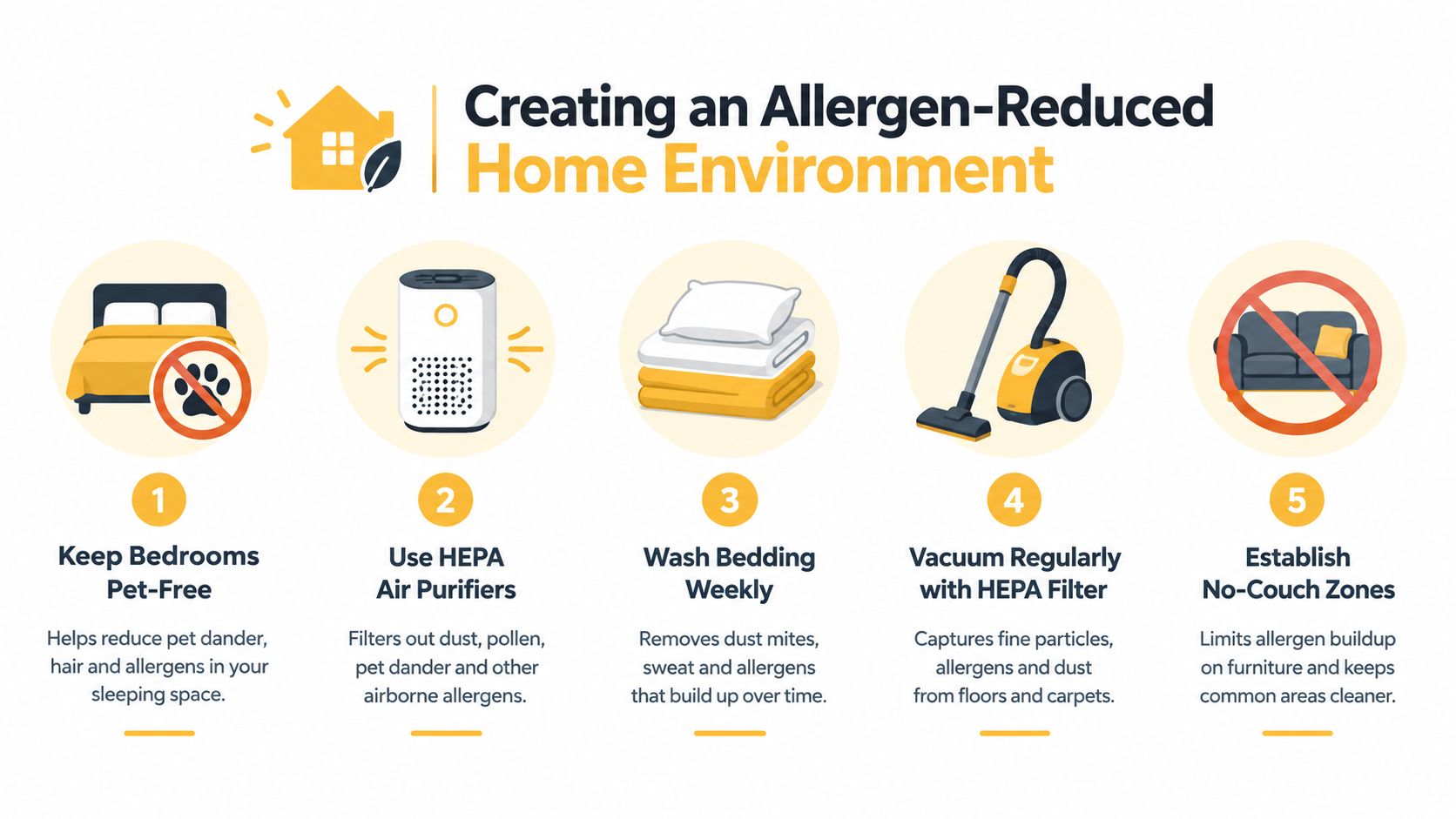
The bedroom deserves priority because people spend roughly one-third to one-half of their time there, according to independent allergy guidance. Make it a pet-free room, not a space where the dog is allowed on the bed but kept off the pillow. Keep the door closed, use washable bedding, and prevent coats, blankets, and toys from migrating inside. (AAFA outlines this bedroom and filtration approach.)
A routine that reduces reservoirs
Use a repeatable schedule rather than waiting until the home looks dusty. The aim is not sterile living. It's preventing carpets, furniture, and fabrics from becoming large, constantly disturbed reservoirs.
- Protect the bedroom: Keep the dog, dog bedding, and loose blankets outside the sleeping area.
- Filter the air: Run a HEPA air cleaner for at least four hours daily, as recommended in the cited allergy guidance.
- Clean fabric surfaces: Vacuum carpets and upholstery weekly with a HEPA filter, paying attention to cushion seams and places where the dog rests.
- Dust damp: Use a damp cloth or microfiber tool. Dry sweeping can redistribute settled particles rather than remove them.
- Control the sofa: Use washable slipcovers or create a clear no-couch zone. A rule that changes from day to day won't control exposure consistently.
- Wash bedding: Launder human and dog bedding regularly, and don't return damp items to use.
Carpets deserve special attention because their fibers trap material that becomes airborne when people walk, sit, or play with the dog. If a rug has become heavily soiled or difficult to clean at home, a specialist service such as Rubber Ducky Rug Cleaning Birmingham may be useful for understanding fabric-safe allergen reduction. That service doesn't replace filtration or routine vacuuming, but deep cleaning can address a reservoir that ordinary surface cleaning misses.
Make outdoor exposure easier to manage
After walks during high-pollen periods, wipe the paws, legs, and coat with a damp cloth. Rinsing may be appropriate for some dogs, but avoid harsh products that dry or irritate the skin. Keep windows closed when outdoor pollen is high if indoor exposure is a concern, and don't allow the dog to lie on bedding immediately after rolling through grass or leaf litter.
If shedding is contributing to household buildup, ways to reduce dog shedding can help you build a coat-care routine suited to your dog's hair type. The objective is controlled removal, not aggressive brushing that inflames the skin.
Grooming Routines and Parasite Prevention That Lower Allergens
Grooming is an exposure-control tool, not just a cosmetic task. Washing removes allergen material and outdoor particles from the coat before they spread through the home. A clinical study found that washing dogs at least twice a week was necessary to maintain a reduction in recoverable Can f 1 from hair, and the effect was temporary without repetition. (The PDSA overview discusses bathing, hygiene, and allergy management.)

Don't copy a twice-weekly bathing schedule blindly. A dog with dry skin, infection, a damaged barrier, or a medicated shampoo prescription needs an individualized plan. Use a gentle, veterinary-appropriate product, rinse thoroughly, dry the coat completely, and stop if bathing causes redness or discomfort.
Build grooming around the coat and the household
Brush outdoors when possible, or in a washable area away from the bedroom. Select a brush that reaches the coat without scraping the skin, and ask a groomer or veterinary professional to demonstrate technique for dense, curly, double, or long coats. Wipe paws and lower legs after outdoor exposure, particularly when pollen or dusty ground is likely to cling to the fur.
A practical routine might include:
- Daily spot cleaning: Wipe paws after walks and remove visible debris from the lower coat.
- Scheduled brushing: Brush at a frequency that removes loose hair without creating skin trauma.
- Planned bathing: Repeat the schedule your veterinarian recommends, especially if the dog has allergic skin disease.
- Clean equipment: Wash brushes, towels, and grooming surfaces so they don't become secondary reservoirs.
- Coat inspection: Look for redness, odor, scabs, moist patches, or evidence of chewing rather than assuming every itch is ordinary shedding.
A short demonstration can help owners avoid brushing too aggressively or bathing in a way that worsens dryness.
Flea control is part of allergy prevention
Flea allergy can produce severe itching even when owners don't see fleas. The important preventive action is year-round treatment for every in-contact animal, selected with veterinary guidance. The AAHA guidance on preventive care supports year-round preventive treatment in all in-contact animals, while veterinary references emphasize flea avoidance as a core part of managing allergic skin disease.
Don't rely on seasonal judgment, visible fleas, or occasional treatment. If one dog is allergic and another animal remains untreated, the household can continue to expose the allergic dog. For broader coat and skin-care context, see dog skin and coat support, while remembering that supplements can't substitute for parasite prevention.
Diet, Supplements, and Early-Life Prevention Strategies
Primary prevention extends beyond floors and filters. A 2025 review reported lower canine atopic dermatitis incidence in puppies exposed to domestic-prepared food, outdoor grass time, reduced passive smoking, and possibly fish oil. (The review's discussion of canine atopic dermatitis prevention) The same review associated heat-treated, carbohydrate-rich diets and passive smoke with higher allergy risk, while describing HEPA purifiers and probiotics as promising options that are not formally proven preventive measures.

These findings do not justify rigid puppy rules. Homemade diets can lack key nutrients unless a veterinary nutrition professional formulates them. Outdoor activity also brings parasite and environmental exposure, while avoiding smoke supports general health without proving that every puppy will avoid dermatitis. The practical goal is a balanced, low-irritant household, not an extreme prevention protocol.
Make nutrition decisions for the individual dog
Feed puppies a complete diet designed for growth, and obtain professional guidance before using a homemade recipe. Repeated food changes in response to ordinary itching can complicate a later dietary investigation and create nutritional gaps. If food allergy is suspected, use a veterinarian-directed elimination trial instead of choosing products based on marketing claims.
Adult dogs with allergy-prone skin may benefit from nutrition that supports skin-barrier function and general condition. Diet alone cannot identify an environmental trigger. Before adding products, ask whether infection, parasites, or atopic dermatitis better explains the signs.
A supplement may simplify a routine, but convenience does not establish preventive value. The guide to dog supplements for allergies can help owners prepare questions about ingredients and intended use. Read the label, report every supplement to the veterinarian, and stop any product linked with digestive or skin changes.
Reduce avoidable household stressors
Keep the home smoke-free, prepare food hygienically, and provide normal outdoor activity. Puppies need exercise and socialization. Prevention should reduce harmful exposure while preserving a routine owners can maintain.
Clinical perspective: Nutrition can support resilience, but prevention still depends on identifying what is driving the dog's signs.
When Prevention Requires Veterinary Testing and Immunotherapy
Home controls work best when the problem is mild, exposure-related, and clearly understood. They aren't enough when a dog scratches persistently, develops repeated ear or skin infections, has seasonal relapses despite environmental changes, or shows a pattern consistent with flea allergy. Those cases need a veterinary examination because allergies can resemble infection, parasites, hormonal disease, or other skin disorders.
Start with a detailed history. Record when the itching began, which body areas are affected, whether signs change by season, what the dog eats, what flea prevention is used, and whether other animals or people in the home have symptoms. Photographs taken during a flare can be more useful than trying to reconstruct the episode from memory.
Testing follows clinical reasoning
A veterinarian may recommend skin cytology, parasite checks, dietary investigation, or environmental allergy testing depending on the presentation. Intradermal testing and blood panels can help identify relevant environmental triggers, but a test result needs to be interpreted alongside the dog's history and examination. Testing isn't a shortcut that removes the need to control fleas, manage infections, or reduce exposure.
When environmental allergens are confirmed, allergen-specific immunotherapy, or ASIT, can help reduce relapse risk after exposure. A veterinary systematic review describes ASIT as a preventive strategy for relapses, and the Merck Veterinary Manual reports an approximate 70% success rate in dogs with atopic dermatitis. (The systematic review of ASIT in canine atopic dermatitis provides the clinical context for that approach.)
ASIT isn't an instant cure and doesn't work identically for every dog. The usual plan combines confirmed trigger information, reduced exposure to fleas and known allergens, regular skin care, and additional treatment when needed. Expecting one injection, one diet, or one cleaning routine to solve a multifactorial disease is the common mistake.
Building a Sustainable Long-Term Allergy Prevention Plan
A workable plan should survive busy weeks, travel, weather changes, and symptom-free periods. Owners often clean intensively during a flare, then stop when the dog improves. That pattern allows reservoirs and triggers to rebuild, so prevention needs a small daily core and a seasonal review rather than occasional bursts of effort.
Use a simple monitoring system
Keep a short record on the refrigerator or phone. Note grooming, flea prevention, outdoor conditions, scratching, paw licking, ear odor, and any new food or household product. You don't need elaborate scoring. The value comes from spotting a pattern before a mild irritation becomes a full flare.
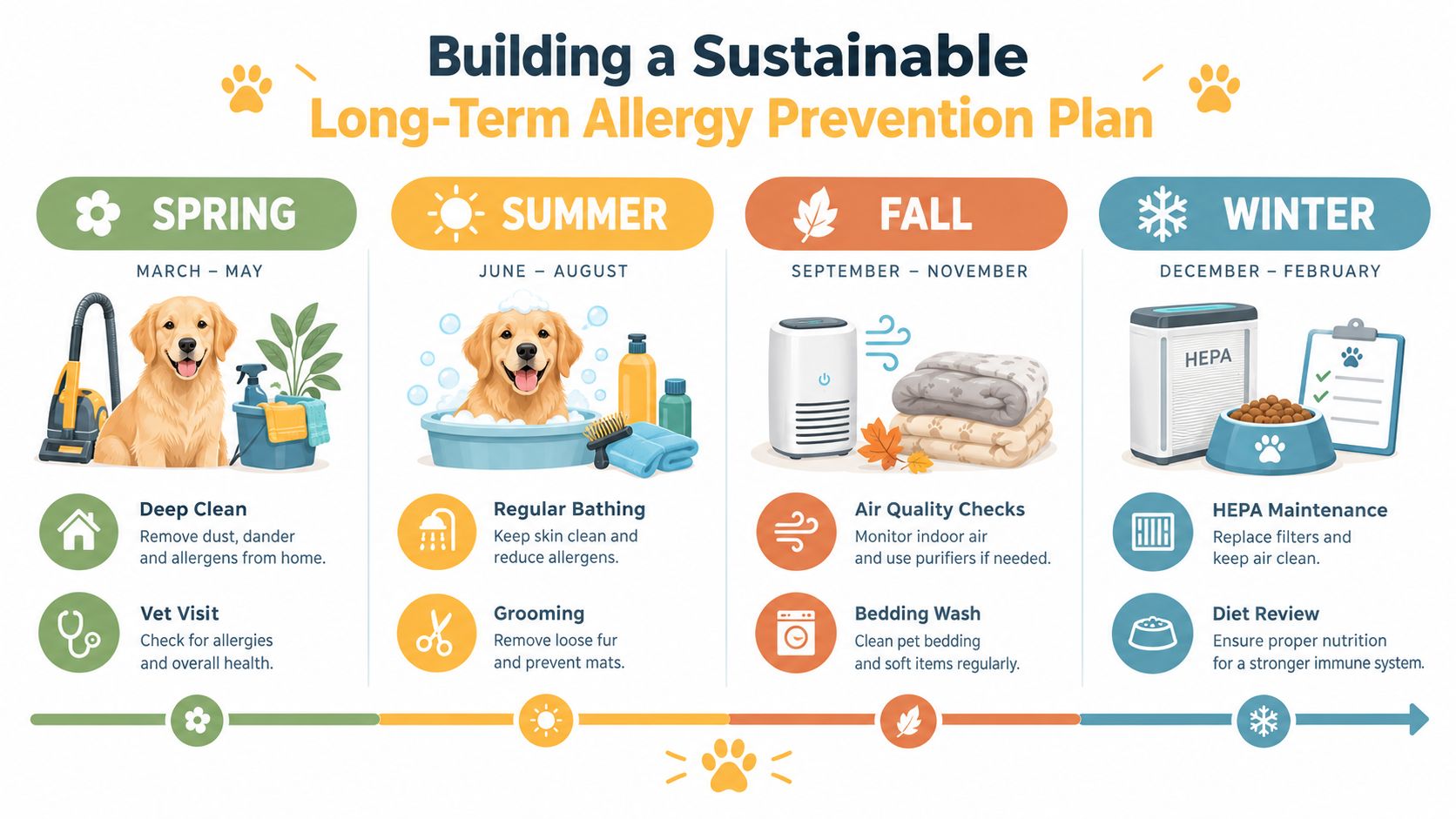
A seasonal plan can look like this:
- Spring: Deep-clean fabric reservoirs, review outdoor exposure, and schedule a veterinary review if signs return with pollen.
- Summer: Maintain the bathing and brushing routine, wipe the coat after outdoor activity, and keep flea prevention current.
- Fall: Wash bedding, reassess indoor dust and ventilation, and watch for symptoms that continue after pollen exposure changes.
- Winter: Maintain HEPA equipment, inspect filters, review diet, and avoid letting reduced outdoor activity turn into poor coat care.
The timing will vary by climate and by the dog's triggers. Don't increase bathing, change food, or add supplements solely because a calendar says you should. Adjust one meaningful variable at a time when possible, so you and your veterinarian can tell what helped.
Know the signs that your plan needs strengthening
Early warning signs include more frequent scratching, new paw chewing, head shaking, recurrent odor from the ears, red skin between the toes, or hair loss from self-trauma. Contact the veterinarian before the dog has been uncomfortable for weeks, especially if the skin is moist, painful, crusted, or foul-smelling.
The most reliable prevention strategy combines a pet-free bedroom, controlled fabric reservoirs, HEPA filtration, repeated grooming, year-round parasite control, sensible nutrition, and timely veterinary care. No single step guarantees an allergy-free dog or home, but a consistent combination gives owners a practical way to lower exposure and catch disease earlier.
Pure Paw Labs offers science-backed, human-grade dietary supplements for dogs, including a daily formula designed to support skin and coat alongside gut, joint, immune, and stress-related needs. Review the product information and visit Pure Paw Labs to decide whether its supplement approach fits your dog's broader preventive care plan, then discuss any new addition with your veterinarian.