


A seven-year-old Labrador hesitates at the stairs after a weekend hike. He lifts one paw, studies the first step, and then turns away from the SUV tailgate he used to clear in a single bound. You might call it a senior-dog problem, but that label often delays useful action. Mobility changes can set in gradually, and dogs frequently compensate before owners see an obvious limp.
Dog mobility support works best as a lifelong system, not as a last-minute supplement purchase. Movement, body condition, traction, muscle, nutrition, home design, and veterinary monitoring all influence how comfortably a dog moves. The practical aim is simple: preserve useful strength and confidence for as long as possible, then respond quickly when the pattern changes.
Table of Contents
- Why Dog Mobility Support Is a Lifelong Strategy
- How to Assess Your Dog's Mobility at Home and at the Vet
- Building a Daily Exercise Plan for Stiff Joints
- Weight Management as a Mobility Lever
- Diet, Supplements, and the All-in-One Approach
- Assistive Devices That Actually Help
- Putting It All Together and Knowing When to Call the Vet
Why Dog Mobility Support Is a Lifelong Strategy
Osteoarthritis is common enough that every owner should treat joint health as part of routine care, not an issue reserved for the oldest dogs. Veterinary evidence places reported prevalence across different canine populations from 6.6% to 37.3%, depending on the population and diagnostic method, while one UK primary-care analysis reported an annual prevalence of 2.5%. The same review notes that osteoarthritis affects dogs at scale and isn't limited to extreme old age. (Royal Canin Veterinary Academy review)
Young dogs can also carry joint disease that isn't obvious during a casual walk. A 2024 study found radiographic osteoarthritis in 39.8% of 123 dogs aged 8 months to 4 years, with clinical signs in 23.6% and moderate-or-greater joint pain in an affected joint in 16.3%. Those findings don't mean every young dog needs a supplement. They do mean that a prevention-first plan makes more sense than waiting for a dramatic decline. (Scientific Reports study)
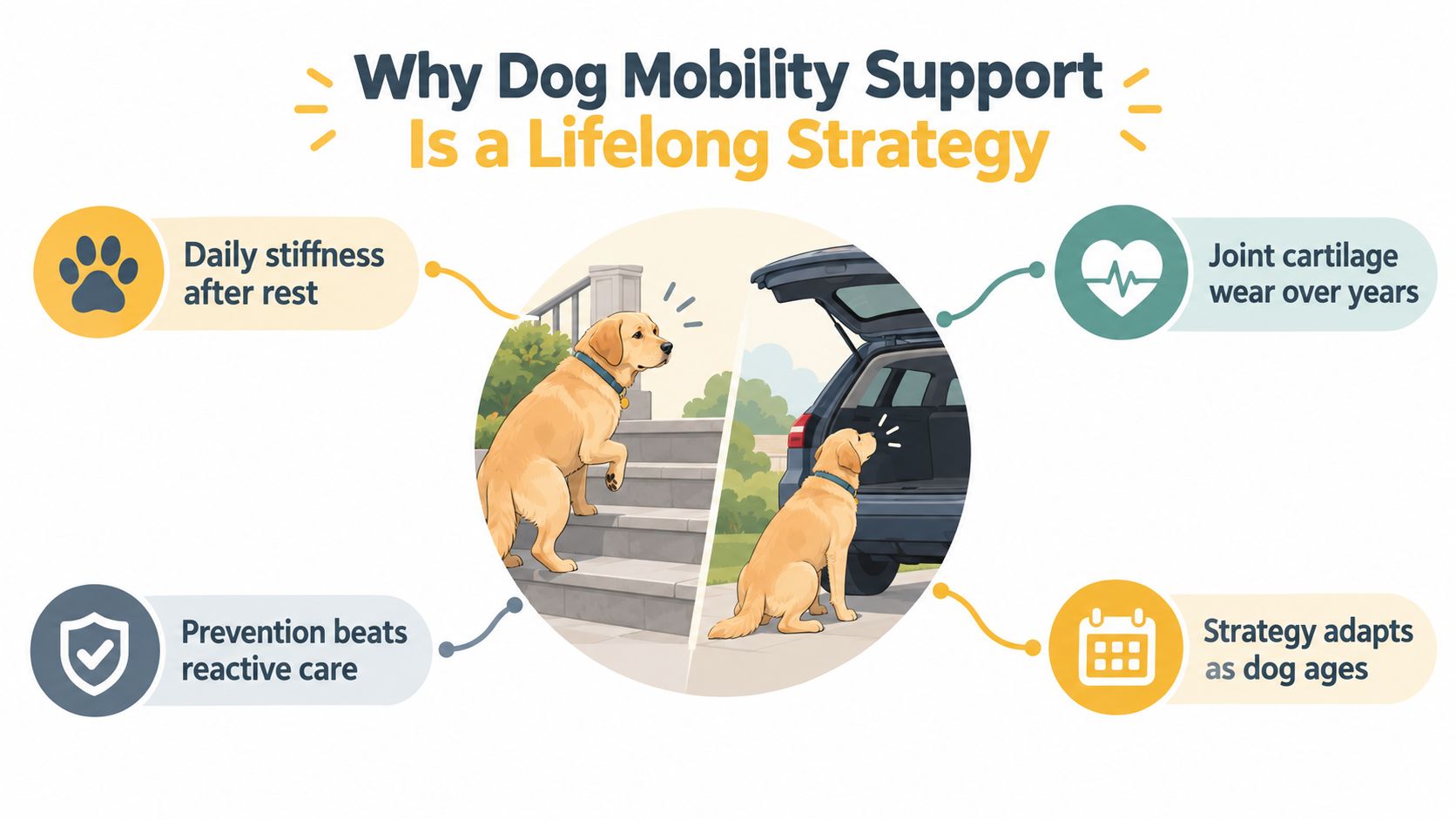
Protect the assets that keep a dog moving
Joint cartilage matters, but it isn't the whole mobility system. Muscle mass, coordination, proprioception, body weight, and confidence on different surfaces all affect how a dog distributes force. A dog with good muscle control may cope better with a compromised joint than a dog that has become inactive and weak.
The five pillars are straightforward:
- Movement: Regular, controlled activity maintains strength and joint range better than occasional exhausting outings.
- Weight: A lean body reduces the mechanical demand placed on every step.
- Home setup: Rugs, ramps, and clear pathways prevent slips that turn caution into fear.
- Nutrition and supplements: A complete diet provides the base, while selected ingredients may support a targeted plan.
- Veterinary monitoring: A changing gait can reflect orthopedic pain, neurological disease, injury, or another condition that supplements won't solve.
Practical rule: Don't wait for a dog to become lame before you start protecting mobility.
Owners often focus on muscle loss only after the hindquarters look visibly thin. This guide to muscle atrophy in dogs is useful because muscle preservation belongs in the plan long before a dog needs lifting assistance. The best routine is usually boring: consistent walks, sensible portions, safe flooring, and regular observation.
How to Assess Your Dog's Mobility at Home and at the Vet
You don't need a treadmill or specialist equipment to notice a trend. Pick a calm day, film the movements from the side and behind, and use the same surface and sequence each time. Don't force a dog through pain, and stop if the dog becomes distressed.
A simple home check
Start after your dog has rested. Watch how quickly they rise, whether they push evenly through both hind legs, and whether one side stays tucked beneath the body. Then observe a short walk and an easy trot on a non-slip surface, followed by a gentle turn in each direction. Stairs should be optional, never a test you impose on a painful dog.
Use a one-to-five score for each movement, where one means smooth and confident and five means the dog refuses, struggles, or shows clear discomfort. Record the date, surface, activity from the previous day, and any medication or supplement changes. Trends are more useful than a single score.
| Movement Test | What a Healthy Dog Does | Warning Sign | Score (1-5) |
|---|---|---|---|
| Rise from rest | Gets up smoothly without rocking | Delays, groans, or uses furniture for support | 1 to 5 |
| Sit to stand | Sits squarely and rises with balanced effort | Kicks one leg out or avoids sitting | 1 to 5 |
| Short trot | Maintains an even rhythm | Hops, shortens stride, or drops the head | 1 to 5 |
| Tight turn | Turns without swinging the hindquarters | Takes wide turns or slips | 1 to 5 |
| Stairs | Climbs with steady, deliberate steps | Hesitates, skips steps, or refuses | 1 to 5 |
| Nail wear | Shows broadly similar wear on both sides | One side is unusually long or scuffed | 1 to 5 |
A dog that develops persistent stiffness, audible clicking, a posture change, sudden stair reluctance, or weight loss alongside reduced movement needs a veterinary assessment. The guidance in this overview of dog mobility issues can help you organize observations before the appointment.
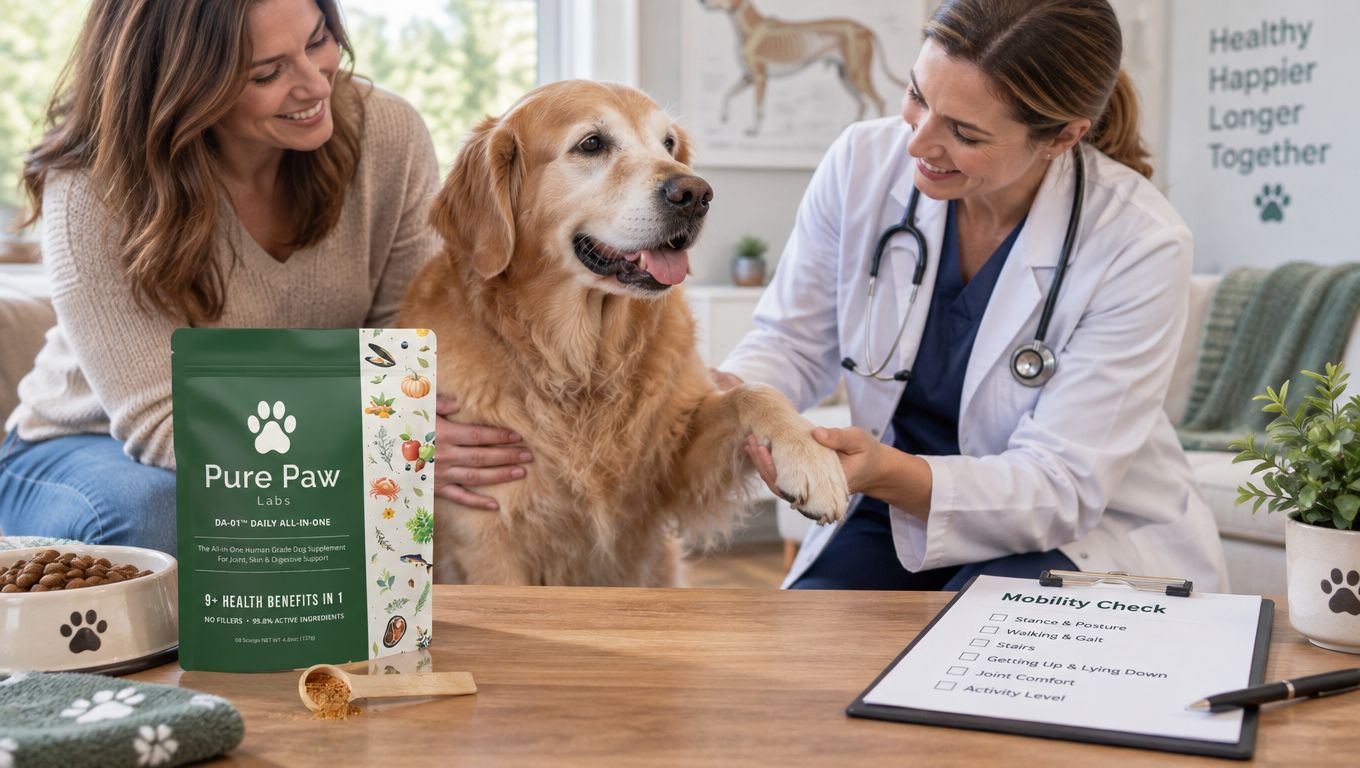
If you want to simplify a supplement routine while you track changes, DA-1™ Daily All-in-One - Senior Dog Support, Joints, Skin/Coat & More is described by its product information as a powdered, multi-system formula with 18 human-grade ingredients, delivered as one scoop without pills or fillers. Treat it as one part of the plan, not as a substitute for diagnosis.
What happens at the veterinary appointment
A proper mobility workup starts with history. Bring your videos, scores, notes about slipping or hesitation, and a list of every food, supplement, and medication. The veterinarian may assess gait, joint range of motion, pain on palpation, muscle symmetry, spinal responses, and weight distribution. Radiographs may be recommended when the examination suggests structural joint or bone disease.
Don't accept “just getting old” as the entire explanation. Aging can expose a problem, but the useful question is what is causing the movement change and which combination of pain control, rehabilitation, exercise, weight management, and home support fits that dog.
Building a Daily Exercise Plan for Stiff Joints
The right exercise plan leaves your dog more comfortable afterward, not exhausted and sore. Replace the occasional heroic hike with controlled, repeatable movement. A dog with stiff joints usually benefits from several manageable outings rather than one demanding burst of activity.
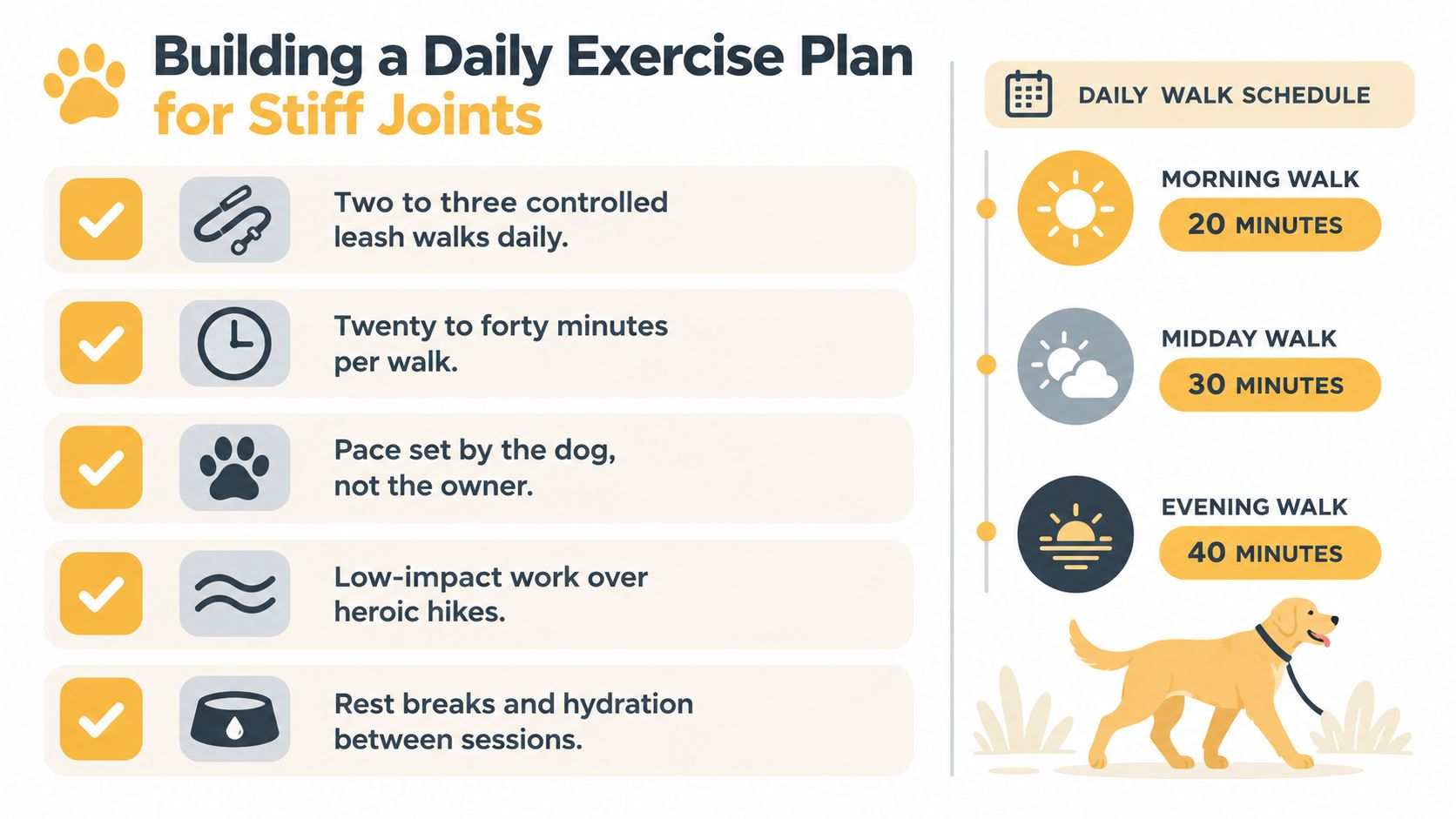
Begin with two or three leash walks daily, adjusting duration to the dog's current tolerance. A practical starting range is twenty to forty minutes per walk for a dog already accustomed to walking, but a painful or deconditioned dog may need much less. Let the dog's pace set the session. Grass, packed dirt, or another forgiving surface is often preferable to repeated hard pavement.
Build strength without provoking pain
Add a short warm-up before activity and a calm cool-down afterward. At home, use treats to guide slow sit-to-stands, gentle weight shifts on a stable cushioned surface, and controlled figure-eights. Keep the movements deliberate. If the dog rushes, slips, pants heavily, or looks less comfortable later that day, reduce the challenge.
Hydrotherapy or swimming can provide low-impact conditioning when a suitable facility and veterinary clearance are available. It isn't appropriate for every dog, particularly one with poor coordination, open wounds, significant weakness, or fear of water. A rehabilitation professional can show you how to progress safely.
For illustrated movement ideas, the Aspen Falls Wellness mobility guide offers a useful reference for owners who want to make controlled exercises part of a home routine.
Increase duration before intensity. Don't increase both in the same week, and schedule easier activity after a demanding session.
The progression rule matters more than the exact schedule. Add time only when the dog remains comfortable during the outing and afterward. Keep a note of next-morning stiffness, since delayed soreness can reveal that the previous session was too ambitious.
At home, make movement easier by placing rugs over slick floors, blocking unsupervised stair access, and keeping food and water at a comfortable height. A ramp can replace repeated jumping into a vehicle. For more practical guidance on dog joint pain relief, focus on the full combination of activity, pain management, traction, and veterinary care rather than exercise alone.
Weight Management as a Mobility Lever
Body condition is one of the most powerful mobility variables an owner can influence. Extra fat adds physical load, changes gait, and can make a dog less willing to move, which then weakens the muscles needed for stable movement. A lean dog isn't guaranteed to avoid arthritis, but excess weight makes every existing problem harder to manage.
Start with the food label and write down the dog's current daily intake, including treats, chews, table scraps, and food used during training. If the dog is carrying excess weight, make a modest reduction in total calories, weigh portions with a kitchen scale, and review progress with your veterinarian. Don't slash food aggressively or assume a “lite” label solves the problem. Some formulas replace fat with less satisfying ingredients, and treats can erase a carefully measured meal reduction.
Use body condition, not appearance alone
The nine-point body condition score is more useful than a bathroom scale by itself. You should be able to feel the ribs under a thin covering, see a waist from above, and identify an abdominal tuck from the side. A thick coat can hide changes, so use your hands and take consistent photographs from above and beside the dog.
A useful home process is:
- Measure meals: Serve the same measured portion rather than filling the bowl by eye.
- Count extras: Include treats, dental chews, supplements, and scraps in the daily total.
- Check weekly: Weigh the dog under similar conditions and record the body-condition score.
- Adjust gradually: If the trend isn't moving, review portions with your veterinarian instead of making a sudden cut.
- Protect muscle: Pair weight loss with controlled movement and adequate dietary protein as advised for the individual dog.
The same amount of extra body weight doesn't affect every dog in exactly the same way. A small, short-legged dog may show a noticeable change in movement from a modest gain, while a larger dog may distribute that load differently. The practical answer isn't to compare breeds by a fixed formula. It is to judge the individual dog's body condition, gait, muscle, and comfort.
For owners evaluating whether a broader wellness routine should include L-carnitine for dogs, start with the fundamentals first. No ingredient can compensate for uncontrolled portions, unrestricted grazing, or a dog that has stopped using its muscles.
Diet, Supplements, and the All-in-One Approach
A complete, nutritionally balanced dog food should form the foundation. Supplements are additions, not permission to feed an incomplete diet or to postpone an examination. Before buying anything, identify the actual mobility problem, check the label for active ingredients and amounts, and decide how you'll measure change.
The canine evidence isn't equally strong across ingredient categories. A multicenter, double-blind, randomized, placebo-controlled trial tested a combination containing eggshell membrane, krill meal with omega-3 fatty acids, astaxanthin, hyaluronic acid, and Boswellia serrata, and reported improvements in mobility and quality of life. Veterinary reviews continue to place omega-3-based interventions among the better-supported options, while controlled reviews have found glucosamine and chondroitin results weak or inconsistent. (Controlled canine supplement trial)
Undenatured type II collagen and Boswellia also have controlled canine research behind them, but the strength of an ingredient class depends on the formulation, dose, outcome measure, and study design. One placebo-controlled crossover study enrolled 60 dogs with mobility problems, with 17 dogs with mild-to-moderate osteoarthritis completing the crossover phase. The protocol used one chew daily for eight weeks with a four-week washout, and owner assessments detected improvement by four weeks. (Collagen and Boswellia study)
| Ingredient | Evidence in Dogs | Typical Daily Dose | Onset of Action |
|---|---|---|---|
| Omega-3 fatty acids | Among the more consistently supported mobility options in veterinary reviews | Use the product's stated active amount and veterinary guidance | A response may emerge over several weeks |
| Eggshell membrane | Included in a controlled canine combination trial | Follow the tested product label or veterinary direction | Assess over several weeks |
| Undenatured type II collagen | Supported by a placebo-controlled canine crossover study | Follow the studied formulation or label | Owner-reported signal appeared by about four weeks in one study |
| Boswellia serrata | Included in controlled canine mobility research | Use species-appropriate label directions | Allow several weeks for a fair assessment |
| Green-lipped mussel | Used in canine mobility formulas, with supportive evidence that varies by product | Confirm the active amount with a veterinarian | Judge response over a structured trial |
| Glucosamine and chondroitin | Marketing is stronger than the controlled evidence in dogs | Don't assume a larger serving creates a better result | Avoid promising a fixed onset |
Simplify the stack intelligently
Six separate products create practical problems: missed servings, duplicated ingredients, changing variables, and uncertainty about which product caused a stomach upset. An all-in-one formula can make adherence easier, but only if the label clearly states active ingredients, serving instructions, testing information, and the intended species.
The all-in-one supplement framework is useful for thinking about consolidation. Choose one change at a time when possible, introduce it gradually alongside the regular diet, and monitor stool quality, appetite, itching, energy, and movement. Don't combine several new products and then claim you know which one helped.
Measure outcomes with the same home checks each time. The strongest practical evidence comes from repeated, standardized observations and blinded placebo-controlled trials, not a single enthusiastic owner impression. If a dog has severe pain, rapidly worsening function, or neurological signs, veterinary treatment takes priority over supplement experimentation.
Assistive Devices That Actually Help
The right device solves a specific task. Don't buy a cart for a dog that only needs traction on a kitchen floor, and don't ask a weak dog to climb stairs with a loose sling that gives poor support. Match the aid to the dog's strength, body size, coordination, and home layout.
| Mobility Stage | Best-Fit Device | Dog Size Suitability | Home Setup Needed |
|---|---|---|---|
| Mild stiffness with slipping | Rugs, runners, toe grips, or booties | Any size, fitted correctly | Cover slick routes and rest areas |
| Walking dog that needs help on stairs or car entry | Rear-support harness | Small to large dogs, with correct fit | Clear handling space and secure lifting technique |
| Neck or shoulder limitation | Front-support harness | Any size with professional fitting | Avoid pressure over painful areas |
| Reluctance to jump or use stairs | Folding ramp | Especially useful for larger dogs | Stable angle, non-slip surface, training time |
| Difficulty rising or resting | Orthopedic foam or memory bed | Bed must fit the dog at full stretch | Place it near food, water, and family activity |
| Significant paresis or post-surgical weakness | Rear-wheel cart | Selected according to body measurements | Flat, safe routes and a commitment to supervised use |
Ramps beat stairs for vehicle access whenever the dog can walk up them safely. The ramp must be stable, broad enough, and covered with a surface that doesn't slide. Introduce it gradually on the ground before asking the dog to use it at height.
Booties can improve traction on hardwood, but many dogs need time to accept the sensation. Check for rubbing, trapped moisture, and altered gait. Toe grips may work for some dogs, though fit and nail condition matter.
A rear-support harness is often the best early purchase for a dog that still walks but struggles with stairs or getting into a car. A full cart is a more serious commitment. It requires accurate fitting, supervised practice, safe routes, and regular checks of the skin and limbs. It can give a dog useful independence, but it isn't a casual accessory.
Prioritize purchases this way:
- First: Improve flooring and provide a supportive bed.
- Next: Add a correctly fitted harness or ramp for the task causing daily difficulty.
- Later: Consider booties, toe grips, or a cart when the dog's movement pattern and veterinary diagnosis justify them.
Putting It All Together and Knowing When to Call the Vet
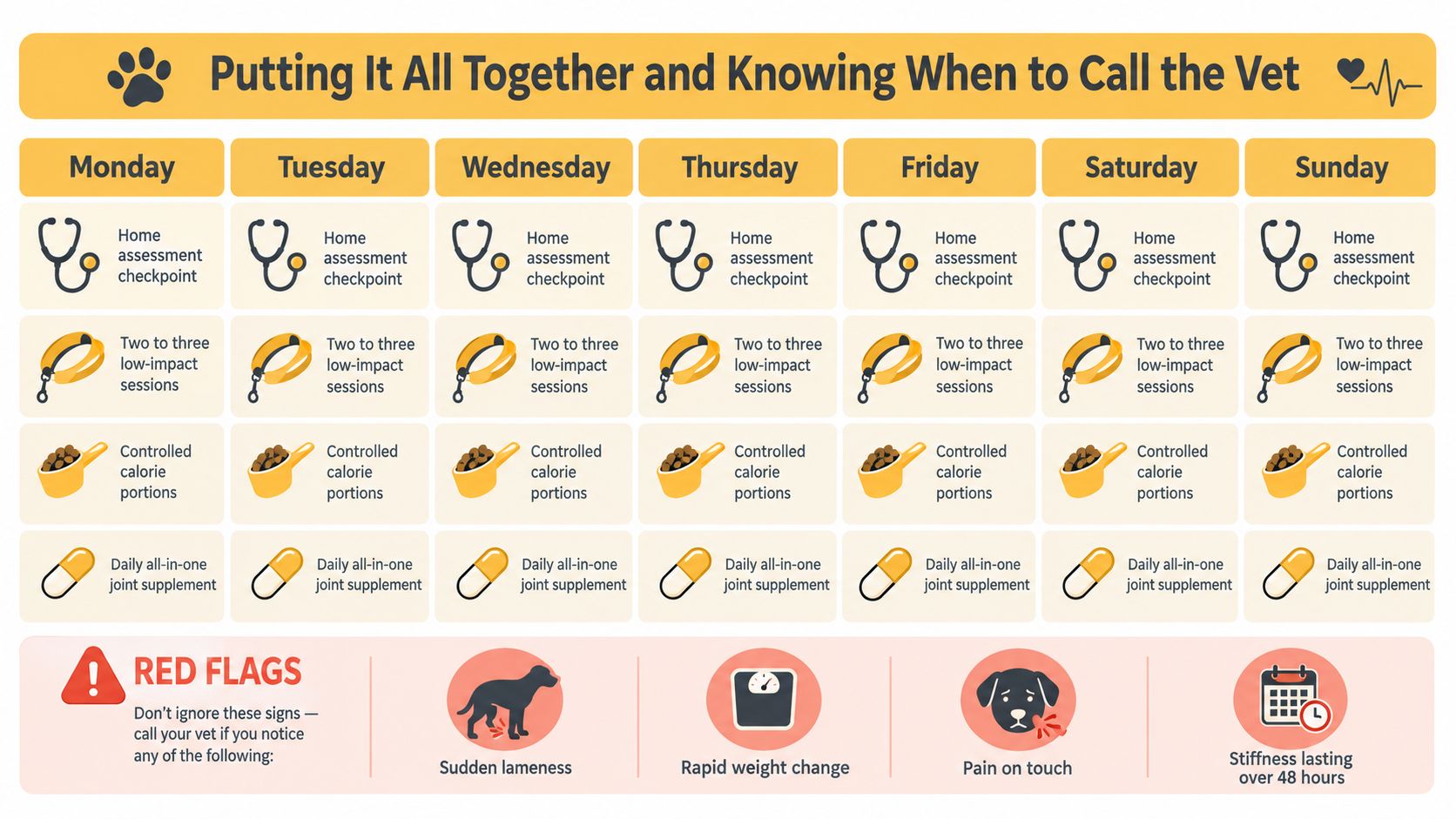
A workable program doesn't need to dominate your day. Keep the routine predictable and measure the basics:
- Daily: Serve controlled portions, provide the chosen supplement according to its label, inspect the walking surface, and complete comfortable low-impact movement.
- Several times each week: Use a short strength exercise or a device-assisted outing, depending on the dog's ability.
- Weekly: Review videos, note stiffness after rest, check body condition, and record whether the dog is rising, turning, and climbing with more confidence.
- At each review: Change one major variable at a time whenever possible, so you can tell whether the adjustment helped.
Expectations should be realistic. In placebo-controlled canine research, owner-reported mobility improvement appeared by about four weeks in one study, while other protocols assessed outcomes after longer treatment periods. A fair home trial therefore needs consistent exercise, portions, and scoring over several weeks rather than a decision based on one good walk. (Evidence on canine mobility timelines)
Red flags override the home plan
Call your veterinarian promptly for sudden lameness that persists, inability to bear weight, a hot or swollen joint, pain vocalization during movement, loss of bowel or bladder control, or a rapid decline after a stable period. Don't exercise through these signs, and don't use a supplement as a reason to wait.
Tell the clinic when the change started, which limb or movement is affected, whether there was a fall or unusual activity, and what your dog has eaten or received. Bring the videos and mobility scores. The veterinarian may perform an orthopedic and neurological examination, assess pain, and recommend imaging such as radiographs when the findings call for it.
If treatment begins, rebuild the home routine around the diagnosis. A dog recovering from injury or surgery may need restricted movement, while another may benefit from guided rehabilitation. Pain relief can make movement possible, but increased activity must still be gradual. Continue traction and safe resting arrangements even when the dog seems better, because confidence often returns before strength does.
The goal isn't to keep a dog moving at any cost. It's to preserve comfortable, purposeful movement and act quickly when the pattern changes.
Pure Paw Labs offers daily powdered supplements designed to consolidate several wellness categories into one scoop, including joint, gut, skin and coat, immune, and stress support. If a simplified routine fits your dog's needs and your veterinarian is comfortable with the ingredients, visit Pure Paw Labs to review the available daily all-in-one approach and product information.