


Your dog used to pull you down the block. Now he hangs back, pauses at the curb, or stands at the bottom of the stairs like he's thinking hard about whether the trip is worth it. On cold mornings he may get up slowly, walk stiffly for a minute, then seem almost normal again.
A lot of owners see that and do what most of us have been taught to do. We reach for a joint supplement and hope that's the answer. Sometimes that helps. Sometimes it doesn't. Often, the problem is that joint pain relief works best as a layered plan, not a single tub, chew, or ingredient.
That matters because joint disease is common. In one large UK primary-care study of 455,557 dogs, the annual period prevalence of canine osteoarthritis was estimated at 2.5%, equal to about 200,000 affected dogs per year in the UK, while broader summaries report North American estimates near 20% of dogs over 1 year old. That wide range tells you two things at once: it's common, and it's often missed or measured differently depending on the population studied (canine osteoarthritis prevalence summary).
Good dog joint pain relief usually means combining veterinary diagnosis, weight control, smart movement, home changes, and targeted nutrition. The trick is knowing which piece matters most for your dog right now.
Table of Contents
- Why Dog Joint Pain Deserves a Real Plan
- What Causes Joint Pain in Dogs
- Recognizing the Signs and How Serious They Are
- How Vets Diagnose the Source of Joint Pain
- Evidence-Based Treatment Options Owners Should Know
- Daily Care That Actually Helps with Joint Pain Relief
- When Joint Pain Needs More Than Home Care
- Building a Long-Term Joint Health Plan
Why Dog Joint Pain Deserves a Real Plan
Joint pain tends to creep in. A dog doesn't usually wake up one day and announce, “My hips hurt.” You see behavior changes instead. Shorter walks. Less enthusiasm for fetch. A careful hop into the car that used to be effortless.
That's one reason owners get stuck. They're trying to solve a moving target with one product.
Joint pain usually has more than one driver
A sore joint affects more than the joint itself. Dogs shift their weight, tighten nearby muscles, move less, and lose strength. Once that starts, the body compensates in ways that can make the original problem feel bigger.
A simple example helps. A dog with sore knees may shorten his stride. Then his back works harder. Then he becomes less active, gains a little weight, and every step loads those same joints more. The pain loop builds on itself.
Practical rule: If your dog's mobility has changed for more than a few days, think in layers. Medical care, body weight, exercise, footing, and nutrition all matter.
Relief works better as a stage-based plan
A young dog with an injury doesn't need the exact same plan as an older dog with long-standing osteoarthritis. A lean, active dog with mild stiffness after rest has different needs from an overweight dog who struggles with stairs every day.
That's why a real plan is stage-based. Early on, the focus may be diagnosis, load management, and preserving muscle. Later, the focus may shift toward comfort, traction, routine pain control, and adapting the home.
The old default has been “start glucosamine and chondroitin.” The problem is that current canine evidence doesn't support treating those ingredients as the automatic answer. Relief usually comes from a broader approach, and in many dogs the supplement question is only one small part of the picture.
Here's the mindset that tends to help most:
- First, identify the source. A ligament injury, hip dysplasia, and osteoarthritis can all look like “slowing down.”
- Then reduce stress on the joint. That may mean weight loss, shorter walks, less jumping, or better traction at home.
- Then add support. Medications, rehab, and selected nutrition often work better together than alone.
What Causes Joint Pain in Dogs
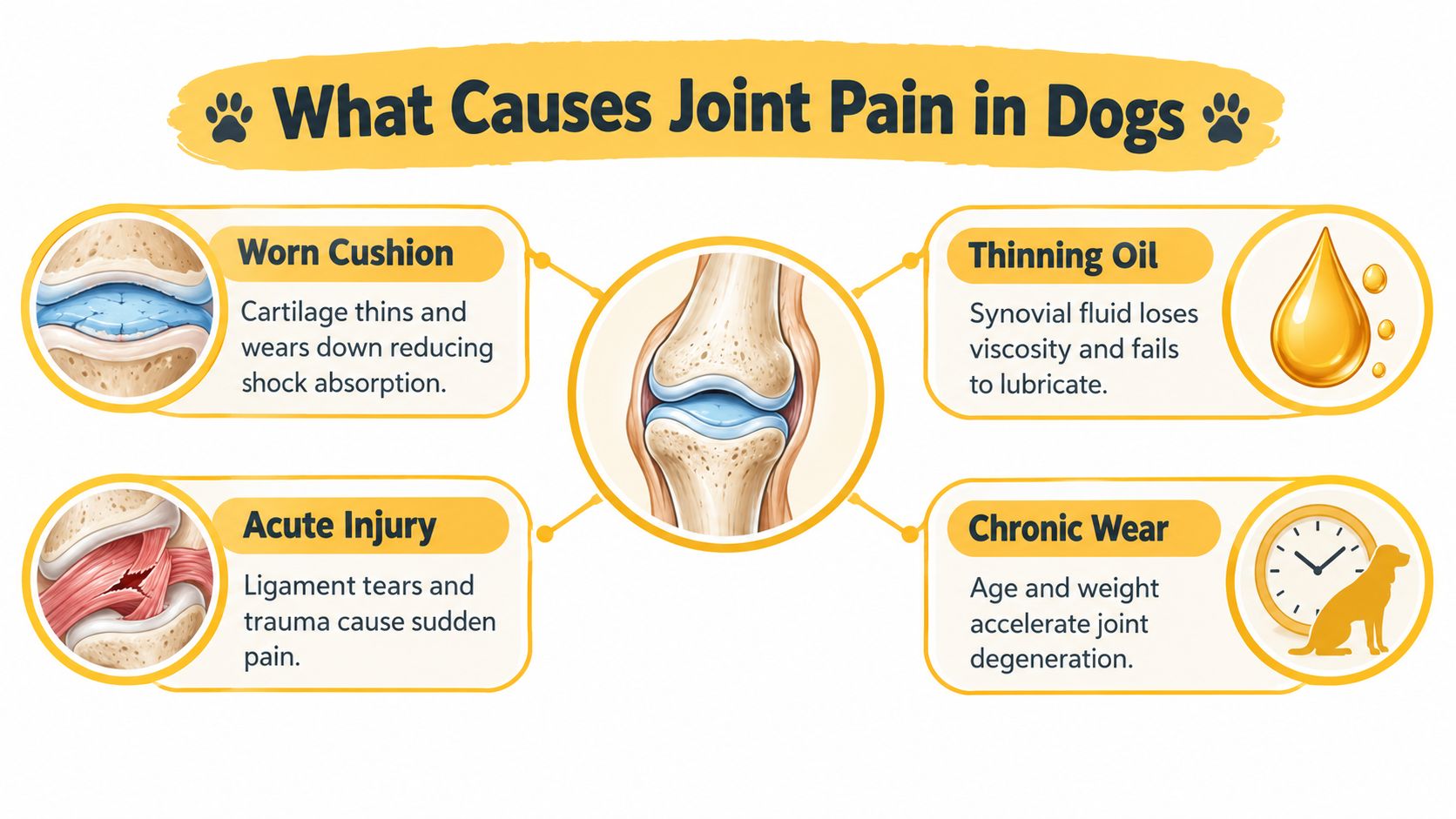
Joint pain isn't one disease. It's a symptom with several possible causes. The easiest way to understand it is to think of a healthy joint as a well-padded hinge with good lubrication and stable support around it.
When the cushion and joint fluid change
Cartilage works like a cushion on the ends of bones. When that cushion gets worn or damaged, the joint stops gliding smoothly. Movement becomes less comfortable, and the body responds with inflammation.
Synovial fluid is the joint's natural lubricant. You can think of it as oil in a moving part. When the joint is inflamed or aging, that lubrication may not protect movement as well, so every step feels a little rougher.
Over time, those changes can become osteoarthritis, which is one of the most common causes of chronic joint pain in dogs.
Acute injuries and chronic problems can look similar
Some dogs develop joint pain suddenly. Others build toward it over months or years.
Common patterns include:
- Acute injury: A torn ligament, hard fall, fracture, or traumatic twist can cause sudden pain and obvious limping.
- Developmental issues: Dogs with hip or elbow dysplasia may have poorly fitting joints that wear unevenly over time.
- Kneecap instability: Patellar luxation can create skipping, hopping, or intermittent lameness.
- Chronic degeneration: Repeated stress and age-related wear can gradually produce osteoarthritis.
A Labrador who loves high-impact play, a senior Beagle who's getting older, and a stocky terrier carrying extra weight can all end up with sore joints through different paths.
Why age matters, but not in the way many owners think
Arthritis is often associated with senior dogs, and age does matter. One veterinary epidemiology source reported that more than 50% of arthritis cases are observed in dogs aged 8 to 13 years. But early change can happen much sooner. Radiographic studies cited in the same source found osteoarthritis in 39.8% of dogs as young as 8 months to 4 years, and another dataset reported radiographic OA in 57.4% of elbows, 39.2% of shoulders, 36.4% of stifles, and 35.9% of hips in older dogs (canine OA age patterns and radiographic findings).
That doesn't mean every young dog with X-ray changes is painful. It does mean waiting for “old age” before taking mobility seriously isn't a great strategy.
A dog can be sore long before the limp looks dramatic.
Recognizing the Signs and How Serious They Are
Some dogs show joint pain loudly. Others hide it so well that owners only notice after watching old videos and realizing their dog used to move very differently.
Early clues owners often miss
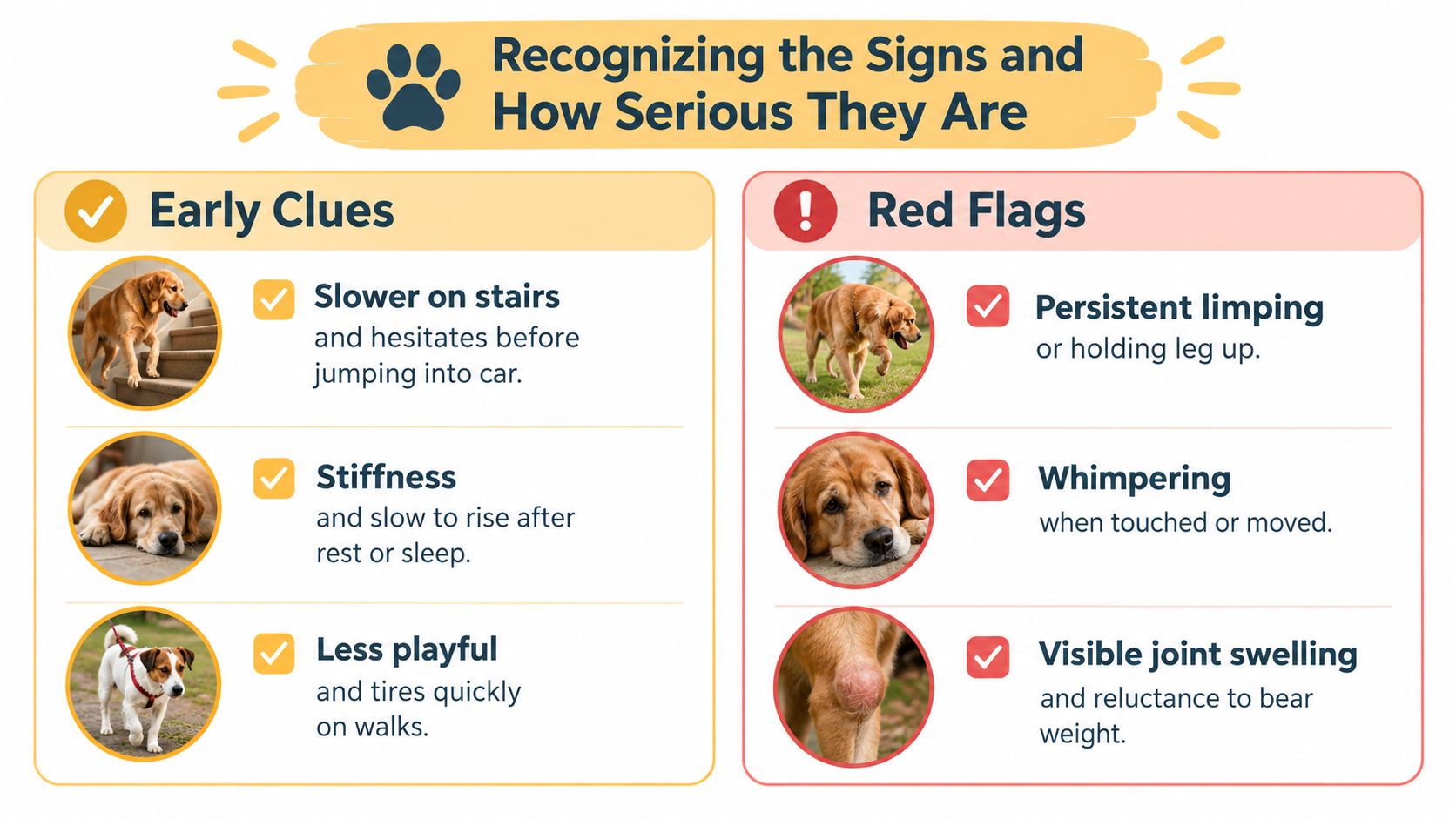
Early joint pain is often less about crying out and more about hesitation. Your dog may still want to do the usual things, but he starts negotiating with them.
Watch for changes like these:
- Slower transitions: Rising more stiffly after sleep or taking a moment before starting to walk.
- Small acts of hesitation: Pausing before stairs, furniture, or the car.
- Changed exercise tolerance: Shortening walks or fading earlier during play.
- Warm-up lameness: A mild limp that improves after moving around a bit.
- Focused licking: Repeatedly licking one wrist, knee, or hip area.
These signs matter because they often show up before owners would describe the dog as clearly lame.
Signs that suggest the problem is progressing
As discomfort grows, dogs often protect the sore limb more visibly. You may notice a head bob, a shortened stride, or a strange stance when standing still. Some dogs also lose muscle in the affected leg because they're using it less.
Other progression clues include:
- Reluctance to play
- Less interest in long walks
- Difficulty getting comfortable
- Noticeable gait changes
- Posture shifts, such as standing with more weight on the front end
One useful question is this: Has the problem changed your dog's normal day? If the answer is yes, it deserves attention even if your dog still seems cheerful.
Red flags that need prompt care
Some signs shouldn't wait for “let's watch it another week.”
If your dog suddenly won't bear weight, cries when touched, or has a hot swollen joint, skip the supplement shopping and call your vet.
Seek prompt veterinary attention for:
- Sudden severe lameness
- A leg held completely off the ground
- Visible swelling or heat in a joint
- Whimpering, snapping, or obvious pain when handled
- Any limp after trauma, rough play, or a fall
Severity isn't only about how dramatic the limp looks. It's about how much normal function your dog has lost and how fast the change happened.
How Vets Diagnose the Source of Joint Pain
A good joint workup is usually more methodical than many owners expect. The goal isn't just to confirm that a dog hurts. It's to find out where, why, and what type of problem is driving it.
The exam starts before your dog is on the table
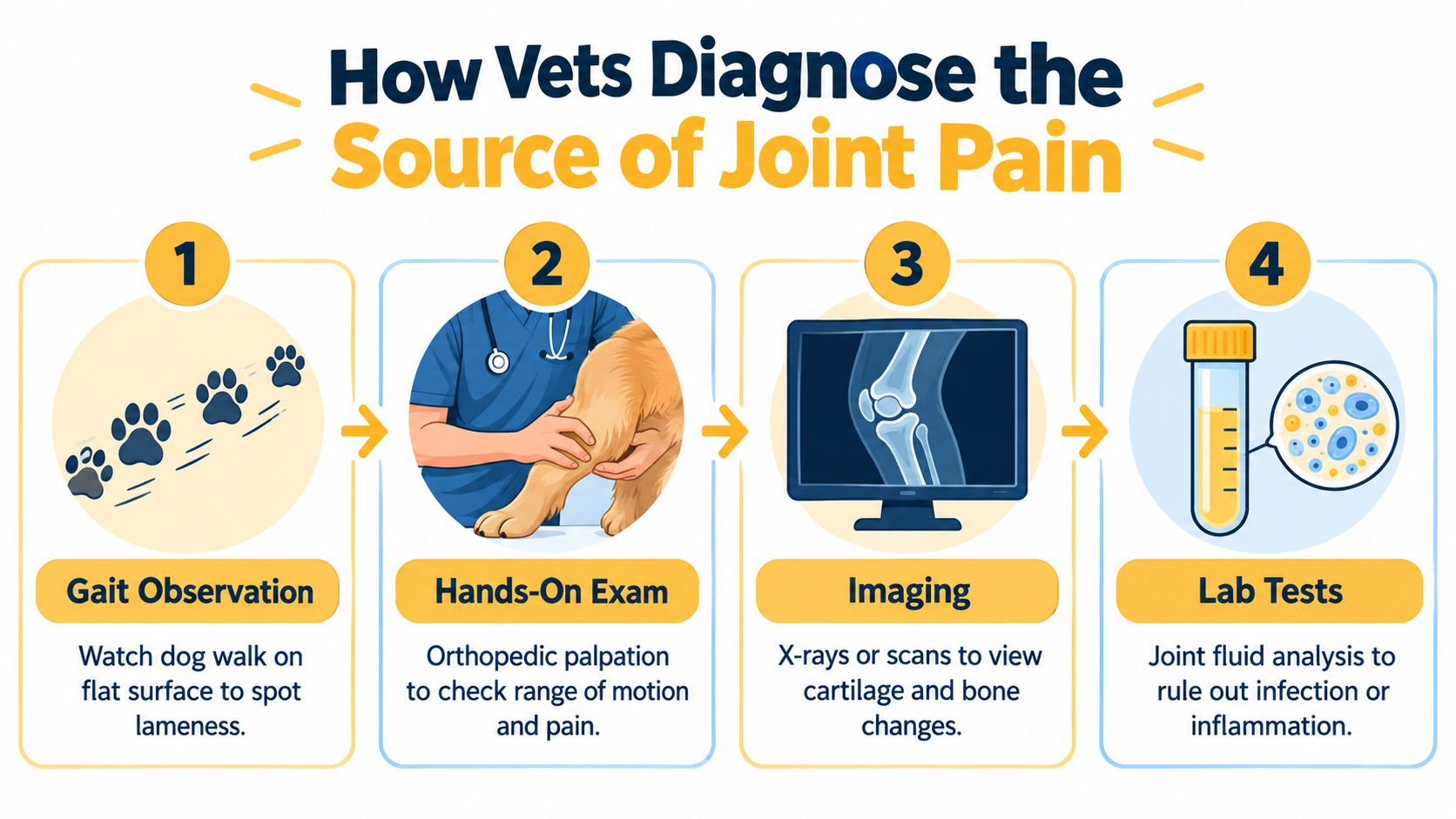
Vets often learn a lot by watching a dog walk into the room. They may look at movement on a flat floor, turning, sitting, rising, or using steps if that's safe. A limp, shortened stride, or toe-touching pattern can narrow the problem quickly.
Then comes the hands-on exam. The vet palpates joints and surrounding muscles, checking for pain, swelling, reduced range of motion, instability, crepitus, and heat. They'll also compare left to right, because side-to-side differences can reveal a lot.
Tests are chosen based on what the exam suggests
The next step depends on the suspected cause.
A typical workup may include:
- X-rays to look for bony remodeling, arthritic change, dysplasia, fractures, or alignment issues.
- Joint fluid analysis if infection or immune-mediated joint disease is a concern.
- Bloodwork and urinalysis to rule out broader illness and to create a safe baseline before some medications.
- Advanced imaging such as CT or MRI when soft-tissue injury, complex elbow disease, cruciate damage, or spinal involvement is suspected.
Not every dog needs every test. A straightforward arthritis case may need a much simpler path than a young dog with shifting leg lameness or a dog with multiple painful joints.
The diagnosis matters because treatment that helps one joint problem can be incomplete or even wrong for another.
For example, a partial cruciate injury may call for stricter activity restriction than stable hip arthritis. A dog with immune-mediated polyarthritis needs a very different plan from a dog with ordinary wear-and-tear osteoarthritis. Precision helps owners spend energy on the right fix.
Evidence-Based Treatment Options Owners Should Know
When owners ask about dog joint pain relief, they often mean supplements. Vets usually think bigger than that. They're looking at body weight, pain control, joint mechanics, muscle support, and daily function.
The foundation is usually not glamorous
For many dogs with osteoarthritis, weight management has the biggest practical impact because every extra pound increases load on already sore joints. That's not exciting advice, but it often changes comfort more than owners expect.
Prescription pain relief is also a core part of treatment for many dogs. Depending on the diagnosis, vets may use NSAIDs, adjunctive pain medications such as gabapentin or amantadine, monoclonal antibody injections such as bedinvetmab, or short steroid courses for certain inflammatory conditions. The exact mix depends on the cause, the dog's age, medical history, and response.
Rehab and supportive therapies can add real value
A medication-only plan often leaves progress on the table. Many dogs do better when pain control is paired with guided physical rehabilitation.
Common add-ons include:
- Physical rehab: Strength, balance, and range-of-motion work
- Hydrotherapy: Useful when land exercise is hard but muscle support is needed
- Laser therapy or acupuncture: Sometimes included as adjuncts when a dog responds well
- Regenerative approaches: Options such as platelet-rich plasma or stem cell therapy are being explored, though evidence is still developing
The main idea is simple. Less pain helps a dog move. Better movement helps preserve muscle. Better muscle support often helps the joint.
The glucosamine question deserves a straight answer
A lot of owners get mixed messages.
The best available canine evidence does not show reliable benefit from glucosamine and chondroitin as standalone answers for osteoarthritis pain. A 2022 systematic review and meta-analysis found a “very marked non-effect” for chondroitin-glucosamine nutraceuticals and concluded they should no longer be recommended for pain management in canine and feline OA. A separate evidence review also found no beneficial effects in canine OA trials using glucosamine hydrochloride and chondroitin sulphate, while noting that perceived benefit may come from other components in multi-ingredient formulas rather than those ingredients alone.
If you want a deeper owner-level breakdown, this review of whether joint supplements work for dogs is useful for sorting marketing from evidence.
Evidence at a Glance for Common Joint Pain Treatments for Dogs
| Treatment | Evidence Strength | Typical Role |
|---|---|---|
| Weight management | Strong practical support in routine care | Lowers joint load and improves comfort |
| NSAIDs and other prescribed pain options | Established clinical use | Reduces pain so dogs can function and rebuild activity |
| Physical rehabilitation | Commonly used as part of multimodal care | Builds strength, mobility, and joint support |
| Glucosamine and chondroitin alone | Weak and inconsistent in current canine evidence | Not a reliable standalone solution |
| Combination formulas with other joint-support ingredients | Mixed and formula-dependent | May serve as one part of a broader plan |
Recent veterinary literature also points toward multimodal management rather than one-size-fits-all supplement use, with ongoing development in alternatives such as fish oil plus ASU or phytotherapeutic blends, eggshell membrane-based formulas, and investigational gene therapy.
Daily Care That Actually Helps with Joint Pain Relief
Home care is where a good treatment plan either becomes real or falls apart. The goal isn't to do everything. It's to make daily life easier on the joints, then repeat that routine consistently.
Move more gently, not less
Many owners accidentally swing between too much exercise and too little. The classic pattern is a quiet week followed by one big weekend outing. That's rough on sore joints.
A better routine usually looks like this:
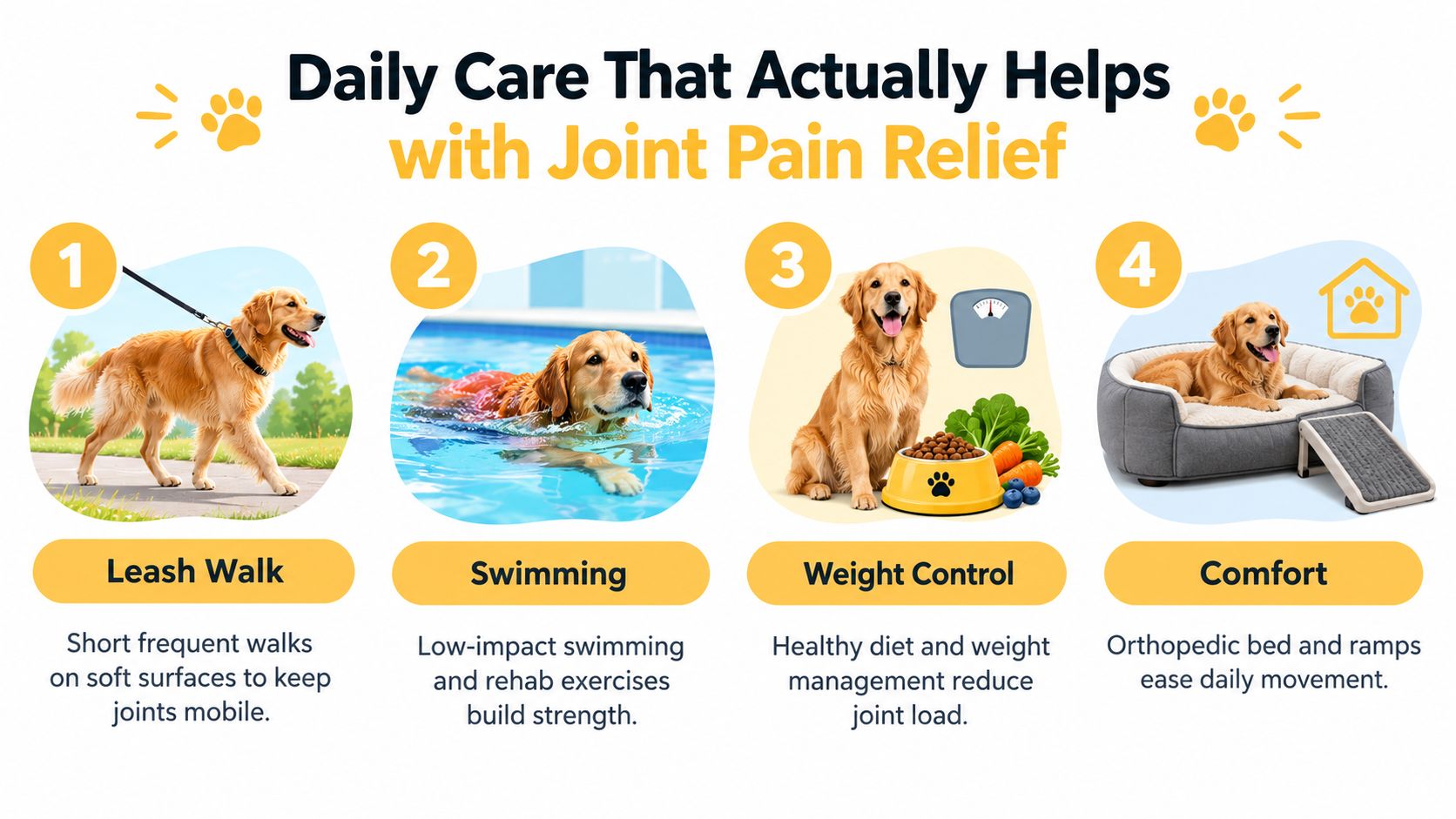
- Short leash walks: Frequent, controlled walks beat occasional marathon walks.
- Softer footing: Grass, packed dirt, or other forgiving surfaces are often easier than slippery floors or long stretches of pavement.
- Low-impact options: Swimming or rehab-style exercises can help maintain muscle without the same pounding load.
- Fewer explosive moves: Limit repeated ball-chasing, hard stops, and jumping in and out of cars.
This short demo can help owners picture safer movement patterns at home:
Set the house up for success
Small home changes can spare a sore dog dozens of painful micro-movements each day. Rugs over slick floors, ramps where there used to be jumps, and a bed that supports pressure points can all help.
If you're thinking about sleep setup more generally, the ideas in this piece on a Protect-A-Bed back pain solution are a useful reminder that surface support matters when a body is already sore. Dogs aren't people, but the comfort principle carries over. Pressure, stability, and ease of getting up all matter.
Helpful upgrades often include:
- Non-slip rugs or runners
- Ramps for cars or furniture
- An orthopedic bed in the room your dog uses most
- Food and water placement that doesn't force awkward reaching
- Nails and paw fur kept tidy for traction
Use supplements as support, not as the whole plan
Many owners get tripped up. A supplement can be useful, but it shouldn't replace diagnosis, pain control, or weight management.
When you look at labels, focus on practical questions:
- Does the formula fit your dog's actual problem?
- Are the ingredients part of a broader joint-support strategy?
- Is the product tested and easy to give every day?
If you want one scoop rather than several separate products, DA-1™ Daily All-in-One - Senior Dog Support, Joints, Skin/Coat & More is described as a multi-system formula for aging dogs that delivers 18 human-grade ingredients targeting cells, gut, and joints, with no fillers or pills. That kind of format can fit well for owners who are trying to simplify a daily routine, as long as it's treated as one part of a larger plan.
Some owners also like to pair joint routines with food-based support, and this guide to dog bone broth benefits can help you think through where that may fit.
A simple weekly check helps keep all of this realistic:
- Mobility: Is your dog rising, walking, and turning about the same as last week?
- Appetite and weight trend: Are you keeping portions consistent?
- Home setup: Are rugs, ramps, and bedding still working?
- Recovery after activity: Is your dog stiff later that day or the next morning?
When Joint Pain Needs More Than Home Care
Home care works best for mild, stable problems that have already been assessed or for very early signs you're monitoring closely. Once function starts dropping, the timeline matters.
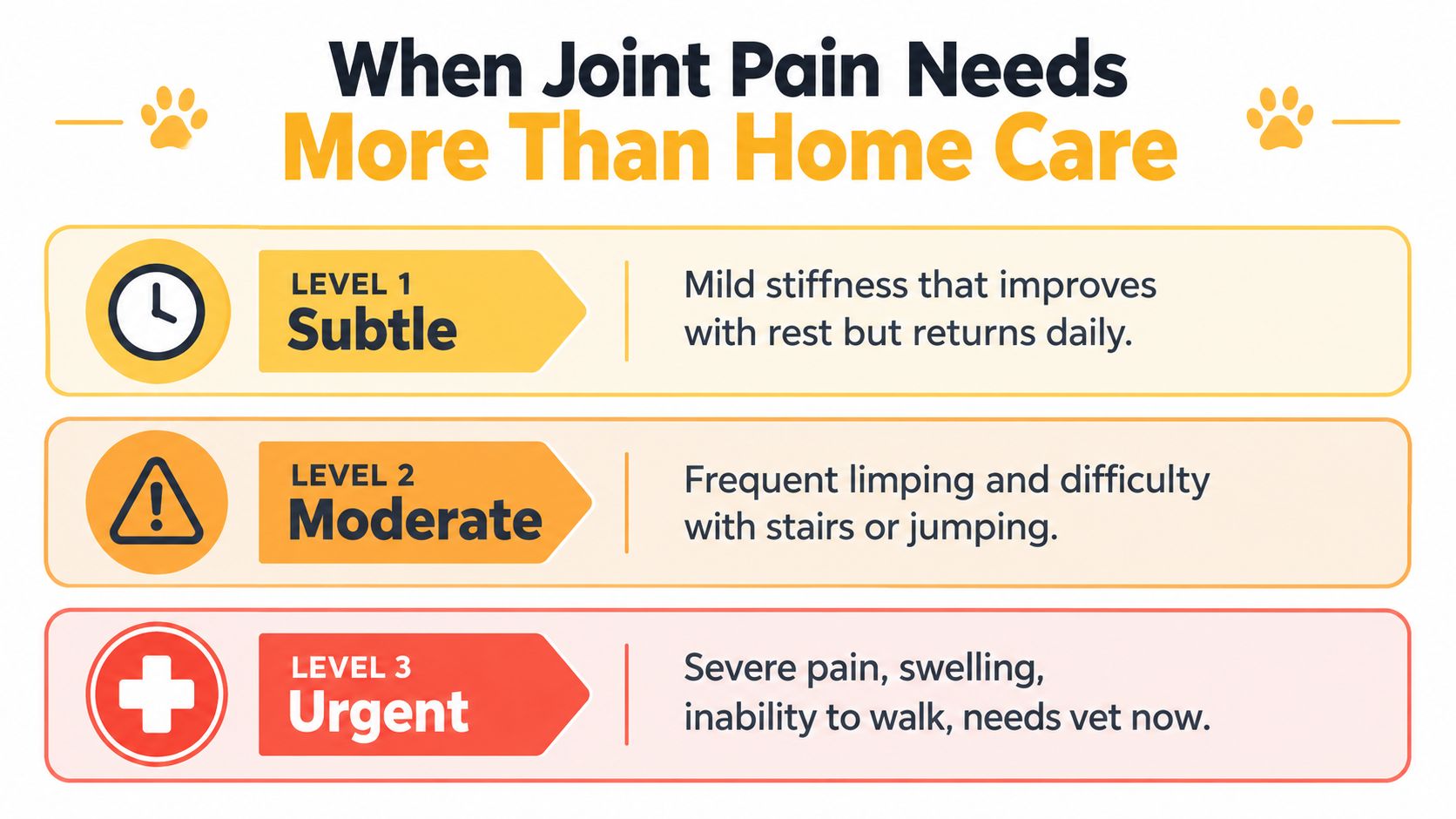
Level one changes
These are the dogs who are still doing most normal things, but not quite the same way. Daily stiffness, a slower climb into the car, or reduced enthusiasm for walks usually deserves a scheduled vet visit within about a week.
This level often fits early arthritis, a minor flare, or a problem that's still easy to manage if you catch it now.
Level two changes
Persistent limping, repeated trouble with stairs, stiffness after rest that keeps coming back, or noticeably less interest in movement should move faster. These dogs should usually be seen within a day or two.
At this point the cause could still be manageable at home after diagnosis, but owners shouldn't assume it's “just age.” If your older dog also seems unstable or weak in a broader way, this article on why a 14-year-old dog may keep falling over is a helpful reminder that not every mobility problem is just a sore joint.
Urgent signs
Some cases need same-day care.
Severe lameness, a hot swollen joint, yelping on touch, or sudden inability to walk can point to injury, major inflammation, or a problem that needs more than rest.
Also take lethargy, poor appetite, or obvious whole-body illness seriously when they show up with joint pain. A painful dog who also seems unwell may have something broader going on than routine osteoarthritis.
Building a Long-Term Joint Health Plan
The dogs who do best over time usually don't have a magic fix. They have a rhythm. Their owners notice small changes early, keep exercise steady, protect body condition, and adjust the environment before flare-ups become big setbacks.
A workable long-term plan is simple enough to repeat:
A routine owners can actually maintain
- Daily check-in: Watch how your dog rises, walks, and settles.
- Consistent low-impact movement: Keep activity regular rather than heroic.
- Weight and appetite tracking: Small drifts matter when joints are already stressed.
- Home adjustments as needed: Add traction, ramps, or easier resting spots when you see friction points.
- Supplement use with meals: If you use one, make it part of the routine, not an occasional add-on.
- Regular reassessment: At-risk dogs benefit from periodic veterinary review, often every six to twelve months.
The broader shift in canine joint care is encouraging. Management is becoming more personalized, more multimodal, and less dependent on the old idea that one supplement ingredient should carry the whole load. That's a better model for dogs, and a more realistic one for owners too.
If you're trying to build a practical daily routine around dog joint pain relief, Pure Paw Labs offers science-minded dog supplements designed to simplify that process without replacing veterinary care. For owners who want to explore joint support as one part of a broader mobility plan, visit Pure Paw Labs.