


You've probably seen the warning: taurine, grain-free food, and dilated cardiomyopathy, or DCM, mentioned in the same conversation. Perhaps your dog eats a home-prepared diet, belongs to a breed that makes you cautious, or takes a daily scoop of supplements and you're wondering whether taurine powder belongs in it. The difficult part is separating a genuine nutritional question from the idea that every dog needs a heart supplement.
Taurine matters, but it isn't a universal cure or an automatic requirement for every healthy dog. The useful questions are more specific: Can your dog make enough taurine? Is the current diet supplying the building blocks needed for that process? Does testing make sense? And when is diet correction more important than adding powder?
Table of Contents
- Introduction to Taurine Powder for Dogs
- What Taurine Is and Why Dogs Still Need It
- Signs Causes and Testing for Low Taurine in Dogs
- Evidence Based Benefits Risks and the DCM Connection
- How to Use Taurine Powder Safely and Accurately
- How to Choose a Quality Taurine Powder for Dogs
- Building a Simple Daily Nutrition Routine With Targeted Support
Introduction to Taurine Powder for Dogs
A dog may seem fine at breakfast and still leave its owner with difficult questions by dinner. Perhaps a Golden Retriever eats a grain-free formula, a Newfoundland is less eager on walks, or a homemade recipe contains plenty of protein without professional balancing. Searching for taurine powder for dogs then brings up products with different labels, doses, and directions. The practical concern is whether a scoop addresses a real nutritional gap or adds another supplement.
Dogs can synthesize taurine, so it is not generally classified as an essential dietary amino acid for dogs in the same way it is for cats. That production is more like an internal workshop than a guarantee of unlimited supply. The body needs suitable raw materials, enough intake, and the ability to process them. Diet composition, individual biology, and health status can affect whether production keeps pace.
Taurine also supports more than the heart. It is relevant to several body systems, including vision, nervous-system function, reproduction, and fat metabolism. This broader role explains why taurine is often described as conditionally essential. A dog may make enough under ordinary conditions, then need closer evaluation when diet, disease, absorption, or demand changes.
The FDA's discussion of diet-associated DCM explains why veterinarians may examine both nutrition and taurine when cardiac disease is suspected. It does not make taurine powder a stand-alone heart treatment. The FDA's guidance on canine DCM and taurine provides useful background for that distinction.
The question isn't simply whether taurine is good
The more useful question is “Does this dog have a reason to need targeted taurine support?” A dog eating a complete, balanced diet without relevant risk factors may not need extra taurine. A dog with possible diet-associated DCM needs veterinary examination, a detailed diet history, appropriate taurine testing, and assessment of heart function.
This guide explains how taurine works, which dogs may warrant closer attention, why plasma and whole-blood results can differ, how veterinary dosing guidance is applied, and how to read a powder label carefully.
The goal is not self-diagnosis. It is better preparation for a veterinary visit, including a clear record of food, symptoms, body size, and current supplements.
What Taurine Is and Why Dogs Still Need It
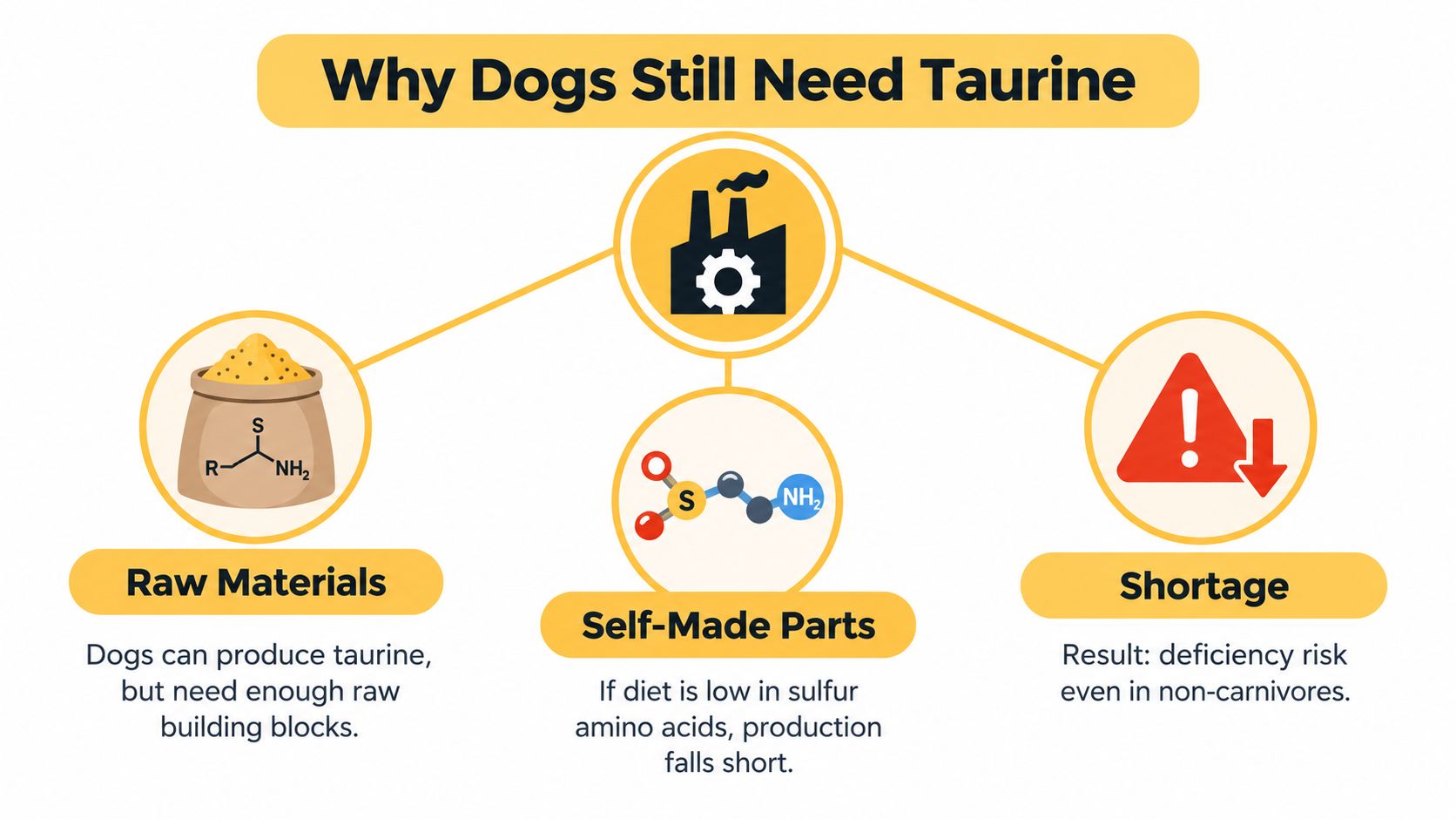
Think of your dog's body as a small factory. It can manufacture some of its own taurine, but the factory still needs raw materials, working equipment, and enough production capacity. Dogs make taurine from the sulfur-containing amino acids cysteine and methionine, yet that ability doesn't guarantee that every dog produces enough under every dietary condition.
That's why taurine is often described as conditionally essential. A nutrient can be made by the body under ordinary circumstances and still become important to supply or supplement when synthesis, intake, absorption, or demand isn't keeping up. Recent veterinary literature describes taurine as relevant to more than the heart, including the myocardium, retina, central nervous system, reproduction, and lipid metabolism. This veterinary review of taurine physiology and testing also highlights why a simple “the dog can make it” explanation is incomplete.
The raw-material problem
A diet can contain plenty of total protein and still raise questions about taurine production. What matters here is the availability and balance of the amino acids involved, along with the individual dog's ability to use them. Grain-free, vegetarian, vegan, or heavily home-prepared diets may deserve closer review when they don't reliably provide the nutritional pattern a dog needs.
Size can complicate the picture, too. Larger dogs may have different nutritional demands and can be harder to assess through a single laboratory value. That doesn't mean every large dog is deficient. It means body size belongs in the conversation when a veterinarian reviews diet, symptoms, breed history, and test results.
Key concept: A dog's ability to synthesize taurine is a safety mechanism, not proof that taurine status is always sufficient.
Taurine supports normal heart-muscle function, but its broader roles help explain why the subject shouldn't be reduced to “heart powder.” It participates in tissues that support vision, nervous-system function, reproduction, and fat metabolism. If you're considering a broad daily food topper rather than a standalone amino acid, DA-1™ Daily All-in-One - Skin/Coat, Joints, Gut Health & More is described as a human-grade powder intended to combine support for several wellness categories in one daily scoop. That type of product should still be distinguished from a measured taurine intervention prescribed for a documented nutritional or cardiac concern.
Signs Causes and Testing for Low Taurine in Dogs
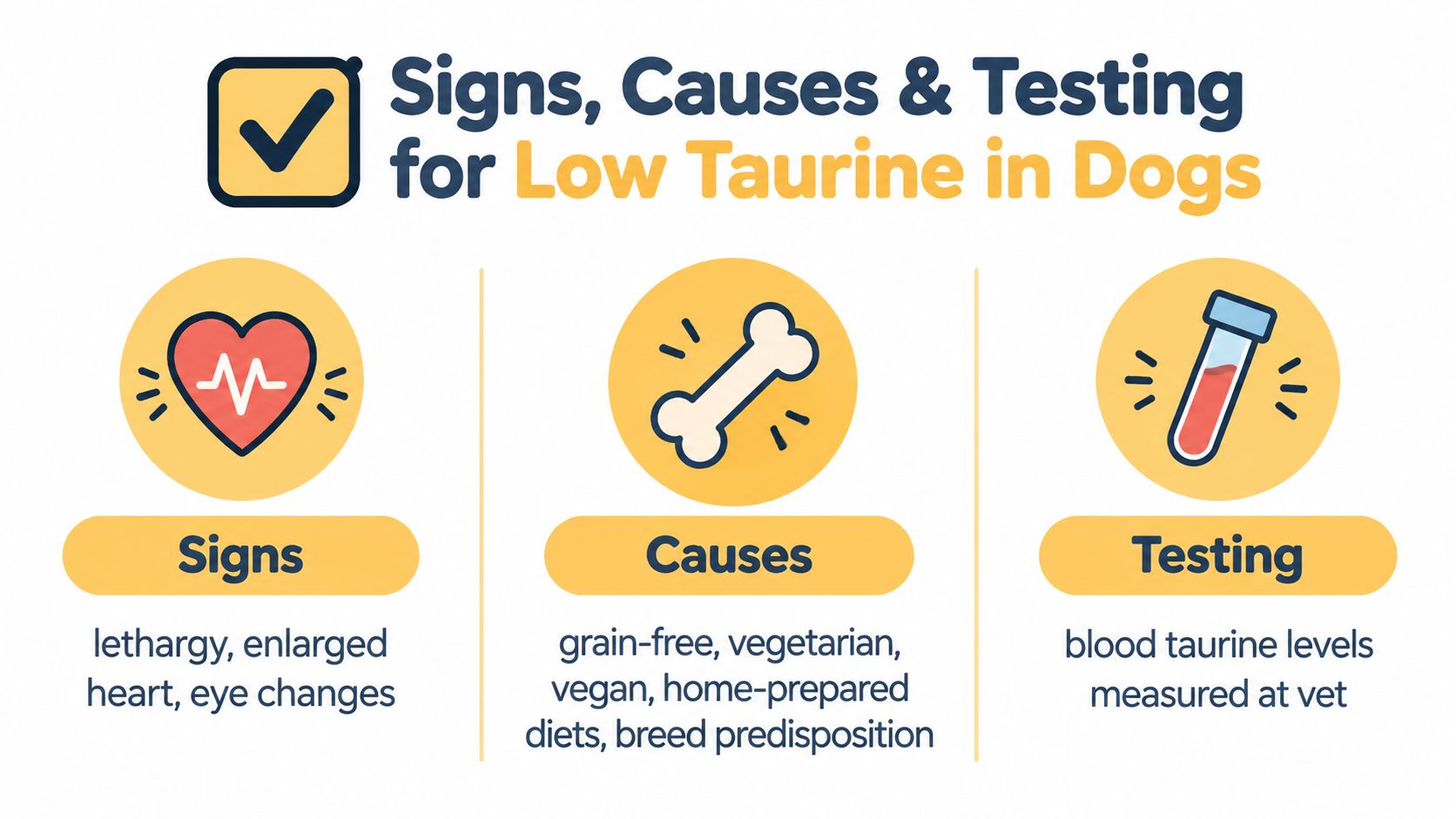
A dog that used to race across the yard may begin stopping sooner, sleeping more after ordinary activity, or breathing harder than expected. Those changes can point to low taurine status, but they also occur with aging, pain, respiratory disease, anemia, and other conditions. They are signals to investigate, not a diagnosis.
Diet provides important context. Veterinary review may be especially useful for dogs eating grain-free, vegetarian, vegan, or heavily home-prepared diets, and for breeds that have received particular attention in taurine or DCM research. Taurine production also depends on sulfur amino acids. Cysteine and methionine serve as the raw materials, so a diet that does not reliably provide enough may affect taurine status.
Symptoms that deserve prompt attention
Possible heart-related signs include lethargy, reduced exercise tolerance, coughing, unusually fast or difficult breathing, weakness, fainting, appetite changes, weight loss, and abdominal enlargement. Eye changes may matter as well because taurine supports retinal tissues. Collapse, labored breathing, or a rapidly worsening ability to exercise calls for prompt veterinary care. Giving powder and watching at home is not an adequate response to those signs.
Testing commonly includes whole-blood taurine and plasma taurine. A later review describes reduced taurine status as whole-blood taurine below 200 nmol/mL, with critically low status below 150 nmol/mL. It also gives reduced hepatic taurine below 60 nmol/mL and critically low hepatic status below 40 nmol/mL. The Morris Animal Foundation overview of canine taurine and heart disease provides these reference points and explains their clinical background.
Golden Retrievers may be evaluated with different thresholds. The FDA describes low whole-blood taurine in taurine-deficient Golden Retrievers at ≤250 nmol/mL, and low plasma taurine at ≤60 nmol/mL. The result is only one part of the picture. Breed, sample type, diet, symptoms, and laboratory method all affect interpretation, so one cutoff should not be applied to every dog. The FDA's discussion of taurine testing in dogs explains why both sample types may be considered when DCM or diet-associated cardiac disease is suspected.
Why a normal result may not settle the question
A blood result can look reassuring while giving an incomplete view of taurine reserves. Circulating taurine is more like checking supplies on a delivery shelf than measuring every storage room in the body. Low sulfur amino acid intake, especially in larger dogs, may affect tissue availability before a routine blood value clearly changes.
That is why diet history, breed, clinical signs, cardiac imaging, and the distinction between circulating and tissue status belong together. A normal result does not automatically justify supplementation, yet it may not close the investigation when the overall pattern remains concerning.
Bring the complete food label, recipe, treats, toppers, and supplement list to the appointment. Ask whether both taurine tests are appropriate, whether an echocardiogram or another heart assessment is warranted, and whether changing the primary diet should come before or alongside measured taurine powder.
Evidence Based Benefits Risks and the DCM Connection
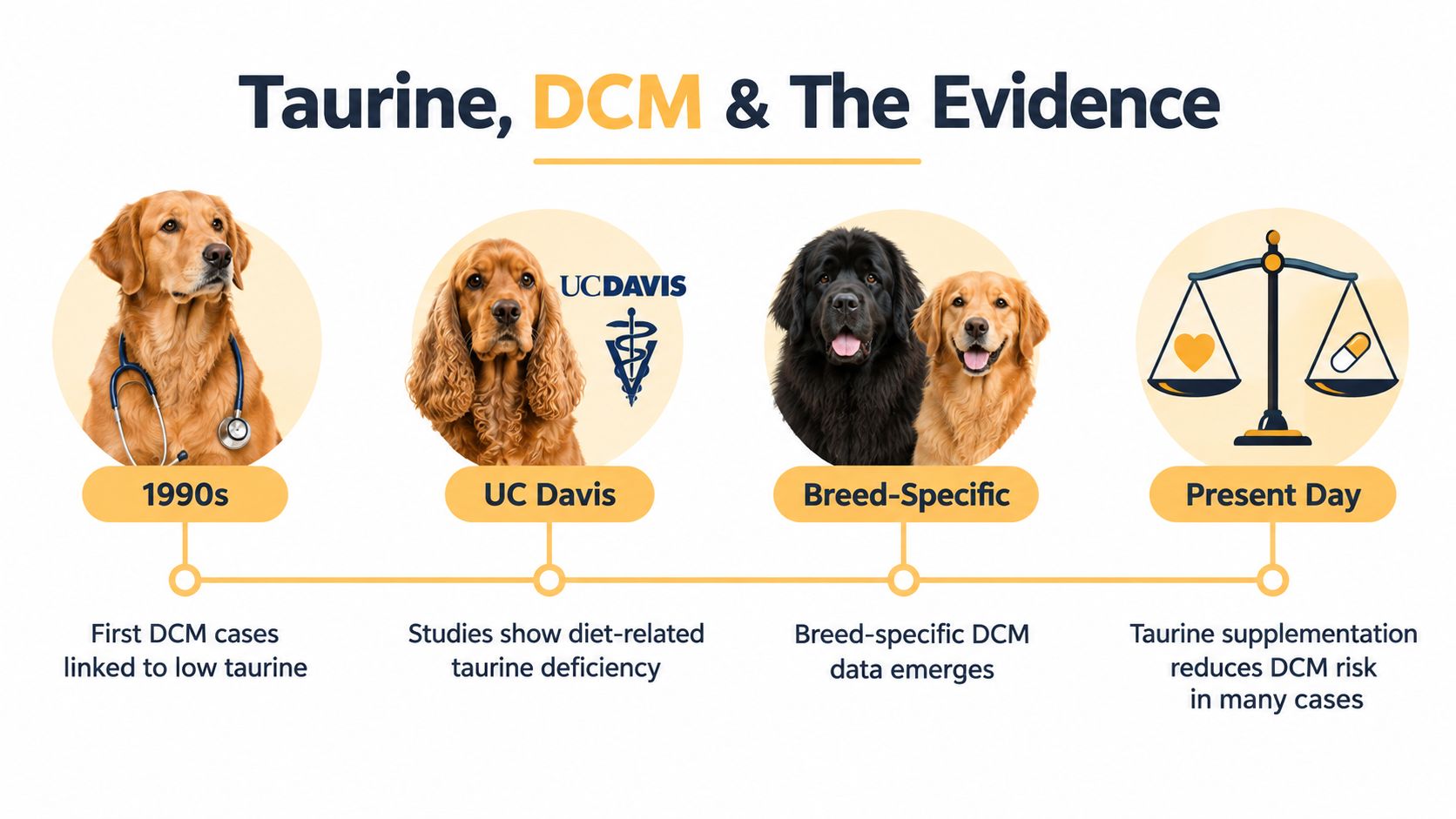
A dog may begin tiring on ordinary walks, yet taurine powder alone cannot explain or fix every heart problem. The taurine and DCM connection developed through clinical observations, breed research, diet review, and follow-up after nutritional changes. In the 1990s, clinicians documented low taurine in some dogs with dilated cardiomyopathy. A mid-1990s multicenter study at the University of California, Davis, found low taurine in many affected American Cocker Spaniels. By 2003, researchers had reported 12 client-owned dogs with low blood or plasma taurine and DCM. Some dogs lived longer and showed reversible cardiac improvement after supplementation. The broader history is summarized by The Morris Animal Foundation history of canine taurine research.
Later work showed why taurine should be treated as a conditional, multi-system nutrient rather than a universal heart remedy. In the landmark 2003 Newfoundland study, plasma taurine ranged from 3 to 228 nmol/mL, while 12 dogs measured below the study's deficiency threshold of 40 nmol/mL. Changing the diet or adding methionine reversed the deficiency. The finding supports a practical point: taurine status can respond to nutrition, and low levels are not always evidence of an irreversible heart process. The published Newfoundland study details those results.
What supplementation can and can't do
For a dog whose DCM is associated with low taurine, supplementation may support improved cardiac function when combined with diet correction and veterinary monitoring. It does not treat every form of DCM. Heart disease may involve genetic, structural, nutritional, or mixed causes, so the powder cannot identify the cause affecting one dog.
Prevention requires the same care. A dog eating a complete diet is not automatically healthier with extra taurine. A dog eating a concerning diet may need the primary food changed before, or instead of, adding powder. The FDA emphasizes investigating diet-associated DCM without reducing the problem to one ingredient or one food label.
Taurine makes the most sense as part of a clinical plan, not as a substitute for finding out why the heart is struggling.
Risks often begin with a wrong assumption. An owner may postpone imaging because taurine has been started, overlook the same ingredient in several supplements, or treat a normal blood result as proof that no concern remains. A measured product can support a veterinary workup, but it cannot replace one. L-carnitine in dogs provides related context for why cardiac nutrition may involve more than one nutrient.
How to Use Taurine Powder Safely and Accurately
Taurine powder is most useful when you can measure the intended amount consistently. Veterinary guidance gives practical benchmarks for dogs with confirmed deficiency or suspected diet-associated DCM, but these are not a reason to select a dose independently when a dog has symptoms or diagnosed heart disease.
| Dog Weight | Benchmark Dose Every 12 Hours | When to Consider |
|---|---|---|
| Under 10 kg | 250 mg | Confirmed deficiency or suspected diet-associated DCM under veterinary direction |
| 10 to 25 kg | 500 mg | Veterinary-supervised nutritional or cardiac plan |
| Over 25 kg | 1,000 mg | Larger dogs with confirmed deficiency or suspected diet-associated DCM |
These benchmarks come from published veterinary guidance at the University of Wisconsin School of Veterinary Medicine. Other expert guidance uses 500 to 1,500 mg per dog every 12 hours, depending on body size and case severity, so your veterinarian's plan should take priority. A general overview of dose calculation, including how to think about taurine amounts in a broader supplement routine, is available in this guide to the optimal taurine dose for TRT.
Measure before you mix
A milligram scale is the most dependable option when the product doesn't include a calibrated scoop. Household measuring spoons aren't designed for small powder doses, and the same scoop can hold different weights depending on particle size and how tightly it's packed.
Mix the measured powder into a portion of wet food your dog will finish, then offer the rest of the meal. Splitting a veterinarian-directed dose between morning and evening meals can make administration easier, particularly when the plan calls for dosing every 12 hours. Keep the container dry, sealed, and away from heat and moisture, and record the product, amount, and administration times.
Use the guide to reading supplement labels to check whether the stated serving refers to taurine itself or to a larger scoop containing several ingredients.
Keep the diet in the plan
Supplementation should accompany diet correction when the primary food is part of the concern. Don't replace a complete diet with random meat additions, organ meat, or a homemade recipe assembled from online suggestions. Ask your veterinarian whether the current diet should change, whether a veterinary nutritionist should formulate a home-prepared plan, and when taurine or cardiac rechecks should occur.
Contact the veterinary team if your dog develops worsening breathing difficulty, fainting, marked weakness, persistent digestive upset, or any new symptom after starting a supplement. A powder can be measured accurately and still be the wrong intervention for the underlying problem.
How to Choose a Quality Taurine Powder for Dogs
A good taurine product should make its contents easy to verify. Start with the ingredient panel, not the front label. A standalone powder with a clearly stated amount of taurine per serving is easier to coordinate with a veterinary plan than a blend that lists several ingredients without showing how much taurine it contains.
A practical product comparison
| What to check | More transparent option | Caution sign |
|---|---|---|
| Ingredient identity | Taurine is clearly named and quantified | Taurine appears without an amount |
| Formula design | Single-ingredient powder when targeted dosing is needed | Proprietary blend obscures the dose |
| Additives | No unnecessary fillers or flavoring agents | Long additive list with unclear purpose |
| Manufacturing information | Country and facility details are disclosed | Origin and facility information are absent |
| Quality verification | Batch-specific third-party testing is available | No testing documentation can be provided |
| Documentation | Certificate of Analysis matches the lot | Purity claims have no supporting record |
A Certificate of Analysis, or COA, should identify the tested material, the batch or lot, the test date, and the measured result. Look for a method that confirms identity and purity, along with results that match the label. A claim such as 99% or higher purity is meaningful only when the manufacturer can connect it to a documented batch result, not when it appears as an unsupported marketing phrase.
Standalone powder or broader formula
A standalone powder may be easier to adjust when a veterinarian has prescribed a specific taurine amount. A broader supplement may be more convenient for general wellness categories, but it can create duplication if another product already contains taurine. Write down the daily amount from every label before combining products.
Claims such as “human-grade,” “made in the USA,” or “produced in an FDA-registered facility” can provide useful manufacturing context, but they don't replace batch testing. If you want to understand why lot-level documentation matters, review this explanation of supplement batch testing.
Building a Simple Daily Nutrition Routine With Targeted Support
A sustainable routine begins with the primary diet. If that diet is incomplete, poorly balanced, or inappropriate for the dog's life stage, taurine powder can't correct every nutritional gap. If the diet is suitable but a veterinarian identifies low taurine or diet-associated cardiac risk, a separate measured powder may fit alongside diet correction and monitoring.
For a generally healthy dog, daily support may focus on different needs, such as joints, skin and coat, gut health, immunity, or stress. Pure Paw Labs describes DA-1™ Daily All-in-One as a human-grade powder designed to combine those categories in one daily scoop. That kind of all-in-one routine may reduce the number of separate products an owner has to remember, but it shouldn't be assumed to provide the same targeted taurine plan a veterinarian might prescribe.
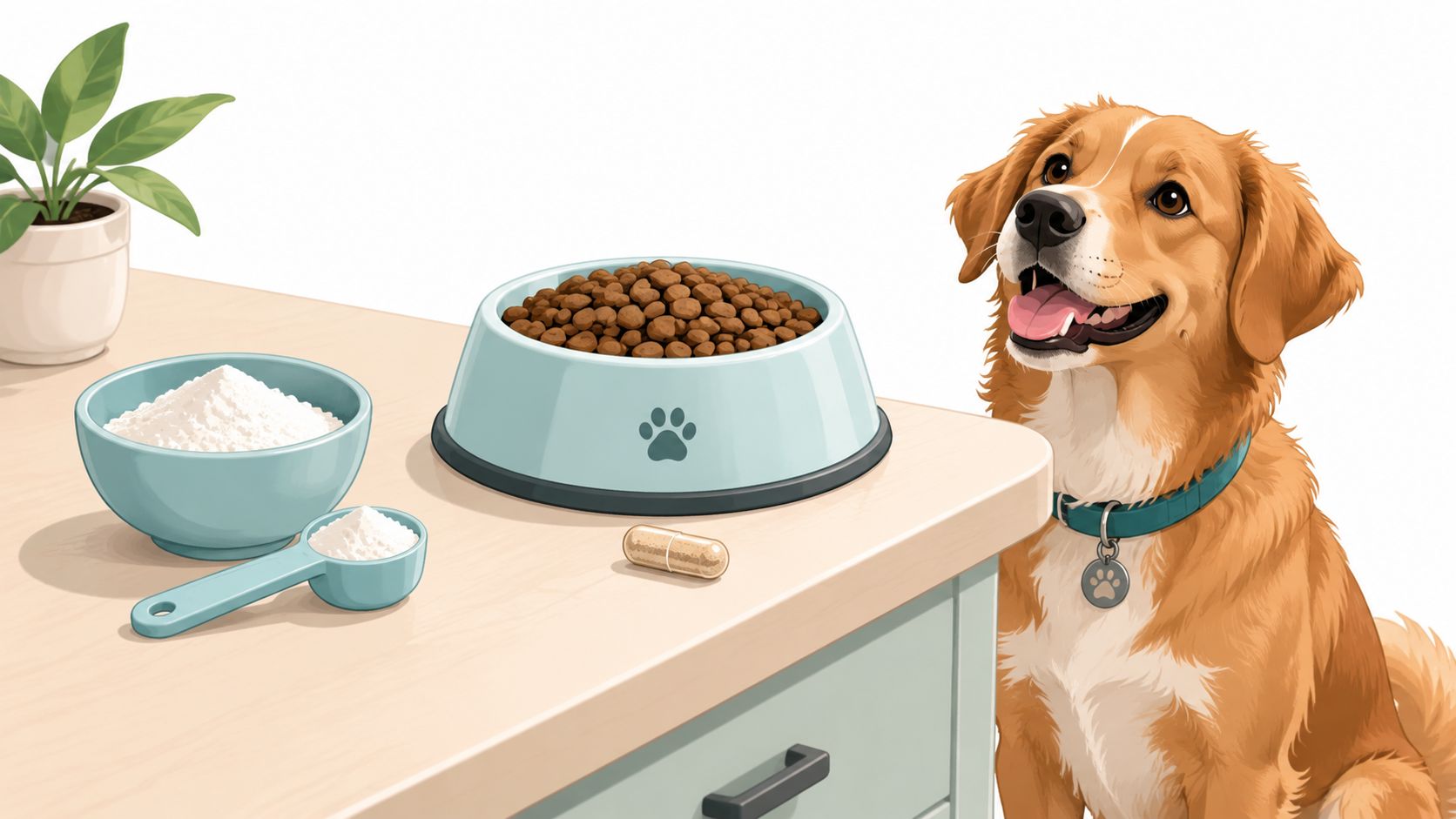
Keep the routine simple enough to follow. Feed the chosen complete diet consistently, add only the supplements that address a defined need, measure powders rather than guessing, and maintain a written list for your veterinary team. If your dog has heart symptoms, a breed-related concern, or a diet that may not provide dependable sulfur amino acid nutrition, arrange an evaluation instead of relying on preventative self-treatment.
Supplements aren't intended to diagnose or treat disease. Use taurine powder as a targeted, measured intervention when the clinical context supports it, and keep diet correction at the center of the plan.
Pure Paw Labs offers DA-1™ Daily All-in-One as a human-grade daily powder for joint, skin and coat, gut, immune, and stress-related support, which can simplify a broader wellness routine alongside a suitable diet. Visit Pure Paw Labs to review the product information and decide whether it fits your dog's everyday nutrition plan.