


You're standing at the kitchen counter with a dog bowl in one hand and five half-empty jars in the other. There's glucosamine for stiff joints, fish oil for the coat, probiotics for digestion, an omega chew from an earlier recommendation, and a multivitamin that seemed sensible at the time. You want to support your dog's mobility, skin, gut, and immune health, but the routine has become a small pharmacy, and you're no longer sure which ingredients overlap.
That frustration explains the appeal of a superfood dog supplement. One carefully formulated powder or chew promises broader daily coverage without asking you to measure several products. Convenience matters, but it shouldn't replace evidence. The right question isn't whether a blend contains impressive-sounding ingredients. It's whether the formula names those ingredients, provides meaningful doses, explains its testing, and matches your dog's actual needs.
Table of Contents
- The Five-Jar Problem Most Dog Owners Know Too Well
- What a Superfood Dog Supplement Actually Is
- The Ingredients That Actually Have Science Behind Them
- Why Natural Does Not Always Mean Safe
- How to Read a Supplement Label Like a Pro
- All-in-One Powder vs Single-Purpose Supplements
- Matching the Right Formula to Your Dog
- A Simple Plan for Getting Started
The Five-Jar Problem Most Dog Owners Know Too Well
The five-jar problem usually starts innocently. A dog begins moving slowly after rest, develops a dull coat, or has inconsistent stools. You add one product, then another when a new concern appears. Before long, breakfast involves opening containers, counting chews, measuring oils, and remembering which product should be given with food.
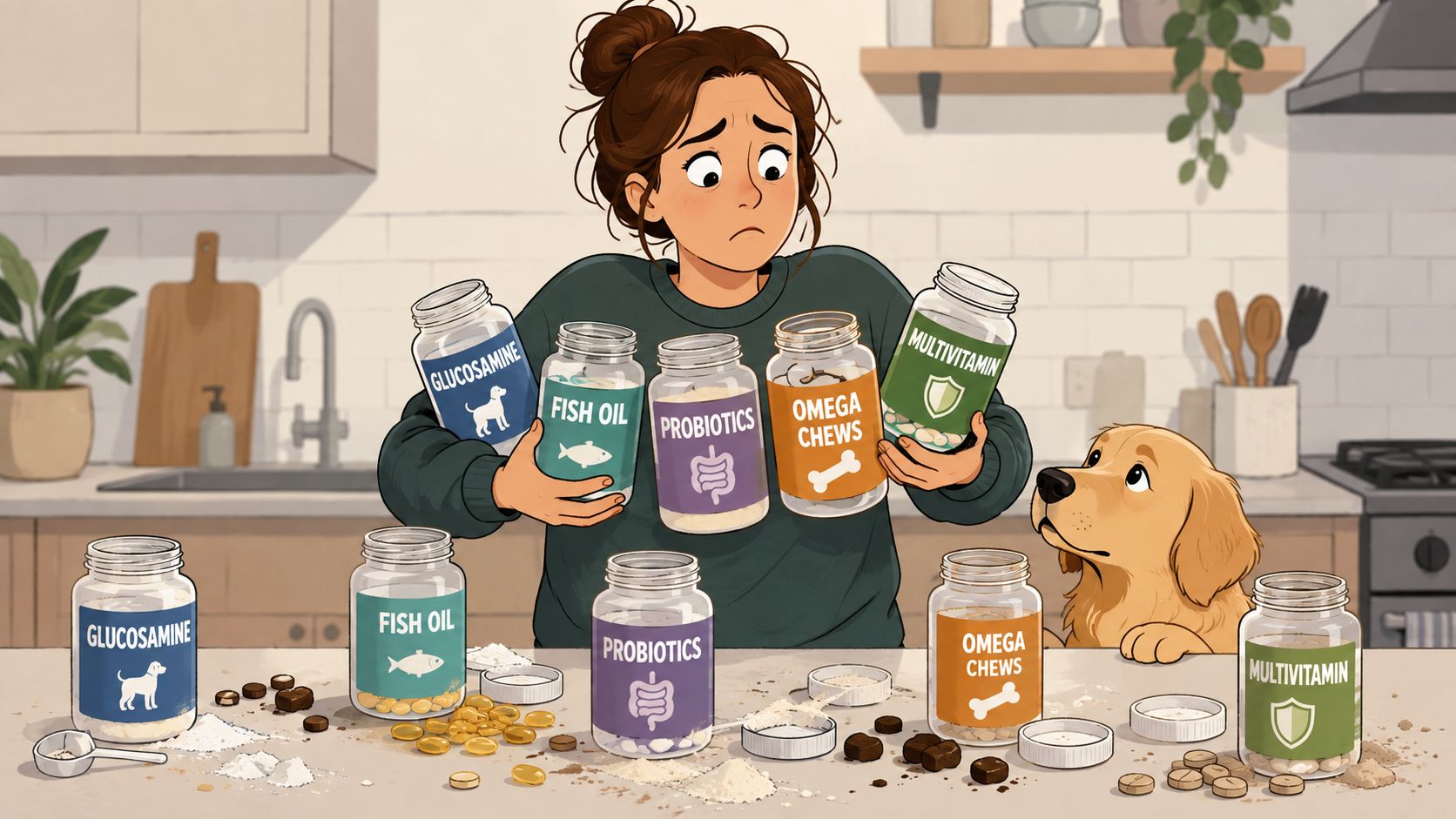
The problem isn't only inconvenience. Several products may contain the same nutrient under different names. A multivitamin could overlap with a fortified diet, while separate fish oil and skin chews may both contribute fatty acids. If labels hide amounts inside proprietary blends, you can't easily tell whether the total intake is modest, meaningful, or more than your dog needs.
Administration also affects results. A product that sits untouched in a cupboard does nothing, and a complicated routine creates more opportunities for missed servings. Owners often respond by searching for an all-in-one supplement, hoping to reduce both the number of jars and the possibility of accidental duplication.
Practical rule: Fewer products can simplify a routine, but only if the single formula gives you enough information to assess every active ingredient.
The category has grown alongside wider interest in preventive pet care. One independent estimate valued the global pet supplements market at USD 3.14 billion in 2025 and projected it to reach USD 5.47 billion by 2034, with a 6.34% CAGR. North America represented 43.37% of the market in 2025, while dogs accounted for 63.1% of pet supplement demand in another segment estimate, according to Fortune Business Insights' pet supplements market data.
A useful guide therefore needs to do three things. It should define what “superfood” means in a canine formula, separate plausible ingredient science from marketing language, and give you a practical method for deciding whether one blended product is appropriate or whether your dog needs targeted veterinary support.
What a Superfood Dog Supplement Actually Is
Think of the difference between a pill and a smoothie. A pill may deliver one isolated nutrient or compound. A smoothie combines several foods and nutrient groups into one serving, although the quality still depends on what went into the blender and in what amounts.
A superfood dog supplement generally follows the second model. It combines multiple nutrient-dense or functional ingredients in a daily serving, often as a powder, chew, or food topper. The term “superfood” isn't a guarantee of clinical effectiveness, and it doesn't mean the product can replace a complete, balanced diet. It's a marketing category that usually describes a blend intended to support more than one body system.
The formula matters more than the label
A basic multivitamin may focus mainly on vitamins and minerals. A broader superfood blend may also include whole-food ingredients, marine oils, fibers, fermentation products, plant extracts, or mushroom-derived compounds. Some formulas use terms such as adaptogens, postbiotics, or green extracts, but those labels don't tell you whether the ingredient is relevant to dogs or present at a useful amount.
Look for a clear connection between each ingredient and a practical goal:
- Joint support may involve marine omega-3 fatty acids or other mobility-focused compounds.
- Skin and coat support may depend on essential fatty acids and bioavailable minerals.
- Gut support may include prebiotics, probiotics, or postbiotic ingredients.
- Immune support may involve nutritional adequacy and selected antioxidant or beta-glucan sources.
This places the product between ordinary diet fortification and veterinary-directed nutraceutical use. It may help fill a routine wellness role, but it shouldn't be treated as a treatment for diagnosed disease.
For owners managing several questions at once, a structured record of symptoms, medications, diet, and supplement changes can make veterinary conversations more productive. Digital tools that help practices organize client information, including resources for automate vet support with DocsBot, may also support that communication.
One example in this category is DA-1™ Daily All-in-One, Senior Dog Support, Joints, Skin/Coat & More. Its product snapshot describes one scoop with 18 human-grade ingredients aimed at cells, gut, and joints, with no fillers or pills and a 60-day money-back guarantee. Those claims still need to be evaluated through the label, dose, testing, and your dog's individual health context.
The Ingredients That Actually Have Science Behind Them
A long ingredient list can create the impression of sophistication, but evidence isn't evenly distributed across every “superfood.” The strongest practical approach is to group ingredients by the problem they're intended to address, then ask whether canine research supports the claimed outcome.
Joint support
Omega-3 fatty acids deserve particular attention. A 2022 systematic review and meta-analysis concluded that omega-3 products beneficially modulate pain in dogs with osteoarthritis, while chondroitin-glucosamine showed a very marked non-effect for pain management in that analysis. An AVMA review also described clinical trials supporting omega-3 use in dogs with osteoarthritis, after trauma or surgery, and in healthy dogs as a preventive measure. The findings are summarized in the systematic review of enriched diets and supplements for canine osteoarthritis.
That doesn't mean glucosamine or chondroitin have no conceivable role. It means you shouldn't assume they're the primary evidence-backed driver of pain relief just because they're familiar. For a mobility-focused formula, ask whether it clearly identifies marine EPA and DHA and gives their amounts separately or together.
Skin and coat
Skin quality is more than visible shine. The skin barrier helps limit moisture loss, and controlled canine data found that zinc plus linoleic acid produced significant improvements in coat gloss and coat scale. Zinc alone, and zinc combined with linoleic acid, also reduced transepidermal water loss during the study period. The research record on zinc and linoleic acid supplementation in dogs explains why this pairing is more meaningful than a vague “beauty blend.”
Omega-3 fatty acids may also support skin function, but the label should distinguish EPA and DHA from a generic fish oil quantity. A large oil number doesn't automatically reveal how much of the biologically relevant fatty acids your dog receives.
Gut and immune support
Probiotics, prebiotics, and postbiotics belong to different categories. Probiotics are live microorganisms. Prebiotics are substrates that support selected microbes. Postbiotics are non-living microbial products or components. A formula can include one, two, or all three, but each should be identified clearly and supported by a realistic administration and storage plan.
Evidence for specific strains and outcomes varies. A product that names the organism, strain where relevant, viable count at the end of shelf life, and serving guidance gives you more to assess than one that only says “proprietary probiotic blend.” Beta-glucans from yeast or mushrooms may be included for immune support, but broad immune language should carry less weight when canine outcome data aren't clear.
| Ingredient | Primary Benefit | Typical Daily Dose (per kg) |
|---|---|---|
| Marine omega-3 EPA/DHA | Joint and inflammatory support | A meaningful dose should be stated on the label, with EPA and DHA identified |
| Zinc plus linoleic acid | Skin barrier and coat quality | Use the product's species-specific dosing guidance |
| Probiotic strains | Digestive and microbiome support | The label should identify organisms and viable count |
| Prebiotic fibers | Microbial substrate and stool support | Dose depends on fiber type and tolerance |
| Postbiotic ingredients | Digestive or immune support | Look for a named ingredient and defined serving amount |
| Beta-glucans | Immune-supportive nutritional role | Species-specific dose and source should be disclosed |
Ingredients such as blueberries, leafy greens, turmeric, mushrooms, or chia may contribute nutrients, fiber, or plant compounds, but their presence alone doesn't prove a clinical benefit for your dog. Treat them as supporting components unless the formula provides canine-specific evidence and transparent dosing.
Why Natural Does Not Always Mean Safe
“Natural” describes an origin, not a safety profile. A plant, oil, mushroom, or organ concentrate can still interact with medication, upset digestion, carry contaminants, or deliver an excessive amount of a nutrient.
A 2026 analysis of 70 canine and feline dietary supplements detected lead in 16 products and cadmium in 10. Selenium appeared in 52 samples, even though it was listed on only 10 labels, and the authors noted that species-specific maximum tolerance data remain incomplete for many minerals in dogs and cats. Those findings are reported in the analysis of pet probiotic and supplement market safety concerns.
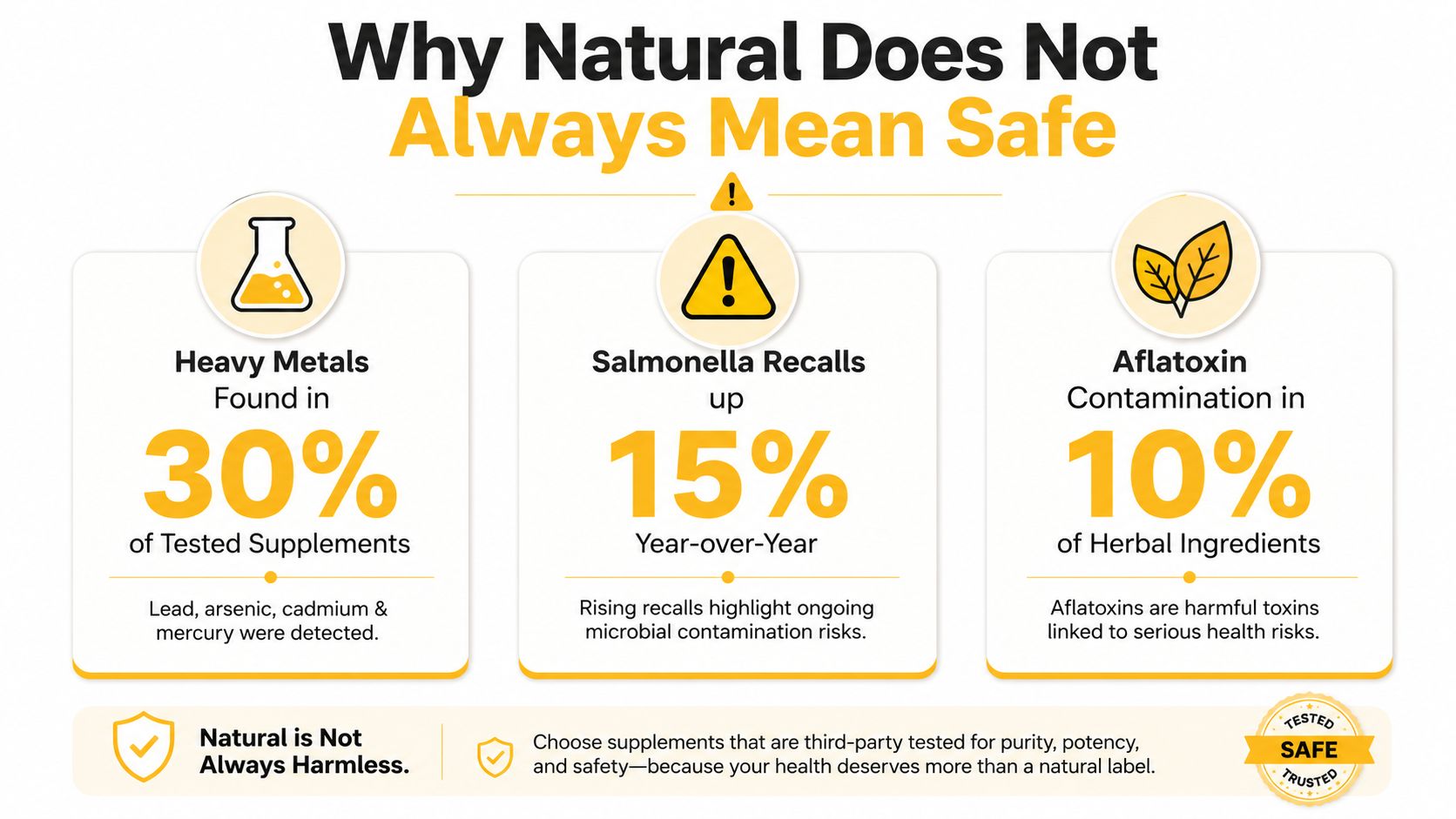
The issue is especially important for concentrated products. Garlic illustrates the point: a whole-food ingredient can become hazardous depending on form and amount. Xylitol is another serious concern in products made for people, because a sweetened blend may be unsafe for dogs. Liver concentrates can also provide excessive vitamin A when owners combine them with other fortified products.
Transparency is part of safety
A proprietary blend creates a practical problem. If the label lists a total blend weight but doesn't disclose each ingredient's amount, you can't compare the formula with published safety guidance or calculate overlap with the rest of your dog's diet.
Omega-3 provides a useful example. A joint-support formula may need a meaningful EPA/DHA contribution, but guessing the dose from a front-label statement such as “contains fish oil” isn't responsible. The same ingredient can be useful, irrelevant at a tiny amount, or inappropriate for a particular dog depending on health status, diet, and medications.
“Holistic” and “wholesome” aren't testing methods. Ask for batch information, contaminant screening, and a dose you can calculate.
Dogs with low body weight, chronic disease, pregnancy, bleeding risk, or concurrent medication need extra caution. If a supplement claims to support a medical condition, discuss it with your veterinarian before use. A more detailed discussion of ingredient risks is available in natural dog supplements and safety considerations.
How to Read a Supplement Label Like a Pro
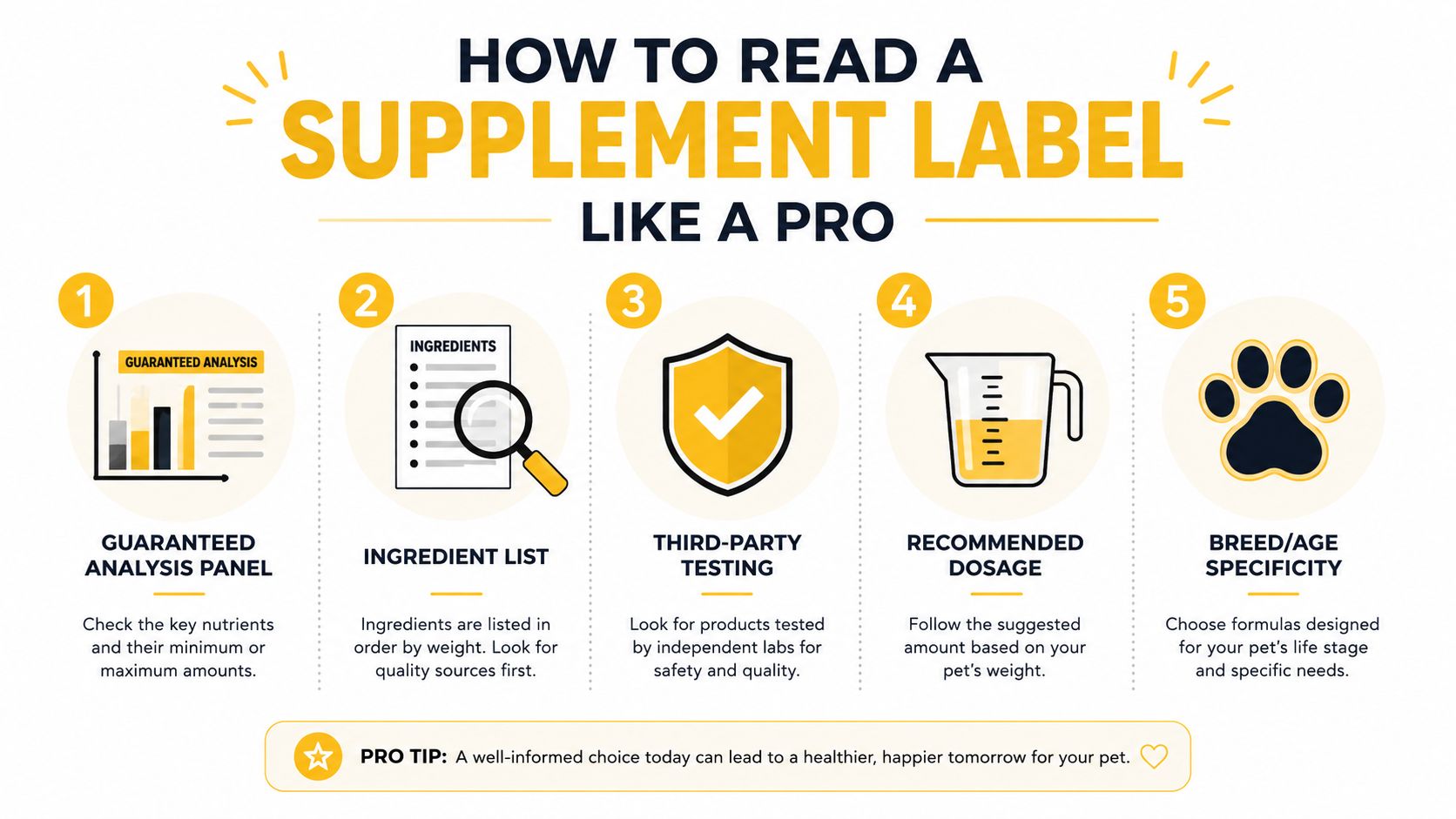
A good label lets you answer five questions quickly: what is in the product, how much is present, where it came from, whether anyone tested it, and how to use it for your dog.
Start with the amount, not the front panel
Find the guaranteed analysis or active-ingredient panel first. It should identify meaningful quantities in units you can understand, such as milligrams, rather than relying only on scoops, proprietary totals, or broad claims like “high potency.”
Next, read the full ingredient list. “Mussel” is less useful than a named source such as green-lipped mussel, and “fish oil” is less informative than an EPA/DHA breakdown. Species-specific sourcing helps you evaluate both relevance and allergy concerns.
Check the quality trail
Look for credible third-party quality signals, such as an NASC Quality Seal, USP verification where applicable, or testing performed by an ISO 17025-accredited laboratory. A seal isn't a substitute for reading the label, but independent verification can add confidence that manufacturing and testing follow a defined process.
Then look for a batch or lot number and a certificate of analysis. The certificate should relate to the product or lot you're buying, not merely show a generic laboratory example. If the company won't explain how customers can access testing information, treat that as a transparency gap.
Finish with use instructions
Confirm whether the product is described as human-grade or feed-grade, where it's manufactured, how it should be stored, and when it expires. “Natural flavor” can conceal an unclear protein source, while a proprietary blend can conceal low amounts of the ingredients you care about.
Use this one-minute cabinet test:
- Find the active amounts: Can you see the quantity of each important ingredient?
- Name the purpose: Can you connect the formula to one or more real needs?
- Check overlap: Does your dog already receive the same nutrients elsewhere?
- Locate testing details: Is there a lot number and a meaningful quality record?
- Verify dosing: Does the serving instruction account for your dog's size and health?
A practical overview of this process appears in how to read supplement labels.
All-in-One Powder vs Single-Purpose Supplements
A single-purpose supplement concentrates its identity around one goal. That can be useful when a veterinarian has identified a dominant problem and wants a specific ingredient, dose, or therapeutic approach. It also means you may need separate products for unrelated concerns.
An all-in-one powder takes the opposite approach. It spreads the serving across multiple systems, usually trading the highest possible amount of one active ingredient for broader daily coverage and easier administration. That trade-off isn't automatically good or bad. It depends on whether your dog has several mild wellness goals or one condition that needs focused care.
| Factor | Single-Purpose Supplements | All-in-One Powder, e.g., DA-1 |
|---|---|---|
| Cost per day | Must be calculated for each product and combined | Calculated from one serving |
| Active ingredient transparency | Often easier to assess for one target | Requires careful review of every active |
| Ease of administration | More jars, chews, or measuring steps | One routine may reduce missed servings |
| Best fit | A clearly defined need requiring focused support | Broad daily support across several systems |
| Main limitation | Ingredient overlap can grow as products are stacked | Each individual active may be present at a more moderate amount |
For a healthy young adult, an all-in-one product may be unnecessary if the dog already eats a complete diet and has no defined nutritional gap. A senior dog with mild changes in mobility, coat, digestion, and energy may benefit more from a simple routine that the household can follow consistently.
A dog with a diagnosed condition is different. Severe osteoarthritis, persistent allergic skin disease, recurrent gastrointestinal problems, or heart disease may require veterinary assessment and a targeted plan. A broad powder shouldn't delay prescription treatment or substitute for diagnostic work.
The all-in-one supplement guide offers useful context for thinking about convenience without assuming that one product is right for every dog. The decision should rest on transparent doses, appropriate ingredients, and the problem you're trying to solve.
Matching the Right Formula to Your Dog
Your dog's age, size, diet, and primary symptom should shape the decision more than the word “superfood” on the package. A puppy has different nutritional priorities from a senior dog, and a small dog has less room for dosing mistakes than a large dog.
Match the life stage first
Puppies need a complete growth diet, and owners shouldn't add concentrated minerals or supplements casually. Adult dogs with a balanced diet may need no routine supplement unless a veterinarian identifies a specific reason. Seniors often have several overlapping goals, such as easier movement, skin-barrier support, digestive regularity, and maintaining appetite.
Size affects exposure. A scoop that seems modest for a large dog may be substantial for a small dog, so follow weight-based instructions rather than estimating by eye. Never assume that doubling a serving will double the benefit.
| Dog Profile | Priority 1 | Priority 2 | Priority 3 |
|---|---|---|---|
| Puppy on a complete growth diet | Nutritional completeness | Veterinary guidance | Avoid unnecessary concentrated nutrients |
| Healthy adult | Diet assessment | Goal-specific support if needed | Simple administration |
| Senior with stiffness | Mobility ingredients with transparent dosing | Veterinary assessment | Easy daily routine |
| Dog with itchy skin or dull coat | EPA/DHA and skin-barrier nutrients | Allergy evaluation | Monitor scratching and coat changes |
| Dog with sensitive digestion | Identified prebiotic or probiotic support | Diet review | Stool and appetite monitoring |
| Dog with a diagnosed condition | Veterinary treatment plan | Targeted supplement review | Interaction screening |
Glucosamine and chondroitin are common in senior mobility formulas, but the evidence reviewed earlier places particular emphasis on omega-3 products for osteoarthritis pain modulation. For coat quality, look for EPA/DHA, zinc, and linoleic acid rather than relying on a generic “skin blend.” For digestive support, named probiotic strains and clearly described fibers are more useful than an undefined microbiome claim.
Some dogs need extra screening before use. Discuss omega-3 supplementation with your veterinarian if your dog takes anticoagulant medication or has a bleeding disorder. Probiotics may also need careful timing or selection during active antibiotic treatment, and chronic disease can change what is safe.
Consider a seven-year-old Labrador with itchy skin and loose stools who also rises slowly after rest. The priority stack is joint, skin, and gut support, but the loose stools and itching still deserve investigation. An all-in-one formula may fit the daily wellness role, provided its label is transparent and your veterinarian agrees.
A Simple Plan for Getting Started
Start with an audit, not a purchase. Write down every supplement, medication, fortified treat, and diet component your dog receives. Record the active ingredients and amounts, then look for duplicated oils, minerals, vitamins, or herbal compounds.
Next, choose one to three observable goals. “Better wellness” is too vague to assess. A more useful baseline might include stool consistency, willingness to rise after rest, frequency of scratching, appetite, or coat condition. Take notes before changing the routine so normal variation doesn't look like a supplement effect.

Use the label checklist on one shortlisted product. Confirm named ingredients, per-ingredient amounts, testing information, manufacturing location, storage instructions, and expiry date. If you're building a consistent delivery routine, practical pet subscription tools from RecurX(https://recurx.app/shopify-subscriptions-for-pet-brands) may help manage recurring orders, but automation should support a sound feeding plan, not lock you into a product you haven't evaluated.
Introduce the supplement gradually over 7 to 10 days, beginning with half the recommended serving mixed into food. Watch stool quality, appetite, vomiting, itching, energy, and unusual behavior. Don't introduce several new products at once, because you won't know which one caused a reaction or improvement.
Reassess at 30 and 60 days against your written baseline. Continue only if the product remains appropriate, tolerated, and relevant to your goals. Supplements complement veterinary care. They don't replace an examination, diagnostic testing, a complete diet, or treatment for a diagnosed condition.
Pure Paw Labs offers DA-1™ Daily All-in-One as a single-scoop, human-grade powdered supplement designed to combine support for joints, skin and coat, gut health, immunity, and stress-related needs. Review the ingredient amounts and testing information for your dog's situation, then visit Pure Paw Labs to explore the formula and decide whether it fits your veterinarian-informed wellness plan.