


You're standing in a pet store aisle with a bag of mushroom powder in one hand and a capsule bottle in the other. One label promises immune support, another mentions healthy aging, and a third lists several species without explaining how much of each your dog would receive. Your dog is waiting at home, and you're left wondering whether you're choosing a useful supplement or paying for an attractive label.
That uncertainty is reasonable. A mushroom supplement for dogs may contain biologically active compounds, but the canine evidence is much narrower than the marketing language suggests. The practical question isn't whether mushrooms sound healthy. It's whether a particular species, preparation, dose, and claimed outcome are supported by research in dogs.
Table of Contents
- Why Dog Owners Are Suddenly Asking About Mushrooms
- What Functional Mushrooms Actually Are
- The Main Mushroom Species Marketed for Dogs
- What the Canine Research Actually Shows
- Where the Marketing Runs Ahead of the Science
- Choosing a Mushroom Supplement Without Getting Burned
- Dosing, Safety, and How Mushrooms Fit a Daily Routine
- A Realistic Path Forward for Curious Owners
Why Dog Owners Are Suddenly Asking About Mushrooms
Functional mushrooms moved into pet care through several overlapping channels. Human wellness culture popularized products built around adaptogens, mushroom drinks, powders, and concentrated extracts. Integrative veterinary discussions then made fungal ingredients more familiar to dog owners already looking for nutrition-based ways to support aging, digestion, immune function, or day-to-day resilience.
Social media accelerated the process. Breed-specific communities share supplement routines, senior-dog checklists, and stories about changes in energy, skin, stool quality, or behavior. Those personal accounts can help owners discover options, but they can also blur the line between an individual experience and a controlled canine study.
Longevity-focused pet care added another layer. Owners are paying closer attention to mobility, cognitive changes, sleep, and preventive routines, while “natural” ingredients often feel more approachable than conventional medicines. A mushroom blend fits neatly into that conversation because it sounds both traditional and scientifically interesting.
The problem is that product adoption has moved faster than dog-specific research. Many labels borrow confidence from human trials, laboratory experiments, or studies in other animals, then present the result as though it applies directly to every dog. It doesn't.
Practical rule: Treat a mushroom label as a list of hypotheses, not a list of proven outcomes.
A useful starting point is to separate three questions:
- What does the product contain? Identify the species, plant part, growing form, extraction method, and amount.
- What outcome matters to you? “Immune support” is broad. A defined concern, such as digestive tolerance or senior-dog cognitive changes, gives you a clearer standard.
- What evidence exists in dogs? Human or laboratory research may explain why an ingredient is interesting, but it doesn't establish canine effectiveness or dosing.
Owners who want a broader introduction to daily canine nutrition can also review this superfood dog supplement guide, then return to the mushroom question with a more specific goal in mind.
What Functional Mushrooms Actually Are
Functional mushrooms are fungi valued for compounds that may influence biological processes, rather than mainly for flavor and texture. Button and portobello mushrooms belong to the culinary category, where taste, aroma, and food texture matter most. Functional species can also be eaten, but supplement makers focus on compounds found in their cell walls and fruiting bodies.
The names can sound technical. Think of beta-glucans as microscopic scaffolding. They're complex carbohydrates that can interact with immune receptors, rather like a textured surface that immune cells can recognize. Triterpenes are another group of compounds. Their bitter chemistry makes them useful as an analogy for signaling molecules, substances that may influence how cells communicate.
Other mushroom compounds receive attention for different reasons. Hericenones, associated with lion's mane research, are discussed in relation to nerve biology. Ergothioneine is an antioxidant compound found in mushrooms. These descriptions explain why researchers study fungal ingredients, but they don't prove that a supplement will produce a visible change in your dog.
The form on the label matters
A mushroom isn't one uniform ingredient. A product might use a fruiting body, the mature structure people commonly recognize as a mushroom, or mycelium, the threadlike network that grows through a substrate. Some products use mycelium cultivated on grain, which means the final material can contain both fungal tissue and the growth medium.
That distinction changes the compound profile. Fruiting bodies and mycelium don't necessarily contain the same balance of beta-glucans, triterpenes, hericenones, or other constituents. A label that says only “mushroom blend” gives you no way to understand those differences.
Processing matters, too. A plain dried powder, a hot-water extract, and a concentrated dual extract aren't interchangeable. Extraction can concentrate particular compounds, while a broader whole-material preparation may retain a different mixture. Without clear information, you can't reliably compare one product with another based on the species name alone.
For owners comparing a mushroom ingredient with a wider daily formula, DA-1™ Daily All-in-One - Skin/Coat, Joints, Gut Health & More is described as a human-grade powder used as a once-daily food topper. That kind of product-category distinction matters, because a multi-system food topper and a targeted mushroom extract answer different supplement needs.
The chemistry explains why product evaluation requires more than asking, “Which mushroom is best?” The better question is, “Which preparation, at what amount, for which outcome, and supported by what canine evidence?”
The Main Mushroom Species Marketed for Dogs
The five species most often associated with canine supplements are reishi, lion's mane, cordyceps, turkey tail, and shiitake. Their traditional reputations differ, and so does the amount of research conducted in dogs.
| Species | Traditional use | Canine research status |
|---|---|---|
| Reishi | Traditionally associated with immune balance and general vitality in Eastern herbal practice | Canine evidence remains limited, with small pilot work and tolerability observations rather than strong efficacy trials |
| Lion's mane | Traditionally linked with nerve health and cognitive support | Published canine efficacy evidence is not established; owner reports aren't a substitute for controlled research |
| Cordyceps | Traditionally used in discussions of stamina, breathing, and physical endurance | Canine research is sparse and doesn't establish broad wellness benefits |
| Turkey tail | Commonly associated with immune and oncology applications | Canine hemangiosarcoma research offers an interesting but limited and mixed evidence base |
| Shiitake | Studied for compounds such as lentinan and immune-related activity | A 2024 dog study reported measurable biochemical changes after shiitake powder supplementation |
Reishi and lion's mane
Reishi is often marketed around immune modulation, stress resilience, and general wellness. In dogs, the available information doesn't support treating those claims as settled conclusions. Small exploratory work can generate interest, but it can't establish a dependable result for healthy dogs or dogs with a particular diagnosis.
Lion's mane has a long association with nerve health and is frequently promoted for senior-dog cognition. That idea is biologically interesting, but anecdotal reports of improved alertness or stamina aren't published canine efficacy trials. Owners should ask whether a product's cognitive claim comes from dogs, another species, or laboratory work.
Cordyceps and turkey tail
Cordyceps is traditionally connected with stamina and respiratory function. Canine research remains sparse, so a label promising improved endurance or kidney support should be treated as a claim requiring verification, not as a proven outcome.
Turkey tail has the most prominent canine oncology history in this group. Research associated with the University of Pennsylvania examined turkey tail polysaccharopeptide in dogs with hemangiosarcoma, but later evidence did not confirm an added survival benefit over standard chemotherapy alone. That makes turkey tail a species with meaningful canine research interest, not a universally validated cancer supplement.
People interested in the preparation side of mushroom products may find these home cultivation tincture tips useful for understanding why extraction methods can affect a finished preparation. That information shouldn't be treated as dosing guidance for dogs.
Shiitake
Shiitake has been studied for immune-related compounds in other settings. The important canine-specific development is a 2024 study in which dogs receiving shiitake mushroom powder showed decreased plasma total cholesterol and significantly increased superoxide dismutase activity and leukocyte sirtuin1 messenger RNA expression. The researchers concluded that oral shiitake powder increased antioxidative activity and might help ameliorate age-related disease signs, including obesity, in dogs. Read the canine shiitake study.
Those findings are objective biochemical signals, which makes the study more useful than a label supported only by theory. They still don't prove that every shiitake product will produce the same result, or that changing a blood marker will necessarily improve a dog's quality of life.
For owners comparing targeted ingredients with broader senior-dog routines, DA-1™ Daily All-in-One - Senior Dog Support, Joints, Skin/Coat & More is described as a human-grade, multi-system powder with 18 ingredients in one scoop. That is a different formulation strategy from choosing a single mushroom species for a defined research question.
What the Canine Research Actually Shows
The canine evidence becomes clearer when you stop grouping all mushrooms together. A shiitake powder study, a turkey tail oncology study, and an emerging cognitive-support report don't answer the same question, and they shouldn't be presented as though they do.
The most concrete biochemical evidence comes from the 2024 canine shiitake study. Dogs receiving the supplement experienced a reduction in plasma total cholesterol, alongside significant increases in superoxide dismutase activity and leukocyte sirtuin1 messenger RNA expression. Those endpoints are measurable physiological markers, so the study provides a specific signal for metabolic and oxidative support rather than relying only on broad language such as “boosts wellness.” The published study is available here.
The limitation is equally important. A biochemical change isn't the same as a demonstrated improvement in symptoms, lifespan, or everyday function. The result applies to the studied shiitake powder and study conditions, not automatically to blends, capsules, tinctures, or products that disclose no preparation details.
| Mushroom species | Condition or endpoint | Study design | Key finding | Notable limitation |
|---|---|---|---|---|
| Shiitake | Cholesterol, antioxidant activity, and sirtuin1 expression | Published canine supplementation study | Cholesterol decreased, while superoxide dismutase activity and leukocyte sirtuin1 expression increased significantly | Biomarker changes don't establish class-wide effectiveness or clinical outcomes |
| Turkey tail | Hemangiosarcoma and survival | Early pilot work followed by prospective research | Early work suggested possible benefit in some settings | The evidence appraisal found major design limitations and insufficient support for clinical use |
| Turkey tail | Survival alongside chemotherapy | Later prospective study involving 101 dogs | No added survival benefit over standard chemotherapy alone was found | The result doesn't answer questions about healthy dogs or non-cancer uses |
| Mushroom-derived nutraceutical | Cognitive decline, sleep, and restlessness in aging dogs | 2025 proof-of-concept evaluation | 59% showed measurable cognitive improvement and another 23% remained stable, according to independent industry reporting | Small, early-stage evaluation of one proprietary product, not a general dosing or effectiveness standard |
The turkey tail evidence deserves careful wording. An early pilot signal can justify further research, but the evidence appraisal concluded that the study was too weak to support clinical use because it lacked a control group and had major design limitations. The later prospective study involving 101 dogs didn't find an added survival benefit over standard chemotherapy alone. Read the evidence appraisal.
The 2025 cognitive report is encouraging but preliminary. Independent pet-industry coverage reported that 59% of dogs showed measurable cognitive improvement and 23% remained stable, meaning 82% didn't worsen during the evaluation period. It also described better sleep efficiency, less nighttime restlessness, and exploratory biomarker trends, but the report concerns one proprietary nutraceutical and doesn't establish a universal mushroom effect. Review the reported cognitive findings.
A simple credibility scale helps:
- More informative: Objective canine measurements from a defined preparation, such as the shiitake study.
- Promising but uncertain: Early cognitive or oncology signals that need replication and stronger controls.
- Weak support: Broad claims based mainly on human research, laboratory mechanisms, testimonials, or unnamed blends.
Where the Marketing Runs Ahead of the Science
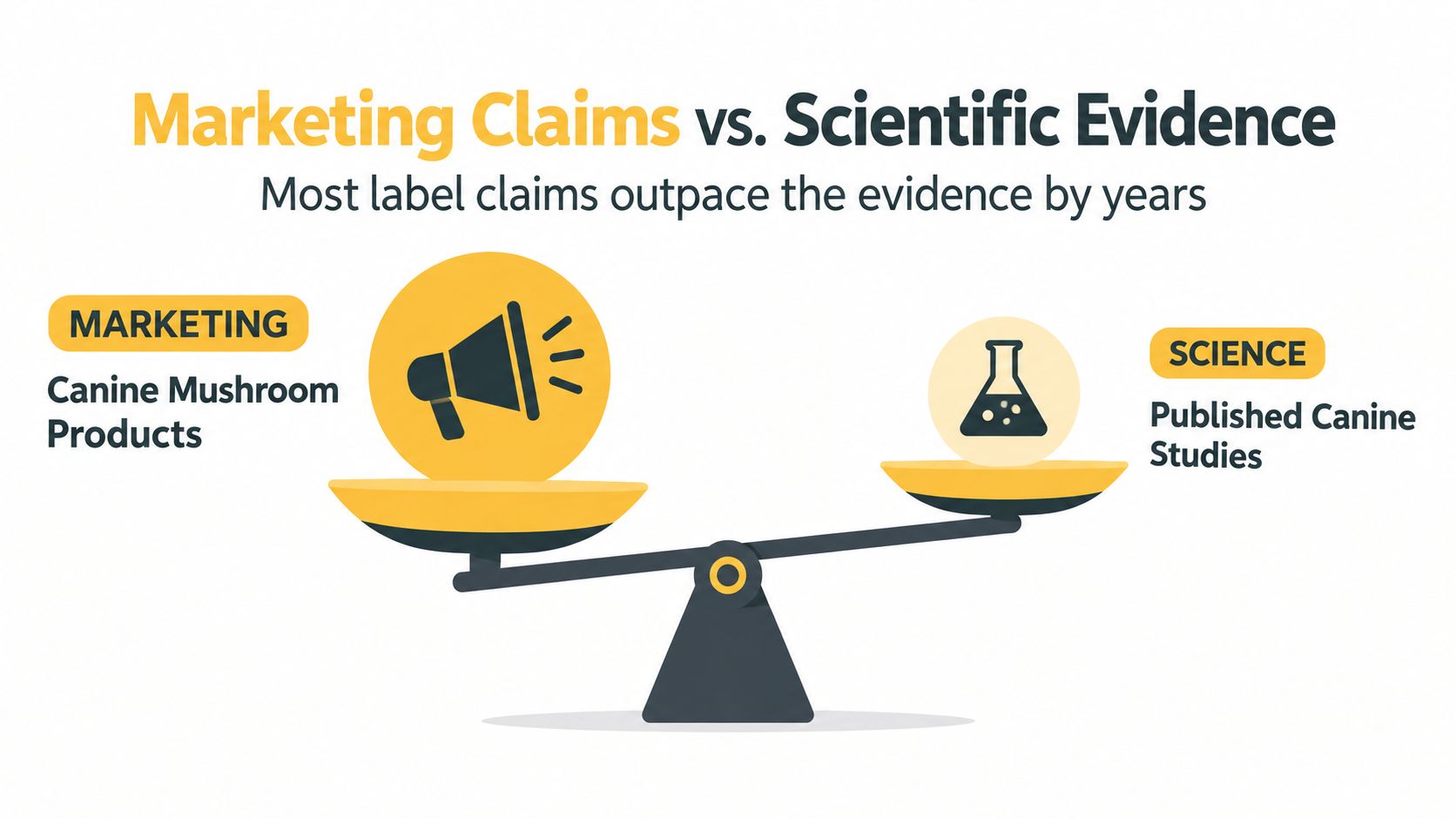
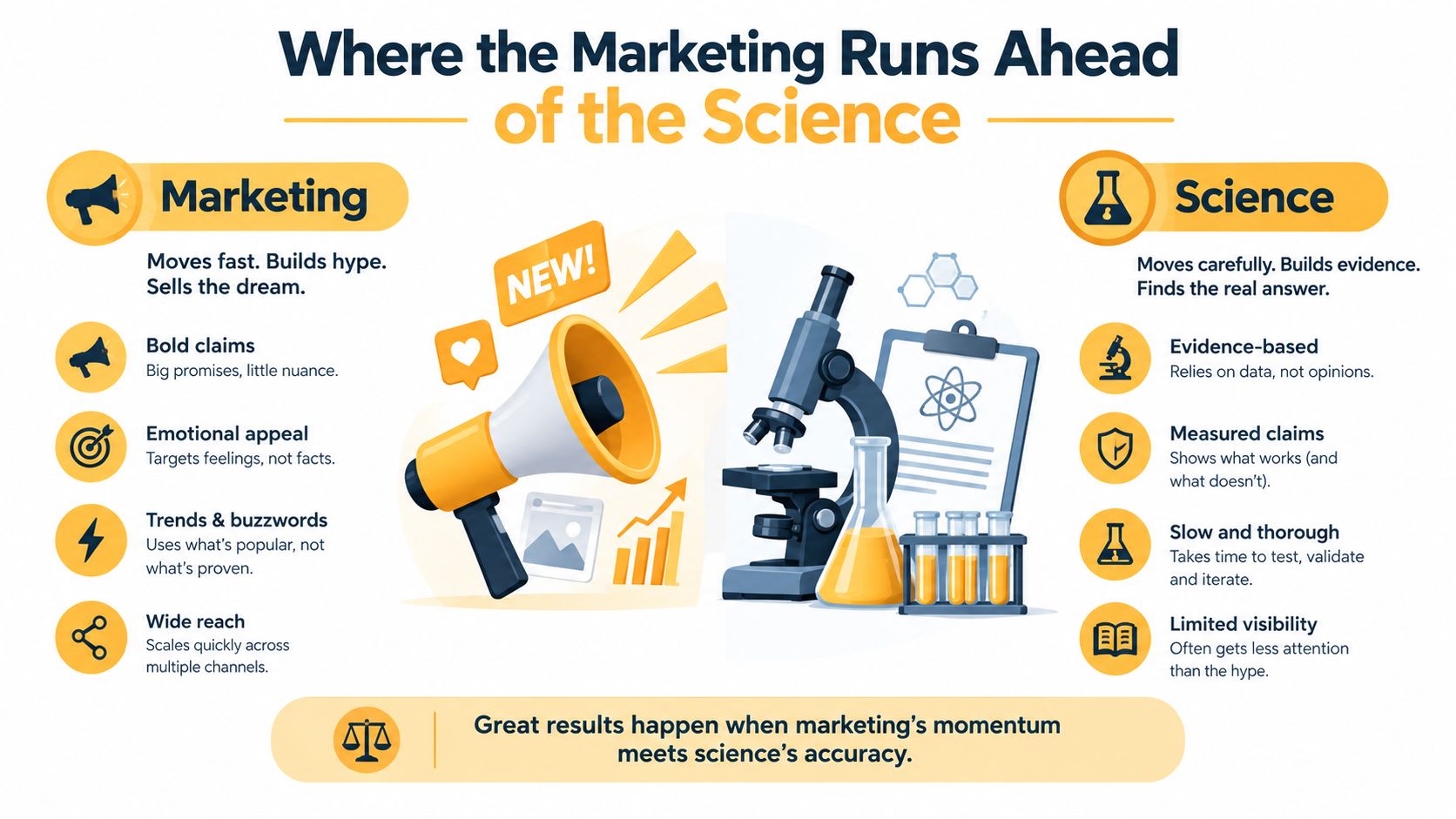
The central marketing problem is category inflation. A study involving one species, one preparation, and one canine condition gets converted into a promise about immune health, aging, cognition, cancer, digestion, stress, and longevity. The label becomes broader while the evidence stays narrow.
Turkey tail shows why that matters. The early hemangiosarcoma work attracted attention because it suggested a possible oncology benefit, but the evidence appraisal found the research too weak to support clinical use. A later prospective study involving 101 dogs found no added survival benefit over standard chemotherapy alone. The evidence appraisal details those limitations.
That doesn't mean the ingredient is worthless. It means the claim must stay attached to the actual question studied. Evidence from a cancer setting can't automatically establish benefit for a healthy dog, a dog with itchy skin, or a dog experiencing ordinary age-related slowing.
Broad language hides narrow evidence
“Immune support” sounds precise, but it can refer to many different things. A product might mean antioxidant activity, changes in immune markers, support during illness, or a general wellness intention. Those are not interchangeable outcomes, and no single phrase tells you which one the manufacturer has measured in dogs.
Blends create another illusion. Adding six species to a label can make a formula look more detailed, but it doesn't create six bodies of canine evidence. If the label hides the amount of each ingredient, you can't connect the product to a study dose or determine whether one species is present in a meaningful quantity.
Marketing education can help explain why emotional storytelling and influencer content shape buying decisions, so this UK guide to pet influencer marketing offers useful context. Owners should still evaluate the underlying evidence independently of how persuasive a product story feels.
A practical question cuts through the noise: Which species, in which preparation, was studied for which outcome in dogs? If a brand can't answer that clearly, interpret the claim as positioning rather than proof. Product transparency, including independent testing, is a separate question from efficacy, and this guide to third-party lab testing explains why those checks matter when evaluating supplement quality.
Choosing a Mushroom Supplement Without Getting Burned
Start with the outcome, not the mushroom name. If your concern is senior-dog cognition, a product should explain why its ingredients fit that goal and identify any canine evidence. If you're interested in general wellness, recognize that the evidence is weaker and define what you'll monitor, such as appetite, stool consistency, or daily activity.
Then inspect the preparation. Look for the Latin species name, whether the product uses fruiting body, mycelium, or both, and whether it's a powder or extract. Mycelium grown on grain isn't automatically poor quality, but the label should clarify how much of the final material is fungal tissue and how much is substrate.
Read the active-compound information
Beta-glucan content can help you understand what a product is emphasizing, but a percentage without testing context tells you little. Ask whether the company provides an extract ratio, identifies the testing method, and supplies a lot-level Certificate of Analysis.
A useful label should answer these questions:
- Species: Are the mushrooms named individually, rather than hidden under “mushroom complex”?
- Form: Does it identify fruiting body, mycelium, or a combination?
- Processing: Does it explain whether the material is extracted or just dried and powdered?
- Testing: Does an independent laboratory test the lot for identity, contaminants, and heavy metals?
- Dose: Can you see the amount of each species, rather than only a combined blend total?
- Warnings: Does the product provide safety information and advise veterinary consultation when appropriate?
Fruiting-body terminology can be confusing because some marketing treats it as automatically superior, while other products emphasize mycelium. This fruiting bodies guide can help owners understand the difference between the mature mushroom structure and the broader fungal life cycle. It isn't a substitute for canine dosing advice.
Watch for comparison traps
A proprietary blend may contain several named mushrooms but conceal individual amounts. That prevents a meaningful comparison with published research and makes it difficult to identify which ingredient might cause a reaction.
A long ingredient list also doesn't guarantee a better formula. If your dog already receives joint, digestive, immune, or stress-support ingredients elsewhere, an all-in-one product may create overlap. The safer choice is the one whose purpose, composition, testing, and introduction plan you can explain in plain language.
Dosing, Safety, and How Mushrooms Fit a Daily Routine
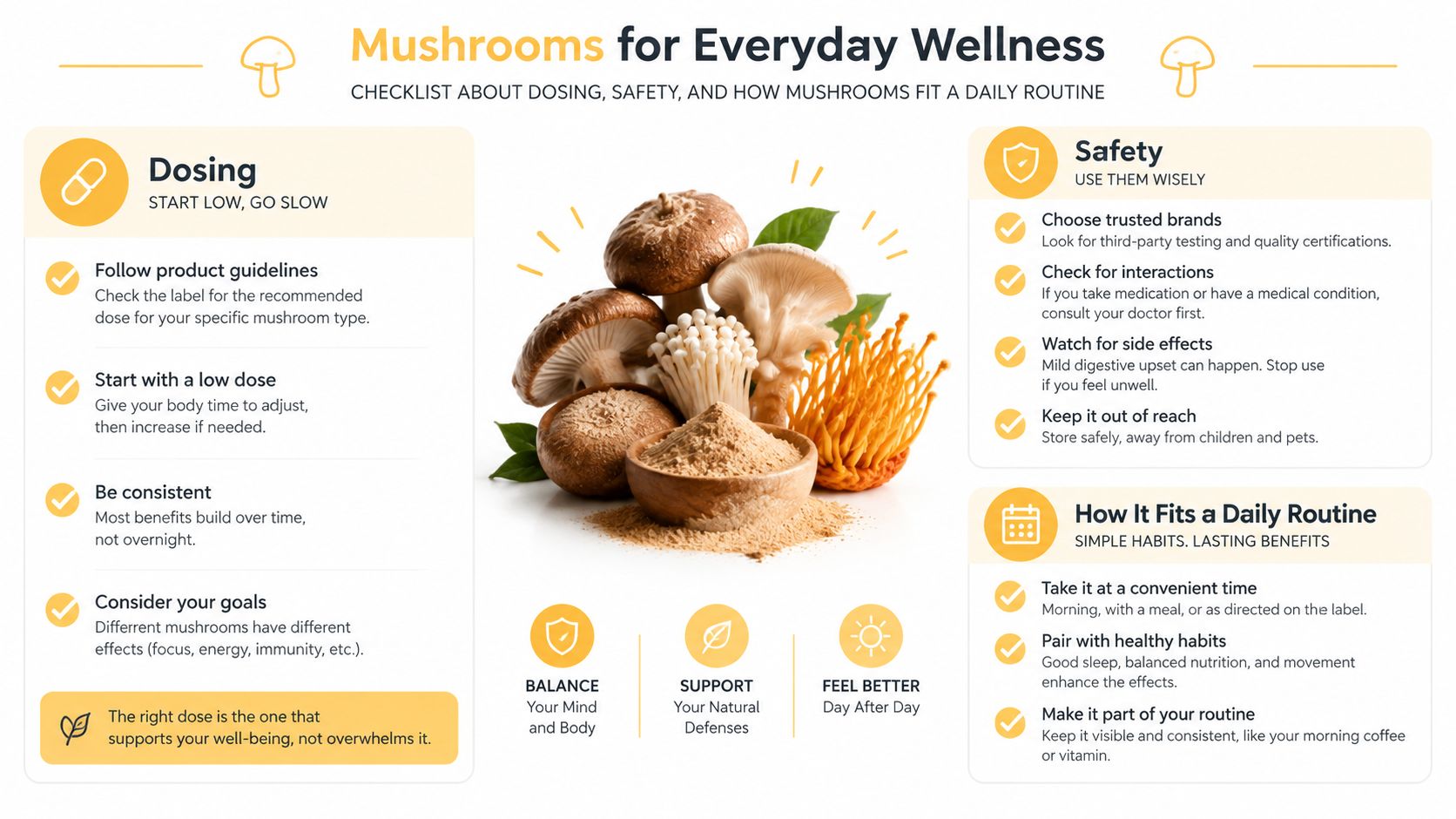
The most honest answer to “How much mushroom supplement should I give my dog?” is that established canine dosing parameters are missing for many preparations. Independent coverage reports sparse canine-specific evidence, no published randomized controlled trials for mushroom extracts in dogs, absent safety data for many preparations, and no systematic species-specific toxicity datasets. Review the current safety and dosing gap.
That means an exact milligram-per-kilogram recommendation often looks more authoritative than the evidence allows. Products may adapt human supplement practices, use different extraction strengths, or combine species with very different compound profiles. A scoop of one powder can't be treated as equivalent to a capsule or tincture from another product.
Start with your veterinarian if your dog is a puppy, pregnant, elderly, medically fragile, scheduled for surgery, or taking prescription medication. Extra caution is sensible for dogs with liver disease, bleeding disorders, blood-sugar problems, or immune-mediated conditions. Reishi, lion's mane, and cordyceps are often discussed in relation to liver metabolism, blood clotting, or glucose regulation, but those concerns shouldn't be turned into a diagnosis or a universal warning without reviewing the exact product and your dog's history.
Introduce one change at a time
Mix the product into food according to the manufacturer's instructions, but ask your veterinarian to review the plan when health conditions or medications are involved. Introducing one new supplement at a time makes it easier to identify vomiting, diarrhea, appetite changes, itching, lethargy, or other unwanted responses.
If a reaction appears, pause the product and contact your veterinarian. Seek prompt clinical advice for breathing difficulty, facial swelling, collapse, persistent vomiting, severe diarrhea, unusual bleeding, or marked weakness.
Routine design matters as much as ingredient selection. A mushroom product may overlap with omega-3s, probiotics, digestive enzymes, joint ingredients, or other immune-focused supplements. Before adding it, list everything your dog receives and identify the single outcome you're trying to support. For more help decoding serving sizes, ingredient panels, and blend language, use this guide on how to read supplement labels.
A single-species product is easier to evaluate when you want to observe one ingredient. A blend may be more convenient, but it makes both benefit and side effects harder to attribute.
A Realistic Path Forward for Curious Owners
Mushroom supplements show mixed evidence. Shiitake has produced measurable biochemical changes in a canine study, turkey tail has generated oncology signals that remain uncertain, and an early cognitive-support report is interesting but not broad validation. General wellness claims remain much less secure, while dosing and species-specific safety still contain meaningful gaps.
If you choose to try a product, use a cautious sequence:
- Select a product with named species, disclosed preparation details, independent testing, and transparent beta-glucan information.
- Introduce one species or one clearly defined formula at a conservative, veterinarian-reviewed amount.
- Keep a simple log of appetite, stool, sleep, energy, and the specific concern you're monitoring.
- Reassess after a few weeks with your veterinarian rather than assuming that more time or a higher dose will produce more benefit.
Mushrooms make the most sense as a possible complement to balanced nutrition, exercise, preventive care, and appropriate veterinary treatment. They shouldn't replace diagnosis, medication, or follow-up when your dog is ill.
Pure Paw Labs offers human-grade daily powdered supplements designed to combine support for areas such as joints, skin and coat, digestion, immunity, and stress in one food topper. If you're comparing a targeted mushroom product with a broader daily routine, visit Pure Paw Labs to review its formulation and testing information.