


Pomeranians usually live 12 to 16 years, and the American Kennel Club lists 14 to 16 years. That's a strong lifespan for a tiny dog, but it's a range, not a promise.
A Pom's life expectancy is more like a probability band than a fixed number. Think of it the way you'd think about human height percentiles, not everyone lands in the middle, and the same is true here. Some dogs stay on the younger-looking, lower end of the curve, while others keep bouncing through the teen years with the right mix of genetics, body condition, dental care, and routine monitoring.
Table of Contents
- What to Expect from a Pomeranian's Lifespan
- Why the 12 to 16 Year Range Varies So Much
- Health Issues That Shape Pomeranian Longevity
- Preventive Care and Nutrition for a Longer Life
- How Daily Supplements Fit into a Longevity Plan
- Signs of Aging in Senior Pomeranians
- When to Call the Vet and What to Ask
- A Practical Longevity Mindset for Every Pom Owner
What to Expect from a Pomeranian's Lifespan
The simplest answer to how old do Pomeranians live is this, 12 to 16 years, with the AKC placing the breed at 14 to 16 years (AKC lifespan guidance; Pomeranian lifespan overview). That doesn't mean every healthy Pom hits the same number, it means the breed sits in a long-lived toy-dog band that's shaped by more than one factor.
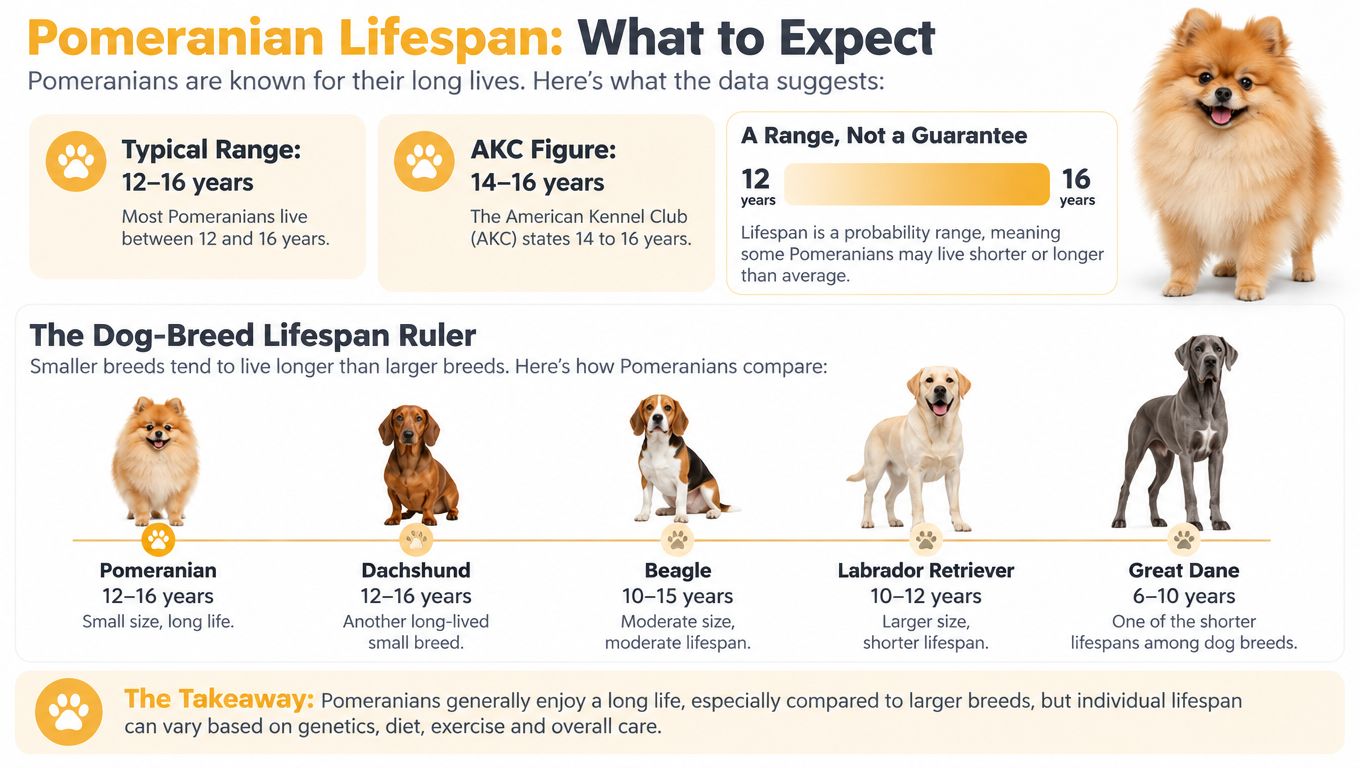
Reading the number the right way
A lifespan range works like a weather forecast, not a guarantee. It tells you what's common, what's plausible, and what kind of care shifts the odds. A Pom that reaches 12 years isn't “old beyond expectation,” it's entering the lower end of the breed's expected span, while a dog still active at 14, 15, or 16 is doing exactly what the breed is known for when care is steady (Pomeranian lifespan overview).
That's why the right question isn't just “How long do they live?” It's “What pushes my dog toward the upper end?” The answer lives in the details, body size, sex, muzzle shape, teeth, heart, joints, and the day-to-day habits that keep small problems from becoming chronic ones.
Practical rule: if you know the typical range, you can plan earlier for senior care instead of reacting late.
What this guide will help you do
You'll see why the same breed can have different life outcomes, how common health issues shorten the curve, and which care habits actually matter. You'll also get a preventive framework, guidance on supplements, age-related changes to watch for, and clear signs that mean it's time to call the vet. The goal is not to chase a perfect number, it's to give your Pom the best shot at a long, comfortable life.
Why the 12 to 16 Year Range Varies So Much
The number changes because different sources measure different populations. Breed references place Pomeranians at 14 to 16 years in one case, while broader veterinary and pet-health references often use 12 to 16 years as the practical range (AKC lifespan guidance; Pomeranian lifespan overview). Historical data also lands in the low-to-mid teens, with a UK study cited in breed references at 12.2 years and a Japanese pet-cemetery study at 14 years for Pomeranians, compared with 15.3 years for cross-breed dogs under 10 kg (historical lifespan comparison).
Source differences are normal
Those numbers don't conflict, they describe different populations and care environments. A clinic population, a breed survey, and a cemetery record won't produce identical results. That's why “average lifespan” is useful, but only if you treat it as a midpoint of overlapping curves rather than a promise made to every dog.
A newer longevity study adds another layer. A 2024 analysis found that small, long-nosed female dogs had the longest median lifespans at 13.3 years, while flat-faced breeds had a 40% higher risk of shorter lives (2024 longevity research). For a Pom owner, the useful lesson is that size and body type matter, and sex can matter too, even inside the same breed.
Pomeranian lifespan by source and demographic
| Source | Reported Range | Notes |
|---|---|---|
| AKC | 14 to 16 years | Breed reference figure, on the higher end |
| Veterinary and pet-health references | 12 to 16 years | Practical range used by many owners and vets |
| UK study cited in breed references | 12.2 years | Historical estimate in the low teens |
| Japanese pet-cemetery study | 14 years | Real-world estimate that lands higher |
| Cross-breed dogs under 10 kg | 15.3 years | Comparative small-dog figure from the same study set |
The best way to read this table is simple, a Pom's lifespan is influenced by probability, not fate. Smaller dogs generally live longer than larger dogs, so a Pomeranian starts with an advantage from body size alone, but that advantage can shrink if breed-prone health issues go unmanaged (AKC lifespan guidance; 2025 dog lifespan review).
Health Issues That Shape Pomeranian Longevity
Maya's six-year-old Pom, Biscuit, still looks young enough to scamper across the room, but he's started skipping on one back leg and coughing after excited bursts of play. That combination matters because Pomeranians are prone to conditions that don't always look dramatic at first, yet slowly compress the upper end of the lifespan curve (WebMD Pomeranian health overview).
The problems that often start quietly
Luxating patellas can show up as an intermittent skip, a brief hop, or a dog that suddenly won't put full weight on a rear leg. When that pattern keeps repeating, movement gets less efficient, activity drops, and weight gain becomes more likely. If you want to understand how joint pain management fits into comfort and mobility, this joint pain relief guide is a useful companion resource.
Collapsing trachea often shows up as a honking cough, especially during excitement, pulling, or changes in temperature. Heart disease may look like exercise intolerance, tiring sooner on walks, or a softer version of the dog who used to race to the door. Dental disease can be even easier to miss, because bad breath, tartar, and sore gums develop gradually, but chronic oral inflammation affects overall comfort and can interfere with eating.
What owners should watch for
- Intermittent skip: a clue that the kneecap may be slipping in and out.
- Honking cough: a classic sign that the airway deserves attention.
- Exercise intolerance: a dog who used to keep up but now pauses sooner.
- Bad breath and red gums: common signs that oral disease is advancing.
- Symmetric coat loss: a pattern that can fit alopecia X, which is usually cosmetic but still worth tracking because it can affect skin and coat quality (WebMD Pomeranian health overview).
A long life isn't only about adding years, it's about keeping those years usable. A Pom with chronic pain, cough, or untreated dental disease may still live a decent number of years, but the quality of those years drops fast if owners wait for obvious collapse before acting.
Preventive Care and Nutrition for a Longer Life
A longer-lived Pom usually comes from small, boring habits done well. Food portions stay controlled, teeth stay clean, and the dog keeps moving without pounding tiny joints every day. That routine matters because small breeds can gain weight quickly, and extra weight puts more strain on the knees, trachea, and heart.
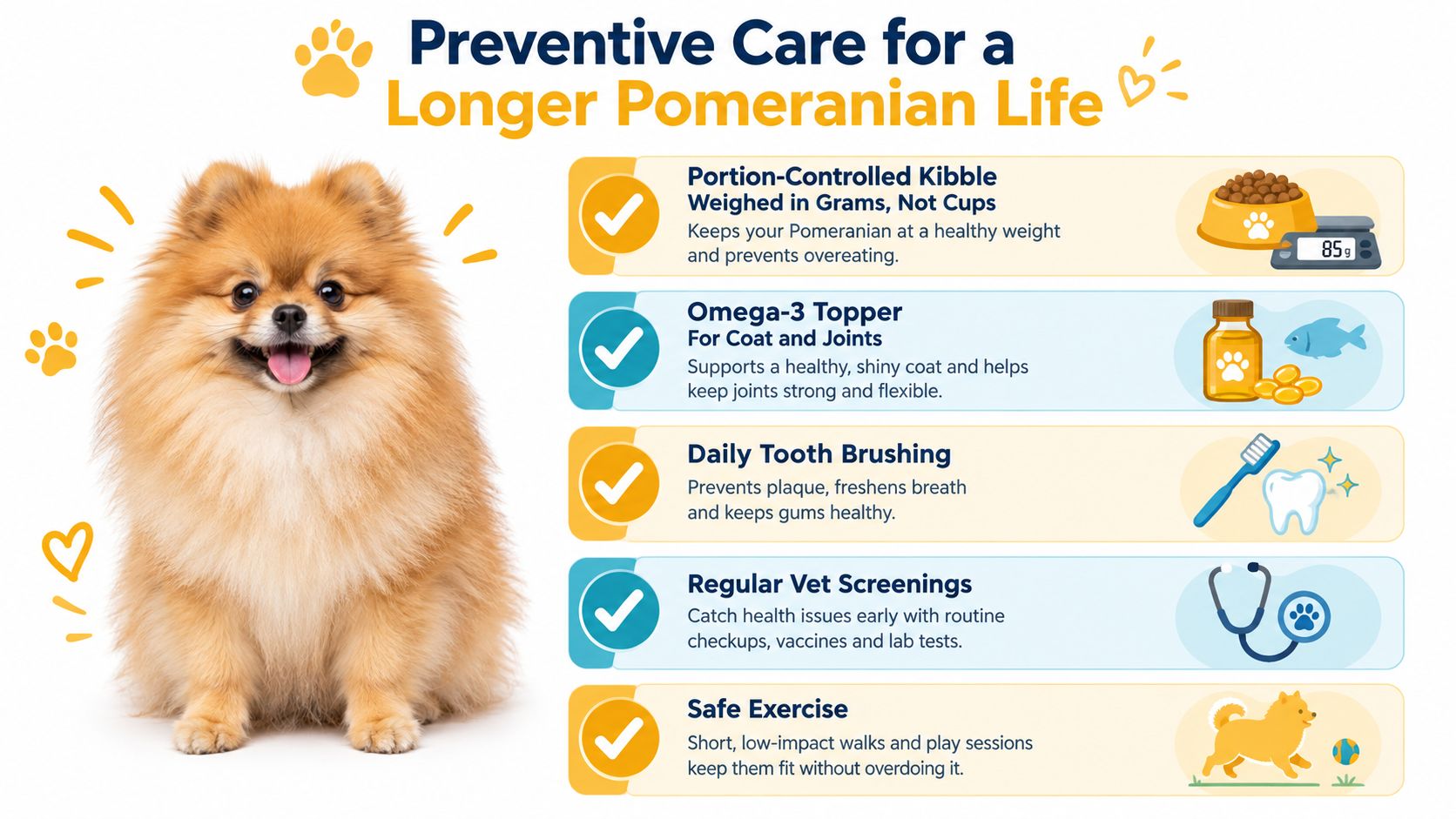
A layered care plan that actually helps
Start with food measured carefully. Portion-controlled kibble weighed in grams, not cups, gives you a more reliable baseline than eyeballing the bowl. Add an omega-3-rich topper if your vet agrees, because coat and skin quality often reflect overall nutrition, and Pomeranian coats benefit from structured support (Pomeranian nutrition and coat health).
Dental care needs to be daily or near-daily, not occasional. Brush if your dog allows it, or use VOHC-approved dental chews as a backup, because the mouth is one of the easiest places for chronic inflammation to build. For vet care, a twice-yearly rhythm makes sense for adults, then more frequent monitoring as a Pom enters senior years, since small dogs often need earlier aging support.
Good preventive care is repetitive on purpose. The same few habits do most of the heavy lifting.
A simple weekly habit list
- Weigh monthly: catch slow weight creep before the coat hides it.
- Rotate proteins carefully: if your dog has a sensitive stomach, introduce changes slowly and keep notes.
- Book dental cleanings on schedule: don't wait for the breath to get unbearable.
- Log energy dips: a dog who stops jumping, playing, or greeting you the same way may be telling you something.
- Protect tiny joints: choose low-impact play, short walks, and non-slip flooring where possible.
The exercise piece doesn't need to be intense. 20 to 30 minutes of low-impact play usually does more good than a single hard burst of activity, because it supports circulation and muscle tone without asking tiny joints to absorb too much impact. A consistent routine is what shifts the odds toward the upper end of the breed's lifespan range.
How Daily Supplements Fit into a Longevity Plan
Supplements can help, but only when they match the problem. A joint product may make sense for a dog with a slipping kneecap, while fish oil may be more useful for coat quality and skin comfort. A multi-ingredient daily blend can be convenient for owners who want one scoop instead of several products, but convenience isn't the same as proof, so the safest approach is to match the ingredient to the need and ask your vet before adding anything new.
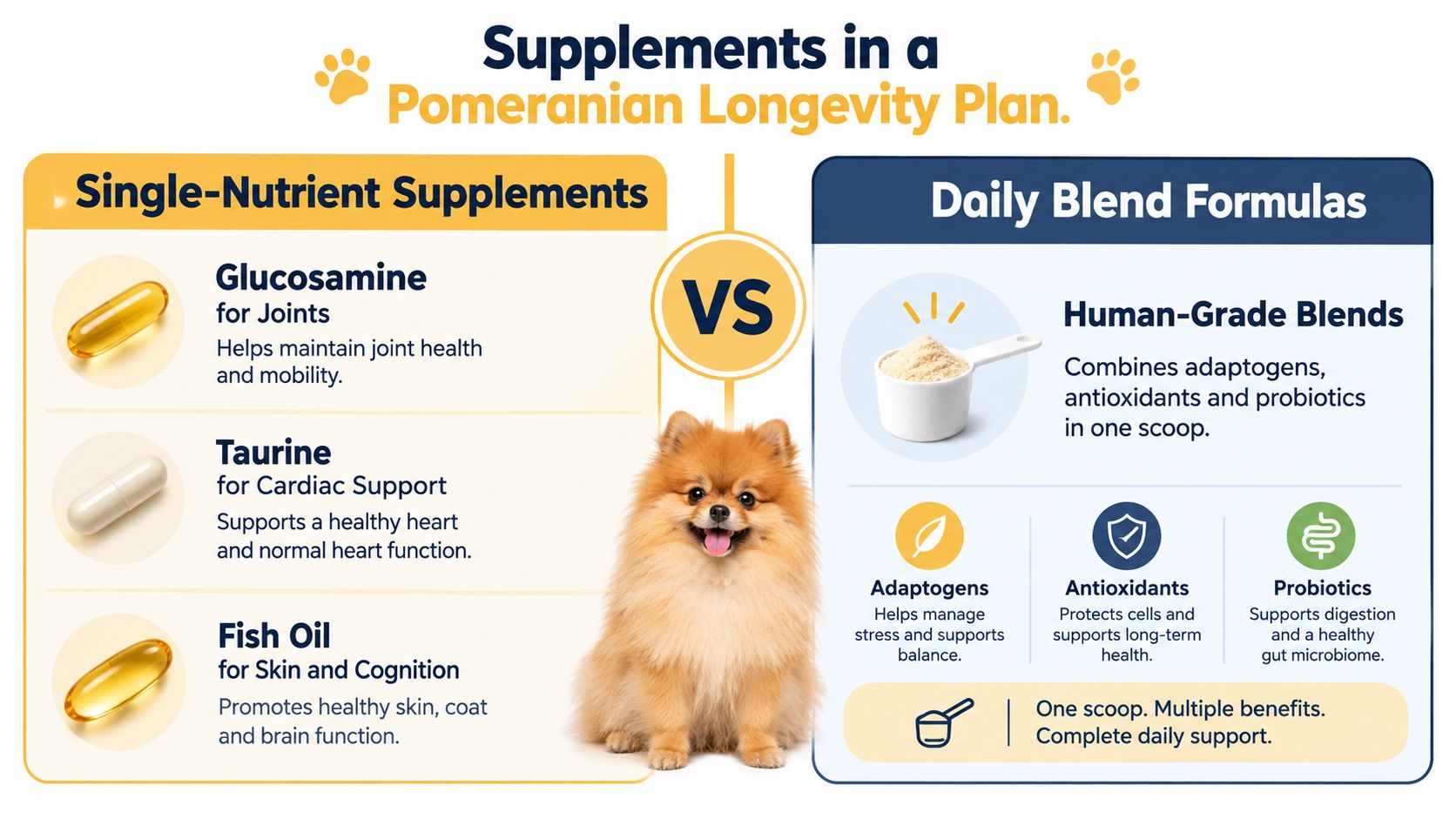
Single-nutrient support versus blended formulas
Single-purpose supplements are easier to evaluate. Glucosamine is aimed at joints, taurine is often discussed in cardiac support contexts, and fish oil is commonly used for skin and cognition. That makes them easier to match to a specific concern, and easier to stop if they don't agree with the dog.
Daily blends take a different path. A product such as DA-1™ Daily All-in-One - Senior Dog Support, Joints, Skin/Coat & More is described as a multi-system formula with 18 human-grade ingredients, aimed at the cells, gut, and joints, with no fillers, no pills, and a 60-day money-back guarantee. If you prefer a broader routine, the matching overview in this all-in-one supplement guide helps explain where a single daily scoop can fit.
Use supplements safely
Read the label, then start one ingredient at a time. Watch appetite and stool quality for about two weeks before you layer anything else in, because that gives you a cleaner read on what's helping and what isn't. If you're wondering how long a supplement may take to show a change, this timing guide is a useful general resource for setting expectations.
The 2024 to 2025 longevity research doesn't turn supplements into magic, it reinforces the bigger point that lifespan is shaped by breed type, genetics, and environment (2025 dog lifespan review). Supplements are one layer in that picture, not the whole plan.
Signs of Aging in Senior Pomeranians
Around age 7, many Poms start to feel a little less invincible. A dog that used to rocket up the stairs may pause halfway, not because something is wrong, but because the body is asking for a slower pace. That's the stage where careful observation starts to matter more than guesswork.
Normal aging looks gradual
A graying muzzle, deeper sleep, a slightly slower recall, and a mild change in play drive are all common signs that a Pom is entering later life. Some dogs also gain or lose a little weight as activity changes, and a faint cloudiness in the lens can appear without causing immediate panic. Those shifts are worth tracking, but they aren't the same thing as illness.
The key is pattern. If the dog is still eating, greeting you, and moving around with steady comfort, you're usually looking at normal aging rather than a crisis. If the changes happen slowly, without pain or breathing trouble, it often means you have time to adjust routine care rather than rush to the emergency clinic.
Red flags that need a vet visit
A sudden collapse, labored breathing, a hacking cough that gets worse, or refusal to eat for more than a day are not normal aging. Those signs need attention because they can point to heart, airway, pain, or systemic issues that need treatment. A calm owner who notices the difference between “older” and “sick” gives the dog a better chance at early care.
Watch for change in function, not just change in appearance.
That mindset keeps you from overreacting to every gray hair while still taking meaningful symptoms seriously. Senior life should feel slower, not fragile.
When to Call the Vet and What to Ask
If a Pom is gagging, breathing hard, collapsing, limping suddenly, or showing eye changes, don't wait for the next routine visit. The same goes for persistent vomiting or diarrhea beyond 24 hours, a new lump, blue gums, or reverse sneezing that won't stop. Those are the moments where same-day care is smarter than home observation.
What to say when you call
Use a clear phrase tied to the symptom, not a vague worry. Ask, “Could this be a collapsing trachea flare?” if the cough sounds honking or harsh. Ask, “Could this be a patella issue?” if the dog is skipping or favoring one leg. Ask, “Does this look cardiac?” if the dog is tiring early, breathing differently, or seeming unusually quiet.
A simple senior wellness cadence
For any Pom over 7, twice-yearly wellness exams are a good baseline, with annual bloodwork, dental checks every 6 months, and annual cardiac auscultation to listen for changes in heart sounds. If changes are gradual, book a routine follow-up and bring notes on appetite, energy, coughing, stairs, and sleep. If symptoms are acute, call for a same-day appointment and describe exactly what you saw, when it started, and whether it's getting worse.
That kind of specific reporting helps the clinic triage faster and helps your vet narrow the likely cause. It also keeps you from minimizing something important just because the dog still looks bright between episodes.
A Practical Longevity Mindset for Every Pom Owner
The easiest way to protect a Pom's lifespan is to turn care into a few repeatable habits. Know what's normal, prevent the avoidable problems, detect small changes early, and adapt the home and routine as the dog ages. That approach doesn't require perfection, it requires consistency.
Keep the four pillars on your fridge
- Know: track baseline weight, energy, breathing sounds, and how the dog moves on stairs.
- Prevent: brush teeth daily, weigh food, and keep biannual vet visits on the calendar.
- Detect: check eyes, gums, joints, and skin once a month, and feel for new lumps.
- Adapt: lower jump risk, choose gentler exercise, and reassess food and supplements as the dog gets older.
Each of those can fit into a five-minute habit. A quick glance at the gums, a hand on the ribs, a note about cough or skip, and a decision to slow things down when the dog needs it, that's the stuff that adds up over years. The 12 to 16 year range isn't just a statistic, it's the space where good daily decisions either support comfort or let small problems grow.
Your Pomeranian doesn't need every day to be perfect. It needs a watchful owner, steady routines, and fast responses when something changes.
Pure Paw Labs offers a human-grade, single-scoop supplement approach for dogs whose routines are getting more complex with age. If you want a practical way to think about joint, skin and coat, gut, and senior support in one place, visit Pure Paw Labs and see whether that kind of daily routine fits your Pom's care plan.