


The typical Pomeranian lifespan is 12 to 16 years, and many live well into their mid-teens. Some reach 17, 18, or even 20 years, but those exceptional ages shouldn't shape your basic care plan.
You may be asking because your Pom has just turned six and still acts like a puppy, or because a new puppy is sleeping beside your desk and you're already wondering how many years you'll have together. Either way, the useful question isn't only “how old do Pomeranians live?” It's which decisions help a particular dog reach the healthy end of that range.
Lifespan estimates are planning tools, not promises. Genetics set part of the starting point, while body condition, dental care, respiratory protection, preventive screening, and quick responses to warning signs determine how many healthy years your Pomeranian gets to enjoy.
Table of Contents
- What the Typical Pomeranian Lifespan Really Looks Like
- Why Lifespan Numbers Vary Between Sources
- Pomeranian Life Stages From Puppy to Senior
- Health Risks That Most Affect Pomeranian Longevity
- Daily Care That Makes a Difference
- Vet Visits, Screenings, and Warning Signs
- Your Longevity Plan for the Years Ahead
What the Typical Pomeranian Lifespan Really Looks Like
Biscuit is six, still races through the house, barks at delivery drivers, and expects to be carried upstairs. That behavior does not make him an old dog. With the widely cited 12 to 16 year lifespan, a six-year-old Pomeranian may still have many active years ahead, especially when illness is found early and daily care stays consistent (PetMD's Pomeranian breed guide).
The range places Pomeranians among the longer-lived toy breeds, but it is a planning range, not a promise. Population records also sit in the low-to-mid teens. One UK dataset reported a life expectancy of 12.2 years, while Japanese pet-cemetery data estimated 14 years for Pomeranians (historical and comparative lifespan data). Those figures come from different populations and methods, so do not treat them as interchangeable. Together, they support a practical expectation: a healthy Pom commonly reaches adolescence and middle age alongside its owner.
What moves a dog toward either end
Use the range to make decisions, not predictions:
- Genetics: Before choosing a puppy, ask for specific information about patellar, cardiac, eye, and dental history. A general claim that the parents are healthy is not enough.
- Body size and condition: Small dogs often outlive larger breeds, but excess weight undermines mobility and respiratory comfort. Keep your Pom lean rather than merely “within a normal weight.”
- Sex and reproductive decisions: Females often live slightly longer in broad canine observations, yet inherited disease, body condition, and preventive care usually matter more for an individual dog.
- Daily management: Measure meals, brush teeth, provide safe exercise, and arrange veterinary assessment promptly when behavior, breathing, appetite, or movement changes.
Start this week by checking your dog's body condition, weighing meals, and scheduling any overdue dental or preventive appointment. These choices influence the years your Pom spends comfortable, not just the number of birthdays reached.
Some Pomeranians reportedly live beyond the usual range, including exceptional records. Do not build a care or financial plan around an outlier. Prepare for a companion who may remain with you into the mid-to-late teenage years, and account for that commitment in housing, travel, finances, and caregiving.
Why Lifespan Numbers Vary Between Sources
A lifespan figure can look exact while answering a different question from the one you have in mind. Some sources record age at death, others estimate life expectancy from living dogs, and some report a mean, median, or owner-reported experience. Treat the number as a measurement shaped by its method, not as a promise for your dog.
The population matters just as much. A UK primary-care dataset represents dogs brought to veterinary practices, while Japanese pet-cemetery records depend on owners choosing that form of after-death documentation. Breed guidance commonly gives a practical 12 to 16 year planning range, while a formal population study may offer a narrower estimate and more detail. Use the range for household planning, then inspect the evidence behind any narrower claim, as shown in PetMD's breed lifespan reference.
Read the method before trusting the headline
The UK estimate of 12.2 years and the Japanese estimate of 14 years come from different populations and collection methods. That difference does not prove that Pomeranians in one country age differently. The Japanese dataset also placed Pomeranians below the reported 15.3-year average for cross-breed dogs under 10 kilograms. Comparisons only work when the breed categories, populations, and methods match, as the comparative Pomeranian lifespan records illustrate.
| Source | Typical reported range | Why it differs |
|---|---|---|
| Consumer veterinary breed guidance | 12 to 16 years | A practical breed range for owners |
| UK population data | 12.2 years | Geography, case population, and life-expectancy method shape the estimate |
| Japanese pet-cemetery data | 14 years | A different end-of-life record and population |
| Exceptional historical record | 21 years, 8 months, and 13 days | One extraordinary case, not a breed expectation |
Practical rule: Before accepting a new lifespan claim, ask who was counted, where the dogs lived, whether the source recorded deaths or estimated survival, and whether it reports a mean or a median.
Do not use a record age to set your forecast. For household planning, the broad range is more useful than an outlier. For health decisions, the collection method matters because it determines how confidently the figure can guide your expectations. Evaluate the evidence first, then make care decisions based on your own dog's age, condition, and veterinary findings.
Pomeranian Life Stages From Puppy to Senior
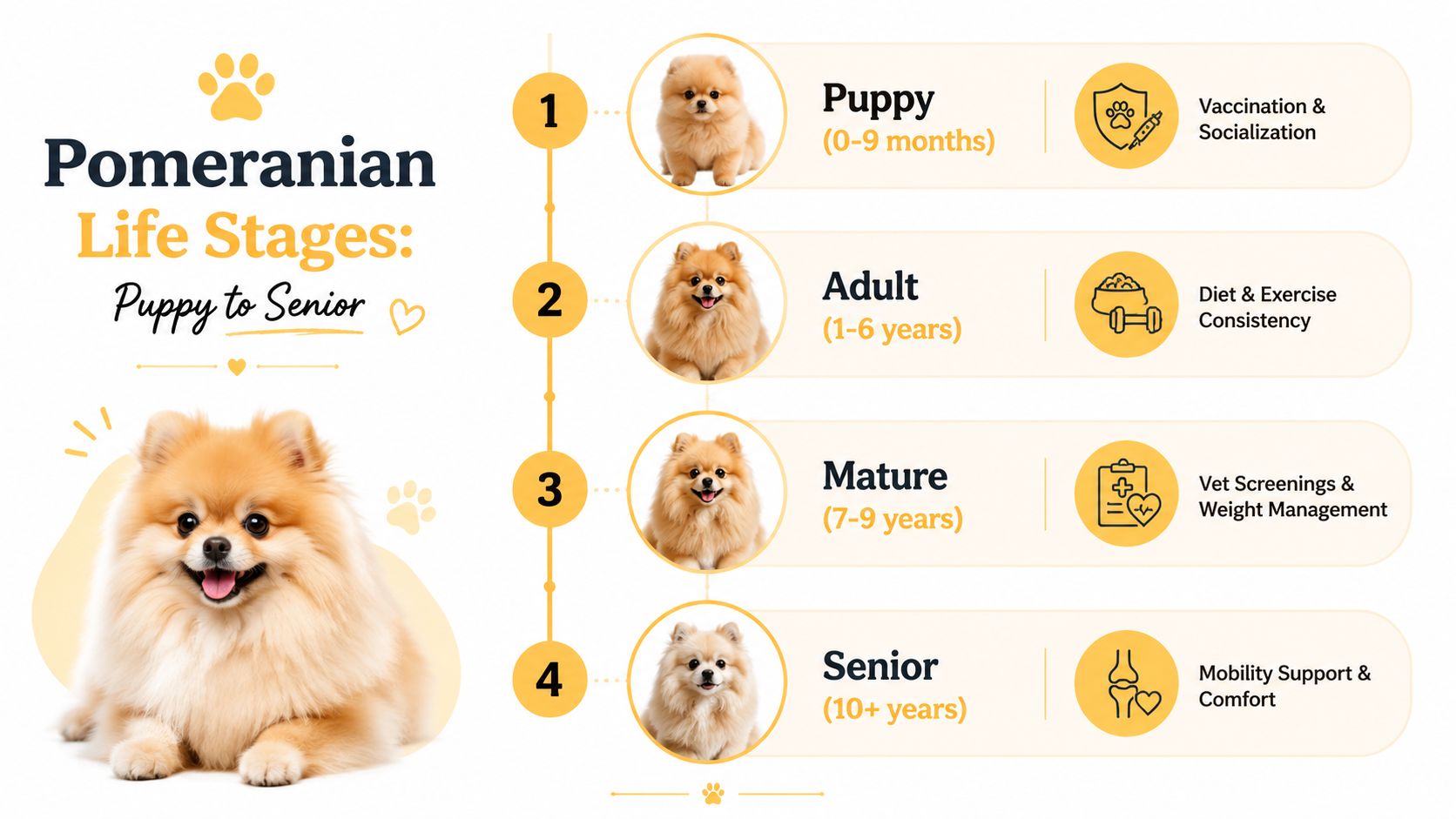
A Pomeranian's care priorities change long before the dog looks elderly. The most useful approach is to match each stage with one concrete owner decision instead of waiting for visible decline.
Puppyhood from birth through 6 to 9 months
Your job is to build a stable body and a confident nervous system. Keep the vaccination and growth schedule set by your veterinarian, expose the puppy gradually to handling and grooming, and make tooth checks part of play. Toy-breed puppies can be vulnerable to low blood sugar, so feeding instructions should be individualized rather than improvised.
Start cooperative care early. Touch the paws, lift the lips, inspect the ears, and reward calm behavior. A puppy that accepts brushing and oral care is far easier to protect from preventable dental trouble later.
Junior years from roughly 9 months to 2 years
This is when owners should stop seeing the dog as a fragile baby and start calibrating adult habits. Confirm the target body condition with your veterinarian, continue reward-based training, and discuss reproductive timing in the context of your dog's health, breed, and future plans.
Pomeranians also need coat maintenance that prevents tangles and allows you to notice skin changes. Owners who want a practical grooming routine can review this guide on Pomeranian shedding and coat care.
Mature adulthood from 3 to 8 years
Consistency matters most here. Use measured meals, preserve comfortable muscle, inspect the mouth routinely, and establish a bloodwork baseline when your veterinarian recommends it. A dog that appears energetic can still have dental, cardiac, orthopedic, or eye problems developing quietly.
Senior and geriatric years from 9 onward
After the senior transition, schedule visits more frequently and watch function rather than appearance. Changes in stairs, jumping, sleep, appetite, coughing, or willingness to play deserve attention.
For owners discussing supportive options with a veterinarian, DA-1™ Daily All-in-One - Senior Dog Support, Joints, Skin/Coat & More is described as a powdered, multi-system formula with 18 human-grade ingredients aimed at cells, gut, and joints. It shouldn't replace diagnosis, dental treatment, or prescribed care.
Health Risks That Most Affect Pomeranian Longevity
Pomeranians don't need an encyclopedia of every possible disease. They need owners who recognize the conditions most likely to affect comfort, breathing, mobility, eating, or vision.
Patellar luxation often first appears as an intermittent skip, a hind leg briefly held up, or reluctance to climb. A veterinarian assesses the kneecap by palpation and grades its movement. Breeding decisions can reduce inherited risk, while maintaining lean body condition helps reduce mechanical stress.
Tracheal collapse may produce a dry, honking cough, especially with excitement, heat, or pressure around the neck. Use a harness rather than relying on a collar, and ask your veterinarian whether radiographs or additional respiratory evaluation are appropriate.
Chronic mitral valve disease can present as a murmur before an owner notices anything at home. Later warning signs may include coughing, reduced stamina, fainting, or labored breathing. Cardiac auscultation is the starting point, and an echocardiogram can clarify structure and function when indicated.
Breathing changes aren't a normal aging milestone. A sudden cough, fainting episode, or effortful breath deserves a veterinary call rather than a wait-and-see approach.
Dental disease deserves special attention because small mouths can hide crowded teeth and inflamed gums. Red gums, bad breath, dropping food, chewing on one side, or reluctance to eat should prompt an oral examination. Dental radiographs may reveal disease below the gumline that a surface inspection misses.
Young puppies also need protection from hypoglycemia. Weakness, trembling, unusual sleepiness, wobbliness, or collapse is urgent. Eye disease, including cataracts, may show as bumping into objects or a cloudy lens, and an ocular examination can distinguish a harmless appearance change from a vision problem.
| Condition | Typical onset age | Common signs | Screening test |
|---|---|---|---|
| Patellar luxation | Puppyhood or young adulthood | Skipping, intermittent hind-leg lifting, stiffness | Orthopedic palpation |
| Tracheal collapse | Adulthood or later | Honking cough, cough with excitement, breathing difficulty | Examination and, when indicated, radiographs |
| Mitral valve disease | Later adulthood or senior years | Murmur, reduced stamina, cough, fainting | Cardiac auscultation and possible echocardiogram |
| Dental disease | Early adulthood onward | Bad breath, red gums, chewing changes | Oral examination and dental radiographs |
| Hypoglycemia | Young puppyhood | Weakness, trembling, wobbliness, collapse | Immediate veterinary assessment and blood-glucose evaluation |
| Cataracts and other eye disease | Variable, often later life | Cloudiness, bumping into objects, vision changes | Ocular examination |
If you're arranging transport for a small dog and need broader relocation planning, this complete dachshund relocation guide offers a useful example of the practical details owners should organize before travel.
Daily Care That Makes a Difference
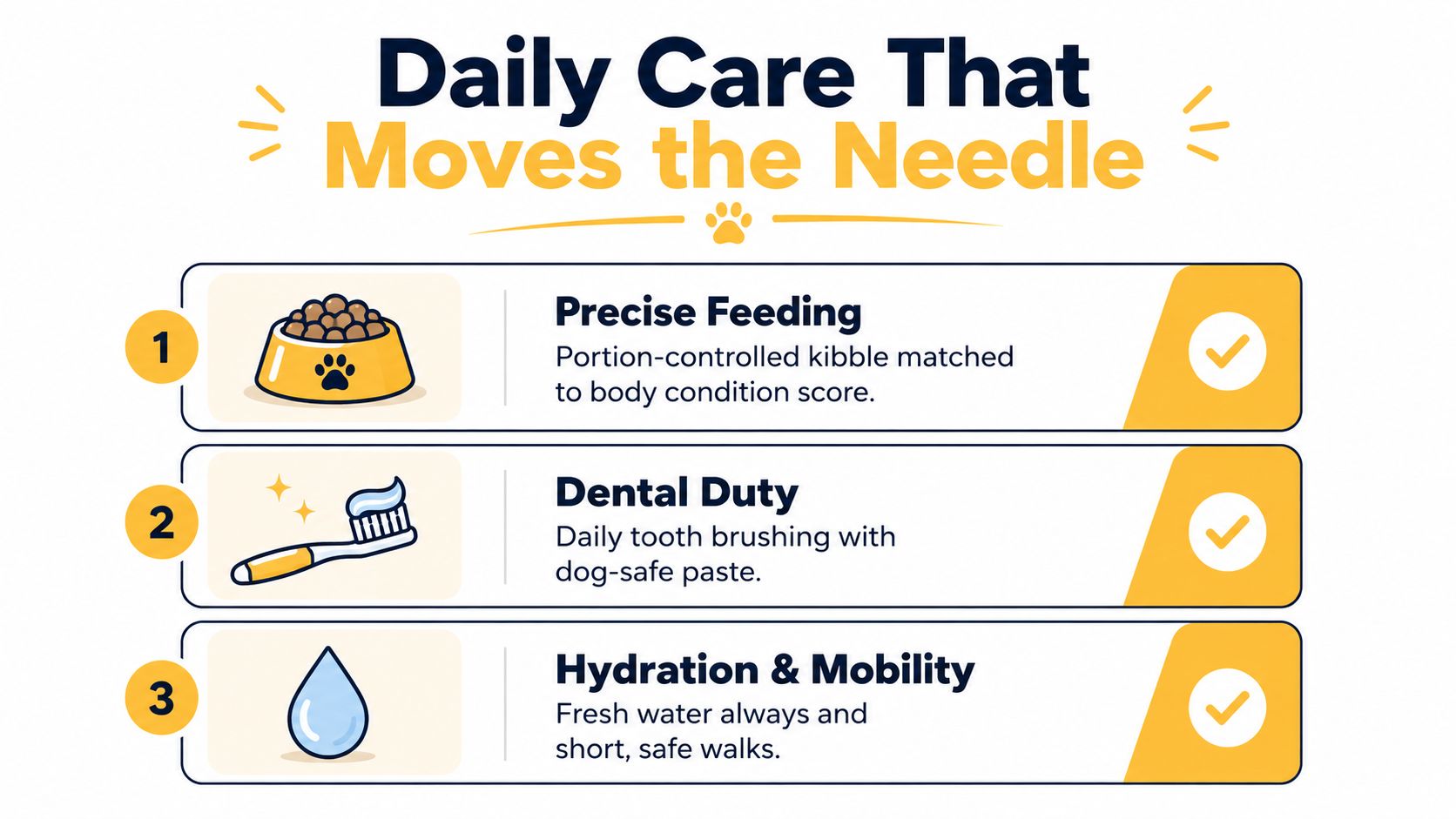
A Pomeranian can look healthy while weight gain, dental pain, or airway strain develops. Longevity depends less on a crowded supplement shelf than on habits you repeat every day, especially those that protect the mouth, breathing, joints, heart, and body condition.
Feed the dog in front of you
Choose a complete diet suited to the dog's current life stage, and measure every portion instead of filling the bowl by eye. A thick coat can hide gradual weight gain. Feel the ribs regularly and ask your veterinarian to assess body condition.
Breed-level research supports keeping small dogs lean. One peer-reviewed analysis estimated that each additional 1 kilogram of average breed body mass corresponded to about 25.6 fewer days of mean lifespan, while each 1% increase in heterozygosity predicted about 30.7 additional days (peer-reviewed longevity study).
Those figures do not predict an individual Pomeranian's lifespan. They do support a clear decision: keep your Pom lean. Limit free-feeding, count treats within the daily portion, and do not let a fluffy coat disguise a changing waistline.
Prioritize Daily Oral Care
Brush your dog's teeth daily with dog-safe toothpaste. Begin with brief lip lifts, touch the outer tooth surfaces, and lengthen the session gradually. Dental chews with an appropriate veterinary dental acceptance seal can support brushing, but they do not replace brushing or professional examinations.
Bad breath deserves attention. Red gums, loose teeth, mouth pain, or difficulty eating warrant a veterinary visit, even if your dog remains playful.
Protect Movement and the Airway
Use short, regular walks on stable, relatively flat surfaces, along with gentle indoor play. Block repeated jumps from furniture and place rugs over slippery floors. A harness is a better choice than neck pressure for a Pomeranian that pulls or coughs.
Supplements belong in a specific plan, not a random stack. Omega-3 fatty acids may support joints or the heart when a veterinarian identifies a reason to use them, but dosing and product quality matter. Ask focused questions about integrated dog wellness, then review those choices with your veterinary team.
Your weekly checklist should stay simple: measure food, brush teeth, inspect the gums, provide safe movement, and record any new cough or limp. Repetition beats novelty.
Vet Visits, Screenings, and Warning Signs
A calendar helps, but a life-stage plan works better. Puppies need visits for vaccine and growth monitoring. Adults need a consistent wellness relationship, with a baseline laboratory assessment discussed around age six. By the later adult and senior period, the examination should include careful listening to the heart, an oral assessment, body-condition review, and blood-pressure consideration.
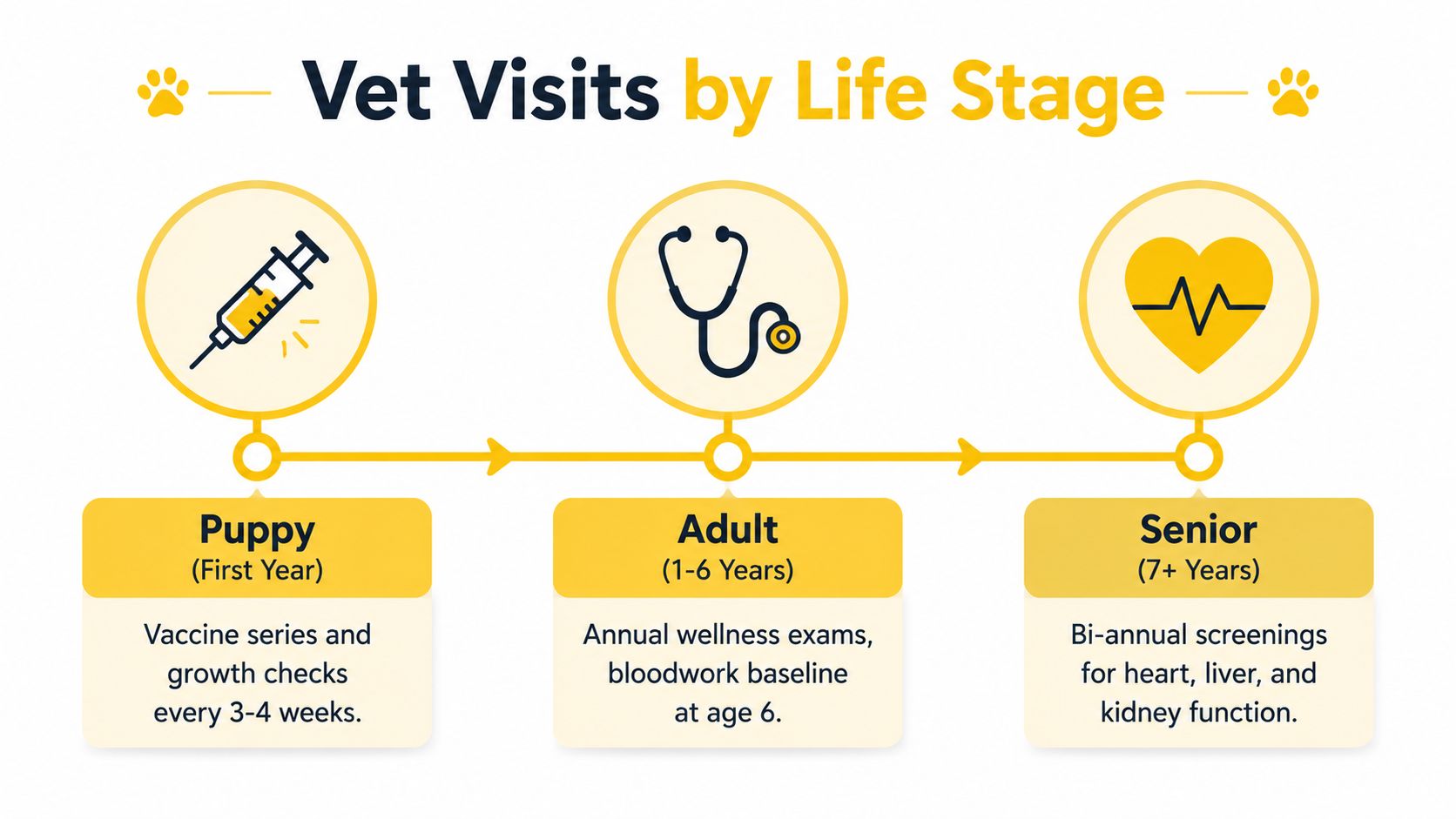
For older Pomeranians, ask whether the dog should move to twice-yearly visits, with bloodwork and urinalysis when clinically appropriate. This isn't because every senior has the same disease risk. It's because smaller changes are easier to identify when the veterinarian has a recent baseline.
Ask a question that leads to action
At each visit, don't settle for “everything looks fine” if you've noticed a change. Ask:
- New cough: Could this be airway disease, heart disease, or another cause, and does the dog need imaging?
- Fainting or weakness: Is the heart rhythm, blood pressure, or blood sugar contributing?
- Weight loss: Does the examination or laboratory work suggest dental, digestive, kidney, or systemic disease?
- Stiffness or skipping: Is the patella painful, unstable, or masking another orthopedic problem?
- Cloudy eyes: Is vision affected, and should an eye specialist examine the dog?
Watch for labored breathing, repeated vomiting, rapid weight loss, a new lump, collapse, or sudden behavior change. These signs warrant an unscheduled call, not a promise to mention them at the next routine appointment.
Your Longevity Plan for the Years Ahead
Start with the intervention owners skip most often: daily tooth brushing. It takes less time than dealing with painful dental disease, and it gives you a regular chance to notice red gums, loose teeth, or oral swelling.
Next, keep body condition lean through measured meals and regular weighing. This protects joints and reduces avoidable strain on a small dog's airway. Use a harness, not a neck-straining collar, particularly if your Pom coughs or pulls.
Once your dog reaches the senior transition, ask your veterinarian whether visits should occur twice yearly and whether bloodwork, urinalysis, blood pressure, cardiac assessment, dental imaging, or orthopedic evaluation belongs in the plan. Breeding dogs and older dogs deserve especially careful discussion of patellar and cardiac screening.
Pomeranians commonly live into their teens, with the broad planning range at 12 to 16 years and some exceptional dogs living much longer (PetMD's lifespan guidance). You can't guarantee the upper end, but you can improve the odds of more comfortable years by detecting disease early and refusing to normalize preventable problems.
Use this weekly routine:
- Weigh your dog monthly and record the result.
- Check the gums for redness, swelling, bleeding, or unusual odor.
- Log any cough, skipped step, appetite change, or sleep change.
- Brush the teeth daily.
- Put the next veterinary appointment on the calendar before the current one is forgotten.
For owners exploring digestive support for an aging dog, this guide to probiotics for senior dogs can help you prepare focused questions for your veterinarian.
Pure Paw Labs offers human-grade, science-backed dietary supplements for dogs, including a daily powder designed to support areas such as joints, skin and coat, gut health, immunity, and stress. Visit Pure Paw Labs to review the available options, then discuss whether a supplement fits your Pomeranian's individual diet and medical plan.