


Osteoarthritis is more common in dogs than a typical supplement label suggests. A large UK primary-care study covering 455,557 dogs estimated annual appendicular osteoarthritis prevalence at 2.5%, equivalent to just over 200,000 affected dogs in the UK in one year. Other widely cited estimates place osteoarthritis at about 20% of dogs older than one year in North America, while a 2024 study identified radiographic osteoarthritis in 39.8% of 123 young dogs and clinical pain in 23.6% overall. These findings, reported in the canine osteoarthritis prevalence research, change the buying question. The issue isn't whether joint supplements deserve attention, but whether a review can distinguish meaningful canine evidence from familiar marketing language.
Most dog joint supplement reviews still rank products by stars, popularity, or the length of an ingredient list. A more useful review reverse-engineers the evaluation itself. Canine clinical evidence comes first, followed by transparent dosing, product quality, safety, and total cost. Price and convenience matter, but they shouldn't rescue a formula whose central ingredients have little support in dogs.
Table of Contents
- Why Joint Health Reviews Matter for Most Dogs
- An Evidence-Based Ingredient Hierarchy
- Comparing Legacy and Modern Joint Formulas
- How to Read a Joint Supplement Label
- Matching the Formula to Your Dog's Life Stage
- Dosing, Safety, and Realistic Timelines
- Cost, Subscriptions, and Total Value
- A Reusable Checklist for Every Joint Supplement Review
Why Joint Health Reviews Matter for Most Dogs
Joint supplements sit in a high-stakes category because owners often shop when a dog is slowing down, struggling to rise, or showing reluctance to walk. Those signs can reflect osteoarthritis, but they can also indicate injury or another medical problem, so a supplement review should never replace veterinary assessment. The prevalence data above also shows why early symptoms shouldn't be dismissed only because a dog isn't very old.
The market creates a second problem. Product labels may list several familiar compounds without stating the amount of each one, while reviews may treat every named ingredient as proof of value. A five-star rating can describe palatability or delivery speed, but it can't establish that a dog received a clinically meaningful amount of an active ingredient.
The review standard that matters
A neutral review should answer five practical questions:
- Evidence: Has the ingredient or formula been tested in dogs, preferably through objective mobility or pain outcomes?
- Dose: Does the label state the exact amount of each active ingredient?
- Quality: Can the manufacturer provide credible testing information?
- Safety: Does the product fit the dog's health history and current medication?
- Value: What does the owner pay for the actual active ingredients over a sustained trial?
The 2022 systematic review and meta-analysis of canine and feline osteoarthritis nutraceuticals provides an important benchmark. It found clear analgesic benefit from omega-3-enriched diets and omega-3 supplements, while glucosamine-chondroitin nutraceuticals showed no analgesic effect and were described as having a very marked non-effect. The systematic review of osteoarthritis nutraceuticals makes ingredient identity more informative than popularity.
Review principle: A product shouldn't earn a strong rating merely because it contains many ingredients. It should earn one because its important ingredients are identifiable, appropriately dosed, and supported by canine outcomes.
That framework also exposes why generic rankings fail. A formula for a dog with diagnosed osteoarthritis should be judged differently from a low-dose preventive product for a healthy adult. The same label can be convenient for one household and scientifically unhelpful for another.
An Evidence-Based Ingredient Hierarchy
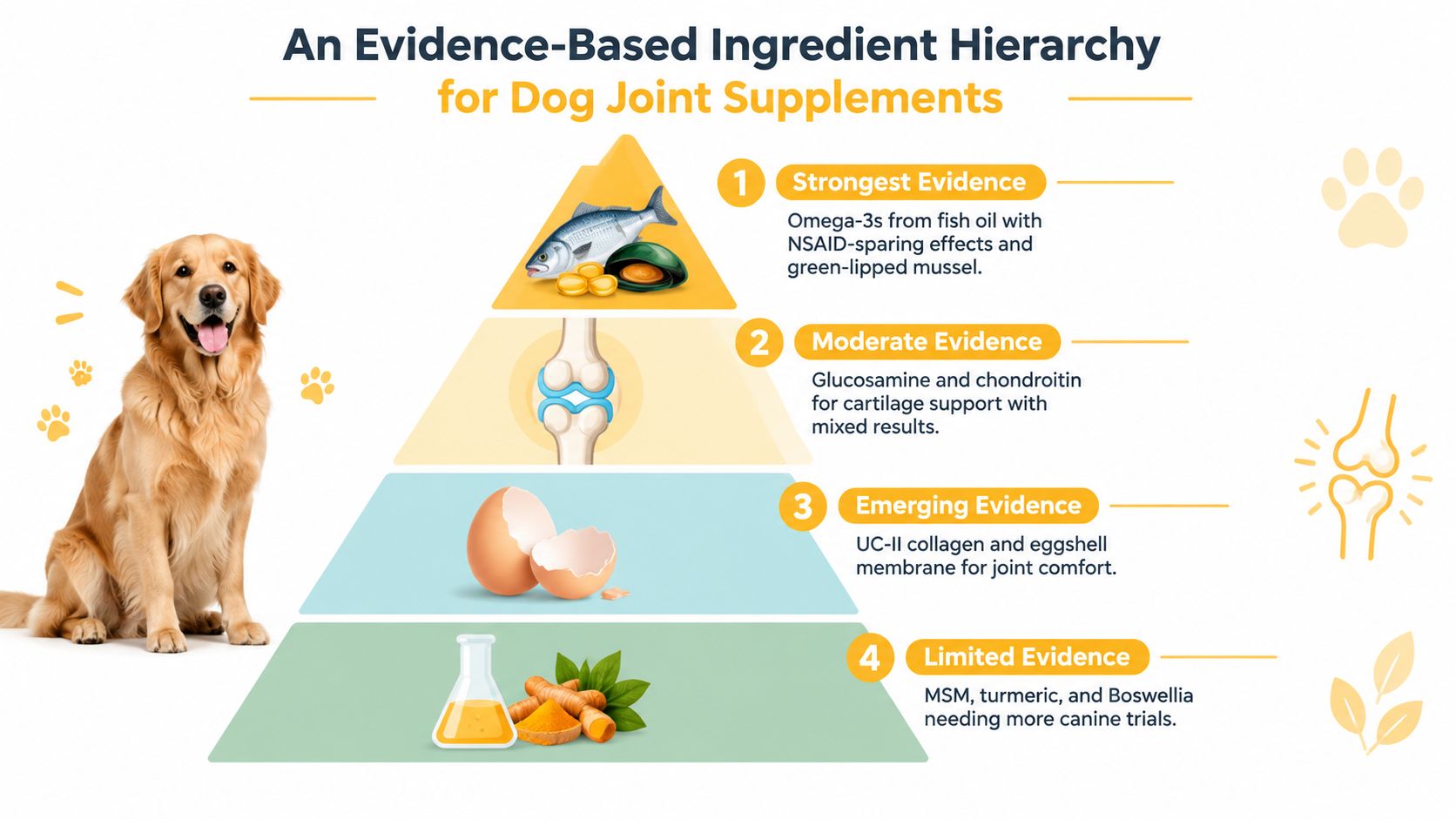
A useful hierarchy separates evidence strength from familiarity. Ingredients found on many labels do not automatically have the strongest canine data. The 2025 evidence review from the Pet Evidence Project identified strong support for omega-3 fish oil, moderate support for green-lipped mussel, emerging support for eggshell membrane and undenatured type-II collagen, and weak or inadequate evidence for glucosamine, chondroitin, and MSM.
Start with the strongest canine signal
Omega-3 fatty acids, especially when the label identifies relevant fish-oil actives, deserve priority because controlled evidence has shown analgesic benefit in dogs and cats with osteoarthritis. Green-lipped mussel has a more moderate evidence position, yet it remains easier to defend than an ingredient included only because it sounds modern or complete.
For context, readers can review this evidence-based explanation of whether dog joint supplements work. The question is not whether an ingredient appears on a label, but whether canine studies, active amounts, and relevant outcomes support the product's claim.
Eggshell membrane and undenatured type-II collagen belong in the emerging group. They may be reasonable candidates when a label provides clear quantities and makes measured claims. Emerging evidence should not be presented as equivalent to stronger omega-3 data.
Treat legacy staples with precision
Glucosamine, chondroitin, and MSM have long histories of use and may appear in sensible formulations. A long history of use does not establish pain relief. The 2022 meta-analysis found no meaningful analgesic effect from chondroitin-glucosamine nutraceuticals, so reviews should not describe those compounds as proven pain relievers.
Turmeric, curcumin, hyaluronic acid, collagen peptides, and botanical extracts can broaden a formula, but their value depends on canine trial quality, dose transparency, and safety context. A combination is more credible when it provides meaningful amounts of supported actives rather than using a crowded label to conceal small quantities.
For readers comparing a multi-system product, DA-1™ Daily All-in-One - Senior Dog Support, Joints, Skin/Coat & More is described as a once-daily formula with 18 human-grade ingredients supporting cells, gut, and joints. That description defines its scope. A rigorous review should still inspect each joint-active and its amount before drawing conclusions.
Comparing Legacy and Modern Joint Formulas
Legacy formulas often focus on glucosamine and chondroitin in a tablet or powder. Modern formulas may combine omega-3 sources, green-lipped mussel, eggshell membrane, hyaluronic acid, Boswellia serrata, astaxanthin, or other compounds in a chew, liquid, or powder. The difference isn't just old versus new. The question is whether the modern formula gives its strongest ingredients enough attention and enough dose transparency to justify the extra complexity.
A 2025 multicenter, double-blind, randomized, placebo-controlled study tested a combination of eggshell membrane, krill meal, astaxanthin, hyaluronic acid, and Boswellia serrata in dogs with osteoarthritis. The study reported improved mobility and quality of life. Its design matters because placebo-controlled functional outcomes provide a stronger basis for review than descriptors such as “advanced,” “complete,” or “maximum strength.” Read the 2025 controlled canine osteoarthritis trial for the study details.
| Attribute | Legacy Formulas | Modern Formulas |
|---|---|---|
| Core approach | Often centered on glucosamine and chondroitin | Often combines several structural and inflammation-related ingredients |
| Evidence question | Familiarity can exceed current analgesic evidence | Newer combinations may have controlled-trial support, but each claim still needs scrutiny |
| Label risk | May omit meaningful dose context | May use a long list to create an impression of completeness |
| Potential advantage | Simpler ingredient profile and easier comparison | Broader mechanisms when the label gives exact quantities |
| Main limitation | Chondroitin-glucosamine should not be treated as established pain relief | More ingredients don't guarantee adequate amounts or canine relevance |
A legacy product can remain a rational choice for an owner who values a simple formula and accepts the evidence limitations. A modern blend can be more informative when it identifies active quantities and has canine mobility data behind the finished product. Neither category deserves an automatic win.
The decisive comparison is not ingredient count. It's the number and quality of evidence-backed actives delivered at transparent amounts.
How to Read a Joint Supplement Label
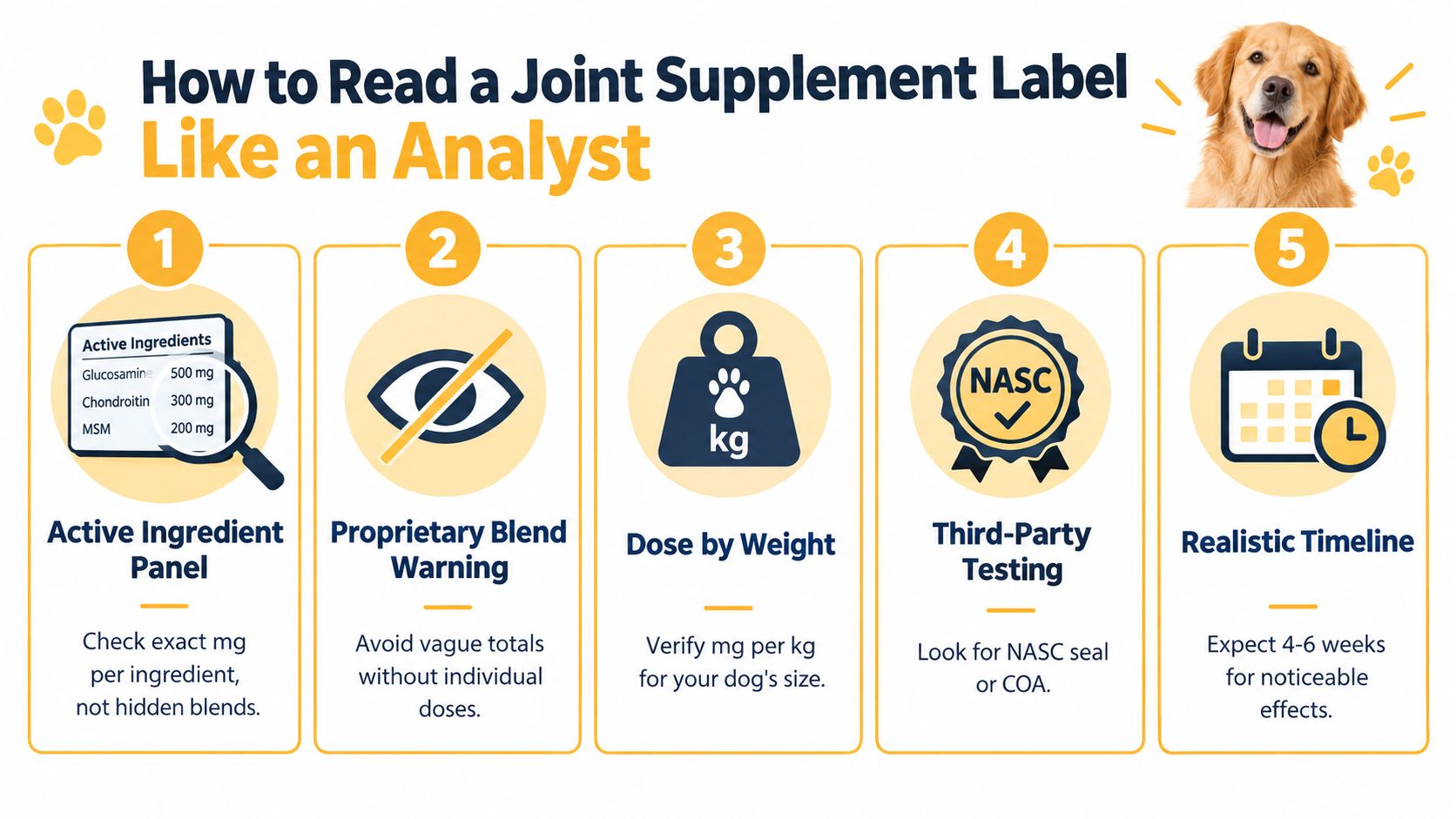
Read the label from the active panel outward. First identify the exact amount of each joint ingredient per chew, scoop, capsule, or measured volume. Then determine how many units the dog receives each day. If the label lists a proprietary blend with only a total weight, you can't tell whether the most important ingredient contributes a meaningful share.
Chemical form also matters. A label may list glucosamine hydrochloride rather than glucosamine sulfate, or a general fish oil amount without identifying EPA and DHA. Those aren't interchangeable details for an analyst. A reviewer should record the exact form and active mass rather than treating every mention of “glucosamine” or “omega-3” as equivalent.
Separate substance from presentation
Inactive ingredients deserve attention when a dog has food sensitivities or reacts to new products. Fillers and processing aids can include maltodextrin, brewer's yeast, or silica, but their presence doesn't automatically make a product unsuitable. The relevant question is whether the label discloses them clearly and whether they fit the dog's diet.
Terms such as human-grade, pharmaceutical grade, and veterinary-formulated can describe a product's positioning without proving clinical effectiveness. Third-party testing, a recognized quality seal, or an independent certificate of analysis may provide useful manufacturing evidence, but none of these proves that the finished formula improves mobility. Quality control and efficacy are separate review categories.
For more practical label-reading guidance, use this guide to reading supplement labels.
A simple cost calculation
Suppose a hypothetical container costs $60 and contains 120 daily servings. The serving price is $60 divided by 120, or $0.50. If each serving contains 2,000 milligrams of the dominant active ingredient, the container provides 240,000 milligrams in total. The cost per gram is therefore $60 divided by 240 grams, or $0.25 per gram.
That calculation becomes meaningful only after checking whether the dominant ingredient is the one with the strongest canine evidence. A low cost per gram of a weakly supported active isn't automatically better value than a higher cost per serving that delivers a clearly disclosed, better-supported ingredient.
Matching the Formula to Your Dog's Life Stage
A joint supplement review should begin with the dog's situation, not a star rating. Age, workload, diagnosis, body condition, diet, and medication determine which evidence deserves priority. The same ingredient hierarchy cannot be applied equally to every dog.
For a senior dog with diagnosed osteoarthritis, a clinically guided plan matters more than a label aimed at seniors. Omega-3, green-lipped mussel, or eggshell membrane may deserve closer examination when their canine evidence is stronger than a familiar glucosamine, chondroitin, or MSM claim. A working or sport dog may need support that fits recovery and tolerability, but high activity alone does not establish a need for supplementation.
| Life Stage | Top Priority | Secondary | Watch For |
|---|---|---|---|
| Senior dog with diagnosed osteoarthritis | Veterinary assessment and transparent, evidence-led actives | Mobility tracking and appropriate exercise | Treating a supplement as a replacement for pain management |
| Working or sport dog | Formula fit, tolerability, and inflammation-related support | Consistent conditioning and recovery | Assuming heavy activity validates every ingredient claim |
| Post-surgical recovery | Surgeon or veterinarian coordination | Carefully timed rehabilitation support | Interactions, altered appetite, or unsupervised dose changes |
| Healthy adult or large-breed puppy | Long-term safety, simple dosing, and need assessment | Palatability and adherence | Starting a preventive regimen without a clear reason |
Four different decisions
Post-surgical recovery changes the review question. Timing, rehabilitation, and compatibility with the veterinary plan can outweigh an ingredient's general position in an evidence hierarchy. The care team should know every supplement, particularly when pain medication is involved or recovery conditions change.
For a healthy adult or growing dog, prevention has thinner evidence than supplementation after osteoarthritis is diagnosed. The review of canine osteoarthritis research describes limited research on preventive supplementation. Reviews should therefore avoid promising that early use will prevent arthritis.
A guide to choosing a joint supplement for senior dogs can help owners organize symptoms and daily routines, but it cannot replace a condition-specific assessment. Start with one question: Which problem are you trying to address, and which evidence tier matches that problem?
For diagnosed osteoarthritis, give greater weight to canine clinical evidence. For prevention, examine safety, necessity, and veterinary guidance before considering price or popularity. That order keeps the evaluation focused on measurable relevance rather than marketing labels.
Dosing, Safety, and Realistic Timelines
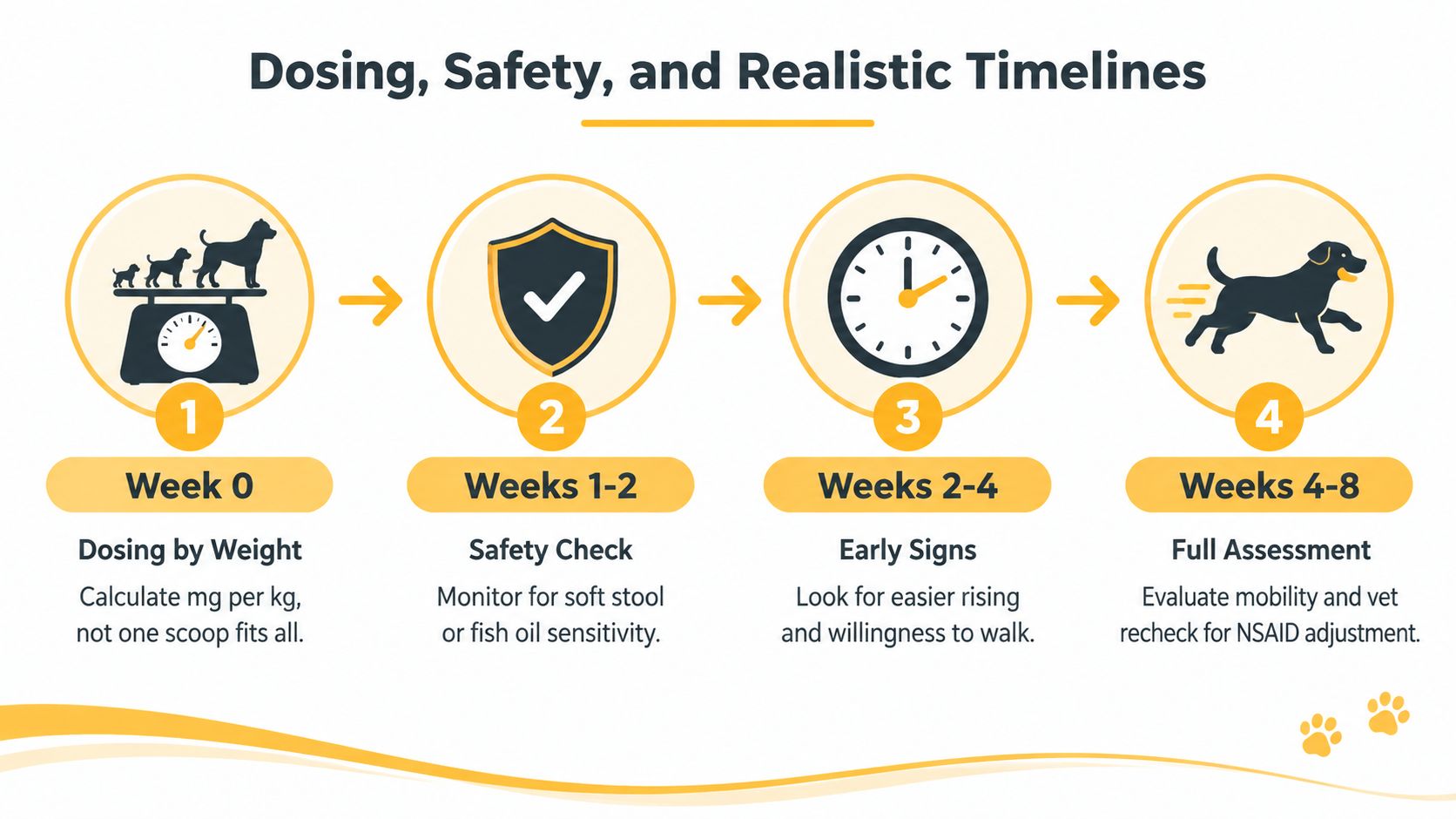
A scoop count isn't a dosing strategy unless the label explains what that scoop delivers for the dog's body weight. Small dogs may receive a very different exposure from large dogs when both get a generic “one scoop” direction. Analysts should convert the daily amount into milligrams per kilogram wherever the label permits, then compare the active ingredients with the amounts used in canine research.
That comparison is especially important for omega-3 products. A total fish-oil number doesn't tell you how much EPA and DHA the dog receives. The same problem appears when a formula gives a combined glucosamine-chondroitin total without separating the compounds, or when green-lipped mussel appears in a blend without a declared quantity.
Monitor before escalating
Introduce a product according to its label and observe appetite, stool quality, vomiting, itching, or other changes. Don't increase the dose just because improvement hasn't appeared quickly. A loading phase may be appropriate for some formulations, but it should come from the manufacturer's directions or a veterinarian, not from guesswork.
Medication makes independent experimentation less appropriate. Tell the prescribing veterinarian about supplements when a dog receives NSAIDs, gabapentin, anticoagulants, or other treatment. The concern isn't that every combination is unsafe. It's that the clinician needs the complete list to assess the individual dog, especially before changing pain control.
Use a measured outcome
Track a small set of repeatable observations, such as willingness to rise, comfort on stairs, walk duration, or interest in ordinary activity. Look for a pattern rather than a single good day. If mobility worsens, pain appears sudden, or the dog stops normal activity, contact a veterinarian instead of waiting for a supplement timeline.
Supplements also sit inside a larger mobility plan. Weight management and controlled exercise can influence joint load and muscle support, so a product shouldn't be judged in isolation. A review that discusses only the jar misses the conditions that determine whether a dog can move comfortably.
Cost, Subscriptions, and Total Value
A sticker price tells you very little until you know the dog's daily dose, the active ingredients delivered at that dose, and the length of the trial. Larger dogs may require more product than smaller dogs, so a container that looks inexpensive can carry a higher ongoing cost. A concentrated formula may also be less costly per relevant active than a cheaper product padded with low-value ingredients.
| Model | Average Annual Cost | Per-Serving Price | Shipping | Return Window |
|---|---|---|---|---|
| Single jar | Calculate from the actual number of jars used | Jar price divided by daily servings | Check the order total and delivery terms | Confirm the written policy |
| Vet-channel refill | Calculate from refill frequency and dose changes | Refill price divided by servings | Ask whether delivery is included | Verify the clinic or seller's terms |
| Direct-to-consumer subscription | Include every scheduled shipment | Subscription price divided by servings | Check thresholds and recurring delivery charges | Read cancellation and refund conditions |
The table uses a calculation framework rather than invented market averages. That distinction matters because product sizes, dosing rules, shipping policies, and return terms vary. A responsible review should show its arithmetic instead of presenting an unsupported “average annual cost.”
A worked comparison
Use a generic example with your own figures. If Product A costs $45 and supplies 60 daily servings, its daily cost is $0.75. If Product B costs $90 and supplies 90 servings, its daily cost is $1.00. Product B isn't automatically worse or better. Compare the amount of the strongest relevant active per serving, then add shipping, renewal timing, and any second product needed to cover the same goal.
Subscriptions deserve a separate check. Look for automatic renewal, self-service cancellation, pause options, shipping thresholds, and refund deadlines. A low introductory price can obscure the cost of continued use if the owner doesn't understand when the next order is processed.
The best value is therefore evidence per usable daily dose, not the lowest jar price. A transparent formula with a credible active profile can justify a higher serving cost, while a large container with vague blends may offer poor value even when its shelf price looks attractive.
A Reusable Checklist for Every Joint Supplement Review
A strong review should work for a single-ingredient powder, a multi-ingredient chew, or an all-in-one formula. Use the same questions every time so packaging, star ratings, and brand familiarity don't change the standard.
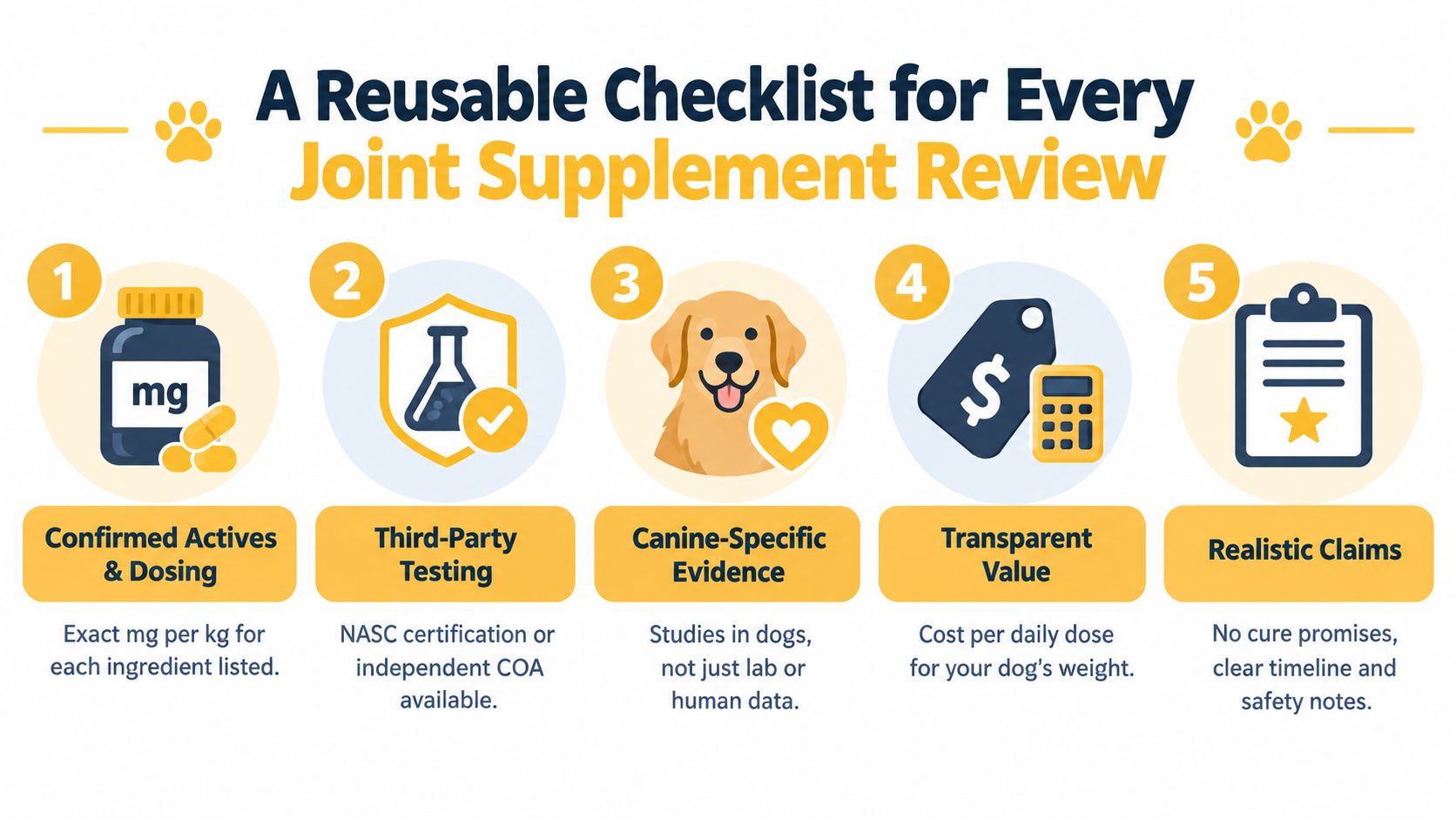
- Confirm the actives and dose. Ask, “What is the exact amount of each active ingredient per daily serving?” If the answer is a proprietary blend total, the formula can't be audited properly.
- Check quality documentation. Ask whether the manufacturer can provide a current independent certificate of analysis or explain its quality-seal verification. Testing can support identity and purity, but it doesn't establish mobility benefit.
- Match claims to canine evidence. Ask, “Which claims rely on controlled studies in dogs?” Give more weight to measured mobility, pain, or quality-of-life outcomes than to laboratory rationale or testimonials. Omega-3s currently deserve a different evidence position from glucosamine and chondroitin, as the earlier research indicates.
- Calculate the dog-specific value. Record the daily serving for your dog, the cost over a sustained trial, and the amount of the most relevant active delivered. Include shipping and recurring-order terms rather than comparing container prices alone.
- Test the claims for realism. A responsible label should state how to use the product, identify safety considerations, and avoid cure promises. Ask what improvement the owner should monitor and when a veterinarian should reassess the dog.
Rule out a product when the active amounts are hidden, the label omits important ingredients, the claims promise disease cures, or the manufacturer can't answer basic quality questions. A supervised trial may still be reasonable when the label is transparent, the dog's veterinarian agrees, and the owner can measure mobility consistently.
Pure Paw Labs offers DA-1™ Daily All-in-One, a once-daily powdered formula described as supporting joints, skin and coat, gut health, immunity, and stress with 18 human-grade ingredients. If an all-in-one approach fits your dog's routine, review the joint-active quantities and safety information using the framework above, then visit Pure Paw Labs to examine the product details and available customer support.