


Boxer dogs are naturally born with full-length, normal tails. The short-tail look many people recognize usually comes from cosmetic docking or from specific breeding standards, not from the breed's basic anatomy.
So why do so many Boxers appear tailless? The answer sits at the intersection of biology, history, and human preference. Docking became common long ago, then kennel standards reinforced the familiar silhouette. As a result, people often see a docked Boxer first and assume the breed is naturally short-tailed.
That assumption can create practical confusion for new owners. A puppy with a natural tail may look unusual beside docked relatives, while a naturally bobtailed puppy may be mistaken for one whose tail was altered. Understanding the difference helps you make better decisions about identification, communication, care, and your dog's overall comfort.
Table of Contents
- The Truth About Boxer Dog Tails
- Natural Anatomy and Genetic Factors
- The History of Breed Standards and Docking
- Comparing Docked and Natural Tails
- Tail Health and Whole-Body Wellness
- Daily Care and Injury Prevention Tips
The Truth About Boxer Dog Tails
A Boxer does have a tail. Under natural conditions, that tail is present at birth and normally develops to a full length. The United Kennel Club describes the tail as generally docked, but says that when left natural it is of normal length. The Boxer Club and United States breed standard likewise describe the natural tail as normal in length and left natural, as documented by the Boxer breed standard information.
The short or absent-looking tail associated with many Boxers is usually a docked tail. Docking removes part of the tail when puppies are very young, which changes the dog's outline but not the underlying fact that Boxers are born with tails. In some lines, a puppy can also be born with a naturally short tail, known as a bobtail. That is a genetic variation, not the result of surgery.
Why the confusion persists
The question “do Boxer dogs have tails” is common because the most recognizable show and pet images often feature a short tail held upright. Decades of docking made that appearance familiar, so people naturally treat it as a breed trait in the same way they might recognize a Boxer's square muzzle or athletic build.
More varied. You may meet a Boxer with a docked tail, a Boxer with a full natural tail, or, less commonly, a Boxer born with a natural bobtail. Country regulations, breeder choices, rescue history, and show rules can all affect which version you see.
The simplest rule: A Boxer's natural anatomy includes a tail. A short tail tells you about alteration or genetics, not that the breed is naturally tailless.
That distinction matters beyond appearance. A tail contributes to movement and social signaling, so owners should evaluate the dog in front of them rather than assuming every Boxer has the same tail structure.
Natural Anatomy and Genetic Factors
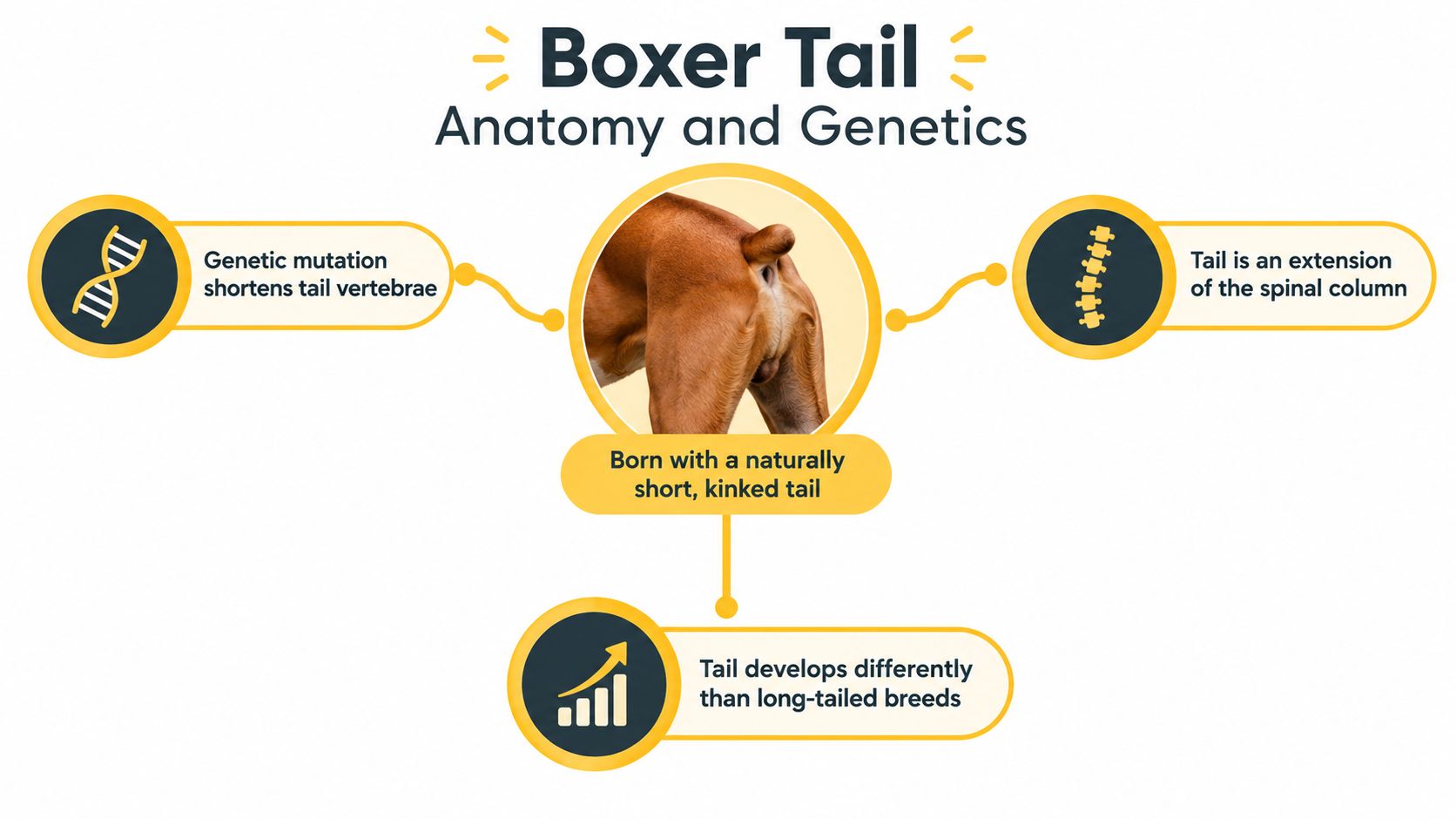
A natural-tailed Boxer puppy is born with a tail that continues from the spine. It contains vertebrae, muscles, connective tissues, blood vessels, and nerves, with the bones becoming smaller toward the tip. As the puppy grows, the tail lengthens in proportion to the rest of the body, producing the normal-length tail described in breed references.
The term natural tail covers two different possibilities. One is the usual full-length tail present from birth. The other is a naturally bobbed tail, which is short because of inherited genetics rather than because a person removed part of it.
Docking and bobtail genetics aren't the same
A docked tail usually has a clean, deliberately shortened appearance determined by an early physical procedure. A natural bobtail develops differently before birth because inherited genetics influence the length and shape of the tail vertebrae. It may look short, kinked, or otherwise unlike a typical full tail.
These differences can matter when you're examining a puppy. A docked tail may show a healed end consistent with alteration, while a bobtail is part of the puppy's original anatomy. A breeder should be able to explain the parentage and tail history, and a veterinarian can assess unusual structure if you're uncertain.
Natural bobtails have existed in Boxer lines, but they're not the default condition for the breed. The UK Kennel Club began recording puppies born with naturally bobbed tails in October 2008, which shows that tail status had become important enough for formal registration in a major market. The policy confirms that natural bobtails can occur, while the normal biological starting point for Boxers remains a full tail.
If you want a simple refresher on how the skeleton fits together, this guide to dog leg bones and canine anatomy can help put the tail's connection to the rest of the body into context.
A dog's tail isn't an isolated decoration. It functions as part of the spinal structure and works with muscles and nerves throughout the rear of the body. That's why a change in tail length or shape can influence appearance, balance, and communication without changing the dog's identity as a Boxer.
For aging dogs whose mobility and general condition need broader attention, DA-1™ Daily All-in-One - Senior Dog Support, Joints, Skin/Coat & More is described as a multi-system formula with 18 human-grade ingredients supporting cells, gut, and joints in one scoop. It should complement, not replace, veterinary advice specific to the individual dog.
The History of Breed Standards and Docking
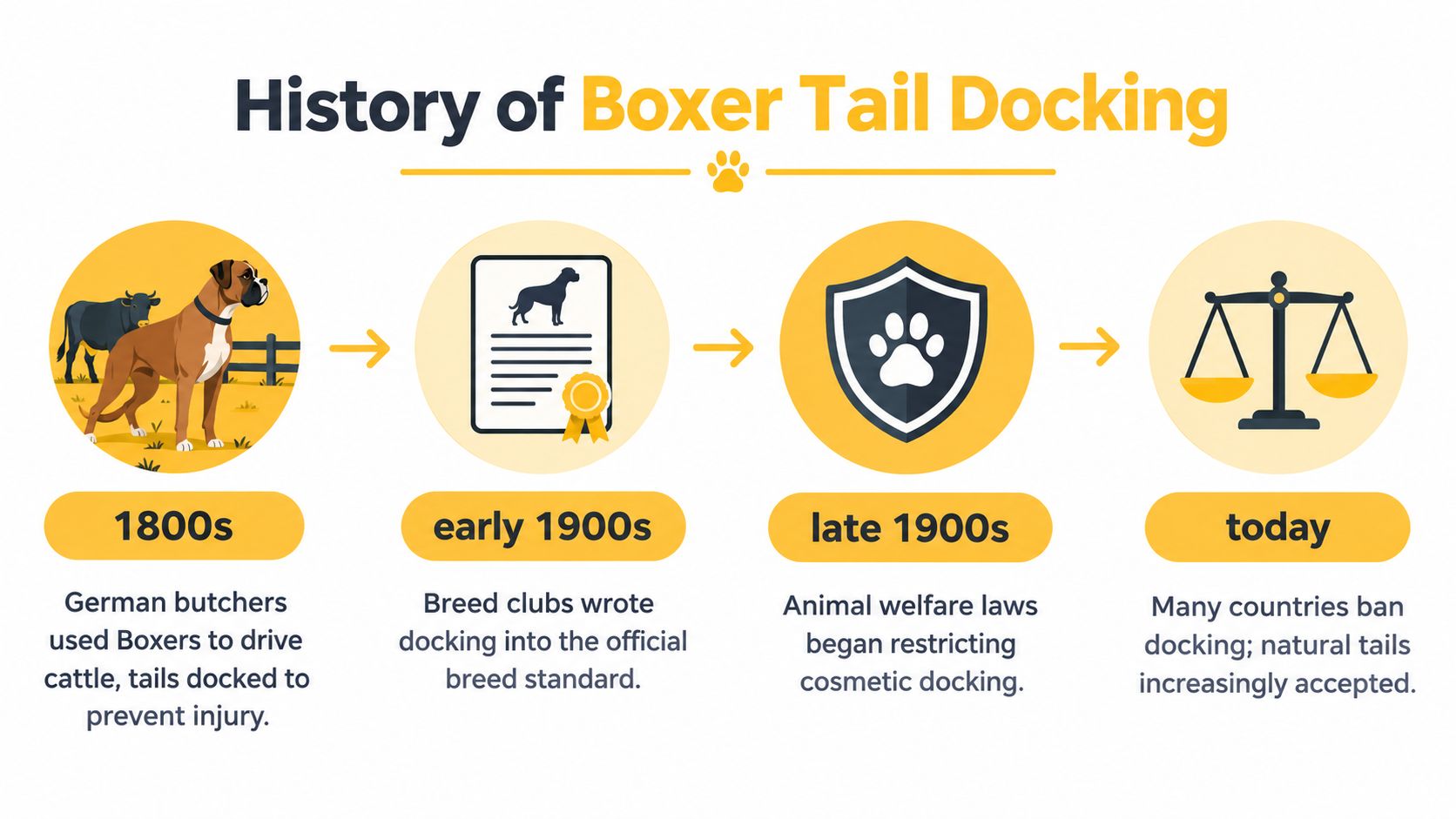
Boxer tail appearance developed through human decisions layered onto an already-tailed breed. The Boxer traces back to the German Bullenbeisser, and historical accounts connected with related dogs mention clipping young tails as far back as 1719, according to the historical material summarized in the AKC Boxer standard.
By the late nineteenth century, the modern Boxer was being developed in Germany. Tail docking then became tied not only to working traditions but also to the visual expectations written into conformation standards. The American Kennel Club standard describes the tail as “set high, docked, and carried upward,” and says an undocked tail should be “severely penalized.”
That wording reveals an important point. A breed standard can describe the preferred appearance of a dog, but it doesn't determine the dog's underlying anatomy. When a standard rewards a docked tail, breeders and owners may encounter more docked dogs, which can make the altered appearance seem natural.
Standards changed over time
Naturally short-tailed Boxer lines developed in the UK were accepted into the Kennel Club registry in 1998 after several generations of controlled breeding. In 2008, the Fédération Cynologique Internationale added a naturally stumpy tail as a disqualifying fault in member countries. Those decisions point in different directions, but together they show how strongly policy shaped the tail's place in the show ring.
The broader history also explains why tail procedures are often discussed alongside other traditional breed alterations. Owners researching the subject may find it useful to understand the medical and welfare questions surrounding dog ear surgery, while keeping in mind that ear procedures and tail docking involve different anatomy and purposes.
The key lesson is straightforward: the Boxer's short-tail image is historical and cultural, not proof that the breed is born without a tail.
Comparing Docked and Natural Tails
A docked Boxer and a natural-tailed Boxer can look noticeably different, but both can be healthy, active companions. Tail length alone doesn't tell you whether a dog is well cared for, comfortable, or suitable for family life. It tells you something about the dog's history or genetics.
| Feature | Docked Tail | Natural Tail |
|---|---|---|
| Appearance | Shortened and often held upright | Full length unless the dog has a natural bobtail |
| Origin | Altered after birth | Present from birth, either normally long or naturally short |
| Communication | Uses the remaining tail movement alongside posture, ears, face, and voice | Has more tail movement available for social signaling |
| Movement | The dog adapts balance and body language to its tail length | The tail can contribute to balance and directional movement |
| Show acceptance | Depends on the country and registry rules | Depends on local standards and regulations |
| Care needs | Inspect the remaining tail and healed end | Inspect the full tail, especially the tip and areas exposed to impact |
| Legal context | Rules may restrict or regulate docking and exhibition | Often the less legally complicated option where docking is restricted |
Reading the dog, not just the tail
Dogs communicate with their whole bodies. Tail position is only one clue, alongside facial expression, posture, ear position, movement, and vocalization. A natural-tailed Boxer may provide more visible information through tail carriage, but owners shouldn't interpret a wag in isolation.
A fast wag doesn't automatically mean friendliness, and a still tail doesn't automatically mean illness. Look for a pattern. A tail that suddenly hangs differently, becomes rigid, or stops moving normally may deserve attention, particularly when the change comes with reluctance to sit, jump, play, or be touched.
Regional rules also matter. A natural-tailed Boxer may be accepted in everyday life but treated differently in a particular show system. Conversely, a docked dog may have been legally altered in one location and imported into another with different requirements. Ask local veterinary and registry professionals about current rules rather than relying on assumptions from another country.
Tail Health and Whole-Body Wellness
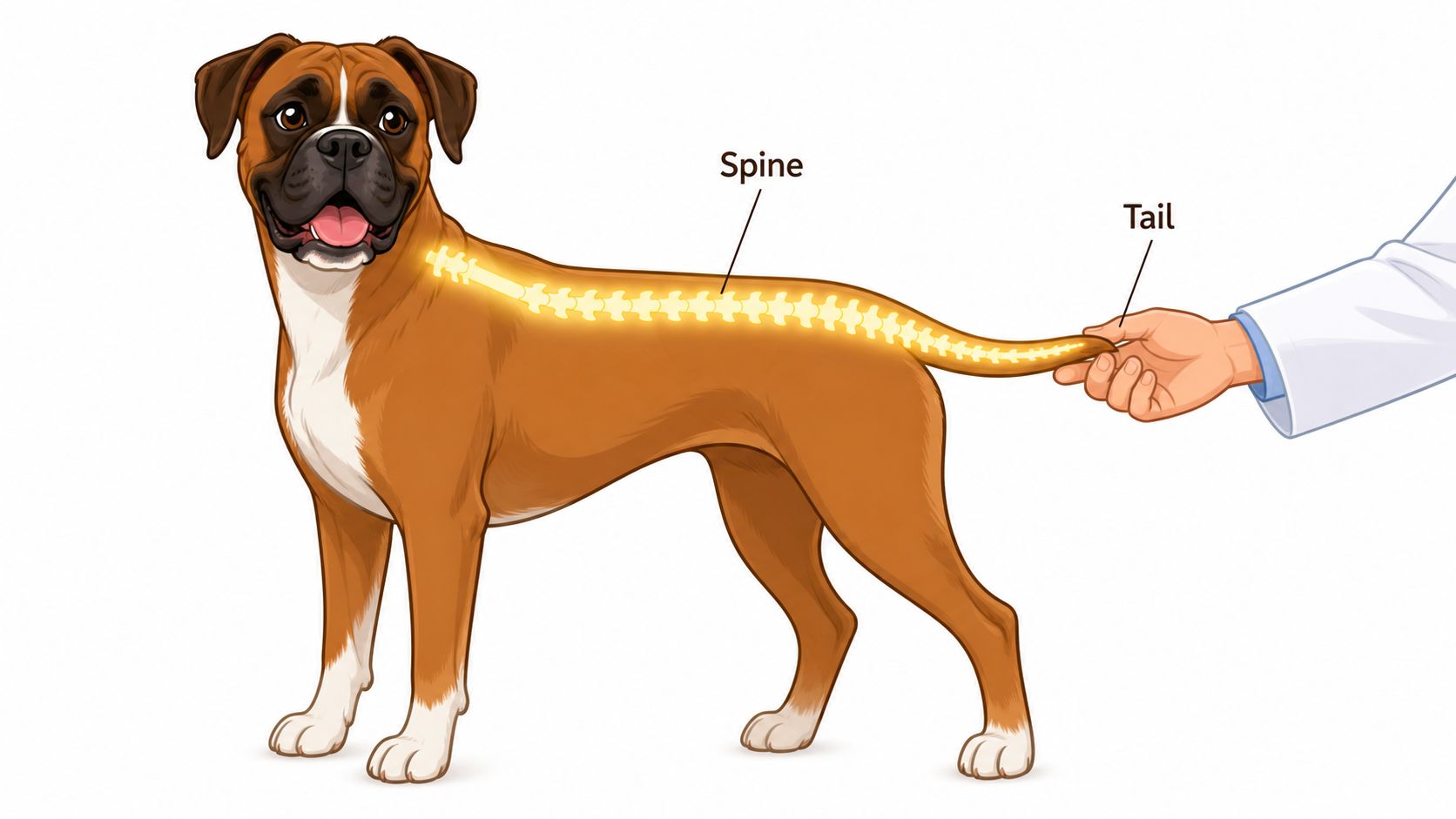
The tail is an extension of the spinal column, so tail comfort depends on more than the skin at the tip. Muscles, nerves, joints, and connective tissues all contribute to how a Boxer carries and moves it. A dog with stiffness in the rear, pain near the lower spine, or irritation around the tail may change posture or movement before the problem becomes obvious.
What whole-body observation looks like
Watch your Boxer during ordinary activities rather than checking only when something seems wrong. Notice whether the dog:
- Moves freely: Stiffness after rest, reluctance to climb, or a changed gait can point to discomfort elsewhere in the body.
- Uses the tail normally: A sudden change in carriage or movement deserves a closer look.
- Keeps the skin healthy: Redness, hair loss, swelling, sores, or persistent licking may indicate irritation or injury.
- Maintains normal behavior: Reduced play, unusual hiding, or sensitivity to touch can accompany pain.
Nutrition is one part of a broader wellness plan that also includes appropriate exercise, body-condition monitoring, grooming, and veterinary care. A daily formula may be considered when an owner wants nutritional support across several systems, but supplements shouldn't be used to diagnose or treat a tail, spinal, or joint problem.
The most useful mindset is to treat tail changes as potential clues, not isolated cosmetic issues. A Boxer that suddenly stops wagging, guards the rear, or reacts when the tail is handled should receive a professional assessment, especially if the change follows an impact or rough play.
Daily Care and Injury Prevention Tips
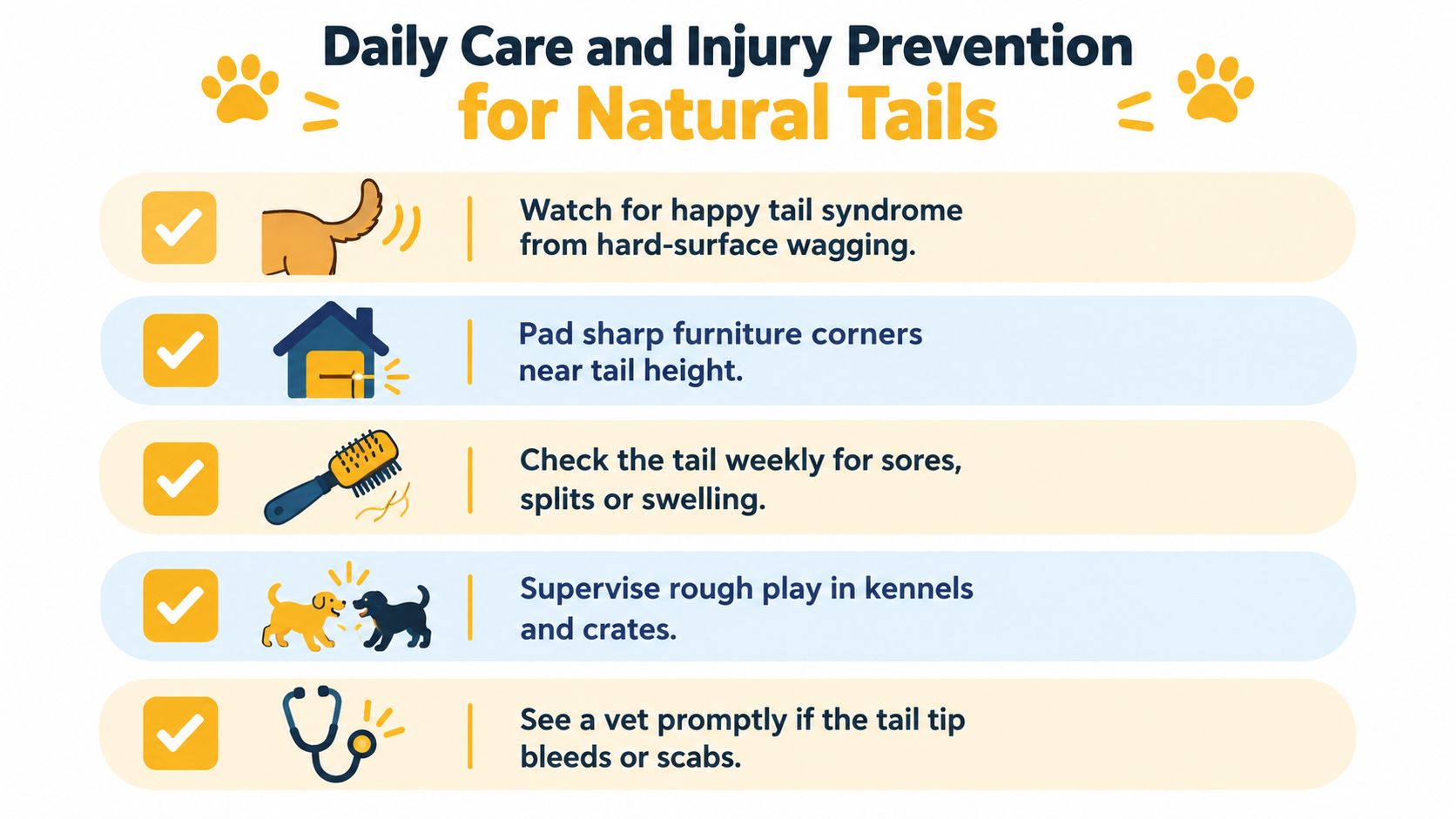
Natural tails need routine observation because they can strike hard surfaces, catch on objects, or become irritated during energetic play. Boxers are enthusiastic dogs, and a happy wag against a wall, crate, or furniture can cause repeated trauma to the tip. This is often called “happy tail.”
Use this practical checklist:
- Inspect the tail regularly. Look for bleeding, scabs, splits, swelling, heat, discharge, or a new bend. Check gently rather than squeezing or repeatedly manipulating a sore area.
- Reduce impact points. Pad sharp furniture corners and notice whether the tail repeatedly hits a wall, door, or crate.
- Review confinement areas. Crates and kennels should allow comfortable movement without trapping the tail against bars or hard edges.
- Supervise rough play. Stop games that repeatedly cause collisions, grabbing, or twisting around the tail.
- Keep the skin clean and dry. Follow veterinary instructions for any wound, and don't apply household products to an open injury without professional guidance.
A bleeding or repeatedly reopening tail tip can be difficult to manage at home because every wag may disturb healing. Contact a veterinarian promptly if bleeding continues, the area becomes swollen, your dog shows pain, or the tail suddenly changes position or movement.
Puppies also deserve special care while they grow. Their bones and supporting tissues are still developing, so avoid forcing unusual movements or allowing uncontrolled impacts. This overview of the dog growth plate provides useful context for why developing dogs need age-appropriate activity.
The answer to “do Boxer dogs have tails” is clear, but each Boxer still needs an individual care plan. Check the tail, watch the whole dog, and seek veterinary help when a change persists.
Pure Paw Labs offers science-backed, human-grade daily dog supplements designed to support areas such as joints, skin and coat, digestion, immunity, and stress with a simple routine. Visit Pure Paw Labs to review its wellness options and choose support that fits your Boxer's broader health plan.