


You're standing in the kitchen at night, your dog is off his food or dealing with loose stool, and your own probiotic bottle is right there on the counter. The question is immediate and practical, can dogs eat human probiotics tonight, or is this one of those situations where you should wait for the vet in the morning?
The honest answer is more useful than a simple yes or no. A human probiotic may be tolerated by some healthy dogs, but that doesn't mean it matches a dog's gut, dose, or delivery format. The rest of this article walks through what changes from bottle to bottle, when a human product is probably low-risk in a pinch, and why a dog-formulated option is usually the better daily choice. If you want a broader gut-health primer alongside this question, this dog gut health guide is a helpful companion read.
Table of Contents
- The Moment Every Dog Owner Has Had
- What Probiotics Do in a Dog's Gut
- Three Key Differences Between Human and Dog Probiotics
- Reading the Label Before You Share the Capsule
- What the Evidence Shows About Benefits and Risks
- Warning Signs and When to Call the Vet
- Better Alternatives for Owners Who Want a Simpler Routine
- A Simple Decision Rule You Can Use Tonight
The Moment Every Dog Owner Has Had
Your dog has an unsettled stomach. Maybe he's gassy, maybe he skipped dinner, maybe he's on antibiotics and the stool is changing. You open the cabinet, spot your own probiotics, and think, Can I just give him one capsule now?
That question sounds small, but it's really three questions at once. First, is the product itself safe for a dog? Second, is it likely to do anything useful? Third, if you do need something simple, what's the cleaner option going forward?
The evidence points to a careful middle ground. Cornell's Riney Canine Health Center notes that probiotics are generally safe, but dogs with severely weakened immune systems need veterinary supervision, and a veterinary review emphasizes that probiotics work by strain and host species, not by the word “probiotic” alone: Cornell's canine probiotic overview and the canine and feline review linked there. That means a human capsule may be tolerated, yet still miss the mark biologically.
Practical rule: if the dog is bright, drinking, and only mildly off, the real issue is usually fit, not panic.
The useful way to think about this is simple. One bottle can look harmless on the outside and still be mismatched on the inside. The rest of the article breaks that down in plain language, starting with what probiotics are supposed to do in the first place, then moving to the label details owners usually overlook, and finally to simpler routines for people who don't want to juggle multiple products every day.
What Probiotics Do in a Dog's Gut
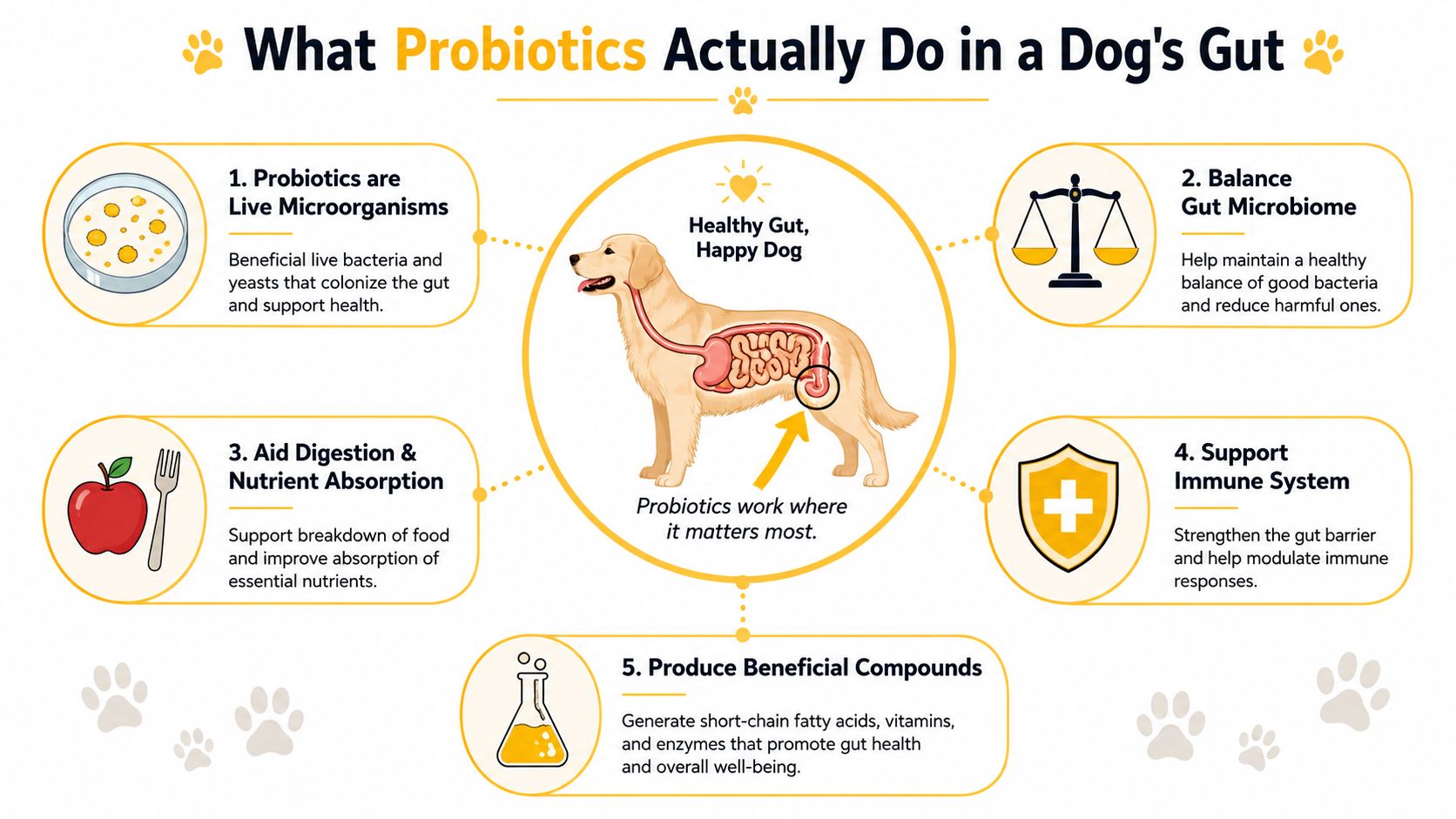
A probiotic is a live microorganism meant to support the community of microbes already living in the digestive tract. The easiest way to understand it is to picture a busy neighborhood. New neighbors can help the block settle down, but only if they fit the area, stay long enough, and do not create more disruption than benefit.
That neighborhood idea matters because dogs and humans do not live in the same microbial block. The canine gut has its own microbiota, and probiotic effects depend on the strain and the host species, not just on whether the product sounds healthy. In dogs, the important question is whether the organism can survive, interact with the gut, and do a job that makes sense for canine digestion. A human capsule may still pass through a dog without causing obvious harm, but that does not mean it is doing the right biological work.
A strain is a specific version of a microbe, like a particular key cut for a particular lock. Two products can list a familiar species name and still behave differently once they reach the gut. That is why a strain made for people may not persist well in a dog's gastrointestinal tract, even if the label looks reassuring on the surface. Cornell's probiotic overview lays out that species-specific point clearly.
A probiotic can be biologically active and still be the wrong guest for the wrong house.
For owners, the practical takeaway is straightforward. Probiotics can support digestion and other gut-related functions, but the benefit depends on whether the organisms fit the animal in front of you. That is why the label matters, and why a human probiotic may be tolerated by a dog without being especially useful.
The labels can get confusing because words like prebiotic, probiotic, and postbiotic are related but not interchangeable. If you want those terms separated cleanly, this prebiotic, probiotic, and postbiotic guide breaks them down in a simple way.
Three Key Differences Between Human and Dog Probiotics
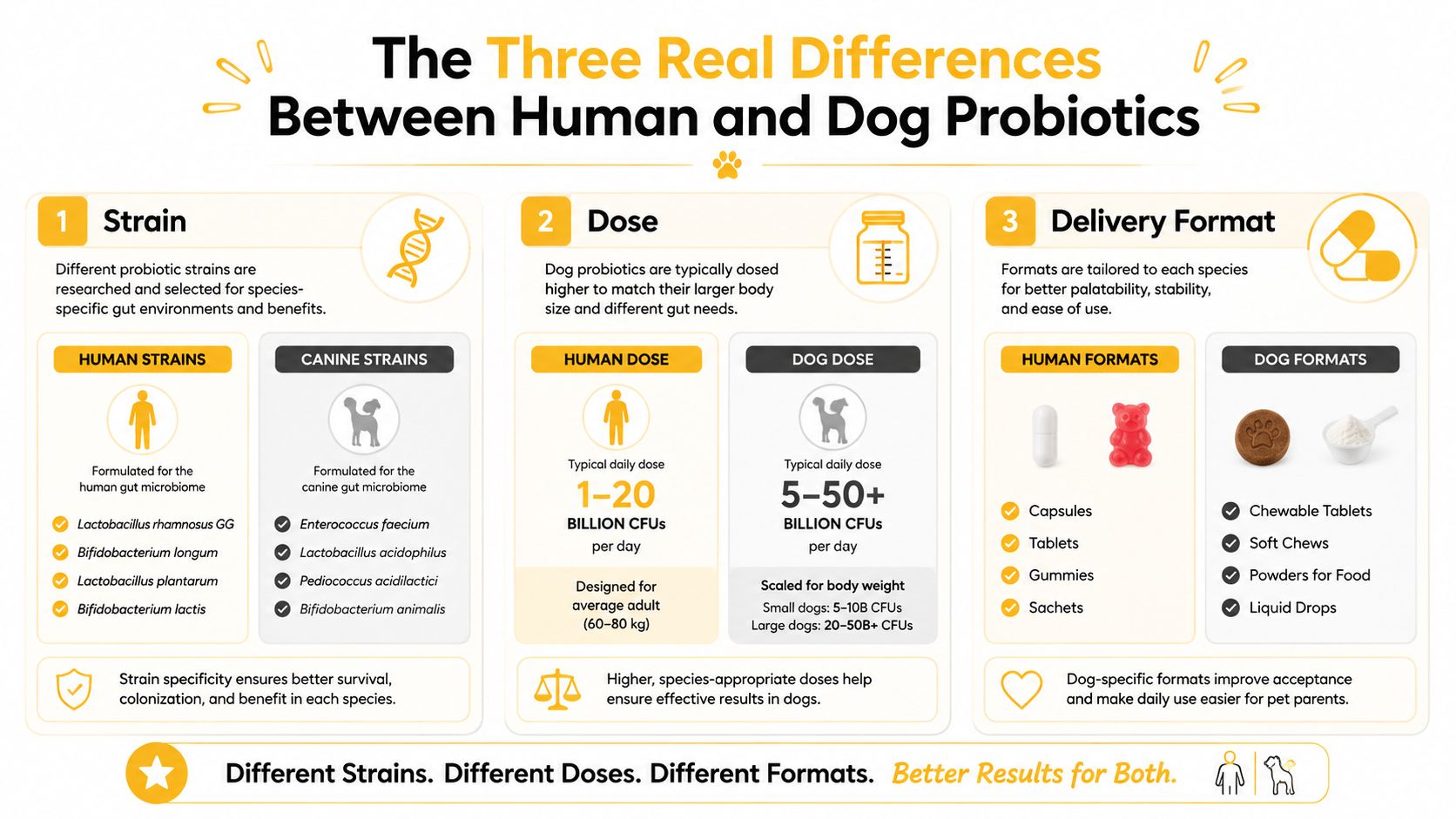
The biggest mistake owners make is assuming a probiotic label is interchangeable just because the bacteria names look familiar. It is not. Strain, dose, and delivery format can all change how a product behaves once it reaches a dog.
Strain Defines the Effect
A bottle may list the same species name that appears on a canine product, but that still does not mean the strain behaves the same way. The species name is the broad label, while the strain is the specific version, the part that often determines what the microbe does in the gut. Two products can sound alike on the shelf and still act differently in the body.
That is why veterinary research has moved toward strain-level testing in dogs. Effects do not transfer cleanly just because the species name matches. A human strain can be perfectly acceptable in theory and still be a poor fit in practice if it does not survive long enough or interact with the canine gut the way it does in people. As noted earlier, Cornell's review makes that species-specific point clearly.
Dose is not just a bigger number
Human labels are built around human serving sizes, not dog body weight or gut volume. That creates two problems. A small dog may get more than he needs relative to his size, while a large dog may get too little to matter. The number on the front of the bottle does not tell you whether the serving makes sense for a dog.
Dose also works like a recipe. Too much of one ingredient can overwhelm the dish, and too little may not change anything. Probiotics are no different, because the amount that fits a person is not automatically the amount that fits a dog.
Delivery format changes what reaches the gut
Human probiotic capsules often assume a human digestive pace. Dogs can process food differently, and that matters when a product relies on capsule breakdown or a carrier designed for people. The result can be a product that looks fine on paper but never behaves the way the label suggests.
Delivery format also affects what else comes along for the ride. A capsule, powder, or chew can carry different fillers, flavorings, or binding agents, so the format is part of the label decision, not just the bacteria name. If you want a clearer breakdown of how veterinary formulas are usually chosen, this probiotic supplement guide for dogs is a useful place to compare the basics.
| Dimension | What Human Labels Show | Why It Matters for Dogs |
|---|---|---|
| Strain | Familiar species names that look reassuring | The exact strain may not act the same way in dogs |
| Dose | Human serving sizes and human-style CFU counts | The serving may be too much, too little, or simply uncalibrated for a dog |
| Delivery Format | Capsules, powders, or mixed carriers made for people | Some formats do not fit canine digestion as well |
Reading the Label Before You Share the Capsule
A human probiotic isn't one thing. The format changes what else is inside the package, and that's the part many owners miss when they ask whether they can give their dog their exact brand.
Capsules are the closest thing to a simple answer
Capsules usually have fewer extras than gummies or flavored chews. That makes them the most defensible “in a pinch” format, but only if the inactive ingredients are clean. Check for xylitol, chocolate flavoring, or other additives that don't belong in a dog's bowl.
Gummies are usually the easiest no
Gummies often rely on sweeteners, flavor systems, and sticky binders that are designed for people, not pets. Many human gummy products are a poor match for dogs because the full label is often built around human taste, not canine tolerance. If the ingredient list includes a sugar alcohol, the question is over before you start.
Powders and yogurt-based products need more scrutiny
Powders can be simple or messy, depending on what's added to them. Some are mostly active cultures, others are padded with flavorings, carriers, or allergen-prone extras. Yogurt-based products bring in dairy, which some dogs handle poorly, and the live-culture count can be inconsistent from one product to the next.
Read the inactive ingredients first. The bacteria are only half the story.
Here's the quick checklist to use tonight: look for xylitol, check the full inactive ingredient list, confirm the serving size, and ask whether the format makes sense for a dog with a much smaller digestive volume. That's a more useful question than “is it a probiotic?”
What the Evidence Shows About Benefits and Risks
The research question breaks into two separate issues, is it safe, and does it work well enough to matter. Those are different questions, and a lot of casual advice blends them together as if they were the same.
On safety, the picture is fairly reassuring for healthy dogs. Cornell describes probiotics as generally safe, and accidental ingestion of a human probiotic is usually low-risk in a healthy animal, while also warning that severely immunocompromised dogs need veterinary supervision. Protexin also states that human probiotics are not safety-tested for dogs, which is why most guidance stays cautious even when the immediate danger is usually low.
Safety and effectiveness do not move together
A product can be relatively safe and still fail to deliver a meaningful benefit. That is the pattern the evidence keeps showing. A systematic review of 17 studies found that the risk of bias was generally moderate to high, sample sizes were small, and the overall effect for preventing or treating acute gastrointestinal disease was limited and possibly clinically unimportant. For chronic GI disease, dietary intervention remained the main therapy, with probiotics adding little measurable improvement. Systematic review in the Journal of Veterinary Internal Medicine
That does not mean probiotics are useless. It means expectations should stay realistic. Veterinary reviews still describe possible support for gut microbiota modulation, fecal-quality improvement, short-chain fatty acid production, and mucosal immunity, but those effects depend on the exact strain and the exact indication. A capsule is only as useful as the microbes it contains, and the label has to match the job.
If your dog has mild digestive upset, stress, or recent antibiotic exposure, a probiotic may fit as a support tool. If the goal is to manage a serious GI problem, the evidence does not support treating a human product like a stand-alone solution.
Warning Signs and When to Call the Vet
A probiotic should not leave your dog feeling worse for long. If the reaction keeps building, the answer is to stop it, not to wait and hope the gut settles on its own.
Watch for worsening diarrhea, bloating, extra gas, vomiting, loss of appetite, lethargy, itching or hives, or any sudden behavior change after starting a probiotic. A small stool change can happen while the digestive system adjusts, but a clear slide in how your dog feels means the product is not a good fit.
Stop the product if the signs are getting worse, not better.
Some dogs need veterinary approval before any probiotic goes into the routine, whether the product is meant for people or dogs. That includes severely immunocompromised dogs, dogs with ongoing chronic illness, and dogs whose digestive disease history makes the situation harder to interpret. As noted earlier, dogs in these groups need extra caution because the same capsule that seems harmless in a healthy pet can be a poor choice in a medically fragile one.
If symptoms last more than 24 hours, if you see blood in the stool, or if your dog seems dehydrated, stop the product and contact your veterinarian the same day. That rule matters more than whether the bottle came from a human supplement aisle or a pet shelf.
Better Alternatives for Owners Who Want a Simpler Routine
Human probiotics can be a stopgap, but they're not the cleanest long-term plan. The cleaner choices usually fall into three buckets: a canine-specific probiotic, a postbiotic, or a broader daily supplement that handles more than one need at once.
A canine probiotic is the most direct match when you want named strains and dog-specific dosing. A postbiotic makes sense when live cultures don't sit well or when a vet wants a non-living gut-support approach. An all-in-one supplement is different, because it's less about replacing a probiotic and more about reducing supplement clutter for owners who are tired of separate products for digestion, skin, joints, and stress support.
That's where DA-1™ Daily All-in-One - Skin/Coat, Joints, Gut Health & More fits as an example. It's a once-daily powder described as a human-grade, all-in-one topper for dogs, with support positioned around digestion, immunity, skin and coat, joints, and stress-related needs. For owners who want one routine instead of a shelf full of separate items, that kind of consolidation may be the practical answer.
| Option | Best For | Key Strength | Watch Out For |
|---|---|---|---|
| Canine-specific probiotic | Dogs with targeted digestive support needs | Strain and dose are built for dogs | Still strain-specific, so not every formula fits every case |
| Postbiotic | Dogs that don't do well with live cultures | No live microorganisms | Less familiar to many owners |
| All-in-one daily supplement | Owners who want one routine instead of several | Consolidates multiple support categories | Not a substitute for a vet visit when symptoms are active |
A Simple Decision Rule You Can Use Tonight
Use three rules and you won't overthink this.
- Read the label carefully. Check for xylitol, flavorings, and every inactive ingredient, not just the probiotic name.
- Prioritize dog-specific probiotics. Look for strain names and dosing that were chosen for dogs, not borrowed from people.
- Call your veterinarian when the dog is young, older, medicated, or medically complicated. That matters more than convenience.
The middle answer is the one most owners need. A human probiotic capsule is not automatically dangerous for a healthy adult dog, but that's a very different statement from saying it's the right daily choice. For a routine you can maintain, pick a product that matches canine physiology instead of relying on a human bottle by default.
Before your next vet visit, write down the strain names, the CFU per serving, and the inactive ingredients from any product you're considering. That small note can save a lot of guessing later.
If you want a simpler daily routine for your dog's gut, skin, joints, and stress support in one scoop, take a look at Pure Paw Labs. Their DA-1 Daily All-in-One is built for owners who'd rather manage one consistent supplement than juggle multiple products, and it fits naturally into the same label-checking mindset this guide covers.