


You're standing in the pet aisle with a dog who scratches through the night, sheds across every room, or has a coat that feels rough instead of glossy. The shelves offer fish oil, multivitamin chews, biotin, zinc, powders, and complex blends, all promising healthier skin and a better coat. The problem is that the best dog vitamins for skin and coat depend on the symptom you're trying to solve, not on which bottle has the most impressive label.
Skin problems are common veterinary concerns, not minor cosmetic annoyances. A U.S. university-clinic survey of 1,299 dogs found dermatological disorders in 17.0% of examined dogs, while hospital-based studies cited in the same literature reported burdens ranging from 18.8% to 33.4% in other settings, with a 28.6% caseload reported in a 2026 hospital study. The veterinary literature on canine dermatological disorders makes the practical point clear: itching, scaling, hair loss, and coat changes deserve a symptom-led plan.
| Your dog's main problem | Nutrient class to prioritize | Best starting format |
|---|---|---|
| Persistent itching or scratching | Marine omega-3s, especially EPA and DHA | Measured oil, capsule, or transparent powder |
| Dry, flaky skin | Omega-3s with barrier-support nutrients | Oil or powder |
| Dull or brittle coat | Essential fatty acids, protein, biotin, vitamin E | Powder or targeted chew |
| Excessive shedding | Balanced nutrition, protein cofactors, zinc when appropriate | Complete diet review plus targeted supplement |
Table of Contents
- Why Your Dog's Coat Problem Changes the Right Supplement
- Key Nutrients That Drive Skin and Coat Health
- Single-Target Supplements vs All-in-One Formulas
- What the Evidence Actually Supports
- How to Choose the Right Supplement for Your Dog
- Powder, Chew, Oil, or Capsule
- When an All-in-One Like DA-1 Makes Sense
- Matching the Product to the Real Problem
Why Your Dog's Coat Problem Changes the Right Supplement
A dog who scratches after every walk may have an inflammatory skin problem, an allergy, parasites, infection, or a nutritional issue. A dog with a dull coat but no itch may need better fatty-acid support, adequate protein, or correction of a diet gap. A dog shedding heavily during seasonal coat changes may not need the same intervention at all.
That distinction matters because owners often treat every coat complaint as an omega-3 problem. Marine fish oil has useful evidence for inflammatory skin support, but it won't correct every deficiency-linked dermatitis, and it won't replace diagnosis when the skin is red, infected, painful, or losing hair in patches. The symptom tells you where to start.
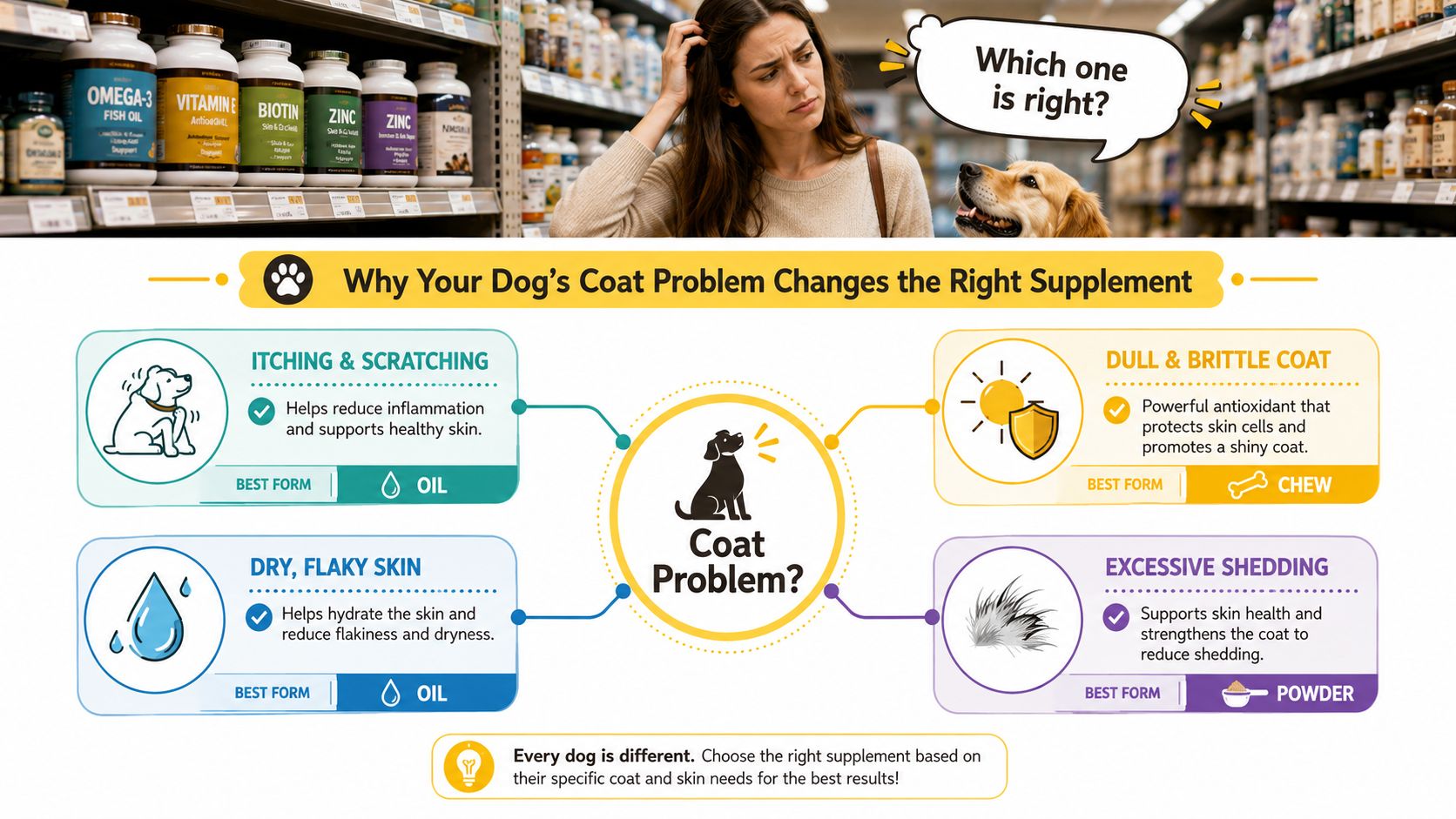
Match the complaint before choosing the bottle
Consider three common owners.
The first has a Labrador who scratches its ears and belly constantly. That pattern calls for an investigation of allergies, parasites, infection, and inflammation. If nutritional support is appropriate, EPA and DHA from marine oil deserve priority because they target inflammatory pathways more directly than a generic multivitamin.
The second has a small dog with a dry, brittle coat and visible flakes, but little scratching. Essential fatty acids may support skin moisture and coat texture, while vitamin E, zinc, and adequate protein become more relevant to barrier function and tissue repair.
The third has a healthy dog leaving fur on every sofa during a seasonal shed. A supplement may help only if the diet is missing a supporting nutrient. Grooming, diet adequacy, and medical screening matter more than throwing several unrelated vitamins into the bowl.
Practical rule: Don't buy a supplement because it says “skin and coat.” Buy it because its nutrient profile matches your dog's dominant problem.
A fish oil product can be sensible for inflammatory itch and coat dryness, but it isn't automatically the answer for zinc-responsive dermatitis or a poorly balanced home-prepared diet. This symptom-to-nutrient approach is more useful than a generic ranking because it tells you what to prioritize, what to treat as secondary, and when supplementation is unlikely to solve the underlying problem.
Key Nutrients That Drive Skin and Coat Health
Skin and hair need more than a single vitamin. They need fats for signaling and surface oils, minerals for cell turnover, vitamins for protection, and protein for the hair shaft itself.
Omega-3 fatty acids
For persistent itch, marine EPA and DHA are the strongest starting point. Independent evidence reviews describe fish oil as providing a modest but real benefit for canine skin and coat health, with moderate evidence and a role that usually complements, rather than replaces, veterinary treatment. The evidence review on fish oil for canine skin and coat health specifically supports marine omega-3s for reducing itching and improving coat quality, while also noting that responses can be mild or inconsistent.
A controlled canine atopic dermatitis trial reported improvement after 10 weeks of omega-3 supplementation using either flax oil at 200 mg/kg/day or EPA at 50 mg/kg/day plus DHA at 35 mg/kg/day. The study found that the total omega-6 to omega-3 ratio didn't correlate well with clinical response, which means dose and formulation matter more than advertising a ratio alone. The canine atopic dermatitis trial provides a useful warning against choosing products based only on broad “balanced fats” language.
Zinc and barrier support
Zinc supports skin-barrier integrity, cell turnover, and hair-follicle function. It makes the most sense when a dog has a documented deficiency, a diet that may be incomplete, or clinical signs that lead a veterinarian to investigate zinc status. Routine high-dose zinc supplementation isn't a sensible default for a dog already eating a complete diet.
Biotin, B vitamins, and vitamin E
Biotin and other B vitamins are best viewed as coat-texture and tissue-support nutrients, not universal itch cures. Vitamin E acts as an antioxidant and supports cell membranes, making it a useful companion to fatty-acid supplementation rather than a replacement for EPA and DHA.
High-quality complete protein also matters. Hair is built from protein, so a formula packed with vitamins can't compensate for inadequate or poorly digestible protein in the overall diet.
| Symptom | Primary nutrient | Supporting nutrients | Role |
|---|---|---|---|
| Inflammatory itch | EPA and DHA | Vitamin E, zinc when indicated | Helps regulate inflammatory skin responses |
| Dry or flaky skin | Essential fatty acids | Vitamin E, balanced nutrition | Supports surface oils and barrier function |
| Brittle or dull coat | Protein and fatty acids | Biotin, B vitamins, vitamin E | Supports hair structure and coat appearance |
| Excessive shedding | Complete nutrition | Zinc, B vitamins, antioxidants | Helps address nutritional contributors to hair turnover |

For owners who want a broader routine, DA-1™ Daily All-in-One, Senior Dog Support, Joints, Skin/Coat & More is described as a multi-system formula with 18 human-grade ingredients in one scoop, targeting cells, gut, and joints. It's positioned as a no-pill, no-filler daily powder with a 60-day money-back guarantee, but it should still be matched to the dog's diet and actual symptoms.
Single-Target Supplements vs All-in-One Formulas
A single-target supplement is easier to evaluate. You can see what you're giving, adjust one ingredient at a time, and stop quickly if the dog reacts. That makes a measured fish oil, zinc product, or biotin chew the better choice when a veterinarian has identified one nutrient class or when your dog has a sensitive stomach.
The limitation is coverage. Owners often notice itch, shedding, dullness, and flakes together, then buy several bottles. That creates more measuring, more chances to forget a dose, and more opportunities to duplicate ingredients. An all-in-one powder can simplify that routine, but it may not deliver enough of one specific nutrient to address a confirmed deficiency or therapeutic need.
Where single-target products win
Choose a focused product when:
- The problem is clear: A dog with a confirmed nutrient deficiency needs a controlled correction, not a broad blend.
- Dose adjustment matters: A measured oil or powder lets you change one active ingredient without changing the entire supplement routine.
- Your dog reacts easily: Fewer ingredients make it easier to identify what caused digestive upset or intolerance.
- You're already using other products: A single nutrient reduces the risk of overlapping vitamins or minerals.
Where all-in-one formulas win
An all-in-one is more practical when symptoms overlap and the owner can't confidently identify the missing nutrient. One daily scoop may cover several support categories without asking the household to manage multiple containers and separate schedules.
Take an owner with an adult dog that scratches during allergy season, sheds heavily, and has a coat that looks dry. Three separate products might provide more precise control, but the owner may skip doses or accidentally combine overlapping nutrients. A powder offers broader coverage and a simpler routine, although its label still needs to show meaningful amounts of the active ingredients.
The right comparison isn't “more ingredients versus fewer ingredients.” It's precision versus coverage, with compliance deciding whether either option gets used consistently.
Don't accept an all-in-one merely because it sounds complete. Compare the active amounts, the dog's current diet, and the likelihood that the formula addresses the dominant symptom rather than decorating the label with a long ingredient list.
What the Evidence Actually Supports
Marketing often treats every skin-and-coat ingredient as equally important. The research doesn't. Omega-3s, zinc, biotin, and antioxidants have different evidence profiles, and the buying decision should reflect that difference.
Omega-3s have the clearest role
Marine EPA and DHA deserve the highest priority for inflammatory itch and some coat-quality problems. A double-blind crossover study of marine oil supplementation reported significant improvements in pruritus, self-trauma, and coat character, with reported values of P < 0.001, P < 0.05, and P < 0.01 for those endpoints respectively. The controlled marine-oil study in dogs is a stronger benchmark than a label that lists “omega fatty acids” without identifying EPA and DHA.
That doesn't make fish oil a standalone cure. The evidence review cited earlier describes the benefit as moderate, often mild, and more useful as an adjunct that may reduce reliance on prescription medication in some dogs with allergic skin disease.
Zinc is targeted, not universal
Zinc is important for barrier repair and follicle function, but its value rises when deficiency is plausible. Recent research on trace-mineral forms found that dogs receiving chelated sources had improved hair growth and hair quality with less shedding than dogs receiving inorganic sources, supporting the broader principle that source and formulation matter. The trace-mineral research is relevant when comparing mineral forms, not a reason to add high-dose zinc to every dog's bowl.
Biotin has a narrower position. It can support coat quality, but canine-specific evidence is less convincing than the marketing suggests, so treat it as a complement. Vitamin E and other antioxidants may support skin-cell protection, but they rarely solve persistent itch alone.
| Nutrient | Evidence strength | Best for | Priority |
|---|---|---|---|
| Marine EPA and DHA | Moderate, with controlled canine support | Inflammatory itch and coat quality | High when symptoms fit |
| Zinc | Strongest when deficiency or source quality is a concern | Barrier and hair-follicle support | Conditional |
| Biotin and B vitamins | Supportive, less decisive | Coat texture and tissue maintenance | Secondary |
| Vitamin E and antioxidants | Emerging to moderate support | Cell protection and fatty-acid support | Complementary |
The buying conclusion is straightforward. Prioritize transparent marine omega-3 content, use zinc for a reason, and treat biotin and antioxidants as supporting players. A complete diet already supplies many nutrients, so paying for duplicated trace minerals may add complexity without adding value.
How to Choose the Right Supplement for Your Dog
Use three filters before you buy. They'll eliminate most attractive but poorly matched products.
Filter one, identify the dominant symptom
Persistent scratching deserves a medical check and, if appropriate, an omega-3-focused plan. Dry flakes with a home-prepared diet point toward reviewing overall nutritional completeness before adding a random chew. A dull coat in an otherwise comfortable dog may need diet and protein review before a broad supplement.
Don't confuse a visible symptom with a diagnosis. Redness, odor, sores, pain, patchy hair loss, or intense discomfort can signal a condition that supplements won't fix.
Filter two, demand dose transparency
A product that says “fish oil” without listing EPA and DHA leaves you unable to judge what you're buying. Look for the amount of each key active, serving guidance, ingredient sources, storage instructions, and a clear expiration date.
Proprietary blends are a poor choice when you're trying to match a nutrient to a symptom. Before purchasing, use this practical guide on how to read supplement labels so the ingredient panel tells you what the dog will receive.
Filter three, check the current diet
A dog eating a complete and balanced commercial diet may not need a broad multivitamin. A dog eating a home-prepared or limited-ingredient diet may need a more careful nutritional review, especially if the coat changes after the diet change.
An itchy Golden Retriever should be screened for non-nutritional causes before supplementation. A Whippet with dandruff while eating a home-prepared diet needs diet adequacy assessed first. A senior Beagle with a dull coat and several overlapping wellness concerns may reasonably suit a broad powder, provided the label is transparent and the ingredients don't duplicate another product.
Quality signals include species-appropriate sourcing, batch testing, and recognized manufacturing standards. Price comes after symptom fit, dose clarity, and diet compatibility.
Powder, Chew, Oil, or Capsule
The best format is the one you can give correctly and consistently. Delivery form affects dose control, freshness, taste, and whether the dog accepts the supplement at all.
Oil
Liquid fish oil usually offers the most flexible dosing. You can measure it according to the product directions and adjust gradually, which is useful when the dog needs a defined EPA and DHA intake. The drawbacks are practical: oil can spoil if stored badly, may require refrigeration, and can make meals unappealing to a selective dog.
Read whether dogs can have fish oil before adding it, especially if your dog has a history of digestive sensitivity or a condition where extra fat needs veterinary supervision.
Chew
Soft chews are convenient and often easy to accept. They're better suited to ingredients such as biotin, zinc, and antioxidants than to delivering substantial marine omega-3 support, because large amounts of oil don't fit neatly into a chewable matrix. A chew can work well for a dog who refuses powders, but don't assume palatability means the omega-3 dose is adequate.
Powder
Powders sit between single-ingredient oils and multi-bottle routines. You can mix them into food, and a broader formula can carry fat-soluble and water-soluble nutrients together. The trade-off is that some picky dogs notice the taste, and scoop size must be followed accurately.
Capsule
Capsules protect the oil from repeated exposure and provide a fixed serving. They're useful for owners who want dose consistency, but many dogs won't swallow them willingly. Puncturing the capsule and mixing it into food can solve that problem, though it adds another step.
Compliance test: Choose the format you can maintain on an ordinary busy day, not the format that looks most sophisticated on the label.
When an All-in-One Like DA-1 Makes Sense
An all-in-one formula makes sense when your dog has several overlapping concerns and your household needs a simple routine. A dull coat, occasional itch, shedding, digestive sensitivity, and age-related wellness needs can lead owners into a stack of separate products. Each extra bottle creates another measuring decision, and missed doses undermine even a well-designed plan.
A powder can be useful in that situation because it combines several nutrient categories in one daily serving. It won't give you the same control as a clinical single-nutrient product, but it can make broad nutritional support easier to manage.
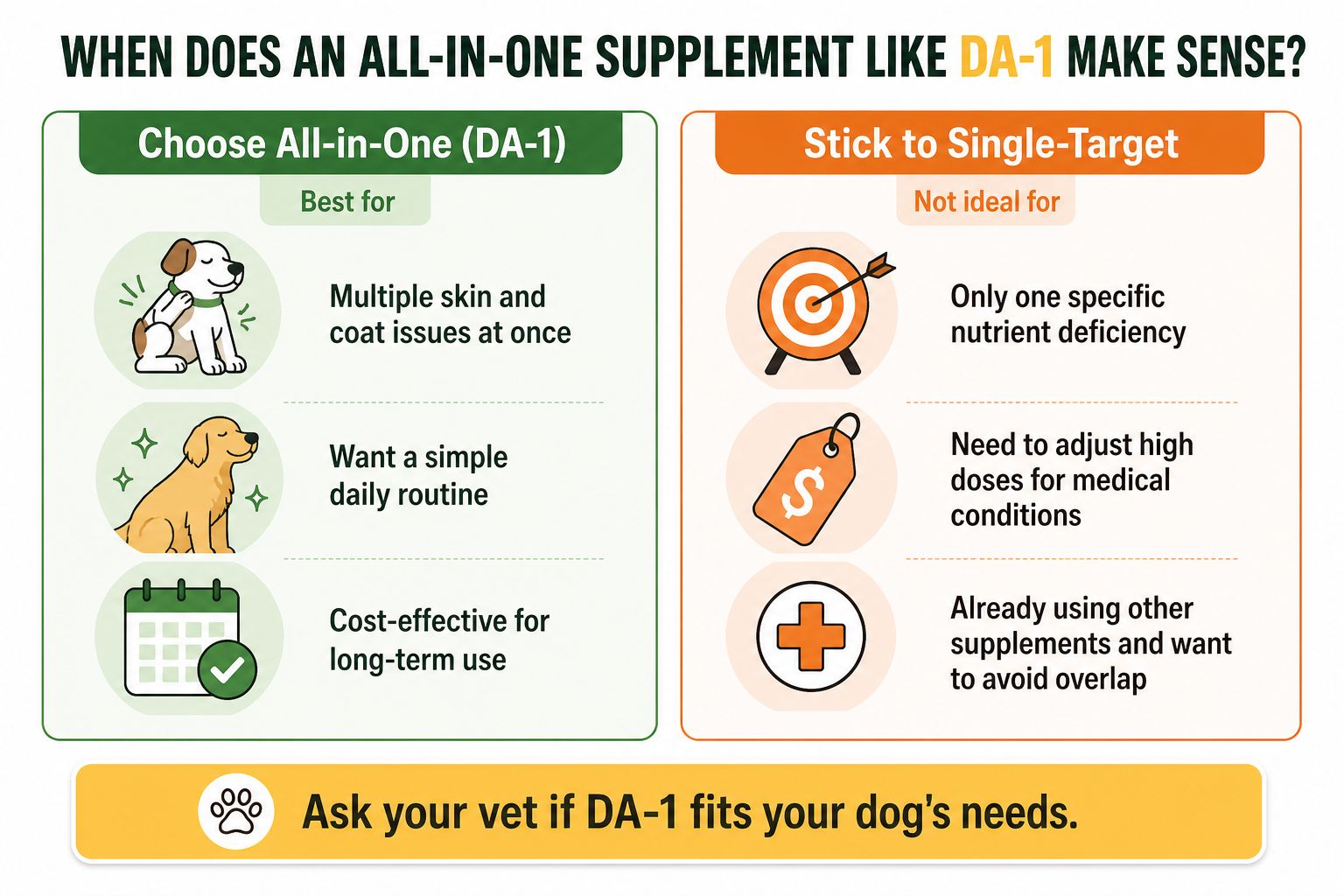
Choose an all-in-one when symptoms overlap
DA-1 is a reasonable category fit for an owner who wants one powder added to food rather than separate pills, chews, and oils. Its product description presents it as a daily formula with 18 human-grade ingredients supporting cells, gut, and joints, alongside skin and coat support. That broader scope suits a senior dog whose coat change appears alongside other age-related concerns, rather than a dog with one isolated nutritional problem.
It also helps when the owner can't identify whether the main gap is fatty acids, antioxidants, minerals, or broader diet quality. The formula provides a general support approach, but it shouldn't be described as a diagnosis or a substitute for veterinary treatment.
Stay with a single target when precision matters
An all-in-one is not the best choice for every dog.
Use a targeted supplement instead when:
- A deficiency is confirmed: Your veterinarian may need a specific nutrient at a controlled dose.
- Therapeutic dosing is required: A broad formula may not supply enough of one active ingredient.
- Your dog has a sensitive stomach: A shorter ingredient list makes troubleshooting easier.
- Another supplement is already in use: Overlap can create unnecessary intake of vitamins or minerals.
- Only one dog needs support: In a multi-dog household, sharing a broad formula can expose the wrong dog to ingredients it doesn't need.
The deciding question is simple: Do you need broad coverage or narrow control? Owners managing several mild, connected concerns generally benefit more from routine simplicity. Owners managing a documented deficiency, medical condition, or strict diet need precision.
Before combining products, review how all-in-one supplements work and show the complete supplement list to your veterinarian. That step helps prevent duplicate ingredients and keeps the plan tied to the dog's actual diet.
Matching the Product to the Real Problem
You can route most buying decisions quickly if you start with the dominant symptom rather than the product category.
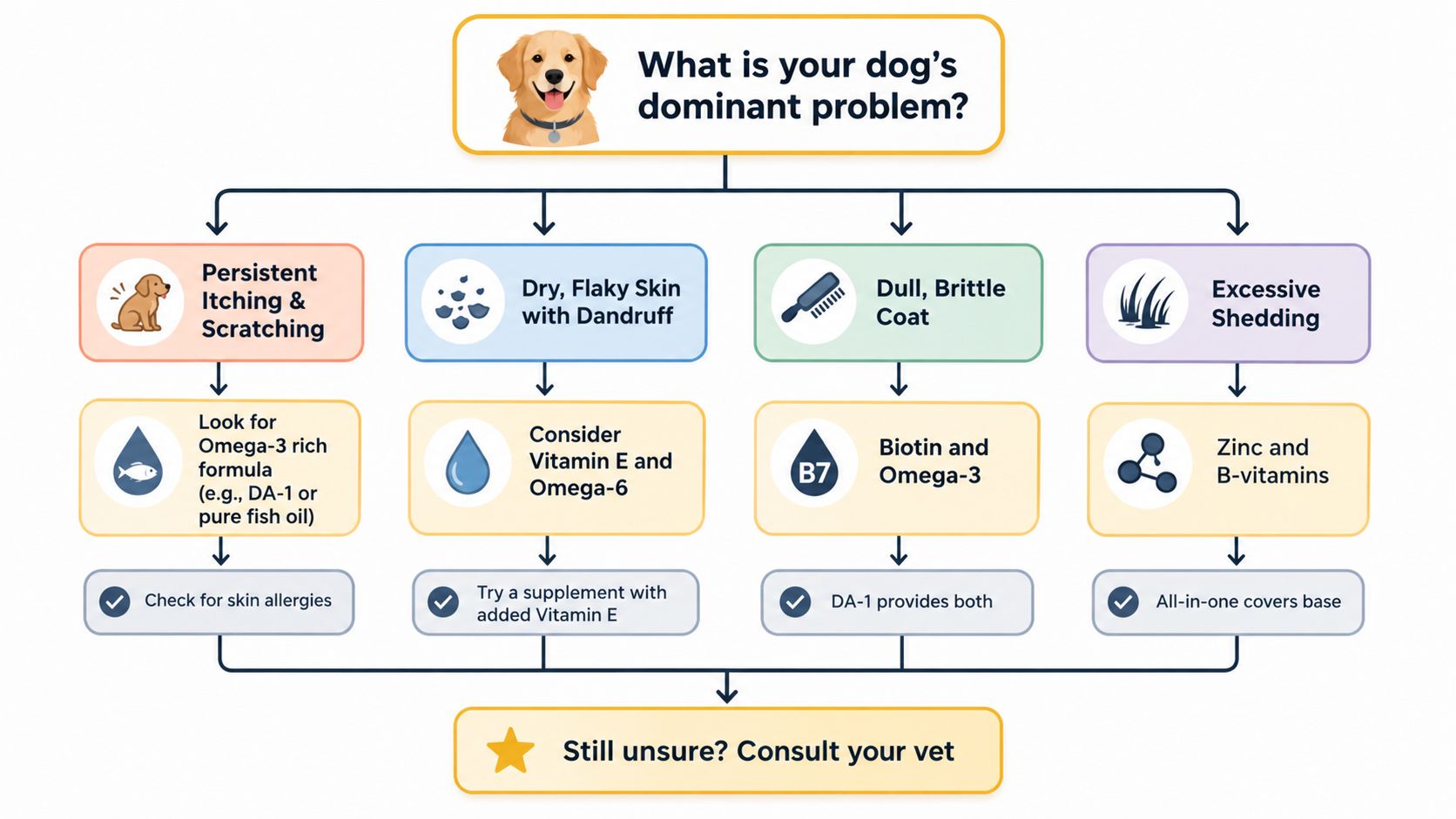
If itching is the main complaint
Persistent scratching should trigger a veterinary assessment before you treat it as a vitamin gap. Once allergies, parasites, infection, and other causes are being addressed, prioritize a product that clearly lists marine EPA and DHA. A measured oil or transparent powder is preferable to a vague “omega blend.”
If your dog is also a picky eater, palatability becomes part of the treatment decision. A flavored chew may be easier to administer, but check whether it provides meaningful EPA and DHA rather than relying on the word “fish.”
If dryness or dandruff dominates
Dry, flaky skin calls for a diet review and barrier-focused support. Essential fatty acids may help, while vitamin E and appropriate mineral nutrition can provide supporting coverage. Don't keep increasing oil if the flakes persist, especially when the dog also has redness, odor, sores, or hair loss.
A dog eating a home-prepared diet needs the diet evaluated before you layer on supplements. The product may be fine, but the underlying feeding plan could be the more important problem.
If the coat is dull or brittle
Prioritize adequate protein, essential fatty acids, and coat-support nutrients such as biotin and vitamin E. For a dog with no itch, redness, or skin lesions, a broad formula can be more convenient than assembling several small products.
If shedding is excessive
First separate normal seasonal shedding from bald patches, inflamed skin, or sudden hair loss. If nutrition contributes, zinc, B vitamins, antioxidants, and protein cofactors may have a role, but source quality and overall diet adequacy matter more than a long ingredient list.
Final buying rule: The best dog vitamins for skin and coat aren't the products with the most reviews or the longest labels. They're the products that match the symptom, disclose useful doses, and fit the dog's daily routine.
If the decision still feels unclear, choose evaluation over experimentation. A veterinarian can help determine whether your dog needs a targeted nutrient, a complete diet adjustment, or no supplement at all.
Pure Paw Labs offers daily, human-grade powdered supplements designed to combine skin and coat support with broader wellness needs in one routine. Visit Pure Paw Labs to review DA-1 and decide whether an all-in-one approach fits your dog's symptoms, diet, and feeding habits.