


Most advice about dog digestion starts with “give a probiotic.” That's convenient, but it's often wrong. A probiotic can be useful during a specific disruption, yet independent reviews have found limited or clinically unimportant effects for many acute and chronic gastrointestinal problems in dogs. The best dog supplements for digestive health aren't the most heavily marketed products. They're the ingredients matched to your dog's diet, symptoms, trigger, and medical history.
A dog eating a rich, high-fat diet with soft stools probably needs a food review before another bacterial supplement. A dog eating a narrow diet with little fermentable fiber may be a better candidate for prebiotic support. A dog with confirmed exocrine pancreatic insufficiency needs veterinary-directed enzyme replacement, not a generic “digestive blend.” The useful question is simple: what problem are you trying to solve, and which supplement class addresses it?
Table of Contents
- Why Digestive Health Is More Than a Probiotic
- The Main Supplement Classes That Support Dog Digestion
- When Probiotics Actually Help and When They Don't
- Matching Supplement Type to Your Dog's Digestive Profile
- How to Read a Dog Digestive Supplement Label
- Safety, Dosing, and Red Flags to Watch For
- Where an All-in-One Product Fits in a Daily Routine
- Building a Routine That Actually Works for Your Dog
Why Digestive Health Is More Than a Probiotic
Probiotics are only one lever in a much larger system. Your dog's digestion depends on the food's fat and fiber content, meal size, eating speed, enzyme activity, intestinal movement, stress level, and the composition of the gut microbiome. A capsule containing live bacteria can't correct every one of those variables.
The evidence supports that broader view. A 2023 systematic review found that probiotics may improve intestinal microbiota balance, suppress inflammation, support immune function, and alleviate intestinal disorders in dogs and cats. But a separate review of 17 canine studies concluded that probiotic effects for acute gastrointestinal disease were limited and possibly clinically unimportant, while dietary intervention remained central for chronic gastrointestinal disease. You can read the full review history in this systematic review of probiotics for dogs and cats.
Start with the likely cause
A dog that produces soft stool after fatty treats is showing a food-pattern problem until proven otherwise. Adding more bacteria may create expense without addressing the excess fat or abrupt feeding routine. Likewise, a dog eating a uniform kibble with little fermentable fiber may need a carefully introduced fiber or prebiotic source to support the bacteria already present.
Stress matters too. Boarding, travel, medication, a sudden food change, or weaning can disturb stool quality even when the regular diet is appropriate. In that situation, a targeted probiotic may make sense for a defined period. It still shouldn't replace a review of the trigger.
Practical rule: Match the ingredient to the failure point. Fiber affects stool structure, prebiotics feed selected microbes, probiotics introduce live strains, and enzymes help break down food.
The distinction between these categories is laid out clearly in this guide to prebiotics, probiotics, and postbiotics. Use it to avoid buying a product because “gut health” appears on the front label.
Digestive supplements have become part of a large pet-wellness market. One 2026 industry projection estimated that digestive-health pet supplements will grow at a 6.3% CAGR from 2026 to 2033, while another report valued the dog intestinal-health dietary supplement market at USD 34.5 billion in 2023 and projected 4.7% annual growth through 2032. Those figures, cited in the pet supplements market analysis, show commercial momentum, not proof that every dog needs a daily probiotic.
The Main Supplement Classes That Support Dog Digestion
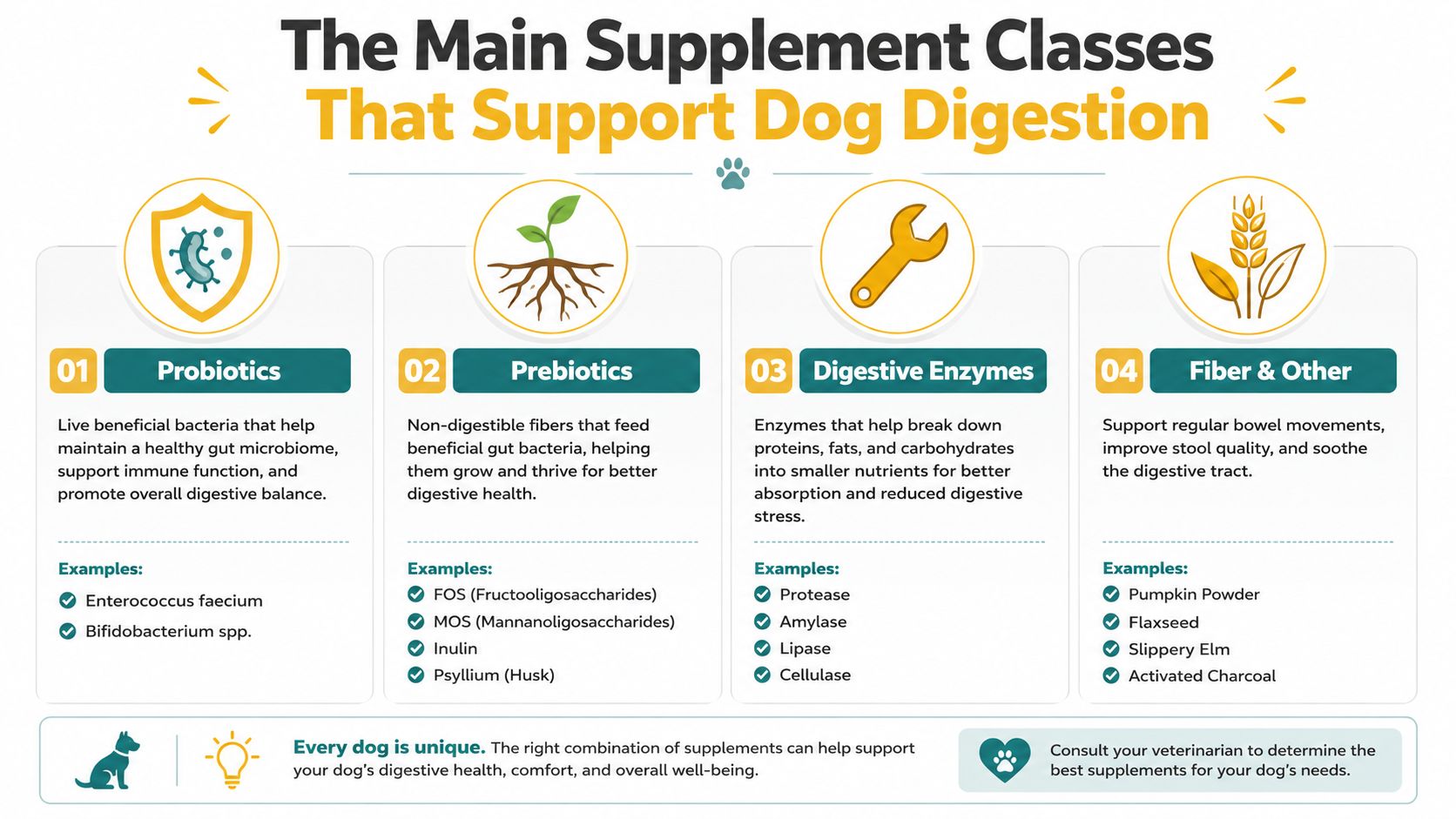
Think in categories before you think in products. Each class works differently and fits a different digestive pattern.
Probiotics
Probiotics are live microorganisms supplied in a dose intended to influence the intestinal environment. Common label examples include Enterococcus faecium and Bifidobacterium, but the species name alone isn't enough. The specific strain, dose, survivability, and intended use determine whether the product is meaningful.
Probiotics fit best when digestion has been disrupted by a defined event, such as antibiotic exposure, acute stress, or weaning. Their broad benefits are biologically plausible, but canine clinical outcomes remain inconsistent. A generic “probiotic blend” isn't automatically a strong choice.
Prebiotics
Prebiotics are fermentable substrates that feed selected microbes already living in the gut. Labels may list FOS, MOS, inulin, or psyllium. They don't add bacteria directly. Instead, they change the environment in which intestinal microbes ferment food.
The evidence is more consistent for microbiome changes than for obvious clinical improvement. An independent review found that prebiotics can shift the canine microbiome favorably, with limited evidence for measurable clinical benefits and no adverse effects in the assessed studies. That makes prebiotics a sensible maintenance tool for some sensitive dogs, not a guaranteed cure for chronic diarrhea.
Digestive enzymes
Digestive enzymes break food into absorbable components. Amylase acts on carbohydrates, protease on proteins, and lipase on fats. Enzyme support has its clearest role in diagnosed exocrine pancreatic insufficiency, where a dog's pancreas doesn't provide adequate digestive enzymes. That condition requires veterinary diagnosis and a specific treatment plan.
Healthy dogs don't automatically need pancreatic enzymes. A broad enzyme blend may be poorly matched to a dog whose actual issue is diet composition, intolerance, parasites, or inflammatory disease. Read more about appropriate use in this guide to digestive enzymes for dogs.
Fiber and postbiotics
Targeted fibers can absorb water, add stool bulk, or provide fermentable material for intestinal microbes. Postbiotics are nonliving microbial components or metabolites intended to support the gut environment without supplying live organisms. The quality of evidence varies by ingredient and indication, so products should disclose exactly what they contain.
For an older dog with mild, recurring digestive inconsistency, a formula such as DA-1™ Daily All-in-One - Senior Dog Support, Joints, Skin/Coat & More can be considered as a multi-system layer. Its product snapshot describes 18 human-grade ingredients targeting cells, gut, and joints, without fillers or pills. That doesn't make it a substitute for diagnosis or a condition-specific treatment.
When Probiotics Actually Help and When They Don't
The right probiotic decision has three parts: strain, timing, and trigger. Ignore those filters and you're mostly buying a label promise.
A strain is not interchangeable with every other strain in the same species. A product that lists only “Lactobacillus blend” gives you little basis for judging whether its organisms were studied in dogs or whether they'll survive storage and digestion. A high CFU count can sound impressive, but the count matters less than a clearly identified strain, a useful dose, and a guarantee that the organisms remain viable through expiration.
Use a trigger-based decision
A probiotic makes the most sense when you can identify why the gut changed. Antibiotic recovery, acute stress-related diarrhea, and puppy weaning are reasonable situations for targeted support. Research on Saccharomyces cerevisiae found that a yeast probiotic helped stabilize the microbiota and increased fecal IgA during rapid dietary transition in dogs, while newer canine-strain research points to distinct effects during weaning and fermentation.
That doesn't justify routine use in every healthy dog. A 2026 evidence review graded probiotics for canine gastrointestinal maintenance as limited evidence. Across the reviewed studies, there was no documented reduction in gastrointestinal disease development, quality of life, or lifespan. The practical conclusion is direct: use a canine-specific probiotic for a defined window when a disruption exists, and skip it as a default daily add-on when your dog has no symptoms or trigger.
For more practical context, see this guide on probiotics for dogs.
| Scenario | Probiotic Useful? | Better First Step |
|---|---|---|
| Loose stool after a clear stress event | Often reasonable as targeted support | Remove the trigger where possible and keep meals consistent |
| Recovery after antibiotics | Potentially useful | Follow the veterinarian's medication plan and introduce one canine-specific product |
| Puppy during weaning | May fit the transition | Keep the food change controlled and gradual |
| Chronic loose stool on an unsuitable diet | Not the default answer | Review diet composition and seek veterinary evaluation |
| Healthy dog with no digestive symptoms | Routine benefit remains unproven | Don't add a probiotic just because it's popular |
Probiotics aren't useless. They're not the universal first choice.
Matching Supplement Type to Your Dog's Digestive Profile
A useful formula is the one that matches the pattern you can observe. Don't select a supplement because the ingredient list is long. Select it because the combination addresses the likely mechanism and gives you a reasonable way to judge whether it helped.
The outcomes below are practical expectations, not guaranteed clinical results. A dog with a medical disorder may need testing, diet therapy, medication, or a specific enzyme protocol instead.
| Digestive Profile | Symptom Pattern | Best Supplement Combo | Expected Outcome |
|---|---|---|---|
| Soft stool or stress-triggered loose stool | Stool softens after boarding, travel, visitors, or routine disruption | Soluble fiber plus a targeted canine probiotic | Stool may become more consistent during the trial if the trigger is controlled |
| Grain-heavy or sensitive-stomach diet | Gas, inconsistent stool, or discomfort associated with meals | Prebiotic fiber with carefully selected enzyme support | Improved tolerance is possible, but a diet review remains the priority |
| Post-antibiotic recovery | Digestive disruption follows a prescribed antibiotic course | Multi-strain probiotic plus prebiotic support | The goal is steadier stool and appetite while the gut environment recovers |
| Chronic irregularity in an older dog | Alternating stool consistency, mild gas, or slower digestive routine | Soluble fiber with moderate probiotic support | More predictable bowel movements may develop during a controlled trial |
What each pairing is trying to do
Fiber gives loose stool structure and can regulate irregularity, but too much can worsen gas. Prebiotics support microbial fermentation, yet independent evidence indicates that microbiome improvements don't always translate into noticeable clinical benefits. Enzymes address food breakdown, so they're more logical when poor digestion or a pancreatic condition is suspected than when symptoms clearly follow a dietary mismatch.
A probiotic and prebiotic pairing is most defensible after a disruption because the probiotic supplies selected organisms while the prebiotic supports fermentation. Even then, introduce the combination carefully. If you start several new ingredients at once, you won't know which one helped or caused a setback.
A realistic trial is controlled, not complicated. Keep the diet stable, introduce one supplement plan, and record stool, appetite, gas, and comfort.
Independent review of 17 canine studies found limited benefit for acute gastrointestinal disease and no significant added improvement for chronic disease when probiotics were used alongside dietary intervention. That evidence should keep expectations grounded. The best combination depends on the dog's profile, not the product's number of ingredients.
How to Read a Dog Digestive Supplement Label
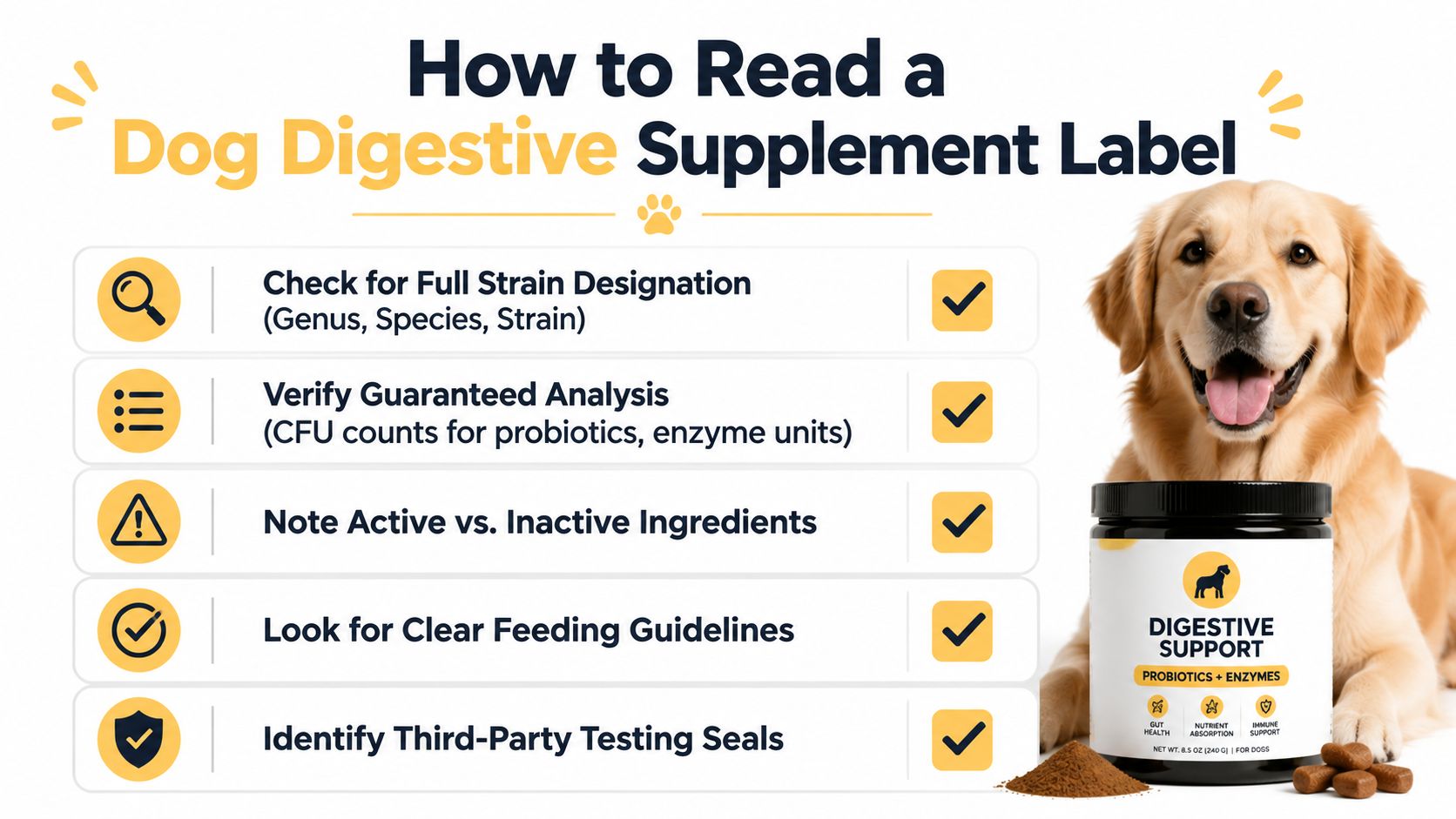
A strong label lets you answer four questions quickly: what is active, how much is present, how long does it remain viable, and what exactly is the product intended to support?
Start with the active ingredients
For probiotics, look for the complete designation: genus, species, and strain code. A label that says only “proprietary probiotic blend” doesn't tell you which organism you're giving your dog. For enzymes, look for named activities such as amylase, protease, or lipase and a clear unit amount.
Prebiotic and fiber sources should also be named. FOS, MOS, inulin, and psyllium are more useful label information than a vague statement such as “supports healthy digestion.” You should be able to identify the intended function of each major ingredient.
Check viability and transparency
A probiotic CFU guarantee at expiration is more informative than a count stated only at manufacture. Live organisms can lose viability during storage, so the expiration-date guarantee gives you a better sense of what the dog is expected to receive.
Look for clearly disclosed amounts rather than a proprietary blend that hides individual doses. Also inspect inactive ingredients for lactose, artificial flavors, unnecessary protein bases, and any sweetener that could create a safety concern. Third-party quality marks or an independent Certificate of Analysis can add useful manufacturing transparency, but they don't turn an unsuitable formula into the right one for your dog.
Use this quick ranking rule when comparing two products:
- Choose the label with a fully identified strain or active ingredient.
- Prefer a guaranteed expiration-date amount over a manufacturing-date promise.
- Select the formula with a clear feeding direction and fewer unnecessary ingredients.
- Reject any product that hides meaningful amounts behind a proprietary blend.
Safety, Dosing, and Red Flags to Watch For
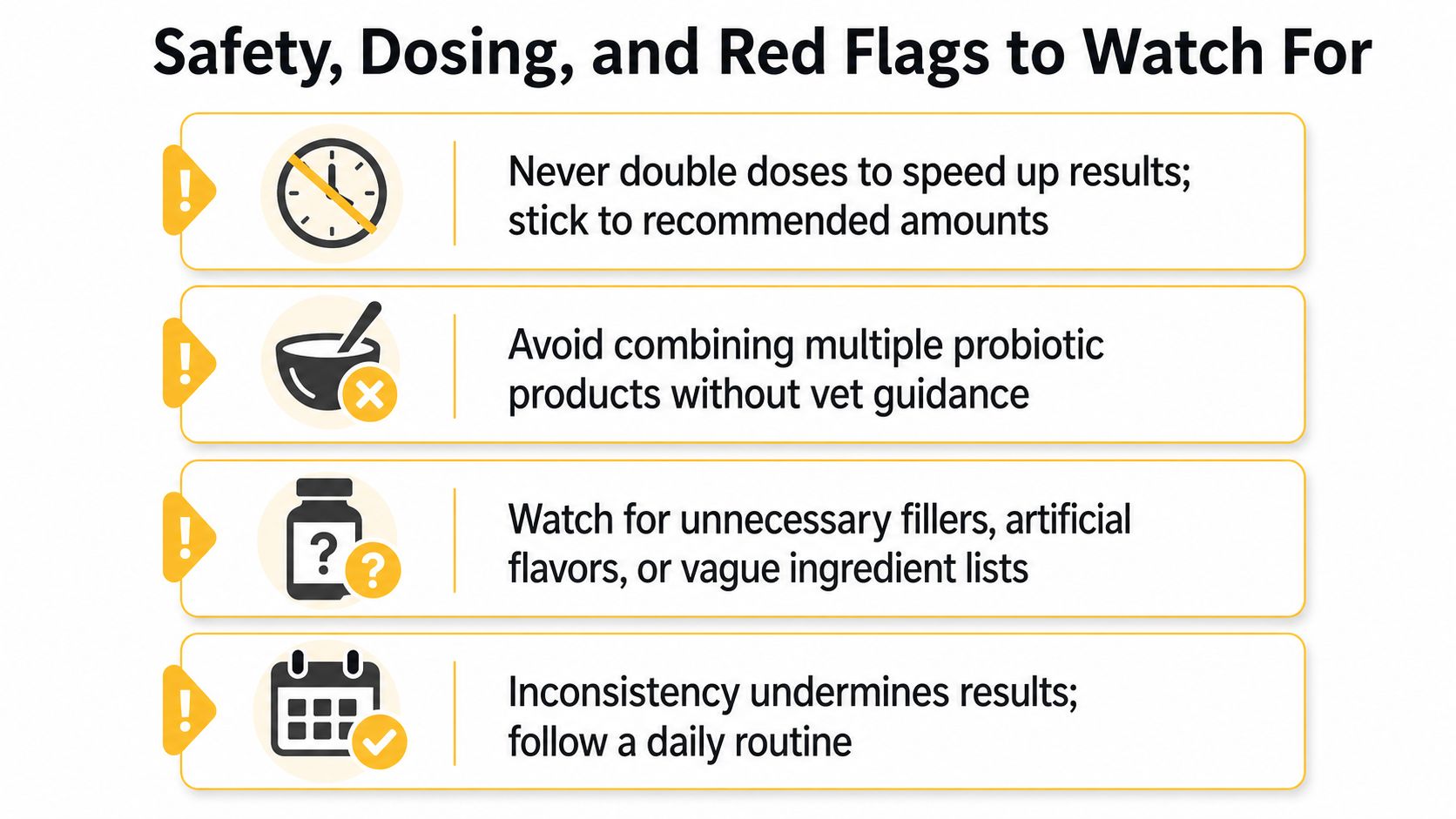
Digestive supplements are still biologically active products. More isn't better, and doubling the serving to speed up results is a common way to create gas, loose stool, or confusion about what caused a reaction.
Avoid stacking blindly
Don't combine multiple probiotic products without veterinary guidance. Stacking can expose your dog to overlapping ingredients, make adverse effects harder to interpret, and turn a simple trial into an uncontrolled experiment.
Human digestive products deserve caution too. They may contain ingredients unsuitable for dogs, including xylitol or chocolate-derived flavoring, and their enzyme concentrations may not fit canine use. Use a product formulated and labeled for dogs unless your veterinarian has directed otherwise.
Know when to ask first
Puppies under 12 weeks, pregnant dogs, and dogs taking immunosuppressants should receive explicit veterinary clearance before starting a gut supplement. Their nutritional, immune, or reproductive circumstances make casual experimentation a poor choice.
Stop and seek veterinary advice for blood in stool, severe or rapidly worsening diarrhea, repeated vomiting, marked abdominal distension, rapid weight loss, or significant loss of appetite. A supplement shouldn't be used to delay care for a diagnosed gastrointestinal condition.
Read the label for warning signs
- Undisclosed amounts: “Proprietary blend” language can hide the dose of each active ingredient.
- Missing CFU information: A probiotic without a clear viable count is difficult to evaluate.
- Disease-replacement claims: No supplement should claim to replace veterinary treatment for diagnosed disease.
- Unnecessary additives: Artificial flavors, questionable sweeteners, or protein bases can complicate a sensitive dog's routine.
- Dose escalation: Follow the product's directions instead of increasing the amount because results aren't immediate.
If symptoms worsen after seven to ten days, stop the product and contact your veterinarian. That timeframe isn't permission to ignore serious symptoms before then. Urgent signs need prompt care.
Where an All-in-One Product Fits in a Daily Routine
An all-in-one supplement belongs on top of a sound baseline, not in place of it. Your dog still needs a complete, balanced diet, appropriate feeding routine, adequate hydration, and veterinary care when symptoms suggest disease.
A combined digestive formula may bundle probiotic strains, prebiotic fibers, enzymes, postbiotics, or targeted fiber. The advantage is practical: one daily routine can be easier to follow than several separate containers. That simplicity can help owners avoid missed servings and reduce the temptation to change multiple products at once.

Where it fits well
An all-in-one can be reasonable for a dog with mild, recurring inconsistency, modest digestive sensitivity, or a defined recovery period after a gut stressor. It may also suit owners who want a single layered formula rather than separate probiotic, fiber, and enzyme products.
DA-1 is designed as a multi-system powder that sits alongside a complete diet. Its product information describes one scoop with 18 human-grade ingredients aimed at cells, gut, and joints, with no fillers and no pills. That makes it a routine-support option, not a diagnostic tool.
Where it doesn't belong
A bundled formula won't correct a poor diet. It can't diagnose food intolerance, inflammatory bowel disease, parasites, obstruction, or pancreatic disease. It also may be less appropriate than a targeted single-class supplement when the problem is clearly defined, such as confirmed exocrine pancreatic insufficiency.
The more complex the symptom pattern, the less useful broad marketing language becomes. If your dog has persistent diarrhea, weight loss, vomiting, pain, or appetite changes, get the cause assessed before adding layers.
Building a Routine That Actually Works for Your Dog
Use three questions before buying anything:
- Is the diet complete, balanced, and appropriate for the dog's age and size?
- Are the symptoms mild and recurring, or acute and severe?
- Has a veterinarian ruled out medical causes?
The answers determine your starting point. If the diet is inconsistent, correct the food and feeding routine first. If symptoms are mild and stool is the main issue, consider soluble fiber or a prebiotic before reaching for a probiotic. If a clear stressor, antibiotic course, or weaning transition disrupted digestion, a targeted canine probiotic is more logical. If poor digestion is linked to pancreatic insufficiency, use veterinary-directed enzyme support. An all-in-one belongs with mild, nonspecific patterns where a layered routine is practical, not where a diagnosis demands precision.
Change one variable at a time
Run a controlled trial for two to four weeks, unless symptoms worsen or a veterinarian advises otherwise. Keep a simple log covering stool consistency, frequency, gas, appetite, vomiting, energy, and the timing of any trigger. Don't change the diet, treats, probiotic, fiber, and enzyme blend on the same day.
If there's no meaningful improvement, stop guessing. Take the log and the supplement label to your veterinarian, especially if symptoms are chronic or recurring. The best dog supplements for digestive health are matched to a real trigger and used with a clear endpoint, not selected because the bottle is expensive or the ingredient list is long.
Pure Paw Labs offers DA-1™ Daily All-in-One, a human-grade powdered formula designed to combine multi-system support in one daily scoop, including gut-focused ingredients. Visit Pure Paw Labs to review the product details and decide whether a layered routine fits your dog's baseline care plan.