


You're up at 2 a.m. with a dog that won't settle, scratching, licking, and waking everyone else up. At that point, the question isn't which brand looks nicer on the shelf, it's what will calm the itch without making the problem more complicated. The smartest way to buy the best dog supplement for itchy skin is to treat it like a symptom-management decision, not a branding exercise.
A supplement can help, but only if it matches the likely cause, the dog's tolerance, and the owner's ability to give it consistently. That means checking the itch pattern first, then choosing ingredients with real skin support, then filtering for safety and label quality. If you want a quick starting point for the bigger picture of scratching and skin irritation, this why is my dog scratching so much guide is a useful companion.
| What to look at first | What matters most | What to avoid |
|---|---|---|
| Likely cause | Allergy, fleas, food, dryness, infection | Guessing and stacking random products |
| Active ingredient | EPA, DHA, or other targeted skin supports | “Kitchen sink” blends with tiny amounts of everything |
| Format | The one your dog will actually take daily | Fancy shapes that reduce compliance |
| Safety | Transparent dosing and species-appropriate formula | Proprietary blends and vague labels |
The rest of this guide keeps it simple. First, identify the likely trigger. Then look at which ingredients have the strongest support for itchy skin in dogs, how the format affects real-world use, and which safety signals separate a sensible product from hype. A good supplement can reduce itch and support the skin barrier. It can't replace diagnosis, and it can't fix a dog that needs veterinary treatment right now.
Table of Contents
- Why Your Dog Keeps Scratching and What to Do Next
- The Most Common Causes of Itchy Skin in Dogs
- Ingredients With the Strongest Evidence for Itchy Skin
- Supplement Formats Compared for Itchy Dogs
- Safety and Quality Signals to Check Before You Buy
- Matching the Right Supplement to Your Dog's Situation
- When an All-in-One Formula Makes Sense
- Buyer Checklist and Common Questions About Itchy Skin Supplements
Why Your Dog Keeps Scratching and What to Do Next
A dog that scratches at night usually isn't “being dramatic.” The dog is telling you something is irritating the skin, and the fastest path to relief starts with narrowing the cause instead of shopping at random. That's the whole logic behind choosing the best dog supplement for itchy skin, because the right ingredient depends on what's driving the itch.
Start with the obvious causes
Look for fleas first, because flea allergy can turn a small infestation into relentless scratching. Check the skin for red patches, scabs, hot spots, or areas that look wet and inflamed. Also note whether the itch began after a walk, a bath, a food change, a move to a new home, or the start of pollen season.
Patterns matter. If the dog scratches more after outdoor time, environmental allergies climb the list. If the scratching follows meals or comes with ear trouble and repeated belly or paw irritation, food sensitivity becomes more plausible. If the coat feels dry and the dog has been bathed often or lives in low humidity, the problem may be skin-barrier stress rather than a pure allergy.
Practical rule: supplements make the most sense when they support a known or suspected skin issue, not when they're used to cover up an undiagnosed one.
Don't treat the supplement like the diagnosis
Itchy skin can also reflect secondary bacterial or yeast infection, contact irritation, and less common endocrine disease such as hypothyroidism. Those cases need a veterinarian to sort out the root cause. A supplement may still be useful as support, but it's not the main fix.
The best mindset is simple. Rule out fleas, inspect the skin, track timing, and write down what seems to trigger the flare. Then use that pattern to decide whether you need omega-3 support, barrier support, gut-skin support, or veterinary care first. If the dog has open sores, recurring infections, or the itching is getting worse instead of better, don't wait. That's a clinic visit, not a supplement decision.
The Most Common Causes of Itchy Skin in Dogs
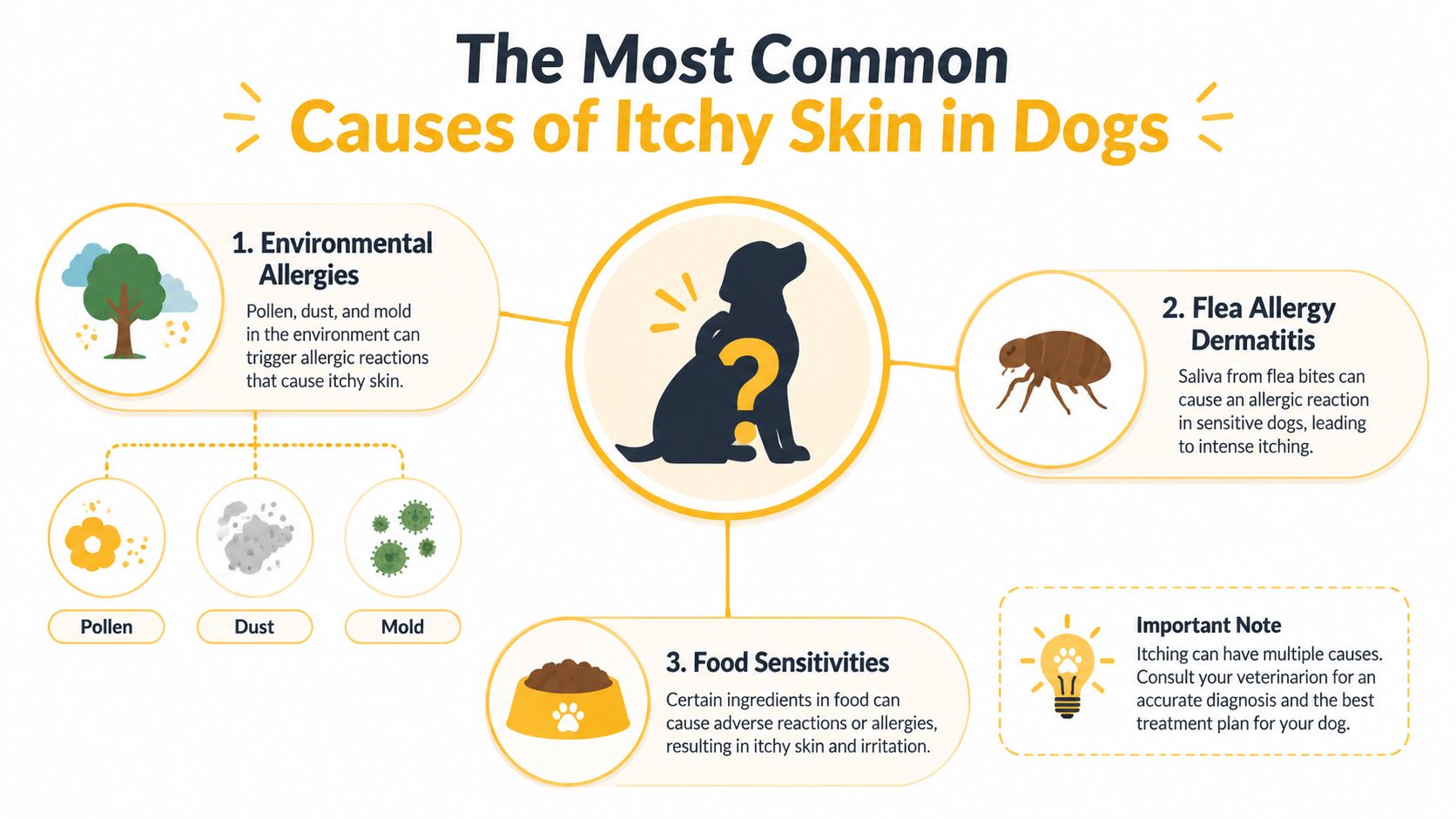
A dog that keeps scratching is usually reacting to one of a few common triggers. Environmental allergies, flea allergy dermatitis, food sensitivities, contact irritants, dry skin, and secondary infection explain most everyday cases. The job is not to guess perfectly. The job is to match the supplement to the pattern instead of buying whatever sounds calming.
Where the itch usually shows up
Environmental allergies often show up as paw licking, face rubbing, belly itching, and flares that follow pollen, grass, or dusty indoor spaces. When the itching rises after outdoor time or during seasonal exposure, inflammation support makes more sense than a generic “skin” formula. For dogs with that pattern, omega-3 fatty acids deserve the first look because they support the inflammatory response directly.
Flea allergy dermatitis can look far worse than the number of fleas you see. One bite can trigger a strong reaction, so the itching may seem out of proportion to what is on the coat. Flea control comes first in those cases. A supplement can support the skin, but it cannot replace removing the trigger.
Food sensitivities and true food allergies usually create itch that does not track with the seasons. The ears, paws, and face are common trouble spots, and digestive upset may show up alongside the skin issues. In that pattern, gut-skin support can be a sensible part of the plan, especially if meals seem tied to the flare.
Dry skin from low humidity or overbathing looks different. The coat may seem dull, flaky, or rough, and the itch is often broader rather than focused in one area. Barrier support and targeted skin nutrients fit that picture better than aggressive allergy blends that promise too much.
A supplement should match the story the skin is telling. Seasonal flares point toward inflammation. Meal-related flares point toward food. Flea-related flares call for flea control first.
For a broader background on allergy triggers, this vitamin guide for allergies is a useful read. It does not replace veterinary guidance, but it reinforces the main point, the trigger matters as much as the support product.
Ingredients With the Strongest Evidence for Itchy Skin
The clearest evidence for itchy skin support in dogs still centers on marine omega-3 fatty acids, especially EPA and DHA. In a randomized, double-blinded, placebo-controlled trial, dogs received either flax oil at 200 mg/kg/day or EPA 50 mg/kg/day plus DHA 35 mg/kg/day for 10 weeks, and the supplemented dogs improved clinically while the placebo group did not (PubMed). A later randomized, double-blind, placebo-controlled trial in 40 dogs found CADESI-4 reductions of 25% by day 30 and 49% by day 60, plus a 46% reduction in owner-reported itching, while the control diet did not change meaningfully (PMC).
What deserves attention first
That evidence leads to one clear recommendation. Start with omega-3s if you want one ingredient category that deserves real scrutiny for itchy dogs. Judge products by EPA and DHA content, not by total fish oil weight. “Fish oil” on the front of the bottle says very little about the actual anti-inflammatory payload.
Probiotics can make sense when skin and gut issues show up together, but they are a support tool, not a fix on their own. Zinc helps when barrier repair and wound healing matter. Biotin and B vitamins support coat quality, collagen fits a repair-focused formula, and antioxidants like vitamin E often round out skin support. For a closer look at why skin formulas often include more than one nutrient, see this guide to vitamins for dog skin.
| Ingredient | Evidence Strength | Primary Benefit | Best for Which Cause | Key Caution |
|---|---|---|---|---|
| Omega-3 fatty acids | Strongest for itch support | Inflammation control and skin support | Environmental allergies and mixed inflammatory itch | Check EPA and DHA amounts, not total oil |
| Probiotics | Emerging and formulation-dependent | Gut-skin axis support | Food-linked sensitivity patterns and digestive overlap | Strain identity and storage matter |
| Zinc | Supportive | Barrier integrity and healing | Dry, irritated, poorly resilient skin | Dose should be species-appropriate |
| Biotin and B vitamins | Supportive | Coat quality and skin maintenance | Dull coat and maintenance support | Rarely enough on their own for active itch |
| Collagen and hydrolyzed protein | Supportive | Tissue repair and skin structure | Recovery and broader skin support | Not a stand-alone itch solution |
| Vitamin E and antioxidants | Supportive | Helps round out oxidative support | Broad skin-health formulas | Best as part of a balanced formula |
A simple example makes the choice clearer. A dog with seasonal face rubbing and paw licking usually needs a formula that leads with omega-3s, not a chew built around trendy extras. A dog with dry coat, mild flaking, and a sensitive stomach may do better with a broader formula that combines gut support and skin nutrients.
One product that fits that all-in-one pattern is DA-1™ Daily All-in-One - Senior Dog Support, Joints, Skin/Coat & More, which is described as a once-daily powder with 18 human-grade ingredients aimed at cells, gut, and joints. That kind of formula makes sense when skin is only one part of the picture, but the active ingredients still matter more than the all-in-one label.
Supplement Formats Compared for Itchy Dogs
Format changes the experience a lot more than most owners expect. A product can have solid ingredients and still fail if the dog refuses it, the dose is hard to measure, or the active compounds degrade before the tub is empty. For itchy skin, EPA and DHA delivery, stability, and daily consistency matter more than novelty.
| Format | Compliance | Dosing Precision | Shelf Stability | Best For |
|---|---|---|---|---|
| Liquid fish oil | Usually high if the dog tolerates it | Strong, especially for per-pound use | Can drop if handled badly | Dogs needing precise omega-3 support |
| Soft chews | Often excellent at first | Variable, sometimes less transparent | Usually better than liquids for storage, but not always for potency | Dogs that refuse oils |
| Capsules | Mixed | High when the dog will swallow them | Good when stored properly | Owners who want cleaner dosing |
| Powders | Strong for food-motivated dogs | Flexible across sizes | Usually practical if kept dry | Multi-dog homes and mixed-use routines |
Pick the format that matches the dog, not the ad copy
Liquids are the cleanest way to deliver omega-3s efficiently for skin support. If the goal is to get enough EPA and DHA into the dog consistently, liquids usually give you the most control. Soft chews are easier for many owners, but they often hide lower active amounts, and some dogs swallow them without getting meaningful skin support.
Capsules are useful when you want exact dosing and minimal extras. The downside is obvious. If the dog won't take pills, the plan collapses. Powders are the most flexible for mixed-size households and dogs that eat reliably from a bowl. They also make it easier to combine skin support with gut support in one daily routine.
Bottom line: choose the format the dog will take every day, then check whether it delivers enough active ingredient to matter.
Shelf life matters too. Omega-3s are only as useful as their freshness, and probiotics need handling that protects viability. If the product is messy, hard to store, or impossible to measure accurately, compliance drops fast. A well-designed supplement is the one that fits the household routine without turning dinner into a science project.
Safety and Quality Signals to Check Before You Buy
A label can look polished and still be sloppy. The fastest way to avoid wasting money is to check the quality signals that matter before you buy. Run this list in under two minutes and you'll dodge most low-value supplements.
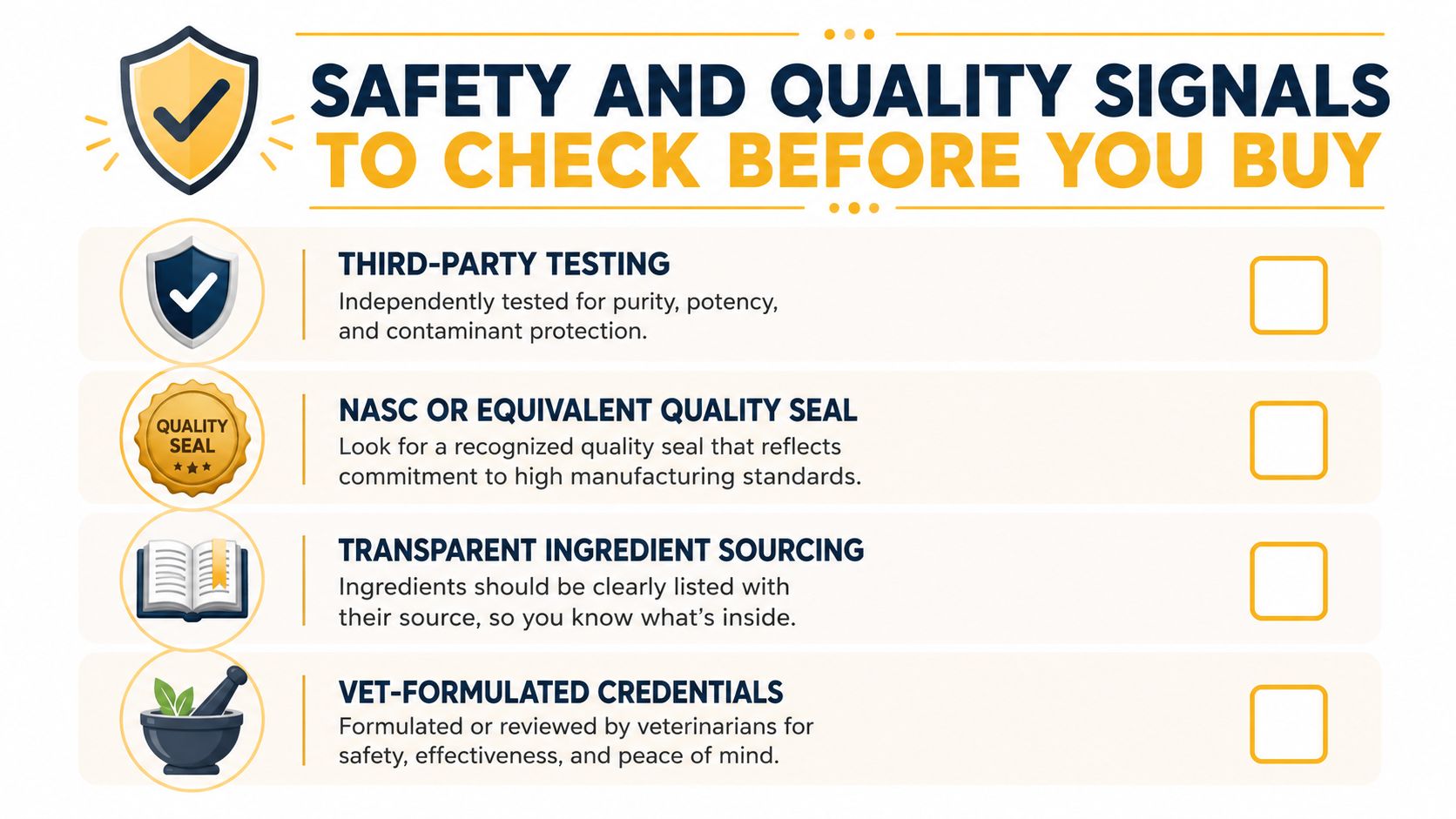
Fast label checks
- Third-party testing: Look for independent testing that verifies what's on the label, especially for marine oils and probiotics.
- NASC or equivalent quality seal: A real quality program signals more discipline than vague marketing language.
- Transparent ingredient sourcing: You should be able to see what each active ingredient is and how much of it is included.
- Vet-formulated credentials: A veterinarian-involved formula is not a guarantee, but it's better than a product built only for ad appeal.
- Species-appropriate fillers: Avoid extra ingredients that don't help the dog and may aggravate sensitive skin or digestion.
- Clear expiration dating: It matters because old oils and degraded actives don't support itchy skin well.
- Per-ingredient dosing: If the label hides behind a proprietary blend, you can't judge whether it's enough.
- Allergen awareness: If your dog reacts to chicken or another common trigger, don't assume every flavored supplement is safe.
The label should also make weight-based dosing straightforward. A small terrier and a large retriever should not be forced into the same vague serving logic. If you can't tell how the dose scales, the product isn't designed well enough for real use.
For a practical walkthrough of what label terms mean, this how to read supplement labels guide is worth keeping open while you compare products. The simple rule is this, if the label makes it hard to verify the active amount, freshness, or species fit, keep moving.
Matching the Right Supplement to Your Dog's Situation
Different households need different supplement strategies. A one-size-fits-all answer usually ends up being a mediocre answer. The best choice depends on the dog's symptoms, the owner's routine, and whether the formula needs to cover just skin or several systems at once.
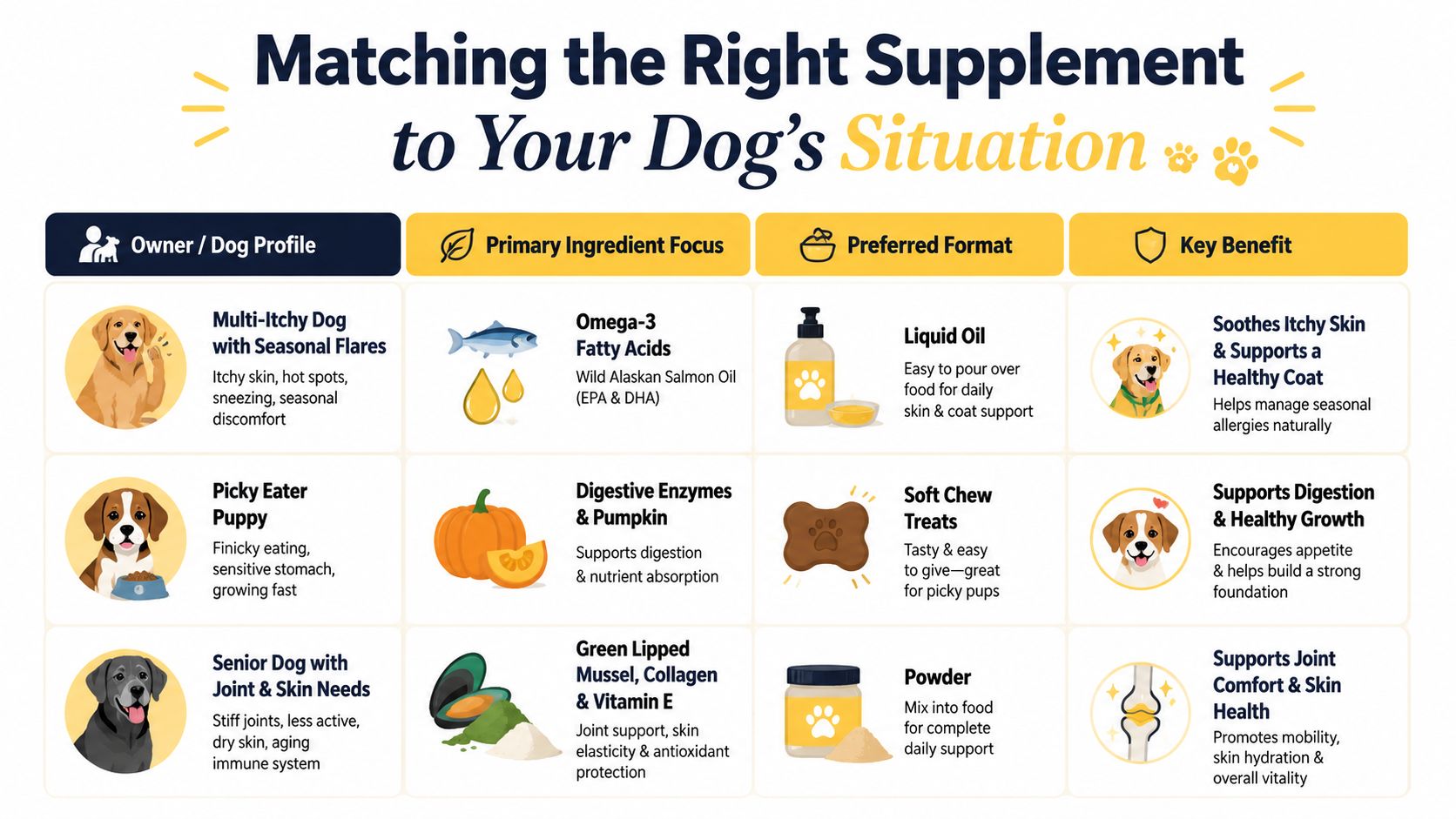
Match the product to the problem
| Dog situation | Primary ingredient focus | Preferred format | Key benefit |
|---|---|---|---|
| Multi-itchy dog with seasonal flares | Omega-3s first, then broader skin support | Liquid or powder | Better anti-inflammatory support and easier daily use |
| Picky eater puppy | Palatable, simple formulas | Powder or capsule if accepted | Higher chance of consistent dosing |
| Senior dog with joint and skin needs | Broad multi-system support | Powder | One routine for skin, mobility, and digestion |
| Multi-dog household | Flexible, shared-use support | Powder | Easier household consistency |
| Sensitive stomach dog | Gentle formulas with gut support | Powder or carefully chosen capsule | Lower risk of overcomplicating the regimen |
An all-in-one formula can make sense for several reasons. If one dog needs skin support, gut support, and mobility support, or if a household wants one daily routine instead of four separate products, a powdered all-in-one can reduce friction. That's the main appeal of a formula like DA-1. It's not magic, it's logistics.
Good fit, not hero worship: a single scoop can be the right answer when the owner needs fewer products, fewer steps, and fewer chances to miss a dose.
The limit is just as important. All-in-ones can underdose a severe problem if the dog needs a targeted therapeutic level of one ingredient. They're most useful when the goal is dependable, broad support rather than aggressive, narrow treatment. If your dog has intense itching, recurring infections, or obvious skin injury, the formula should sit beside veterinary care, not replace it.
When an All-in-One Formula Makes Sense
Daily supplement stacks get messy fast. One bottle for skin, one chew for gut support, one tablet for coat quality, one powder for joints, and suddenly the whole plan depends on memory, compliance, and a dog's willingness to eat four different things. That's why an all-in-one powdered formula is often the more realistic choice for owners who want the best dog supplement for itchy skin without turning the kitchen into a pharmacy.
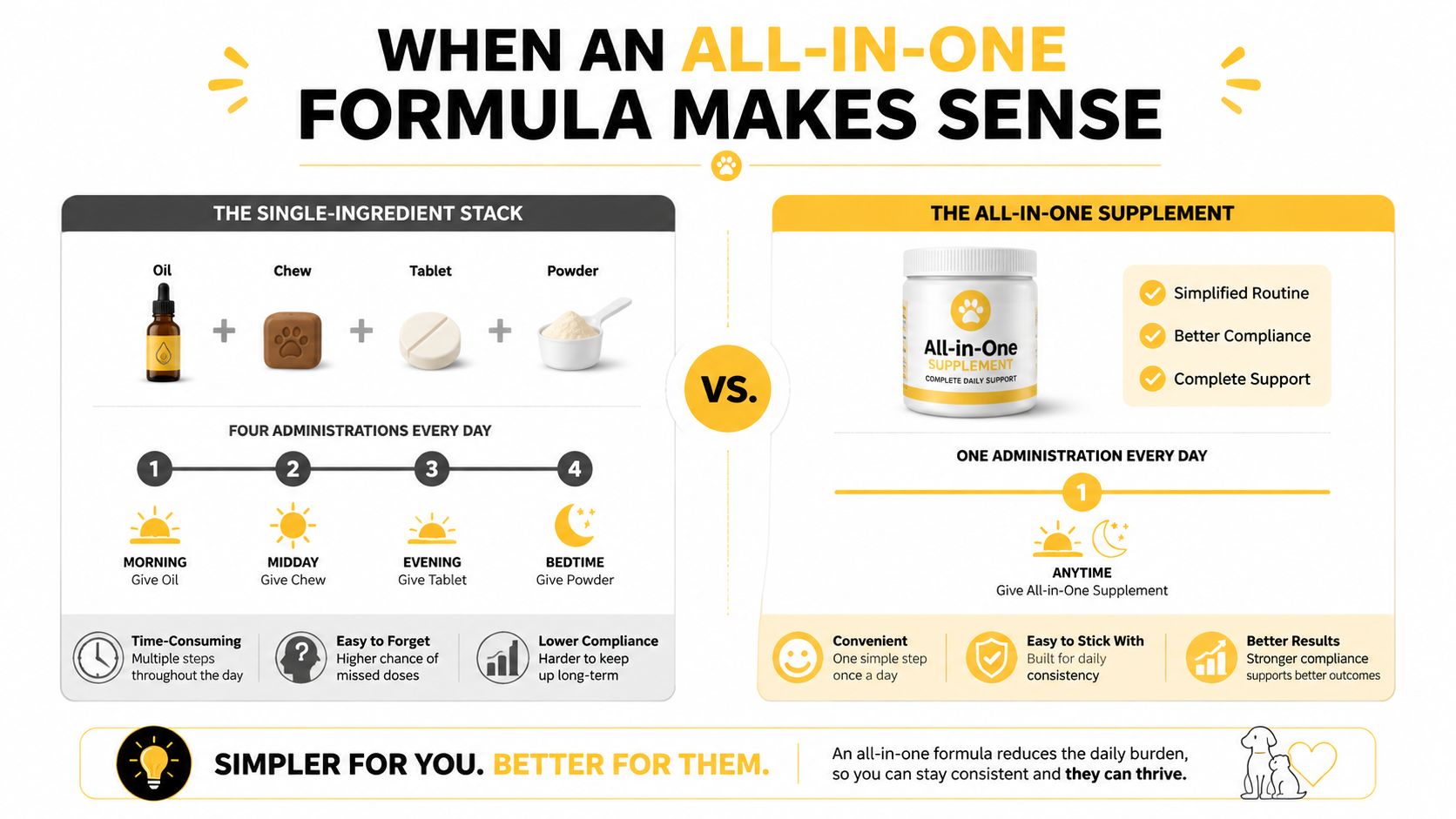
The owners who benefit most
A multi-symptom dog is the clearest match. If skin, coat, gut comfort, and mobility all need support, one scoop is easier to maintain than several separate products. Multi-dog households also benefit because a single tub is simpler to manage than a shelf full of half-used bottles.
Picky eaters are another strong match for powder. Many dogs refuse chews once the novelty wears off, and some turn up their nose at oily toppers. A powder mixed into food can be less dramatic and easier to repeat. That matters, because the best supplement is the one the dog gets.
Budget-conscious owners often miss this part. An all-in-one doesn't automatically cost less on the sticker, but it can reduce the number of products that end up sitting unused. It also reduces the chance of layering redundant ingredients across multiple bottles.
How DA-1 fits the pattern
Pure Paw Labs positions DA-1™ Daily All-in-One as a once-daily powder with 18 human-grade ingredients, no fillers, and a 60-day money-back guarantee. That makes it a logical option for owners who want one daily scoop instead of juggling multiple separate supports. The fit is strongest when itchy skin is part of a wider picture that includes gut and joint concerns.
The limitation is straightforward. If one symptom is severe, the dog may need a more targeted plan than a broad formula can provide. Use the all-in-one as a practical default, not as a reason to ignore a worsening skin case.
Buyer Checklist and Common Questions About Itchy Skin Supplements
Before you buy, check the label for NASC or equivalent testing, transparent milligram dosing, vet-formulated credentials, species-appropriate ingredients, and an expiration date you can trust. Make sure the formula matches the dog's size and symptom pattern, because vague blends are the fastest route to disappointment. If the product hides active amounts or buries the important details, skip it.
A few quick answers close the loop. Visible improvement usually takes 4 to 8 weeks when a supplement is working, and supplements are support tools, not replacements for prescription allergy meds when a dog needs medical therapy. They're often fine for puppies and seniors if the formula is species-appropriate, but any dog on medication, or any dog with chronic skin disease, should run the plan by a veterinarian first.
If itching is leading to open sores, spreading infection, or nonstop discomfort, that's not a supplement problem anymore. That needs a clinic visit. For everyone else, the smartest move is still the same: pick the ingredient that fits the cause, choose the format the dog will take, and confirm the label before you pay for it.
If you want a simpler way to support itchy skin without stacking a dozen products, Pure Paw Labs focuses on dog supplements built around daily routine and multi-system support. Visit Pure Paw Labs to review the options, compare the ingredient approach, and choose a formula that fits your dog's skin, gut, and mobility needs with less guesswork.