


Your dog's stool has turned soft, meals seem to produce more gas, and the coat looks duller than usual. Perhaps the itching has also returned, so you're searching for a vital flora probiotic and wondering whether a daily supplement could address the problem.
Those signs are useful information, but they don't identify one diagnosis. Digestive changes can accompany food transitions, stress, medication use, parasites, dietary imbalance, or illness. Skin changes can also have causes that gut support alone won't resolve. A probiotic may have a sensible role, but it should be chosen with realistic expectations, a clear label, and veterinary guidance when symptoms persist.
The important question isn't whether probiotics are universally good or useless. It's whether a particular strain, dose, and delivery format makes sense for your dog's situation, and how that targeted support fits alongside nutrition, hydration, stress control, parasite prevention, and routine veterinary care.
Table of Contents
- When a Dog's Tummy or Coat Starts Telling You Something
- What Vital Flora Probiotic Actually Is
- Key Strains and How They Support Gut, Immunity, and Skin
- Dosing, Safety, and When to Involve Your Vet
- Single-Strain Probiotic Versus an All-in-One Daily Supplement
- Common Misconceptions Owners Should Drop
- Buying Tips and Questions to Ask Before You Choose
- Bringing It All Together for Your Dog
When a Dog's Tummy or Coat Starts Telling You Something
Maya noticed the change after her dog's food was switched. The stool was loose, the dog passed gas more often, and scratching became frequent enough to disturb sleep. Nothing looked like an emergency, but the combination felt different from normal. Like many owners, she began searching for a probiotic before booking a consultation.
That instinct is understandable. Owners often notice the gut through everyday signals, including stool texture, appetite, flatulence, and energy. The coat and skin can also draw attention before a laboratory test explains what's happening. A dry-looking coat or new irritation may reflect nutrition, allergies, parasites, environmental triggers, or another condition, so it shouldn't automatically be labelled a microbiome problem.
Treat signs as clues, not conclusions
A probiotic can support a dog's intestinal ecosystem, but it doesn't replace a physical examination or diagnostic workup. A dog with occasional digestive disruption after stress may need a different plan from a dog with recurrent diarrhea, weight loss, vomiting, or chronic itching.
Marketing often presents probiotics as broad wellness products. The evidence is narrower. A 2019 systematic review screened 165 studies and found only 17 eligible studies, concluding that effects on acute gastrointestinal disease were very limited and possibly clinically unimportant, while chronic gastrointestinal disease still depended mainly on diet rather than probiotics. The review is summarized in the published evidence on probiotics for canine gastrointestinal disease.
Practical rule: Use a probiotic to answer a specific nutritional question, not to postpone attention to a persistent medical problem.
This guide treats Vital Flora Probiotic as a category of canine digestive support rather than a guaranteed cure. The aim is to clarify strains, colony-forming units, administration, safety, label quality, and the difference between short-term gut support and a broader daily wellness routine.
What Vital Flora Probiotic Actually Is
Vital Flora Probiotic is best understood as a canine digestive supplement containing live beneficial microorganisms. Depending on the product, it may come as a powder, chew, or capsule that's mixed with food or given directly. The purpose is to introduce selected microorganisms into the digestive routine, usually alongside a complete diet.
Dog-focused formulas commonly use bacterial groups such as Enterococcus faecium, Lactobacillus acidophilus, and Bifidobacterium animalis. A 2025 review examined 243 commercial pet food products and 103 patents and found that Enterococcus faecium was the most prevalent probiotic strain across the material reviewed. The same review identified dog-focused products as the leading segment in the wider pet-probiotic category, as described in the review of probiotics in pet food.

Decode the label in a few passes
Start with the strain name, not the front-of-pack promise. “Lactobacillus” describes a genus, while the species and strain identify the organism more precisely. Strain-level information matters because two organisms in the same genus may behave differently in a dog's digestive tract.
Next, look for CFU, or colony-forming units. CFU is an estimate of viable organisms capable of forming colonies under testing conditions. A large CFU number doesn't automatically make a product more appropriate. You also want to know whether the count is guaranteed through expiration, how the product is stored, and whether the label names every included strain.
Species specificity matters, too. A product formulated for people isn't automatically interchangeable with a canine product. Dogs have their own feeding patterns, digestive physiology, medication exposures, and clinical evidence base. For a broader explanation of how to assess a canine probiotic, see this guide to a probiotic supplement for dogs.
If your priority is broader daily support rather than a narrowly focused probiotic, DA-1™ Daily All-in-One - Senior Dog Support, Joints, Skin/Coat & More is described as a multi-system powder with 18 human-grade ingredients targeting cells, gut, and joints.
Key Strains and How They Support Gut, Immunity, and Skin
A probiotic's effect depends on the organism, its ability to survive processing and digestion, the amount delivered, and the dog receiving it. The phrase “supports gut health” is therefore incomplete without the strain details and the intended use.
Lactobacillus species are often associated with carbohydrate fermentation. Their activity can produce metabolites, including short-chain fatty acids, that serve as fuel for cells lining the colon. In practical terms, that may support a more stable intestinal environment and help some dogs maintain firmer stool. It doesn't mean every dog with diarrhea will respond, or that the strain can correct a diet that doesn't suit the animal.
Bifidobacterium strains are also used in canine formulas. They may compete with less desirable organisms for space and nutrients and influence local immune signaling. Owners might associate a successful response with less gas or more consistent stool, but calmer skin and fewer hotspots aren't guaranteed outcomes. Skin problems frequently require their own investigation.
Enterococcus faecium appears especially often in commercial pet-probiotic products. The 2025 review linked earlier in this article identified it as the most prevalent strain across the reviewed commercial products and patents, which shows how central it has become to the category. Prevalence in products is not the same as proof that every formulation works for every dog.
A practical strain comparison
| Strain | Primary mechanism | Owner-visible benefit |
|---|---|---|
| Lactobacillus species | Ferment selected carbohydrates and contribute metabolites that support the intestinal environment | More consistent stool or reduced gas in a responsive dog |
| Bifidobacterium species | Compete with other microbes and interact with intestinal immune activity | Potentially steadier digestion and improved stool quality |
| Enterococcus faecium | Used in canine digestive-support formulations and studied in the context of intestinal disruption | May fit a recovery-focused plan when a veterinarian considers it appropriate |
The strongest product evaluation connects a named strain to a clearly defined canine use case. Generic statements about “balancing the microbiome” tell you less than a label that identifies the organism, potency at expiration, storage requirements, and supporting research. For more context on selecting a product for a particular digestive goal, explore what probiotic is best for gut health.
Recent work is encouraging but preliminary. Studies discussed in the evidence review reported changes in fecal IgA, microbiota stability, and blood parameters during dietary transition with yeast probiotics. Those findings are early signals, not proof of durable real-world benefits for every dog.
Dosing, Safety, and When to Involve Your Vet
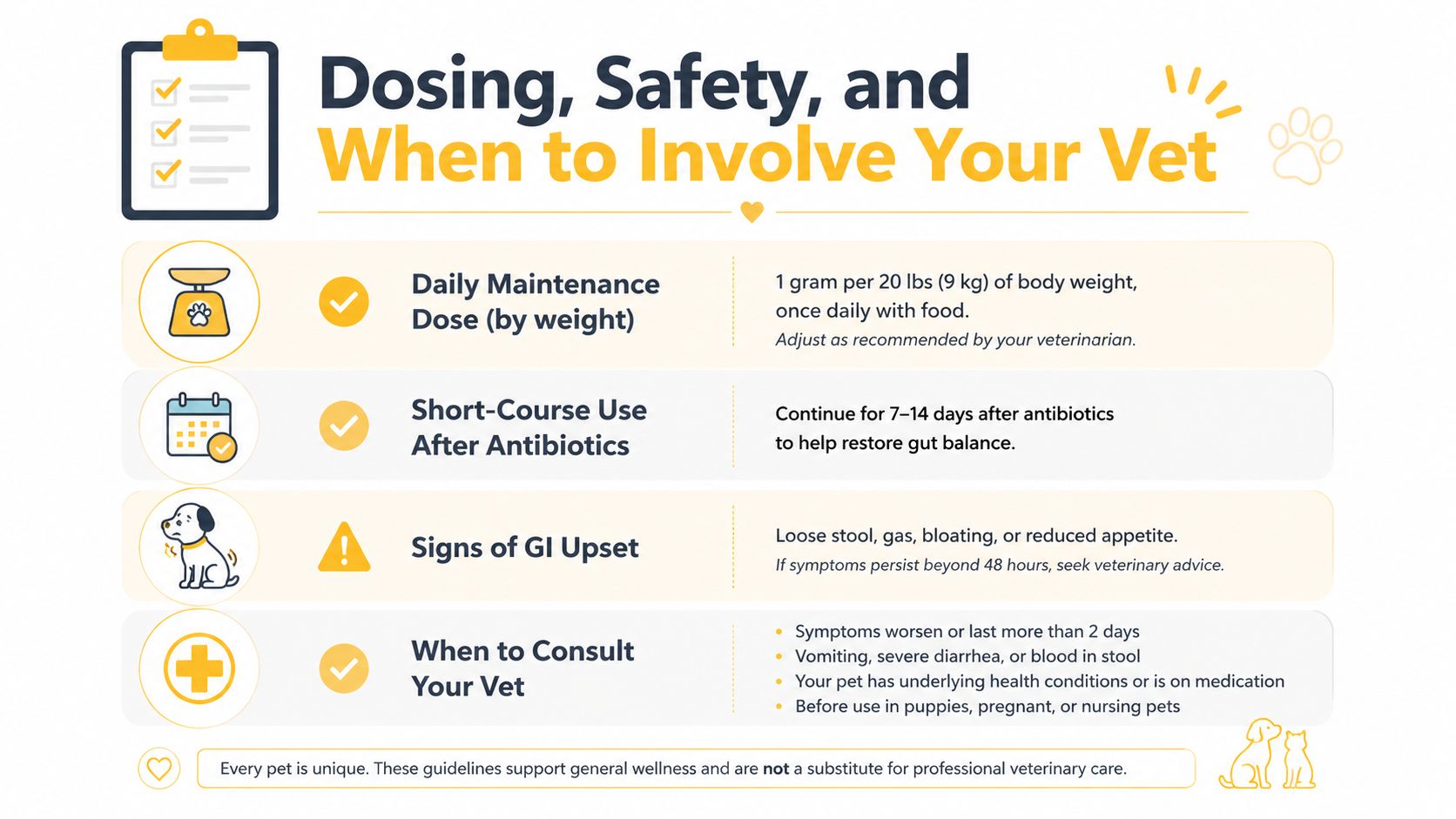
The correct Vital Flora Probiotic dose depends on the product label, the dog's size, the formulation's potency, and the reason for use. Don't convert a human dose or assume that a larger dog needs a simple multiple of a small dog's amount. Follow the canine label unless your veterinarian gives different instructions.
Match the routine to the reason
For daily maintenance, owners generally use the stated serving consistently and monitor tolerance. After antibiotics, acute stress, or a short period of digestive upset, a veterinarian may recommend a time-limited course. The product label may specify whether the powder should be given with food, and mixing it into wet food can help distribute it evenly. With dry food, a small amount of moisture may help it adhere, but avoid adding anything that conflicts with your dog's diet.
Introduce the product calmly. Keep a simple record of stool quality, appetite, gas, scratching, and energy during the first one to two weeks. If signs worsen after starting, stop and ask your veterinarian rather than increasing the dose.
Use extra caution with vulnerable dogs
Puppies, pregnant dogs, senior dogs, and animals taking several medications deserve individualized advice. Dogs with weakened immune systems or those receiving immunosuppressive medication should have veterinary clearance before receiving a live-microorganism supplement. Product quality, storage, and strain selection matter more when the margin for error is smaller.
The 2019 systematic review found a limited canine evidence base, with only 17 eligible studies from 165 screened and limited clinical importance for acute gastrointestinal disease. That doesn't make probiotics irrelevant, but it does mean owners should avoid treating them as established therapy for every digestive complaint.
Call your veterinarian promptly for blood in the stool, unexplained weight loss, persistent vomiting, marked lethargy, dehydration, or recurring symptoms. If a mild problem doesn't improve after a planned trial, reassess the diagnosis and the diet rather than continuing indefinitely. A four-to-six-week period may be appropriate for tracking a non-urgent wellness trial only when your veterinarian agrees and no red flags are present.
Single-Strain Probiotic Versus an All-in-One Daily Supplement
The choice often comes down to focus versus convenience. A narrow probiotic aims at the intestinal microbiome, which can make sense when the immediate question involves stool consistency, diet transition, or recovery after a disruptive event. An all-in-one formula takes a wider approach, combining support for several systems in one daily routine.
A broader supplement may include ingredients such as digestive enzymes, omega-3 fatty acids, antioxidants, joint-support compounds, or prebiotic components. That can simplify administration, especially when an owner is already managing several products. It can also create overlap, particularly if the dog's complete diet already supplies certain nutrients or another supplement contains the same ingredients.
Compare the decision, not just the container
| Factor | Single-strain probiotic, such as Vital Flora | All-in-one daily supplement, DA-1 style |
|---|---|---|
| Primary purpose | Targeted microbiome support | Multi-system daily nutritional support |
| Best fit | A defined digestive question or short-term routine | Owners seeking one routine across several wellness goals |
| Main advantage | Easier to connect the product to a specific response | Fewer separate products to measure and remember |
| Main limitation | Doesn't address unrelated joint, coat, or nutrient needs | May include ingredients the dog already receives |
| Label priority | Named strain, potency, viability, storage | Full ingredient list, serving size, nutrient overlap |
| Combination concern | Interaction with other digestive products | Accidental duplication of nutrients, especially fat-soluble vitamins |
Review the cost per serving and active ingredients, not only the bottle price. A cheaper container may deliver fewer servings or a less transparent potency guarantee. Conversely, a broad formula may be unnecessary if your dog needs a narrowly defined probiotic trial.
A single-purpose product may be more logical after a short-lived disruption. A daily all-in-one may suit an owner who has discussed broader support with a veterinarian and wants to reduce supplement juggling. Before combining products, compare every label and ask about duplicated vitamins, minerals, oils, and botanicals. Guidance on evaluating broader formulas is available in this discussion of all-in-one supplements.
Common Misconceptions Owners Should Drop
Probiotic marketing can make a modest tool sound like a universal solution. These corrections keep expectations aligned with the evidence.
Myth 1: A probiotic fixes every stomach and skin problem.
A probiotic may be relevant to a defined digestive situation, but chronic diarrhea, itching, hotspots, and weight changes can have many causes. Strain-specific evidence matters more than the word “probiotic” on the package.
Myth 2: More CFUs always means better results.
CFU matters, but so do strain identity, viability through expiration, delivery format, storage, and the dog's reason for taking the product. A higher count cannot compensate for an unclear label or poor stability.
Myth 3: A human probiotic works identically in dogs.
Dogs aren't small people with interchangeable digestive needs. Canine formulation, species-appropriate use, and veterinary review are safer foundations than assuming that any human product will perform the same way.
Myth 4: Probiotics replace diagnosis.
They don't. Blood in stool, persistent vomiting, recurrent diarrhea, weight loss, or ongoing skin disease deserves veterinary attention. A supplement can sit beside a diagnostic plan, not stand in for one.
Myth 5: Every dog must take probiotics forever.
Some dogs may benefit from ongoing support, while others need a defined trial or short course. The appropriate duration depends on the dog's response and the underlying reason for use.

The word “probiotic” can also describe non-dietary applications, which creates confusion. For a separate explanation of how microorganisms are used in household cleaning products, read probiotic cleaning products explained. That topic is distinct from feeding a canine probiotic and shouldn't influence how you judge a dog supplement.
Buying Tips and Questions to Ask Before You Choose
A trustworthy buying decision starts with the label, not the product's front panel. You want enough information to understand what the dog receives, whether the organisms are likely to remain viable, and whether the formula matches the problem you're trying to address.
Inspect the product details
Look for:
- Potency at expiration: A CFU guarantee should explain whether the stated amount applies through the expiration date or only at manufacture.
- Complete strain names: The label should identify the genus, species, and, where available, strain designation for each microorganism.
- Storage instructions: Heat and moisture can affect live organisms, so packaging and handling requirements deserve attention.
- Quality testing: Check whether the manufacturer describes third-party testing and batch-level verification in clear language.
- Serving clarity: You should be able to calculate servings per container and compare the cost per serving with similar products.
- Medication guidance: The label should provide sensible cautions rather than implying that the supplement suits every dog.
A vague “proprietary blend” makes comparison harder. It also limits your ability to discuss the product meaningfully with your veterinarian. A transparent label helps separate a genuine strain-based trial from a broad promise.
Take these questions to your veterinarian
Ask whether the strain combination suits your dog's age, condition, diet, and current medication. Ask whether the serving should change during antibiotic treatment or a diet transition, and what signs would mean you should stop. If the dog has an immune disorder, chronic gastrointestinal disease, or unexplained weight change, ask whether diagnostic testing should come before supplementation.
Don't commit to an auto-ship routine until your dog tolerates the formula and you've decided that continued use has a clear purpose. A short observation period, careful notes, and an honest review of results are more useful than buying a large supply based on a general wellness claim.
Bringing It All Together for Your Dog
A vital flora probiotic can be one targeted layer in a dog's wellness plan, not the foundation by itself. Start with a complete diet that suits the individual dog, reliable hydration, regular exercise, manageable stress, parasite prevention, and routine veterinary care. Add probiotic support when the strain, purpose, and monitoring plan make sense.

Track the outcomes you can observe, including stool quality, gas, appetite, itching, coat condition, and energy. Review those notes with your veterinarian over the agreed trial period, and change course if the dog doesn't improve or develops warning signs. The right supplement is the one that fits the dog's needs and can be evaluated.
Pure Paw Labs offers human-grade daily dietary supplements for dogs, including a multi-system powder designed to support gut, joint, skin and coat, immune, and stress-related needs in one routine. Visit Pure Paw Labs to review the formula and decide whether broader daily support belongs alongside, or instead of, a targeted probiotic discussion with your veterinarian.