


You measured out breakfast, sprinkled a supplement on top, and still wondered whether it's doing anything at all. That's the spot most dog owners are in, somewhere between a full bowl, a cabinet full of bottles, and a quiet hope that the routine is helping. The problem isn't that people don't care, it's that immune system support supplements are sold with a lot more confidence than the evidence deserves.
The smart move is to separate what canine research supports from what's just label noise. That means looking at ingredient categories, how dogs really get supplements in daily life, and whether a single scoop makes more sense than stacking multiple jars for the same outcome.
Table of Contents
- Why Dog Owners Are Looking Beyond the Food Bowl
- How a Dog's Immune System Works
- The Main Categories of Immune-Support Ingredients
- Gut Health, Postbiotics, and the Immune Connection
- Signs Your Dog Might Actually Benefit From Supplementation
- How to Judge the Quality of a Dog Supplement
- Why an All-in-One Daily Formula Can Make Sense
- Putting It All Together and Choosing Wisely
Why Dog Owners Are Looking Beyond the Food Bowl
Most owners don't start with supplements because they love buying supplements. They start there after a season of picky eating, a rough stool pattern, a scratchy coat, or a senior dog who seems a little flatter than last year. In that moment, the food bowl feels too ordinary to explain what's going on, so the next stop is the supplement aisle.
The pressure comes from three directions
First, there's the plain fact that commercial diets don't always cover every micronutrient gap in every dog, especially when the dog is stressed, aging, or eating inconsistently. Second, the market is loud, and immune claims appear on everything from chews to powders. Third, there really is a nutritional side to immune resilience, which is why owners keep looking for support instead of giving up on the idea entirely.
The broader supplement market reflects that shift. One independent estimate values the immune health supplements market at USD 35.35 billion in 2024 and projects USD 76.23 billion by 2033, with a 9.06% CAGR from 2025 to 2033. Another forecast places the U.S. market at USD 6.65 billion in 2023 and USD 12.79 billion by 2030, which implies 10.2% CAGR and shows how concentrated demand is in developed markets, according to Grand View Research.
Practical rule: if a supplement is promising “immune support,” ask whether it's solving a real nutritional or gut-health problem, or just borrowing a strong word.
The guide you actually need
The useful question isn't whether immune support exists. It's whether a specific ingredient has canine evidence, whether the dose is transparent, and whether the product fits the way you live. A family with one older dog and five bottles on the counter has a different problem from a trainer who wants one daily powder that's easy to remember.
That's why this topic deserves a filter, not a hype cycle. If a dog is healthy, well fed, and not showing any signs of trouble, broad daily immune claims are often more marketing than medicine. If a dog has stress, gut instability, recovery needs, or age-related decline, the conversation gets more practical, and more evidence-based.
How a Dog's Immune System Works
A dog's immune system works in layers. The skin, gut lining, and other physical barriers form the outer line of defense, while immune cells patrol inside. The aim is balance, not noise, because a system that fires too hard can become less useful.
Two layers, one job
Innate immunity is the fast-response crew. It reacts quickly, does not need prior recognition, and handles the first wave of defense. Adaptive immunity takes longer but is more precise. It relies on lymphocytes, antibodies, and immune memory so the body can respond better the next time it meets the same threat, a distinction also described by the AVMA and Fred Hutch.
That is why “boosting” immunity is the wrong frame. Pushing the system harder does not make it smarter. Support means enough nutrients, a healthy gut, and a body that can respond without overreacting.
The immune system should stay alert, not frantic.
Early life and changing demand
A puppy's early immune protection starts with colostrum from the mother during the first nursing day. That is basic biology, not a marketing angle. After that, immune competence shifts with age, stress, illness, and gut microbiome balance, so a young dog, a boarding-stressed dog, and a senior dog do not need the same approach.
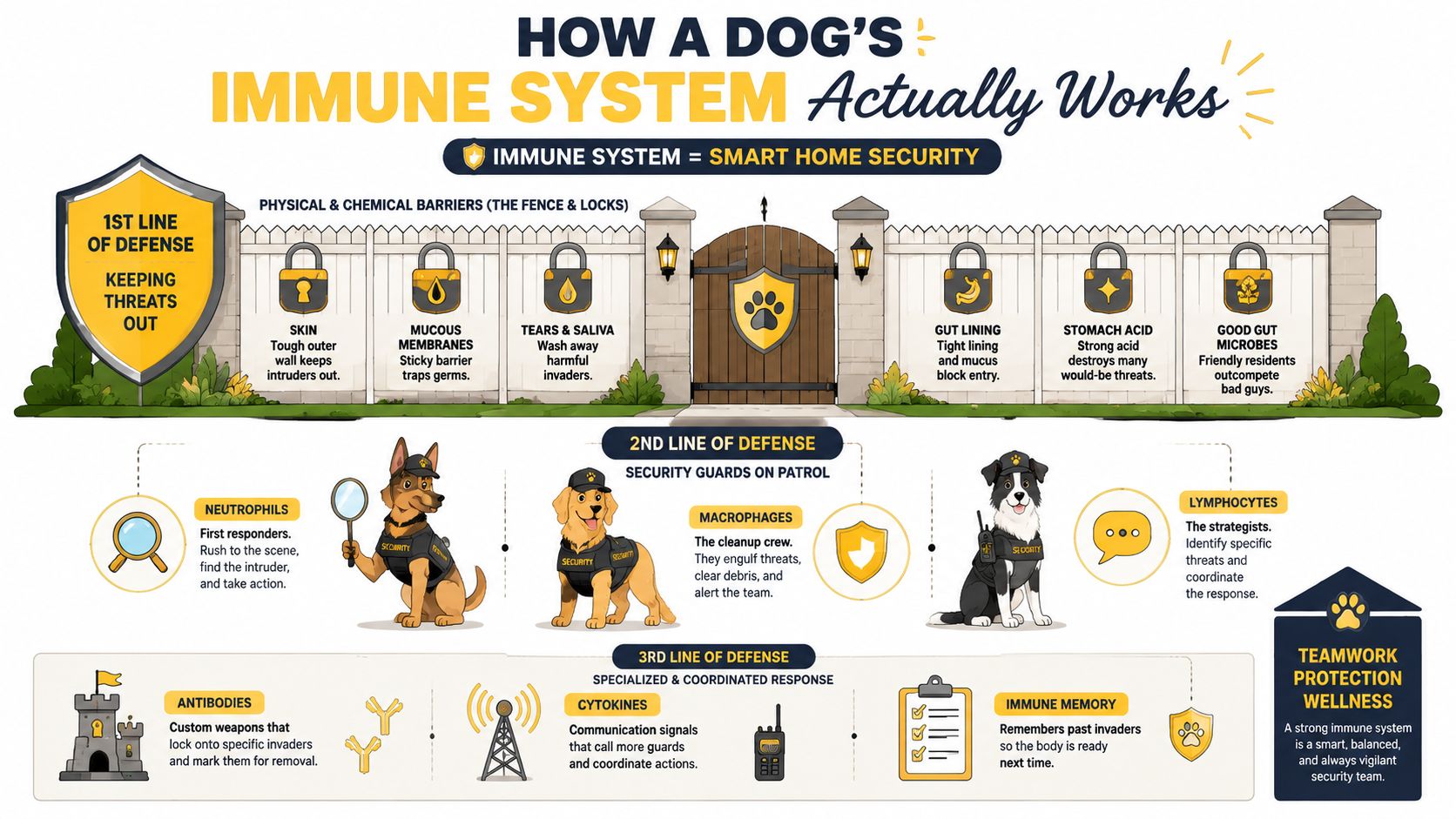
The simple takeaway is this. Immune support is not the same as immune overdrive. Good products work with the body's normal defense systems instead of pretending they can replace them.
The Main Categories of Immune-Support Ingredients
The ingredient list gets messy fast because brands mix real biology with vague wellness language. Sort it by evidence, not by label copy. Some ingredients earn a place in a dog's routine, some are situational, and some are mostly marketing.
What has the most canine relevance
Probiotics sit near the top because specific strains have been studied in dogs, including Enterococcus faecium and Lactobacillus rhamnosus. They are not magic, and strain matters, but they have the clearest practical link to gut-immune support among common supplement ingredients. Vitamin D and zinc matter most when intake is low or deficiency risk is real, because immune function suffers when those nutrients are missing, as the broader immune-nutrition discussion in the veterinary literature makes clear.
Vitamin C and vitamin E are much weaker as standalone immune fixes in a healthy, well-fed dog. Treat them as supporting nutrients, not as a reason to buy an “immune booster” product. Antioxidant-heavy formulas that rely on turmeric, omega-3 fatty acids, or green-lipped mussel can still make sense, but mainly when the goal is inflammation and tissue support, not direct disease prevention.
The middle ground ingredients
Beta-glucans and yeast-derived compounds are promising, especially in products aimed at immune signaling and gut interaction, but canine trial data is still mixed. Bovine colostrum has early interest for gut integrity and immune markers, yet the evidence is narrow enough that I would not treat it like a universal daily need. Many herbal “immune blends” are label decoration, because they rarely come with published canine trials at all.
My view: if a product cannot name the ingredient form, it probably cannot defend the claim.
Product design matters too. A single daily scoop often makes more sense than five separate bottles, because it is easier to follow and easier to judge. A formula like DA-1™ Daily All-in-One - Senior Dog Support, Joints, Skin/Coat & More shows the one-scoop model, with one clear routine instead of stacked jars. That does not prove every ingredient inside it is equally important, but it does show how owners are usually sold convenience around the same ingredient families.
| Ingredient Category | Mechanism in Canine Immunity | Strength of Canine Evidence | Honest Verdict |
|---|---|---|---|
| Probiotics | Supports gut microbes that interact with immune signaling | Moderate | Worth considering when the strain and dose are transparent |
| Vitamin C and Vitamin E | Antioxidant support and cellular protection | Weak as standalone immune claims | Not my first pick for a healthy dog |
| Vitamin D and Zinc | Supports immune competence when intake is inadequate | Stronger when deficient | Useful when there is a real nutritional gap |
| Antioxidants, omega-3s, turmeric, green-lipped mussel | Broad tissue and inflammation support | Moderate | Better for multi-system formulas than “immune” hype |
| Beta-glucans and yeast compounds | May influence immune signaling | Promising but mixed | Reasonable, but not a miracle ingredient |
| Bovine colostrum | Supplies immune-related compounds and supports gut integrity | Early and limited | Interesting, but not universal |
Gut Health, Postbiotics, and the Immune Connection
The gut is where immune support gets real. Dogs don't need another vague “superfood” story, they need ingredients that can influence the place where immunity and digestion overlap. That's why the gut-immune angle is more useful than the old vitamin-only mindset.
Live probiotics, postbiotics, and beta-glucans are not the same thing
Live probiotics are organisms you feed to the gut. Postbiotics are the non-living compounds or metabolites they leave behind, which is why they're more shelf-stable and easier to standardize. Beta-glucans sit in a different lane again, because they're yeast-derived structures that can influence immune signaling rather than replacing gut microbes.
A 2026 randomized controlled trial in healthy adult dogs found that Bifidobacterium animalis-derived postbiotics were safe and well tolerated, modulated gut microbiota, increased short-chain fatty acid production, and were associated with enhanced humoral and cellular immune responses. For a plain-language overview of that ingredient class, I'd point owners to the internal explainer on postbiotics for dogs, because most supplement pages still blur the difference between live bacteria and non-living byproducts.
Don't stack what one formula can already cover
Product design matters. A dog with loose stool after boarding doesn't necessarily need a probiotic bottle, a separate beta-glucan chew, and a colostrum powder on top. It often makes more sense to choose one formula that supports the gut-immune pathway in a single routine.
For digestibility, some owners also look at digestive enzymes as a separate support tool. If you want a simple resource for that angle, Bandana Rx digestive support is a useful reference point for how enzyme-focused products are typically framed. The point isn't that everyone needs enzymes, it's that gut support works best when the category matches the actual problem.
Best mental model: live probiotics seed, postbiotics signal, beta-glucans modulate. None of them should be treated like a cure-all.
The practical takeaway is simple. If the gut is part of the problem, choose ingredients that target the gut. Don't buy a generic immune blend and hope the label somehow covers digestion too.
Signs Your Dog Might Actually Benefit From Supplementation
Not every healthy dog needs daily immune support. Some do. The difference is whether there's a reason to target support, instead of assuming more is better.
Situations that justify a closer look
A dog that gets shaky during boarding, travel, or a big training transition is a reasonable candidate for gut or immune support, because stress can disrupt digestion and routine. Senior dogs can also benefit from targeted support because immune function doesn't stay static with age. Dogs recovering from illness, surgery, or a round of antibiotics may also need extra attention while their gut and appetite settle back down.
Recurrent ear, skin, or soft-tissue issues deserve a harder look than a generic “immune boost.” Those patterns often point to barrier trouble, microbiome imbalance, or something in the diet that needs correction. Pregnancy and working or sporting life can also raise nutritional demands, which means a supplement might be justified if the rest of the care plan is already tight.
What supplements can't replace
Supplements are the backup plan, not the foundation. Diet quality, exercise, sleep, and weight management still do the heavy lifting for immune health. If those are off, a chew or powder isn't going to compensate for the basics.
If a dog's routine is chaotic, the supplement won't fix the whole picture.
Dogs with chronic disease or prescription medications need veterinary input before starting anything immune-active. That matters because ingredients that affect the gut, inflammation, or nutrient absorption can complicate other treatment plans. The cleanest use case is targeted support in a dog with a clear need, not blanket daily use because the bag said “immune.”
How to Judge the Quality of a Dog Supplement
The front of the package is almost never the part that matters. The label claims sound confident, but the quality signals are usually buried in the manufacturing details, ingredient panel, and testing language. That's where you separate a real supplement from a marketing story.
Read the label like a buyer, not a believer
Human-grade ingredients should mean ingredients suitable for human consumption under FDA standards, not just a pretty phrase on the front. FDA-registered or cGMP-compliant manufacturing facilities matter because they suggest controlled production practices. Third-party batch testing with a certificate of analysis is the cleanest proof that a brand is checking label accuracy and contaminants, and the batch-testing explainer is a good guide to what that paperwork should show.
The NASC Quality Seal is another useful benchmark because it signals a brand has met industry standards, though it's still not a substitute for ingredient transparency. What I don't trust are labels that lean on words like premium, or vet-recommended without explaining who verified what.
What should be visible before you buy
The ingredient list should name the specific form, not hide behind a vague umbrella term. A label that says Saccharomyces cerevisiae beta-glucan is more useful than one that just says yeast extract. You also want milligram amounts per serving, not a proprietary blend that leaves you guessing.
| Signal | What to Look For | Marketing Claim to Question |
|---|---|---|
| Human-grade ingredients | Clear sourcing and formulation language | “Clean” without definition |
| Third-party batch testing | Certificate of analysis, contaminant screening | “Lab tested” with no proof |
| FDA-registered or cGMP facility | Documented manufacturing control | “Made with care” |
| Full ingredient disclosure | Exact forms and amounts | “Proprietary blend” |
| Expiration dating | Specific shelf-life information | “Fresh” with no date |
| Transparent dosage | Amount per serving, not just per bottle | “One scoop does it all” without numbers |
Price only matters per serving
Sticker price is the wrong comparison. The question is whether the daily dose gives you the ingredient forms you want, in a transparent formula, without forcing you to buy three more products to fill the gaps. Some owners want a single powder because it lowers friction, and for those shoppers, a well-built all-in-one can make more sense than a cabinet full of partial fixes.
Why an All-in-One Daily Formula Can Make Sense
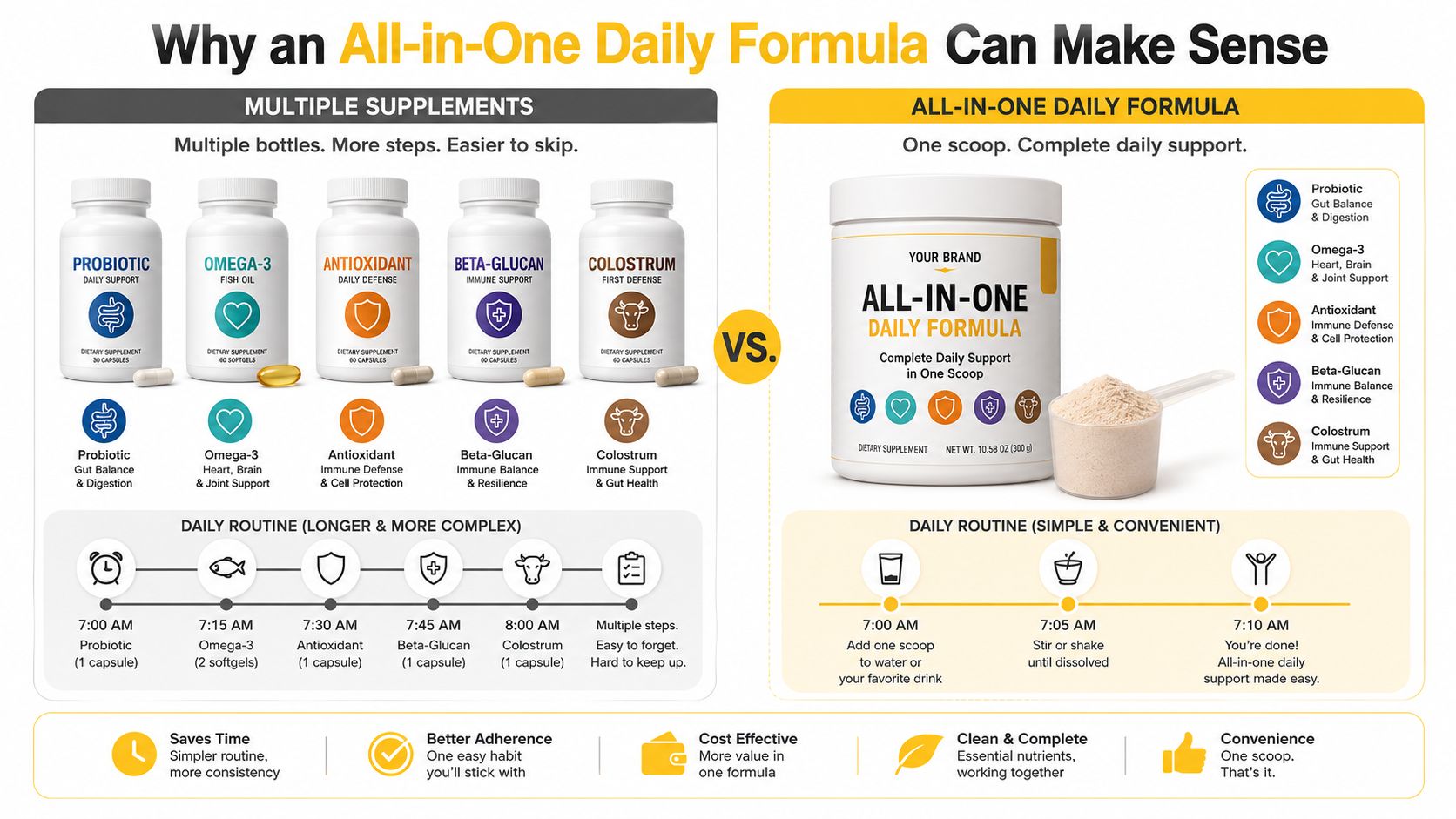
I'm in favor of fewer bottles when the formula is thoughtfully built. A good all-in-one supplement simplifies the routine, makes compliance easier, and reduces the chance that you accidentally overlap ingredients from multiple products. It also matches how most owners feed a dog, one meal, one scoop, done.
The real trade-off is convenience versus precision
The upside is obvious. A single daily scoop can cover gut support, immune support, skin support, and joint support without turning the kitchen counter into a supplement shelf. The downside is also real, because you lose some dose flexibility if your dog needs a very specific clinical strategy.
That's why multi-system formulas work best for dogs with broad wellness needs, not for dogs with a diagnosis that requires a custom plan. If a dog reacts poorly to one ingredient, a stacked approach makes it easier to isolate the cause. If the dog does better with routine and consistency, the all-in-one approach usually wins.
What a solid combination formula should do
A useful combination formula should cover the evidence-backed categories without pretending every ingredient is doing the same job. The formula should be transparent about dosage, clear about the ingredient forms, and reasonable about what it claims to support. That's the difference between a real daily system and a bag of buzzwords.
For readers comparing product architecture, the broader idea is spelled out in the internal guide on all-in-1 supplements. I'd use that kind of framework to judge whether a product is consolidating useful ingredients, or just compressing a lot of marketing into one scoop.
One useful case-study style resource on how product positioning and marketing can shape supplement growth is this 25x revenue increase case study. The lesson for dog owners is simple, growth and claims are not the same thing, so read the formula before you believe the packaging.
Putting It All Together and Choosing Wisely
A dog with recovery needs, gut upset, skin trouble, or senior decline calls for ingredients that match the problem. If the goal is general wellness, choose a transparent formula that addresses the main evidence-backed categories without stacking redundant bottles.
A fast decision filter
Start with human-grade sourcing, third-party testing, and clear dosing. Then check for an FDA-registered or cGMP-compliant facility and named ingredient forms. If a label hides behind a proprietary blend, skip it.
Request the certificate of analysis before you buy if the brand doesn't offer it up front.
Before starting a new supplement, match the dose to your dog's size, ask your veterinarian about interactions if your dog takes medication, and introduce one product at a time. Give it a short trial window, then watch stool quality, coat condition, energy, and any skin or ear changes. Those are the markers that show whether the supplement earns its place in the bowl.
For a closer look at how positioning shapes supplement growth, see the 25x revenue increase case study. The lesson for dog owners is simple, growth and claims are not the same thing, so read the formula before you believe the packaging.