


The most popular advice about immune support supplements for dogs starts with a shopping list: add antioxidants, probiotics, vitamins, and something for gut health. That's the wrong starting point. Before choosing an ingredient, ask what documented need it addresses, whether canine evidence supports that use, and whether the dose could create a new problem.
A nutrient's role in normal immunity doesn't prove that adding more will protect an already well-nourished dog. The useful distinction isn't between supplement users and nonusers. It's between targeted nutritional support and an extra daily product without a clear reason to give it.
Table of Contents
- Immune Support Ingredients and What Dog Studies Show
- What Immune Support Really Means for Your Dog
- How Gut Bacteria Connect to Immune Defense
- Where Vitamin Stacking Turns Into Overdose Risk
- How to Audit a Supplement Label Before Buying
- How to Test Whether a Supplement Is Working
- Bring Your Vet a Clear Plan Before Buying
Immune Support Ingredients and What Dog Studies Show
Common immune-support ingredients and canine evidence
| Ingredient | Immune role | Canine evidence | Main caution |
|---|---|---|---|
| Vitamin C | Antioxidant activity and immune-cell function | Modest immune-related benefits in a small evidence base shared with vitamin E | Don't assume a dog eating a complete diet needs extra |
| Vitamin E | Protects cell membranes from oxidative damage | Modest immune-related benefits in the same limited evidence base | Excess can interfere with absorption or use of vitamins A, D, and K |
| Vitamin A | Supports immune and skin-barrier function | Broad clinical benefits from extra supplementation aren't established in the evidence assessed | Avoid unnecessary additions and overlapping multivitamins |
| Vitamin D | Supports normal immune function | Broad infection-prevention benefits aren't established in the evidence assessed | Excess can cause harm; obtain veterinary guidance |
| Multi-strain probiotics | Gut microbial balance and mucosal immunity | Canine trials report microbial and antibody-marker changes, not guaranteed disease protection | Match the studied strains and check viability through expiry |
| Postbiotics | Gut-related immune signaling from nonliving microbial products | Canine clinical-outcome support isn't established by the evidence assessed | Require a clearly identified preparation and dose |
| Omega-3 fatty acids | Modulation of inflammation | Better support for selected inflammatory conditions than for broad immune outcomes | Check fish-oil contaminant testing |
| Colostrum | Supplies antibody-containing components | Reliable protection against infection isn't established by the evidence assessed | Antibody content alone doesn't demonstrate a benefit in the dog |
A 2024 review identified 27 peer-reviewed studies on vitamins, minerals, and phytonutrients in dogs, but found only two in-vivo studies showing modest immune-related benefits from vitamins C or E, according to the canine supplementation review. That finding supports conditional use, not a blanket recommendation to supplement every dog's immune system.
The review's scope matters. It doesn't provide a head-to-head ranking of every ingredient in the table, and its findings shouldn't be extended to establish benefits for probiotics, fish oils, or colostrum. The table separates biological rationale from demonstrated clinical usefulness, rather than treating all ingredients as interchangeable.
An immune marker isn't the same as protection
A change in immune-cell activity or an antibody measurement can help explain how an ingredient behaves. It doesn't, by itself, establish that treated dogs catch fewer infections, recover faster, or receive better vaccine protection. Those are different outcomes requiring direct investigation.
The distinction also applies to botanical blends. When considering a mushroom supplement for dogs, ask whether the evidence concerns the actual preparation, dose, and canine outcome, rather than merely an ingredient name.
Practical rule: Choose the nutritional objective before choosing the ingredient.
Start by confirming whether your dog's food is complete and balanced for its life stage. Then ask whether any ingredient addresses an identified gap or a defined veterinary objective. Without that connection, a longer ingredient list offers more things to evaluate, not stronger evidence of benefit.
What Immune Support Really Means for Your Dog
A supplement's value depends on the need it addresses and whether adding it could cause harm. More immune activity alone does not show that a dog is better protected. For example, a dog recovering from a respiratory infection may have a defined objective, such as supporting recovery under veterinary guidance, rather than a general goal of “boosting” immunity.
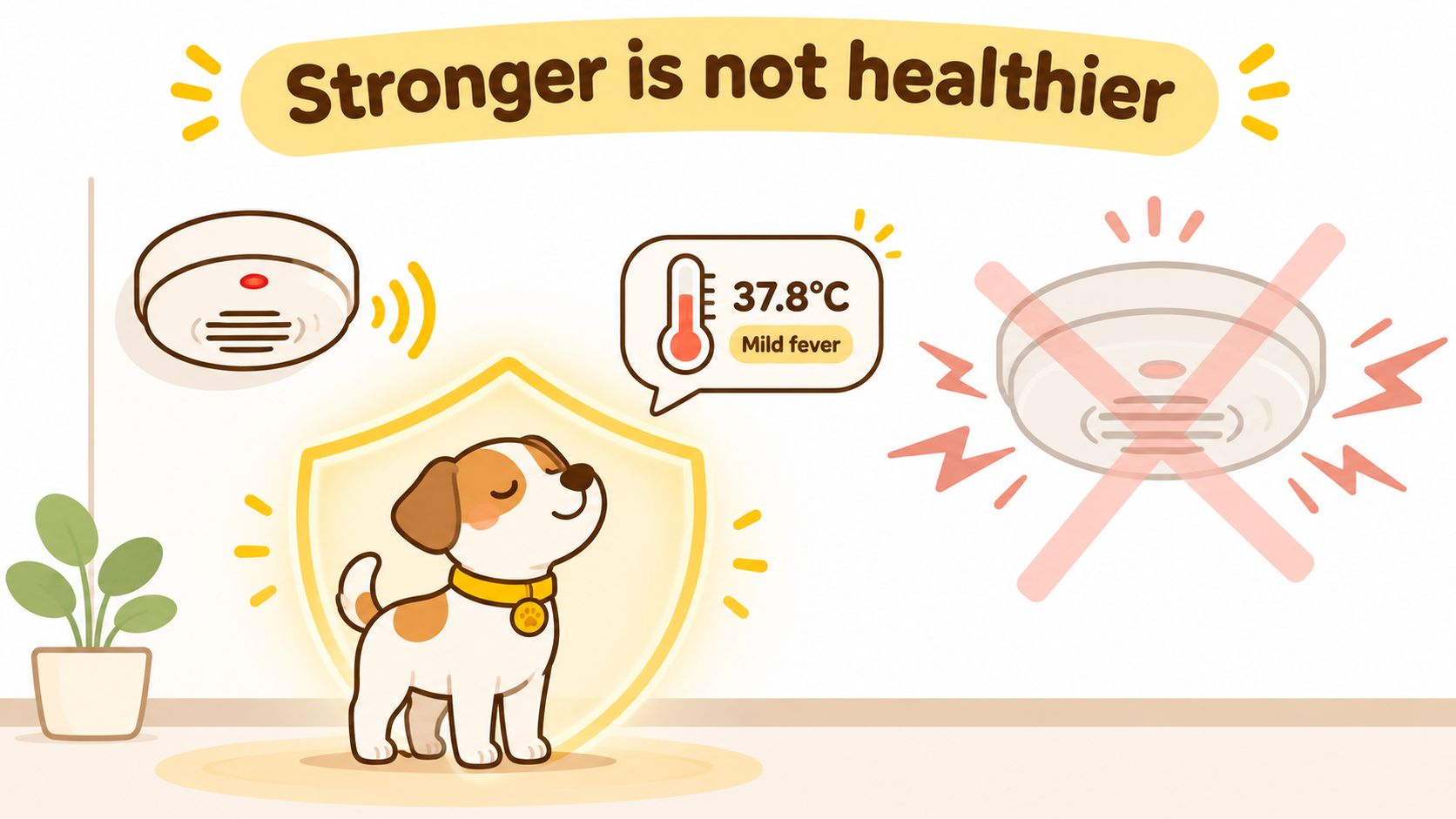
Marketing often groups correcting a deficiency, modulating inflammation, improving vaccine response, and preventing infection as though they were interchangeable outcomes. They are distinct goals. The review indexed by OUCI describes limited support for broad canine immune-supplement claims. A specific nutritional or clinical objective is therefore a more defensible reason to consider supplementation than a general promise of immune stimulation.
The earlier discussion of diet adequacy matters here: a supplement should address an identified gap or veterinary objective, not add more ingredients. Age, symptoms, medication use, and vaccination status can inform whether further assessment is warranted, but none alone establishes that a supplement is needed.
Questions that change the decision
- Is there a documented deficiency or dietary gap? If a dog eats a home-cooked recipe that has not been professionally balanced, the useful next step is a recipe assessment. Choosing an immune blend because it contains several vitamins does not establish that those nutrients are needed.
- Does the ingredient address this dog's specific problem? For a senior dog taking long-term medication, review the diagnosis and treatment plan with the veterinarian. Age by itself does not show that a general immune formula is necessary or compatible with treatment.
- Could the addition create excess or interfere with treatment? A puppy already eating complete growth food may also receive fortified treats or toppers. Extra vitamins need a clear reason, especially when several sources are involved.
These questions distinguish concern from indication. An owner may worry about a puppy encountering other dogs, but that concern does not demonstrate a nutrient deficiency or show that a supplement will prevent illness.
First decide whether supplementation merits discussion. Then consider an ingredient or product.
When no identifiable need exists, maintaining the dog's current care plan may be the more evidence-aligned choice. When a need is identified, a veterinarian can define the objective and assess whether a particular ingredient is appropriate.
How Gut Bacteria Connect to Immune Defense
Gut microbes interact with the intestinal barrier and the signals used by mucosal immunity, the immune defenses associated with surfaces such as the intestinal lining. That creates a plausible route through which selected microbial preparations could influence local immune function. Plausibility, however, is the beginning of an explanation, not proof of protection.
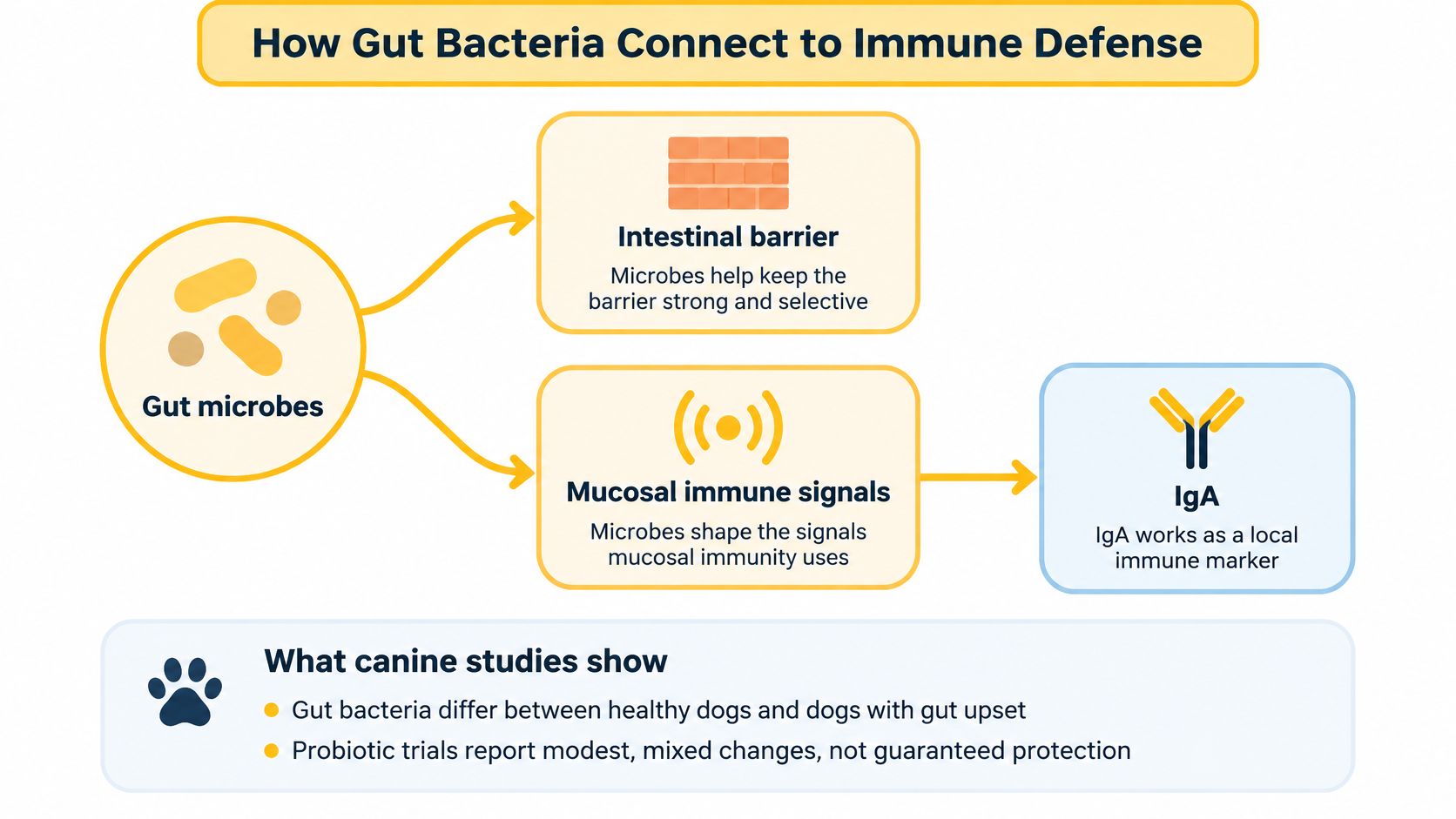
In canine research summarized in a review of microbial supplementation, multi-strain probiotics were associated with reduced fecal Clostridium perfringens, increased Bifidobacteria and Lactobacilli, and higher fecal IgA and plasma IgG. These findings connect changes in microbial communities with changes in immune measurements.
IgA is a relevant local immune marker. Its measurement helps researchers examine mucosal responses, but an increase doesn't automatically establish protection against respiratory infection or systemic disease. Nor should results from human probiotic studies be assumed to transfer to dogs.
The strain is part of the intervention
A probiotic isn't a single uniform ingredient. Strain identity, the viable dose, feeding duration, and the dog's starting microbiota all affect how closely a retail product resembles an intervention studied in dogs.
Read the identification at three levels:
- Genus identifies the broader microbial group.
- Species narrows the organism's identity.
- Strain designation identifies the specific strain needed to match a product to relevant evidence.
A generic probiotic label isn't enough for that comparison. Likewise, a large culture count can't compensate for missing strain information.
Postbiotics are nonliving microbial preparations or products. Their nonliving status means a live-culture count isn't the appropriate way to evaluate them, but owners still need a defined preparation, dose, and canine evidence relevant to the intended use. Don't transfer a live probiotic's findings to a postbiotic because their names sound related.
Match the product to a digestive objective
For live products, look for a viable-count guarantee through the end of shelf life, plus clear storage instructions. A count measured only at manufacture leaves uncertainty about what the dog receives later.
Digestive support during dietary disruption is a more focused discussion than whole-body infection prevention. A practical dog gut health guide can help owners organize diet and stool observations before that discussion. Probiotics should complement complete nutrition, vaccination, parasite control, and veterinary assessment, not replace them when a dog has recurrent infections or gastrointestinal disease.
Where Vitamin Stacking Turns Into Overdose Risk
A dog may receive a multivitamin, fish oil with added vitamin E, and vitamin-enriched treats in the same day. Each product may be reasonable alone, but evaluated separately they can hide the combined dose. Include nutrients from the dog's regular food when assessing total intake.
Count nutrients, not packages
Use a worksheet with a row for every food, treat, topper, and supplement. Photograph the labels so your veterinarian can review the serving amounts and ingredient forms.
- Record the serving given. The label amount reflects daily intake only when the dog receives that exact serving.
- Calculate each product's daily contribution. Multiply the amount per serving by the number of servings given each day.
- Group matching vitamins together. Track vitamins A, D, E, and K separately; do not add unlike nutrients.
- Keep the original units. Don't combine milligrams and international units or convert them without confirming the vitamin form.
- Flag missing information. Ask the food's manufacturer for nutrient details when the package doesn't provide enough.
For example, if a dog's food and treats provide vitamin D and a supplement adds more, record each daily contribution in the same unit before considering the total. If a label gives an amount per serving, multiply it by the servings given. If any product doesn't disclose its vitamin D content, the total remains unknown. Don't guess at a conversion or add another source until your veterinarian can assess the intake.
Vitamin D excess warrants veterinary guidance before adding it to an already complete diet.
Safety boundary: Pause an addition when the combined dose is unclear. Don't estimate a safe amount.
A review of dog multivitamin supplements can support the label review, but the worksheet helps show how the full feeding routine adds up. The aim is to address a documented gap, not increase intake because products advertise overlapping benefits.
Unexplained weight loss, appetite changes, or lethargy warrant a call to the veterinarian. These signs don't establish vitamin toxicity. Bring the full feeding record so the veterinarian can assess the dog and the complete regimen together.
How to Audit a Supplement Label Before Buying
Many pet supplements don't undergo premarket FDA review, so don't mistake a polished label for proof of effectiveness. The label and supporting documents should let you verify identity, dose, and quality before you consider a trial.
A 2025 survey-based study of 40,367 dog owners found that 52% gave their dogs supplements, and its authors recommended more veterinary discussion of use and efficacy, particularly for senior dogs, in the American Journal of Veterinary Research. Widespread use makes careful checking important; it doesn't establish that a product works.
Supplement label checks and what each one proves
| Check | What to look for | Why it matters |
|---|---|---|
| Active ingredients and doses | Amount per serving in mg, IU, or CFU, as appropriate | Allows dose and total-intake assessment |
| Probiotic strain designation | Genus, species, and strain code | Enables comparison with strain-specific evidence |
| Viable count at end of shelf life | Guarantee through expiry, not only at manufacture | Makes the guarantee relevant to when you'll use it |
| Storage instructions | Temperature and handling guidance | Helps preserve the product under intended conditions |
| Third-party testing | Independent results or a recognized quality seal with a defined scope | Supports only the identity, purity, or potency checks actually performed |
| Fish oil contaminant testing | Heavy-metal results tied to the batch | Documents testing for specified contaminants |
| Total intake check | Diet, treats, and other supplements reviewed together | Identifies overlapping nutrients before use |
What should make you hesitate
Proprietary blends that hide individual doses prevent a meaningful comparison with the evidence or your dog's existing intake. Knowing the combined weight of a blend isn't the same as knowing the amount of each active ingredient.
Disease-treatment promises deserve particular skepticism. A statement about supporting normal function isn't equivalent to evidence that a product treats an infection, and supplement use shouldn't delay diagnosis.
Missing lot information also makes it harder to connect a container to a batch-specific test report. Ask what was tested, which batch the report covers, and whether the result addresses potency, identity, contaminants, or something else.
Quality and benefit are separate questions
Choose canine-specific products rather than repurposing human supplements. Dog-focused directions make serving assessment more straightforward, though they don't eliminate the need to review the ingredients and dose.
Our guide to reading supplement labels can help organize that review. Even a product that passes every check still needs a relevant indication: accurate contents and responsible manufacturing don't, by themselves, prove that your dog will benefit.
How to Test Whether a Supplement Is Working
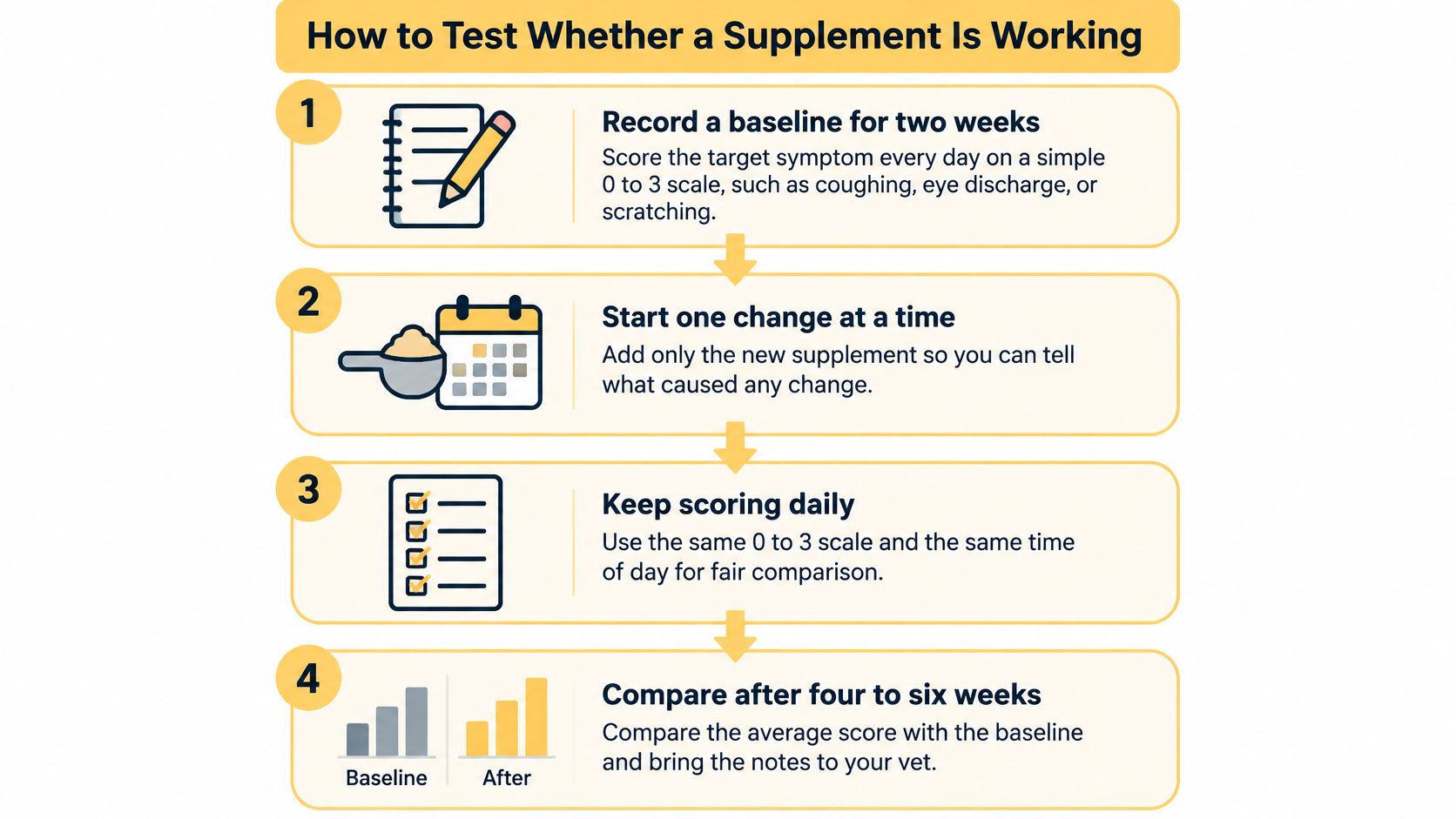
A useful trial starts with a defined symptom and a veterinary assessment, not a general impression that the dog could be healthier. Coughing, eye discharge, recurring skin problems, and persistent digestive changes may need diagnosis before any supplement trial is appropriate.
Use a written observation process rather than relying on memory.
Build a comparison you can interpret
- Record a baseline before starting. Agree with your veterinarian on an observation period and a simple symptom scale with clearly defined categories. For stool quality, for example, write down consistency and frequency rather than merely describing the day as good or bad.
- Log the existing routine. Record the complete diet, treats, medication, and other supplements. Include unusual events such as travel or a food change so they aren't mistaken for a product effect.
- Introduce only the agreed product. Use the veterinarian-approved labeled dose and avoid simultaneous elective changes. If treatment needs to change, prioritize the dog's care and note that the supplement comparison is harder to interpret.
- Set the trial window before the first dose. Let the veterinarian choose a duration suited to the ingredient and target problem. A fixed review date prevents both premature switching and indefinite use without an assessment.
- Compare patterns, not isolated days. Keep observing in the same way and at a consistent point in the routine. Look for a sustained, meaningful improvement rather than selecting the best day as evidence.
- Stop and contact the veterinarian if concerning symptoms appear. Vomiting, persistent diarrhea, lethargy, or another new problem shouldn't be dismissed as adjustment. Don't increase the dose to try to force a response.
The process is also discussed in this accompanying video.
Decide what the result means
A useful result is a measurable change in the symptom you selected. Better stool consistency may support continuing a digestive intervention, but it doesn't demonstrate broader resistance to infection.
An unchanged record is useful too. It gives the veterinarian a reason to reconsider the product instead of adding another supplement on top.
Even improvement doesn't establish causation with certainty in a home trial. Symptoms can fluctuate, and recovery can occur for other reasons. The record supports a more informed decision about continued use, not a claim that the dog's entire immune system has improved.
Bring Your Vet a Clear Plan Before Buying
A supplement is worth considering only if it addresses a specific need and fits safely with the dog's existing diet and care. Bring the product label, feeding worksheet, and symptom log to the appointment. Include your dog's life stage, vaccination status, medication list, and history of recurrent infection or digestive disease.

Leave with a written decision
- Confirm the indication. Ask whether a documented nutritional or clinical need exists.
- Review compatibility. Have the veterinarian assess total intake and possible medication conflicts.
- Name the endpoint. Record the symptom to monitor, the trial window, and the circumstances that mean stopping.
Use a whole-routine approach to dog nutrition to review feeding and care together, rather than adding products without a clear reason.
Pure Paw Labs' DA-1™ Daily All-in-One - Senior Dog Support, Joints, Skin/Coat & More contains 18 human-grade ingredients and no fillers. One scoop combines joint, skin, gut, allergy, and immune support, and may replace multiple separate supplements. Ask the veterinarian whether it can replace any products your dog already receives.
A small number of dogs may have mild digestive changes while adjusting, and these usually pass quickly. Persistent changes or new symptoms warrant veterinary advice before the next dose. The appointment should end with a written plan and a clear decision about whether the product addresses a documented need.
Pure Paw Labs offers a daily all-in-one supplement intended to simplify several support categories. Review the formula on Pure Paw Labs, then ask your veterinarian whether it fits your dog's needs and current routine.