


You get home from a walk, unclip the lead, and notice your dog taking uneven steps across the kitchen. They're still interested in dinner, but one paw isn't landing normally. Should you check it, let them rest, or head straight to the vet?
Knowing how to help a limping dog starts with that decision, not with choosing a remedy. The safest approach is to sort the limp by severity and timing, give appropriate first aid, and keep a useful record if home monitoring is reasonable.
Table of Contents
- How Urgent Is the Limp Right Now
- First Aid Steps to Take at Home
- Common Causes and How to Tell Them Apart
- Long-Term Care for Arthritis and Weight
- Where Joint Supplements Fit Safely
- Monitoring Mild Limps and Preventing Repeats
How Urgent Is the Limp Right Now
A leg held completely off the ground deserves prompt attention, even if your dog isn't crying. Owners sometimes interpret silence as comfort, but refusing to load a limb is more important than whether a dog vocalizes.
Limping is a clinical sign, not a diagnosis. The Merck Veterinary Manual's guidance on when to see a veterinarian lists sudden, severe lameness and staggering as reasons for immediate attention, and swollen joints or lameness lasting more than 24 hours as reasons for veterinary evaluation within that timeframe. Don't treat that threshold as permission to wait when symptoms are severe or getting worse.
Sort the signs before touching the leg
Use the most serious sign you can see, rather than averaging reassuring and concerning signs together. A dog who eats normally but cannot use a leg still needs urgent care.
Limping signs sorted by urgency
| Sign | Urgency | What to do |
|---|---|---|
| Cannot bear any weight on the limb | Immediate | Go to an emergency vet now |
| Staggering, dragging or knuckling a limb | Immediate | Emergency vet; possible neurologic cause |
| Sudden severe pain or yelping when touched | Immediate | Emergency vet; avoid handling the joint |
| Visible deformity or suspected fracture | Immediate | Emergency vet; keep the dog still |
| Limp with fever, vomiting, lethargy or breathing difficulty | Immediate | Contact an emergency vet now |
| Swollen, hot or bleeding joint or paw | Same day or next morning | Arrange a prompt examination; uncontrolled bleeding needs immediate care |
| Limp persisting beyond a day | Prompt veterinary assessment | Book an examination rather than extending home observation |
| Mild limp that improves with rest, no swelling | Brief home monitoring | Restrict activity, record changes, and book an exam if it persists |
For mild monitoring, your dog should still bear weight, remain comfortable at rest, and have normal appetite and behavior. Temporary improvement doesn't rule out a ligament, joint, or neurologic problem.
Practical rule: Severity can shorten the monitoring window at any moment. Improvement doesn't confirm the cause.
Painful dogs may bite, including dogs who normally welcome handling. Stop checking if your dog stiffens, turns toward your hand, growls, or pulls away.
Falling over isn't another version of limping. Guidance on an older dog who keeps falling over can help you describe that different pattern, but new balance problems shouldn't wait for a routine mobility appointment.
First Aid Steps to Take at Home
Home first aid should protect the limb and gather information, not prove a diagnosis. If your dog meets an emergency criterion, make the call first and ask the clinic how to move them safely.
This visual summarizes the basic sequence.
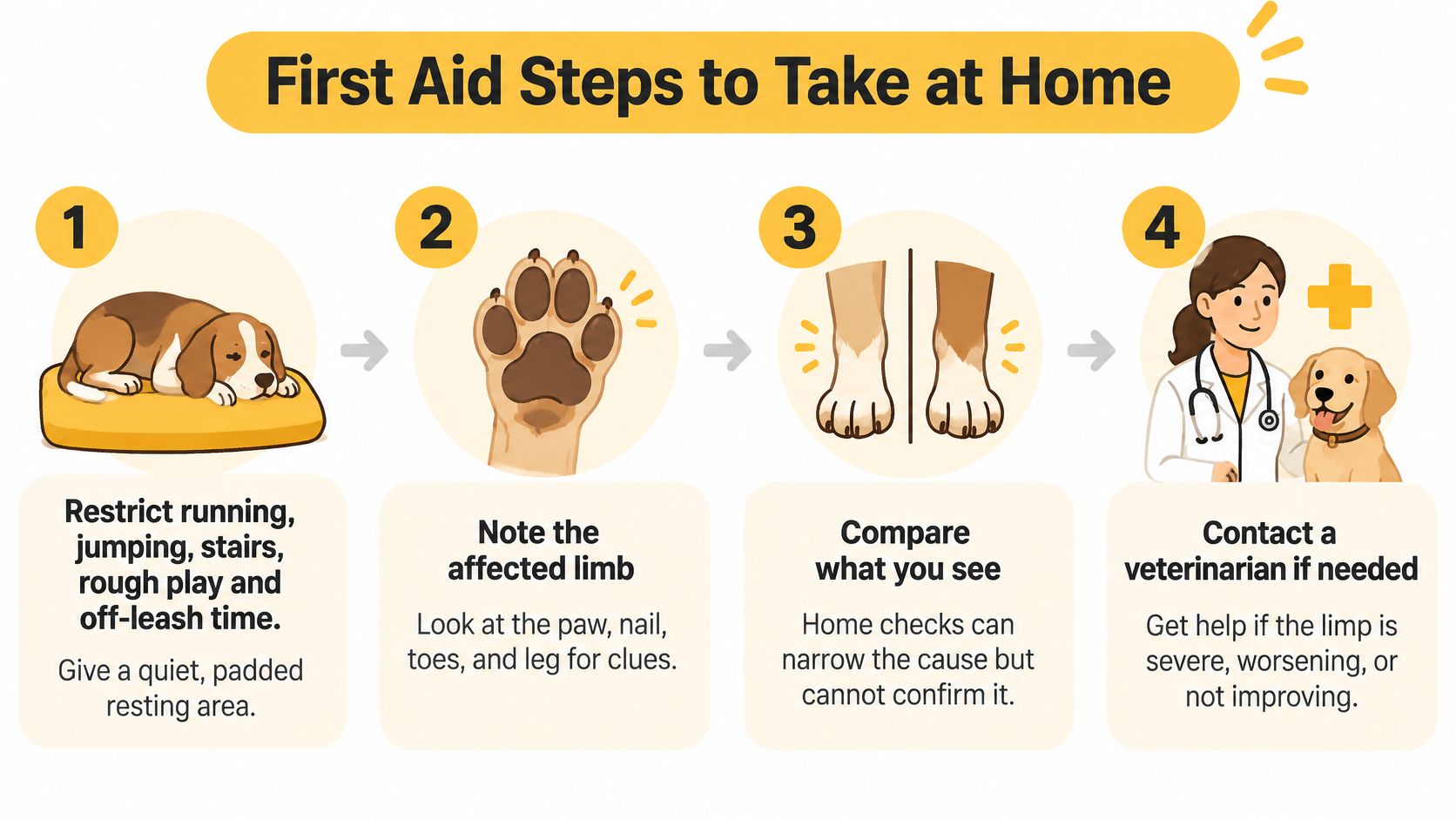
Follow a calm, limited routine
- Stop unnecessary activity. Restrict running, jumping, stairs, rough play, and off-leash time, and provide a quiet, padded resting area. Use a lead for necessary toilet trips rather than allowing an apparently brighter dog to race outside.
- Write down what changed. Identify the affected limb, whether onset was sudden or gradual, and whether discomfort followed exercise or appeared after rest. Record what you observed rather than labeling it a sprain.
- Film natural movement if it's comfortable. Capture your dog walking briefly on a flat, nonslip surface so the vet can compare the gait later. Don't make a reluctant or non-weight-bearing dog walk for the camera.
- Look at the paw gently. Use a light to inspect the pads, nails, and spaces between the toes for cuts, punctures, swelling, or visible debris. Don't squeeze a sore toe, forcefully bend a joint, or continue if your dog resists.
- Apply gentle pressure to bleeding. Hold a clean cloth against the area while arranging veterinary advice, and avoid repeatedly lifting it to check. Don't use a tourniquet or tightly wrap the limb; bleeding that won't settle needs urgent help.
- Keep human pain medicines out of the plan. Ibuprofen, acetaminophen, and other human analgesics can cause gastrointestinal, kidney, or liver toxicity when used inappropriately in dogs, as discussed in the MSD Veterinary Manual's osteoarthritis guidance. Don't substitute a medicine already in your cupboard for veterinary drug selection and dosing.
- Call with a concise description. Tell the clinic which limb is affected, whether your dog bears weight, when the problem started, and what you found. Mention any medication already given, including its packaging details, rather than waiting for the appointment.
Prepare supplies without over-treating
A light, clean cloths, gauze, and your clinic's contact information are useful starting points. Adventure Medical Kits' resource on choosing a dog first aid kit can help you organize supplies before an injury occurs.
A thickened area on a pad also needs interpretation. Comparing it with information about a dog callus on the paw may help you describe it, but don't assume a painful, cracked, or bleeding patch is harmless.
Two common mistakes are taking another walk to test the leg and pulling at an embedded object. Neither gives a reliable answer, and both can make a painful problem harder to manage.
Common Causes and How to Tell Them Apart
A torn nail or something trapped between the toes is a sensible place to start looking because it's accessible. An accessible cause isn't necessarily the actual cause, though, and finding nothing on the paw doesn't clear the rest of the limb.
These are useful categories to recognize before an examination.
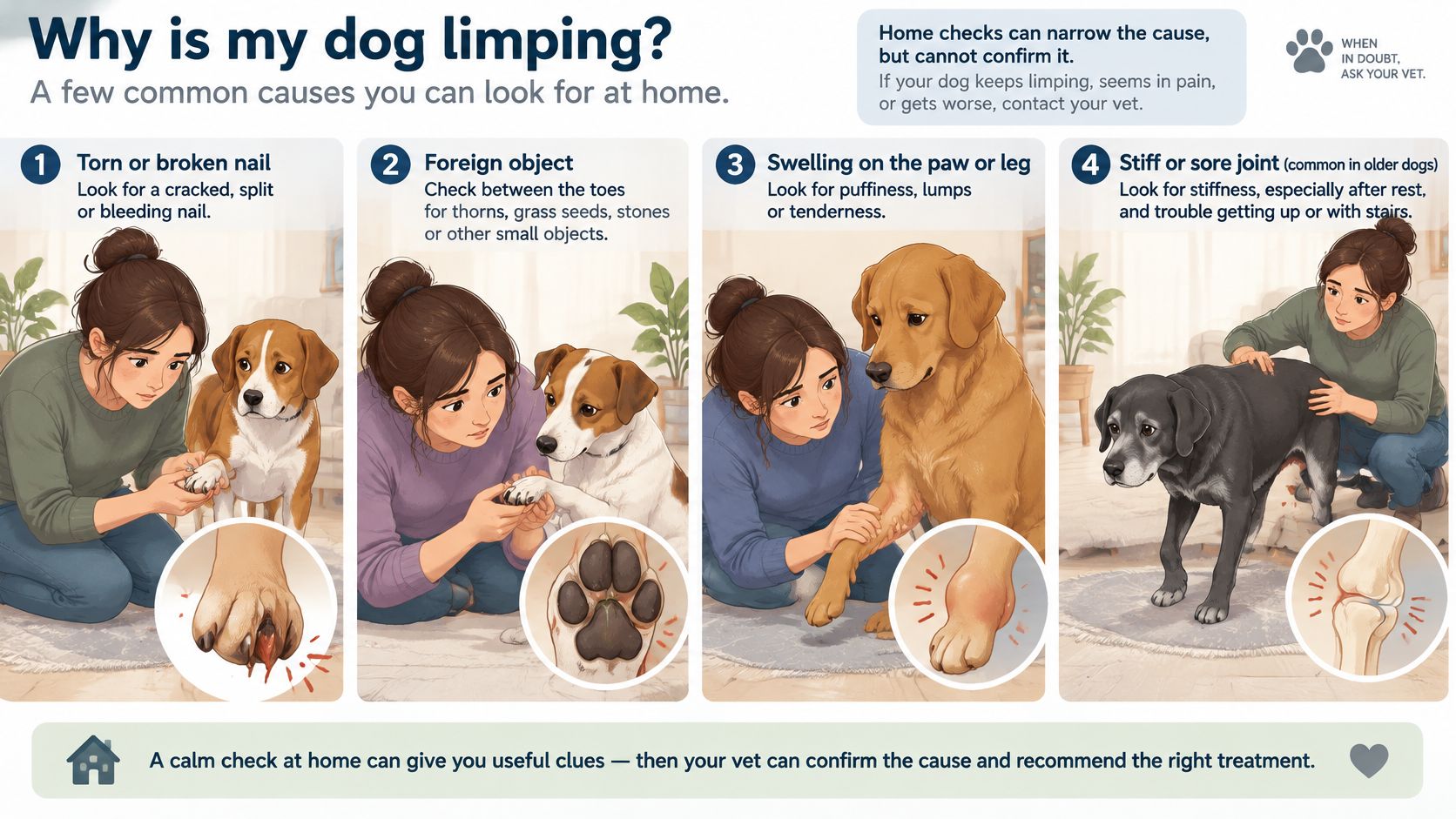
Match the pattern without making a diagnosis
Likely limp causes, signs and home checks
| Likely cause | Typical signs | Home check |
|---|---|---|
| Torn or broken nail | Sudden limp, bleeding nail bed, sensitivity around a toe | Inspect visually; don't cut into an attached, painful nail; seek care for continued bleeding |
| Foreign object between toes or pads | Licking one paw, sudden limp, visible seed or splinter | Look gently; leave deep or embedded objects for the vet |
| Cut or puncture to a paw pad | Blood, limping, pain around the pad | Gently rinse superficial dirt and apply pressure; deep cuts need care |
| Sprain or strain | Mild limp after play that may ease with rest | Restrict activity; persistence requires assessment, not a presumed diagnosis |
| Cruciate ligament injury | Hind-leg limp, possible knee pain or altered sitting posture | Veterinary examination needed; don't test knee stability yourself |
| Fracture | Non-weight-bearing, swelling, possible deformity | Keep still and seek emergency care |
| Osteoarthritis | Stiffness after rest, slow rising, recurring exercise-related discomfort | Arrange an examination and a long-term plan |
| Neurologic problem | Dragging, knuckling, weakness, wobbliness | Seek emergency assessment |
Arthritis can be less obvious than owners expect. A 2022 study of 500 dogs found veterinarian-confirmed osteoarthritis in 38%, while fewer than half of affected dogs had presented with stiffness or lameness. That finding doesn't diagnose your dog, but it explains why a recurring movement change deserves attention.
Heartstrings Pet Hospice & In-Home Euthanasia's guide can help owners spot warning signs of canine leg pain, particularly changes in comfort and everyday movement.
What the clinic can establish
The veterinarian observes gait, localizes pain with an orthopedic examination, and adds neurologic checks when movement suggests more than a sore limb. Understanding dog leg bones can make those explanations easier to follow, but palpation and imaging require professional interpretation.
This video offers an additional visual reference.
Radiographs may assess bones and joints; sedation or additional imaging may be needed for a comfortable, informative examination. A ligament injury isn't necessarily visible directly on a routine radiograph, so the hands-on findings matter too.
Treatment follows the diagnosis. Options include controlled rest, prescribed pain relief, rehabilitation, weight management, or surgery for injuries that require stabilization.
Long-Term Care for Arthritis and Weight
Body weight is one of the most measurable parts of chronic mobility care. When a veterinarian confirms excess weight, the practical starting point is a calorie plan that reduces fat gradually while preserving muscle, not just smaller meals and more exercise.
A veterinary review of osteoarthritis management describes assessment with a 9-point body-condition score and summarizes evidence that approximately 6% weight loss can reduce lameness; studies in overweight dogs with hip or elbow osteoarthritis reported significant improvement in subjective lameness with 11% to 18% weight loss. These are study findings, not a universal target or a promise of recovery on schedule.
Track progress against your dog's baseline
| Stage | What to record | What it helps the vet decide |
|---|---|---|
| Starting assessment | Weight, body condition, portions, treats, comfortable activity | Appropriate calories and initial activity limits |
| Early follow-up | Weight trend, appetite, ability to rise, response after walks | Whether the plan is tolerable and practical |
| Ongoing review | Repeat movement videos, muscle condition, recurring pain | Whether diet, medication, or rehabilitation needs adjusting |
Measure food consistently and include treats, chews, and table scraps in the calorie discussion. Cutting dinner while leaving those extras unchanged can undermine the plan.
Controlled, low-impact activity is different from trying to exercise the weight off. Short leash walks or professionally approved swimming may suit some dogs, but duration should increase gradually and only within comfort.
A dog's willingness to chase a ball isn't a reliable measure of whether the exercise is appropriate.
Combine the interventions that fit
- Pain control: Use the prescribed plan and report breakthrough discomfort rather than adjusting medication yourself.
- Rehabilitation: Ask for an individualized program aimed at strength, function, and joint stability.
- Home setup: Provide secure footing and make food, water, and resting places accessible without jumping.
- Reassessment: Track function as well as weight so a lighter dog with worsening movement isn't mistakenly judged a success.
Evidence for many specific home-exercise protocols remains limited, so don't copy a demanding routine because another dog tolerates it. A broader dog mobility support plan should accommodate the diagnosis, household layout, and your dog's response.
Avoid abrupt activity increases, repetitive ball chasing, and replacing treatment with enthusiasm-driven exercise. A manageable routine that you can repeat and measure is more useful than occasional strenuous outings.
Where Joint Supplements Fit Safely
Should you give a joint supplement for this limp? Not before deciding what the limp needs. Choosing a product first can distract from a condition that needs examination, pain relief, or stabilization.
The safety sequence is straightforward.
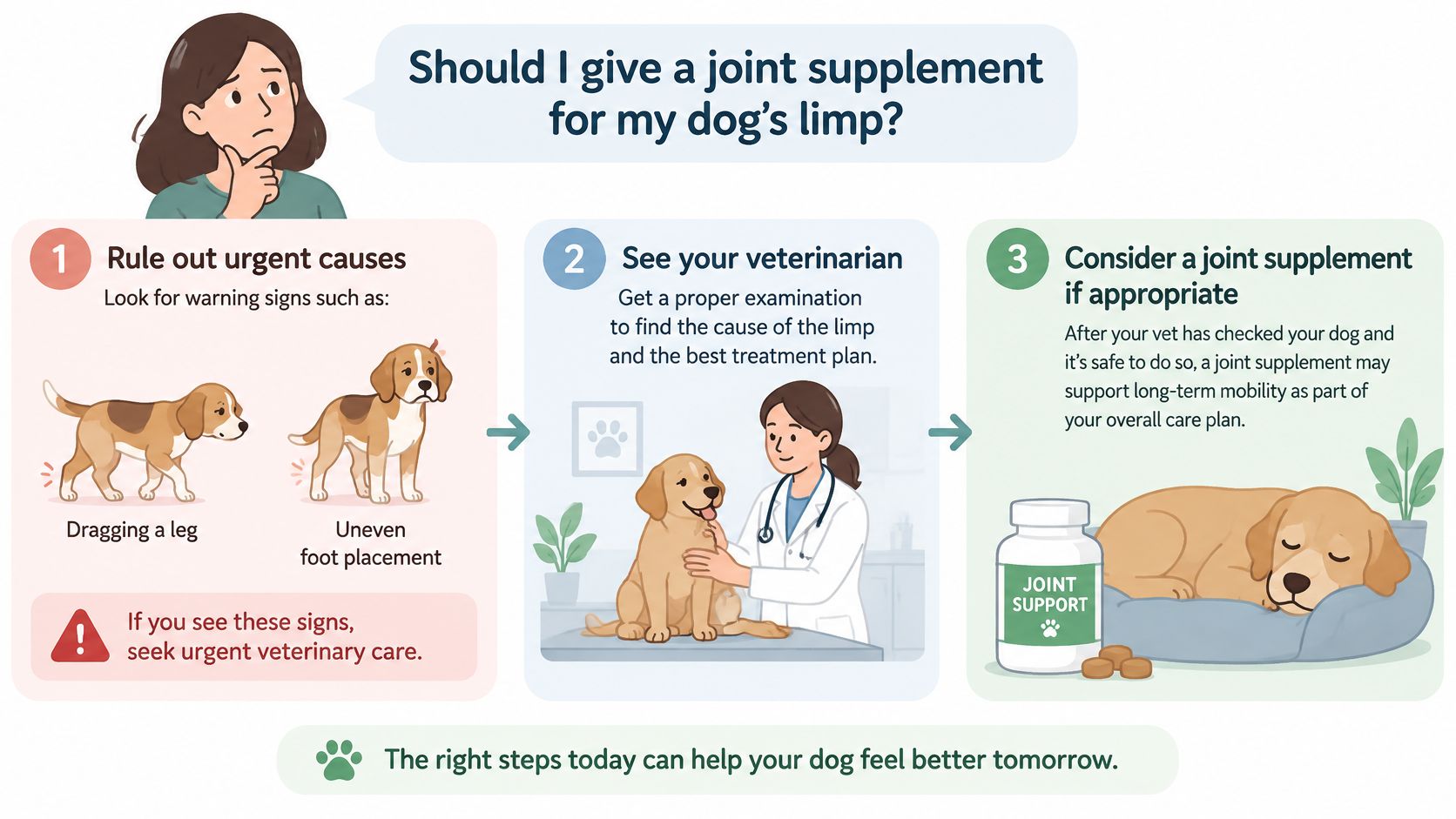
Put diagnosis ahead of nutrition
Dragging, knuckling, inability to rise, multiple-limb weakness, or disproportionate pain can point beyond a simple leg injury, as outlined in this veterinary guide to limping in dogs. Those patterns call for urgent veterinary evaluation, not a trial of nutritional support.
Next, keep medication decisions separate from supplement shopping. Neither a supplement nor a human painkiller is an appropriate substitute for a veterinary pain-management plan.
Then discuss the whole routine: diet, body condition, exercise, flooring, rehabilitation, and existing medicines. The useful question is what an adjunct might add to that plan, not whether it can replace the plan.
Supplement boundary: Joint-health support isn't diagnosis, trauma care, or acute pain relief.
Ask about a specific role
A discussion of dog joint supplements is most useful when you can identify the intended goal and how you'll judge a response. Bring the ingredient list rather than relying on a front-label claim.
One option to discuss is DA-1™ Daily All-in-One - Senior Dog Support, Joints, Skin/Coat & More, a powdered multi-system supplement designed for aging dogs. Its place would be supportive nutrition, not treatment for an unexplained limp.
Ask your veterinarian about suitability when there's:
- Confirmed or suspected osteoarthritis: Establish the diagnosis and treatment priorities first.
- Recurring stiffness: Describe the pattern and functional changes rather than assuming normal aging.
- A known joint history: Review whether support fits the current management plan.
- Other illness or medication use: Have the vet check ingredients, potential interactions, and dosing before starting anything new.
Monitoring Mild Limps and Preventing Repeats
For a mild limp suitable for observation, keep a written log alongside your initial walking video. The American Kennel Club's guidance on limping supports veterinary assessment when lameness persists beyond roughly 24 hours, with faster attention for acute non-weight-bearing lameness.
A monitoring window is a deadline for reassessment, not a reason to delay a call. You can contact the clinic while gathering observations, especially if you're unsure whether the limp qualifies as mild.
Make the log useful
| Entry | What to write |
|---|---|
| Time and context | When you noticed the limp and what happened immediately beforehand |
| Affected limb | Which leg appears involved and whether that identification is certain |
| Weight-bearing | Using the limb normally, loading it less, or avoiding it |
| Response to rest | Better, unchanged, or worse during necessary movement |
| Paw and joint changes | New licking, nail damage, swelling, redness, or bleeding |
| General condition | Appetite, alertness, comfort at rest, and unusual behavior |
| Supporting record | Video filename and any photographs of visible changes |
Record changes when they occur and after necessary toilet trips. Don't wake your dog or repeatedly walk them to generate entries.
Look for repeatable patterns: discomfort after the same activity, difficulty getting up after sleep, or improvement only after prolonged rest. These observations help the vet choose what to examine; they don't distinguish arthritis from injury on their own.
Reduce avoidable strain after recovery
Prevention should follow the diagnosed problem rather than a generic exercise target.
- Maintain appropriate body condition: Check portions against your veterinarian's assessment and account for extras.
- Provide safer access: Use a stable ramp or suitable shallow steps if approved, while blocking uncontrolled stair use during recovery.
- Maintain nails: Inspect regularly and trim before they split, curl, or interfere with comfortable footing.
- Check paws after outings: Look between toes and around pads for damage or trapped material.
- Build activity gradually: Begin with a gentle walk before more demanding play once your vet has cleared it.
Bring the video and log to the appointment, even if your dog walks more comfortably at the clinic. Ask which changes mean stopping activity, when to recheck, and what improvement should look like for the diagnosed condition.
Call the clinic with your observations and ask what examination and monitoring plan fits your dog. A clear next step is more useful than another day of guessing.
Pure Paw Labs offers daily nutritional supplements and educational resources for owners managing joint health and aging-dog wellness. Visit Pure Paw Labs to review supportive-care options, and bring any product's ingredient list to your veterinarian before adding it to your dog's recovery routine.